This article gathers what is on record about the making of Jersey's notes: the printers, the drawn designs that the auction houses have sold, the replacement notes with the prefixes Z, ZB, CZ and DZ, and the specimens. The sources are the catalogue pages, Francis Thornton's articles in the Journal of the International Bank Note Society (IBNS), Bank Note Reporter, the website britishnotes.co.uk and the descriptions of the auction houses. What a house says of a piece it sold is given here as that house's statement.
The printers
The catalogue names W. Adams as the printer of the 5 pounds of 1840. No other source read for this article says anything about the printing of that note.
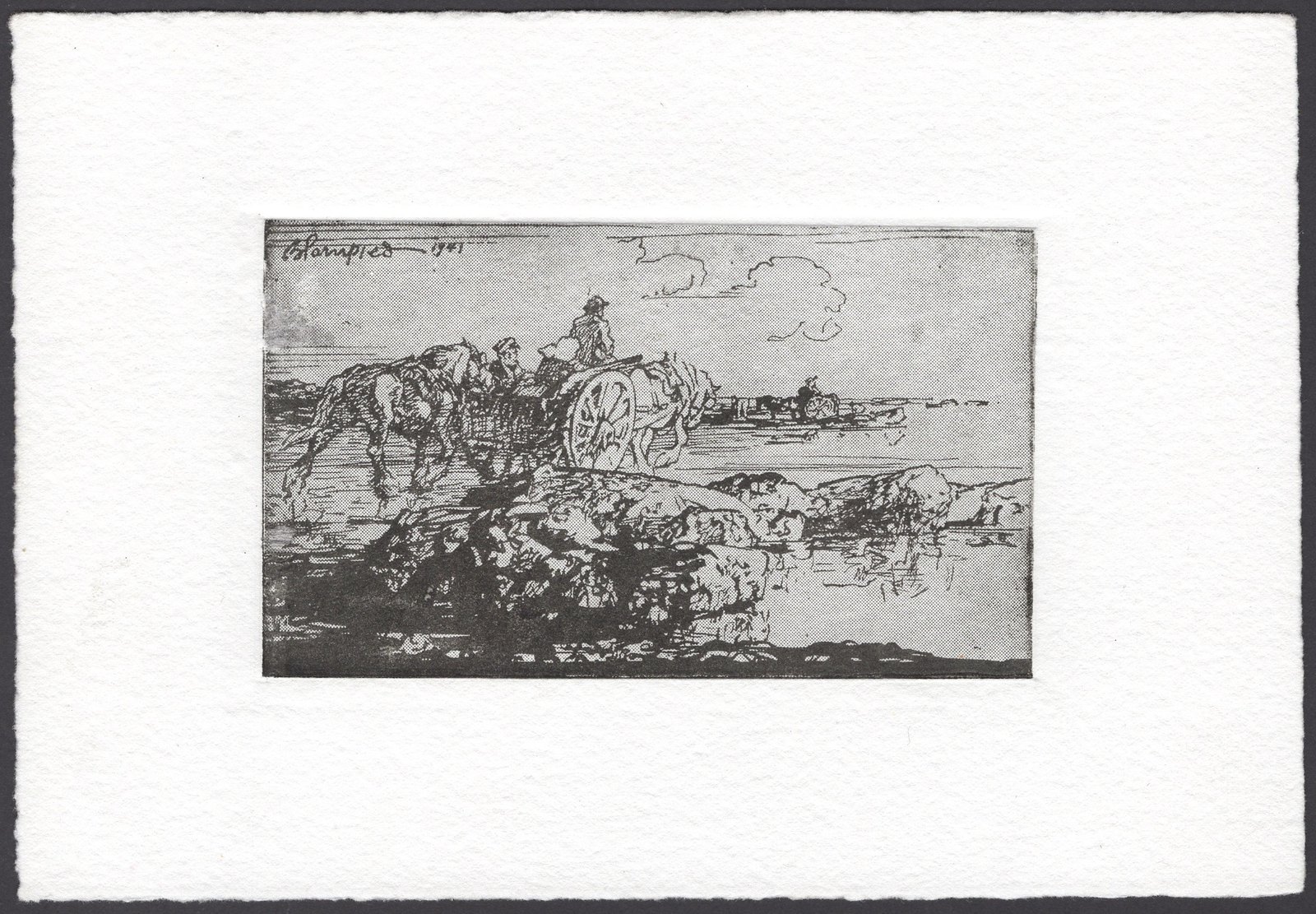
The printer of the 2 shillings of 1941 is not known. For the five notes of 1942, from the 6 pence to the 1 pound, the Jersey Evening Post of 21 April 1942, quoted by Yasha Beresiner (IBNS Journal, volume 10, number 2, 1970), says that the Evening Post made the blocks and Messrs. Bigwood's Ltd. did the printing. Francis Thornton (IBNS Journal, volume 17, number 4, 1978) says the same and places Bigwoods in St Helier. A picture caption on britishnotes.co.uk reads "Francis Le Marquand in 1992 with Edmund Blampieds wartime plates 1942"; the page says no more about them.
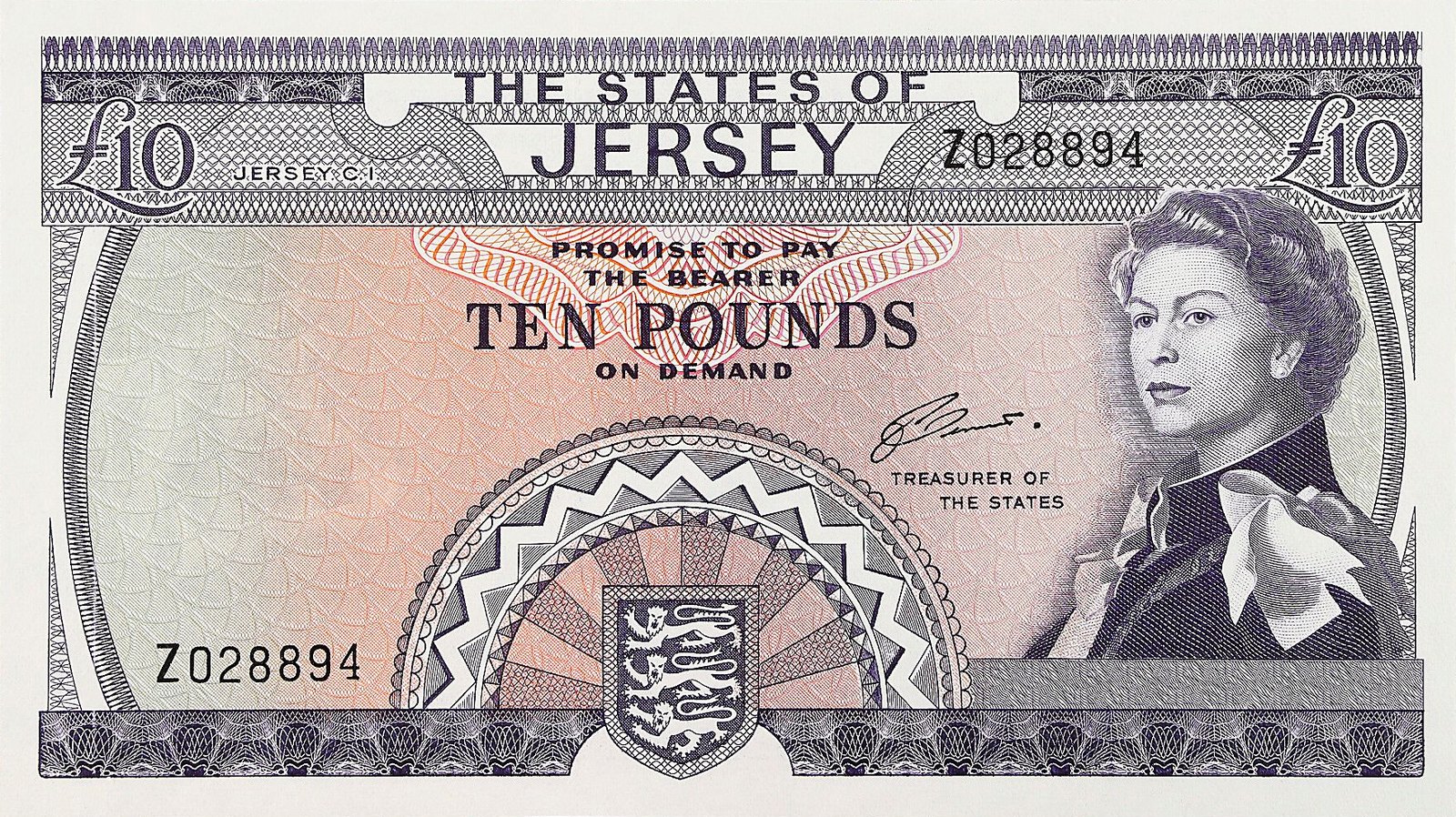
Every note from July 1963 was printed by Thomas De La Rue. Beresiner writes that the notes of 1963 were designed by John White of De La Rue's art department and printed by the company in London. London Coins, describing a 1 pound on 1 September 2019 (lot 335), notes the imprint in small script at the lower centre of the back and the watermark of a cow's head. Bank Note Reporter of July 2004, reporting the 1 pound for 800 years of Jersey, says that De La Rue had printed all of Jersey's notes since 1963. An article on the engraver Stanley Doubtfire (IBNS Journal, volume 44, number 1, 2005) lists the portrait of the Queen on the 5 pounds of 1989 among Doubtfire's engravings for De La Rue.
Designs of 1959 and 1960 that were not used
The Currency Notes (Jersey) Law 1959 was registered on 5 September 1959, and the first notes under it came out in July 1963. Two lots show designs from the years between.
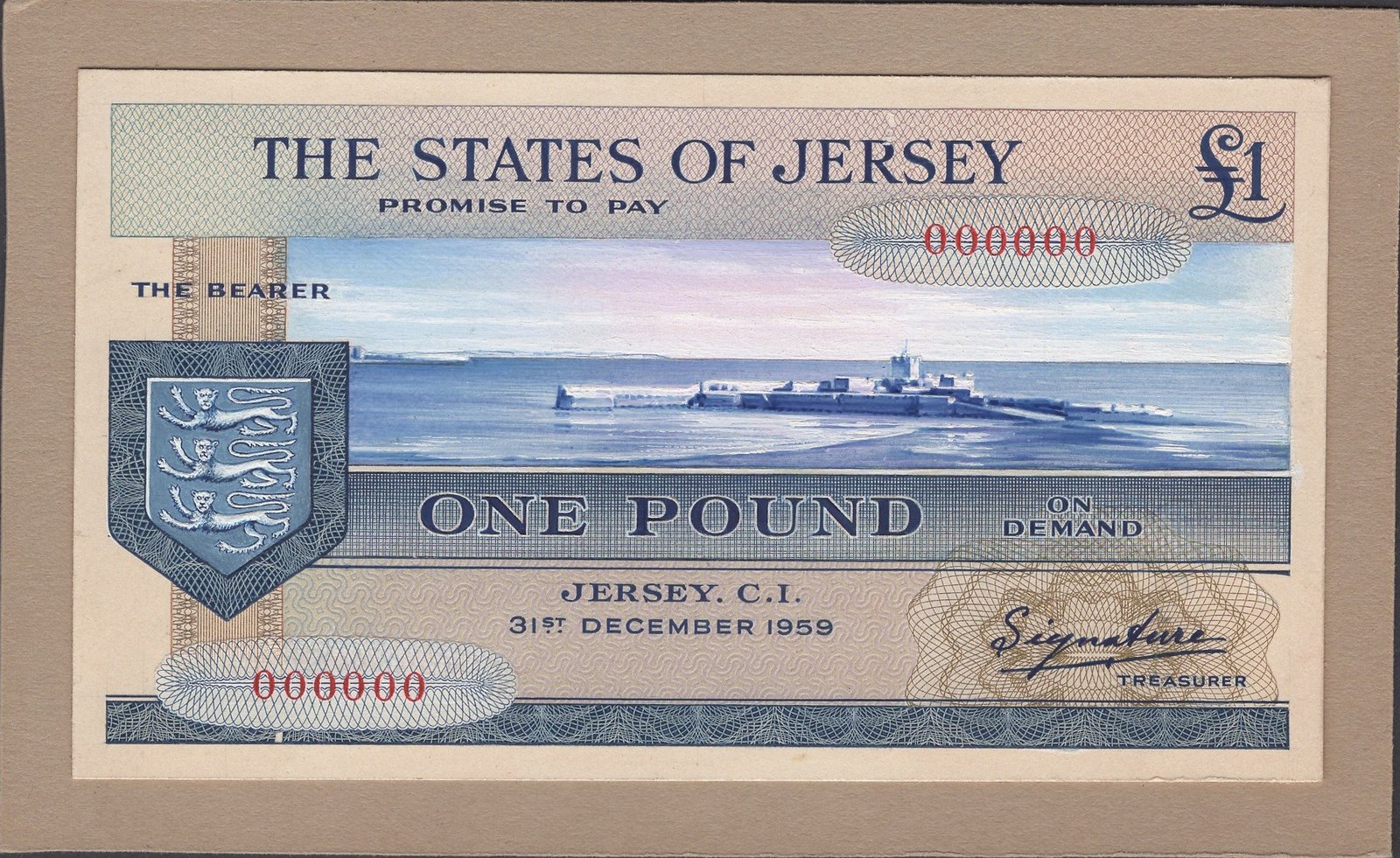
Noonans sold on 28 March 2019 (lot 663) a hand-executed composite essay for a proposed 1 pound dated 31 December 1959. As Noonans describes it, the front is in blue, lilac and brown, with the arms at the right and St Aubin's Fort in the distance, and the back is in lilac and blue with Mont Orgueil Castle; both are backed on thick card. The house did not name a printer.
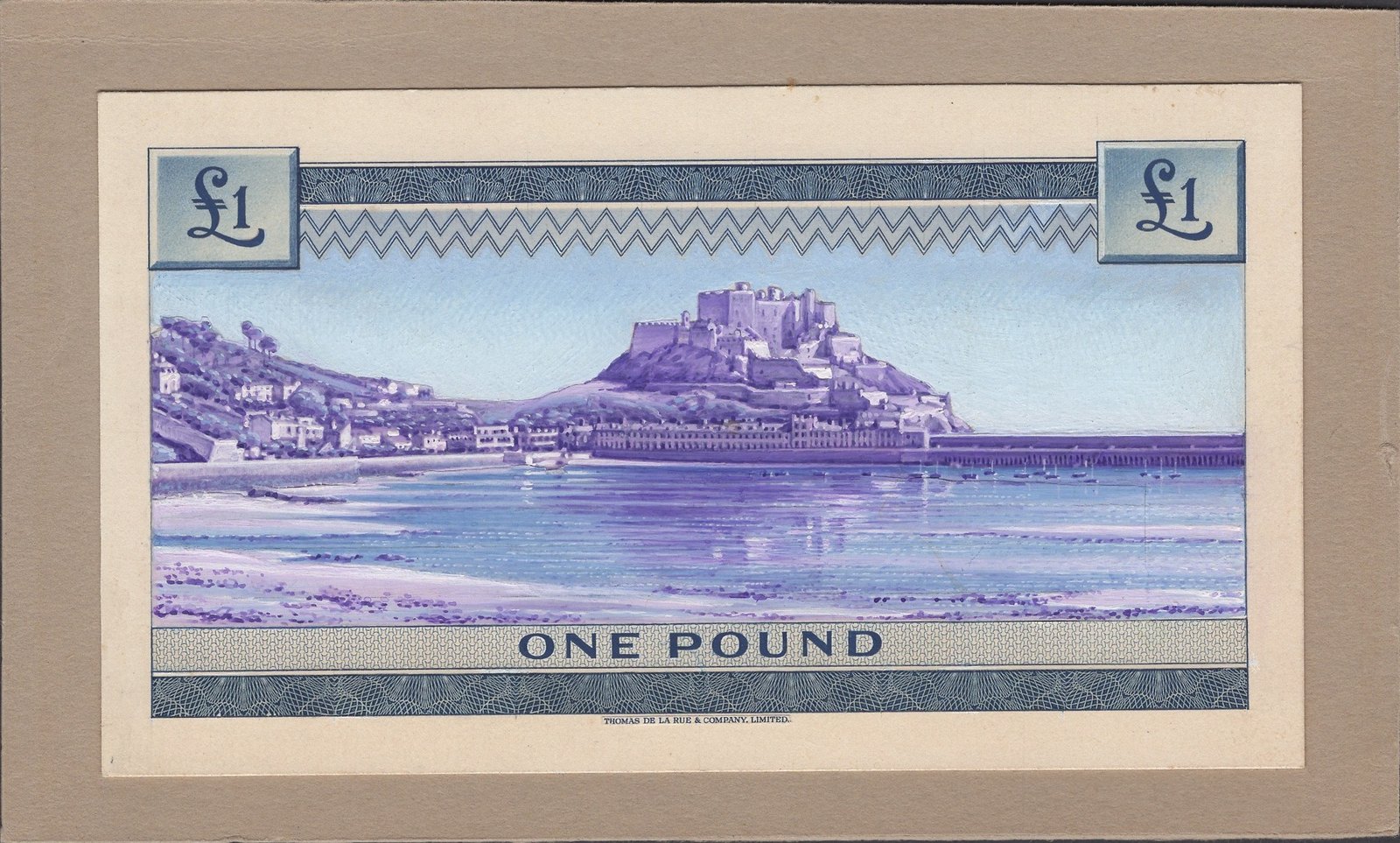
Special Auction Services sold on 2 May 2024 (lot 516) a pair of hand-drawn design essays for the front and back of a 5 pounds, in pencil, ink and watercolour, with a similar essay for the front of a 10 shillings. The year 1960 is written in pencil on the back of the backing paper. The house thought them "most likely produced for Bradbury Wilkinson by Derek Friday". That is the house's attribution. No document read for this article says that Bradbury Wilkinson was asked to design or tender for the notes.
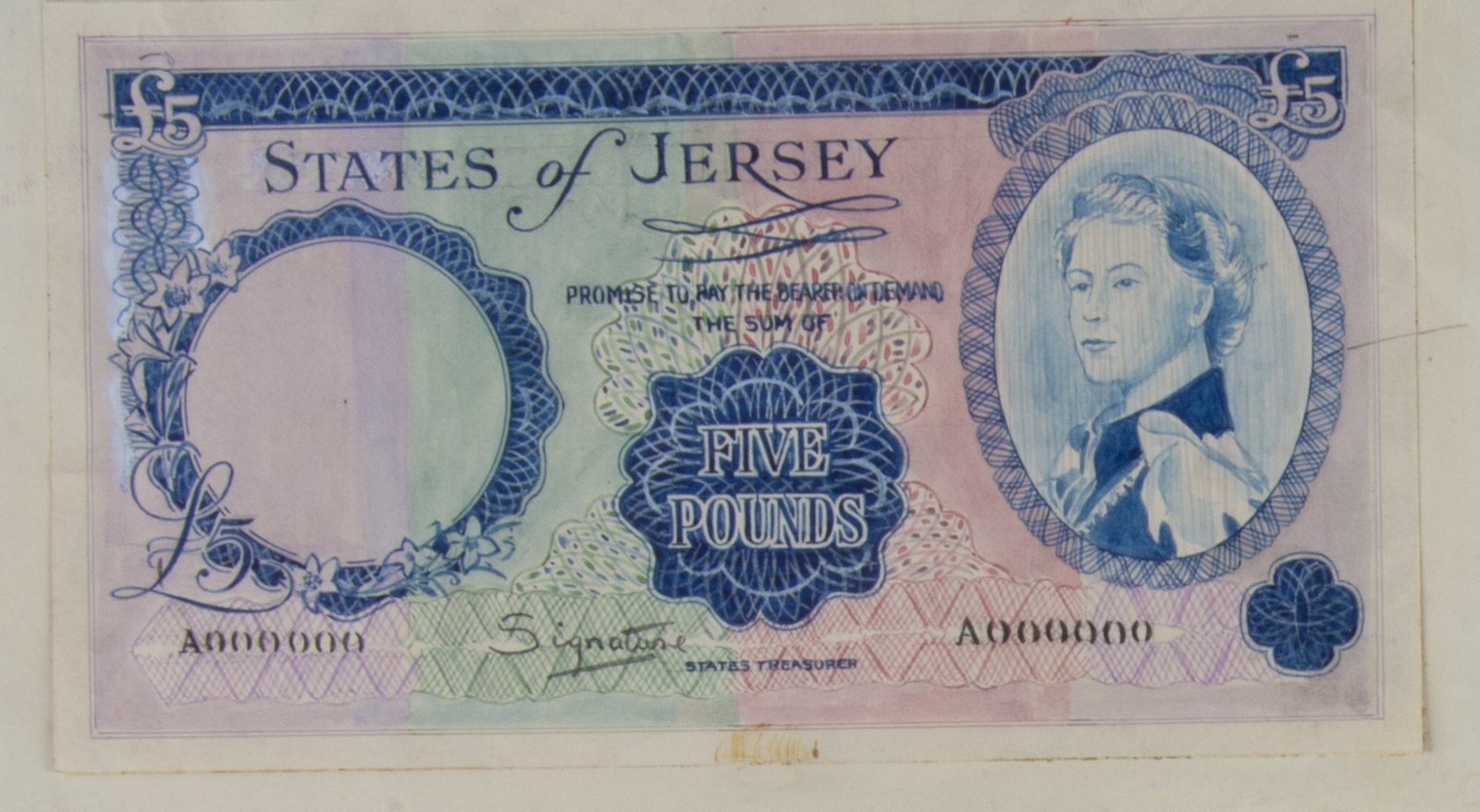
The castle and the fort both reached the notes of 1963, on the backs of the 1 pound and the 5 pounds.
Essays and proofs of 1976 and of 1987 to 1988
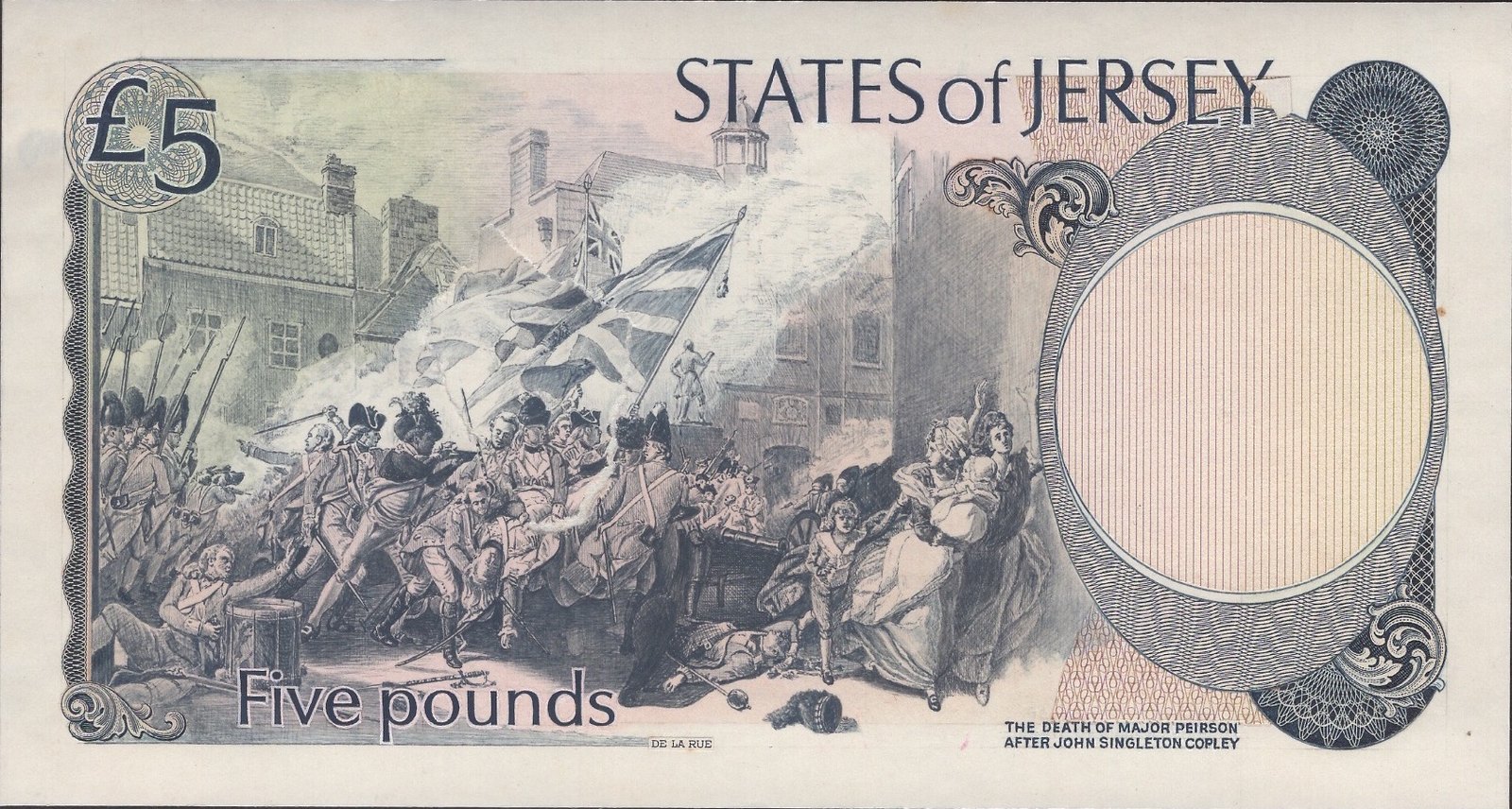
Noonans sold on 15 October 2025 (lot 1081) a group of four pieces: a die proof of the front of the 5 pounds of 1976 in brown, a composite essay for the back of a 5 pounds showing the death of Major Peirson after John Singleton Copley, and two black and white portrait vignettes of the Queen, one of them the Annigoni portrait. The Peirson scene was used in the end on the 1 pound, and the 5 pounds was given Elizabeth Castle.
Three lots sold by Noonans on 8 July 2026 are printer's composite essays on card for the series that came out in 1989, each for the front and the back, each with Leslie May's signature:
- Lot 754, 1 pound. The mount carries two dates, 10.2.88 and 26.5.88. The serial number is AB000000. Noonans describes the front as issued with hand-painted parts and the back as issued, with St Helier Parish Church painted by hand, and takes it for a final-stage essay. The house points out that the first prefix of the issued series is AC, not AB.
- Lot 755, 10 pounds. The mount is dated 1.6.87 and the serial number is GB000000. Front and back are mostly painted by hand, the portrait included. Noonans notes several marked differences from the issued front, with the back as issued.
- Lot 757, 50 pounds. The mount is dated 12.9.88 and the serial number is AB000000. The front is as issued with small hand-painted parts, and Government House on the back is painted by hand.
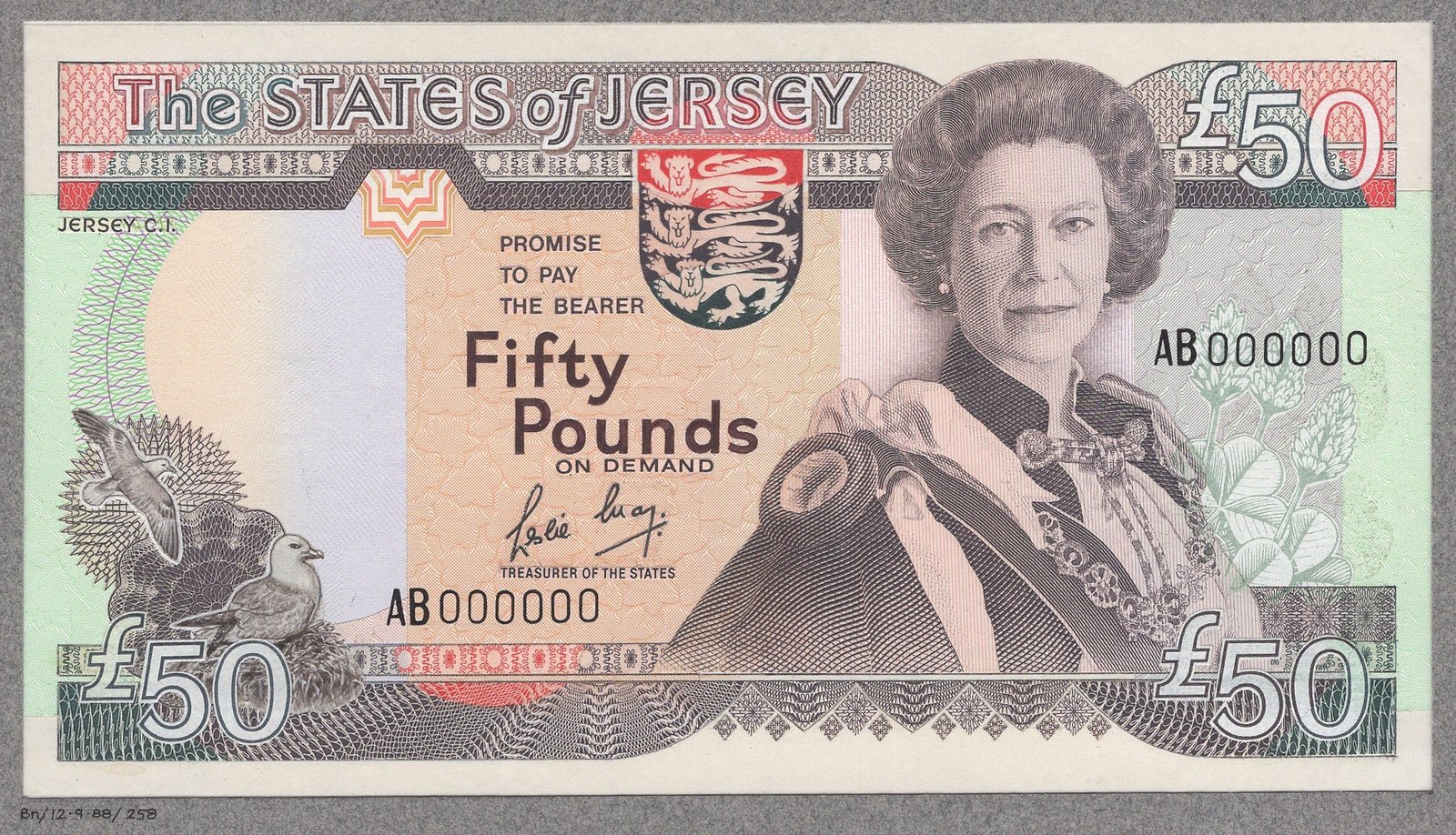
Noonans writes of lots 755 and 757 that the type was first issued in 1993. The catalogue and Thornton date the first issue of both designs, with May's signature, to 1989; 1993 is the year of the reissue signed by Baird.
The website britishnotes.co.uk adds one line on the same series: a proof of the 1 pound of 1989 with the prefix AA and the number 000000 is in archives, and De La Rue produced three such notes.
Replacing a spoiled note: the same number before 1971, the prefix Z after
Francis Thornton took up the replacement notes in "Jersey and Guernsey: Modern Issue Replacement Notes" (IBNS Journal, volume 21, number 4, 1982). Through Ian Monins, adviser on coinage to the States, Thornton had it confirmed by De La Rue that no replacement notes with the prefix Z were issued under F. N. Padgham's signature. The practice then was to replace a defective note with an exact replacement from the printers, a note with the same number. Thornton calls that the most expensive way of doing it.
With the appointment of J. Clennett as Treasurer in 1971 and the new notes with Clennett's signature, the practice changed. Substandard notes were now replaced by notes with the prefix Z, printed as a separate series with their own run of numbers. This is why the catalogue's row for a 10 shillings replacement, a value signed only by Padgham, probably stands for a note that does not exist, and why the Z replacements of the 1 pound and 5 pounds are all signed by Clennett. The 10 pounds has Z replacements too.
Each later series took its own replacement prefix:
| Series | Replacement prefix | Signatures |
|---|---|---|
| 1963 design, from 1971 | Z | Clennett |
| 1976 | ZB | Clennett, then May |
| 1989, 1993 and 2000 | CZ | May, Baird and Black |
| 1 pound of 2000, later | CZZ | Black |
| 2010 | DZ | Black; britishnotes.co.uk also lists 1 pound notes of Bell |
On the notes of 1976 the prefix ZB was used under both signers, so the signature decides the row. The same holds for CZ across three signers. Britishnotes.co.uk dates the prefix CZZ to 2006; the catalogue has a row for it and records only CZ notes so far.
Bank Note Reporter of July 1985 shows how a replacement sits in a bundle. Ian Monins offered what the report calls sandwich notes: three notes in sequence where the middle note has been replaced, for instance HB661259, ZB118773 and HB661261. The report says the replacement stands in for the middle note, whose number it prints as HN661260.
Two auction lots are worth knowing for the 10 pounds of 1976. Heritage Auctions sold on 15 July 2014 (lot 33074), from the Ruth W. Hill Collection, a pair of replacements, one with each signature, and remarked that the May replacement was not listed in Mehilba's book on world replacement notes. Stack's Bowers sold on 5 May 2023 (lot 51092), from the Scott Lindquist Collection, another pair, and pointed out that the grading company had labelled one of them as the Clennett variety when it was the May variety.
The catalogue and britishnotes.co.uk differ on two issues. The pages of the 50 pounds of 1993 and the 5 pounds of 2000 say that no replacement note of the issue has been recorded. Britishnotes.co.uk lists a lowest and a highest CZ number seen for both. Its figures are sightings sent in by collectors.
Specimens
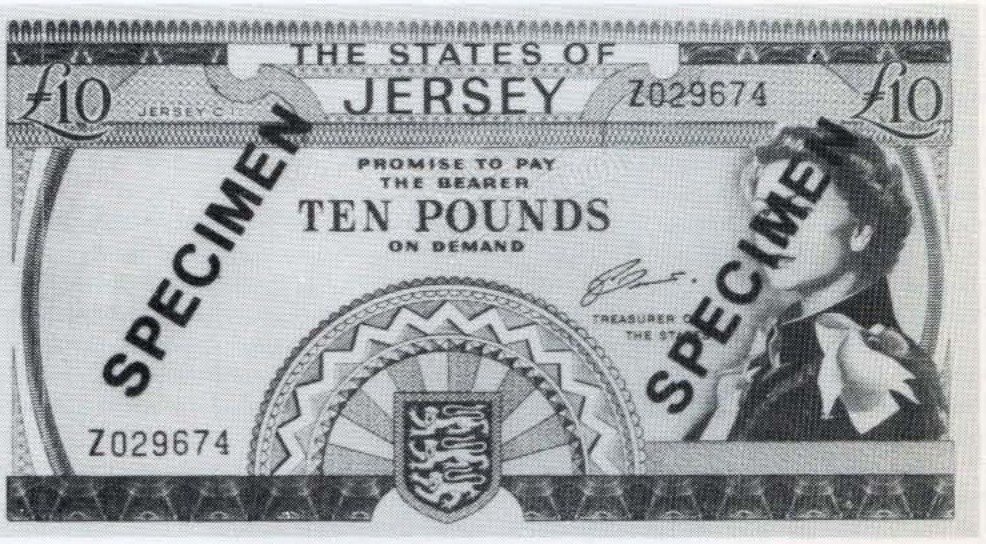
Thornton explains the usual form ("Island of Jersey, Channel Islands, Part 1", IBNS Journal, volume 15, number 4, 1976): specimens of a new design are printed with the prefix of the issue and with every figure of the number replaced by a zero. Thornton's article of 1986 (volume 25, number 1) adds that a limited number of specimens, 200, is produced for each new prefix. The catalogue has a specimen row for nearly every prefix.
The 1 pound of 1963 shows how specimens of one note can differ. Thornton describes three:
- prefix A, signed Padgham, with SPECIMEN overprinted in black;
- prefix B, signed Padgham, with the overprint in red, in round-edged letters 6.5 mm high;
- prefix F, signed Clennett, with the overprint in red, in sharp-edged, broader letters 8.0 mm high.
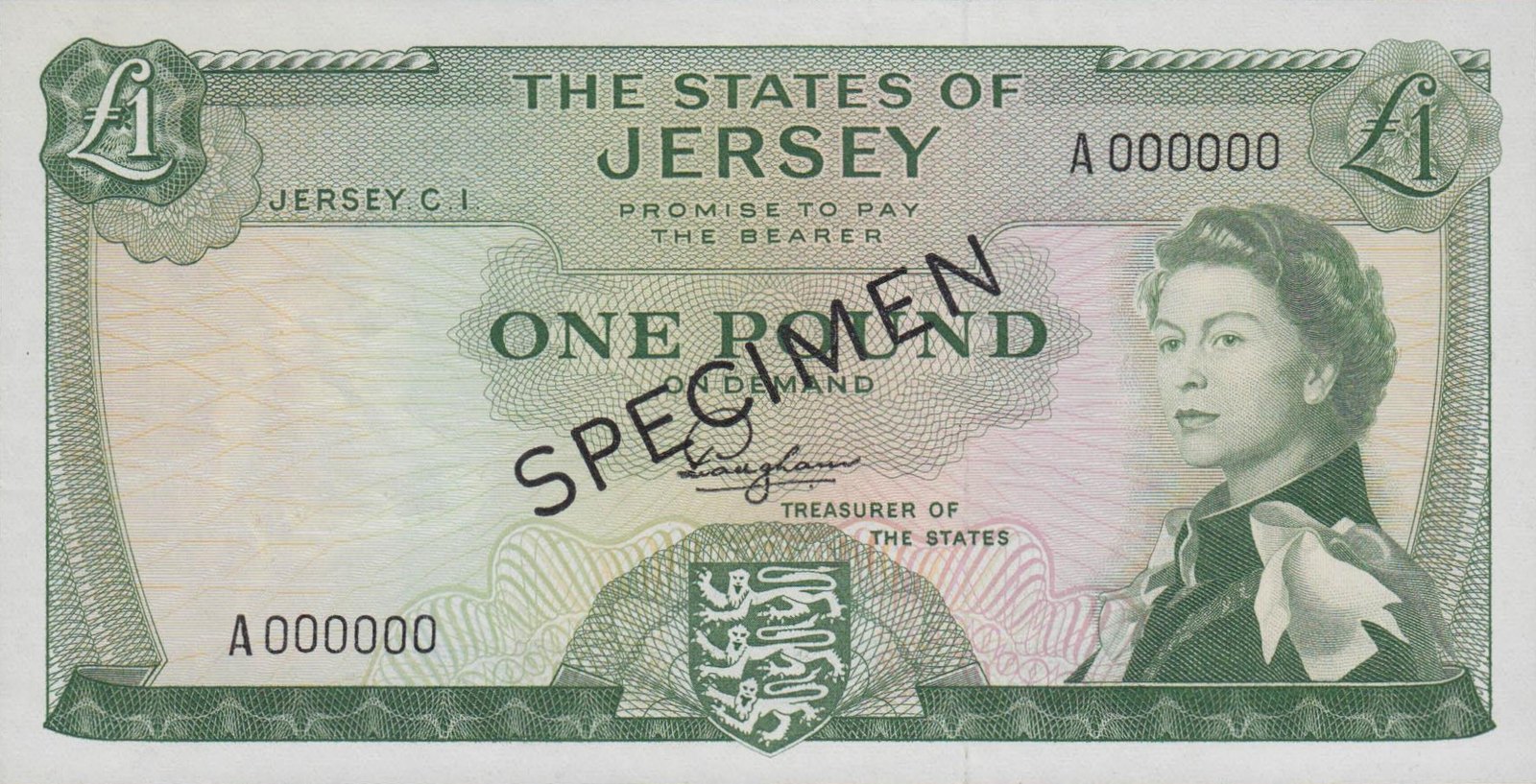
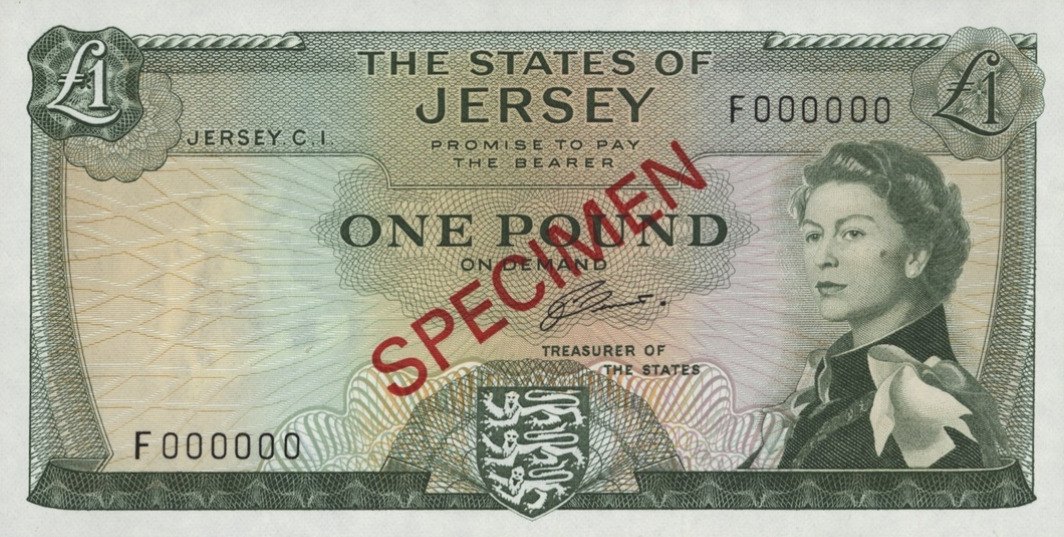
When Clennett's signature came in, specimens with it were printed for the 1, 5 and 10 pounds. On the 10 pounds of 1976 the letters of the overprint grow again, from 8.0 mm to 9.0 mm, on the specimens with prefix EB, the first prefix signed throughout by May.
For the series of 1976 Thornton (volume 16, number 1, 1977) writes of the notes illustrated, one of each of the four values, that the prefix is printed in black and the word in red. The catalogue records a black overprint on the specimens of the 20 pounds, from notes seen in sales; London Coins describes one so in its sale of 3 June 2019 (lot 839).
Other kinds are recorded on the catalogue pages. Specimens from the De La Rue archive carry a red oval stamp of the company, a printed specimen number and one punch hole; they are recorded for the 10 pounds of 1972 and for the 1, 5 and 10 pounds of 1976. Specimens of the 10 pounds of 1972 also exist with blue CANCELLED handstamps added to the red overprint; Heritage Auctions sold one from the Alta California Collection on 9 January 2017 (lot 29813).
Britishnotes.co.uk states that every modern Jersey note from Padgham on exists as a specimen but two: the 5 pounds with prefix GB signed by May and the 10 pounds with prefix DB signed by May. Both are notes on which May's signature came in partway through a prefix. For the 10 pounds this agrees with what Thornton was told in 1986. For the 5 pounds the catalogue records a note numbered GB 000000 with May's signature and no SPECIMEN overprint.
A word of caution about old pictures. Thornton writes in the article on the notes of 1989 (volume 31, number 2) that the illustrations were reproduced with a specimen overprint and at less than full size, in accordance with the requirements of the States of Jersey and Guernsey. A picture in that article with the word SPECIMEN across it is therefore not evidence of a specimen note.
Notes made for collectors
The four values of 1976 were also made for a collector set of 1978 by the Franklin Mint. On these notes a Maltese cross stands in place of the letters before the number, and SPECIMEN is overprinted diagonally. The 1 pound carries Clennett's signature. London Coins, in its sale of 6 March 2022 (lot 193), described a 1 pound of the set and noted that a 20 pounds in the same sale had the matching number. The catalogue keeps a loose note from a broken set on the collector series row, not among the ordinary specimens.
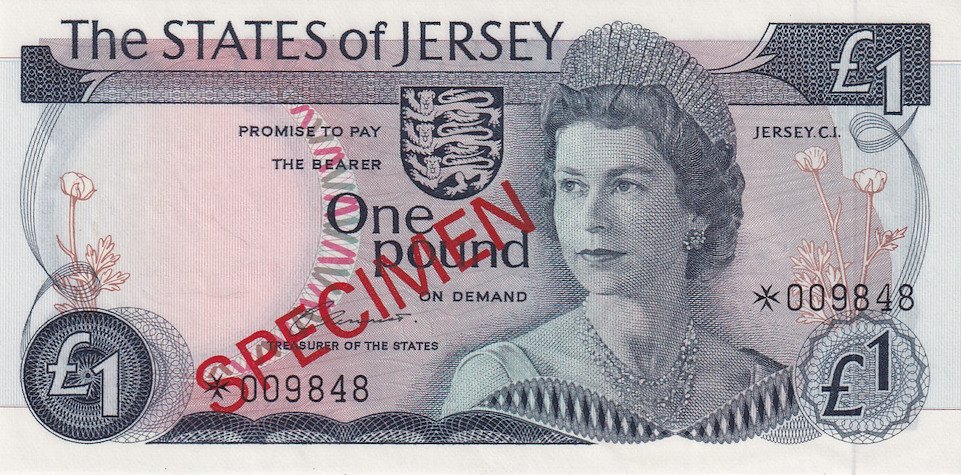
The States Treasury sold notes to collectors directly as well. Bank Note Reporter of March 1987 reports the presentation pack of the 1 pound, described in The notes of the States of Jersey, 1840 to 2012. The accounts of the States list the sale of specimen notes as an item of the Jersey Currency Notes fund, and the accounts for 2010 (page 149) say that the launch of the new series raised the sales of specimen notes and gift sets.
Sources
- Francis Thornton, IBNS Journal: "Island of Jersey, Channel Islands, Part 1", volume 15, number 4, 1976; "Part 2: New Banknote Issue", volume 16, number 1, 1977; "States of Jersey", volume 17, number 4, 1978; "Jersey and Guernsey: Modern Issue Replacement Notes", volume 21, number 4, 1982, pages 114 and 115; "Modern Currency Note Update", volume 25, number 1, 1986; "Channel Island Update", volume 31, number 2, page 15.
- Yasha L. Beresiner, "An Excursion to Jersey", IBNS Journal, volume 10, number 2, 1970, quoting the Jersey Evening Post of 21 April 1942.
- "Stanley Doubtfire, British Engraver", IBNS Journal, volume 44, number 1, 2005.
- Bank Note Reporter, "John Clennett signs last Jersey notes", July 1985; "Jersey offers presentation pound", March 1987; "Scotland, States of Jersey mark anniversaries", July 2004.
- britishnotes.co.uk, Jersey prefix sightings, https://britishnotes.co.uk/news_and_info/prefix_sightings/jersey.php (the copy saved on 11 November 2026).
- States of Jersey, financial report and accounts for 2003 and for 2010.
- Noonans, 28 March 2019, lot 663; 15 October 2025, lot 1081; 8 July 2026, lots 754, 755 and 757.
- Special Auction Services, 2 May 2024, lot 516.
- Heritage Auctions, 15 July 2014, lot 33074, and 9 January 2017, lot 29813; Stack's Bowers, 5 May 2023, lot 51092; London Coins, 3 June 2019, lot 839, 1 September 2019, lot 335, and 6 March 2022, lot 193.
- The catalogue pages of Jersey.


Member comments
Log in or register to post a comment.