This article sets out the paper money of the States of Jersey in order of time, from the 5 pounds of 1840 to the 100 pounds of 2012. It is written from the catalogue pages of Jersey, from the articles of Yasha Beresiner and Francis Thornton in the Journal of the International Bank Note Society (IBNS), from Bank Note Reporter, and from the law and the Government of Jersey's own pages.
Three other articles go further into single subjects: the occupation notes of 1941 and 1942, the Treasurers whose signatures the notes carry, and the printers, replacement notes, specimens and essays.
The 5 pounds of 1840 and the years of the private notes
Yasha Beresiner's article "An Excursion to Jersey" (IBNS Journal, volume 10, number 2, 1970) divides the island's paper money into three periods: an early period of private notes, the German occupation, and the current notes. Beresiner names as the main source Lieutenant-Colonel W. Marshall-Fraser's article of 1949, "A History of Banking in the Channel Islands and a record of Bank Note History".
The early period, in Beresiner's account, began with the first bank in the Channel Islands, founded in Jersey in 1797 by a wine merchant named Hugh Godfrey and later known as the Old Bank. Banks, parishes, vingtaines, firms and societies issued notes from 1 shilling to 1 pound. A law passed on 8 May 1813, known as the law of 10 June from the day the Privy Council confirmed it, forbade notes payable to bearer of less than 1 pound. Beresiner writes that the States did not issue notes of their own in those years, and that the only States notes recorded for the period were 1 pound notes of the States Committee of Harbours dated 2 May 1874, called in between 1882 and 1884. Those harbour notes have no page in this catalogue.
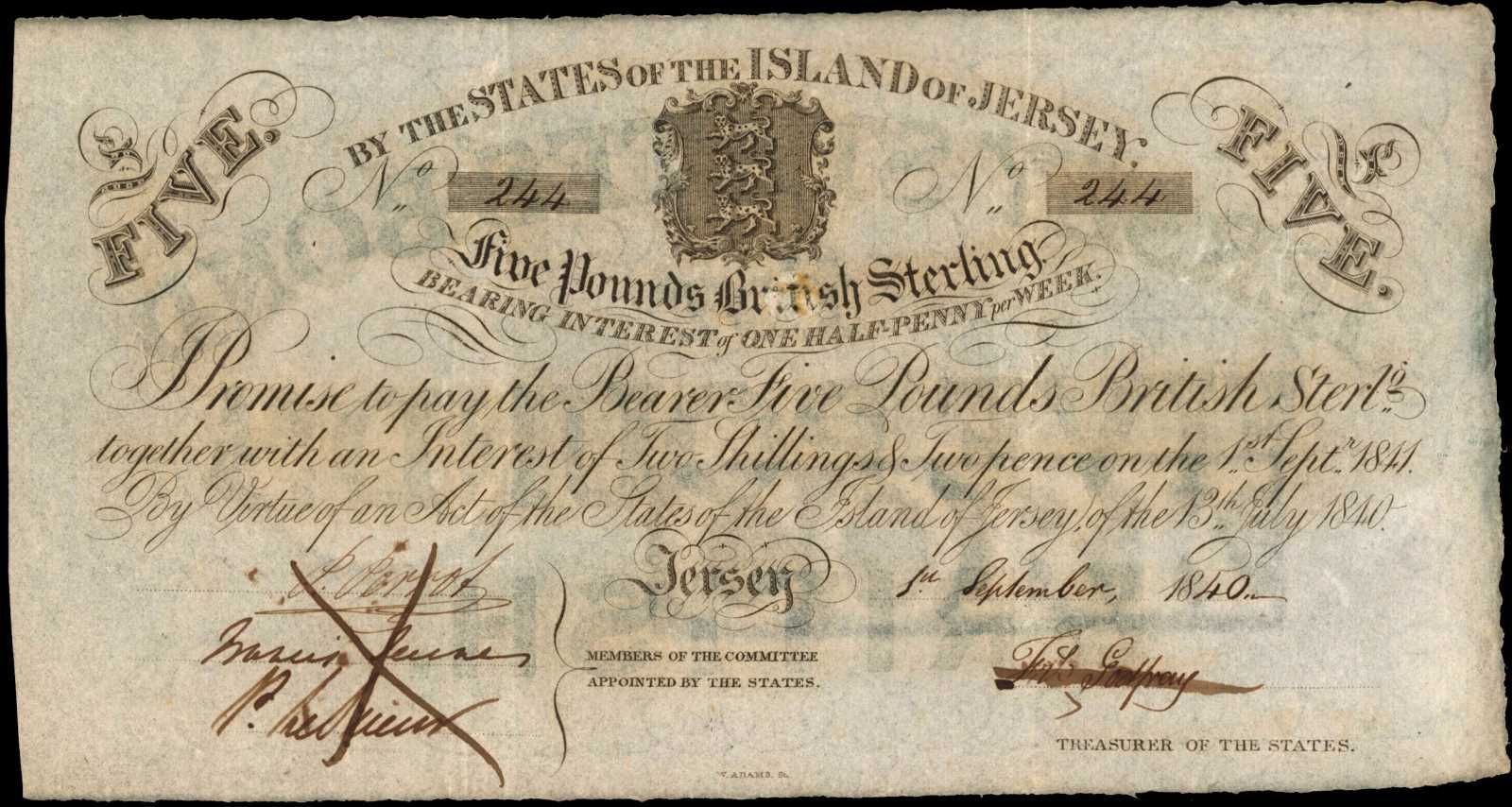
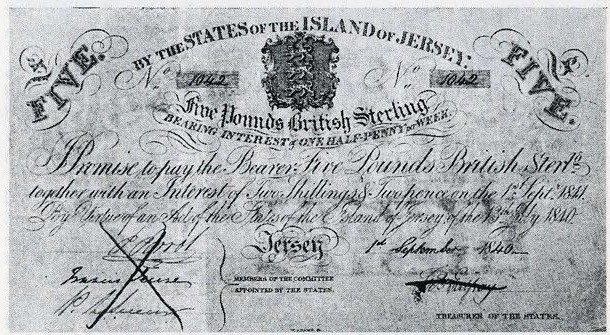
The exception is the 5 pounds British Sterling of 1 September 1840. It is an interest-bearing note headed "By the States of the Island of Jersey", promising 5 pounds together with two shillings and twopence interest on 1 September 1841, one halfpenny a week, "by virtue of an Act of the States of the Island of Jersey of the 13th July, 1840". Three members of the committee appointed by the States signed it by hand at the left and the Treasurer of the States at the right. Beresiner could not trace the Act itself, but found the sitting reported in the Chronique de Jersey of 15 July 1840: on 13 July 1840 the States, with the Bailiff presiding, voted unanimously to issue 5 pound notes bearing a halfpenny a week interest to a value of 15,000 pounds. The back of the note calls it a Jersey States Bond. Beresiner argues that the words "I promise to pay the bearer" make it a promissory note that probably passed from hand to hand. The catalogue's printer field for the note reads W. Adams. Heritage Auctions, selling a pen-cancelled example from the Ruth W. Hill Collection on 4 September 2014 (lot 26567), said it was the first of the type the house had offered.
A letter of 5 May 1948 from the Treasurer of the States, H. F. Ereaut, quoted by Beresiner, stated that all the notes issued by town banks and parishes had been recalled and redeemed.
The occupation, 1941 to 1946, and seventeen years of sterling
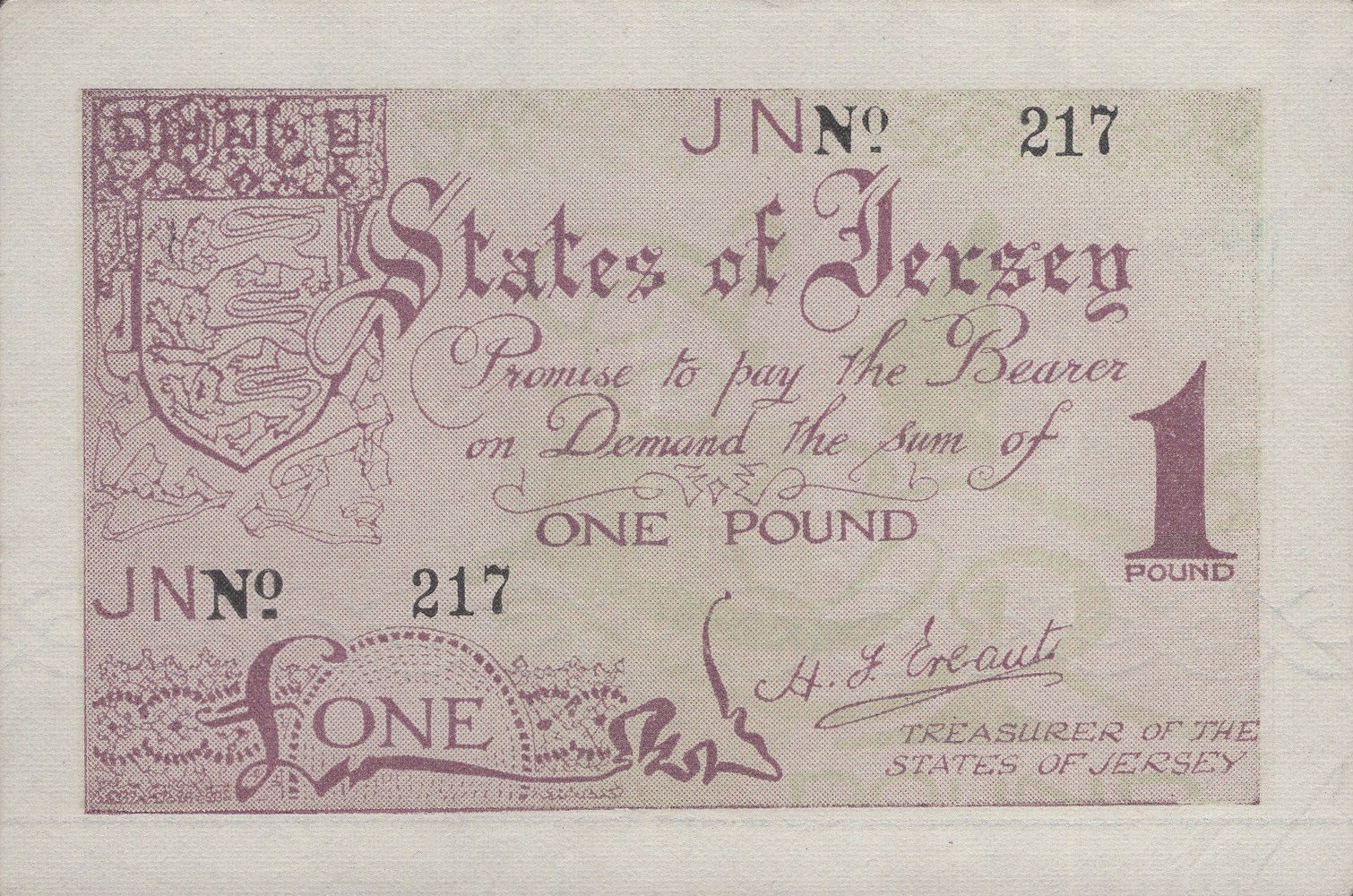
The States issued notes again under the German occupation. The Currency Notes (Jersey) Law 1941 allowed 2 shilling notes, and the 2 shillings of 1941 came out on 31 May 1941. An amendment of 6 December 1941 allowed notes up to 1 pound to a total of 100,000 pounds, and the five notes designed by Edmund Blampied, from 6 pence to 1 pound, were issued on 20 April 1942. All were withdrawn on 27 November 1946. Their story is told in the article on the occupation notes.
Francis Thornton (IBNS Journal, volume 15, number 4, 1976) writes that British sterling, accepted as legal tender through the occupation, then continued as the only currency until the States issue of July 1963. Beresiner dates that from about a year after the end of the occupation. The Government of Jersey's page on its currency notes says the same in one line: Jersey has issued its own banknotes since July 1963.
The law of 1959 and the notes of July 1963
The notes of 1963 rest on the Currency Notes (Jersey) Law 1959. Beresiner says the law was enacted in April 1959 and registered on 5 September of that year. The consolidated text published by the Jersey Legal Information Board gives 5 September 1959 as the day it came into force. As Beresiner summarises it, the law gave the Finance Committee power to issue notes of not more than 5 pounds each and not more than 2,000,000 pounds in all, a limit raised to 5,000,000 pounds on 8 August 1969. The States could recall the notes on one month's notice, after which they ceased to be legal tender. Defacing a note carried a fine of up to 1 pound. The last clause set aside the provisions of the law of 10 June 1813 and raised the highest value allowed under the law of 1941 from 1 pound to 5 pounds.
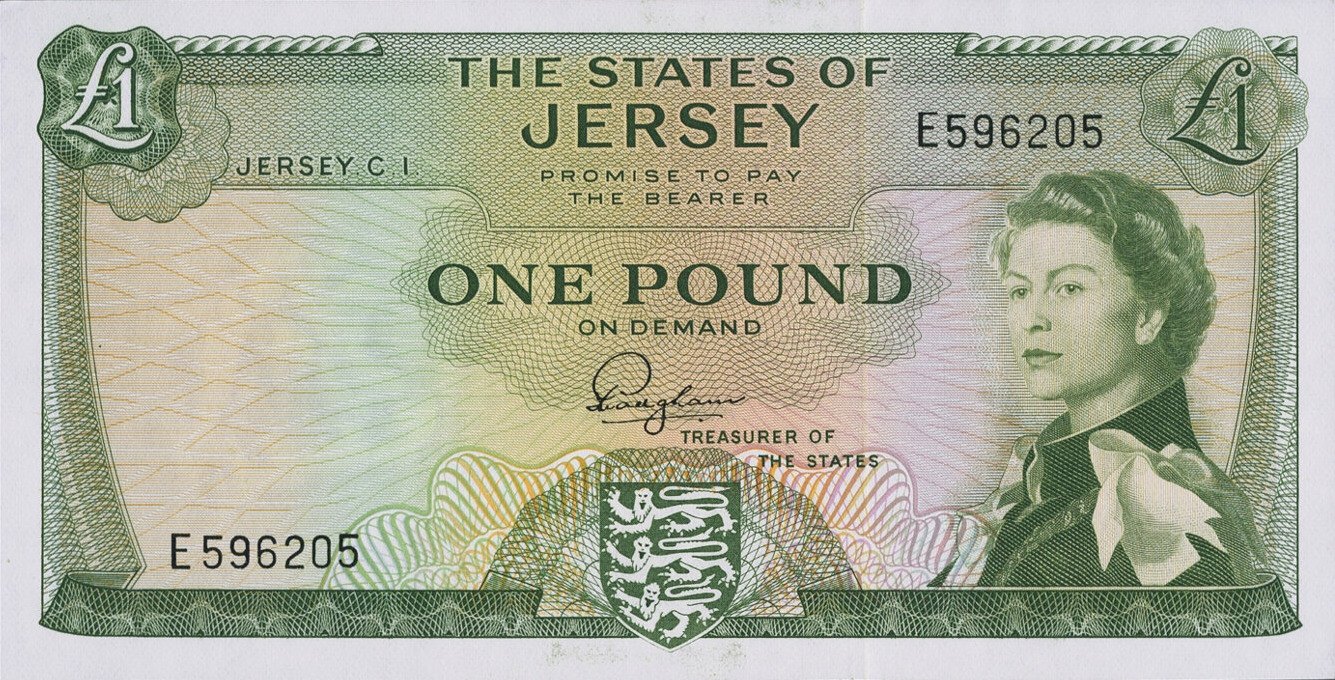
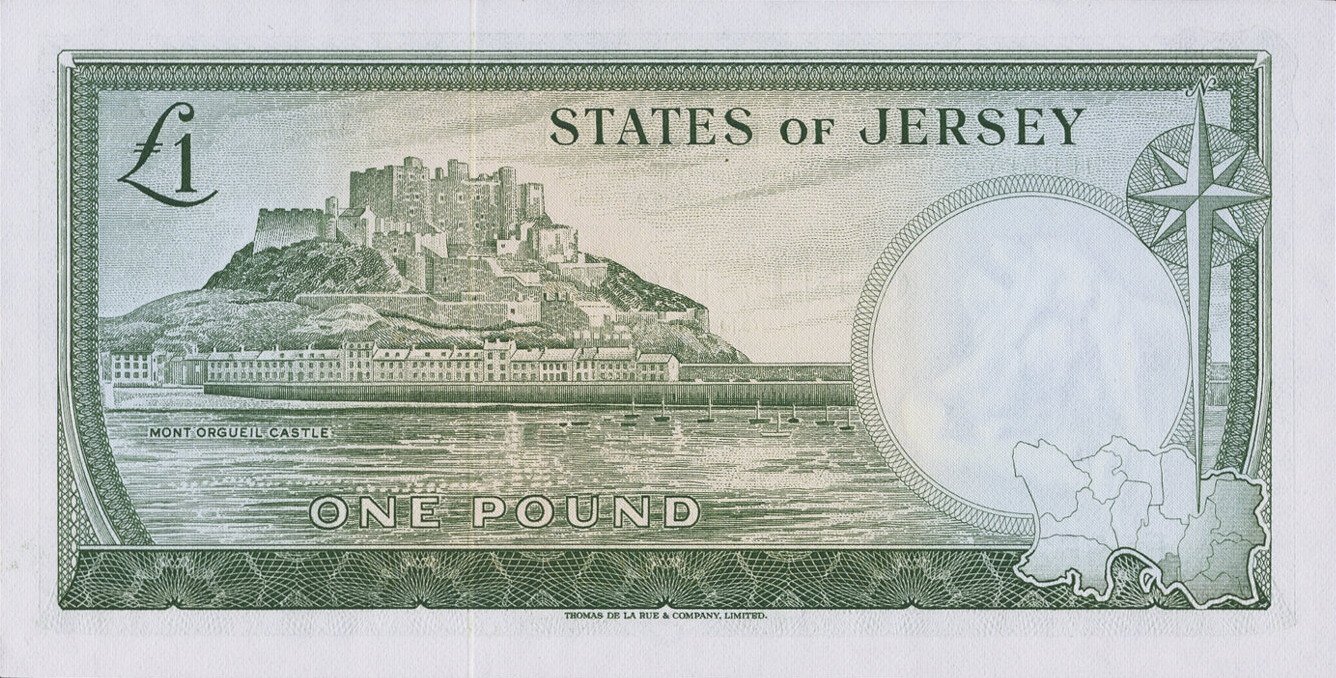
Three values were introduced in July 1963: the 10 shillings in brown, with St Ouen's Manor on the back, the 1 pound in green, with Mont Orgueil Castle, and the 5 pounds in red, with St Aubin's Fort. All three carry Annigoni's portrait of the Queen at the right. Beresiner adds that the notes were designed by John White of the art department of Thomas De La Rue and printed by that company in London, that the thread runs to the right of the centre, that the watermark at the left is the head of a Jersey cow, and that the Treasurer who signed them was F. N. Padgham. A small quantity of 1 pound notes was issued without a signature by mistake; the 1 pound page puts the number at about 600, all with prefix B.
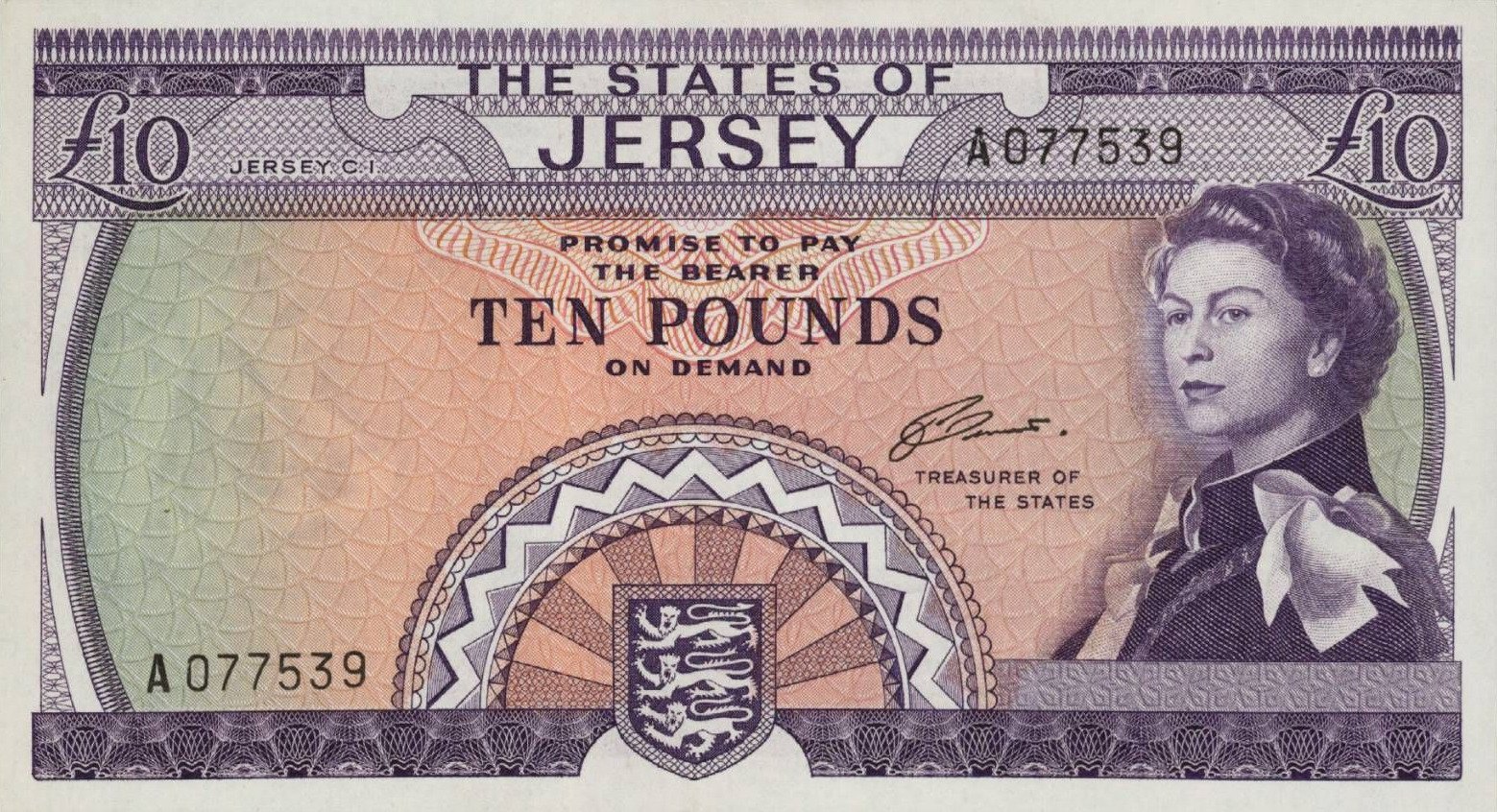
Beresiner wrote in 1970 that the 10 shillings was being withdrawn step by step, at the same time as the English note of that value. Thornton ties the end of the 10 shillings to decimalisation in the United Kingdom in 1971 and to the appointment of a new Treasurer, J. Clennett, in July 1971. A 10 pounds in dark lilac, with St Ouen's Manor moved from the 10 shillings to its back, was then added under Clennett's signature. Thornton dates its introduction to December 1971. The catalogue dates the note 1972, and its page adds that sources mention December 1971.
The series of 1976
Francis Thornton (IBNS Journal, volume 16, number 1, 1977) reports that on 15 July 1976 the Finance and Economics Committee of the States issued a press release announcing a new series to replace the design of 1963. The 1 pound, 5 pounds and 10 pounds became smaller, and a 20 pounds was introduced, a new value for Jersey. Thornton's pictures of specimen notes were used by permission of the States Treasury, and the article thanks the Assistant Treasurer, J. L. Dupre.
The portrait of the Queen on all four is engraved after a photograph by Anthony Buckley. The watermark is again the cow's head. Each note has a flower or plant of the island at the sides of the front and a work of art showing a scene of Jersey's history on the back:
| Value | Size in Thornton's article | Main colour | Plant on the front | Back |
|---|---|---|---|---|
| 1 pound | 134.5 x 66.7 mm | blue | Jersey buttercup | the death of Major Peirson at the Battle of Jersey, 6 January 1781, James Heath's engraving after John Singleton Copley |
| 5 pounds | 145.5 x 77.8 mm | brown | Jersey fern | Elizabeth Castle, from an oil painting by George Wolfe, the original in the Societe Jersiaise museum |
| 10 pounds | 151 x 84.9 mm | green | wild daffodils | Victoria College, from a lithograph of a painting by Felix Benoist |
| 20 pounds | 160 x 90 mm | red | burnet rose | Mont Orgueil Castle, from a print by Jean Le Capelain |
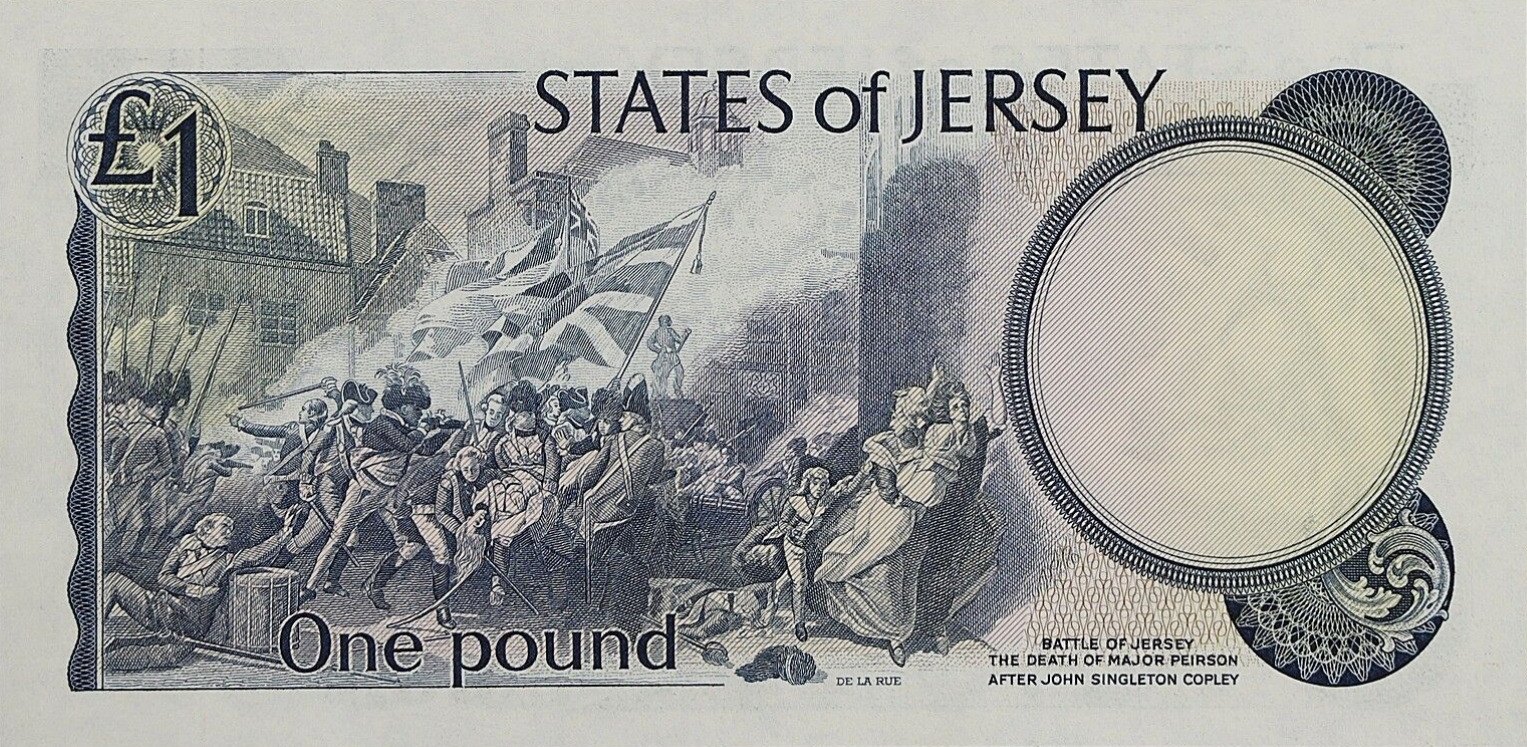
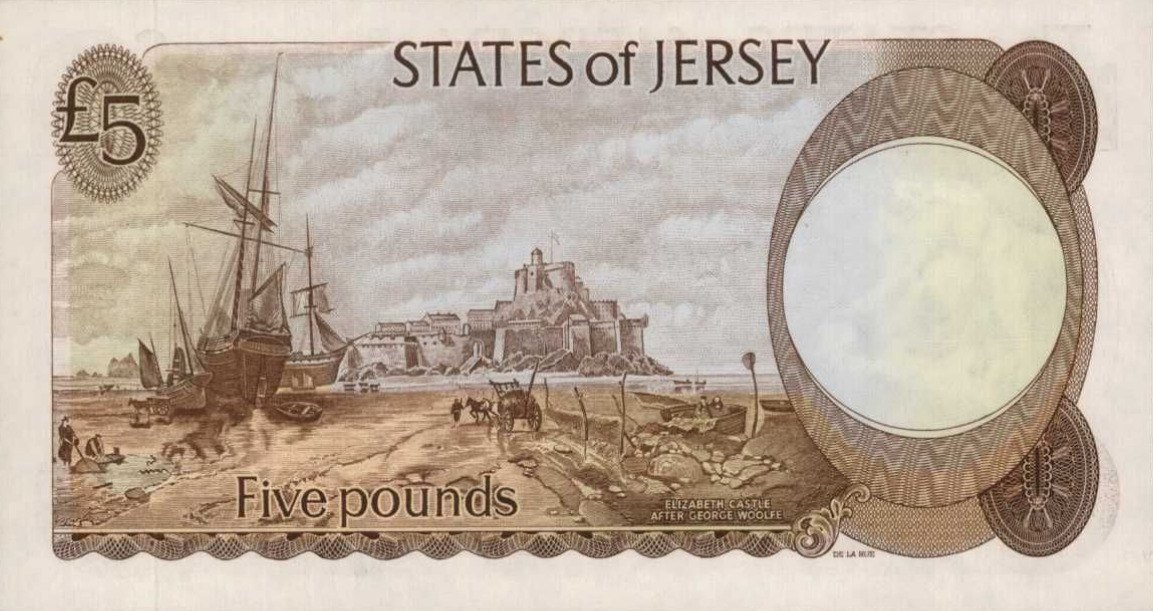
The security thread is at the far right on the 1, 5 and 20 pounds and left of centre on the 10 pounds. De La Rue printed the notes, and they carry Clennett's signature first and Leslie May's later. In a lot sold on 15 October 2025 (lot 1081) Noonans describes a composite essay for the back of a 5 pounds of 1976 with the death of Major Peirson, the scene that, as Noonans says, in the end went on the 1 pound.
Bank Note Reporter of March 1987, under the heading "Jersey offers presentation pound", reports that the States Treasury was then selling the current 1 pound to collectors in a presentation pack. The notes came from a number held back from circulation, and the Treasury planned to do the same with each new series of the 1 pound. The paper calls Jersey one of the last places in the Commonwealth still issuing a 1 pound note.
The series of 1989 and its reissues of 1993 and 2000
Francis Thornton (IBNS Journal, volume 31, number 2) records that Jersey introduced slightly smaller notes in 1989, with a new portrait of the Queen and a 50 pounds added to the 1, 5, 10 and 20 pounds. Thornton gives the sizes as 65 x 128 mm for the 1 pound, 70 x 135 mm for the 5 pounds, 75 x 142 mm for the 10 pounds, 80 x 149 mm for the 20 pounds and 85 x 156 mm for the 50 pounds. The prefixes began again at AC, the signature was Leslie May's, and birds and flowers of the island were worked into the front. Spink, in its sale of 27 August 2021 (lot 591), calls the note of 1989 the first 50 pounds issued in Jersey.
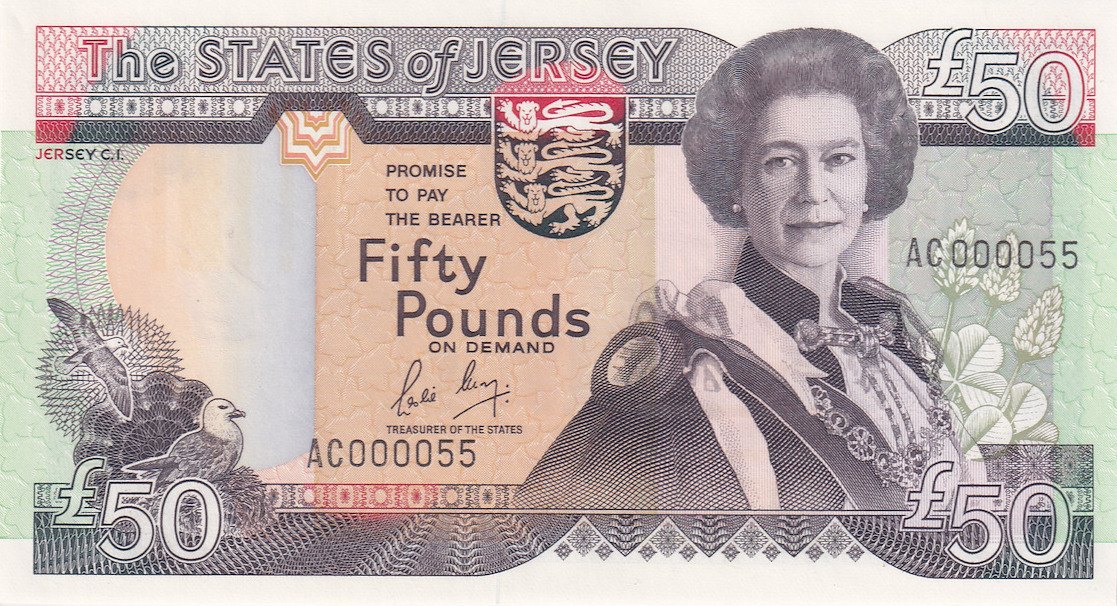
The portrait is the subject of an entry in Peter Symes's survey "The Portraits of Queen Elizabeth II" (IBNS Journal, volume 44, number 2, 2005). Symes lists it as portrait 19, dated 1978, and writes that it is copied from a painting by Norman Hepple showing the Queen in the regalia of the Order of the Garter, that the painting was commissioned by the States of Jersey and hangs in the entrance to the States Chamber, and that it is one of very few engraved portraits of the Queen taken from a painting. An article on the engraver Stanley Doubtfire (IBNS Journal, volume 44, number 1, 2005) lists the portrait on the 5 pounds of 1989 among Doubtfire's work for De La Rue.
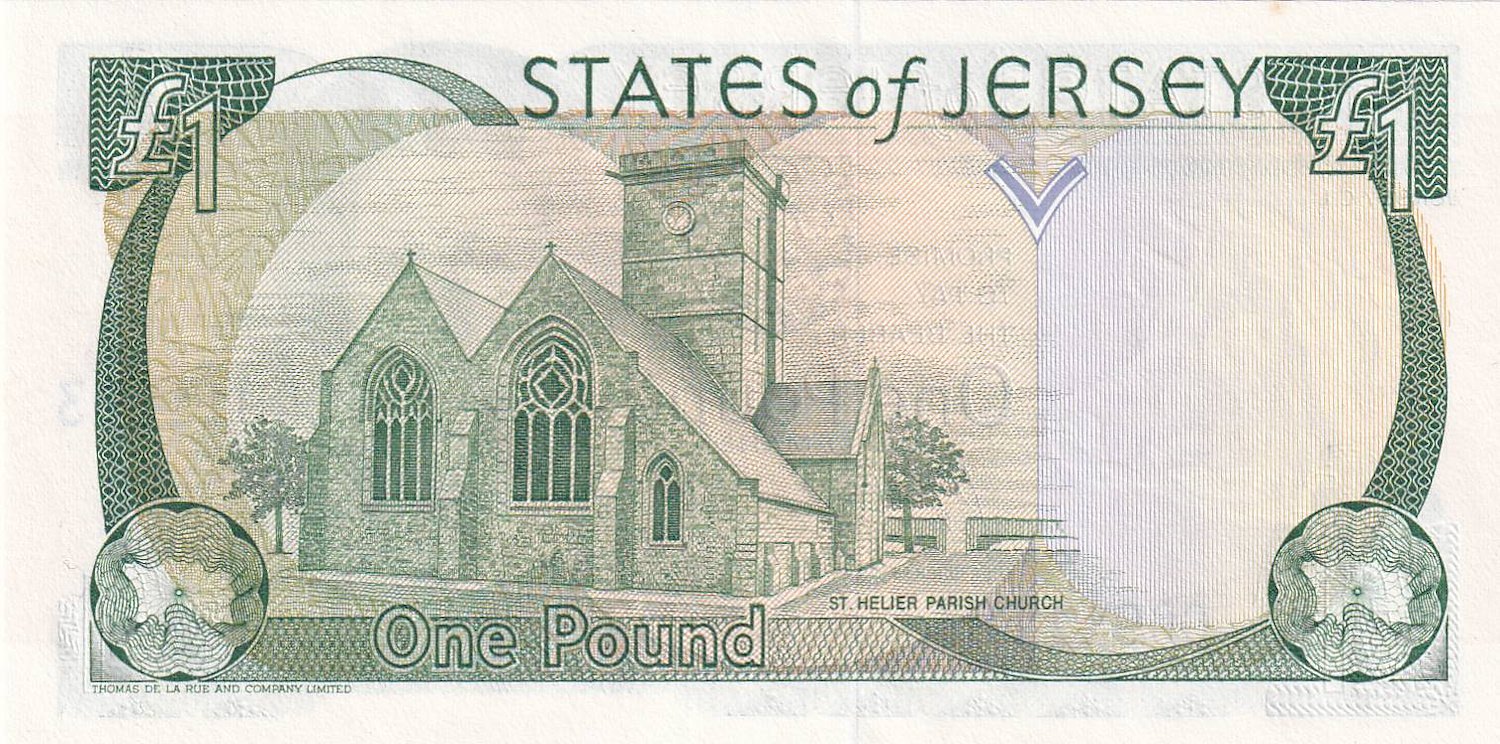
The sources name four of the five backs: St Helier Parish Church on the 1 pound (Noonans, describing an essay sold on 8 July 2026, lot 754), La Corbiere Lighthouse on the 5 pounds (IBNS Journal, volume 49, number 4, 2010), St Ouen's Manor on the 20 pounds (the catalogue page of the 20 pounds of 1976, which tells the two notes with prefix AC apart by it) and Government House on the 50 pounds (Thornton). No source read for this article names the back of the 10 pounds.
The same designs were issued three times, each time with a new Treasurer's signature and the run of prefixes carried on: under May from 1989, under George Baird from 1993, and under Ian Black from 2000. Thornton notes that the first Baird note, a 5 pounds with prefix CC, came in December 1991, and that its upper value is printed in solid lettering where May's is hollow. The catalogue pages use the same test for the 5, 10 and 20 pounds: the value at upper right is outlined on the notes of 1989 and filled with colour on those of 1993. The 1 pound of 2000 ran through the two-letter prefixes and went on to three letters, AAC to AEC.
The commemorative notes of 1995, 2004 and 2012
Three notes mark anniversaries.
The 1 pound of 9 May 1995 marks fifty years since the Liberation. Its front is the 1 pound of 1993 with the anniversary wording printed in the watermark area. Its back shows the face and back of the occupation 1 pound and the Liberation statue in Liberation Square, Saint Helier. Every note recorded carries the prefix LJ.
The 1 pound of 2004 marks 800 years, 1204 to 2004. Bank Note Reporter of July 2004 describes the front as the standard design with an overprint in the watermark area reading "Jersey 1204-2004", and the back as a view of Mont Orgueil Castle. It explains the prefix J8C as "Jersey 8 centuries", and adds that De La Rue had printed all of Jersey's notes since 1963.
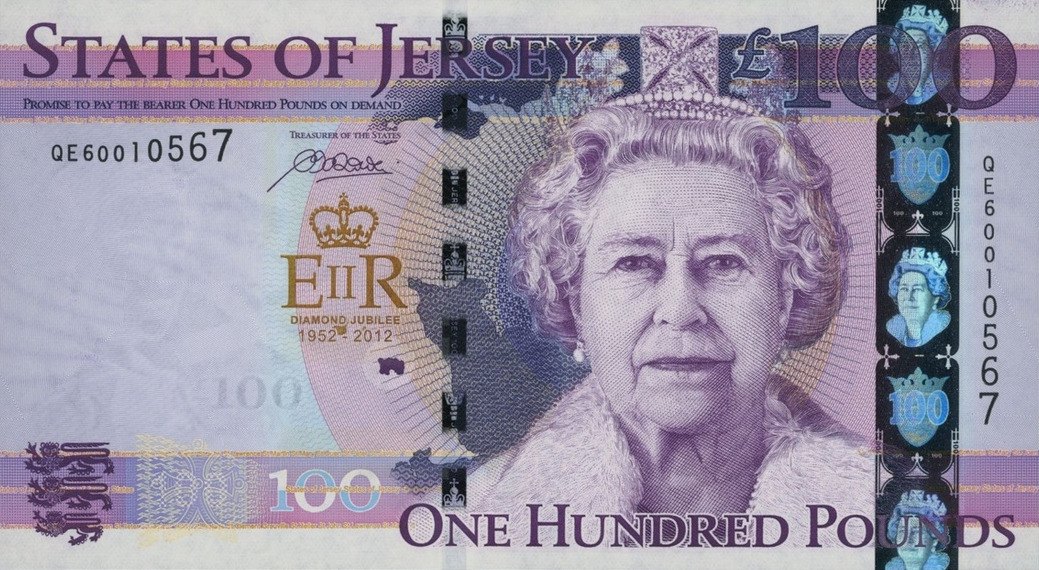
The 100 pounds of 2012 marks the Queen's Diamond Jubilee. The new issues column of the IBNS Journal (volume 51, number 3, 2012) reports that it was first issued on 1 June 2012 and that the back shows the royal mace and the flag of Jersey. Every note recorded carries the prefix QE60. London Coins, describing lot 320 of its sale of 1 September 2019, gives the signature as L. Rowley's.
The endnotes to the law of 1959 list regulations varying the highest value of note that came into force on 14 December 1988 and on 2 November 2011. The first date falls before the first 50 pounds of 1989 and the second before the 100 pounds of 2012, but the endnotes do not say what each regulation changed. The text as it now stands allows notes of up to 100 pounds.
The series of 2010
The catalogue pages of the 1 pound, 5 pounds, 10 pounds, 20 pounds and 50 pounds say that this family of notes was launched in February 2010, redesigned with up-to-date security features when stocks of the earlier notes ran low. The source behind that sentence is the annex to the States of Jersey accounts for 2009 (page 139), which says that stocks ran down in 2008 and that the paper was received in 2009. The Government of Jersey's page on its currency notes, written before the notes came out, says the new designs "will be released into circulation in April 2010", and a later page of the same government says the series entered circulation in early 2010. Launch and release may be two different days. The two pages opened for this article do not give either day.
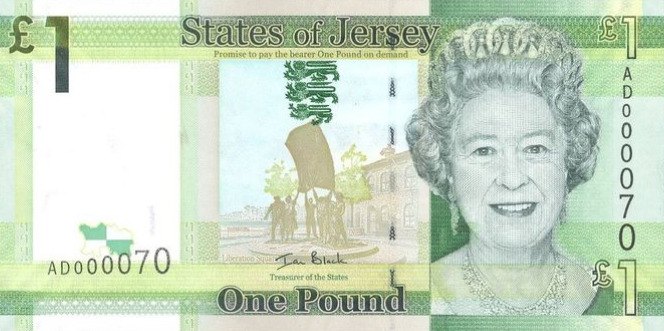
The same government pages describe the notes. The front has an engraved portrait of the Queen and the words States of Jersey above the island's crest. The back gives the value in French and in Jerriais, with the words Etats de Jersey and the crests of the twelve parishes. The banknote page names the landmark in the central design of each value: Le Hocq Tower on the 1 pound, Archirondel Tower on the 5 pounds, Seymour Tower on the 10 pounds, La Rocco Tower on the 20 pounds and Ouaisne Tower on the 50 pounds. The watermark is still the Jersey cow. The 10, 20 and 50 pounds carry a hologram.
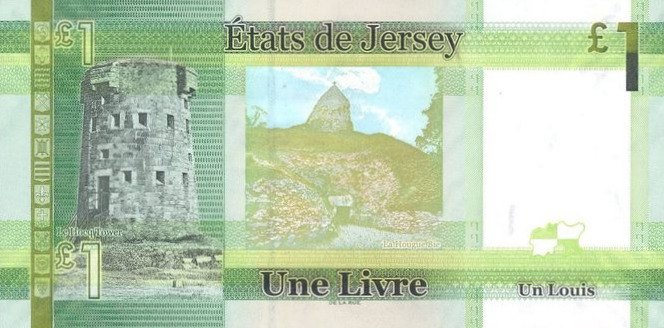
The older notes were not called in at once. The banknote page of the Government of Jersey says that older notes still circulate beside the new ones and will be withdrawn gradually, and that notes of 1963, 1976 and 1989 to 1993 can be exchanged at face value at a local bank or at the government's cashiers.
The law and the circulation today
The law of 1959 is still the law under which the notes are issued. Its present title is the Currency Notes and Currency Fund (Jersey) Law 1959. The power to issue now rests with the Minister for Treasury and Resources, who may issue notes only with the authority of the States. The limit on the whole issue was 2,000,000 pounds in 1959 and 5,000,000 pounds from 8 August 1969, the day the endnotes give for the amending law of 1969. The endnotes list further amending laws of 1971, 1975 and 1976: those of 1971 and 1975 amended the article that sets the limits, and that of 1976 added the power of the States to vary the limits by regulations. They also list regulations varying the maximum amount of issue of 1983, 1989, 1999, 2009 and 2015. The limit now stands at 125 million pounds. The Minister may still call in notes on not less than one month's notice, published in two Jersey newspapers.
For the circulation itself the States of Jersey accounts are the source. The accounts for 2003 (pages 106 to 108) give the average circulation of the Jersey Currency Notes fund as 40.1 million pounds in 2000, 44 million in 2001, 47.3 million in 2002 and 50.5 million in 2003.
What the sources do not give
- The number of notes printed of any issue after 1946. The only print figures in the sources read are those of the occupation notes.
- The day in 1963 on which the first notes were issued. The sources read say July 1963.
- A day of withdrawal for the notes of 1963, 1976 or 1989. The catalogue's withdrawal field is empty for all of them, and the government's page says only that old notes are exchanged at face value.
- The Act of the States of 13 July 1840 itself. Beresiner found the newspaper report of the vote, not the text.
Sources
- Yasha L. Beresiner, "An Excursion to Jersey", IBNS Journal, volume 10, number 2, 1970, pages 81 to 92, citing Lieutenant-Colonel W. Marshall-Fraser, "A History of Banking in the Channel Islands and a record of Bank Note History", 1949, and the Chronique de Jersey of 15 July 1840.
- Francis Thornton, "Island of Jersey, Channel Islands, Part 1: Currency and Specimen Notes", IBNS Journal, volume 15, number 4, 1976.
- Francis Thornton, "Island of Jersey, Channel Islands, Part 2: New Banknote Issue", IBNS Journal, volume 16, number 1, 1977, pages 28 to 32.
- Francis Thornton, "Channel Island Update: The Reduced Size Notes of the States of Jersey and Guernsey", IBNS Journal, volume 31, number 2, page 15.
- Peter Symes, "The Portraits of Queen Elizabeth II", IBNS Journal, volume 44, number 2, 2005, portrait 19.
- "Stanley Doubtfire, British Engraver", IBNS Journal, volume 44, number 1, 2005.
- IBNS Journal, volume 49, number 4, 2010, page 43 (La Corbiere Lighthouse), and volume 51, number 3, 2012, page 58 (new issues).
- Bank Note Reporter, "Jersey offers presentation pound", March 1987, and "Scotland, States of Jersey mark anniversaries", July 2004.
- States of Jersey, annex to the financial report and accounts for 2009, page 139, and accounts for 2003, pages 106 to 108.
- Currency Notes and Currency Fund (Jersey) Law 1959, consolidated text and endnotes, Jersey Legal Information Board, https://www.jerseylaw.je/laws/current/l_17_1959
- Government of Jersey, pages on Jersey currency notes, https://gov.je/TaxesMoney/JerseyCurrency/pages/jerseycurrencynotes.aspx , https://www.gov.je/TaxesMoney/JerseyCurrency/Pages/JerseyCurrencyNew.aspx and https://www.gov.je/News/2022/Pages/JerseyCurrency.aspx
- Heritage Auctions, 4 September 2014, lot 26567; Spink, 27 August 2021, lot 591; London Coins, 1 September 2019, lot 320; Noonans, 15 October 2025, lot 1081, and 8 July 2026, lot 754.
- The catalogue pages of Jersey.


Member comments
Log in or register to post a comment.