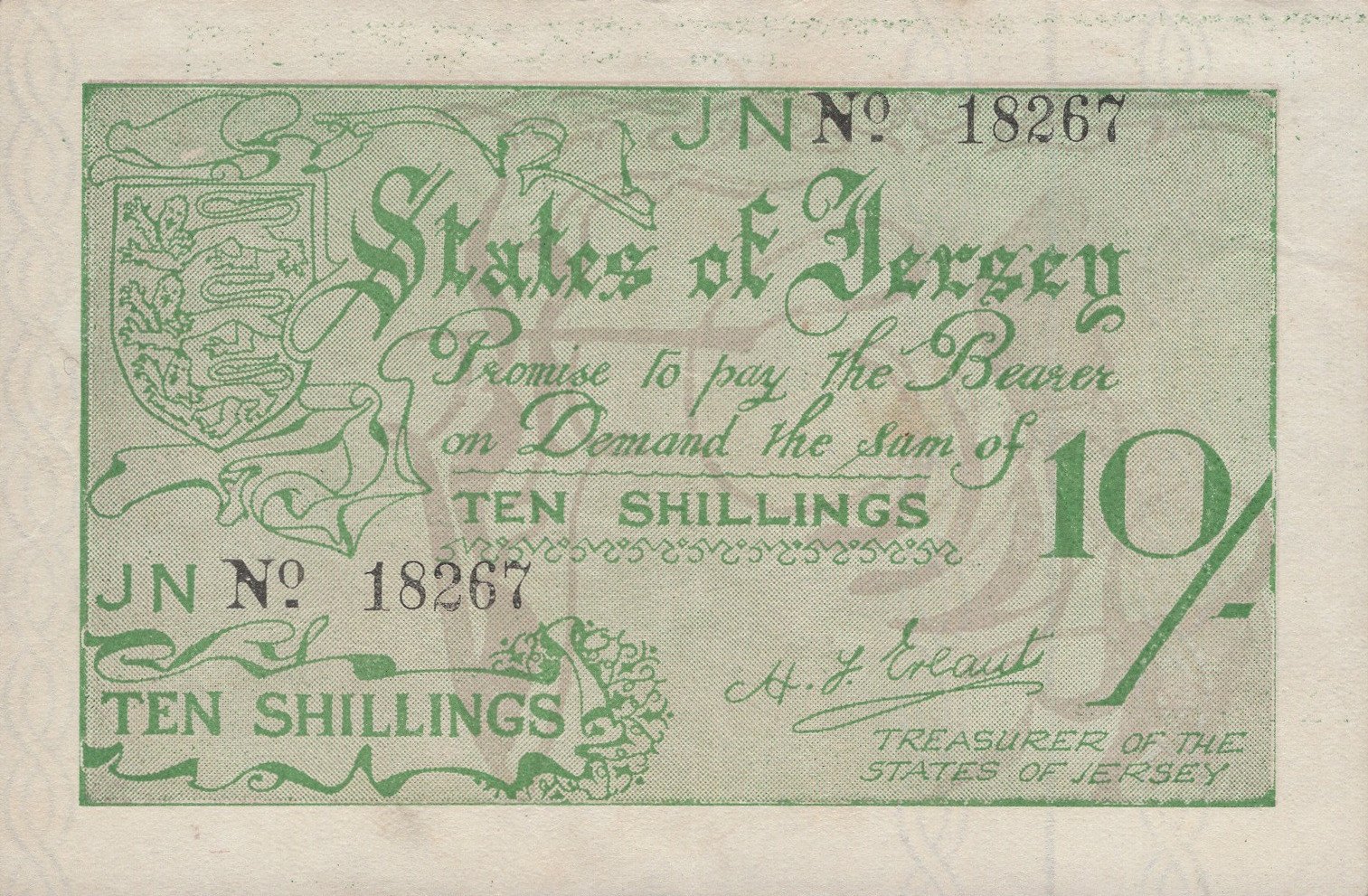
Between May 1941 and February 1945 the States of Jersey put six notes into circulation under German occupation: a plain 2 shillings in 1941 and five notes designed by the Jersey artist Edmund Blampied in 1942. This article tells their story from the catalogue pages, from three articles in the Journal of the International Bank Note Society (IBNS) by Yasha Beresiner, Richard Banyai and Francis Thornton, from the website threeisacollection.org, and from what the auction houses have written about single notes. The wider story of Jersey's notes is in The notes of the States of Jersey, 1840 to 2012.
Marks, hoarded silver and the first law
Yasha Beresiner ("An Excursion to Jersey", IBNS Journal, volume 10, number 2, 1970) dates the start of the occupation to 1 July 1940; the catalogue page of the first note gives 30 June 1940 to 9 May 1945. Beresiner writes that on 4 July 1940 the Germans declared the occupation Reichsmark legal tender in the island at seven marks to the pound. Richard Banyai ("The German Military Occupation of the British Channel Islands", IBNS Journal, volume 10, number 1, September 1970) gives a fuller run of rates: eight marks to the pound by an order of 8 July 1940, a first figure of five marks having been changed, then seven marks on 13 July 1940, 9.60 marks on 2 September 1940 and 9.36 marks on 28 September 1942, where it stayed. The two accounts do not agree on the first days.
Banyai describes what followed. German soldiers spent marks in the shops, the shopkeepers paid them into the banks, and the States bought them from the banks. British notes and silver left circulation. Beresiner follows the shortage of silver month by month: difficulties in the shops in November and December 1940, a request from the States on 23 November 1940 that the public hand its silver coin to the banks, a public warning in the middle of December, and by May 1941 bad coins in circulation and business houses using German paper money, in notes from 25 pfennig to 50 marks.
The answer was the Currency Notes (Jersey) Law 1941. In Beresiner's account the States enacted it on 16 May 1941. It empowered a Finance Committee to issue currency notes for 2 shillings, current in Jersey and legal tender for any amount, to decide how they were designed, printed and authenticated, and to call them in at face value. The face value in circulation at any one time was not to pass 5,000 pounds. The Act was signed by the Greffier of the States, H. Le Riche Edwards, and presented to the Royal Court on Friday 30 May 1941, with the Bailiff, A. M. Coutanche, presiding. The court ordered it published without delay because the matter was urgent. The catalogue page dates the law 30 May 1941, the day of the Royal Court. A working paper of the Johns Hopkins currency board archive (Krus and Schuler, Currency Board Financial Statements, 2014, Jersey section) gives 29 April 1941 for the law and June 1941 for the first notes. No other source read here has 29 April; June 1941 is also the month in Marshall-Fraser's table and on threeisacollection.org.
The 2 shillings of 31 May 1941
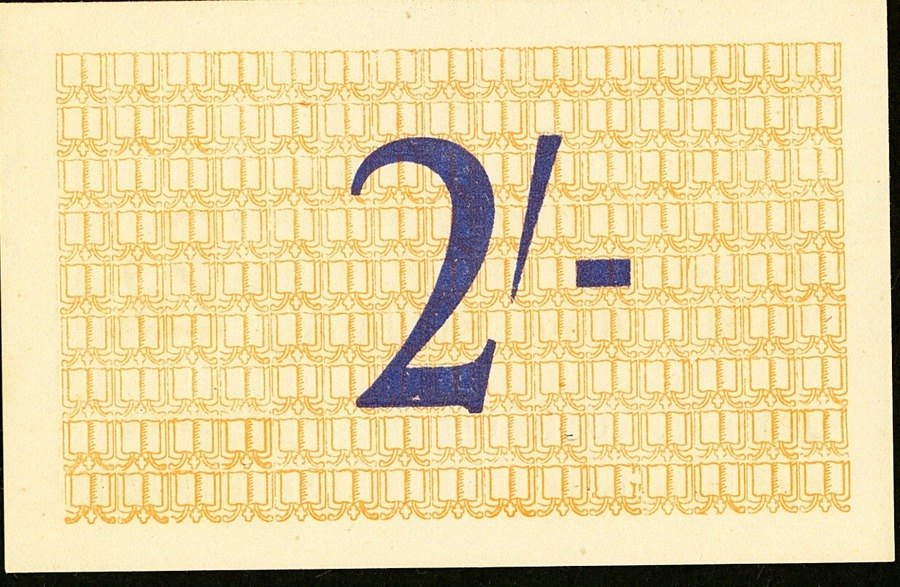
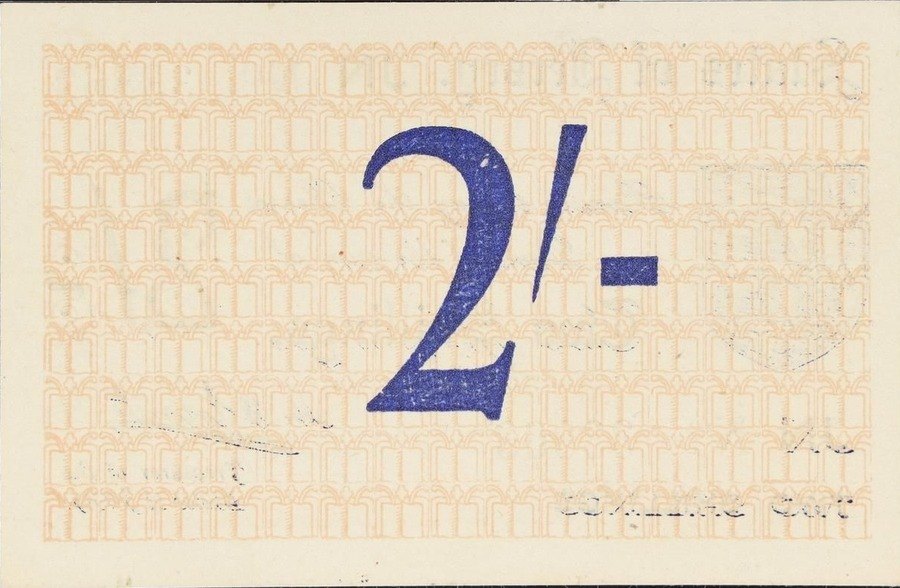
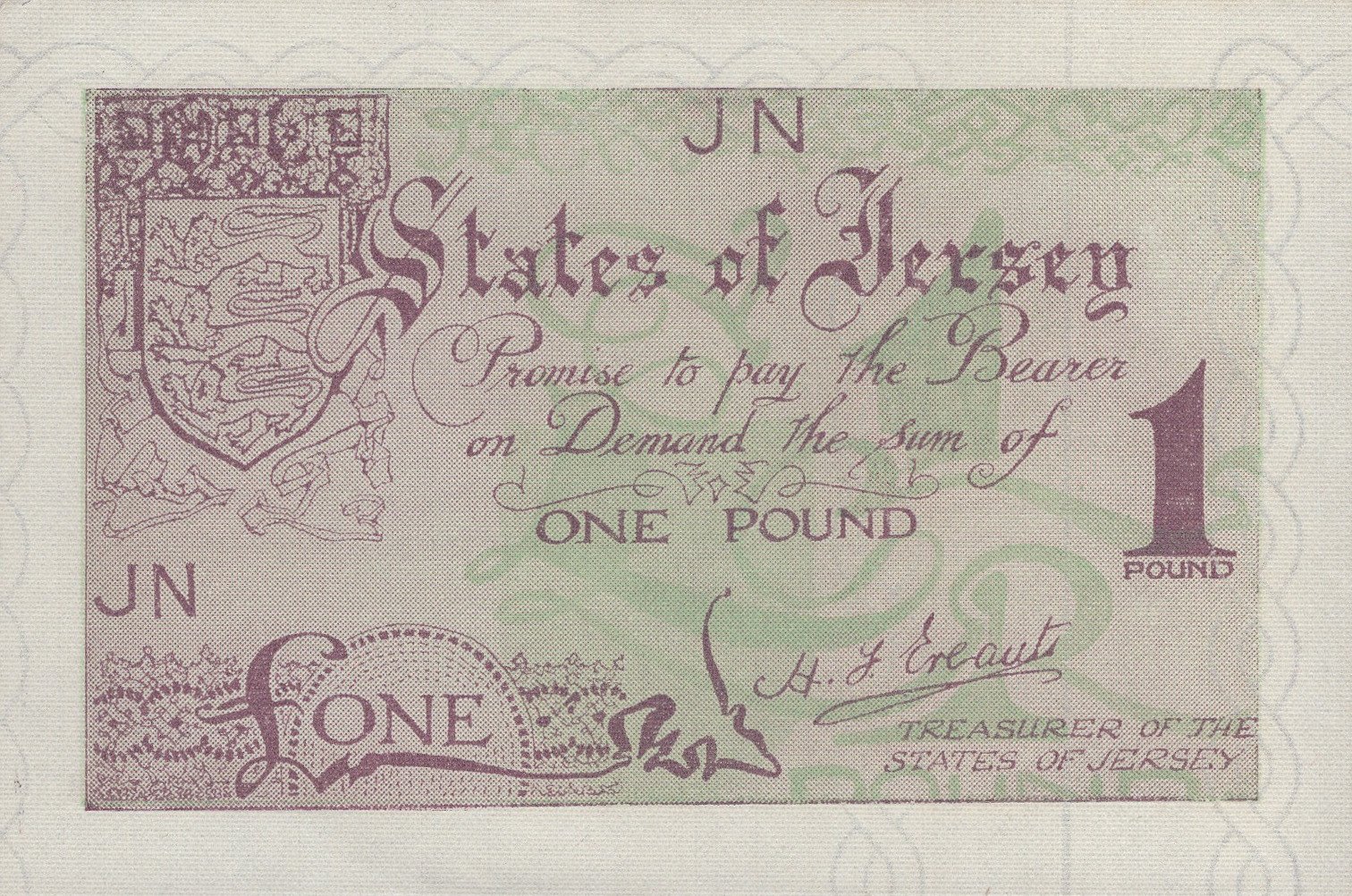
The 2 shillings of 1941 was introduced on 31 May 1941, the day after the Royal Court sat. Beresiner says that 50,000 notes worth 5,000 pounds went into circulation that day. The note is printed in blue on an orange ground made of rows of open books on stands with a cross under each. It has the arms of Jersey at the left, the promise to pay two shillings in the centre and the printed signature of the Treasurer of the States, H. F. Ereaut. The back is a large blue 2/- on the same ground. Beresiner could trace neither the designer nor the meaning of the books. The catalogue records the printer as unknown.
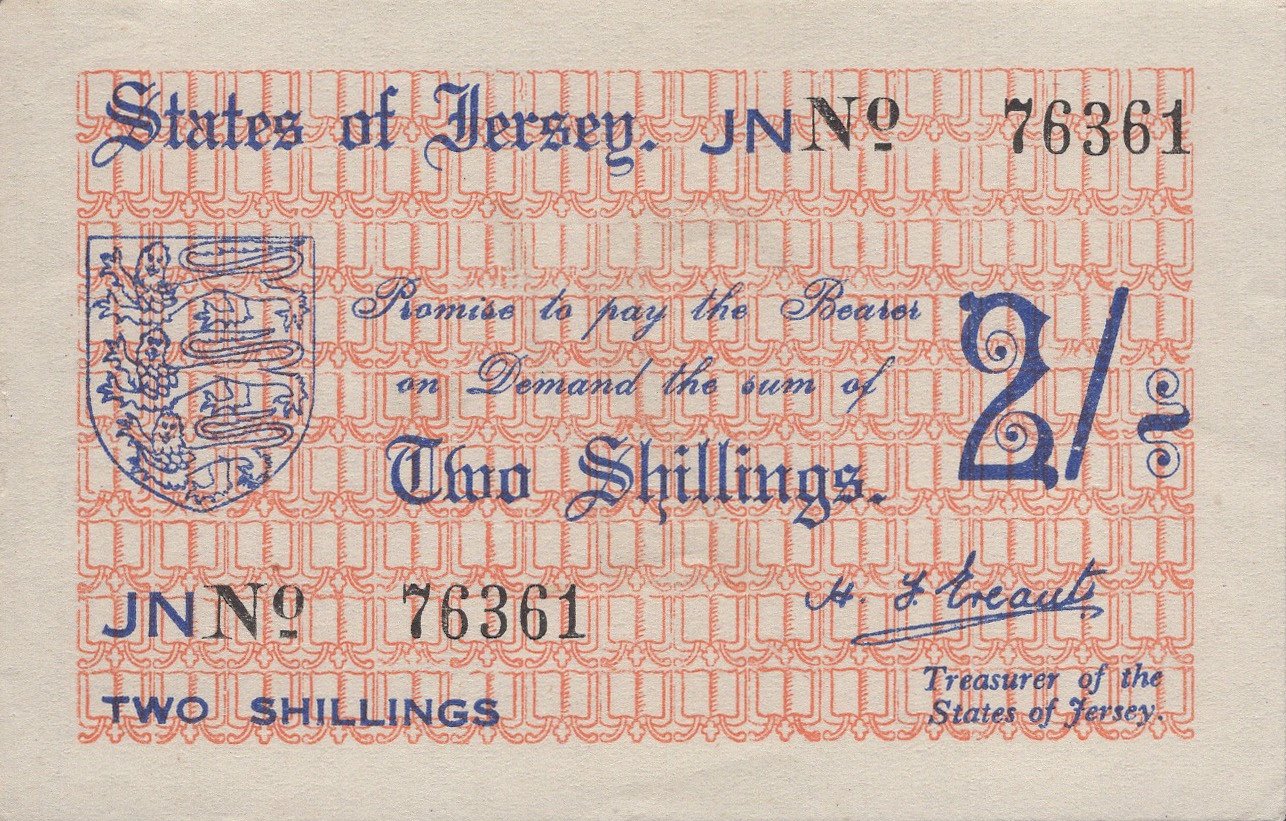
The number printed is an open point. The law allowed 50,000 notes, and Beresiner writes that 50,000 is the figure generally accepted. But Beresiner also points out that the serial numbers run far above 50,000, and cites a note numbered 79021 pictured on page 8 of R. Le Marchant's booklet "Paper Treasure of the Channel Islands". The catalogue page records the same thing and divides the note into two rows by its back. Held with the 2/- upright, the books have their curled feet at the bottom on one row (P-4a) and the pattern is inverted on the other (P-4b); every recorded P-4b is numbered below 50,000 and every recorded P-4a above it. Noonans, describing a note numbered 76361 in its sale of 28 October 2020 (lot 473), reached the same reading: the house noted that McCammon's catalogue gives 50,000 printed, that the note suggests more, probably 100,000 in the house's view, and that numbers from 50,000 up seem all to have the back the other way. No source read for this article states a second printing.
Beresiner also reports "some evidence" that part of the 1941 issue was printed on French paper with a different watermark, because paper was short. The catalogue records no such note.
The amendment of December 1941 and the notes of 20 April 1942
One value and 5,000 pounds were not enough. The Currency Notes (Amendment) (Jersey) Law 1941 was enacted on 6 December 1941; Beresiner adds that it was not finally registered until 23 May 1944. It changed two things in the first law: "2 shillings" became any value not exceeding 1 pound, and the limit of 5,000 pounds became 100,000 pounds.
The new notes came out on 20 April 1942. Beresiner quotes the Jersey Evening Post of 21 April 1942, which reported five values from 1 pound to 6 pence, named the designer as "that well-known Jersey artist, Edmund Blampied", and said that the blocks had been made by the Evening Post and the printing done by Messrs. Bigwood's Ltd. The five are the 6 pence, the 1 shilling, a new 2 shillings, the 10 shillings and the 1 pound. All carry the prefix JN and the printed signature of Ereaut. The three small values are of one size, a little larger than the 1941 note in Beresiner's measure, and the 10 shillings and 1 pound are larger.
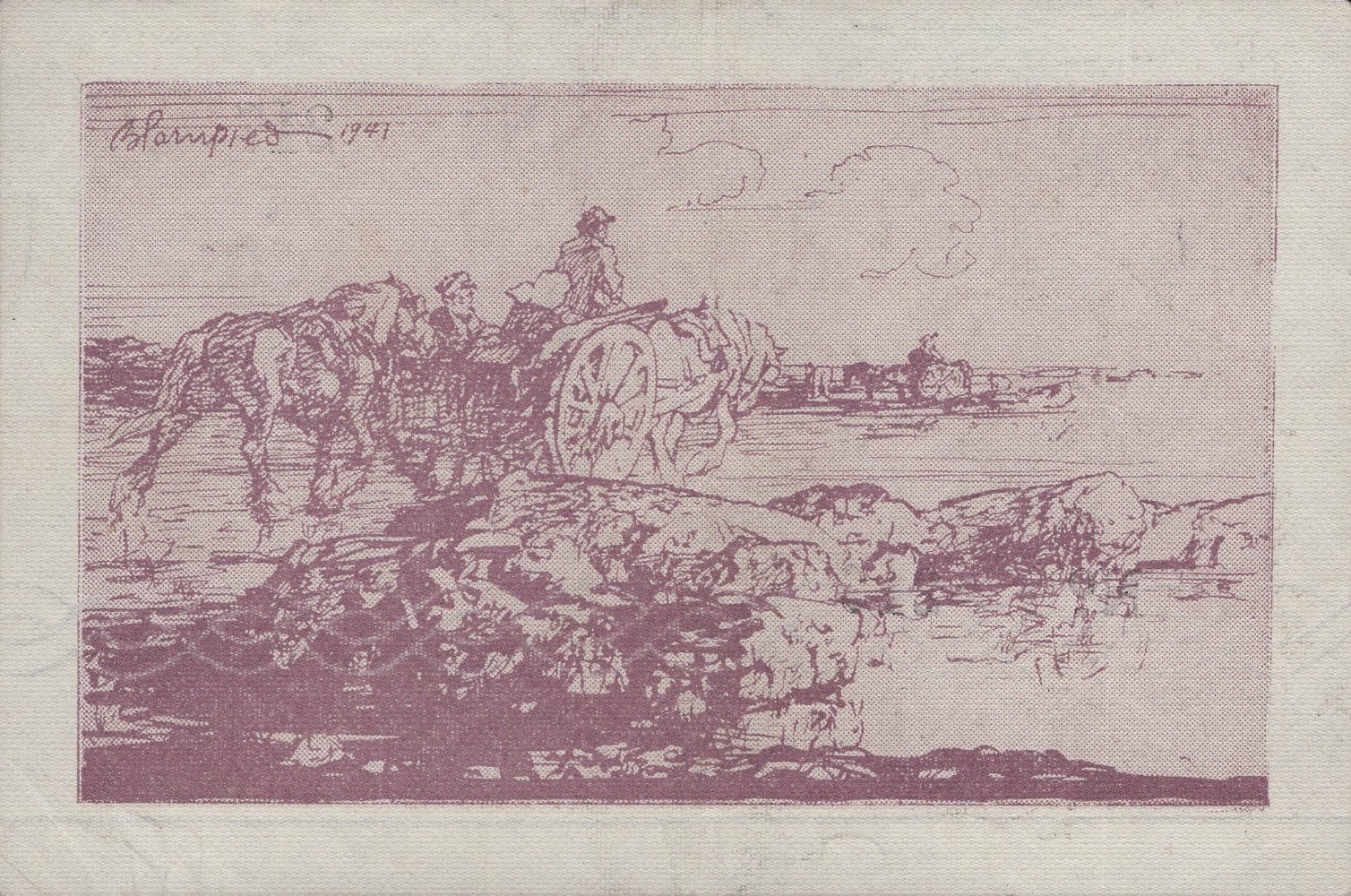
According to Beresiner, Blampied was a close friend of the Bailiff, and it was the Bailiff, as head of the Finance Committee, who asked Blampied to design the issue. The website threeisacollection.org, on its page about the notes, puts the request in late 1941. That fits the plates: the backs of the 10 shillings and the 1 pound are signed and dated 1941.
Edmund Blampied and the five backs
Francis Thornton ("States of Jersey", IBNS Journal, volume 17, number 4, 1978) gives the artist's life in outline. Edmund Blampied was born in the parish of St Martin, Jersey, on 30 March 1886, the fourth son of a farmer, and grew up on the farm. After some teaching at the art school in St Helier, Blampied went to London in January 1903 to attend Lambeth Art School, and a scholarship led to further study at Bolt Court. Blampied married Marianne Van Abbe in August 1914, returned to Jersey and served in the Island Militia through the First World War, then went back to England to study etching and engraving. Thornton lists A Wet Load, The Ox Cart, Jersey Milkmaid and Returning to the Stables among the well-known works, and notes that they cover some of the subjects on the backs of the notes. Blampied died on 26 August 1966.
Stack's Bowers, which sold a set of the five notes on 7 August 2012 (lots 20218 to 20222), added to this in its descriptions, crediting the research to Gar Travis: that Blampied was elected to the Royal Society of British Artists in 1938, had moved back to Jersey from London in the late 1930s, and stayed in the island through the occupation. The house saw a likeness between the back of the 1 pound and a work of 1936 called "Seaweed Harvest, Jersey".
Thornton describes each back:
- 6 pence: a scroll design built on the word sixpence. It is the only one not signed.
- 1 shilling: an elderly couple in caricature, often called the Gossips.
- 2 shillings: a farm cart drawn by a horse, with four people on their way to gather seaweed. The second horse is for the journey back with the heavy wet load.
- 10 shillings: a farm girl with three Jersey cows, signed and dated at the lower right.
- 1 pound: the seaweed gatherers going on to the beach on the ebb tide, signed and dated at the upper left. The seaweed, called vraic in the Channel Islands, was spread on the fields as manure.
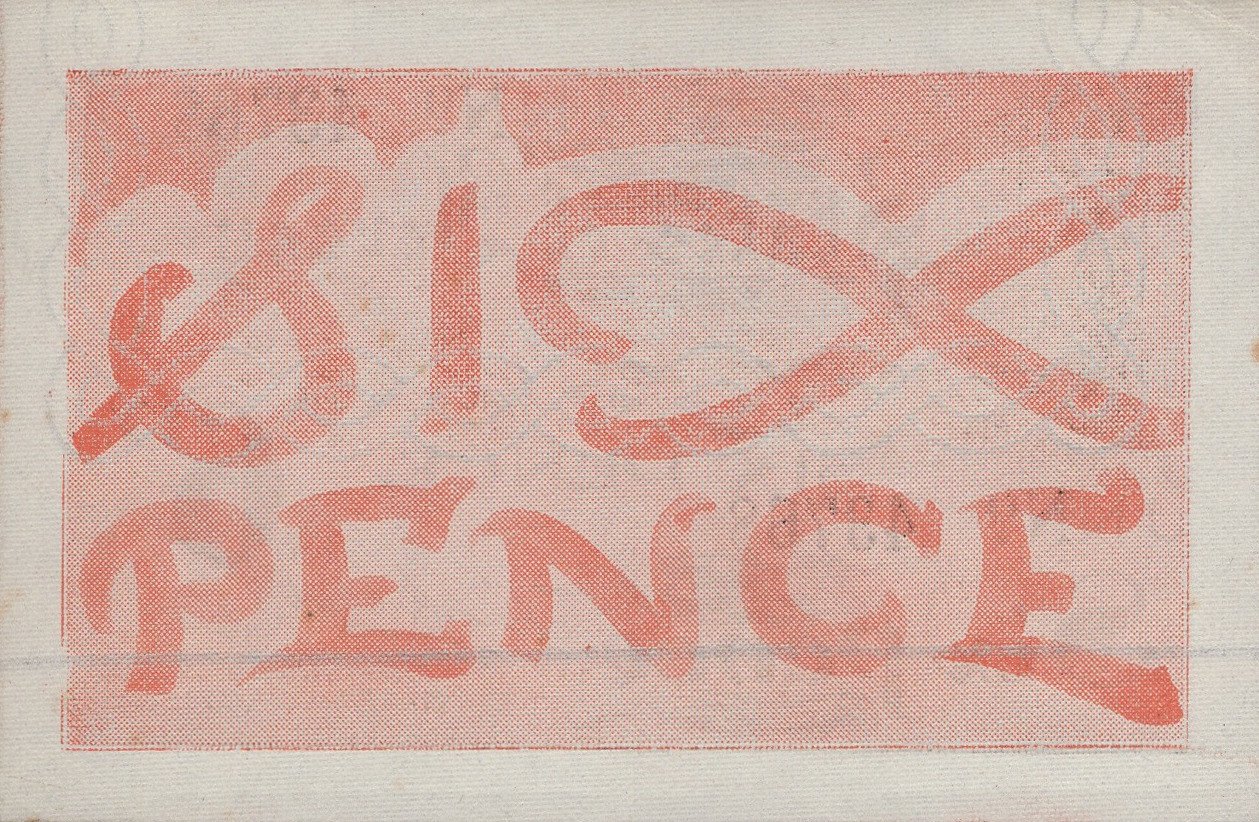
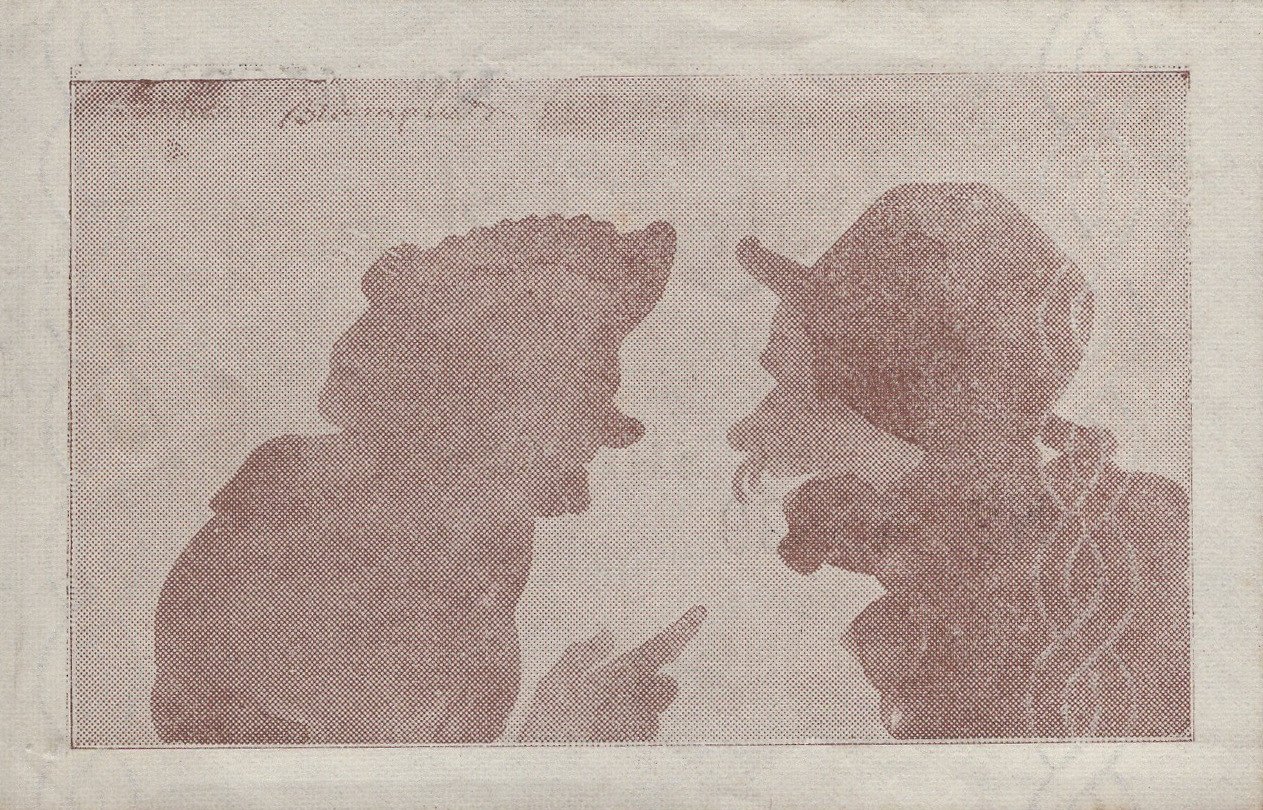
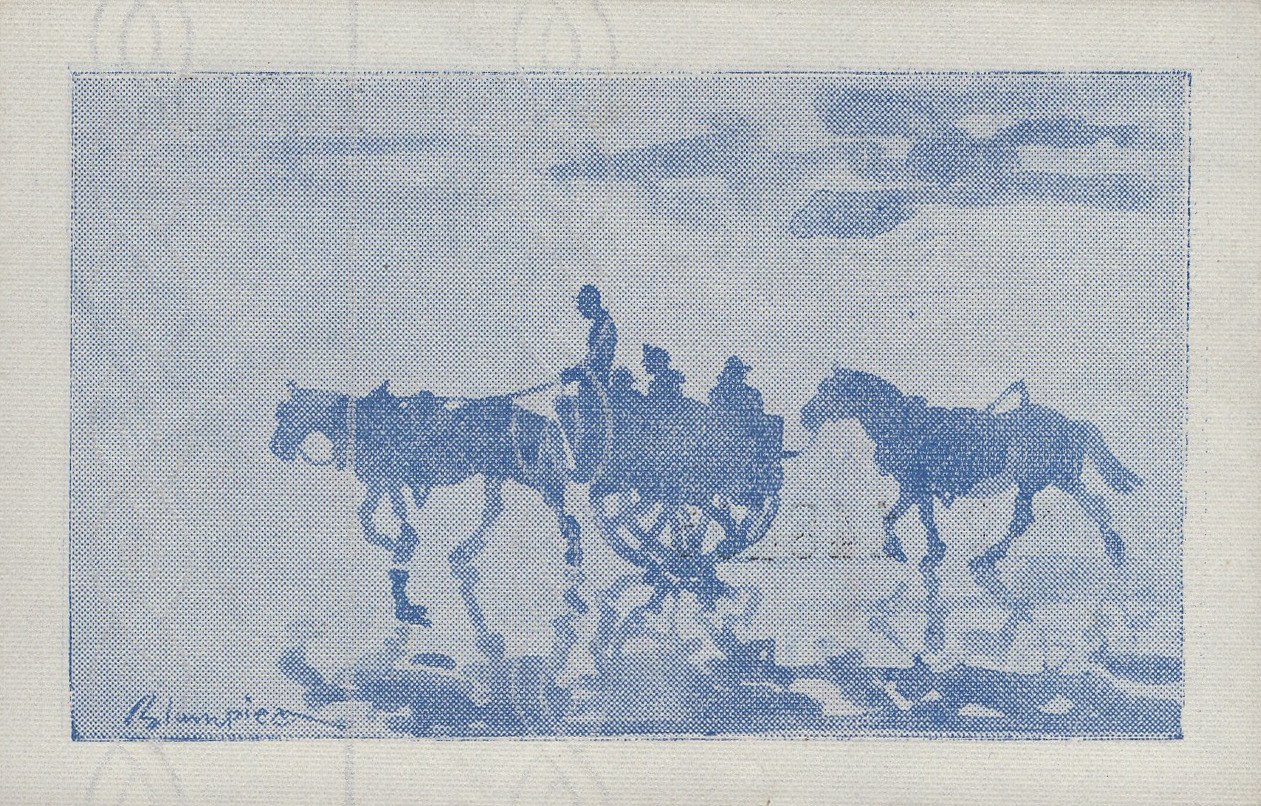
Beresiner adds that the designs are repeated as the background of the fronts. Blampied's drawings for the notes survive, and are described in Wartime and occupation: what the design archive keeps from 1914 to 1945.
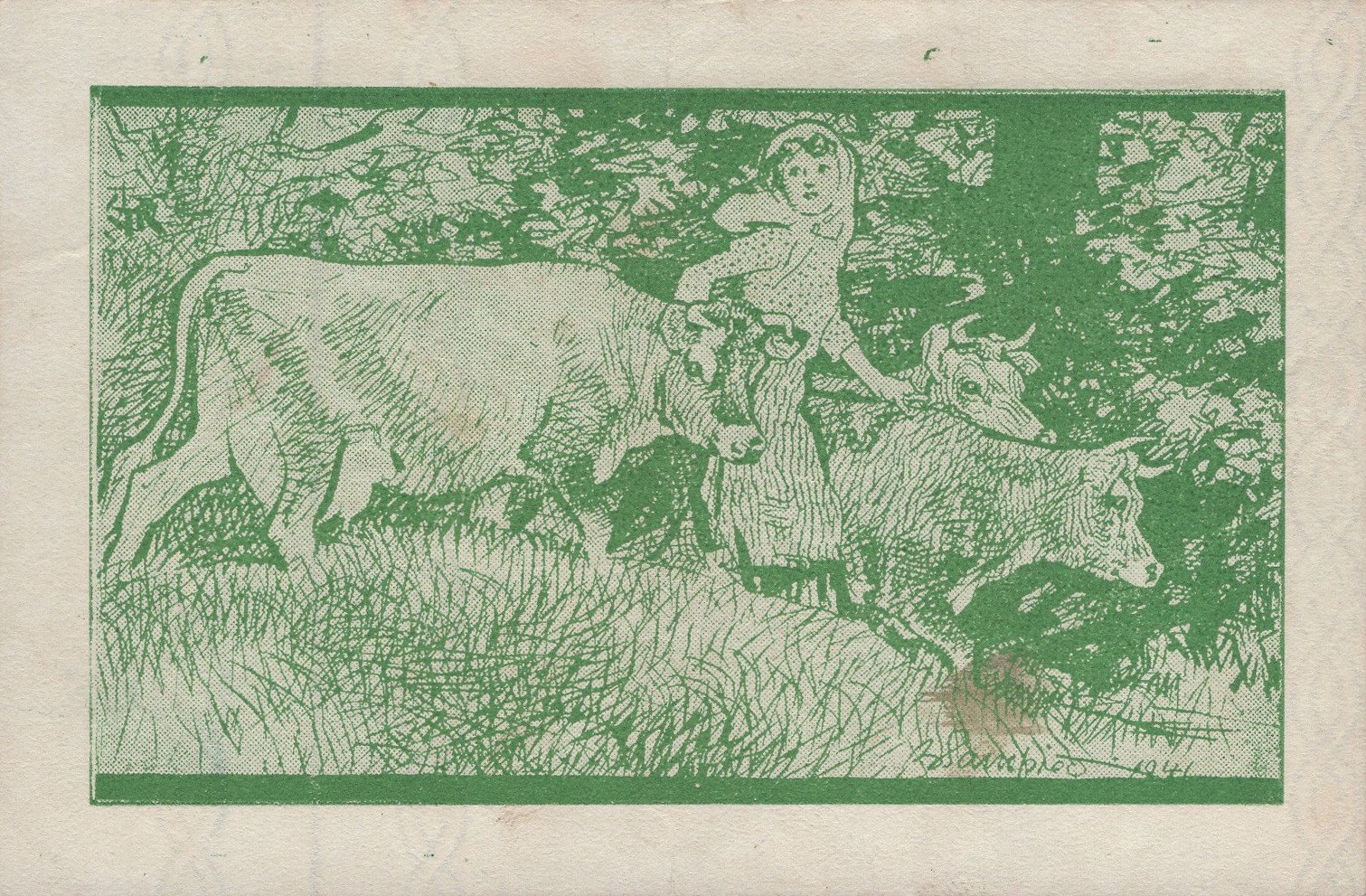
Stories grew up around the backs. A rumour said that the space between the two faces on the 1 shilling outlines the coast of Brittany. Beresiner traced it to a neighbour of the artist, who had made the remark to Blampied in company, and reports that it was not intended; Thornton says Blampied denied it. The page of threeisacollection.org passes on a saying that the 6 pence, when folded, shows a V for Victory. Steve Feller ("Occupied Jersey and Guernsey", IBNS Journal, volume 45, number 1, 2006) reads the same back, seen from the side, as the letters VE. Neither comes with evidence. The same website notes that 20 April was Adolf Hitler's birthday and says, citing a work of 1986 whose author the site spells Syrvet, that Blampied knew it.
One more claim is on record only as hearsay. Beresiner's informant, the same neighbour, said that at Ereaut's request it was Blampied who wrote the Treasurer's signature for all the 1942 notes. Beresiner thought the difference between the signature on the 1941 note and that on the later notes gave this some support. Nothing else confirms it.
How many were issued
Beresiner prints a table of the issue taken from Marshall-Fraser's article of 1949:
| Value | Lots released | Total notes | Total value |
|---|---|---|---|
| 1 pound | 7,000 in April 1942; 4,000 in June 1942 | 11,000 | 11,000 pounds |
| 10 shillings | 20,000 in April 1942; 6,000 in June 1942 | 26,000 | 13,000 pounds |
| 2 shillings | 50,000 in June 1941; 50,000 in April 1942 | 100,000 | 10,000 pounds |
| 1 shilling | 100,000 in April 1942; 100,000 in June 1942 | 200,000 | 10,000 pounds |
| 6 pence | 120,000 in April 1942; 120,000 in July 1942; 160,000 in January 1943; 200,000 in May 1943; 200,000 in October 1943; 40,000 in February 1945 | 840,000 | 21,000 pounds |
The table's own totals are 1,177,000 notes and 65,000 pounds.
The figures for the 6 pence, 1 shilling, 10 shillings and 1 pound are the ones on the catalogue pages, and threeisacollection.org gives the same four totals. The 2 shillings line is the weak one. It dates the first note to June 1941 where the catalogue page and Beresiner's own text have 31 May, it allows only 50,000 for the 1941 note, whose numbers pass that, and it allows 50,000 for the Blampied 2 shillings, where the catalogue page and threeisacollection.org have 150,000. Noonans, describing a Blampied 2 shillings numbered 128086 on 28 March 2019 (lot 656), wrote that McCammon knew of numbers above 50,000 without knowing the full range, and judged that the note was issued later than April 1942.
Beresiner raises one more doubt: whether a 6 pence belonging to the last lot, of February 1945, exists at all.
Paper, watermark and the nickname
Beresiner writes that all the 1942 notes were printed on English paper watermarked with a plaited line crossing the note, and that the colour of single notes varies a good deal, as it does on the 1941 note. The catalogue pages call the watermark a chain and record two forms on the 6 pence and the 10 shillings: links of 9 x 11 mm, the thick chain of the sale catalogues, and links of 6 x 10 mm, the thin chain. Most sale descriptions do not say which.
The paper wore badly. The book Islands in Danger by Wood, quoted by Banyai from page 129, says that as the cheap paper money suffered the wear of the occupation the notes became known as Dirty Berties, after the States' Treasurer, Herbert Ereaut. Beresiner gives the Treasurer's full name as Herbert Frank C. Ereaut, born in Jersey at the end of the nineteenth century and in office some 35 years before retiring in 1953. Ereaut left for England late in 1968 and died in July 1969.
Signed notes, remainders and sets
Some notes were signed by Blampied by hand, in the lower margin of the front on the notes the houses describe. Every signed note that the author of threeisacollection.org has seen is dated 20 April 1942, the day of issue. Three groups in the sale record show how they survive:
- Baldwin's sold the A. L. T. McCammon Collection on 11 October 1999. Lots 432, 434 and 435 held numbered notes of all five values signed and dated by Blampied, with nine notes that have the prefix JN and no number, which Baldwin's called unnumbered specimens. The catalogue places notes without a number on the remainder rows.
- Spink sold a set of the occupation notes on 6 October 2017 (lot 3297), every note with the serial number 30. Spink describes all of them as signed by Blampied with the handwritten date April 20 1942, and gives the set as from the L. G. Burr collection. Beresiner thanks L. G. Burr at the end of the 1970 article.
- Stack's Bowers sold the five values on 7 August 2012 (lots 20218 to 20222), each signed by Blampied at the lower right of the front. The house reads on the back of the 6 pence the written words "In Use During Jersey Occupation, EB".
Spink also sold, on 6 May 2020 (lot 2295), a set of all six notes without serial numbers, which the house called a proof or specimen set.
Withdrawal and afterwards
On 8 November 1941, Beresiner writes, the Germans announced that only the British pound and the Reichsmark would be legal tender in the island. Banyai adds that by the end of 1942 British money had almost gone from circulation and that most business in the last two years was done in marks. After the liberation the banks were allowed to accept the marks until 23 May 1945, when German money ceased to be legal tender in Jersey.
All the occupation notes were recalled on 27 November 1946, to be in the hands of the banks by Saturday 30 November. Beresiner, writing in 1970, says that many of the 10 shilling and 1 pound notes were handed in while the small values were kept as mementos, that a considerable number went to Germany with soldiers as souvenirs, and that the notes could still be redeemed at the Treasury.
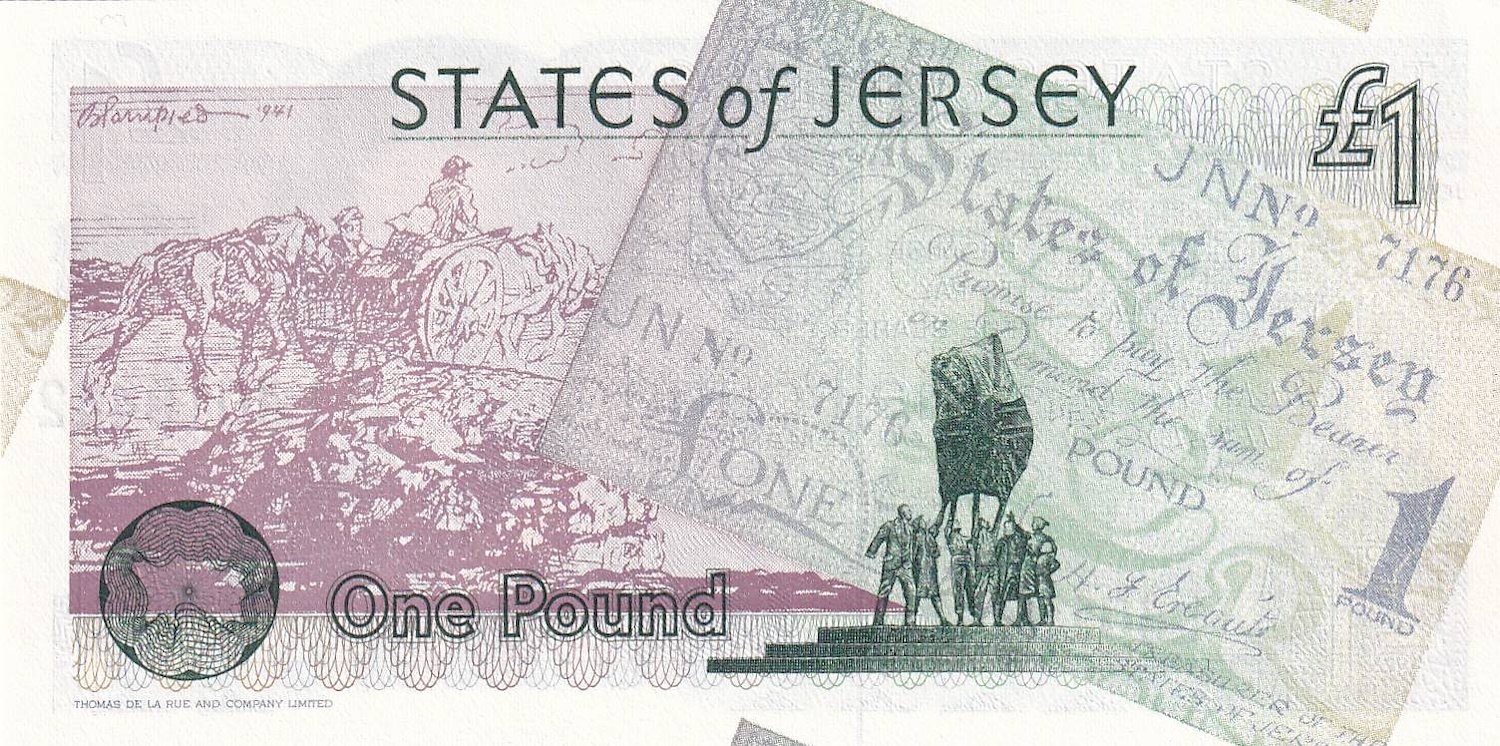
The States returned to the occupation 1 pound once more. The back of the 1 pound of 9 May 1995, issued for the fiftieth anniversary of the Liberation, shows its face and back.
What is not settled
- How many 2 shilling notes of each kind were printed, and whether the 1941 note had a second printing with the back turned.
- Who designed and who printed the 2 shillings of 1941.
- Whether part of the 1941 issue is on French paper.
- Whether Blampied wrote the Treasurer's signature for the plates.
- Whether a 6 pence of the lot of February 1945 exists.
Sources
- Yasha L. Beresiner, "An Excursion to Jersey", IBNS Journal, volume 10, number 2, 1970, pages 85 to 91, with the table from Lieutenant-Colonel W. Marshall-Fraser, "A History of Banking in the Channel Islands and a record of Bank Note History", 1949, and the Jersey Evening Post of 21 April 1942.
- Richard Banyai, "The German Military Occupation of the British Channel Islands", IBNS Journal, volume 10, number 1, September 1970, quoting Wood, Islands in Danger, pages 128 and 129.
- Francis Thornton, "States of Jersey", IBNS Journal, volume 17, number 4, 1978, pages 216 to 218.
- Steve Feller, "Occupied Jersey and Guernsey", IBNS Journal, volume 45, number 1, 2006.
- threeisacollection.org, "Currency notes designed by Edmund Blampied", https://threeisacollection.org/blampied/blampied_money.html (the copy saved on 11 November 2026), which cites John Wadsworth, In Duty Bound, Midland Bank, 1948.
- Krus and Schuler, Currency Board Financial Statements, Johns Hopkins working paper SAE0022, 2014, Jersey section.
- Baldwin's, Auction 20, the A. L. T. McCammon Collection, 11 October 1999, lots 432, 434 and 435.
- Stack's Bowers, 7 August 2012, lots 20218 to 20222; Spink, 6 October 2017, lot 3297, and 6 May 2020, lot 2295; Noonans, 28 March 2019, lot 656, and 28 October 2020, lot 473.
- The catalogue pages of the six notes.


Member comments
Log in or register to post a comment.