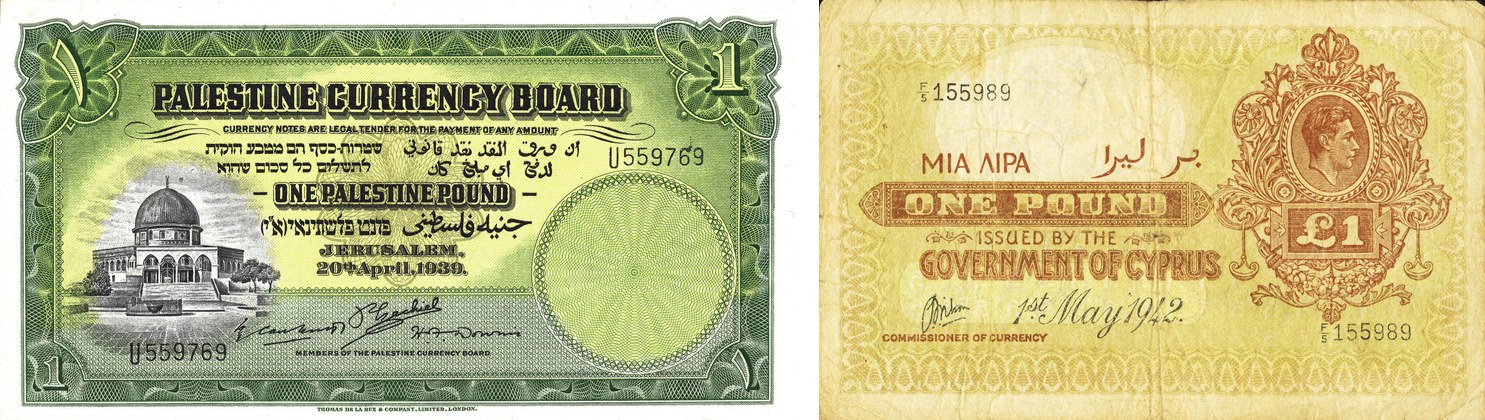
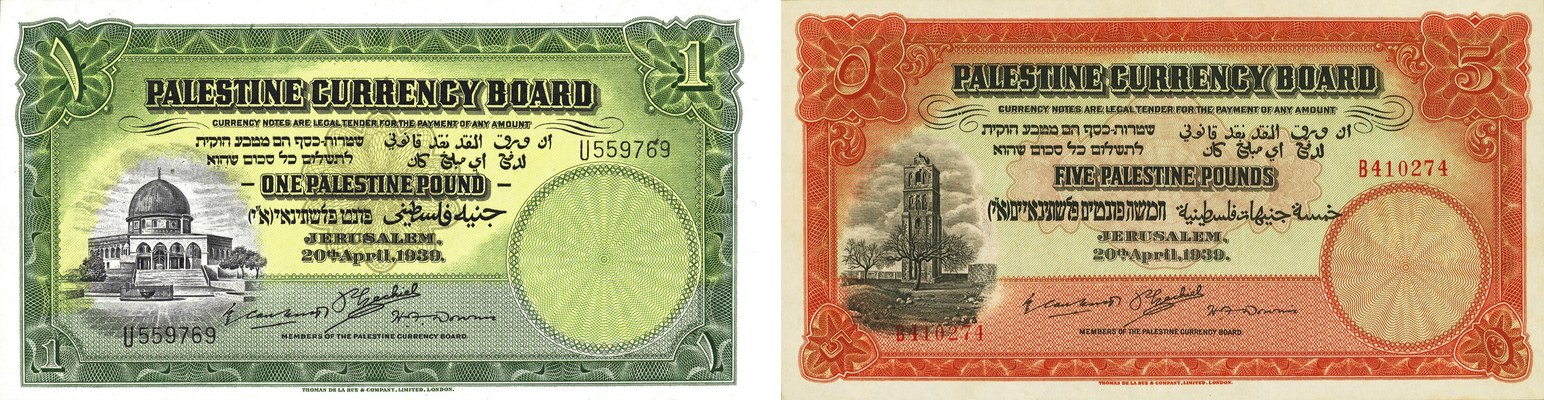
For six months of 1942 the 1 pound and 5 pounds of the Palestine Currency Board were legal tender in Cyprus. They went there as they were. An overprint was proposed and turned down, so no Palestine note marked for Cyprus was ever made.
The story is told by Howard M. Berlin in The Palestine Currency Board: Its History and Currency (EconSciences Books, 2025, pp. 48 to 52), following Raphael Dabbah's book of 2005 and the Cyprus Gazette. The words and the days of the law are given here from the Gazette itself: Supplement No. 3 to The Cyprus Gazette No. 2990 of 5th May 1942 (pp. 117 to 118) and No. 3013 of 17th September 1942 (pp. 255 to 256), read on the copies kept by CyLaw (cylaw.org). The quantities are from Fred Schwan in Bank Note Reporter (February 1983) and from the sources behind this catalogue's Cyprus pages.
Why Cyprus ran short
During the war people in Cyprus held on to notes, and the Treasury's reserve ran down. New supplies had to come from the printer in England, at a time when the Axis powers held much of Europe and of the Mediterranean. By January 1942 the reserve was almost gone, and the army on the island was asking for cash to pay for its works.
What was done
| Day | What happened |
|---|---|
| 6 February 1942 | The Governor of Cyprus, Charles Woolley, asks the Secretary of State for the Colonies for leave to obtain 100,000 pounds in Palestine notes |
| 13 February 1942 | The Secretary of State and the Palestine Currency Board agree. Cyprus must first pay 100,000 pounds sterling into the Board's account in London |
| 24 February 1942 | 100,000 notes of 1 pound are sent |
| 11 April 1942 | A further 150,000 pounds in notes of 1 pound and 5 pounds |
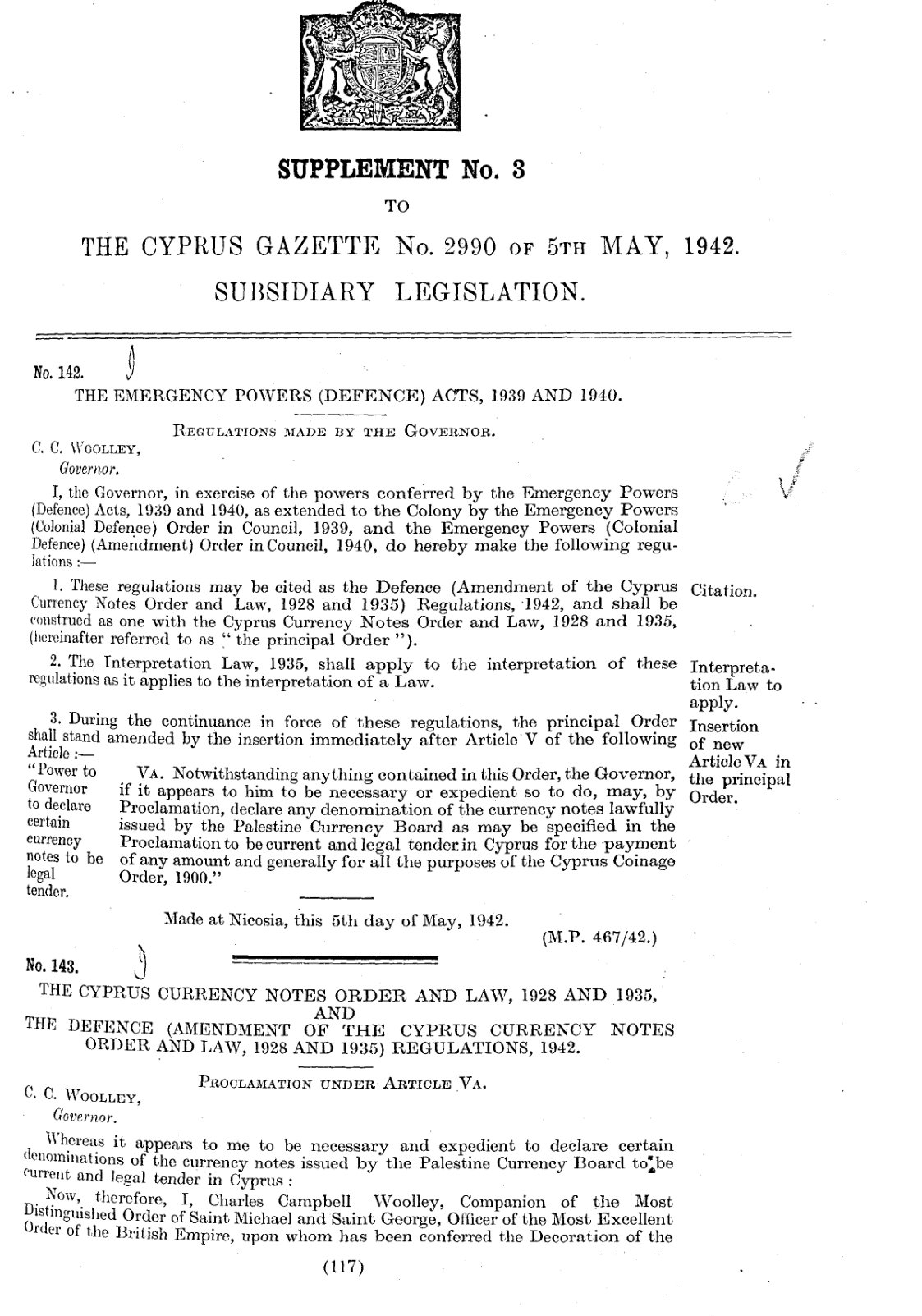
| 5 May 1942 | Regulations made by the Governor under the Emergency Powers (Defence) Acts add Article VA to the Cyprus Currency Notes Order. A Proclamation of the same day, printed in the Cyprus Gazette of that day, makes the Palestine 1 pound and 5 pounds "current and legal tender in Cyprus for the payment of any amount" |
| 6 May 1942 | The Governor reports that 25,000 notes of 1 pound have gone to the Ottoman Bank to be paid out |
| September 1942 | The Cyprus notes ordered from England arrive |
| 10 September 1942 | The Governor makes the Proclamation that ends the Palestine notes' legal tender |
| 17 September 1942 | The Cyprus Gazette prints it |
| 17 November 1942 | The last day the Palestine notes are legal tender in Cyprus, and the last day to hand them in for exchange |
| 18 November 1942 | The Proclamation of 5 May stands revoked |
Schwan gives the totals as 150,000 notes of 1 pound and 20,000 notes of 5 pounds, which is the same 250,000 pounds.
What the Gazette says
Two things were printed on 5 May 1942, one under the other on page 117 of the Gazette's Supplement No. 3. The first is a set of Regulations made by the Governor under the Emergency Powers (Defence) Acts, 1939 and 1940, named the Defence (Amendment of the Cyprus Currency Notes Order and Law, 1928 and 1935) Regulations, 1942. They add one article to the law under which Cyprus issued its own notes, to stand "during the continuance in force of these regulations":
"VA. Notwithstanding anything contained in this Order, the Governor, if it appears to him to be necessary or expedient so to do, may, by Proclamation, declare any denomination of the currency notes lawfully issued by the Palestine Currency Board as may be specified in the Proclamation to be current and legal tender in Cyprus for the payment of any amount and generally for all the purposes of the Cyprus Coinage Order, 1900."
The second is the Proclamation made under that article the same day. Its Schedule names the notes in one line: "The Currency Notes of the denominations of one Palestine pound and five Palestine pounds issued by the Palestine Currency Board." It names no date of issue, no prefix and no quantity, and says nothing of any mark to be put on the notes.
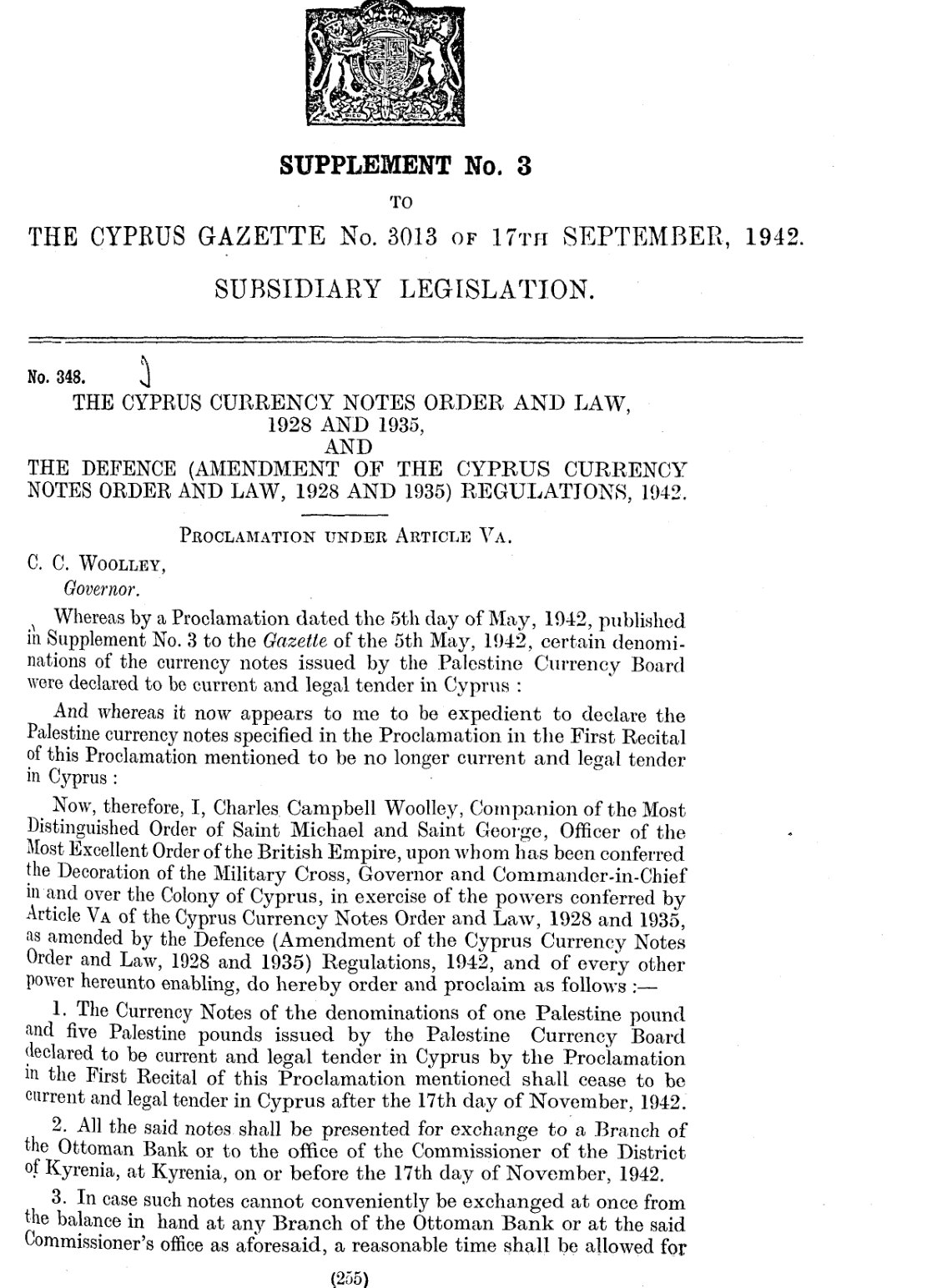
The end came the same way. A second Proclamation under Article VA was given at Nicosia on 10 September 1942 and printed in the Gazette of 17 September. It has five clauses:
- the 1 pound and the 5 pounds "shall cease to be current and legal tender in Cyprus after the 17th day of November, 1942";
- all of them "shall be presented for exchange to a Branch of the Ottoman Bank or to the office of the Commissioner of the District of Kyrenia, at Kyrenia, on or before the 17th day of November, 1942";
- where a branch or that office has not enough in hand to exchange them at once, "a reasonable time shall be allowed" for the balance to be sent for;
- "The Government shall be under no liability whatsoever in respect of any of the said notes not presented for exchange as aforesaid on or before the 17th day of November, 1942";
- the Proclamation of 5 May "shall be revoked as from the 18th day of November, 1942".
Both Proclamations are in the name of C. C. Woolley, Governor, and both carry the same file number, M.P. 467/42.
Two other money measures of 1942 stand in the same Supplement, and no reason is printed for either. Defence Regulations in the Gazette of 9 July forbade anyone to hold more than 100 pounds in currency from 18 July 1942, or 150 pounds for a family living in one house; anything above that was to be paid into a bank or the Treasury. From 5 October 1942 no one might hold more than 5 pounds in silver coin, and the rest was to be changed for notes. Both sets of Regulations were revoked on 20 February 1945.
Berlin's book cites the two Gazettes as No. 299 of 5 May 1942, p. 117, and No. 312 of 10 September 1942, p. 253. The pages themselves are headed No. 2990 of 5th May and No. 3013 of 17th September, and the second Proclamation is on pp. 255 to 256.
The overprint that was refused
With the request went a suggestion: print "legal tender in Cyprus only" across the notes. London refused. The reason Berlin gives is a practical one. The notes were a reserve, and it was not certain they would be needed. If they were overprinted and then not used, they could not go back into circulation in Palestine and would be wasted.
So the notes that circulated in Cyprus were ordinary Palestine notes, the same in every way as those in use in Palestine.
How they were received
Not well. Berlin writes that the notes were unfamiliar and were little liked, and that they were used mainly in and around the large army camps. This catalogue's Cyprus pages say the same.
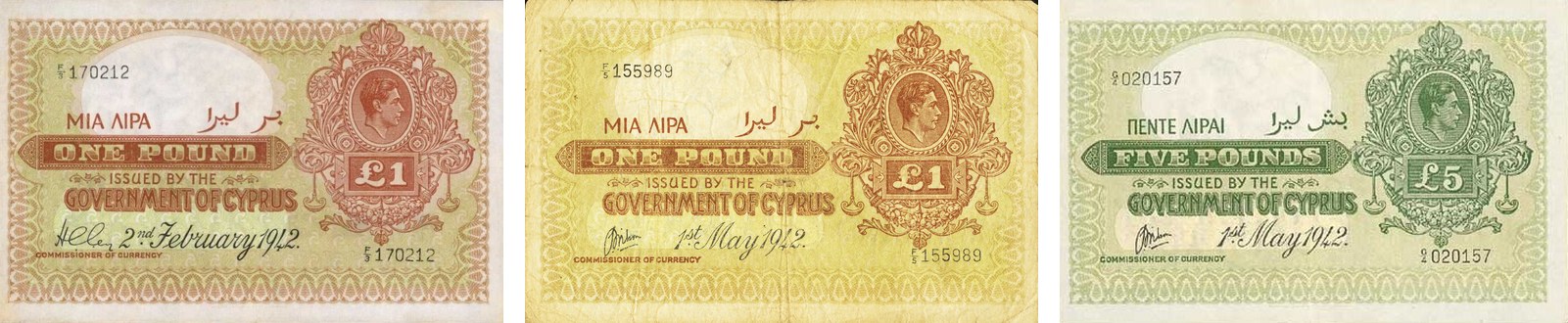
When the island's own notes came, the Palestine notes were withdrawn. The Cyprus 1 pound and 5 pounds are recorded here with the dates 2nd February 1942 and 1st May 1942, and the 10 shillings with the same two dates.
What a collector can and cannot say
- There is no Cyprus overprint. None was authorised and none was printed. A Palestine note that carries one was not made so by the Board or by the Government of Cyprus.
- Only two values were involved, the 1 pound and the 5 pounds. The 500 mils, 10, 50 and 100 pounds were never legal tender in Cyprus.
- No note can be tied to the island. In the spring of 1942 the latest date on both values was 20th April 1939; the date of 1st January 1944 came later. The sources read do not say which dates or which prefixes were sent, and nothing on a note shows that it was there.
- Several days are given for the end, and each has its meaning. 10 September 1942 is the day the Governor made the Proclamation, and 17 September the day the Cyprus Gazette printed it. The notes stayed legal tender until the end of 17 November, which was also the last day to hand them in. Accounts that give 18 November give the day from which the Proclamation of 5 May was revoked.
What became of the Palestine notes after they were handed in, and how many of the 250,000 pounds had been paid out, is not in the sources read for this article. The Proclamation says only where they were to be exchanged, and that the Government took no liability for a note not presented by 17 November 1942.
Member comments
Log in or register to post a comment.