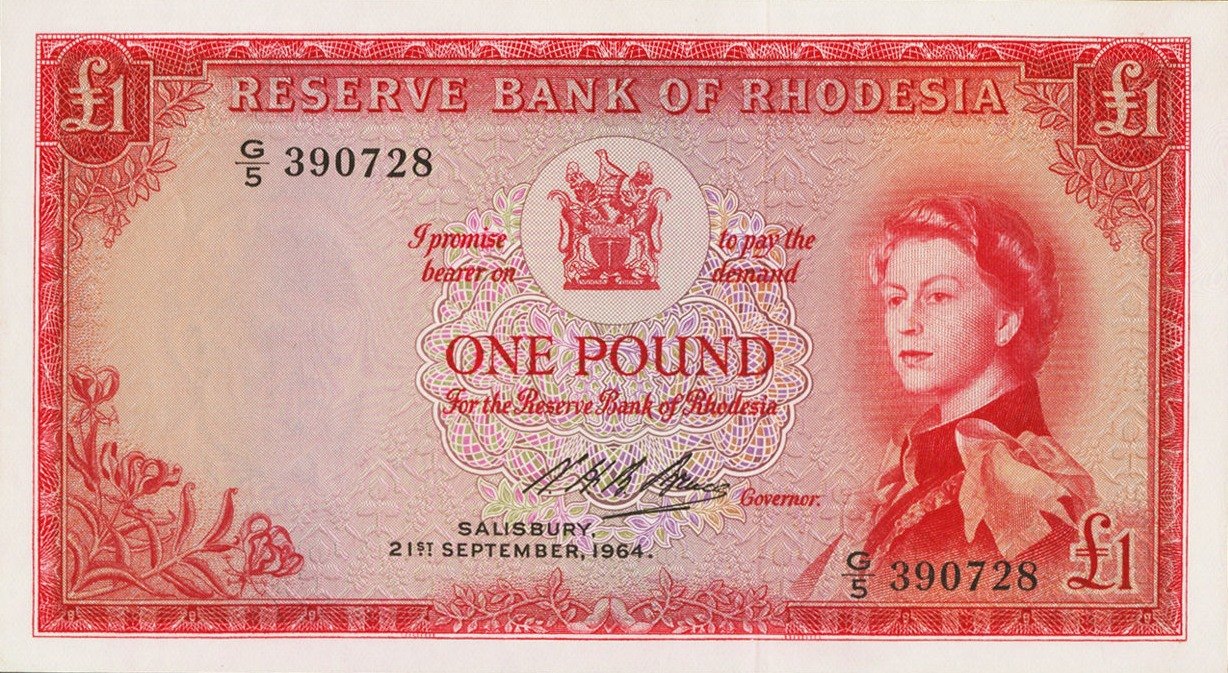
This article sets out the record behind the six pound notes of the Reserve Bank of Rhodesia: the law, the Governor, the day of issue, and the papers on the notes printed in London, in Munich and in Salisbury. It is drawn from the Pick pages of this catalogue, with three passages of Hansard read for it. The story of the three printings and how to tell a London note from a Salisbury note is told in Printed three times, issued once: Rhodesia's pound notes, 1965 to 1967; this article holds the sources and figures in full.
Designs drawn in 1963
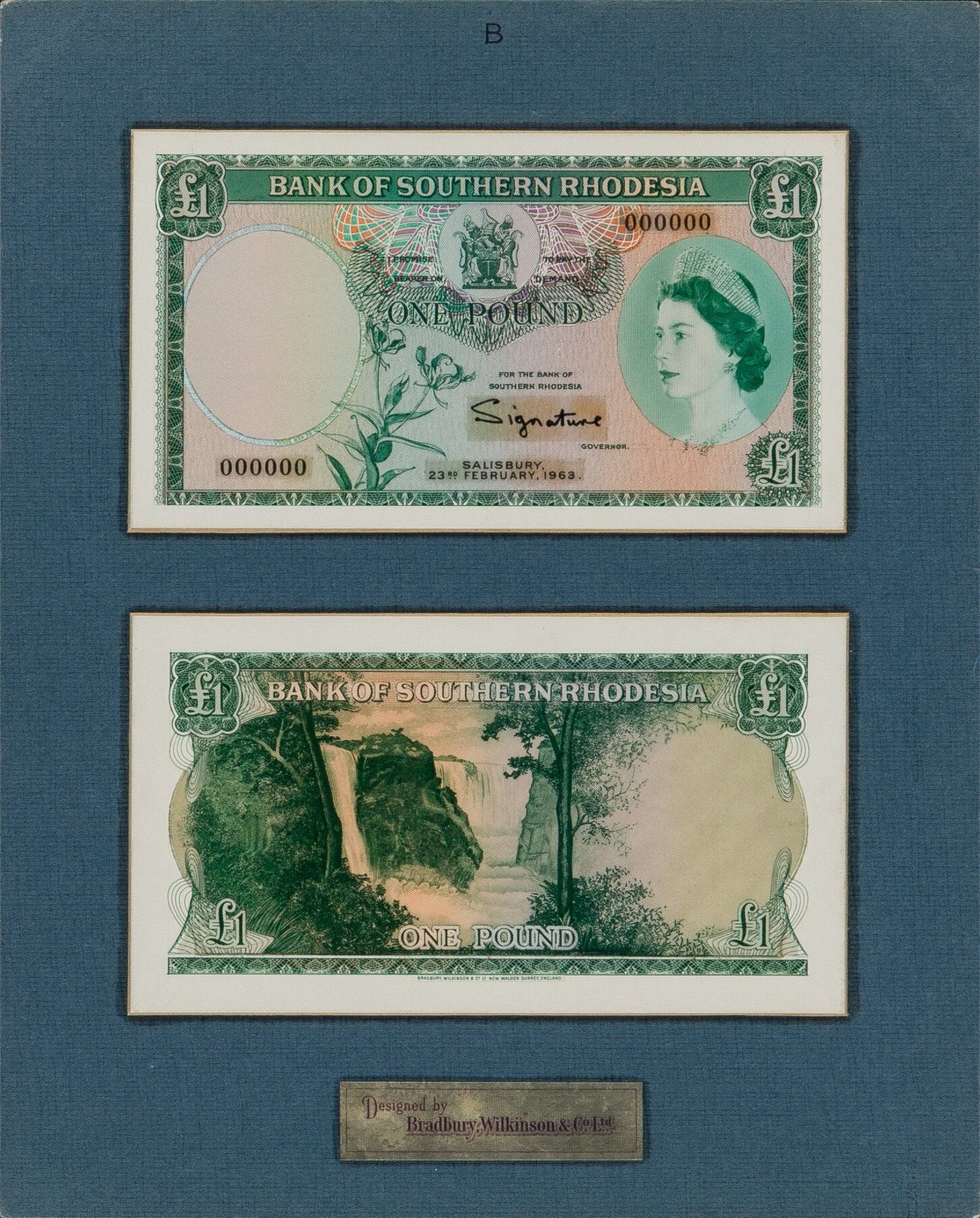
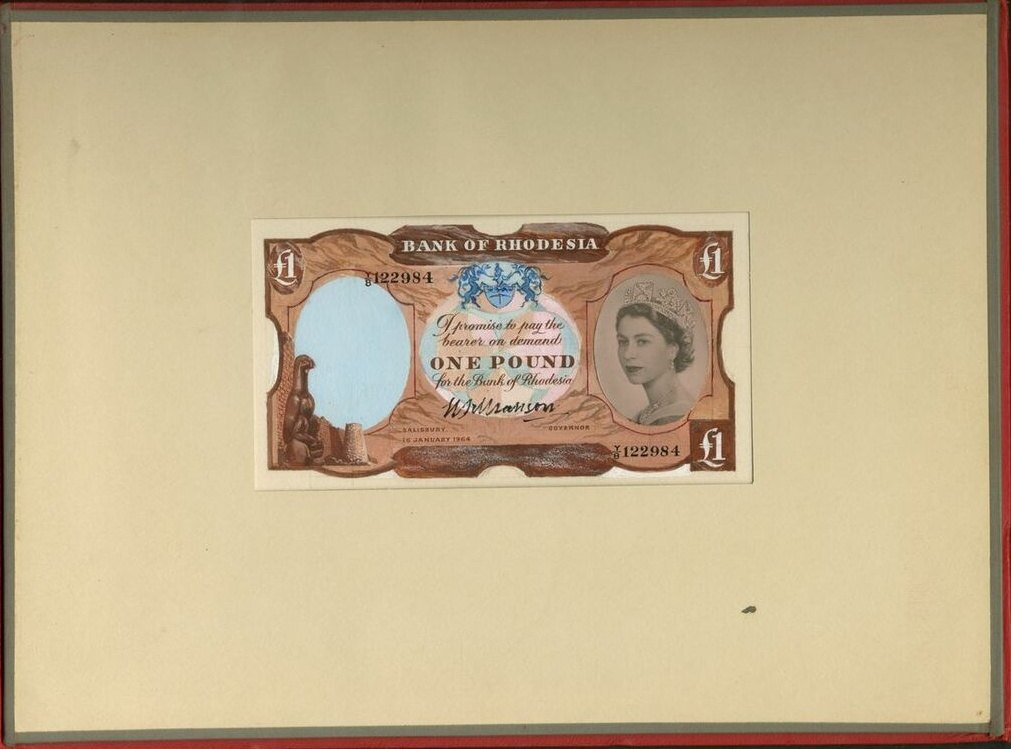
Two groups of designs dated before the Reserve Bank's first notes have been sold. What follows is the houses' account of them.
Heritage's descriptions of lots 28201 and 28202 in its sale of 17 August 2018 concern front and back printer's models of 1 pound and 5 pounds dated 23 February 1963, mounted on card with a printed line naming Bradbury Wilkinson as the designer, with pasted dates and serial numbers and the word SIGNATURE in the signature panel. Heritage catalogued them under the name Bank of Southern Rhodesia and says a 10 pounds was designed with them.
Spink's description of lot 686 in its sale of 7 November 2024 concerns a pair of essays of 1 pound by Harrison and Sons, dated 16th January 1964, in a presentation folder dated November 1963, prepared for a Bank of Rhodesia. Spink notes that no notes were issued under that name.
The Act of 1964 and the Governor
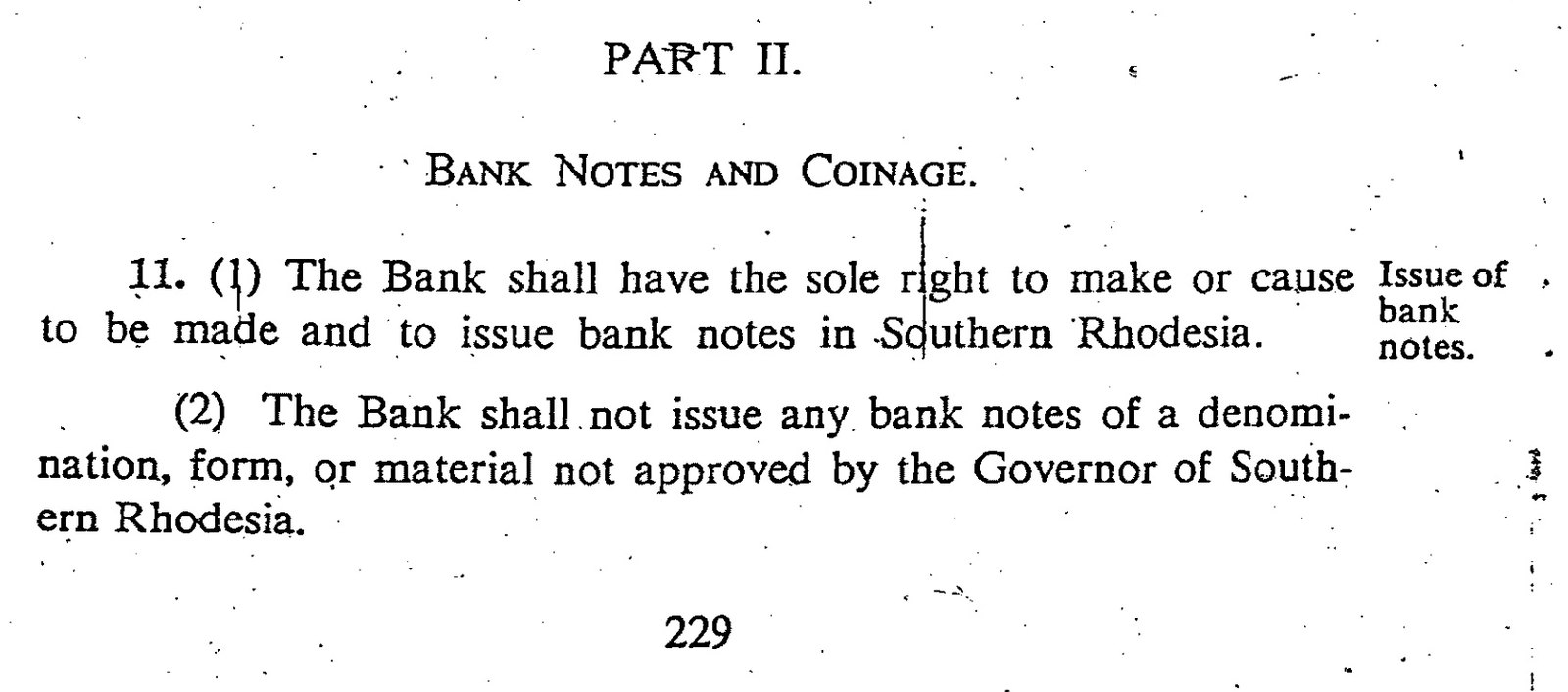
The law behind the notes is the Reserve Bank of Rhodesia Act 1964 (No. 24 of 1964). Three of its sections bear on the notes:
- Section 11 gave the Bank the sole right to issue bank notes in Southern Rhodesia and let it issue none "of a denomination, form, or material not approved by the Governor of Southern Rhodesia".
- Section 12 made its notes legal tender until called in and demonetized by a notice in the Gazette.
- Section 13 made it an offence to make anything resembling a note without the Bank's authority (up to seven years in prison), or to deface, soil or damage a note, write or draw on it or attach an advertisement to it (a fine of up to 25 pounds).
No approval of the denominations of the pound notes was printed in the Gazette.
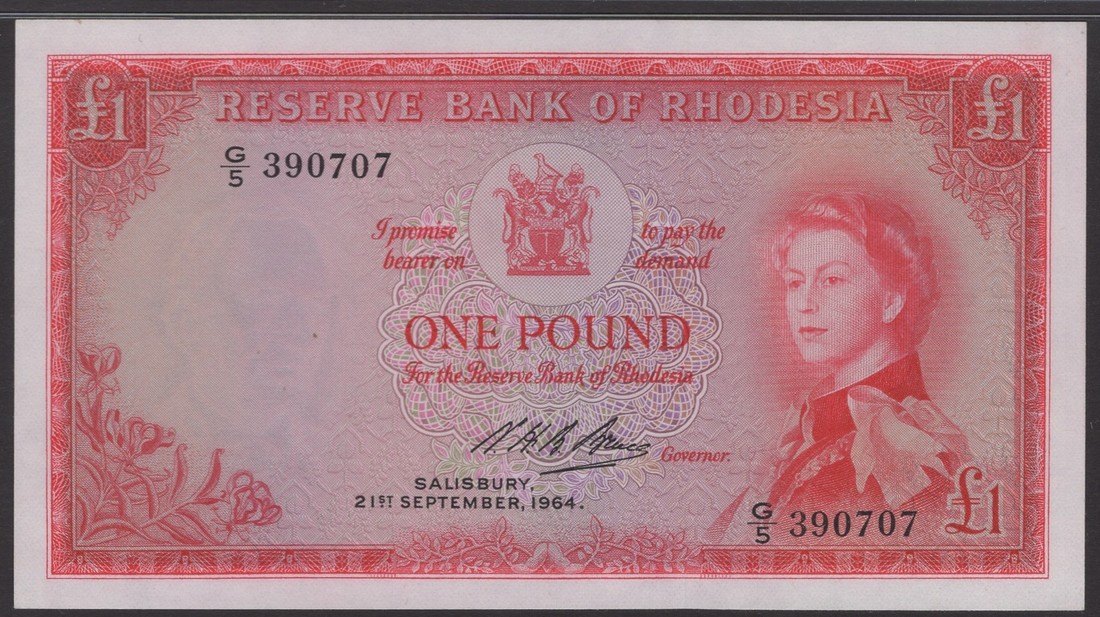
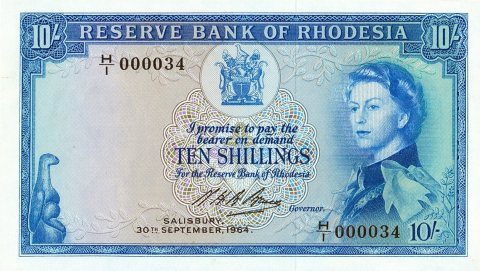
The Act first came into force on 22nd May 1964, and on that day N. H. B. Bruce was appointed the Bank's first Governor (Southern Rhodesia Notice No. 799 of 1964). Bruce was reappointed for seven years from 22nd May 1971 (Rhodesia Notice No. 817 of 1971). Bruce came from the Bank of Rhodesia and Nyasaland, whose weekly statements in the Gazette carry Bruce's signature as Chief Cashier up to June 1965; a letter of Bruce in the Bank of England's files says the same (Tinashe Nyamunda, Financing Rebellion, thesis, University of the Free State, 2015, p. 77). The notes of 1964 are signed by Bruce as Governor.
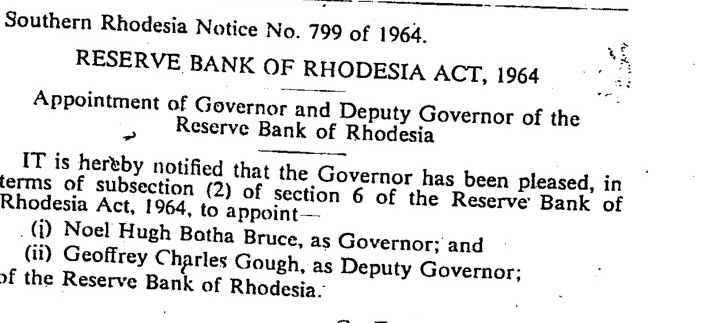
The pieces submitted for approval carry the same day. Specimens dated 15th October 1964, with prefix A/1 and ladder serial numbers, are marked 22-5-64 AS SUBMITTED.
The first issue, 16th November 1964
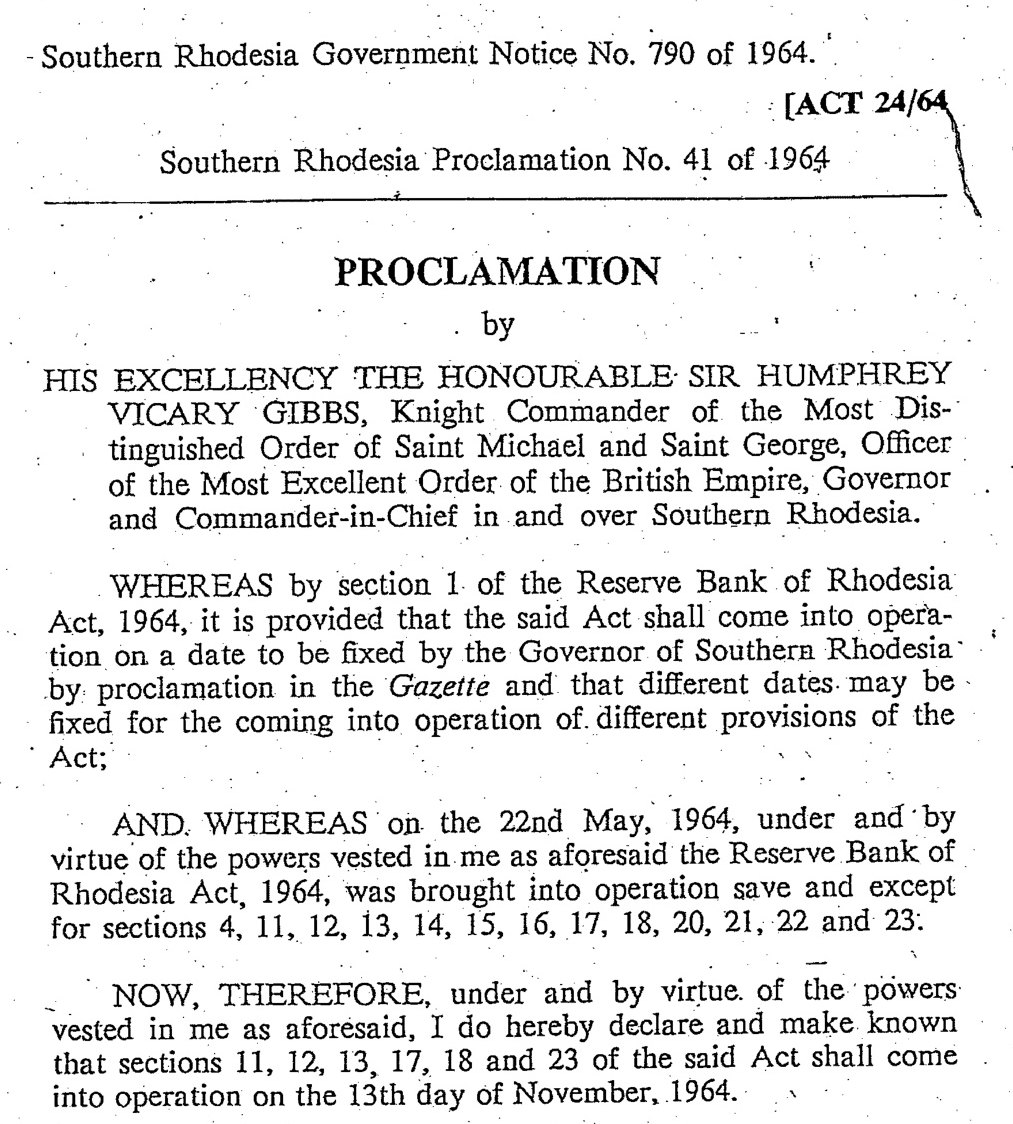
The sections of the Act on the issue of notes came into force on 13th November 1964 (Southern Rhodesia Proclamation No. 41 of 1964). The Reserve Bank issued its own notes from 16th November 1964, according to the Treasury's statement in the Gazette of 4th June 1965 (Rhodesia Notice No. 812 of 1965). The Minister of Finance's Budget statement of 1st July 1965 gives the same day (cited by Nyamunda, p. 79). Sources mention 15 November 1964.
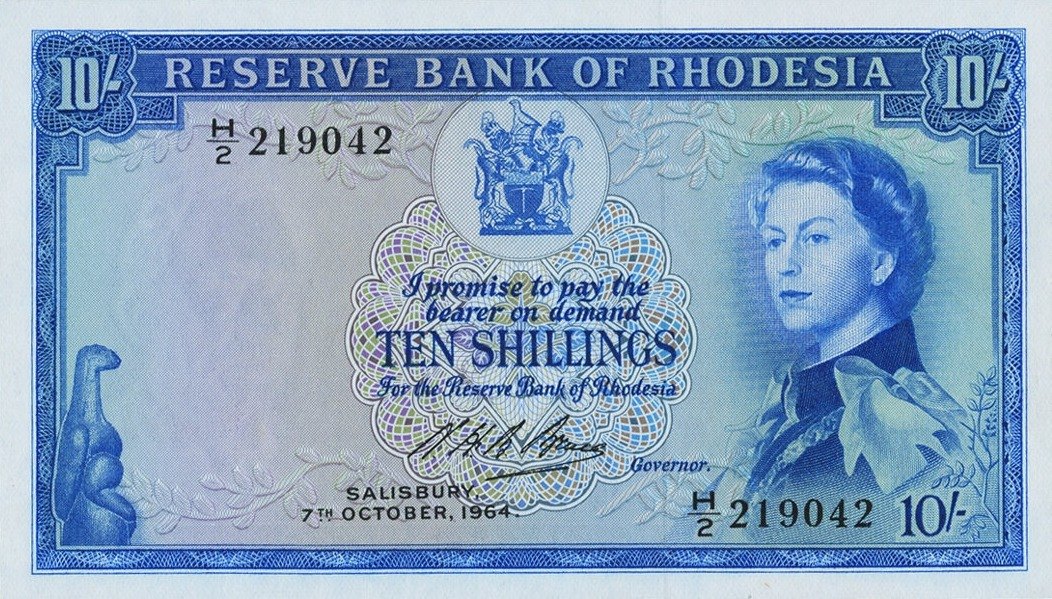
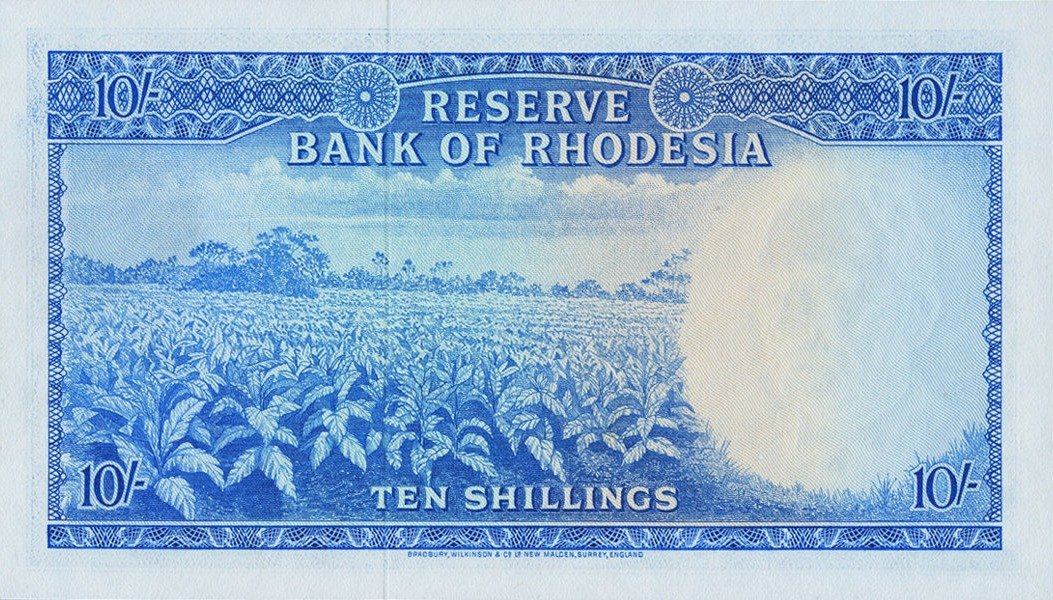
The three notes, printed by Bradbury Wilkinson, are the 10 shillings of 1964, the 1 pound of 1964 and the 5 pounds of 1964. Sources mention the Annigoni portrait of the Queen on all three. The last date of the 1964 printings of each value is 16th November 1964, the day of issue.
The Reserve Bank's first published statement, for 2nd July 1965, shows 12,683,242 pounds of its notes in circulation. The notes of the Bank of Rhodesia and Nyasaland had ceased to be legal tender a month before, on 1st June 1965; the figures of that withdrawal are in The Bank of Rhodesia and Nyasaland and its notes, 1956 to 1965.
The order of October 1965 and the London board
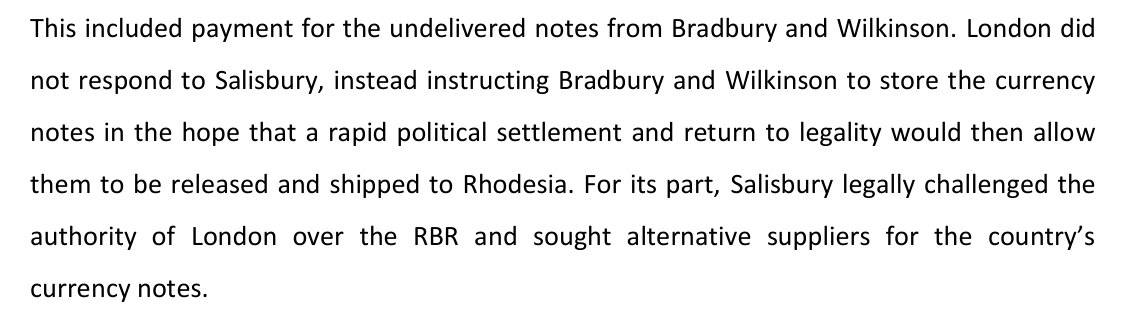
In October 1965 the Salisbury board of the bank ordered a further 20 million pounds' worth of notes from Bradbury Wilkinson: 8 million of 10 shillings, 11 million of 1 pound and 1 million of 5 pounds, for delivery in 1966. Rhodesia declared independence on 11 November 1965.
On 3 December, by the Reserve Bank of Rhodesia Order 1965, the British government suspended the Salisbury board and appointed one in London under Sir Sydney Caine. Hansard for 14 December 1965 (House of Commons, vol. 722) records the six members as Sir Sydney Caine, Lord Harcourt, Lord Poole, Mr. Warburg, Sir Norman Kipping and Sir Gordon Munro. Munro's signature as Chairman is on the Southern Rhodesia Currency Board's notes of 1950 to 1952, the 10 shillings, 1 pound and 5 pounds of King George VI.
The Order left the issue of notes inside Rhodesia to the bank's officers in Salisbury, the Chief Secretary to the Treasury told the House of Commons on 14th December 1965. In Hansard's report of that debate the Chief Secretary, Mr. Diamond, lists the issue of bank notes in Rhodesia among the day-to-day internal affairs that the chief cashier and the other officers would go on conducting from Salisbury. In Salisbury the Reserve Bank of Rhodesia Amendment Act 1966 (No. 28 of 1966) answered the Order: it made it an offence, inside or outside Rhodesia, to act as a director of the Bank without appointment under the Act.
The London board let the printer finish the order in May 1966. The Salisbury board refused to pay, and the British government refused an export licence. Tinashe Nyamunda, in Financing Rebellion (pp. 107-108), writes from the Bank of England's Rhodesia files that the London board told the printer to hold the notes in the hope of an early settlement, and in August 1966 paid Bradbury Wilkinson's bill of 64,337 pounds out of the Reserve Bank's funds frozen in London. Steve Milner (I.B.N.S. Journal, vol. 52 no. 2, 2013), from the same papers, puts the payment in July 1966. In 1967 the notes went into store at the Bank of England. They were burned at its Debden printing works from 18th to 26th June 1973.
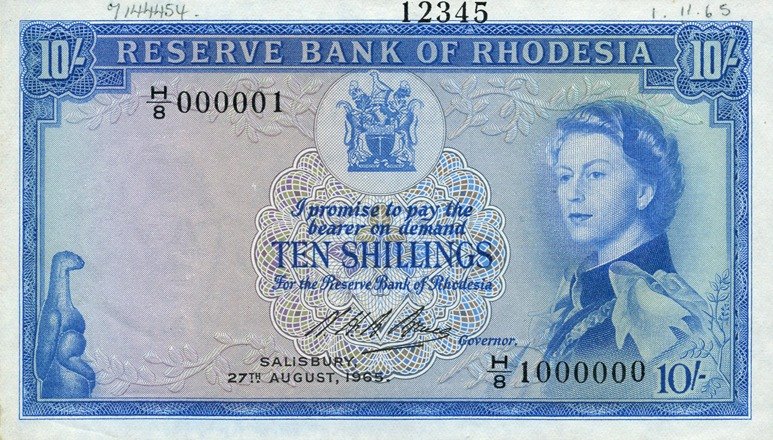
The dates on these notes were set afterwards. On 3rd December 1965 the Salisbury board told the printer to date them from 27th August, with the last date moved back to 1st December. That is why some dates fall before the order of October 1965. What the Pick pages record of this printing is a set of range specimens, listed on the pages of the 10 shillings and the 1 pound; no 5 pounds of 1965 is recorded.
The German order, 1966 to 1969
A new series was ordered on 7 April 1966 from Giesecke and Devrient in Germany. Nyamunda (pp. 119 and 138) writes from the Bank of England's Rhodesia files that the order was for notes with a face value of 29 million pounds.
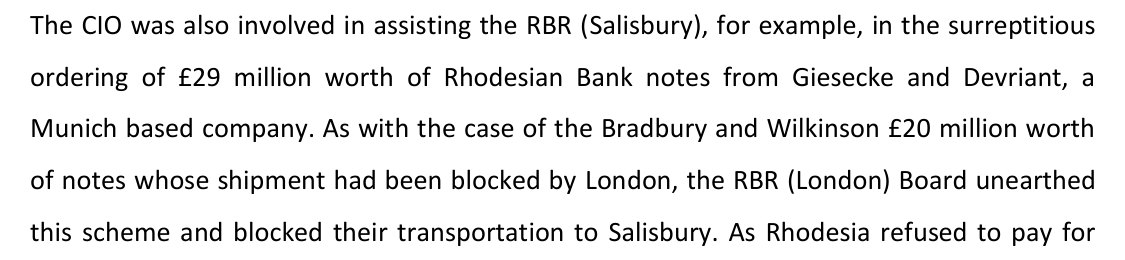
The London board went to law in Germany. On the Pick pages the German courts declined to uphold a seizure and injunction, and the order was stopped by an out-of-court settlement of 6 March 1967. The House of Commons heard the matter on 18th April 1967 (Hansard, vol. 745):
- The Solicitor-General, Sir Dingle Foot, said that the London board paid DM 3 million (275,000 pounds) for the settlement, out of the bank's funds and not public money.
- A member, Mr. Biggs-Davison, said that the injunction, obtained shortly before Christmas 1966, stopped 28 tons of these notes from being flown to Salisbury, and that they were signed by a Mr. Bruce as Governor of the Reserve Bank. In Hansard's report the same member says that the civil court at Frankfurt ruled on 27 January that the export of the notes could be permitted.
A written answer of 21 April 1967 (Hansard, vol. 745 c. 177W) gives the Government's account of the same events. It says that on 27 January 1967 the German court recognised Sir Sydney Caine and the other directors as the sole legitimate representative of the Reserve Bank, that the printers accepted the Bank's terms on 6 March 1967, and that the proceedings were withdrawn with each side bearing its own costs. The two accounts of 27 January are not the same, and the Pick pages do not settle which court decided what.
On what the DM 3 million paid for, the sources also differ in their words. The written answer says it covered the printers' expenses and losses on the transaction. Steve Milner (I.B.N.S. Journal, vol. 52 no. 2, 2013) and Nyamunda (p. 139) say it covered the printer's charge for storing the notes, DM 6,000 a quarter. Milner and Nyamunda give the undertaking: Giesecke and Devrient were to print no notes for Rhodesia for two and a half years unless there was a political settlement, and the printing material was to be destroyed by mutual consent after two years. The written answer gives the same term of two and a half years.
A Bank of England file on the German notes, cited by Nyamunda (p. 179), shows that they lay from 1967 in the vaults of the Bayerische Hypotheken- und Wechsel-Bank. The written answer of 21 April 1967 says the notes, the unfinished notes, the paper and the plates were deposited in the vaults of a German bank in the joint names of the parties.
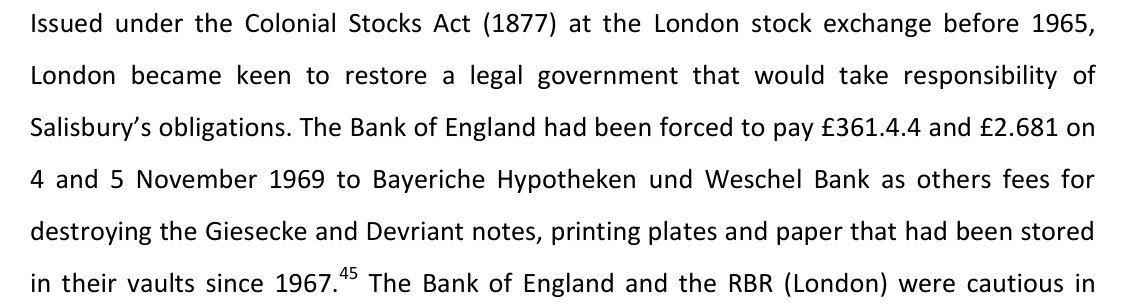
The end came in September 1969. The notes were burned at the Bundesbank in Frankfurt. The printing plates and the unused paper were destroyed as well, the plates at the printer's works and the paper at a Munich power station (Milner). The Bank of England paid the costs of the destruction in November 1969 (Nyamunda, p. 179).
What had been printed is known from the numbering. Of the 10 shillings 8,675,000 were finished, L/1 000,001 to L/9 675,000. Of the 1 pound 5,000,000 were finished, K/1 000,001 to K/5 1,000,000, and 7,140,000 more partly printed, with K/6 to K/16 for the rest. J/1 and J/2 were kept for 5 pounds never begun. Sources mention 100 specimens of the German 10 shillings sent to Salisbury on 29 November 1966; none has been identified in this catalogue.
Salisbury, 1966 to 1968
Unable to buy notes abroad, the Reserve Bank printed its notes in its own works in Salisbury, which became Fidelity Printers on 18 December 1978. The notes have no imprint.
Two accounts of how the works came about are on the Pick pages, each the statement of its source:
- Spink's description of lot 2110 in its sale of 26 April 2017 says the notes were printed in secret in the basement of the old Reserve Bank building, on second-hand presses bought from Germany.
- Ken Flower, head of Rhodesia's Central Intelligence Organisation in those years, wrote in Serving Secretly (1987, p. 72, quoted by Nyamunda, p. 128) that West Germans arranged for a printing press to be flown in aboard a disguised Rhodesian Air Force aircraft so that the notes could be printed in Rhodesia.
Heritage's description of lot 22313 in its sale of 8 December 2023 says that Fidelity Printers opened inside the Reserve Bank at that time; on the Pick pages the name Fidelity Printers dates only from 1978.
The Salisbury notes carry dates of 1966 to 1968 but came out later than their first dates:
| Note | First date on the note | Introduced |
|---|---|---|
| 10 shillings of 1966 and 1968 | 1st June 1966 | 11 September 1967 |
| 1 pound of 1966 to 1968 | 15th June 1966 | 19 July 1967 |
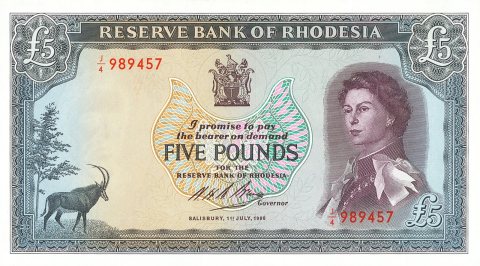
| 5 pounds of 1966 | 1st July 1966 | 10 November 1967 |
They circulated beside the 1964 notes. Their prefixes begin at L/10, K/17 and J/3, because the lower ones had been allotted to the German order.
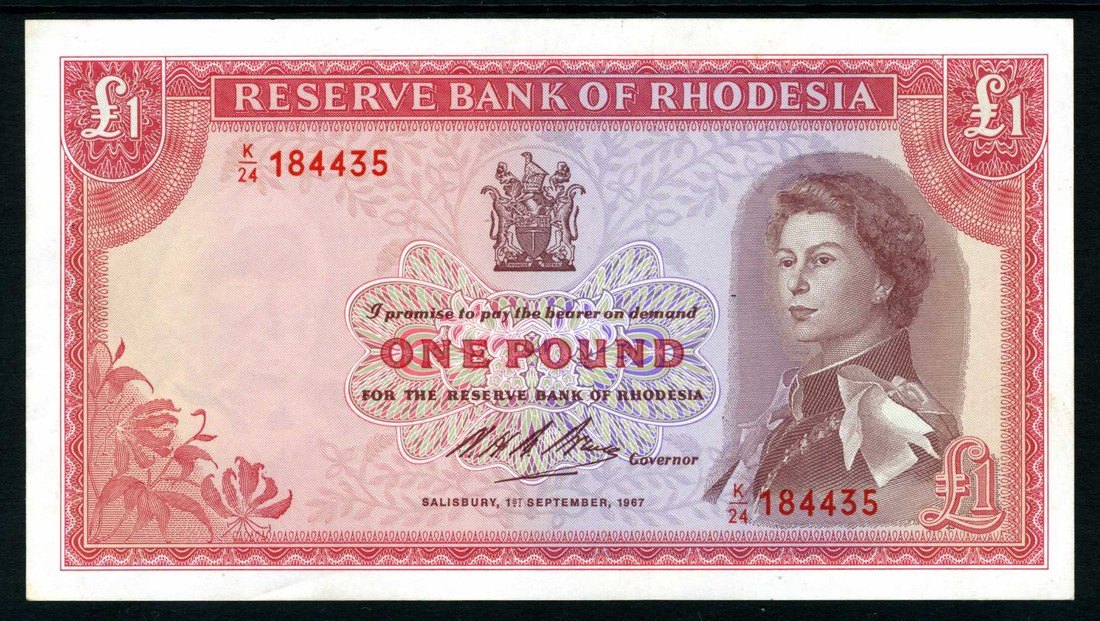
No figures of notes in circulation were published for these notes. The Minister of Finance suspended the publication of the Reserve Bank's statements from 3rd August 1966 to 30th June 1970.
Decimal day and after
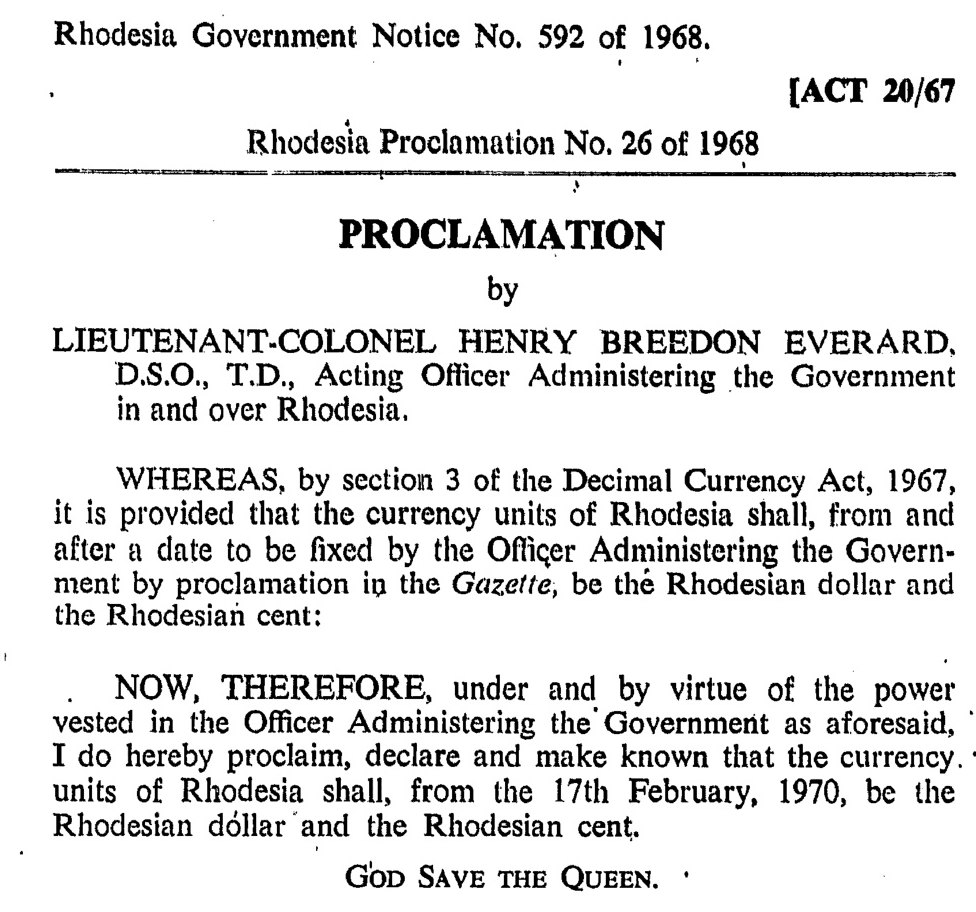
Under section 12 of the Act the pound notes were legal tender until called in by a notice in the Gazette. Decimal day was 17th February 1970 (Proclamation No. 26 of 1968), when 10 shillings became 1 dollar and 1 pound became 2 dollars (Decimal Currency Act 1967, section 4). The Gazette prints no notice calling in the pound notes up to the end of 1973. When the pound notes ceased to be legal tender is not stated on the Pick pages.
Sources
- Reserve Bank of Rhodesia Act 1964 (No. 24 of 1964), sections 11, 12 and 13; Reserve Bank of Rhodesia Amendment Act 1966 (No. 28 of 1966).
- Southern Rhodesia Notice No. 799 of 1964; Southern Rhodesia Proclamation No. 41 of 1964; Rhodesia Notice No. 812 of 1965 (Gazette of 4th June 1965); Rhodesia Notice No. 817 of 1971.
- Proclamation No. 26 of 1968; Decimal Currency Act 1967, section 4.
- The statements of the Bank of Rhodesia and Nyasaland and of the Reserve Bank of Rhodesia in the Government Gazette, to 2nd July 1965.
- Reserve Bank of Rhodesia Order 1965, made 3rd December 1965.
- House of Commons debates, 14 December 1965, vol. 722 cc. 1151-208, and 18 April 1967, vol. 745 cc. 441-90; written answer of 21 April 1967, vol. 745 c. 177W (historic Hansard, api.parliament.uk).
- Tinashe Nyamunda, Financing Rebellion, thesis, University of the Free State, 2015, pp. 77, 79, 107-108, 119, 128, 138, 139 and 179.
- Steve Milner, I.B.N.S. Journal, vol. 52 no. 2, 2013.
- Ken Flower, Serving Secretly, 1987, p. 72, as quoted by Nyamunda, p. 128.
- House descriptions: Spink, 26 April 2017, lot 2110; Heritage, 17 August 2018, lots 28201 and 28202; Heritage, 8 December 2023, lot 22313; Spink, 7 November 2024, lot 686.
Member comments
Log in or register to post a comment.