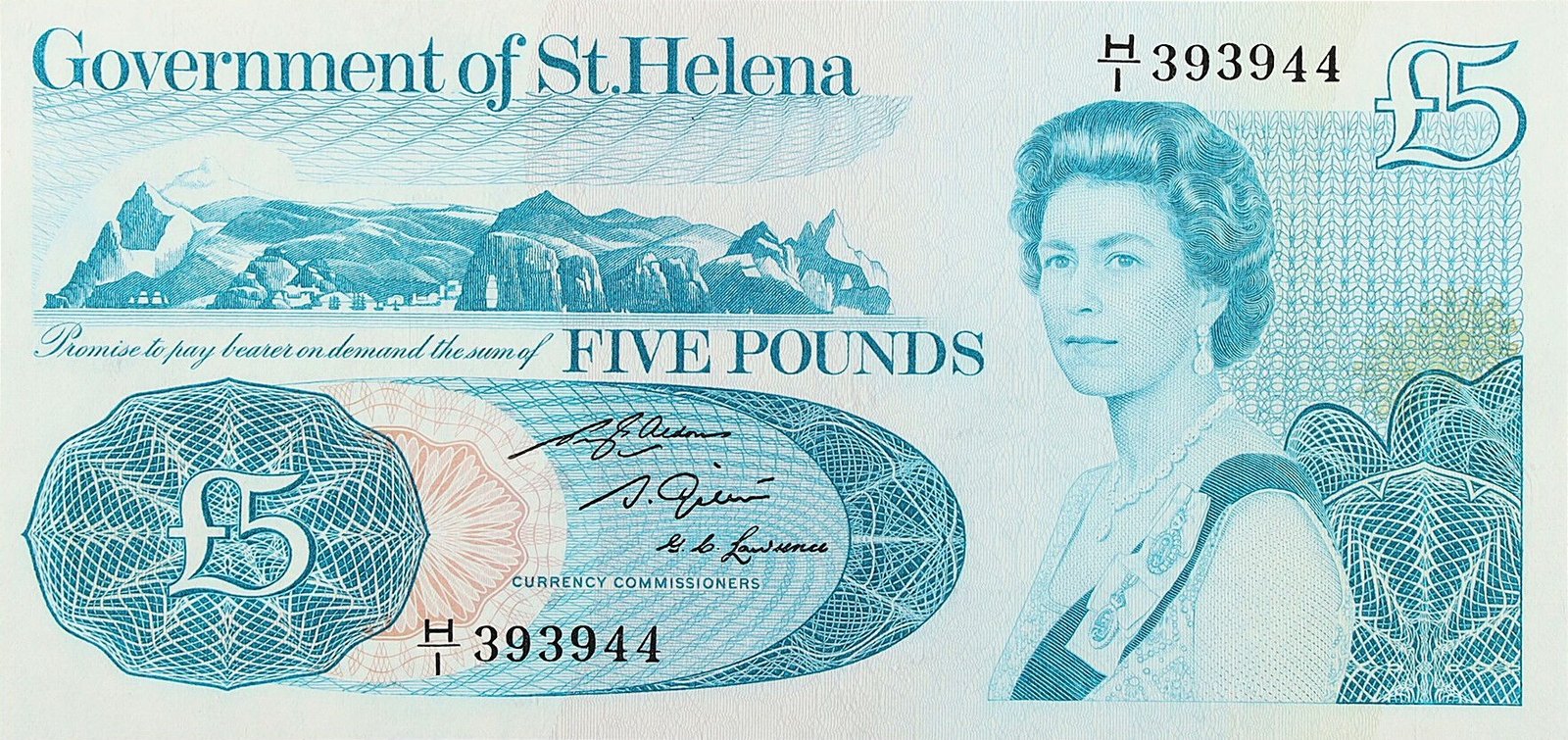
This article tells the story of the notes of Saint Helena in order of time, from the first 1 pound and 5 pounds of 2 February 1976 to the polymer notes of January 2026. It is written from the catalogue's pages, from the Currency Ordinance, 1975, from three articles in the I.B.N.S. Journal of 1976, 1978 and 1980, from the Currency Fund accounts, and from what auction houses wrote about their lots. What the island used for money before 1976 is told in Money on St Helena before its own notes; the law and the accounts are set out in The Currency Ordinance, 1975, and the Currency Fund.
The Ordinance of 1975 and the Commissioners
The notes are issued under the Currency Ordinance, 1975 (No. 7 of 1975), by three or four Commissioners of Currency, holders of public offices named by the Governor. The consolidated text of the Ordinance on the St Helena Government's website gives three days for its coming into force: 19 December 1975, 2 February 1976 and 1 October 1976. Section 5 says there are to be "not less than 3 and not more than 4" Commissioners and that any two of them acting together may use the Commissioners' powers. Section 6 gives the Commissioners, on behalf of the Government of St Helena, the sole right to issue notes and coins, and says that the values, form and design of the notes are those specified by a Proclamation of the Governor made with the approval of the Secretary of State.
The numbers three and four can be read on the notes. The catalogue's pages give three signers for the notes of 1976 to 1985, and four for the 5 pounds of 1998 and the notes of 2004, 2012 and 2026.
They were the island's first notes of its own in modern times. Under the Currency, Coinage and Legal Tender Ordinance (No. 5 of 1948, as amended in 1949) the island's currency was Bank of England notes and United Kingdom coin, and the annual reports on St Helena for 1961 to 1973 call these the only currency in circulation. Section 21 of the Ordinance of 1975 kept Bank of England notes and United Kingdom coin as legal tender on the island beside the new notes.
The 1 pound and 5 pounds of 2 February 1976
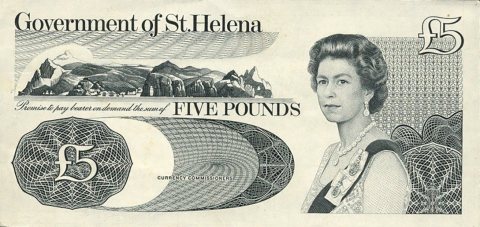
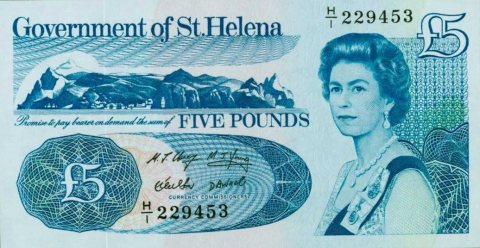
The 1 pound of 1976 and the 5 pounds of 1976 to 1981 were issued on 2 February 1976. Dr David Rogers, in "Island of Saint Helena" in I.B.N.S. Journal volume 15 number 3 (1976), page 140, gives the same day for the regular issue and names the first Commissioners of Currency with their offices: C. B. Kendall as Government Secretary, P. L. Aldous as Treasurer and G. C. Lawrence as Assistant Government Secretary. These three sign the 1 pound of 1976 and the first 5 pounds, P-7a. Jerry Remick, in I.B.N.S. Journal volume 17 number 2 (1978), page 96, calls P. L. Aldous the Colonial Treasurer.
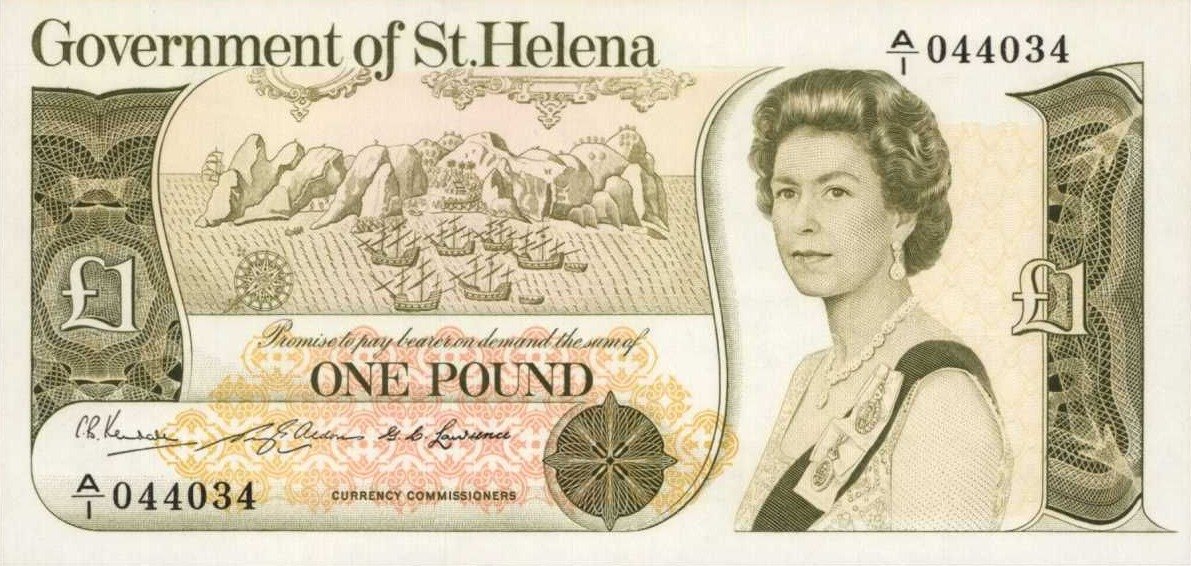
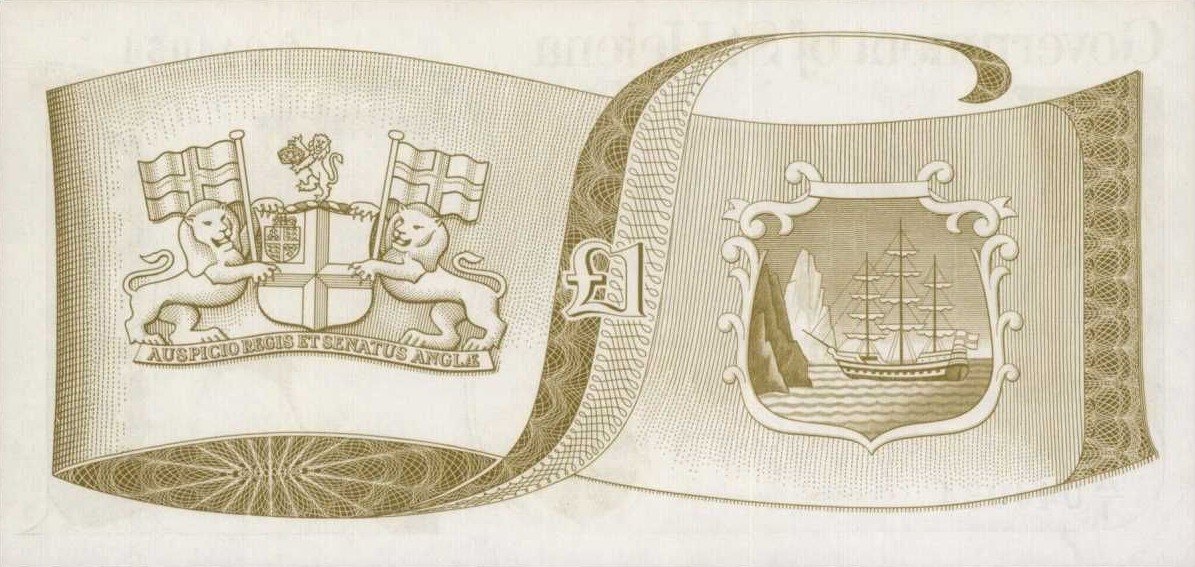
Both notes were printed by Bradbury Wilkinson and Company and measure 151 x 73 mm. The 1 pound has the prefix A/1 and the 5 pounds the prefix H/1. Spink's descriptions of the proofs it sold on 15 July 2014 (lots 1064 and 1065) give the design: the Queen at right and a view of the island at left, and on the back the arms at left and a ship in a shield at right. Peter Symes, in "The Portraits of Queen Elizabeth II" in I.B.N.S. Journal volume 44 number 2 (2005), gives the portrait as taken by Anthony Buckley about 1966, and says it was used first by Bradbury Wilkinson and later by De La Rue on the notes numbered 5 to 10 in the Standard Catalog.
Rogers gives the numbering of the first printing for both values. Numbers 001001 to 002000 were specimens issued on the island, about 8 March 1976. The notes in use on the island ran from 002001 onwards. The numbers below 1,000 were held back and, Rogers wrote, might be issued later. Sets with such numbers have since been sold: Spink's sale of 26 April 2017, lot 2146, was a set of the 50 pence, 1 pound, 5 pounds and 10 pounds that all carry the number 000030, and Stack's Bowers sold a set with the number 000057 on 10 January 2014 as lot 3456.
Rogers also wrote about the notes as they came from the Treasury. Barely one note in four was in perfect condition when issued, with ink smudges and faults in the serial number. Much of the paper after number 5,000 was so thin that the printing of one side showed on the other. The printed sentence that follows is broken up in the journal, but it reads that over 30,000 notes of each value were issued in the first two months. A set of stamps showing the two notes was to follow two or three months after them.
Remick's article of 1978 says the notes were also used on Ascension Island and Tristan da Cunha. Remick's article of 1980 (I.B.N.S. Journal volume 19 number 1, page 15) puts it differently: St Helena's notes were legal tender on Ascension Island, and British banknotes were legal tender on Tristan da Cunha. The proclamation of 2026 names St Helena and Ascension only.
The misspelt motto, 1976 to 1981
The Latin motto on the ribbon under the arms on the back ends ANGLÆ on the 1 pound of 1976 and on the first 5 pounds. The word should be ANGLIÆ.
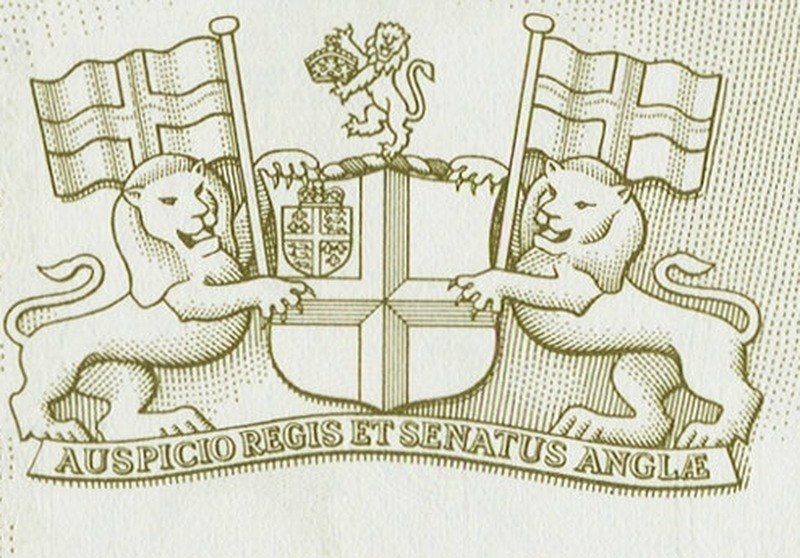
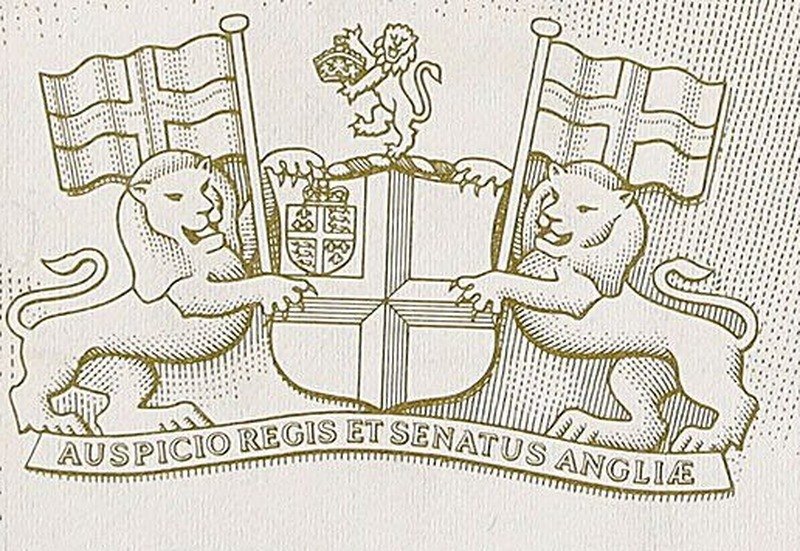
Remick's article of 1980, "St. Helena's 'Anglae' Errors", is the nearest account in time. It says that the word would appear in its correct form on a new 1 pound note then being prepared, that the new note would be a quarter of an inch smaller each way, that no other change would be made, and that no day of issue could be given except that the note was not expected before 1980. The 1 pound then in use would stay in circulation until it wore out. Of the 5 pounds the article says: "There are no plans at present for a new version of the £5 note."
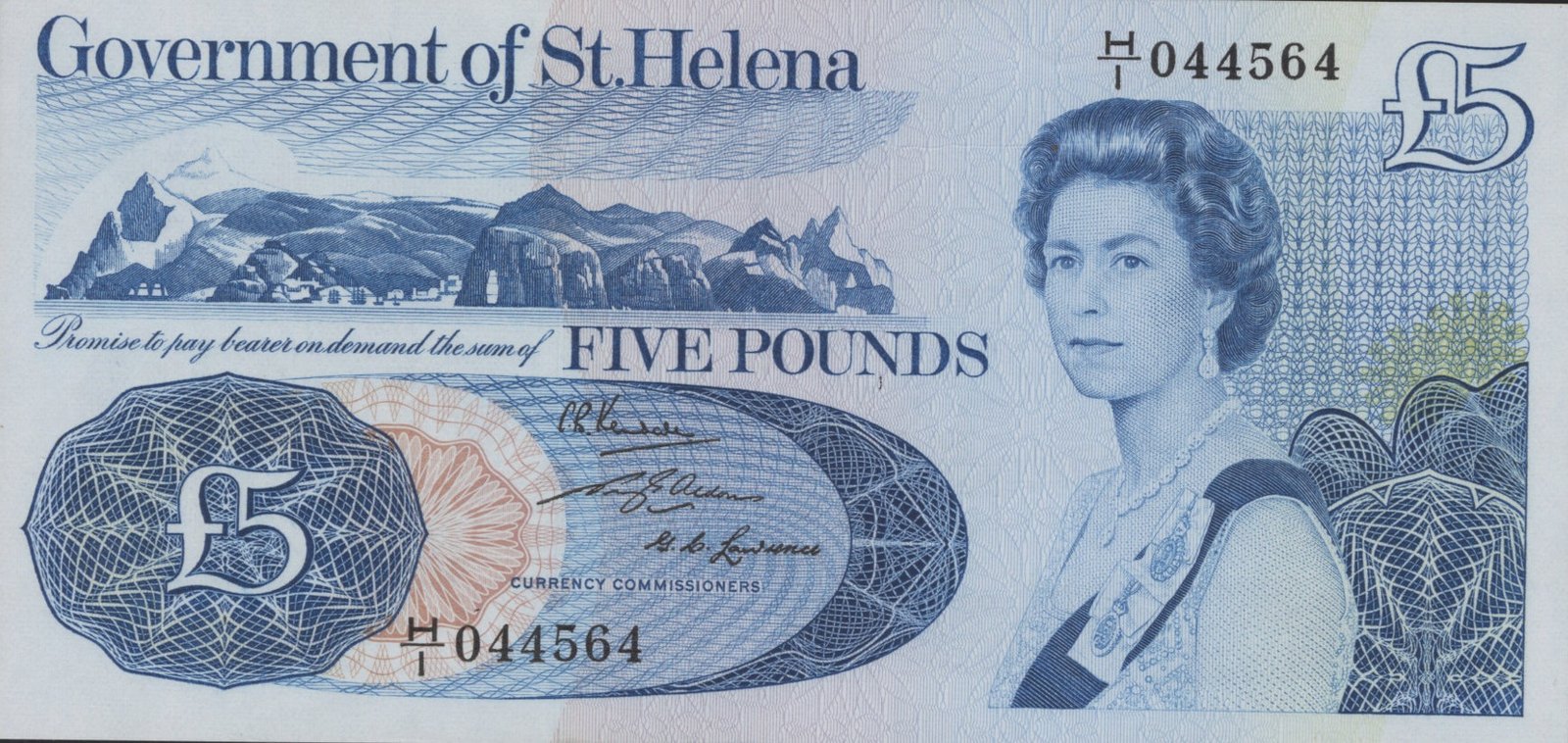
A corrected 5 pounds came all the same. The catalogue dates both the smaller 1 pound with the corrected motto and the corrected 5 pounds, P-7b, ND (1981). Spink's sale of 15 July 2014, lot 1065, held two of the printer's photographic proofs of the 5 pounds back with the corrected spelling, which Spink dated 1979. Spink's description of lot 366 in its sale of 28 April 2015 says the error was "quickly replaced". By the catalogue's dates the misspelt notes of 1976 were not replaced until 1981.
The two corrections are numbered differently in the Standard Catalog: the corrected 1 pound has a number of its own (9), the corrected 5 pounds only a new letter (7b). A writer in I.B.N.S. Journal volume 31 number 2 pointed to this as an example of uneven numbering. The 1 pound did also change its size.
The 50 pence and 10 pounds of 29 January 1979
Remick's article of 1978 reports the Colonial Treasurer, P. L. Aldous, as saying that the first 50 pence and 10 pounds would be issued late in 1978 or early in 1979. The article adds that both notes had already been listed in the Pick catalogue, which confused collectors who could not obtain them, and puts the slow issue down to the mail: no aircraft could land and a boat called once a month.
Remick's article of 1980 gives the day: the 50 pence and the 10 pounds of 1979 to 1985 were issued on 29 January 1979, both with the motto spelt correctly. The article calls the 50 pence considerably smaller than the 1 pound, and the 10 pounds somewhat larger than the 1 pound and 5 pounds. The catalogue gives 142 x 59 mm and the prefix V/1 for the 50 pence, and 157 x 79 mm and the prefix P/1 for the 10 pounds. Spink's description of lot 366 in its sale of 28 April 2015 says 200,000 of the 50 pence were issued.
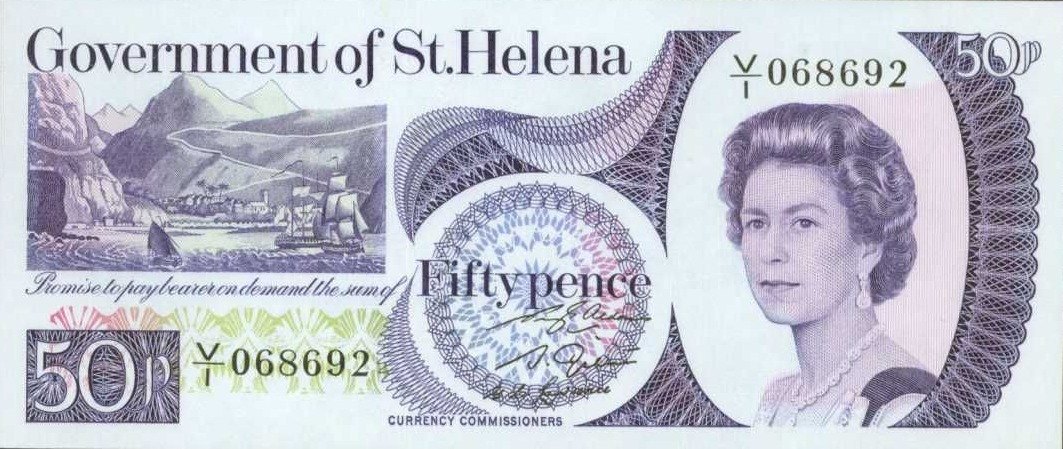
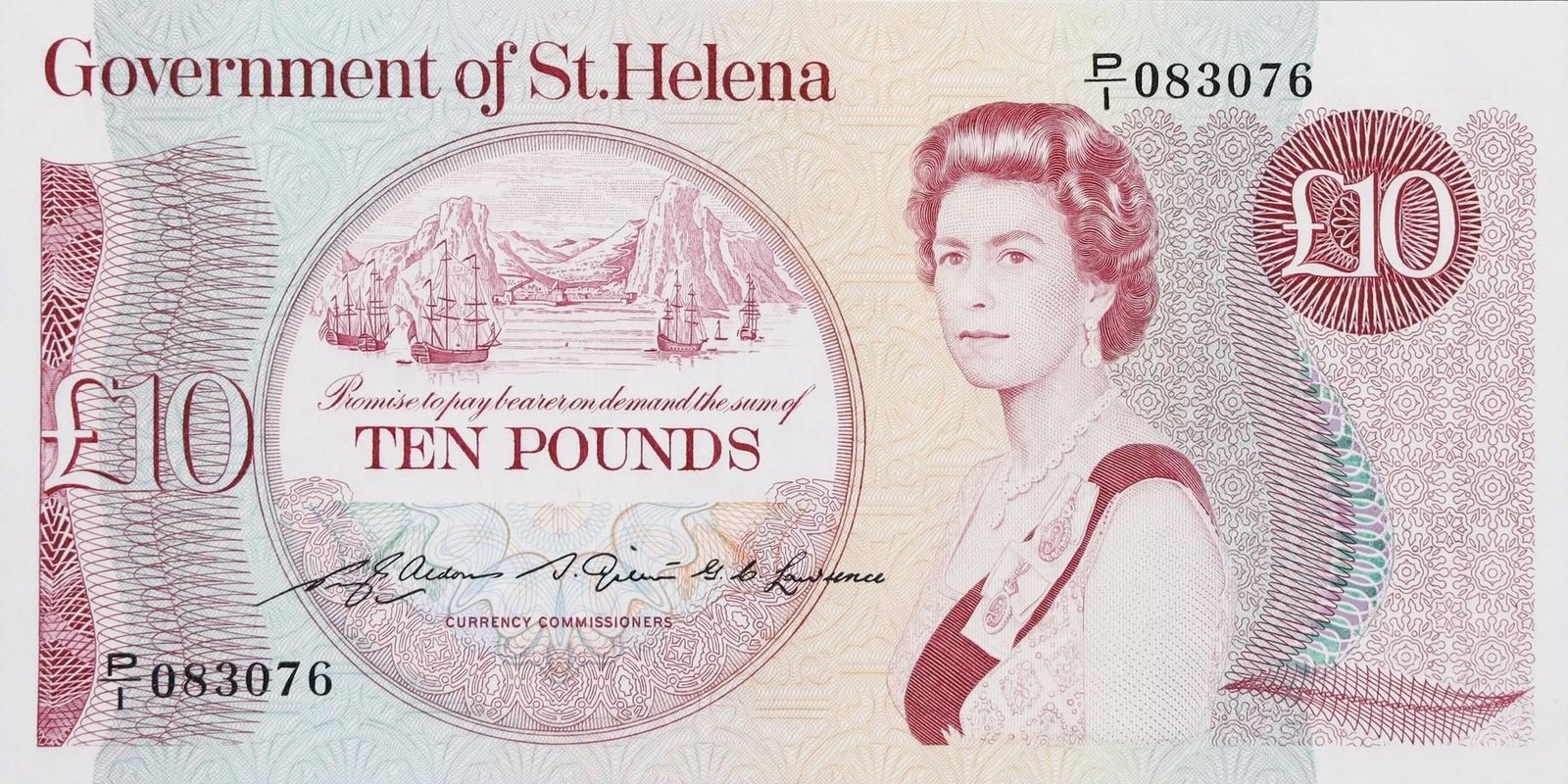
The 10 pounds of 1979 is signed by Aldous, Gillett and Lawrence. Its first approval specimen, of 1978, was printed in error with the signatures of 1976 and the prefix A/1; that story is in The approval proofs and specimens of St Helena's notes.
1981 to 1998: new signers, a 20 pounds and a small 5 pounds
The 1 pound of 1981 measures 144 x 66 mm against 151 x 73 mm and is signed by Aldous, Gillett and Lawrence, as is the corrected 5 pounds. The 10 pounds came again in 1985 with the signatures of Ferguson, Saltwell and Green (P-8b); the catalogue's page records that the approval specimen with these signatures was approved in January 1985.
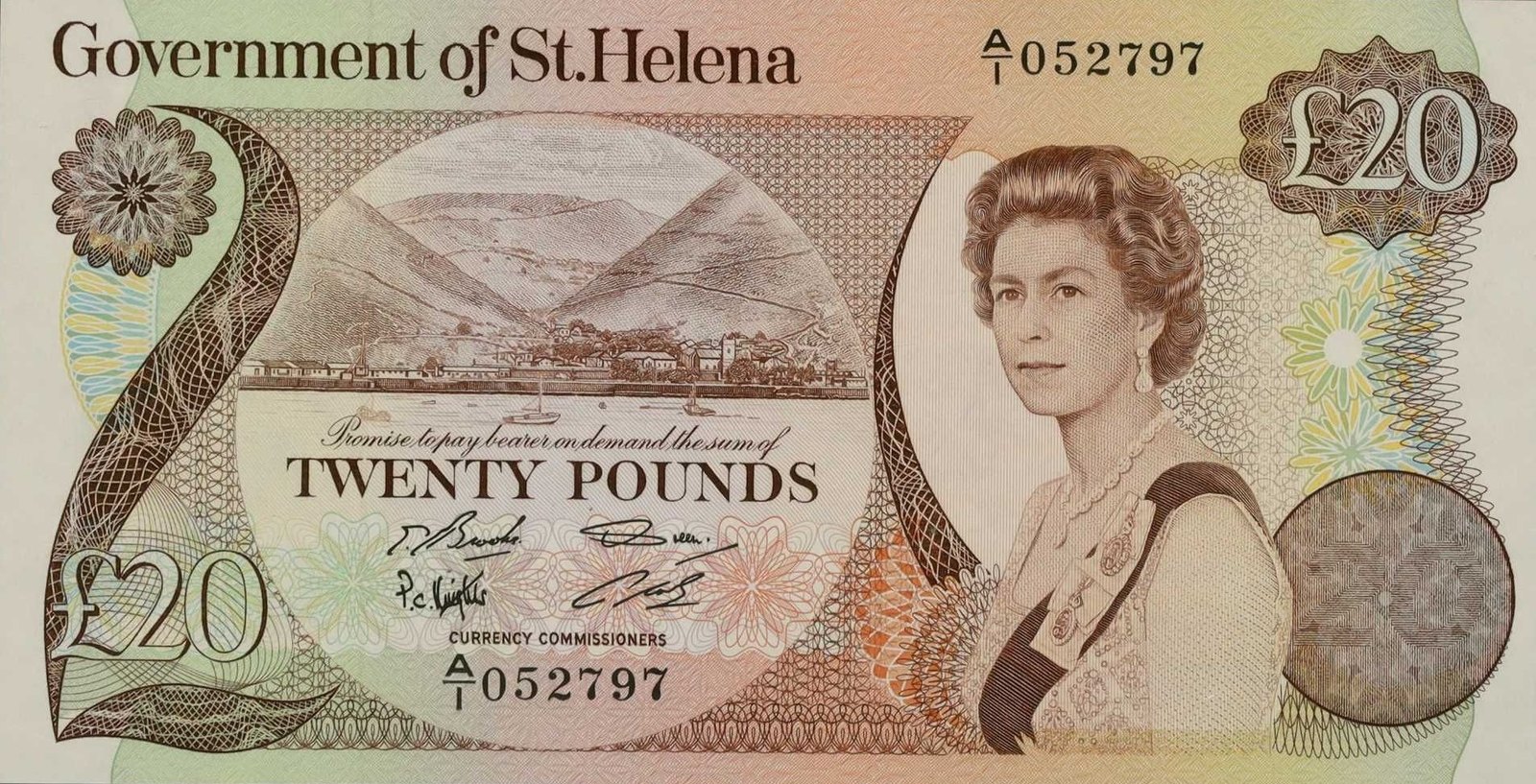
The 20 pounds of 1986 is the first of the island's notes for which the catalogue names De La Rue as the printer. It measures 164 x 84 mm and has the prefix A/1. Stack's Bowers' description of a specimen proof it sold on 16 August 2021, lot 30449, says the piece has the date 16 July 1986 written on it in pen. Corné Akkermans Auctions, describing a specimen as lot 864 on 21 September 2017, read the signatures as Brooks, Green, Knights and Clarke.
The 5 pounds of 1998 repeats the design, colours and prefix H/1 of the 5 pounds of 1976 on a smaller note, 134 x 70 mm, with four signatures in two rows and the corrected motto. Akkermans, describing a specimen as lot 865 in the same sale, read the signatures as Clancy, Young, Yon and Wade. The houses do not agree on the date of this note. Spink (28 April 2015, lot 370) and Akkermans give 1998, as the catalogue does. Stack's Bowers (21 April 2024, lot 33237) and Spink (29 July 2025, lot 748) give 1988. Noonans, selling a Bradbury Wilkinson print of the portrait on 26 February 2020 as lot 916, wrote that the portrait was used on the notes of St Helena from 1976 to 1998.
The dated notes of 2004 and 2012
The 10 pounds of 2004 and 2012 and the 20 pounds of 2004 and 2012 are the first of the island's notes that the catalogue dates by a year printed on the back, and each of the four signatures has the Commissioner's name printed beside it. Both measure 135 x 70 mm and were printed by De La Rue. The notes of 2004 are signed by Styles, Clemett, Yon and Wade, those of 2012 by Wells, Blessington, Kilner and Francis. The prefix does not tell the two years apart: P/1 on every 10 pounds and A/1 on every 20 pounds.
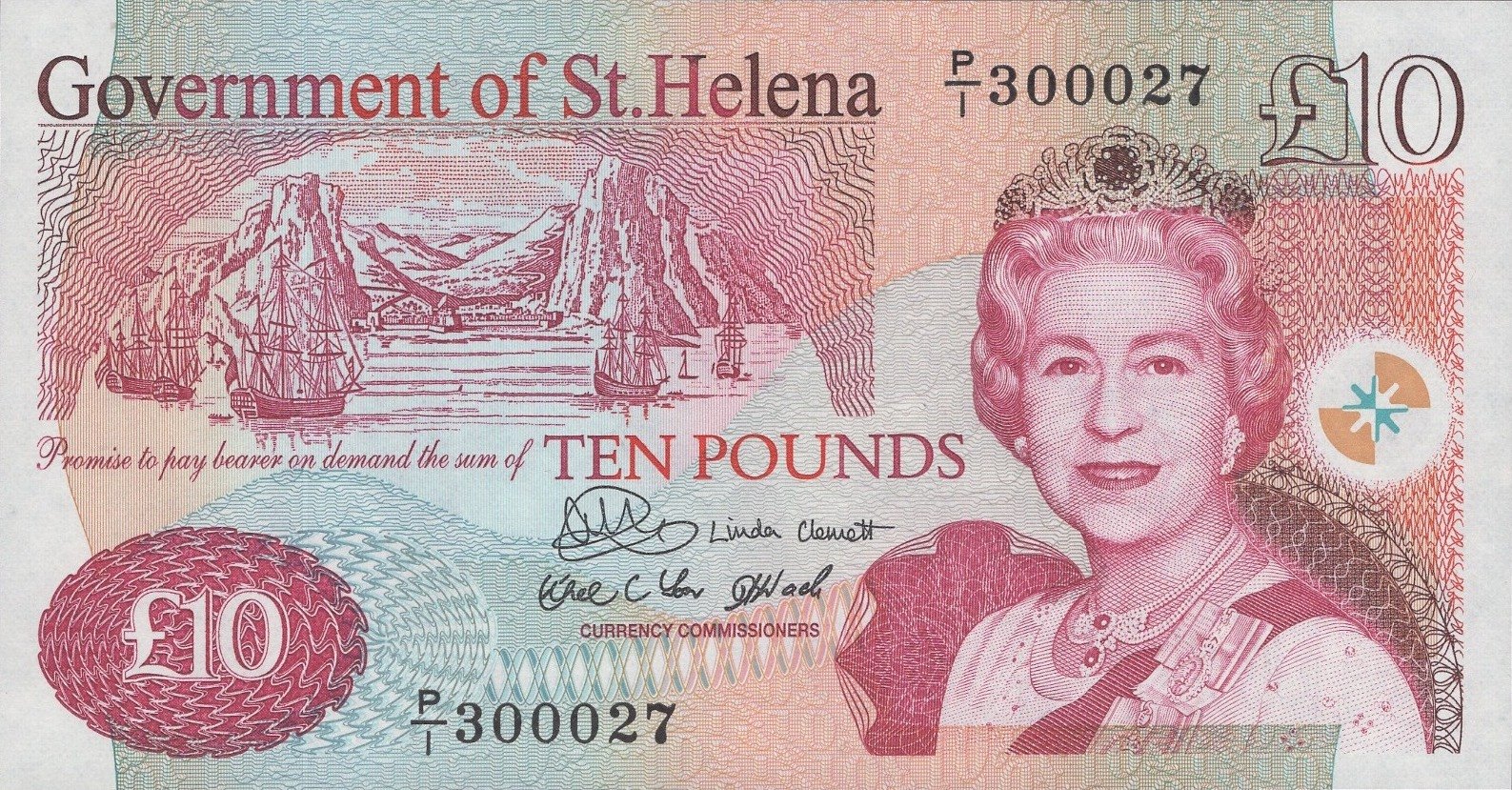
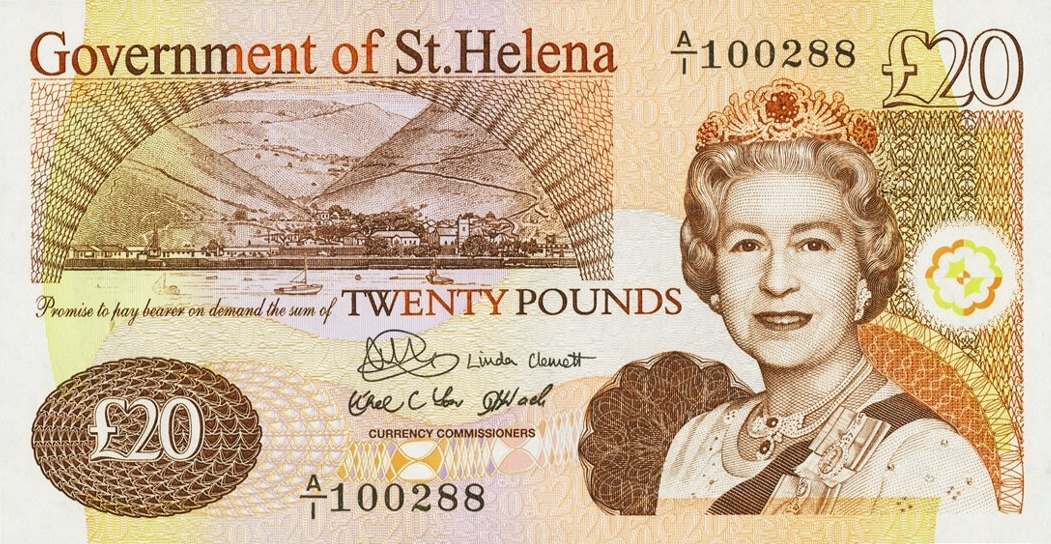
The Currency Fund accounts for 2011-12 record the printing of new notes dated 2012, paid for in two halves in 2010-11 and 2011-12. A note to those accounts calls the printing a one-off that should meet the island's need for cash for the foreseeable future. The accounts for 2012-13 say no notes were printed that year, and the later accounts read, up to 2020-21, show no new order for notes.
Two statements about the numbering come from outside the catalogue. Heritage Auctions, in its description of lot 88134 in its sale of 19 April 2022, wrote that it had been told the serial range of the 20 pounds of 2004 starts at 100000. And the chapter news in I.B.N.S. Journal volume 63 number 1 (2024) reports that Simon Biddlestone showed the East Midlands Chapter, at its meeting of November 2023, a current 20 pounds with a replacement prefix Z/1, "previously unseen and unrecorded", numbered 000014. The catalogue lists this replacement note of 2012.
The polymer notes of 2026
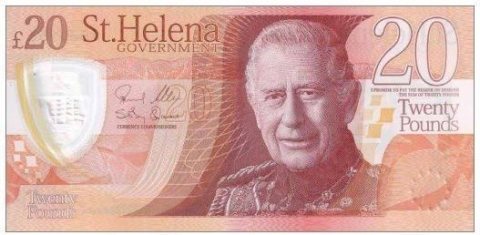
The 5 pounds, 10 pounds and 20 pounds with the portrait of King Charles III were proclaimed in Legal Notice No. 2 of 2026, dated 15th January 2026, and the Government announced on 22nd January 2026 that they had entered circulation. They are the island's first polymer notes, printed by De La Rue. Their story is in St Helena's polymer notes of January 2026.
The end of the small notes, and what is not known
Two bands of numbers are marked on the catalogue's pages as declared non-redeemable, one on the page of the 50 pence and one on the page of the 1 pound of 1981; the numbers are given there. The pages do not name the notice that declared them or give the reason. Section 11 of the Ordinance says that no one is entitled to recover from the Commissioners the value of a lost, stolen, mutilated or imperfect note; whether the two bands were declared under that section is not stated in anything read for this article.
When the 50 pence and the 1 pound notes stopped being issued is not in these sources either. The Currency Fund accounts for 2011-12 to 2020-21 list notes of 20, 10 and 5 pounds in circulation and no others, and do not say when the two small values ceased to be counted. Section 10 of the Ordinance lets the Governor declare by notice in the Gazette that notes cease to be legal tender, and lets their holders claim the value at any time afterwards. No such notice was found for any note of the island.
For the paper notes still in use, the St Helena Government's press release of 12 January 2026 says that the existing notes remain legal tender and circulate beside the new ones, and that older, damaged notes are withdrawn as the Bank of St Helena receives them.
Sources
- The catalogue's pages for the twelve notes of Saint Helena.
- Currency Ordinance, 1975 (Ordinance 7 of 1975), consolidated text of 7 July 2025 in the St Helena Revised Edition of the Laws, 2017, on the St Helena Government's website.
- Colonial annual reports on St Helena for 1949 and for 1960-61 to 1970-73 (the law of 1948 and 1949 and the currency in circulation).
- Dr David Rogers, "Island of Saint Helena", I.B.N.S. Journal volume 15 number 3 (1976), pages 140 to 141.
- Jerry Remick, "First 50 pence and 10 pound banknotes for St. Helena to be issued soon", I.B.N.S. Journal volume 17 number 2 (1978), page 96.
- Jerry Remick, "St. Helena's 'Anglae' Errors", I.B.N.S. Journal volume 19 number 1 (1980), page 15.
- I.B.N.S. Journal volume 31 number 2 (on the numbering of the corrected notes).
- Peter Symes, "The Portraits of Queen Elizabeth II", I.B.N.S. Journal volume 44 number 2 (2005), portrait 15a.
- I.B.N.S. Journal volume 63 number 1 (2024), chapter news, East Midlands Chapter, meeting of November 2023.
- St Helena Currency Fund accounts for 2011-12 and 2012-13, and the financial statements to 2020-21.
- St Helena Government press release of 12 January 2026.
- Spink, 15 July 2014, lots 1064 and 1065; 28 April 2015, lots 366 and 370; 26 April 2017, lot 2146; 29 July 2025, lot 748.
- Stack's Bowers, 10 January 2014, lot 3456; 16 August 2021, lot 30449; 21 April 2024, lot 33237.
- Corné Akkermans Auctions, 21 September 2017, lots 864 and 865.
- Heritage Auctions, 19 April 2022, lot 88134.
- Noonans, 26 February 2020, lot 916.
Member comments
Log in or register to post a comment.