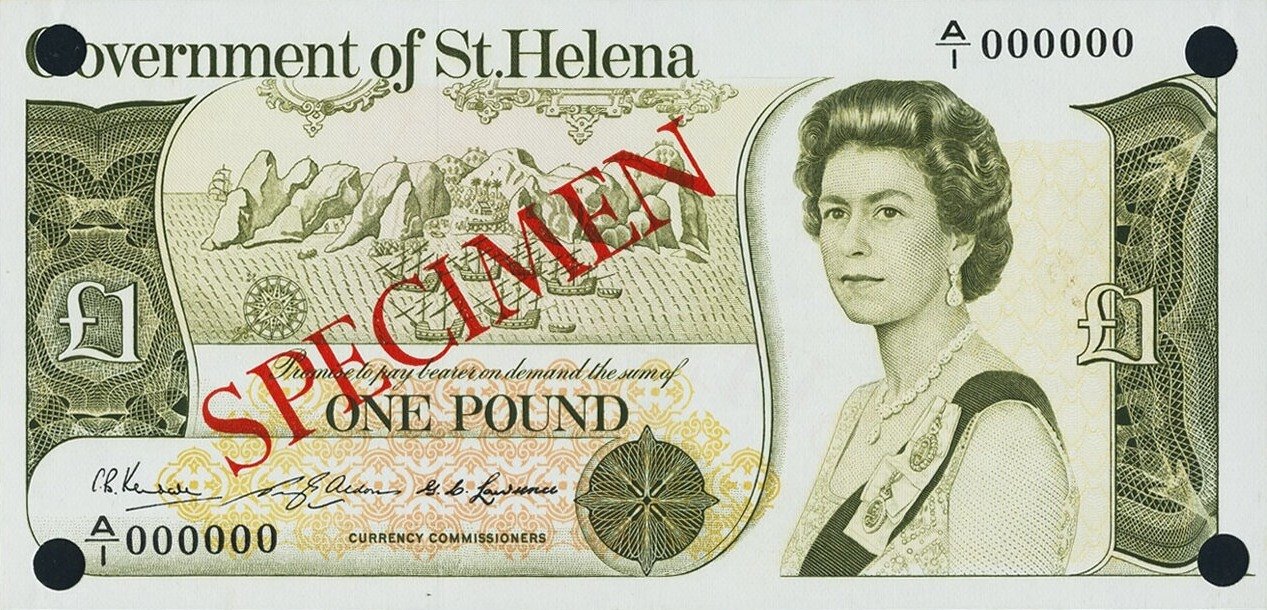
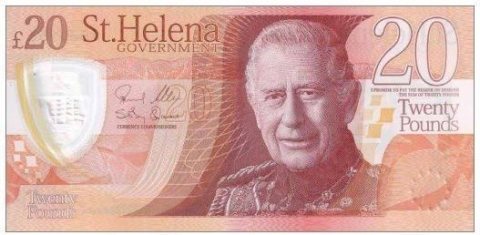
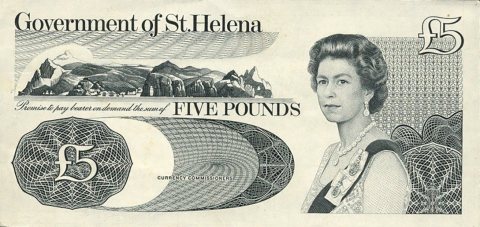
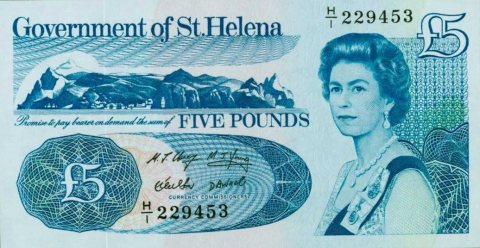
The modern notes of Saint Helena begin on 2 February 1976 with the 1 pound and the 5 pounds. This article gathers what printed sources say about the money of the island before that day: a small issue of hand-signed notes in the eighteenth century, and then, for as long as the colonial annual reports run, no island note at all. It is written from Chalmers' History of Currency in the British Colonies (1893), from the annual reports on St Helena for 1898 to 1973, and from three articles in the I.B.N.S. Journal. The notes of 1976 and after are in The notes of the Government of St. Helena, 1976 to 2026.
The cash notes of 1717
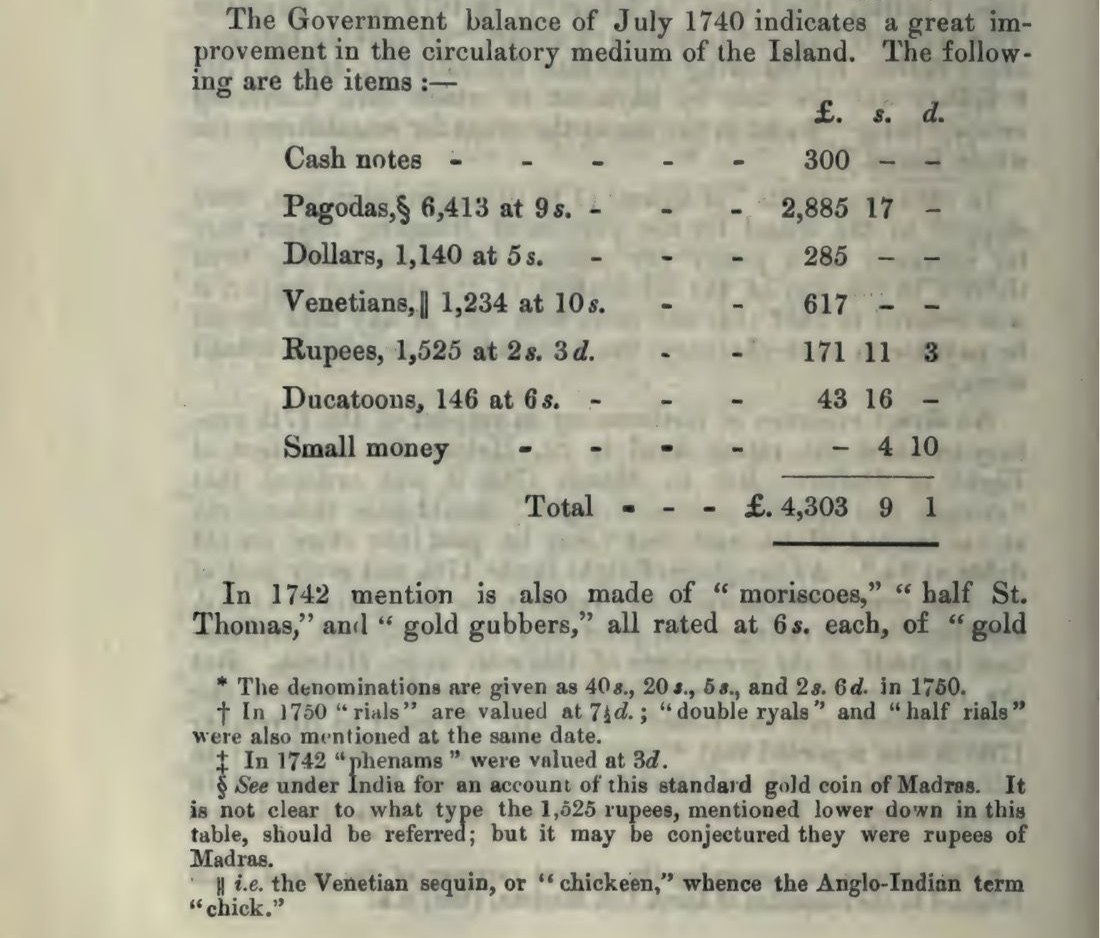
Chalmers, in A History of Currency in the British Colonies (London, 1893), pages 222 and 223, writes that "a paper currency was introduced early in the 18th century, consisting of 'bank bills' or 'cash notes.'" Of the whole Government balance of 700 pounds in January 1717, 400 pounds was in these bills. In the balance of July 1740 the cash notes stand at 300 pounds, in a total of 4,303 pounds 9 shillings and 1 penny. The rest of that balance was pagodas, dollars, Venetians, rupees, ducatoons and a little small money.
A footnote in Chalmers gives the values as 40 shillings, 20 shillings, 5 shillings and 2 shillings 6 pence in 1750. Cash notes are still listed in the balances of 1750 and 1760, and after 1770 the balances are shown simply as specie and cash notes. Chalmers does not cite an Ordinance for the issue. Of the island in 1892, page 239 of the same book records no banks and no paper money.
Two articles in the I.B.N.S. Journal add to this. Brian Kemp, in "Notes of St. Helena" (volume 14 number 3, 1975, pages 120 and 121), calls the issue of 1717 the first and only paper currency of the island, repeats the four values and the 400 pounds in the balance of January 1717, and pictures a bill for 2 shillings and 6 pence dated 17th April 1722. Jerry Remick (volume 17 number 2, 1978, page 96) writes that the issue was limited to 400 pounds for all values, that the notes are dated, numbered and signed by hand, that the issuer was "The Government and Council of the Island of St. Helena", and that only a very few exist. Remick's article prints the lowest value as 2 shillings 5 pence; Chalmers and Kemp give 2 shillings 6 pence, and Kemp's pictured bill is for that sum.
Not every writer begins the island's notes in 1717. A report of a talk in I.B.N.S. Journal volume 60 number 2 gives the note issues of St Helena as "1722 to date"; 1722 is the year on the bill that Kemp pictures.
No note issue in 1917
Some catalogues list notes of 5, 20 and 40 shillings of St Helena under the year 1917. The annual reports on the island do not know of them. The report for 1917, in its section on currency, counts "cash, Imperial currency, and Bank of England notes" in circulation at the end of the year, about 12,500 pounds in all. No report from 1912 to 1922 speaks of an island note, of a Currency Notes Ordinance, of a fund to secure notes or of Commissioners of Currency. The three values are three of the four values of 1717.
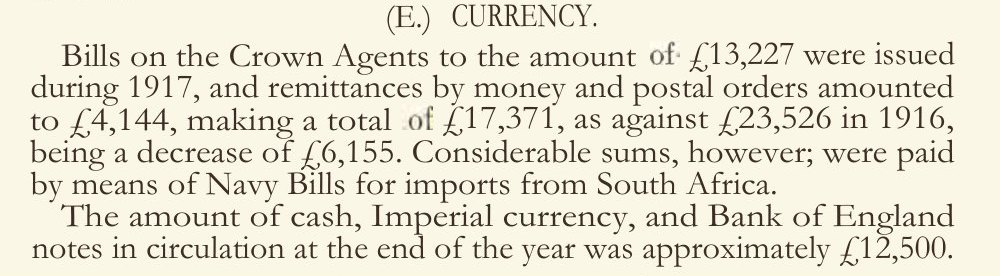
This is silence and not proof. It is the silence of the one series that states the money in circulation year after year.
What the annual reports counted, 1898 to 1973
The colonial annual reports give an estimate of the money on the island in most years. Until 1911 they speak of coin and cash only. From 1912 Bank of England notes are named, from 1916 "Imperial currency" and from 1919 Treasury notes, which are the United Kingdom's notes and not the island's.
| Year | Estimate in pounds | The report's words |
|---|---|---|
| 1899 | 15,000 | coin in circulation; "£15,000 or £3,000 more than in 1898" |
| 1900 | 25,000 | coin in circulation during the year |
| 1901 | 35,000 | coin in circulation during the year |
| 1907 | 5,000 | the cash circulation of the Colony at the beginning of the year |
| 1908 | about 5,000 at the start | "now probably nearer £8,000" |
| 1911 | 5,000 | cash circulation at the start of the year |
| 1912 | about 5,000 | cash and Bank of England notes at the end of the year |
| 1913 | 6,000 | cash circulation at the end of the year |
| 1914 | about 7,000 | cash and Bank of England notes |
| 1915 | about 8,000 | cash and Bank of England notes |
| 1916 | about 9,000 | "cash, Imperial currency, and Bank of England notes" |
| 1917 | about 12,500 | the same words |
| 1919 | 12,000 | "coin and treasury notes in circulation" |
| 1921 | 11,500 | of which British Treasury and Bank of England notes 2,500 |
| 1947 and 1948 | 40,000 | currency in circulation at the end of the year |
| 1949 and 1951 | 40,000 | "including South African notes and silver" |
| 1953 | 40,000 | the same words |
| 1955 | 40,000 | includes South African currency "which is accepted locally" |
| 1957 | 40,000 | South African currency "in general use alongside the statutory currency" |
| 1959 | 50,000 | includes South African currency, no longer reissued by the Treasury |
| 1961 | 55,000 | Bank of England notes and United Kingdom coin, "the only currency in circulation" |
| 1963 | 50,000 | the same words |
| 1965, 1967 and 1969 | 100,000 | the same words |
| 31 March 1973 | 250,000 | the same words (report for 1970-73) |
The reports for 1918, 1920 and 1922 give no figure. The report for 1922 says only that the currency in the Colony was sufficient for local needs. No report for 1939 to 1946 was found, so nothing is known from this series about the war years.
The reports for 1937 and 1938 also count the coin and notes carried in and out of the island. Notes worth 200 pounds came in during 1934 and 1,000 pounds in 1937. Notes worth 361 pounds went out in 1935, 900 pounds in 1936, 3,000 pounds in 1937 and 1,300 pounds in 1938. The reports do not say whose notes these were.
South African money, 1926 to about 1960
The St. Helena Coinage Order in Council of 12 October 1925 came into force on 1 January 1926. The report for 1926 says that South African currency became legal tender. The reports for 1928 and 1929 give the Order's terms more narrowly: all coins that were legal tender in the United Kingdom, and all silver coins that were legal tender in the Union of South Africa, were legal tender in the island. Notes are not named.
South African notes passed all the same. The reports for 1949 and for 1950 and 1951 count "South African notes and silver" in the 40,000 pounds in circulation, after the law had changed. The report for 1958-59 says the Treasury had adopted a policy of not reissuing any South African notes and coin, which were sent back to Cape Town from time to time. From the report for 1960-61 only United Kingdom money is named. The rand is never mentioned.
One bank from South Africa worked on the island. The report for 1922 records that specie worth 2,277 pounds was exported to South Africa that year "in connection with the closing of the local branch of the National Bank of South Africa". No report says whether that bank's notes passed on the island. The reports for 1928 and 1929 call the Government Savings Bank the only bank.
The laws of 1948 and 1949
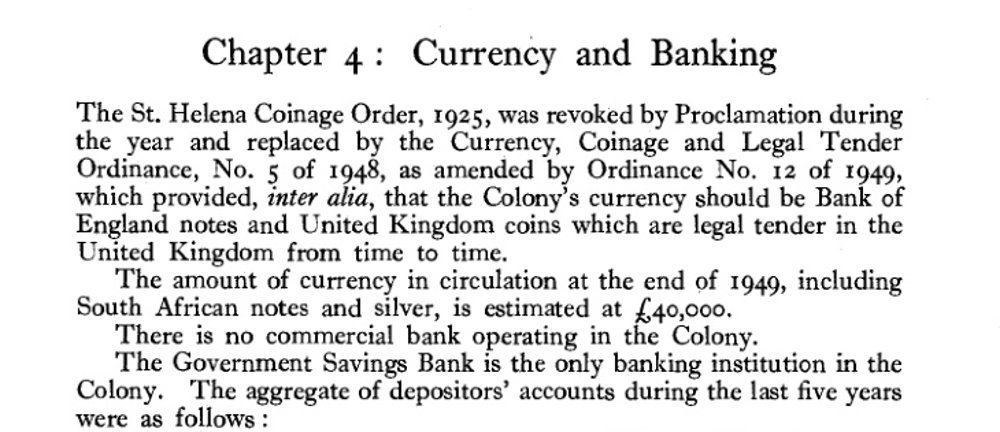
The annual report for 1949 (chapter 4, Currency and Banking, page 15) records that the St. Helena Coinage Order, 1925, was revoked by Proclamation during the year and replaced by the Currency, Coinage and Legal Tender Ordinance, No. 5 of 1948, as amended by Ordinance No. 12 of 1949. The new law provided that the Colony's currency should be Bank of England notes and the United Kingdom coins that were legal tender in the United Kingdom from time to time.
The reports name the steps. Ordinance No. 1 of 1948, of 7 January, was repealed by No. 5 of 1948, of 14 July. The St. Helena Currency Order in Council followed on 22 December 1948. Ordinance No. 12 of 1949 extended the law to notes and made it an offence to deface a note. The Decimal Currency Ordinance came in 1971.
The reports for 1960-61, 1964-65, 1966-67, 1968-69 and 1970-73 repeat the rule of 1948 and add that Bank of England notes and United Kingdom coin are "the only currency in circulation". No report up to 1973 speaks of a plan for island notes, a currency board or Commissioners of Currency. The Currency Ordinance of 1975 lies beyond the reports that were read.
The Treasurers, and what the reports do not hold
The reports name the island's Treasurers from 1925: H. J. Pink (1925 to 1928), Cullen (from 28 September 1928), Barton (from 31 March 1933), W. Millard (until September 1970) and G. O. Whittaker (from September 1970). None is named before 1925 or in the reports for 1947 to 1951. None of them signs a note in the catalogue. P. L. Aldous signs the notes of 1976 as Treasurer; when Aldous took over from Whittaker is not in the reports.
Two more things were looked for and not found. The reports from 1845 to 1911 speak of coin, shipments of specie and bills on the Crown Agents, and say nothing of the cash notes of 1717 or of any paper of the East India Company. And no paper money is known from the two camps where Boer prisoners of war were held on the island during the South African war of 1899 to 1902: Kemp's article of 1975 says that notes issued to prisoners are known from camps in Ceylon and India, but that none had been found for the camps at Broad Bottom and Deadwood.
Sources
- Chalmers, A History of Currency in the British Colonies (London, HMSO, 1893), chapter XX, pages 222, 223 and 239.
- Colonial annual reports on St Helena for 1898 to 1938 and for 1947 to 1970-73, each in its section on currency; the reports for 1922 (No. 1164), 1928 (No. 1432) and 1929 (No. 1475); the report for 1949, page 15.
- Brian Kemp, "Notes of St. Helena", I.B.N.S. Journal volume 14 number 3 (1975), pages 120 and 121.
- Jerry Remick, "First 50 pence and 10 pound banknotes for St. Helena to be issued soon", I.B.N.S. Journal volume 17 number 2 (1978), page 96.
- I.B.N.S. Journal volume 60 number 2, report of a talk on the notes of the Falkland Islands, Gibraltar and St Helena.
Member comments
Log in or register to post a comment.