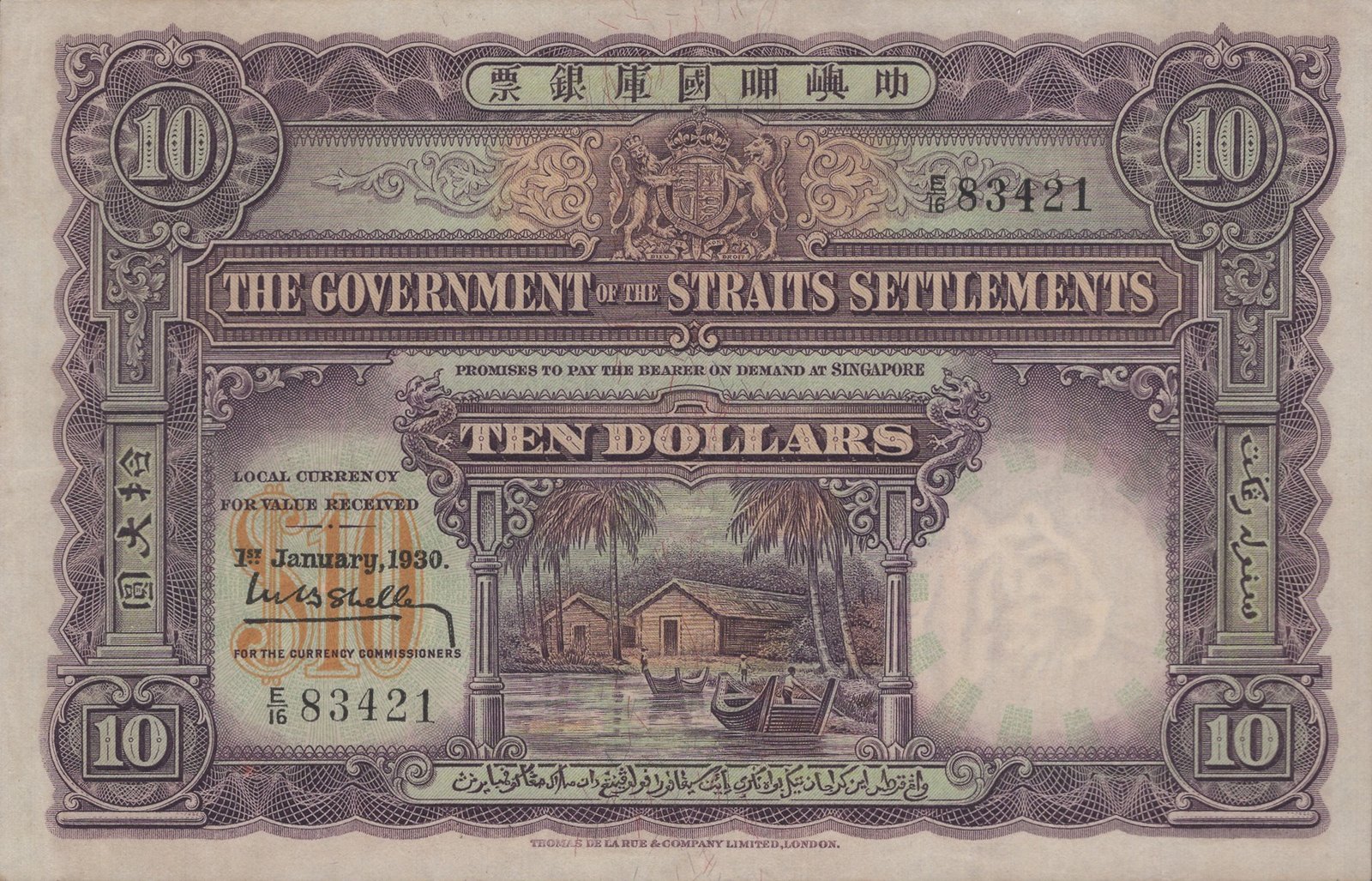
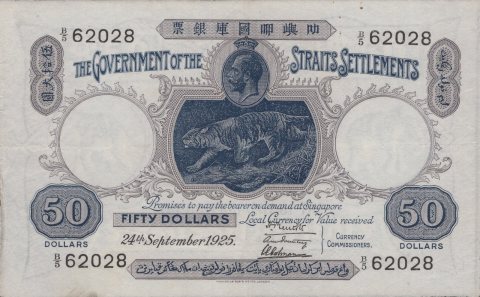
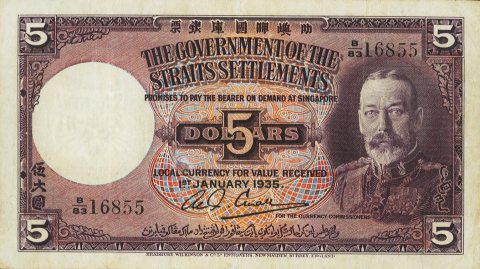
The Blue Books of the Straits Settlements and the Colony's annual reports to the Colonial Office are the first-hand record of its note issue. This article sets out every figure on the notes that was read in them, from the Blue Book for 1904 to the Blue Book for 1938, with two figures from J. O. Anthonisz and the gross figures of Money in British East Asia (1957) beside them. A shorter table is in Notes in circulation in the Straits Settlements, 1891 to 1935. Here the years between are filled in, the average monthly circulation and the costs are added, and each place where two sources print different figures is shown.
What the two kinds of volume print
The Blue Book has a Currency return (page T 2 or S 2 in the volumes of 1904 to 1910) with one line on the Government Currency Note Issue: its circulation on 31st December, the average monthly circulation, and the reserve. The Blue Book for 1915 words it so: the issue "had a circulation on 31st December, 1915, of $57,702,348, it keeps a reserve in gold and silver of not less than one-half of its issue". The estimates in the same volume give the year's expenses of working the note issue.
The annual report has a section on currency. The reports of 1921 and later give the notes in circulation at the end of the year, the notes of less than 1 dollar, the number and value of the notes destroyed, and the notes of the two banks still out.
Neither gives the circulation by value. Twenty Blue Books from 1915 to 1938 and the four of 1904 to 1910 were searched for it. The only split by kind is for the notes below 1 dollar in 1921 and 1922.
The circulation at the end of each year
All figures are in dollars. "Gross" figures are those of Money in British East Asia (1957). The third column is headed as the Blue Books head it, "Average monthly circulation".
| End of year | Notes in circulation | Average monthly circulation | Source |
|---|---|---|---|
| January 1901 | 6,205,000 (gross) | Money in British East Asia, p. 10 | |
| 1904 | 17,195,365 | 17,116,594.16 | Blue Book for 1904 |
| 1907 | 22,444,970 | 24,780,829 | Blue Book for 1907 |
| 1908 | 25,670,505 | 22,428,695 | Blue Book for 1908 |
| 1910 | 34,583,460 | 32,382,064 | Blue Book for 1910 |
| 1911 | 36,859,310 in the text; 37,342,362 in the table of months | Annual report for 1911, pp. 5 and 6 | |
| 1915 | 57,702,348 | Blue Book for 1915 | |
| 1917 | 87,068,993.60 | 81,321,025 | Blue Book for 1917 |
| 1918 | 93,711,847 (gross) | Money in British East Asia, p. 18 | |
| 1919 | 174,681,973.70; 181,056,222 (gross) | 106,015,349 | Blue Book for 1919; Money in British East Asia, p. 18 |
| March 1920 | 183,212,221 (gross) | Money in British East Asia, p. 18 | |
| 1920 | 101,587,186.80 | 141,669,919 | Blue Book for 1920 |
| 1921 | 84,596,806.90 | 88,440,550 | Blue Book for 1921; annual report for 1922 |
| 1922 | 72,944,004.70 | 75,518,402 | Blue Book for 1922; annual report for 1922 |
| 1923 | 81,028,024.70 | Blue Book for 1923 | |
| 1924 | 85,491,478.70 | Annual report for 1925 | |
| 1925 | 161,432,313.70 | Annual report for 1925 | |
| 1926 | 163,279,713.70 | Blue Book for 1926 | |
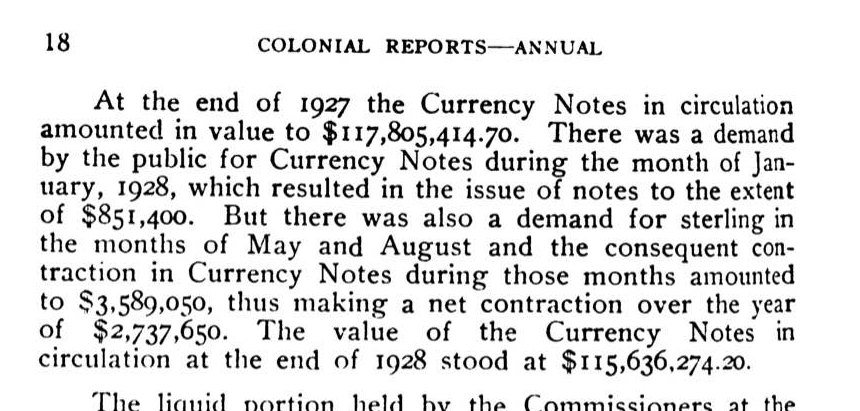
| 1927 | 117,805,414.70 | Annual report for 1928 | |
| 1928 | 115,636,274.20 | Annual report for 1928 | |
| 1929 | 104,159,136.75 | 108,616,795.21 | Blue Book for 1929; annual report for 1930 |
| 1930 | 82,423,391.75 | 91,044,594.72 | Annual report for 1930; Blue Book for 1930 |
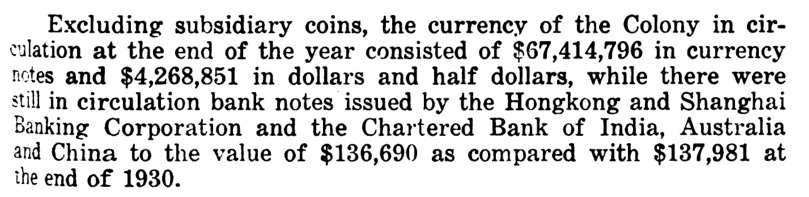
| 1931 | 67,414,796 (report); 67,414,796.75 (Blue Book) | 71,393,015.27 | Annual report and Blue Book for 1931 |
| 1932 | 68,496,575 (report); 68,496,575.75 (Blue Book) | 68,253,126.03 | Annual report and Blue Book for 1932 |
| 1933 | 66,964,286 (report); 66,964,286.70 (Blue Book) | 67,302,373.65 | Annual report for 1934; Blue Book for 1933 |
| 1934 | 75,786,490.20 | 70,110,054.30 | Annual reports for 1934 and 1935; Blue Book for 1934 |
| 1935 | 77,122,486.25 | 76,953,366.60 | Annual report and Blue Book for 1935 |
| 1936 | 83,984,121.75 | 79,554,769.00 | Blue Book for 1936 |
| 1937 | 104,975,521.75 | 97,713,858.00 | Blue Book for 1937 |
| 1938 | 105,300,469.75 | 105,240,354.00 | Blue Book for 1938 |
Anthonisz gives two figures between the Blue Book dates: 27,362,555 dollars on 30th September 1907 and 26,065,505 dollars on 31st January 1909.
Some of these figures were read on the page image and some only in the machine text of the volume. The figures of 1915, 1919 to 1923, 1926 and 1936 to 1938 are from the text alone. In the Blue Books for 1923, 1924 and 1926 the average monthly circulation is cut off in the text, and the text of the Blue Book for 1925 that was read has no currency section at all. The annual report for 1936 was also read in machine text only.
The points where the figures differ
- 1911. The annual report for 1911 gives 36,859,310 dollars in its text and 37,342,362 dollars for December in its own table of months. The report does not explain the two figures.
- 1919. The Blue Book gives 174,681,973.70 dollars at 31st December 1919 and Money in British East Asia 181,056,222 dollars gross. The Blue Book figure is from machine text and its last digits are not sure.
- 1926. The Blue Book's 163,279,713.70 dollars was read in machine text only and has not been checked on the page. It stands between 161,432,313.70 for 1925 and 117,805,414.70 for 1927, both read on page images of the annual reports.
- 1931 to 1933. The annual reports print whole dollars and the Blue Books the cents.
- 1927 and 1928. The report for 1928 gives 117,805,414.70 dollars for the end of 1927, a "net contraction" of 2,737,650 dollars in 1928 and 115,636,274.20 dollars for the end of 1928. The three do not fit one another, and all three are as printed.
The twelve months of 1911
The annual report for 1911, p. 6, is the only one read that gives the circulation month by month.
| Month of 1911 | Notes in circulation (dollars) |
|---|---|
| January | 34,564,299 |
| February | 34,529,921 |
| March | 35,028,644 |
| April | 35,805,727 |
| May | 35,835,057 |
| June | 36,005,953 |
| July | 35,600,395 |
| August | 35,386,470 |
| September | 37,816,430 |
| October | 38,411,429 |
| November | 37,687,110 |
| December | 37,342,362 |
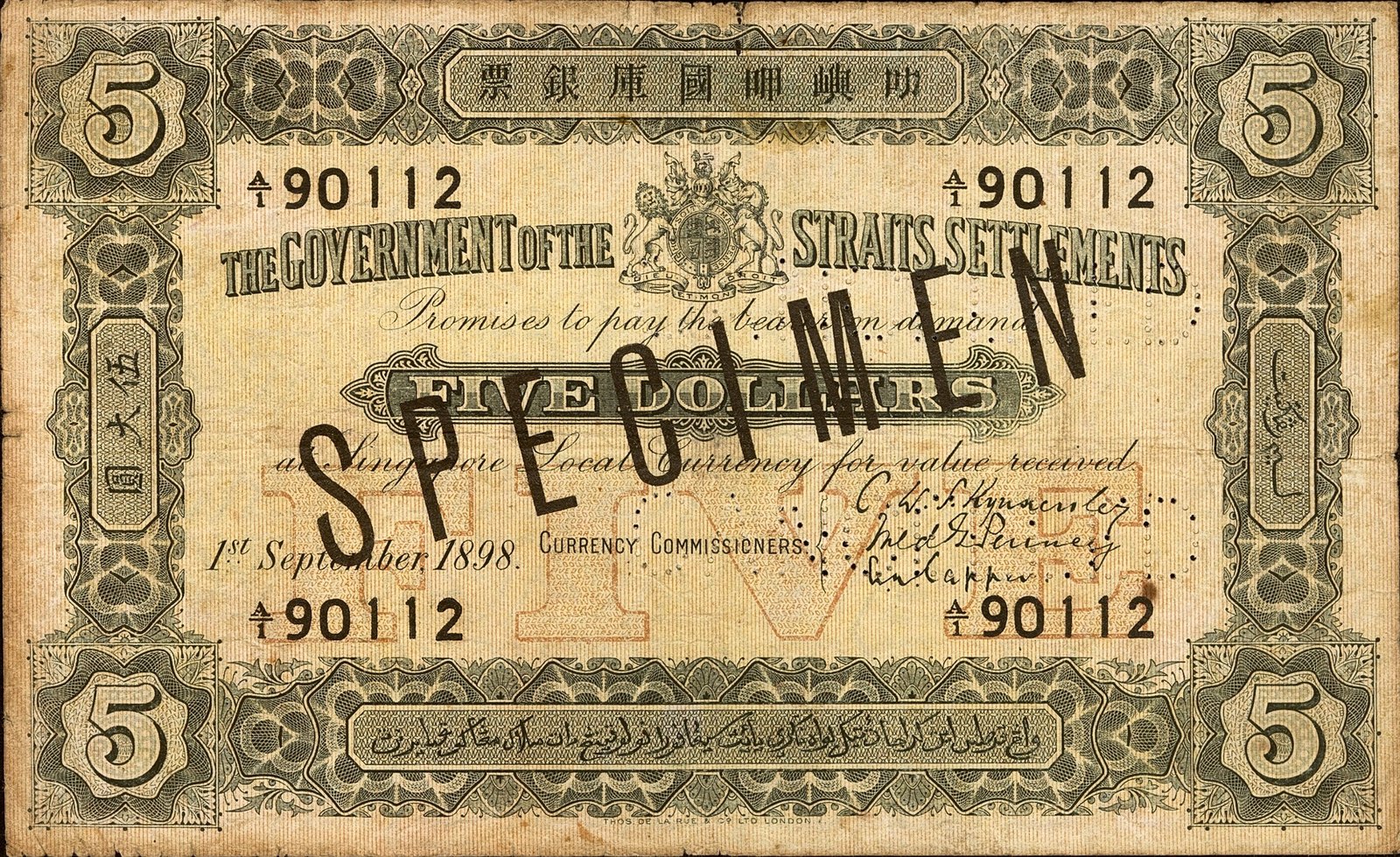
The same report says that the large 5 dollars note and the first issue 1 dollar note were being gradually withdrawn, every such note being cancelled when it came back to the Commissioners. The large note is the 5 dollars of 1898 and 1900. The report does not say which printings of the 1 dollar of 1906 it counts as the first issue.
What moved the circulation
The reports explain a change in some years only.
- 1922: the public asked for sterling in March and April and the currency contracted by 12,728,571.43 dollars; in November a slight demand for currency brought an issue of 857,142.86 dollars against sterling (annual report for 1922, p. 15).
- 1935: public demand expanded the note issue by 1,191,900 dollars (annual report for 1935).
- The rise from 85,491,478.70 dollars at the end of 1924 to 161,432,313.70 dollars at the end of 1925: the report for 1925 (page 15) puts it down to a heavy demand by the public for currency in January and from May to December, which led to the issue of 76,212,784 dollars of notes in exchange for sterling.
The cost of working the note issue
The Blue Books enter each year the expenses of working the Currency Note Ordinance.
| Year | Expenses of working (dollars) |
|---|---|
| 1915 | 9,730.45 |
| 1917 | 16,237.33 |
| 1919 | 17,800.79 |
| 1920 | 56,103.49 |
| 1921 | 59,566.70 |
| 1922 | 62,791.87 |
| 1923 | 57,555.43 |
| 1924 | 37,562.75 |
| 1925 | 37,070.12 |
| 1926 | 33,791.17 |
| 1927 | 34,883.39 |
| 1928 | 36,578.60 |
| 1929 | 38,542.01 |
| 1930 | 40,403.34 |
| 1931 | 41,082.76 |
| 1932 | 39,384.68 |
| 1933 | 35,158.02 |
| 1934 | 35,792.76 |
| 1935 | 37,087.63 |
| 1936 | 38,575.06 |
| 1938 | 56,298.41 |
The figure for 1937 could not be read. For 1929 the Blue Books of 1930 and 1931 print a different figure from the Blue Book of 1929 itself (35,542.01 or 33,542.01 in machine text). The cost was highest in 1920 to 1923, the years in which the small notes of the war were coming back to be destroyed, a story told in Ten cents on paper. The Blue Books do not say what made up the cost.
Notes destroyed, 1921 to 1936
The reports count the notes destroyed each year; the report for 1922 names the Note Cancellation Branch as the place. The quarters and halves in the counts are as printed; the reports do not explain them. The reports of 1928 and of 1930 to 1936 write the count of their own year out in words and give the year before in figures; the table sets both in figures. The count for 1936 is known only from the words of the report for 1936, read in machine text.
| Year | Notes destroyed | Face value (dollars) | Source |
|---|---|---|---|
| 1921 | 8,623,555 | not given | Annual report for 1922 |
| 1922 | 22,421,620 | not given | Annual report for 1922 |
| 1924 | 28,551,362 | not given | Annual report for 1925 |
| 1925 | 20,411,186 | not given | Annual report for 1925 |
| 1927 | 26,697,813 | 140,666,694 | Annual report for 1928 |
| 1928 | 20,542,740 | 87,133,550 | Annual report for 1928 |
| 1929 | 17,894,278¼ | 96,628,037.45 | Annual report for 1930 |
| 1930 | 18,652,188½ | 90,750,079 | Annual report for 1930 |
| 1931 | 17,237,573¾ | 83,528,735 | Annual report for 1931 |
| 1932 | 16,242,301¾ | 73,732,750 | Annual report for 1932 |
| 1933 | 15,454,977 | 66,814,330.25 | Annual reports for 1933 and 1934 |
| 1934 | 15,014,899½ | 64,057,047.75 | Annual report for 1935 |
| 1935 | 15,655,945¼ | 46,700,053.95 | Annual report for 1935 |
| 1936 | 16,616,867½ | 49,993,214.50 | Annual report for 1936 |
Two of these are printed differently a year apart. The report for 1934 gives its own year in words as fifteen million and fourteen thousand eight hundred and ninety-one and a half notes, where the report for 1935 prints 15,014,899½ for 1934; the word ninety-one is partly cut off at the edge of the page that was read. The report for 1936, read in machine text only, gives 15,655,945½ for 1935 where the report for 1935 has a quarter.
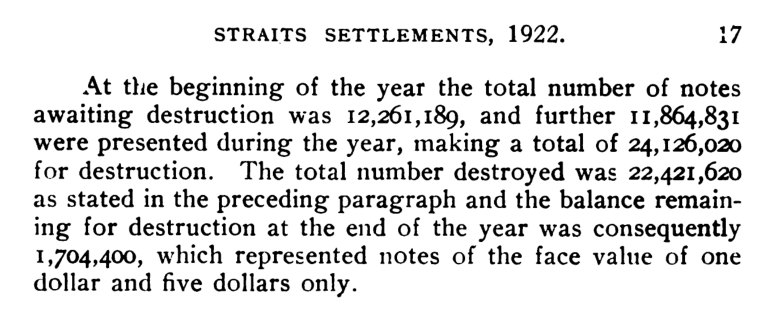
The reports say which notes they were in two years only. Of the notes destroyed in 1922, 19,626,000 were 10 cents notes. Of those destroyed in 1925, 10,651,890 were 10 cents notes and 7,278,585 were 1 dollar notes, and 285,964 notes were still waiting to be destroyed at the end of the year. The report for 1922 also follows the stock in the Cancellation Branch: 12,261,189 notes waiting at the beginning of 1922, 11,864,831 more presented in the year, and 1,704,400 left at the end, all of them 1 and 5 dollars notes. Those last three figures were read in machine text only.
The notes below 1 dollar
The 10 cents of 1917 to 1920, the 25 cents of 1917 and the 10 cents of 14th October 1919 are counted apart from the other notes.
| End of year | Notes below 1 dollar still out (dollars) | Source |
|---|---|---|
| 1920 | 3,364,834.80 | Annual report for 1921 |
| 1921 | 2,422,277.90 | Annual report for 1921 |
| 1922 | 1,621,695.70 | Annual report for 1922 |
| 1923 | 1,323,219.70 | Annual report for 1925 |
| 1924 | 1,539,949.70 | Annual report for 1925 |
| 1925 | 2,411,804.70 | Annual report for 1925 |
| 1926 | 1,923,607.70 | Annual report for 1928 |
| 1927 | 1,124,307.70 | Annual report for 1928 |
| 1928 | 768,391.20 | Annual reports for 1928 and 1930 |
| 1929 | 735,627.25 | Annual report for 1930 |
| 1930 | 729,841.25 | Annual report for 1930 |
| 1931 | 727,657.25 | Annual report for 1931 |
| 1932 | 725,228 | Annual report for 1932 |
| 1933 | 724,075.95 | Annual report for 1935 |
| 1934 | 723,459.20 | Annual report for 1935 |
| 1935 | 722,824.50 | Annual report for 1935 |
| 1936 | 722,402.00 | Annual report for 1936 |
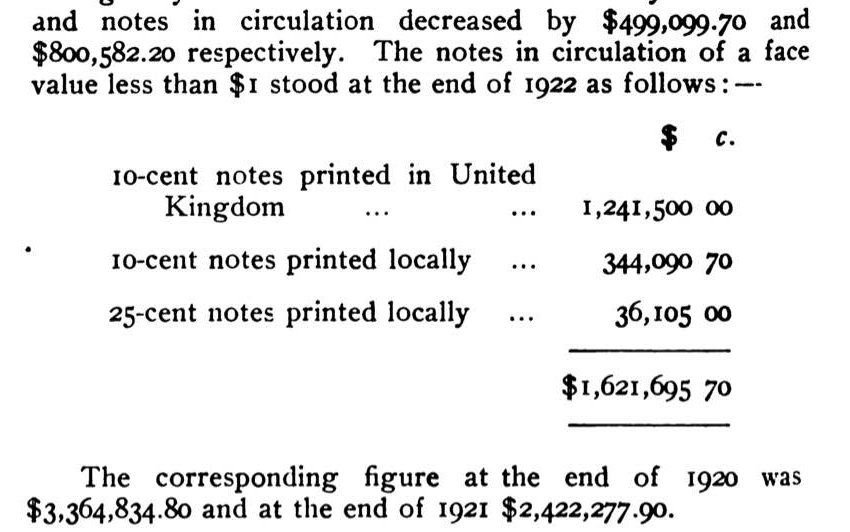
The reports for 1921 and 1922 split the total by kind: at the end of 1921, 1,872,200 dollars in 10 cents notes printed in the United Kingdom, 513,502.90 dollars in 10 cents notes printed locally and 36,575 dollars in 25 cents notes printed locally; at the end of 1922, 1,241,500 dollars, 344,090.70 dollars and 36,105 dollars. The total rose in 1924 and 1925: the report for 1925 speaks of a net increased issue of 10 cents notes to the value of 871,855 dollars. After that each report gives the net fall in the 10 cents notes for its year: 355,838.50 dollars in 1928, 5,759 dollars in 1930, 2,162 dollars in 1931 and 2,366 dollars in 1932. The reports of 1928 to 1936 repeat that the notes of 25 and 10 cents were issued during the War and for some years after and are no longer issued, though a fair quantity of them remains in circulation.
The banks' notes still out
The Blue Books of 1904 to 1910 give the average circulation of the notes of the Chartered Bank and the Hongkong and Shanghai Bank; the annual reports from 1921 give what was still out at the end of the year.
| Year | Bank notes (dollars) | Kind of figure | Source |
|---|---|---|---|
| 1904 | 2,918,136 | average, as the Currency return gives it | Blue Book for 1904 |
| 1907 | 1,825,089 | average, as the Currency return gives it | Blue Book for 1907 |
| 1908 | 1,277,340 | average, as the Currency return gives it | Blue Book for 1908 |
| 1910 | 459,614 | average, as the Currency return gives it | Blue Book for 1910 |
| 1921 | 149,951 | at the end of the year | Annual report for 1922 |
| 1922 | 145,082 | at the end of the year | Annual report for 1922 |
| 1924 | 142,082 | at the end of the year | Annual report for 1925 |
| 1925 | 140,958 | at the end of the year | Annual report for 1925 |
| 1927 | 139,585 | at the end of the year | Annual report for 1928 |
| 1928 | 138,999 | at the end of the year | Annual report for 1928 |
| 1929 | 138,265 | at the end of the year | Annual report for 1930 |
| 1930 | 137,981 | at the end of the year | Annual report for 1930 |
| 1931 | 136,690 | at the end of the year | Annual report for 1931 |
| 1932 | 136,417 | at the end of the year | Annual report for 1932 |
| 1934 | 135,965 | at the end of the year | Annual report for 1935 |
| 1935 | 135,795 | at the end of the year | Annual report for 1935 |
The last digits of the average for 1910 are a little unsure on the page, where the figure is printed sideways in small type. Money in British East Asia (1957) still counts 134,815 dollars of bank notes nominally in circulation after the war. For the time before the Government issue, the Précis of information concerning the Straits Settlements and the Native States of the Malay Peninsula (1882) gives the average paper currency in circulation during 1881 bank by bank: at Singapore, the Oriental Bank Corporation 803,537 dollars, the Chartered Mercantile Bank 711,994, the Chartered Bank 869,183 and the Hongkong and Shanghai Bank 165,625; at Penang, the Chartered Mercantile Bank 534,805 and the Chartered Bank 442,280. That passage was read in machine text only. Chalmers' table for 31st December 1891 splits the banks' notes by Settlement: 3,298,091 dollars at Singapore, 2,472,342 at Penang and 179,400 at Malacca.
The silver dollars beside the notes
The reports also count the dollars and half dollars in circulation: 6,166,832.22 dollars at the end of 1922, 5,958,262 at the end of 1928, 4,268,851 at the end of 1931, 3,612,793 at the end of 1932 and 3,035,919 at the end of 1935.
What the volumes do not give
- The notes in circulation by value, in any year.
- The number of notes issued or printed, the printer, or any order of notes.
- A count of forged notes. The report for 1922 was searched for forgery and holds nothing on it.
- Any figure for 1912 to 1914, 1916 or 1918 from a Blue Book or report. The bound volume of annual reports of 1908 to 1912 that was read is a selection and has no Straits report; the report for 1911 was read in another bound volume, of 1911 to 1913.
The place to look for the figures by value is the Currency Commissioners' own annual report, which the Blue Books do not reprint.
Sources
- Blue Books of the Straits Settlements for 1904, 1907, 1908, 1910, 1915, 1917 and 1919 to 1938.
- Colonial Reports, Annual, Straits Settlements: the reports for 1911 (pp. 5 and 6), 1921 (p. 15), 1922 (No. 1186, pp. 15 to 17), 1925 (pp. 14 and 15), 1928 (No. 1454, pp. 7, 8, 17 and 18), 1930, 1931, 1932, 1933, 1934, 1935 (pp. 66 and 67) and 1936.
- Précis of information concerning the Straits Settlements and the Native States of the Malay Peninsula (1882), for the banks' notes of 1881 (machine text only).
- J. O. Anthonisz, Currency Reform in the Straits Settlements, for the figures of 30th September 1907 and 31st January 1909.
- Chalmers, A History of Currency in the British Colonies (1893), p. 388.
- Money in British East Asia (1957), pp. 10 and 18, and its count of bank notes still out after the war.
Member comments
Log in or register to post a comment.