The law made three persons Commissioners of Currency of the Straits Settlements: the Colonial Secretary, the Treasurer and one person named by the Governor. The Blue Books of 1904 to 1938, the annual reports and J. O. Anthonisz's book were searched for a list of them by name, and none has one. This article sets out what those volumes and the Colonial Office List give in its place, post by post and day by day, and what they leave unexplained. The signers date by date, as the Pick pages tell them, are in The signers of the Straits Settlements notes and their offices, 1898 to 1935; this article adds the office holders that article does not have, the third Commissioner and the staff.
Where the names come from
Three kinds of page were used.
- The Civil Establishment pages of the Blue Books for 1904, 1907, 1908 and 1910, which give each post with its holder and the day of appointment.
- The returns of the members of the Executive and Legislative Councils in the Blue Books for 1915, 1917, 1919, 1925, 1932, 1933 and 1935, which give the day each official member took a seat and in which office.
- The records of service in the Colonial Office List (1920, 1925, 1928 and 1930).
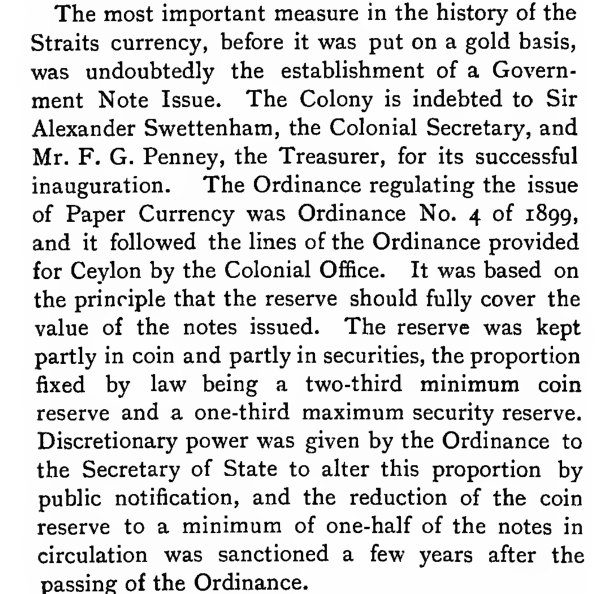
The Ordinance of 1897 and the Ordinance of 1899 name the three members of the Board by office. Anthonisz credits the first issue to Alexander Swettenham, the Colonial Secretary, and F. G. Penney, the Treasurer (pp. 7 and 73).
The Colonial Secretary: the first signature
| Holder | In office | Source |
|---|---|---|
| W. T. Taylor | in the post in 1904 | Blue Book for 1904 |
| A. H. Young | from 28th June 1906 | Blue Books for 1907 to 1910 |
| W. Evans, acting | from 26th April 1910 | Blue Book for 1910 |
| R. J. Wilkinson | member of the Executive Council as Colonial Secretary from 11th September 1911 | Blue Book for 1915 (machine text only) |
| F. S. James | member of the Executive and Legislative Councils as Colonial Secretary from 8th June 1916; still Colonial Secretary in 1922, when James administered the Government from 28th April to 25th September | Blue Book for 1917; annual report for 1922 |
| F. M. Baddeley, acting | from April 1922; signs the annual report for 1922 as Acting Colonial Secretary on 14th August 1923 | Colonial Office List, 1925; annual report for 1922 |
| Hayes Marriott, acting | 7th November 1924 to 10th April 1925, and from 8th May 1925 | Blue Book for 1925 |
| Sir John Scott | 12th February 1929 to 11th August 1933 | Blue Books for 1932 and 1933 |
| Andrew Caldecott | from 8th December 1933 | Blue Book for 1933 |
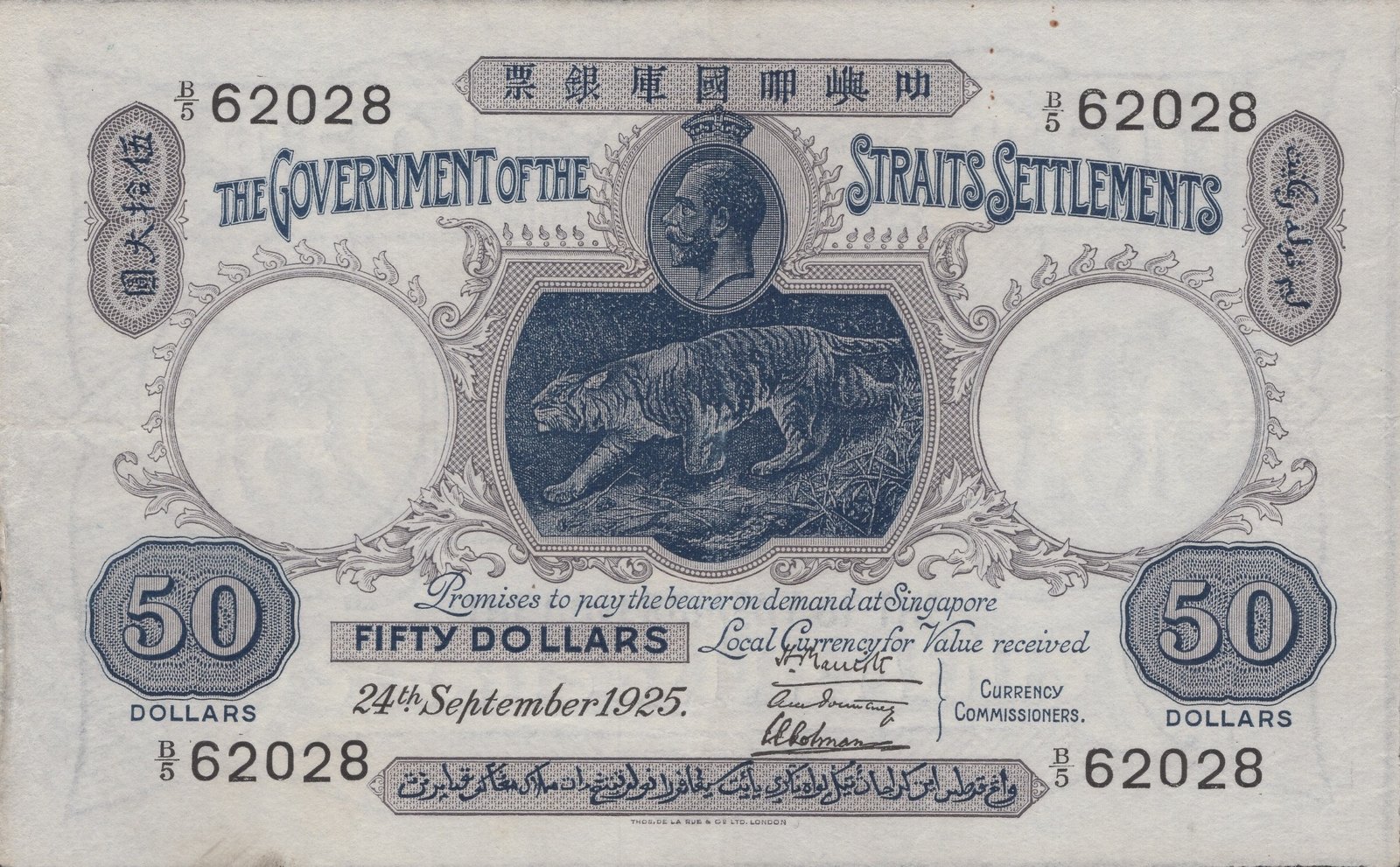
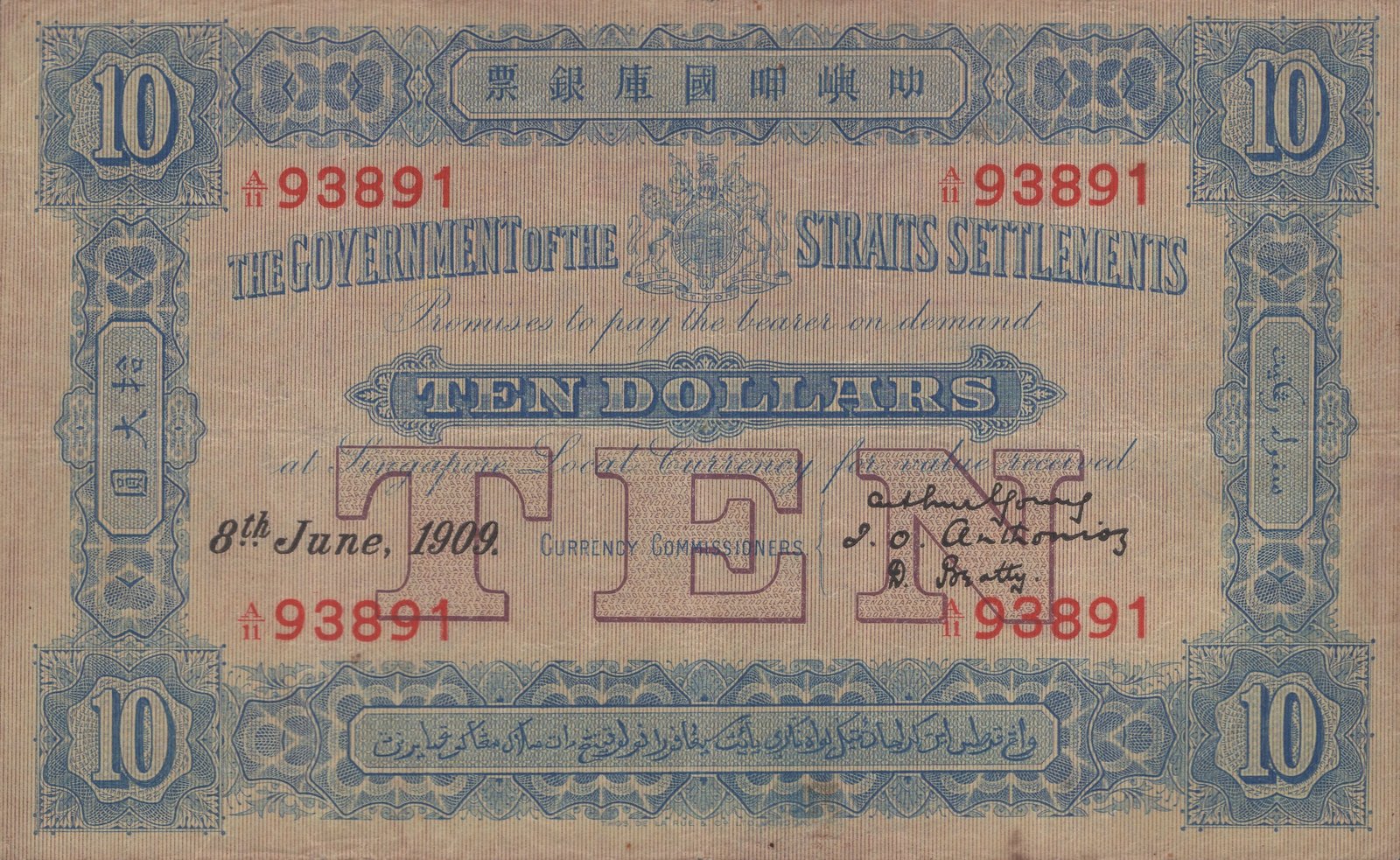
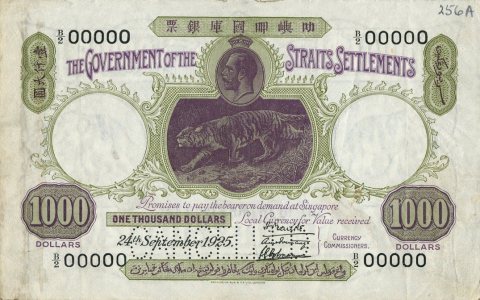
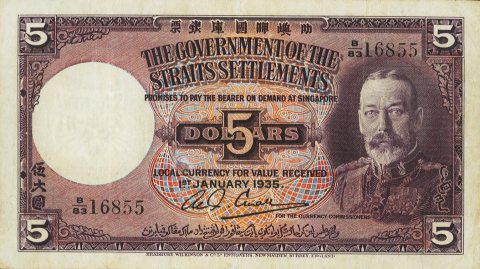
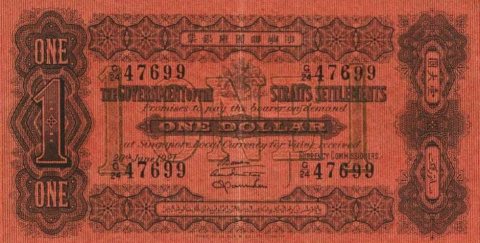
The catalogue's rows have Young first on the notes of 8th June 1909, James first on those of 20th June 1921, Baddeley first on those of 5th September 1924, Marriott first on 24th September 1925, Scott first on 1st October 1930 and Caldecott first on 8th December 1933. Each stands in the table in the office that goes with the place. Two dates fit closely. The high values dated 8th December 1933, the 50 dollars, the 100 dollars, the 1,000 dollars and the 10,000 dollars, carry the very day on which Caldecott took the seat. And Marriott, who signs 24th September 1925 as first Commissioner, had been acting Colonial Secretary since 8th May of that year.
No note of the 1, 5 or 10 dollars is dated in the months of 1922 in which Baddeley acted, so the report for 1922 changes nothing on the rows.
The Treasurer: the second signature
| Holder | In office | Source |
|---|---|---|
| F. G. Penney | at the first issue | Anthonisz |
| R. N. Bland | from 12th July 1904 | Blue Book for 1904 |
| J. O. Anthonisz, acting | from 9th September 1904 | Blue Book for 1904 |
| A. T. Bryant | from 17th February 1907 | Blue Book for 1907 |
| J. O. Anthonisz | from 8th May 1908 | Blue Book for 1908 |
| W. C. Michell, acting | from 27th July 1910 | Blue Book for 1910 |
| Arthur Meek Pountney | member of the Executive Council as Treasurer from 1st February 1914 to 17th January 1917 | Blue Book for 1917, p. J 2 |
| Hayes Marriott, acting | member as Acting Treasurer from 18th January 1917 | Blue Book for 1917, p. J 2 |
| Arthur Meek Pountney | again from 11th December 1918 | Blue Book for 1919 |
| Malcolm Bond Shelley | 7th May 1928 to 21st June 1932 | Blue Book for 1932 |
| Alexander Sym Small | acting from 22nd December 1930; Treasurer from 22nd June 1932 | Blue Book for 1932 |
| Hyman Weisberg, acting | 10th February to 16th June 1935 | Blue Book for 1935 |
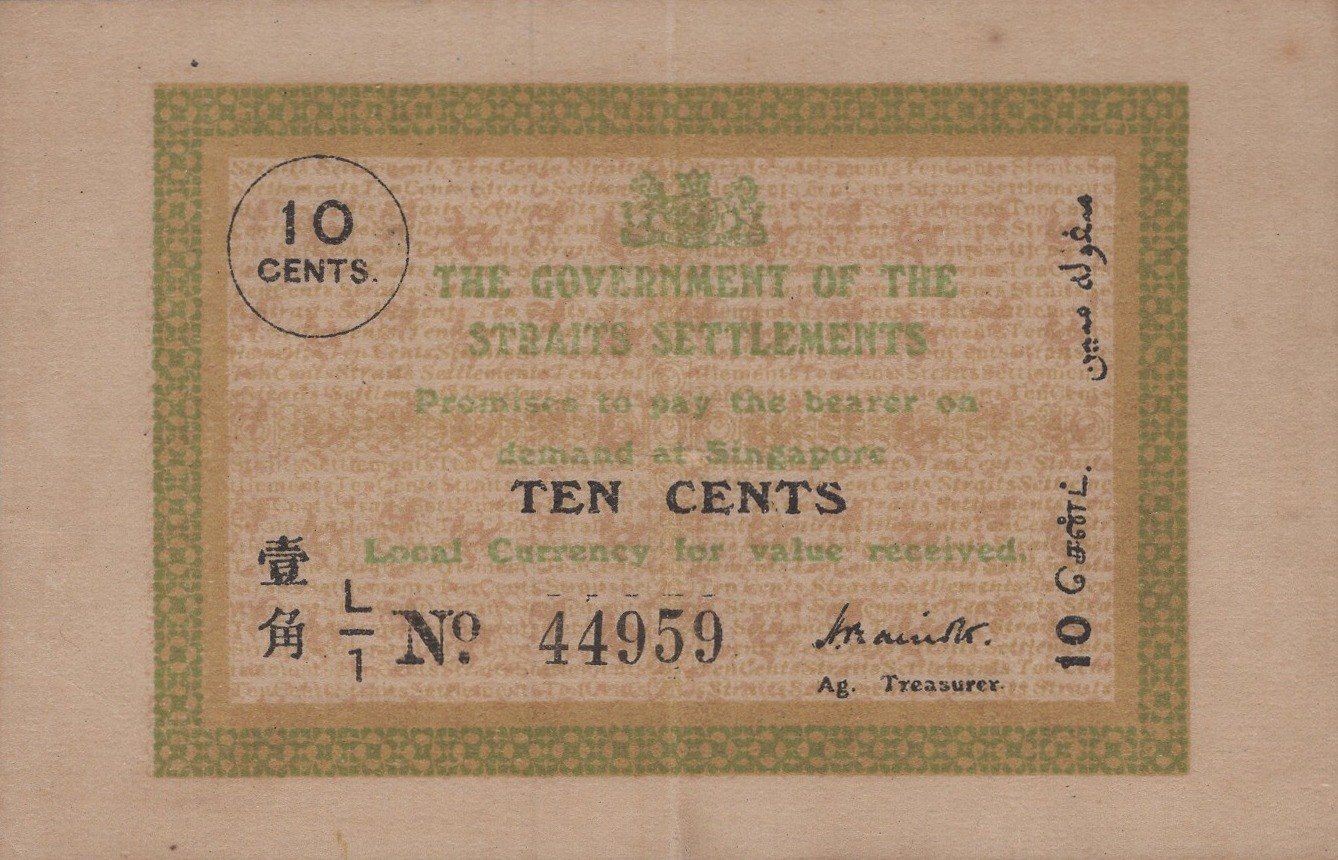
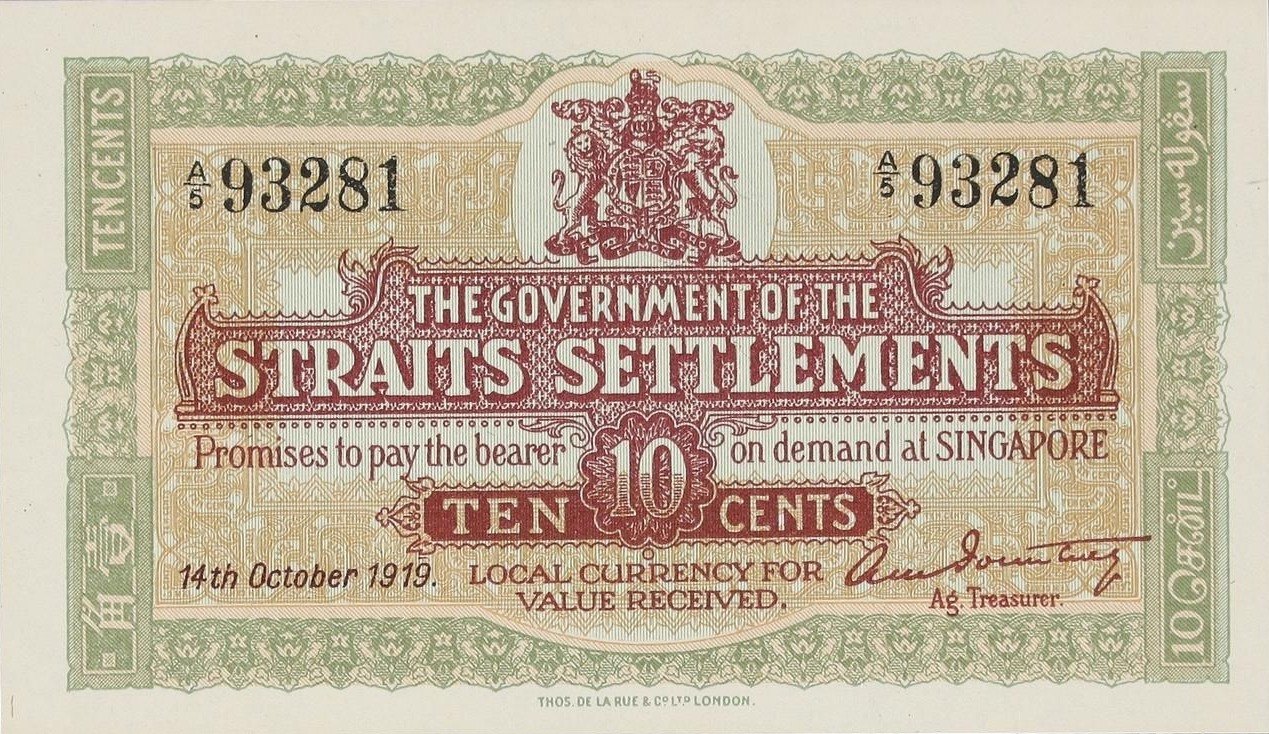
The Treasurer is also the one signer of the small notes and of the 1, 5 and 10 dollars from 1925. The table explains most of what the notes show: Marriott as Ag. Treasurer on the 10 cents of 1917 and 1918 and on the 25 cents, Pountney from 1919, Shelley on the dates of 1929 to 1932 and Small on those of 1933 to 1935.
Weisberg, who acted for four months in 1935, signs no Straits note; the same name is later the signer of the notes of the Board of Commissioners of Currency, Malaya.
Three things the returns do not explain
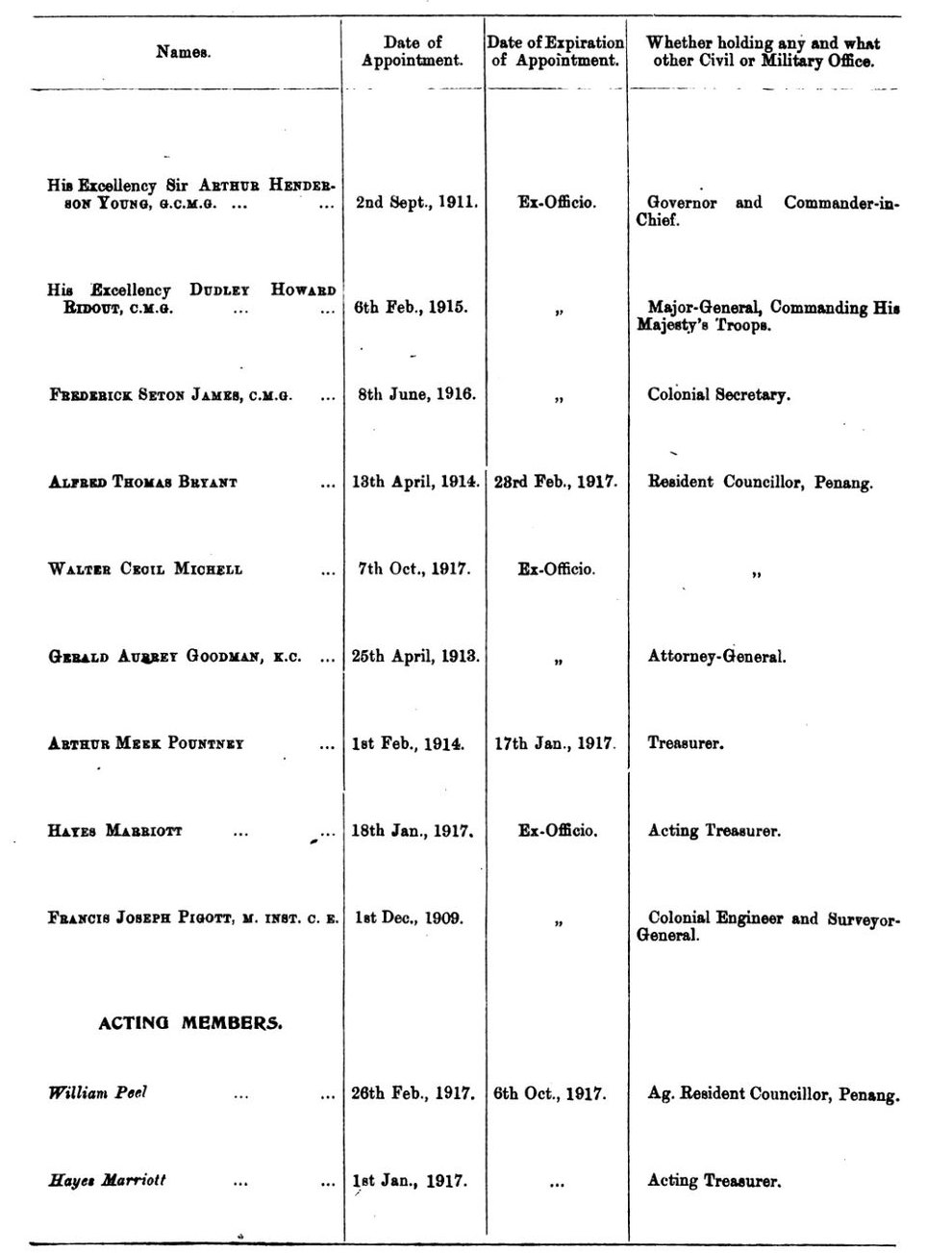
Marriott's months as acting Treasurer. The Executive Council return in the Blue Book for 1917 has Marriott as an acting member from 1st January 1917 and as Acting Treasurer from 18th January 1917. The record of service in the Colonial Office List for 1928 gives "acting Treasurer Jan. 1916 to Mar. 1917". The two do not agree on the start. The List's end in March 1917 comes before the 10 cents notes that Marriott signs as Ag. Treasurer, which are dated from 1st October 1917 into 1918. The return gives no end to Marriott's acting, only Pountney's return on 11th December 1918.
Ag. Treasurer under Pountney's name in October 1919. On the first prefixes of the 10 cents dated 14th October 1919 the title under Pountney's signature is Ag. Treasurer, and on the later ones Treasurer. The returns have Pountney as Treasurer throughout, back since 11th December 1918. Nothing read explains the first title.
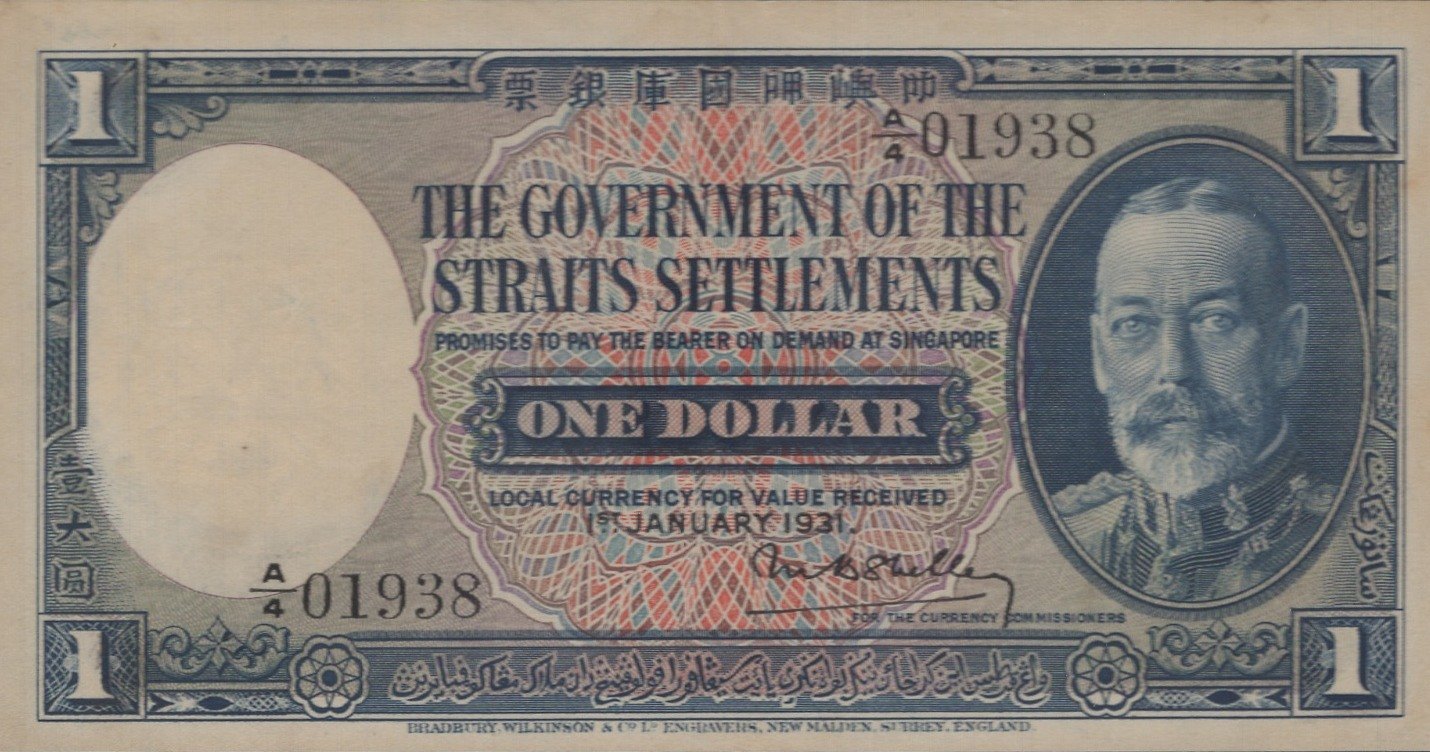
Small acting from December 1930, Shelley on the notes of 1931 and 1932. The Blue Book for 1932 has Small acting as Treasurer from 22nd December 1930, yet the 1 dollar, 5 dollars and 10 dollars dated 1st January 1931 and 1st January 1932 carry Shelley's signature. That would fit notes printed in advance with the signature of the substantive Treasurer, but no source says so.
The third Commissioner
The law says only that the Governor named the third member, and here the volumes are thinnest. The catalogue's rows give as third signer Beatty in 1909, David in 1911, Saunders in 1916, 1920 and 1921, Valpy in 1924, Colman in 1925, Cator in 1930 and Simpson in 1933. What was found on them:
- Saunders is Registrar of Companies in the Blue Book for 1919 and Registrar of Companies and Official Assignee in the Blue Book for 1921 (both in machine text only), and the record of service in the Colonial Office List for 1920 has Saunders acting as Official Assignee at times between 1900 and 1906. Colman acted as Registrar of Companies and Official Assignee from a June whose year is cut off in the Colonial Office Lists for 1928 and 1930; the entry before it is of May 1925. Valpy appears as acting Official Assignee in the Colonial Office List for 1925 (p. 883), though no record of service was found under that name. F. M. Baddeley, who later signs first as acting Colonial Secretary, was acting Official Assignee at Singapore in April 1907 and, in the words of the Colonial Office List for 1925, "apptd. a currency comsnr., May, 1907". So the third seat seems often to have gone with the post of Official Assignee. That link is drawn from these careers; no volume states it as a rule.
- P. A. F. David appears in the Blue Book for 1907 only as District Officer, Christmas Island.
- Simpson was an unofficial member of the Legislative Council from 5th February 1930.
- Brockman is the first name Spink reads on the 1,000 dollars of 17th March 1911 (5 July 2008, lot 0A). The Blue Book for 1910 has W. Evans acting as Colonial Secretary from 26th April 1910, and no office was found for Brockman.
- Beatty is Secretary for Chinese Affairs from 1st January 1919 in the Blue Book for 1921 (machine text only, from a scrambled table). No office was found for Beatty in 1909.
- For Cator the record of service in the Colonial Office List for 1930 ends in October 1929 and names no post in the Straits that went with a seat on the Board.
- McLean, who signs the 1, 5 and 10 dollars of 1st September 1927 in the Treasurer's place, appears as Treasurer, S.S., in the Colonial Office List for 1928 (p. 1022). No record of service and no day of appointment was found.
The Auditor-General never signs a note. The Blue Books give that post to E. C. H. Hill from 1897, to W. C. Michell acting from 9th December 1907 and to A. T. Bryant from 8th May 1908. Two of the three were Treasurer or acting Treasurer at other times.
One remark in the Blue Book for 1904 looks like a fourth Commissioner and is not. On p. L 9 the words "Is also a Currency Commissioner" stand beside the line of the Assistant Treasurer, J. L. King. On the page a brace joins that line to the Treasurer's, and the remark is the end of a note that begins on the Treasurer's line. The Treasurer was a Commissioner by law, so the remark is read as the Treasurer's.
The Currency Note Branch
Behind the three signatures stood a small office in the Treasury.
| Post | Holder | From | Source |
|---|---|---|---|
| Cashier, Currency Note Branch | Chea Hood Teck | 1st May 1899 | Blue Books for 1904 to 1910 |
| Clerk, Currency Note Branch | E. F. Pestana | 1903 | Blue Books for 1904 to 1910 |
| Currency Officer | J. W. R. Bloom | the post is in the Blue Book from 1924 | Blue Books from 1924 |
| Currency Officer | Edward Fernandez | 15th December 1933 | Blue Book for 1933 (machine text only) |
The Cashier's appointment on 1st May 1899 is the earliest dated trace of the note office in these volumes. The Currency Note Ordinance 1899 is dated 28th February 1899. The annual report for 1922 names a Note Cancellation Branch, where the notes waiting to be destroyed were held. By the Blue Book for 1938 the establishment under the heading Currency Commission was a Currency Officer, a Chief Clerk of the Currency Commissioners' Branch, an Officer-in-Charge of the Cancellation Branch, a Cashier and two Assistant Cashiers. A currency exchange office had also worked in Kuala Lumpur since 1st July 1923 (Malayan Union annual report for 1946). What the office cost each year is in The Straits Settlements note issue in the Blue Books and annual reports.
What is still missing
- A list of the Commissioners by name for any year.
- The Colonial Secretaries and Treasurers of 1898 to 1903 and the Treasurers of 1911 to 1913, with their days of appointment.
- The office of Beatty in 1909 and of Cator in 1930, the days of appointment of Valpy and McLean, and the office of Maxwell, whom the pages name as a signer of 7th March 1916.
- Whether Anthonisz signed the 1 dollar of 1st September 1906. The page of the 1 dollar of 1906 to 1924 calls Anthonisz the Treasurer who signed it; the Blue Books have Anthonisz acting as Treasurer from 9th September 1904 and Treasurer from 8th May 1908, with Bland and then Bryant in the post between.
Sources
- Ordinance No. VIII of 1897 and the Currency Note Ordinance 1899 (No. IV of 1899).
- Blue Books of the Straits Settlements for 1904 (with p. L 9), 1907, 1908 and 1910 (Civil Establishment); for 1915, 1917 (p. J 2), 1919, 1925, 1932, 1933 and 1935 (Council returns); for 1921 and 1933 (Establishments); for 1924 and 1938.
- Spink, 5 July 2008, lot 0A, for the names read on the 1,000 dollars of 1911.
- Colonial Reports, Annual, Straits Settlements, report for 1922 (No. 1186).
- Colonial Office List, 1920 (record of service of C. J. Saunders), 1925 (record of service of F. M. Baddeley; p. 883), 1928 (records of service of Hayes Marriott and E. E. Colman; p. 1022) and 1930 (record of service of G. E. Cator).
- J. O. Anthonisz, Currency Reform in the Straits Settlements, pp. 7 and 73.
- Malayan Union annual report for 1946.
- The rows of the catalogue's Pick pages for the names of the signers on each date.
Member comments
Log in or register to post a comment.