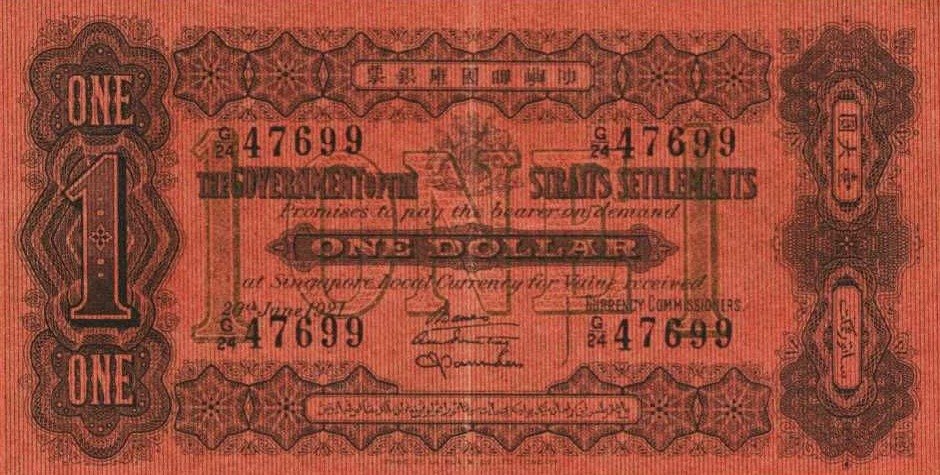
Every currency note of the Straits Settlements promised payment on demand, and the law required the Commissioners of Currency to hold a fund against the notes. This article follows that fund through the sources that print its accounts: the Treasury statements in the Blue Books for 1904, 1907, 1908 and 1910, J. O. Anthonisz's Currency Reform in the Straits Settlements, and the Colony's annual reports for 1911, 1922, 1925, 1928, 1932 and 1935. The laws are in The laws of the Straits Settlements note issue in order of time and the circulation in The Straits Settlements note issue in the Blue Books and annual reports.
The rule: from two-thirds in coin to two-fifths in liquid form
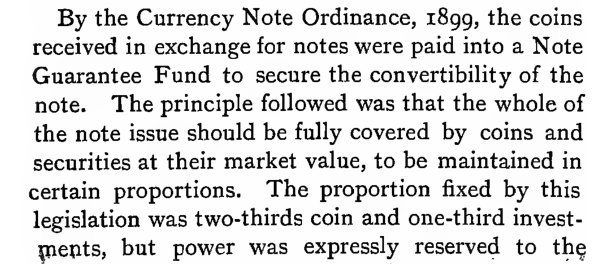
Anthonisz, who was Treasurer and a Commissioner, sets out the first rule at pp. 7 and 73 of the book. The Ordinance followed the lines of the one the Colonial Office had provided for Ceylon. The notes had to be covered in full by a reserve, at least two-thirds of it in coin and at most one-third in securities. A few years after, the Secretary of State cut the coin to a minimum of one-half. The notes were not legal tender for payments by the Commissioners at their own office.
The Blue Books repeat the rule each year in one line, and its wording moves with the law:
| Blue Book | Wording of the reserve |
|---|---|
| 1904 | "it keeps a reserve in silver of one half of its issue" |
| 1907 | gold and silver, at least one half |
| 1908 and 1910 | gold and silver, not less than one-half |
| 1915, 1917 and 1919 | "a reserve in gold and silver of not less than one-half of its issue" |
Gold enters the line between the Blue Books for 1904 and 1907. Ordinance I of 1906, under which notes were issued against gold at 7 pounds for 60 dollars, lies between them. The annual report for 1928 (p. 8) recalls that sovereigns were then declared legal tender at that rate by Order of the King in Council, and adds that gold has never been in active circulation in the Colony.
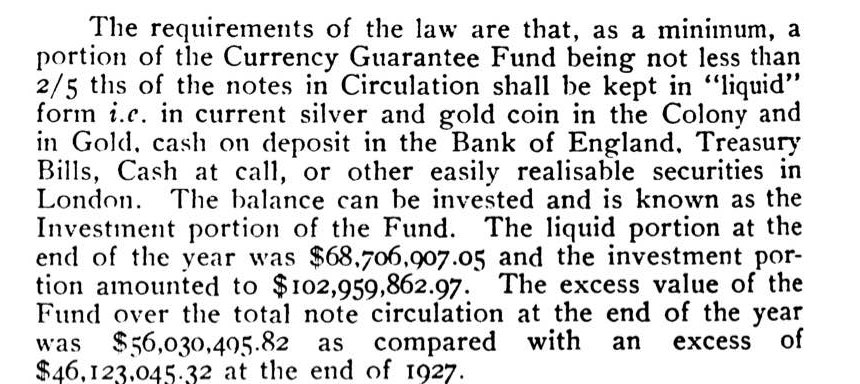
By 1928 the rule was a different one. The report for 1928, p. 18, says the law required as a minimum that a part of the Currency Guarantee Fund, not less than two-fifths of the notes in circulation, be kept in "liquid" form: silver and gold coin in the Colony, and gold, cash on deposit in the Bank of England, Treasury Bills, cash at call or other easily realisable securities in London. The rest could be invested and was called the investment portion. The first rule measured a share of the fund in coin; this one measures a share of the notes in circulation, in coin or London paper. The report names no Ordinance and no date for the change. The name Currency Guarantee Fund is that of the Currency Ordinance 1923.
The accounts of 1904
The Treasury statement of assets and liabilities in the Blue Book for 1904 has the Commissioners' items among the Colony's own.
| Item (dollars) | 1st January 1904 | 1st January 1905 |
|---|---|---|
| Cash balance: Currency Note Reserve | 5,371,363.85 | 11,323,203.85 |
| Advances, Currency Commissioners | 23,659.93 | |
| Investments, Currency Commissioners | 6,272,161.15 | 6,272,161.15 |
| Investments, Depreciation Fund | 117,068.83 | 183,321.12 |
| Deposits (liability), Currency Commissioners | 16,293,722.75 | 17,595,597.75 |
| Deposits (liability), Depreciation Fund | 117,068.83 | 183,321.12 |
Of the cash on 1st January 1905, 1,800,000 dollars lay in the Penang Treasury vault. A line in the expenditure of 1904 for the cancellation of currency notes is blank.
The Currency Note Issue account, 1907 to 1910
From the Blue Book for 1907 the note issue has an account of its own in the Treasury statement. These are the years in which the dollars were shipped away to be reminted, and the account shows the coin going and coming back.
| Item (dollars) | 1st January 1907 | 1st January 1908 | 1st January 1909 |
|---|---|---|---|
| Note Guarantee Fund: in vault | 3,766,324.66 | 9,735,129.34 | 17,973,865.79 |
| In vault at Penang | 1,550,000.00 | 2,930,000.00 | |
| Amount shipped for reminting | 9,255,000.00 | 3,487,500.00 | |
| Shipped for reminting, to be recovered from the Gold Standard Reserve Fund | 196,045.32 | ||
| Remitted to the Crown Agents | 357.14 | ||
| Investments, Currency Commissioners | 9,948,816.17 | 11,181,019.03 | 8,818,348.57 |
| Investments, Depreciation Fund | 333,539.47 | 492,661.40 | 655,079.92 |
| Suspense | 15.43 | ||
| Total assets | 23,303,680.30 | 26,642,355.09 | 30,377,666.85 |
| Deposits (liability), Currency Commissioners | 22,970,140.83 | 23,192,550.83 | 26,418,085.83 |
| Depreciation Fund (liability) | 333,539.47 | 492,661.40 | 655,079.92 |
| Advances from the Straits Settlements Loan Account (liability) | 2,957,142.86 | 3,304,501.10 |
The account for the end of 1910, signed by W. C. Michell as Acting Treasurer on 6th June 1911, is the first of these four to show gold:
| Item at the end of 1910 | Dollars |
|---|---|
| Note Guarantee Fund: in vault, silver | 9,121,316.05 |
| In vault, gold (285,438 pounds) | 2,446,611.43 |
| In vault at Penang | 2,312,229.63 |
| Gold held by the Crown Agents in London (868,917 pounds 9s.) | 7,447,863.84 |
| Investments, Currency Commissioners | 14,003,019.88 |
| Investments, Depreciation Fund | 1,012,432.79 |
| Total assets | 36,343,473.62 |
| Deposits (liability), Currency Commissioners | 35,331,040.83 |
| Depreciation Fund (liability) | 1,012,432.79 |
Against these stood 34,583,460 dollars of notes in circulation on 31st December 1910 (Blue Book for 1910). The annual report for 1911 gives the next year in three figures: cash in reserve 22,518,132.96 dollars, investments 16,319,381.02 dollars and deposits, the liability, 38,837,513.98 dollars at 31st December 1911.
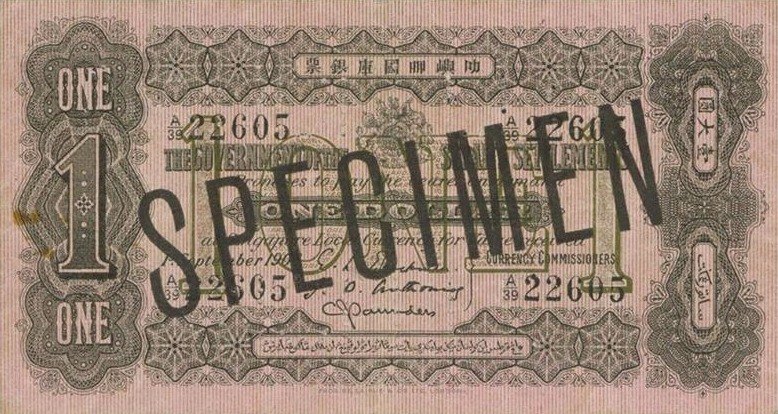
These are the years of the 1 dollar of 1906. Anthonisz writes (pp. 43, 50, 78 and 118) that the note was issued while the silver was away being recoined, to draw in the old dollars, and that by 1907 over 12 million of the 19 million new dollar coins lay in the note reserve.
Gold in Singapore and London, 1907 and 1909
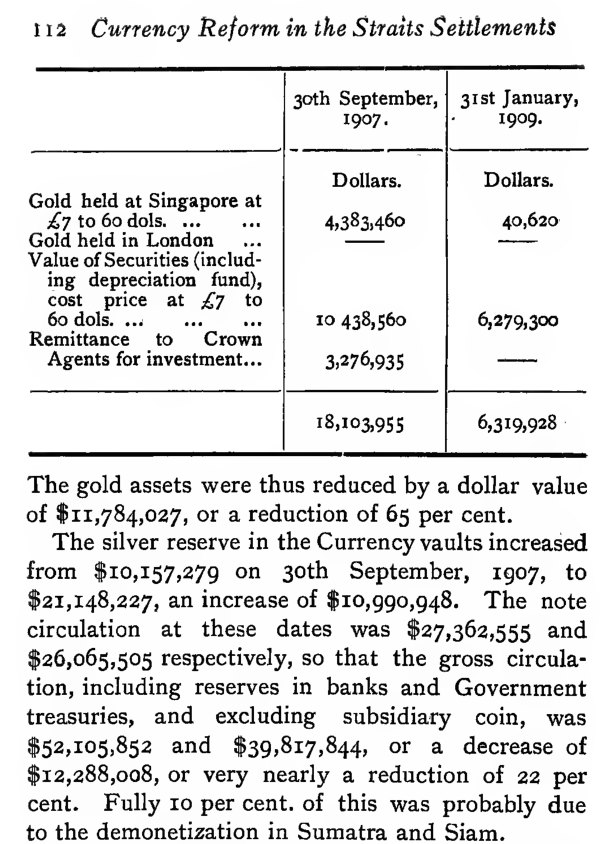
At p. 112 Anthonisz sets the sterling assets of the Commissioners at two dates beside the silver and the notes.
| Item (dollars) | 30th September 1907 | 31st January 1909 |
|---|---|---|
| Gold held at Singapore, at 7 pounds to 60 dollars | 4,383,460 | 40,620 |
| Gold held in London | none entered | none entered |
| Securities, with the depreciation fund, at cost | 10,438,560 | 6,279,300 |
| Remittance to the Crown Agents for investment | 3,276,935 | none entered |
| Total | 18,103,955 | 6,319,928 |
| Silver reserve in the currency vaults | 10,157,279 | 21,148,227 |
| Note circulation | 27,362,555 | 26,065,505 |
The total for 1909 is as the book prints it. Ordinance XXVII of 2nd December 1908 allowed part of the reserve to be held in gold in London, and the account of 1910 above shows gold there.
What the investments were worth, 1904 to 1913
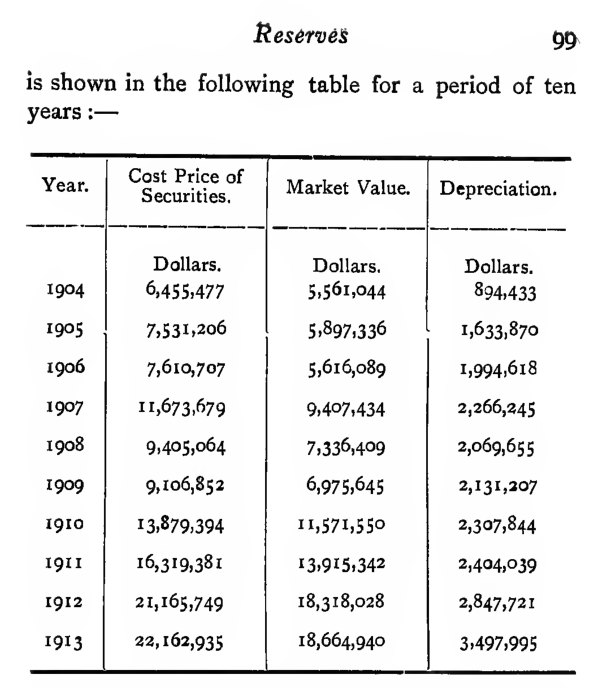
A reserve partly in securities can lose value. The Commissioners kept a Depreciation Fund against that, and Anthonisz prints at p. 99 the cost and the market value of their securities year by year.
| Year | Cost price (dollars) | Market value (dollars) | Depreciation (dollars) |
|---|---|---|---|
| 1904 | 6,455,477 | 5,561,044 | 894,433 |
| 1905 | 7,531,206 | 5,897,336 | 1,633,870 |
| 1906 | 7,610,707 | 5,616,089 | 1,994,618 |
| 1907 | 11,673,679 | 9,407,434 | 2,266,245 |
| 1908 | 9,405,064 | 7,336,409 | 2,069,655 |
| 1909 | 9,106,852 | 6,975,645 | 2,131,207 |
| 1910 | 13,879,394 | 11,571,550 | 2,307,844 |
| 1911 | 16,319,381 | 13,915,342 | 2,404,039 |
| 1912 | 21,165,749 | 18,318,028 | 2,847,721 |
| 1913 | 22,162,935 | 18,664,940 | 3,497,995 |
The cost price for 1911 is the same figure as the investments in the annual report for that year. The Blue Book for 1923 still has, among the Colony's receipts, the balance of an amount refunded by the Currency Commissioners to make good the depreciation in the securities of the Note Guarantee Fund.
1922: a fund larger than the note issue
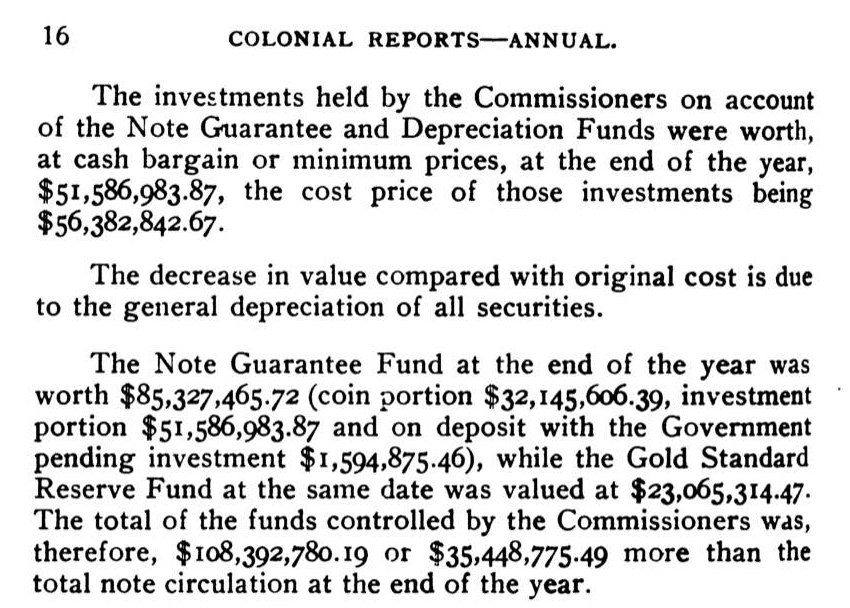
The annual report for 1922 (No. 1186, pp. 15 and 16) is the first read that values the whole fund. At the end of the year the coin reserve was 32,145,606.39 dollars: 328,251 pounds in gold and 8,848,419.53 dollars in silver in the Colony, and 2,389,754 pounds 2s. 8d. in gold in London. The Note Guarantee Fund was worth 85,327,465.72 dollars: the coin, an investment portion of 51,586,983.87 dollars at market value (it had cost 56,382,842.67 dollars) and 1,594,875.46 dollars on deposit with the Government waiting to be invested. The Gold Standard Reserve Fund was valued at 23,065,314.47 dollars. Together the funds the Commissioners controlled came to 108,392,780.19 dollars, which the report itself sets at 35,448,775.49 dollars more than the note circulation of 72,944,004.70 dollars.
1925 to 1935: the Currency Guarantee Fund and its surplus
| End of year | The Fund, as the report gives it (dollars) | Source |
|---|---|---|
| 1925 | Currency Guarantee Fund 194,950,265.24 | Annual report for 1925 |
| 1927 | excess of the Fund over the note circulation 46,123,045.32 | Annual report for 1928 |
| 1928 | liquid portion 68,706,907.05 and investment portion 102,959,862.97 (cost 104,216,567.10); excess over the note circulation 56,030,495.82 | Annual report for 1928, p. 18 |
| 1934 | excess over the note circulation 72,652,450.84 | Annual report for 1935 |
| 1935 | liquid portion 42,486,648.64; investments 103,487,499.96; cash awaiting investment 1,229,895.64; cash at bank 31,806.43; excess over the note circulation 70,114,981.42 | Annual report for 1935 |
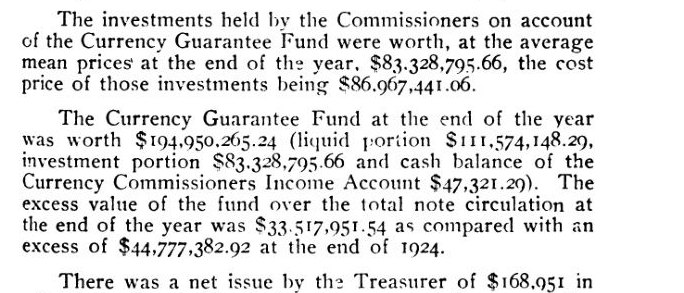
The report for 1928 prints the liquid portion twice and differently: 68,624,647.43 dollars in one sentence and 68,706,907.05 dollars in the next paragraph, without explaining the difference. Its first figure is made up of 328,251 pounds in gold, 16,321,765.71 dollars in silver and 2,736,154.75 dollars on deposit with the Government, held locally, and 73,330 pounds in gold and 5,381,203 pounds 16s. 3d. in sterling and short dated investments in London. In the figure for the excess in 1928 one digit is weak on the page. The liquid portion of 1935 held 10,344,109.32 dollars in silver, 2,306,798.18 dollars on deposit with the Government and 3,480,836 pounds 9s. 4d. in sterling and short dated investments in London.
In 1932 the gold went. The annual report for that year says that, with gold at a high premium in terms of sterling, the Commissioners took the chance to sell the gold held locally and in London, 401,582 pounds of it, at a profit of 1,126,433.33 dollars.
Parts of the Fund were taken into the Colony's revenue. The revenue pages of the Blue Books enter a "part balance of Currency Guarantee Fund transferred" to revenue: an entry in 1925 whose amount was not read, 19,000,000 dollars in 1929 and 10,000,000 dollars in 1932. The Blue Book for 1938 enters 33,437,129.45 dollars as a transfer of currency profits up to 30th September 1933, and 80,798 dollars as reimbursements from the Currency Commissioners for services rendered from 1st October 1933 to 31st December 1938. The Blue Book for 1922 has one more item from the Commissioners: 91,500 dollars, the cost of the old currency vault, refunded by the Commissioners.
What the accounts do not show
- The fund is never set against the notes value by value: no account says how many 50 dollars or 100 dollars notes it covered.
- No account for 1912 to 1921, the years of the war and of the notes that could not be cashed for coin, was read. The Blue Book for 1917 has only a suspense item of 1,704,082.33 dollars under the Currency Commissioners.
- The year in which the coin minimum fell from two-thirds to one-half, and the law that made it two-fifths of the circulation.
- The amount taken into revenue in 1925.
Sources
- Blue Books of the Straits Settlements for 1904, 1907, 1908 and 1910 (Treasury statements and Currency returns), and for 1915, 1917, 1919, 1922, 1923, 1925, 1929, 1932 and 1938.
- J. O. Anthonisz, Currency Reform in the Straits Settlements (a copy printed in 1915 or later), pp. 7, 43, 50, 73, 78, 99, 112 and 118.
- Colonial Reports, Annual, Straits Settlements: the reports for 1911, 1922 (No. 1186, pp. 15 and 16), 1925, 1928 (No. 1454, pp. 8 and 18), 1932 and 1935.
Member comments
Log in or register to post a comment.