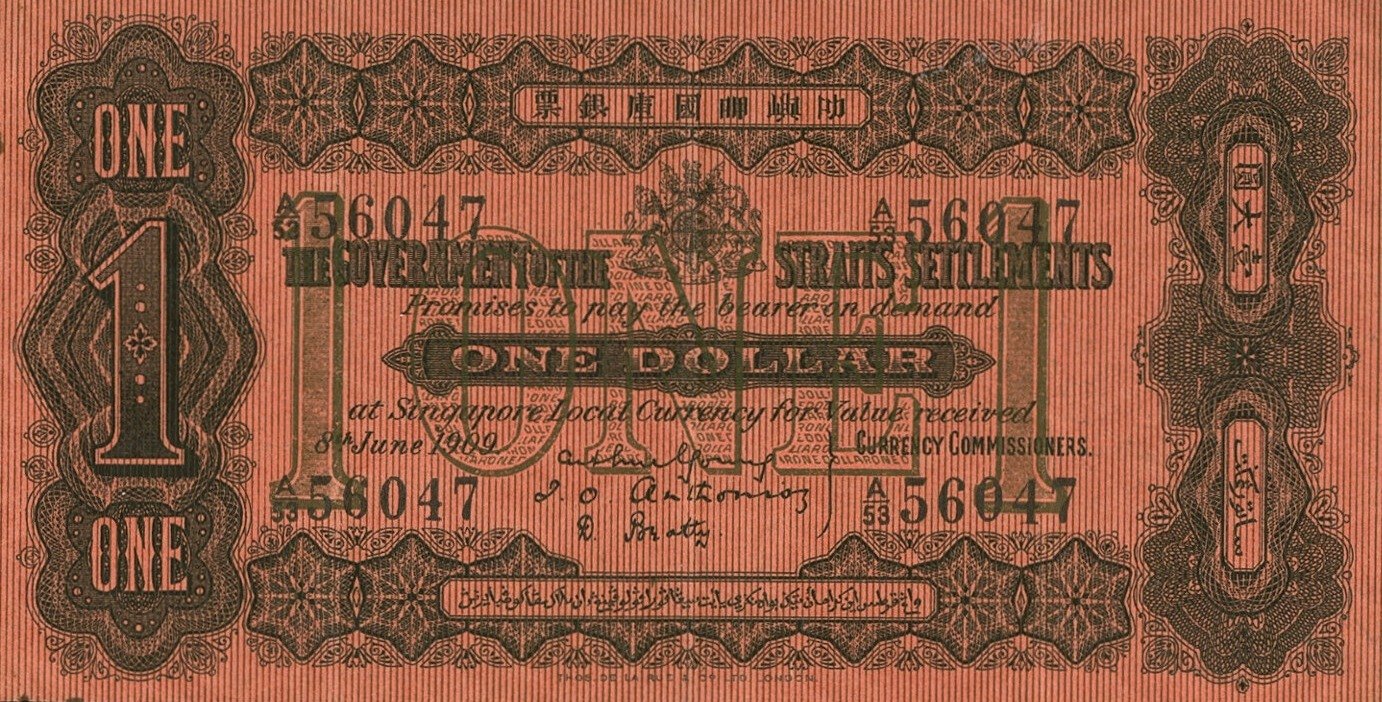
This article lists, in order of time, each law behind the currency notes of the Straits Settlements that the sources name: the lists of Ordinances in the Colony's Blue Books, J. O. Anthonisz's Currency Reform in the Straits Settlements, the texts of the Ordinances of 1897, 1899, 1923 and 1938, the Perak Government Gazette, the Colonial Office List and Money in British East Asia (1957). The short account is in The Government notes of the Straits Settlements, 1898 to 1948. Here every law has its number and day where a source gives them, and the points on which two sources differ are set side by side.
Before the Government issue: the banks and Perak, 1881 to 1895
Money in British East Asia (1957) says that under Ordinance X of 1881 the Hongkong and Shanghai Banking Corporation joined the two chartered banks as an issuer in the Colony. It could issue notes of 5 dollars and multiples of 5 dollars, never more than its paid-up capital, payable in current coin at the place of issue, Singapore or Penang.
The Malay States had no notes of their own. The Perak Government Gazette of 1890 prints an Order in Council (No. 10 of 1890) under which no bank might issue, without the consent of the Governor of the Straits Settlements, a note promising payment at any place in the State. In the Perak Government Gazette of 1893 the Resident writes of having several times in eight years recommended Government notes for the Native States, which then depended on the notes of the Chartered and Hongkong banks: the supply was too small and it had no one dollar note. The Gazette of 1895 records that on 12th June 1895 the State Council approved the proposed scheme for a combined Government note issue by the Straits Settlements.
The table of laws
| Date | Law or order | What it did | Source |
|---|---|---|---|
| 1881 | Ordinance X of 1881 | Let the Hongkong and Shanghai Bank issue notes of 5 dollars and multiples | Money in British East Asia (1957) |
| 1890 | Perak Order in Council No. 10 of 1890 | No bank note payable in Perak without the Governor's consent | Perak Government Gazette, 1890 |
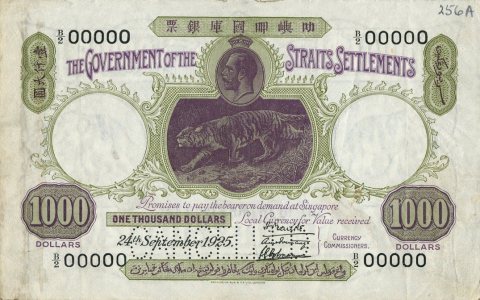
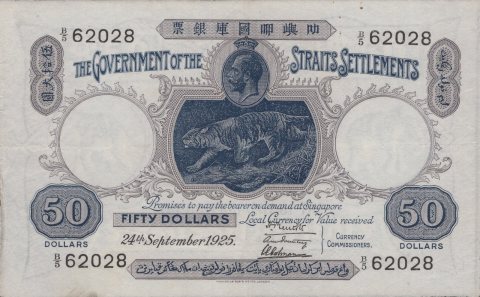
| 2nd September 1897 | Ordinance No. VIII of 1897 | Board of three Commissioners of Currency: the Colonial Secretary, the Treasurer and one person named by the Governor. Notes of 1, 5, 10, 20, 50 and 100 dollars and multiples of 100. The 1 dollar legal tender only up to 10 dollars | Text of the Ordinance (p. 1653) |
| 28th February 1899 | Currency Note Ordinance 1899, No. IV of 1899 | Repealed and re-enacted the Ordinance of 1897 with changes. The same Board, with its office at Singapore, and the same values | Text of the Ordinance (p. 9) |
| 1899 | Ordinance XIV of 1899 | No bank note to be issued payable to bearer on demand | Money in British East Asia (1957) |
| 18th March 1904 | Ordinance IV of 1904 | Allowed notes to be issued against gold. Never used | Anthonisz; Blue Book for 1904 |
| 1905 | Ordinance III of 1905 | Also allowed notes to be issued against gold. Never used | Anthonisz |
| 29th January 1906 | Ordinance I of 1906 | Notes issued against gold at 7 pounds for 60 dollars, which fixed the dollar at 2s. 4d. | Anthonisz |
| 14th September 1906 | Ordinance XXII of 1906 | Gold, or transfers on London, might be paid out for notes | Anthonisz |
| 22nd October 1906 | Ordinance XXVI of 1906 | Power to pay notes in gold from a day to be published in the Gazette | Anthonisz |
| 1907 | Perak Legal Tender Enactment 1907, No. 7 of 1907 | Straits notes legal tender in Perak for any amount. No bank to issue notes payable to bearer on demand in the State | Perak Government Gazette, 1907 |
| 2nd December 1908 | Ordinance XXVII of 1908 | Part of the reserve might be held in gold in London | Anthonisz; Blue Book for 1908 |
| 1913 and 1915 | The reserve rules of 1913, given final effect by Ordinance V of 1915 | New rules for the reserve | Anthonisz |
| 7th September 1917 | Ordinance No. 18 of 1917 | Amended the Currency Note Ordinance 1899. The authority for a note that could not be cashed for coin | Blue Book for 1917, p. H 3; Money in British East Asia (1957), p. 15 |
| 3rd October 1917 | Ordinance No. 23 of 1917 | A second amendment of the Ordinance of 1899 | Blue Book for 1917, p. H 3 |
| 7th December 1917 | Order under the Currency Note (Amendment) Ordinance 1917 | Postponed the redemption of currency notes | Blue Book for 1917, p. H 4 |
| 6th March, 6th June, 6th September and 5th December 1919 | Orders under the same Ordinance | Postponed the encashment of currency notes again | Blue Book for 1919 |
| 1920 | Ordinance No. 147 (Currency Note), Revised Edition of 1920, sections 5 and 6 | Notes of 5, 10, 25 and 50 cents allowed beside the dollar values. Notes of 5, 10 and 25 cents legal tender only up to 2 dollars | Text of the Revised Edition |
| 26th September 1923 | Currency Ordinance 1923, No. 15 of 1923 | Consolidated the law. The same Board of three. A Currency Guarantee Fund. The 10 and 25 cents still limited to 2 dollars | Text of the Ordinance; Blue Book for 1923 |
| 30th September 1923 | Proclamation under the Currency Ordinance 1923 | Fixed the day the Ordinance came into force | Blue Book for 1923 |
| 8th October 1938 | Currency Ordinance 1938, No. 23 of 1938 | Set up the Board of Commissioners of Currency, Malaya, of up to five persons. The Governor might demonetise notes by proclamation | Text of the Ordinance |
| 21st October 1938 | Notification No. 2999 | The Ordinance of 1938 came into force | Blue Book for 1938 |
| 1st April 1946 | Currency (Transitional Amendment) Ordinance, 1946 | The Financial Secretary of the Malayan Union and the Financial Secretary, Singapore, became the Board | Malayan Union annual report for 1947, p. 24 |
| 23rd August 1948 | Proclamations in Singapore, Penang, Malacca, Kedah and Perlis, and under section 6 of the Currency Enactments of the other States | All notes of the Government of the Straits Settlements, and all notes dated before 1st July 1941, no longer legal tender after 31st August 1948 | Colonial Office List, 1951 |
The Blue Books give only the title and the day of each Ordinance, not its text. The annual reports for 1928 and 1930 both say that no change was made in the currency legislation during the year, and the report for 1922 lists no Ordinance on currency.


1897 or 1899: which law the first notes came under
The notes dated 1st September 1898, the large 5 dollars, the 10 dollars, the 50 dollars and the 100 dollars, carry a date between the two Ordinances. The sources do not tell the story in the same way.
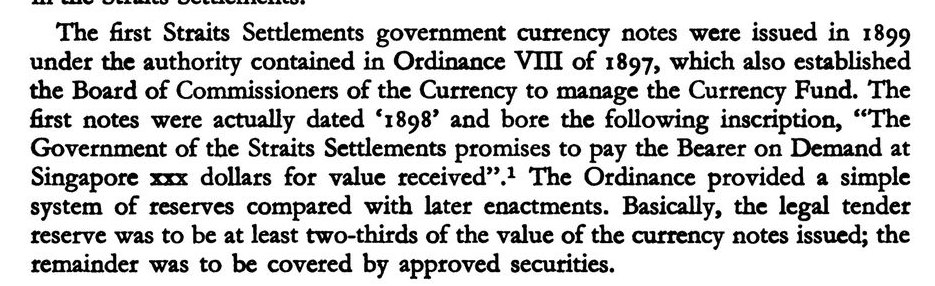
- Money in British East Asia (1957), p. 8, says the first notes were issued in 1899 under the authority of Ordinance VIII of 1897, which also set up the Board, and that the notes were dated 1898. The same book, p. 9, calls Ordinance No. IV of 1899 the real basis of all later currency law and says it became effective in 1900.
- Anthonisz, who was Treasurer and a Commissioner, names only Ordinance No. 4 of 1899 and never mentions the Ordinance of 1897. Anthonisz gives no day or place of first issue.
- The text of the Ordinance of 1899 says it repeals and re-enacts the Ordinance of 1897 with amendments. It does not say whether any note had been issued by then.
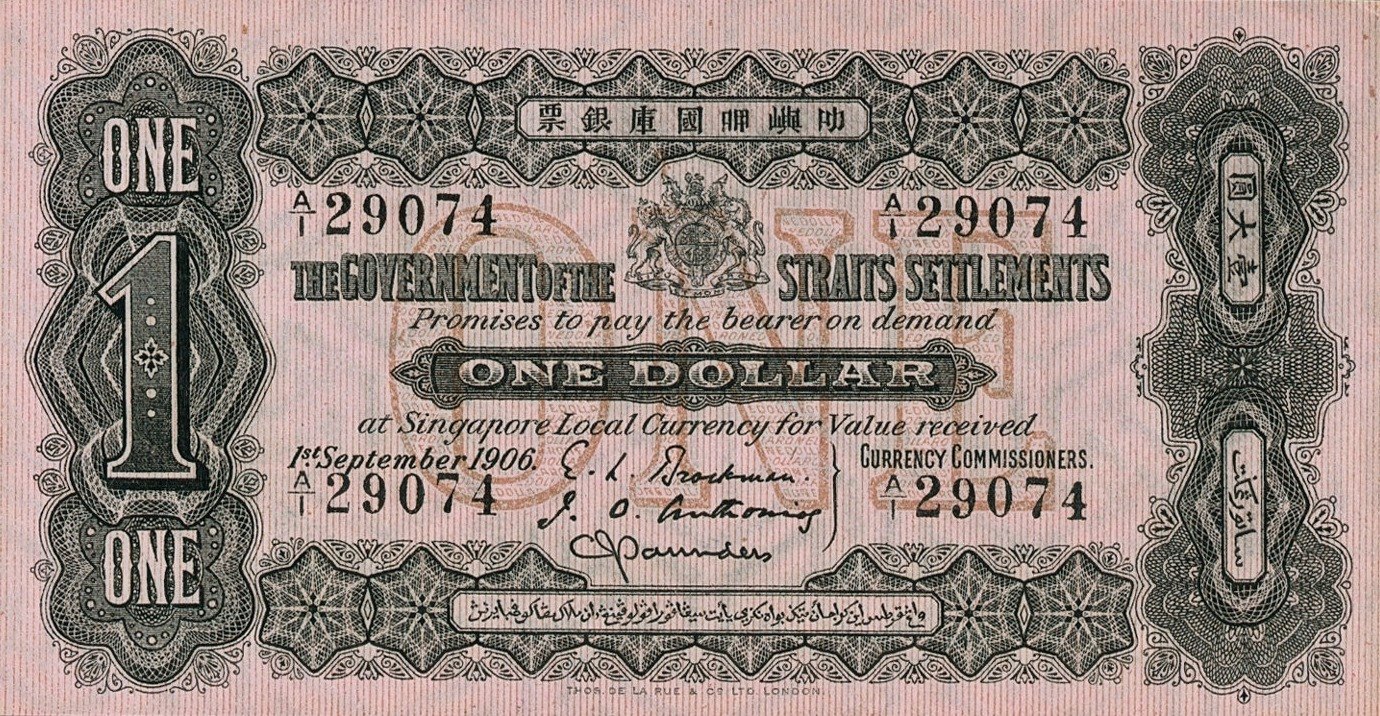
Anthonisz adds, at p. 8, that no one dollar notes were issued until 1905. The same book twice gives 1906 elsewhere (p. 50 and a footnote on p. 118), which is the date on the 1 dollar note. In the same set of measures of 1906 the limit of 10 dollars on its legal tender was taken off.
The banks' right to issue ends
Money in British East Asia (1957) says the Chartered Bank's authority to issue notes expired in December 1904 and that of the Hongkong and Shanghai Bank in August 1908. The same book notes that the Ordinance of 1923 does not name bank notes in its list of legal tender money, but that they remained legal tender until 1938, and that the banks went on paying bank note duty on the notes still out until 1950. An Economic Survey of the Colonial Empire for 1932 puts it differently: the banks had ceased to issue notes years before, but their existing notes remained legal tender until withdrawn. How many of those notes stayed out is in The Straits Settlements note issue in the Blue Books and annual reports, 1901 to 1938.
The small notes and the law
The 10 cents of 1917 to 1920, the 25 cents of 1917 and the 10 cents of 14th October 1919 were not among the values of the Ordinance of 1899. The Malayan Year Book for 1939 says the 10 and 25 cents notes were issued under an Ordinance of 1917 because silver was short. The Revised Edition of 1920 shows the law as it then stood, with notes of 5, 10, 25 and 50 cents allowed. The amending Ordinance that first added the cents values has not been read, so it is not known whether it was No. 18 or No. 23 of 1917. No 5 cents or 50 cents note of the Straits Settlements is recorded in this catalogue.
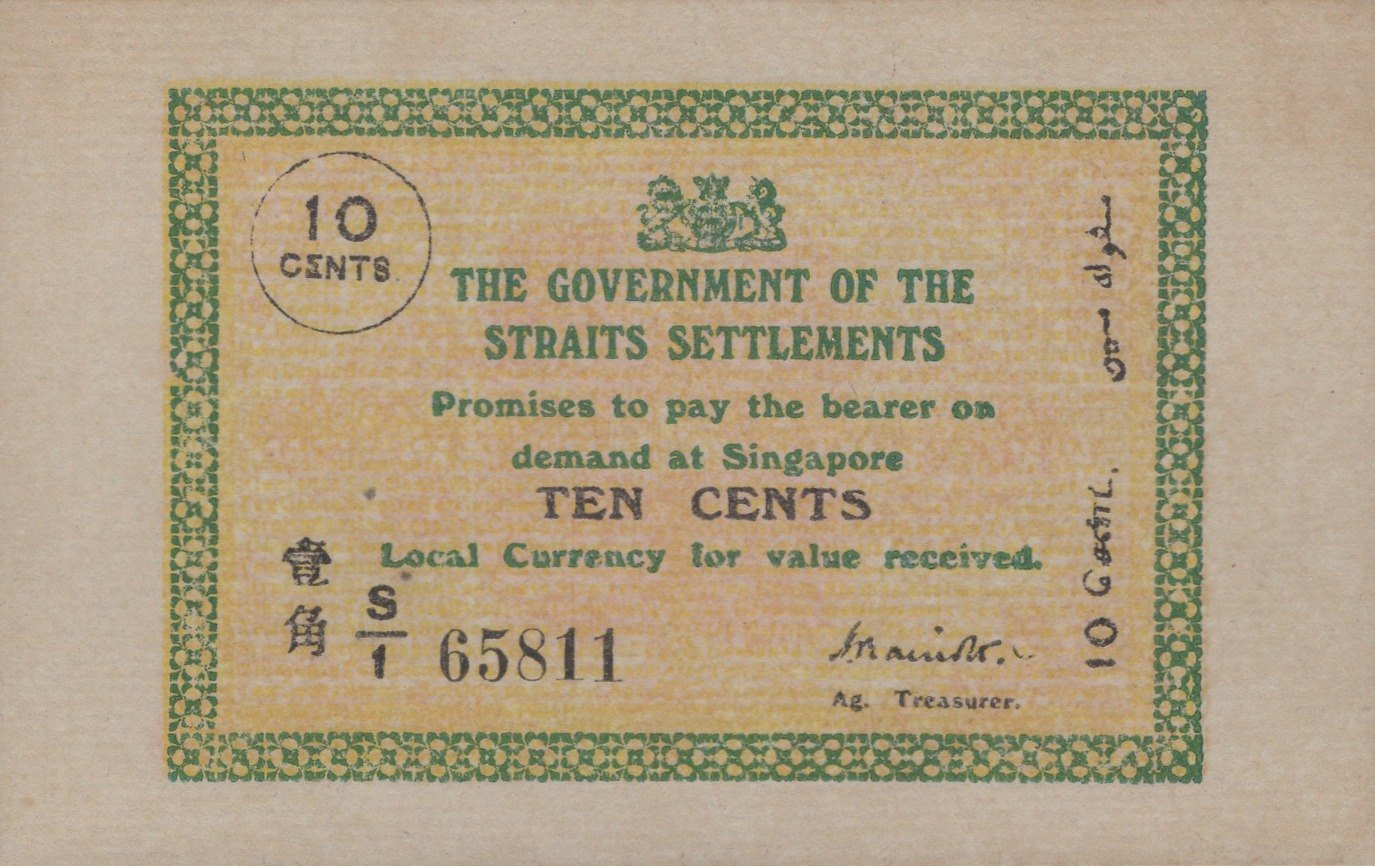
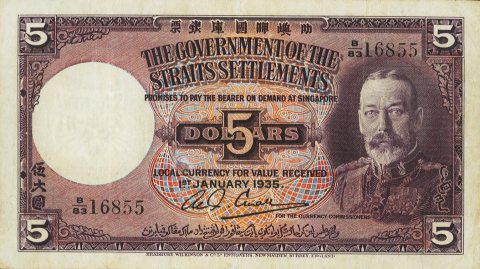
The Blue Book for 1935 still states the rule: notes of 1 dollar and upwards are legal tender for any amount, except when tendered by the Commissioners at their own offices, and the notes of 10 and 25 cents, "not now issued", are legal tender up to two dollars.
The Ordinance of 1938: No. 22 or No. 23
The Blue Book for 1938 twice gives the Currency Ordinance as No. 23 of 1938, in force from 21st October 1938, and so do the Singapore annual report for 1950 and Money in British East Asia (1957), p. 22. The Singapore annual report for 1951, describing the law that replaced it, calls it No. 22 of 1938. Four places stand against one. The Malay States' annual reports for 1938 (Trengganu and Johore) still describe their currency as that of the Straits Settlements and do not mention the new Ordinance or the new Board.
31st August 1948: four wordings
The sources agree on the date and not quite on what it means.
| Source | Wording |
|---|---|
| Colonial Office List, 1951 | "no longer legal tender in the Federation after 31st August, 1948" |
| Singapore annual report for 1948 | ceased to be legal tender "from and after the 31st August, 1948" |
| Colonial Office Lists of 1955 to 1962 | "demonetized on 31st August, 1948" |
| Money in British East Asia (1957), p. 140 | ceased to be legal tender "with effect from 31st August, 1948" |
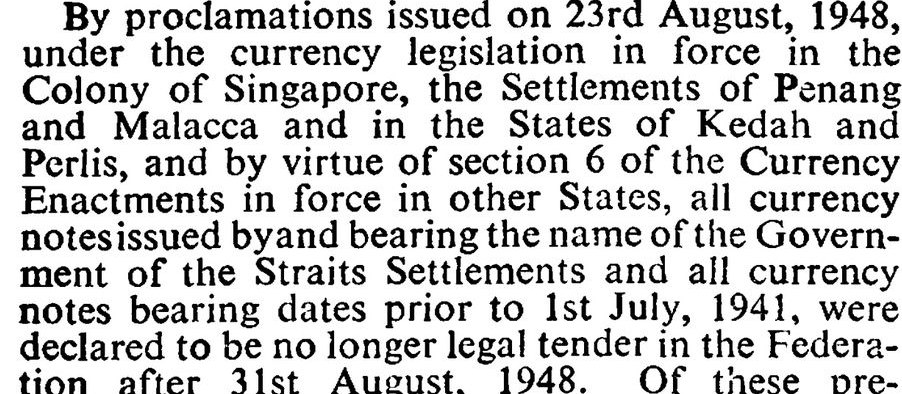
So 31st August 1948 is either the last day of legal tender or the first day without it. The catalogue's pages give the date and follow the wording of the Colonial Office List of 1951. What became of the notes after that day is in The Straits Settlements notes after the fall of Singapore, 1942 to 1954.
The notes in the Malay States
The Supplement to the Perak Government Gazette of 1904 says that in currency matters the States were following the lead of the Straits Settlements, and that Straits currency notes were recognised as legal tender within the usual limits. Section 5 of the Perak Legal Tender Enactment 1907 treats the notes of the Government of the Straits Settlements as equal to the standard coin and makes them legal tender for any amount. The annual report on the Federated Malay States for 1931 says the notes of the Straits Settlements Currency Commissioners were legal tender to any amount throughout the Federation. The reports on Kedah, Perlis, Johore, Kelantan and Trengganu that were read, of years from 1928 to 1938, say that the currency is that of the Straits Settlements, and those on Brunei add that there are currency notes from 1 dollar upwards. The Malayan Union's report for 1946 adds that a currency exchange office had worked in Kuala Lumpur since 1st July 1923, giving banks new notes and coin for old and changing old notes for the public.
The Perak papers also hold a few traces of bad notes. The Supplement to the Gazette of 1903 says several currency notes that had been tampered with were presented, though none was passed for more than its face value. A list of gifts to the Perak Museum in the Supplement of 1906 has three forged 5 dollars Government notes from the Deputy Commissioner of Police, Perak, and one more from a private giver; this list was read in machine text only and the names in it are not sure. The forged and altered notes that have rows in the catalogue are in Forged and altered notes of the Straits Settlements, 1901 to 1935.
What the sources do not give
- The text of the two Ordinances of 1917, and the day on which notes could again be cashed for coin. The Blue Book for 1919 shows the orders renewed to December 1919 and no source read gives the end.
- The Ordinance or the day that changed the reserve rule to the two-fifths of the report for 1928. The reserve is the subject of What stood behind a Straits Settlements note.
- The Gazette notice of the proclamations of 23rd August 1948 itself. The Colonial Office List gives their effect.
Sources
- Ordinance No. VIII of 1897 (passed 2nd September 1897) and the Currency Note Ordinance 1899 (No. IV of 1899, 28th February 1899), texts.
- Ordinance No. 147 (Currency Note), Revised Edition of 1920, sections 5 and 6.
- Currency Ordinance 1923 (No. 15 of 1923, assent 26th September 1923) and Currency Ordinance 1938 (No. 23 of 1938, assent 8th October 1938), texts; Notification No. 2999.
- Blue Books of the Straits Settlements for 1904, 1908, 1917 (pp. H 3 and H 4), 1919, 1923, 1935 and 1938.
- J. O. Anthonisz, Currency Reform in the Straits Settlements (a copy printed in 1915 or later), pp. 7, 8, 50 and 118.
- Perak Government Gazette, 1890, 1893, 1895 and 1907; Supplements to the Perak Government Gazette, 1903, 1904 and 1906.
- Annual reports on the Straits Settlements for 1922, 1928 and 1930; on the Federated Malay States for 1931; on Trengganu and Johore for 1938; Malayan Union annual reports for 1946 and 1947; Singapore annual reports for 1948, 1950 and 1951.
- Malayan Year Book, 1939.
- An Economic Survey of the Colonial Empire (1932).
- Colonial Office List, 1951, and the Lists of 1955 to 1962.
- Money in British East Asia (1957), pp. 6, 8, 9, 15, 18, 22 and 140.
Member comments
Log in or register to post a comment.