This article follows the currency notes of the Government of the Straits Settlements from the first law of 1897 to the proclamations of 1948 that ended them. It is put together from the Pick pages of this catalogue, which rest on the Colony's Blue Books and annual reports, on the writing of J. O. Anthonisz, a Treasurer of the Colony, on Chalmers' History of Currency in the British Colonies (1893) and on Money in British East Asia (1957). The yearly figures are set out in Notes in circulation in the Straits Settlements, 1891 to 1935, and the signers in The signers of the Straits Settlements notes, 1898 to 1935.
Before the Government notes, and the Ordinances of 1897 and 1899
Before the Ordinance of 1897 the Colony had no government notes. Chalmers' History of Currency in the British Colonies (1893) counts 5,949,833 dollars in notes of the Mercantile, Chartered and Hongkong and Shanghai banks in circulation on 31st December 1891, none of them legal tender. Chalmers also says that when the Oriental Bank failed in 1884 the Straits government, unlike Ceylon's, did not guarantee its notes, which the other banks cashed.
The first currency note law was Ordinance No. VIII of 1897, passed on 2nd September 1897. It was replaced with changes by the Currency Note Ordinance 1899 (No. IV of 1899, 28th February 1899). Both named three Commissioners of Currency: the Colonial Secretary, the Treasurer and one member named by the Governor. That is why the notes carry three signatures. The Monetary Authority of Singapore, in its History of Currency in Singapore, likewise dates the forming of the Board of Commissioners of Currency, Straits Settlements, to 1897 and its first government note to 1899.
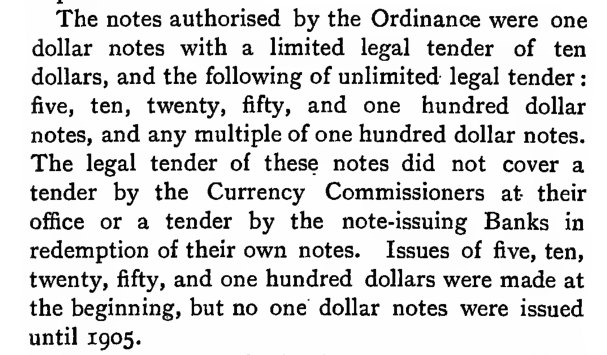
The 1899 Ordinance allowed notes of 1 dollar (legal tender up to 10 dollars only), 5, 10, 20, 50 and 100 dollars and multiples of 100 dollars. It followed the Ordinance drawn up for Ceylon. The notes were covered in full by a Note Guarantee Fund, at least two-thirds of it in coin and the rest in securities; the share in coin was reduced to one-half a few years later. J. O. Anthonisz credits the issue to Alexander Swettenham, the Colonial Secretary, and F. G. Penney, the Treasurer.
Later laws changed what stood behind a note. Under Ordinance I of 1906, passed on 29th January 1906, the Commissioners issued notes against gold at 7 pounds for 60 dollars, which fixed the dollar at 2s. 4d. Ordinance XXVII of 2nd December 1908 allowed part of the reserve to be kept in gold in London. By 1928 the rule was looser again: the Colony's annual report for that year gives the law's minimum as two-fifths of the notes in circulation, to be kept in liquid form, that is in coin in the Colony or in gold, cash and easily realisable securities in London.
The first notes, dated 1898 to 1901
Money in British East Asia (1957) says the first Government notes, dated 1898, were put into circulation in 1899, and gives the gross circulation of Government notes as 6,205,000 dollars in January 1901. The pages name no day of first issue. All of these notes were printed by Thomas de la Rue and Company.
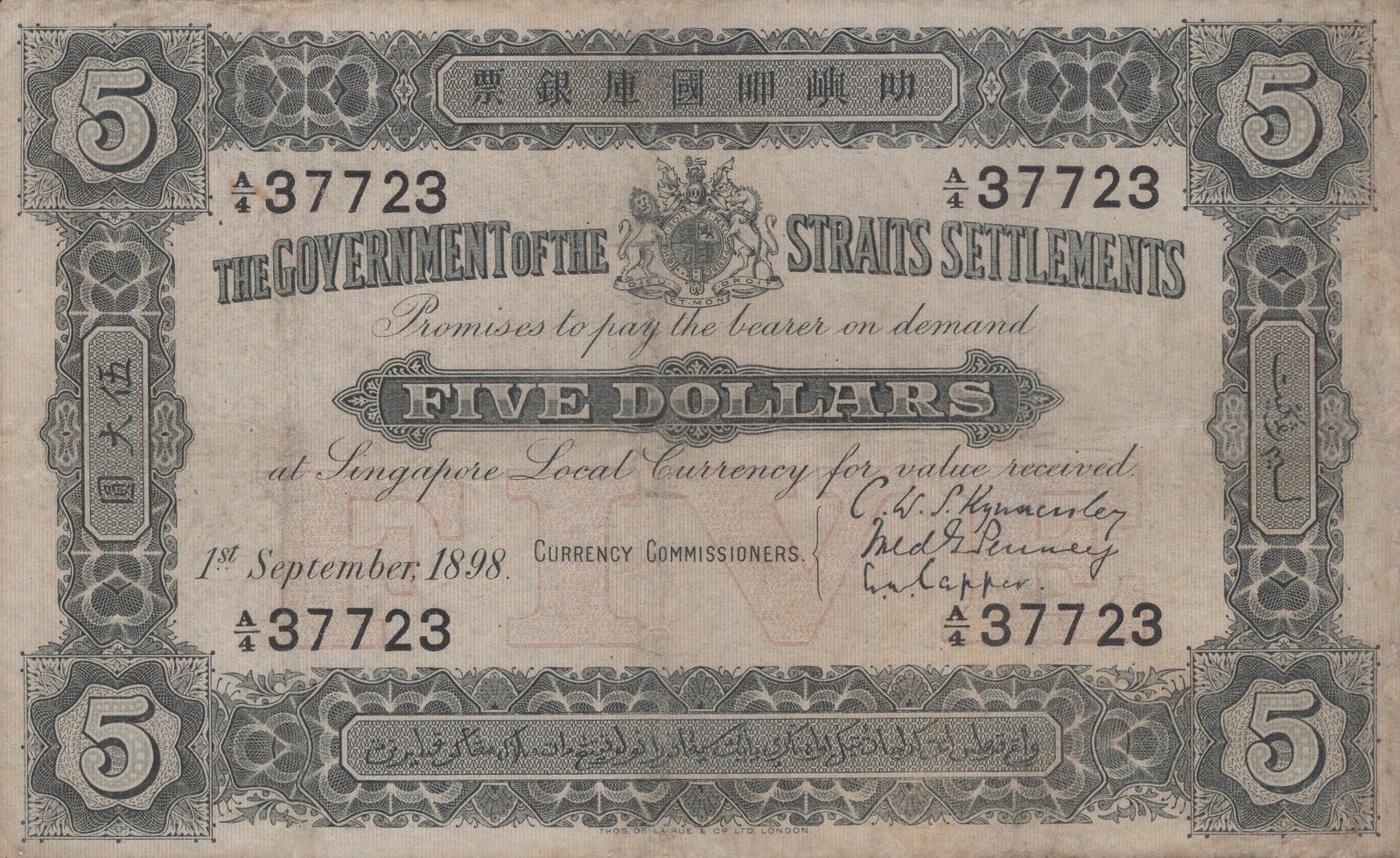
Four values are recorded with the date 1st September 1898:
- the large 5 dollars, 195 x 120 mm, dated 1st September 1898 and 1st March 1900;
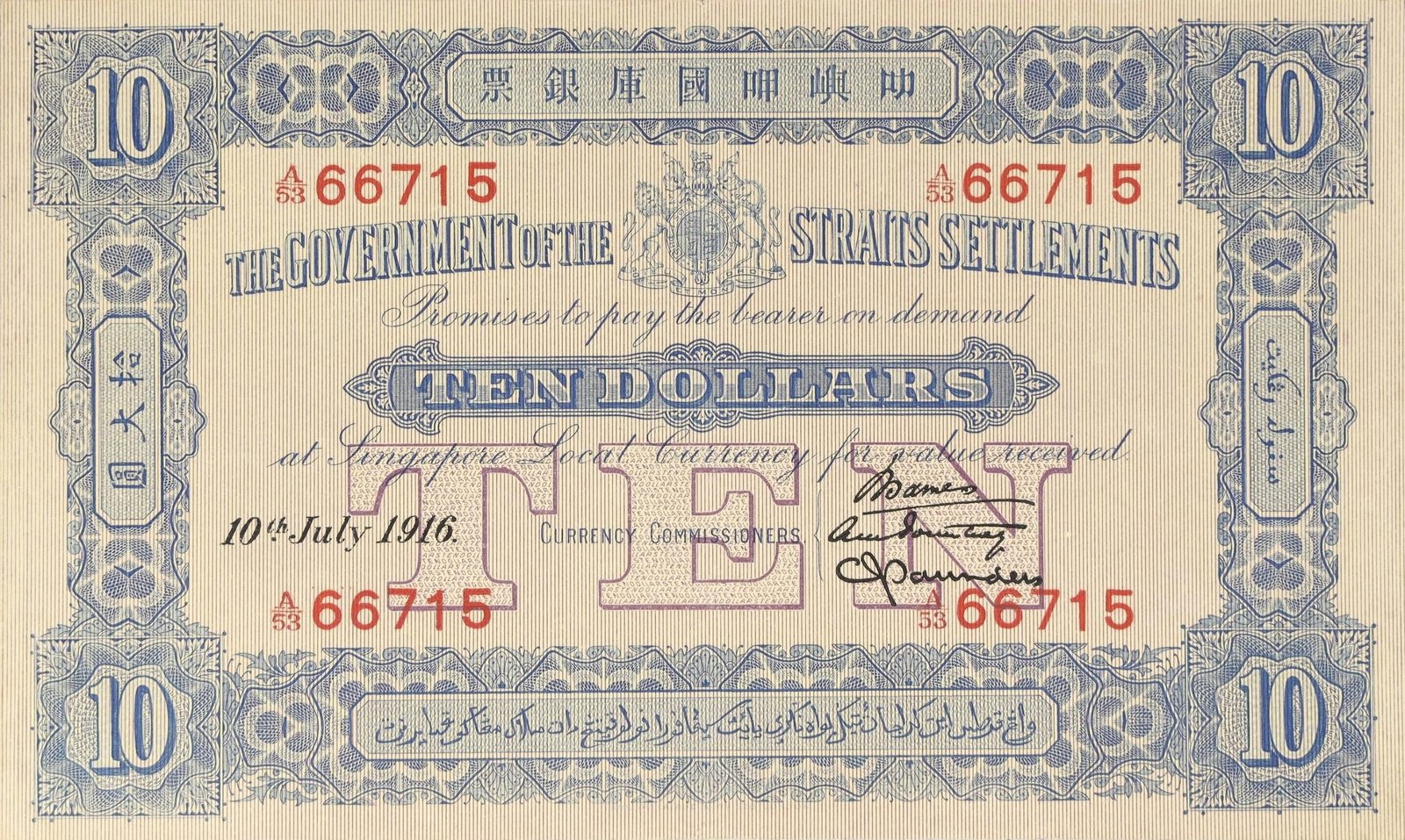
- the 10 dollars, which kept its large blue design through ten dates to 5th September 1924;
- the 50 dollars, dated 1st September 1898 and 1st February 1901;
- the 100 dollars, dated 1st September 1898, 1st February 1901 and 8th June 1909.
Anthonisz writes that 5, 10, 20, 50 and 100 dollars were issued at the beginning. No 20 dollars note has been recorded, and Anthonisz may be repeating the list in the Ordinance. Some dates are known only in part: no issued 50 dollars of 1898 and no issued 10 dollars of 1st March 1900 has been recorded (a specimen of the 10 dollars of that date has), and the 100 dollars of 1909 is recorded only as a specimen.
From 1st February 1901 the 5 dollars is the small note of 121 x 76 mm, on white paper in 1901 and on cream paper from 1909. It ran to 5th September 1924.
The 1 dollar of 1906
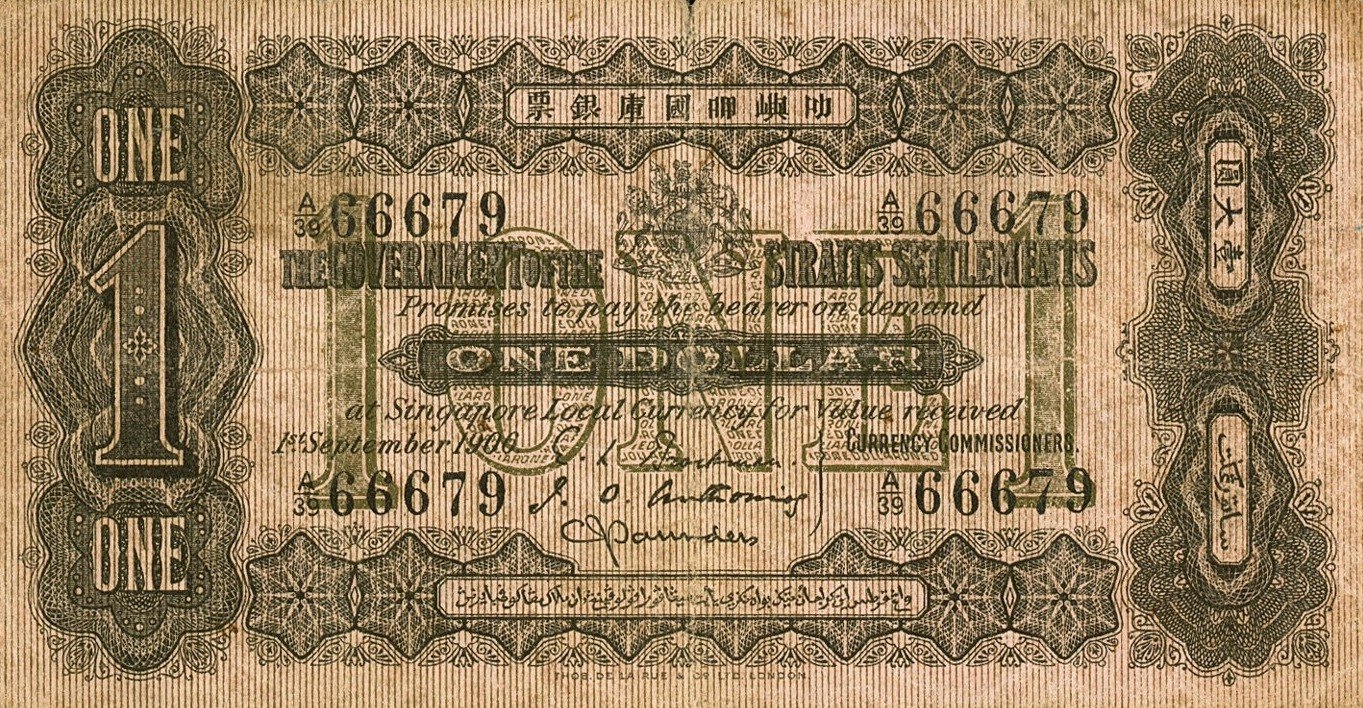
The Ordinance of 1899 already allowed a 1 dollar note, legal tender only up to 10 dollars, but none was issued until 1906, and by then the 1 dollar was unlimited legal tender like the higher notes. Anthonisz writes that the 1 dollar note was issued in 1906 to draw in the old silver dollars while they were recoined, and that by 1907 it had largely driven the silver dollar out of use. The notes were taken in Hong Kong and the China treaty ports at nearly their face value.
Three printings carry the date 1st September 1906: one in black on plain or pink paper, one on white paper with a large olive-green 1 at each side of the centre underprint, and one in black and olive green on red paper, which is the form the later dates kept. The 1, 5 and 10 dollars then share their dates: 8th June 1909, 17th March 1911, 2nd January 1914, 4th March 1915, 10th July 1916, 20th June 1921 and 5th September 1924. A 1,000 dollars of 17th March 1911 in the old design is known from specimens only.
The portrait notes for the high values, 1916 to 1933
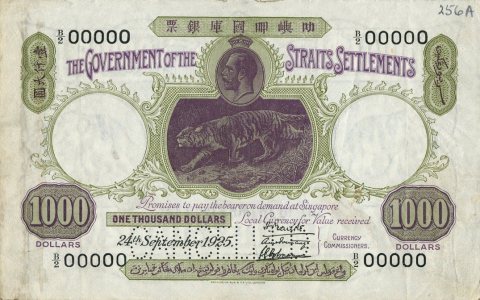
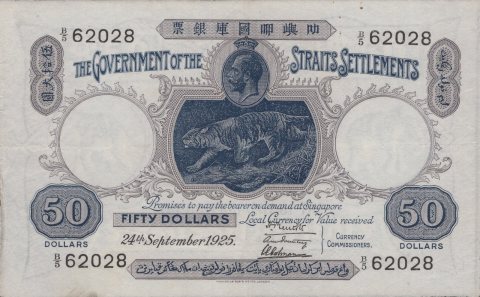
A new design, with the portrait of King George V above a tiger and a blank back, came in for the high values. The 50 dollars and the 100 dollars are dated 7th March 1916 and 1st June 1920. The same design continues with the 50 dollars of 1925 to 1933 and the 100 dollars of 1925 to 1933, dated 24th September 1925, 1st November 1927 and 8th December 1933, with 1st October 1930 as well for the 50 dollars.
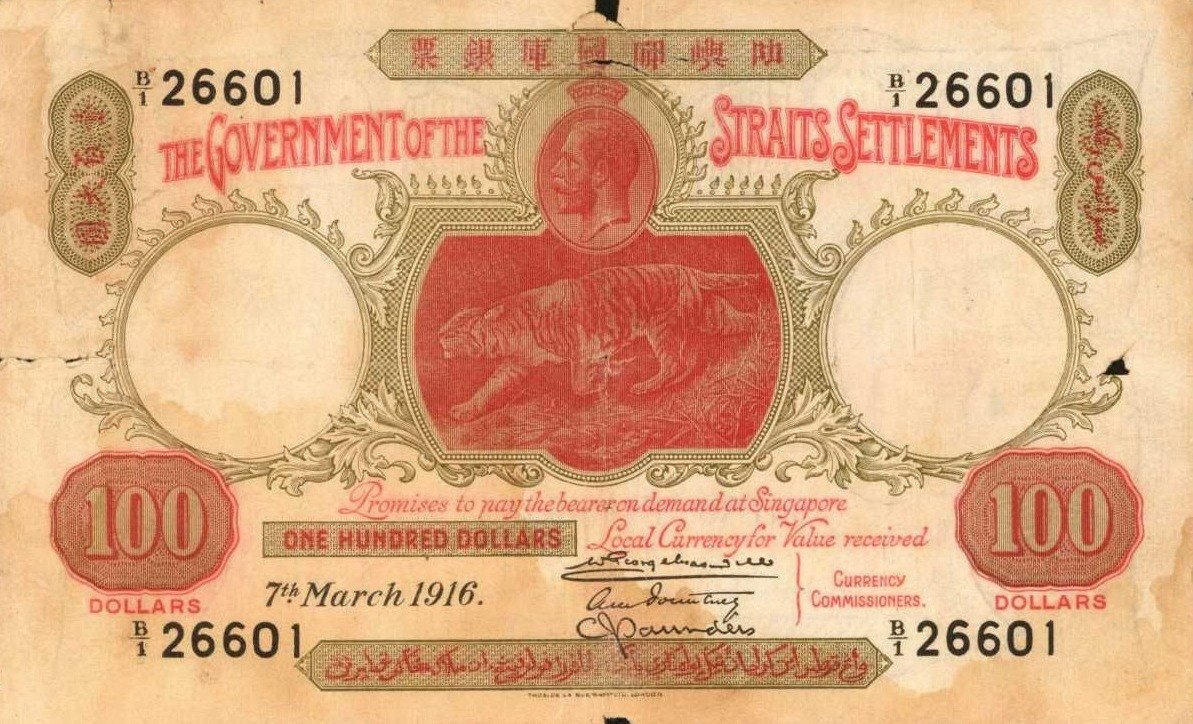
The 1,000 dollars and the 10,000 dollars in this design are dated 1st September 1919, 24th September 1925, 1st October 1930 and 8th December 1933. The annual report for 1928 says the 10,000 dollars was used mainly for the bankers' clearances. The page for that note adds that it was first printed in 1919 (a specimen and a proof carry the requisition mark 95/19) and introduced in October 1922; it names no source for the month. Both values are known only from specimens.
The war: small notes, and notes not payable in coin, 1917 to 1920
Three notes for less than a dollar belong to the war years. The 10 cents of 1917 to 1920 and the undated 25 cents of 1917 were printed by the Government Survey Office at Kuala Lumpur. The 10 cents dated 14th October 1919 was printed by Thomas de la Rue. The 10 and 25 cents notes were legal tender only up to 2 dollars.
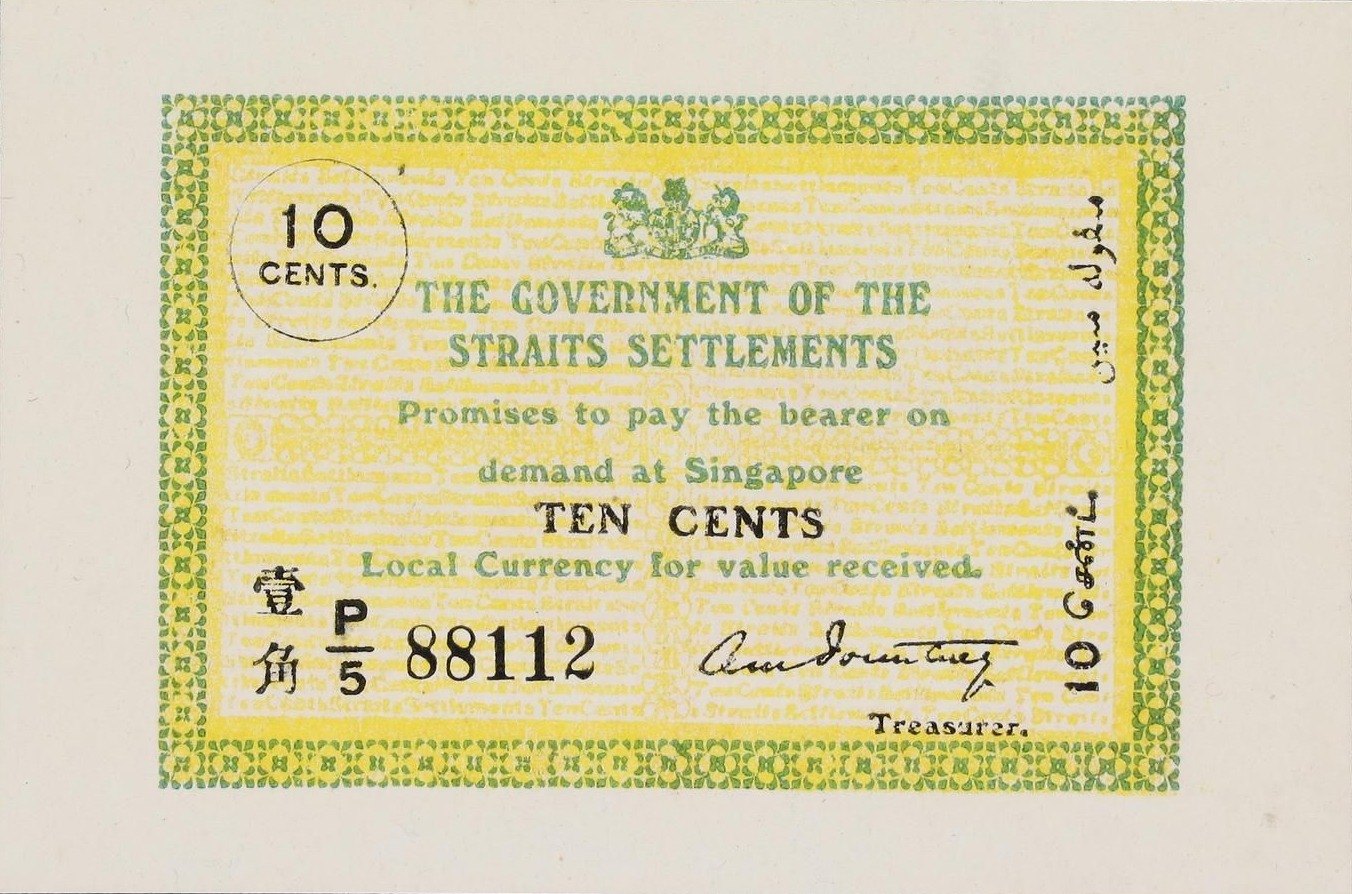
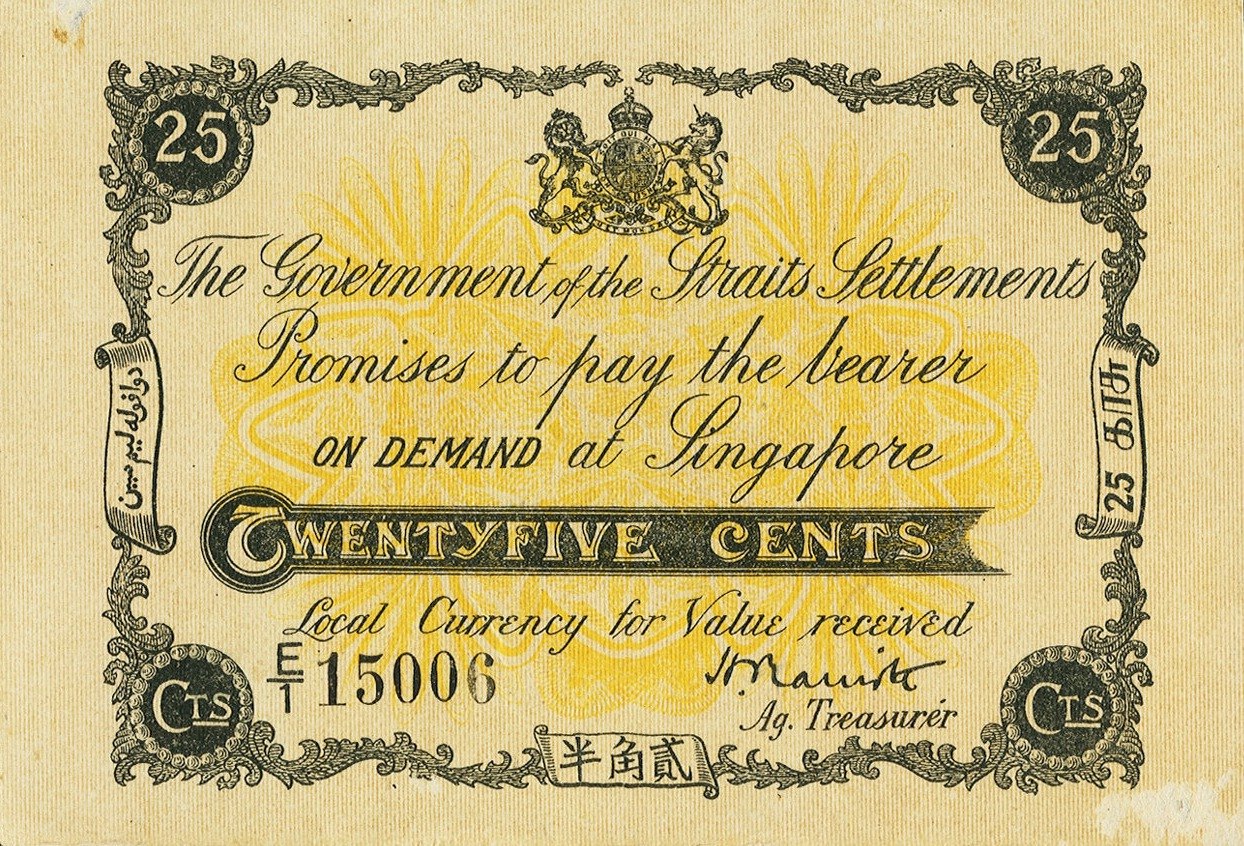
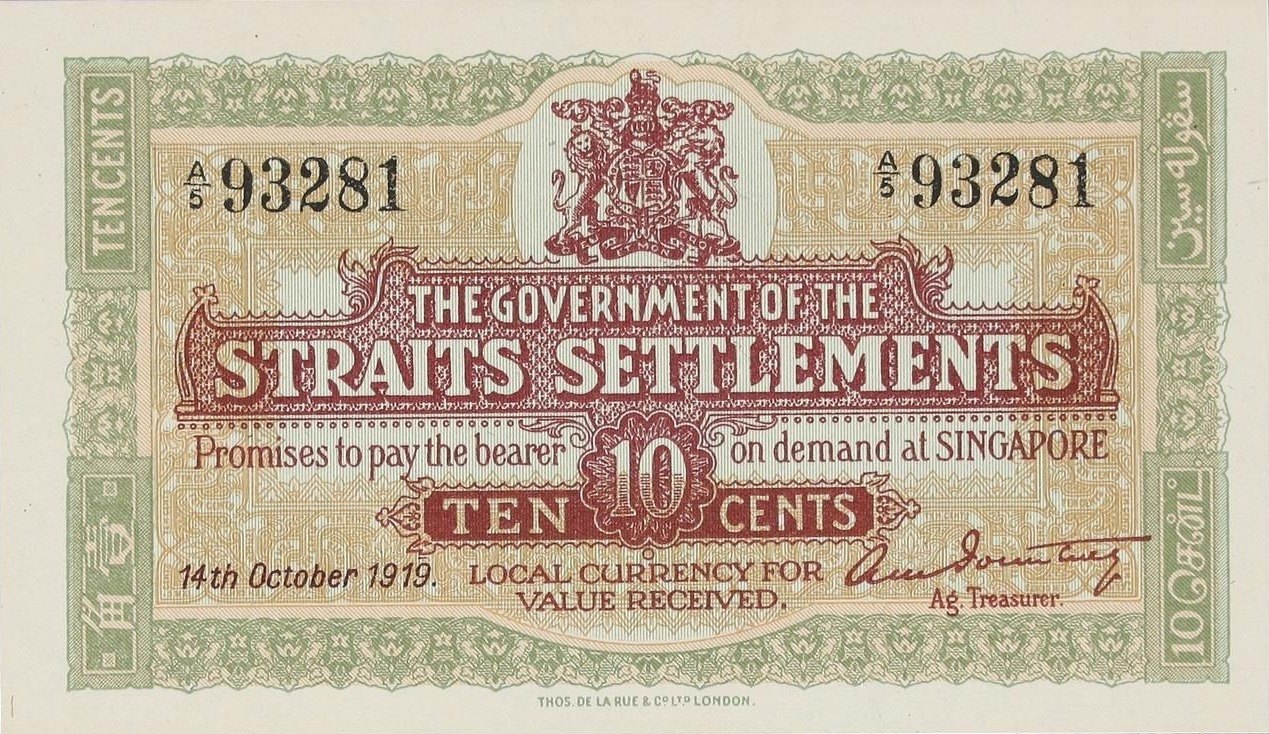
In the same years the notes could not be cashed for coin. Two Ordinances of 1917 amended the Currency Note Ordinance 1899: No. 18 of 7th September and No. 23 of 3rd October 1917. Under them an order of 7th December 1917 postponed paying out coin for currency notes, and the order was renewed every three months through 1919 (Blue Books for 1917 and 1919). Money in British East Asia (1957) names Ordinance No. 18 of 1917 as the authority for the inconvertible note.
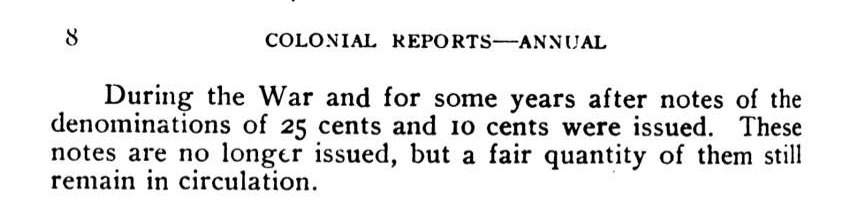
The report for 1928 says the 10 and 25 cents notes were no longer issued, though a fair quantity of them remained in circulation. How they came back and were destroyed is told in Ten cents on paper: how the Straits Settlements burnt its small notes, 1920 to 1928.
The series of 1925 and of 1931
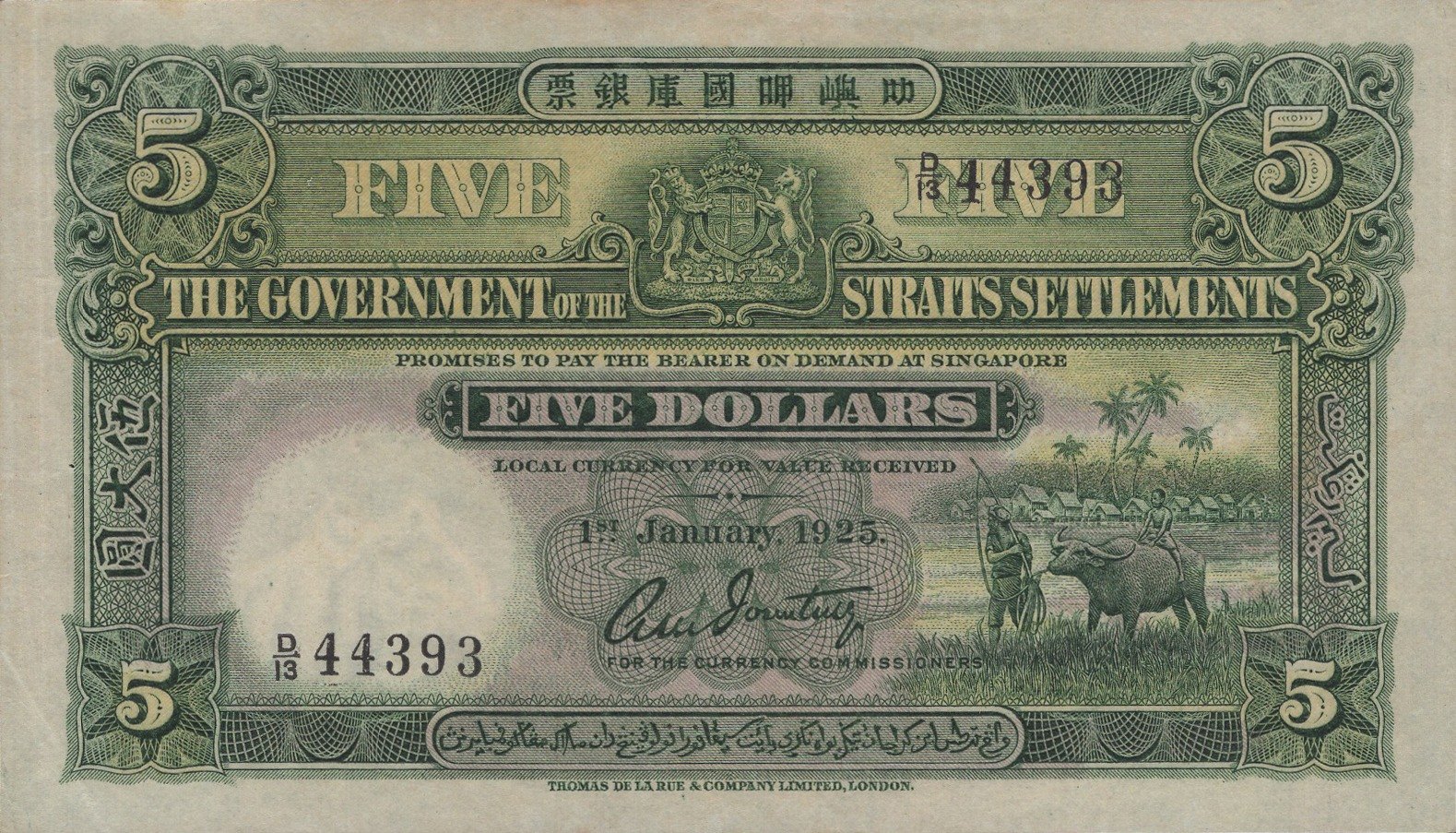
On 1st January 1925 the three lower values changed design: the 1 dollar, the 5 dollars and the 10 dollars, again by Thomas de la Rue. Their dates are 1st January 1925, 1st September 1927, 1st January 1929 and 1st January 1930. On the 1 dollar the first three dates are printed in red and on the 5 dollars in green, and the date of 1930 is in black on both. On the 10 dollars the page gives the date of 1925 in purple and that of 1930 in black. The 1 dollar of 1930 is on paper with security fibres.
These notes passed well beyond the Colony. The annual reports on Brunei for 1928 and 1929 say the currency there "is that of the Straits Settlements", with currency notes from 1 dollar upwards, and the report on Kelantan for 1928 says Straits Settlements currency was in use.
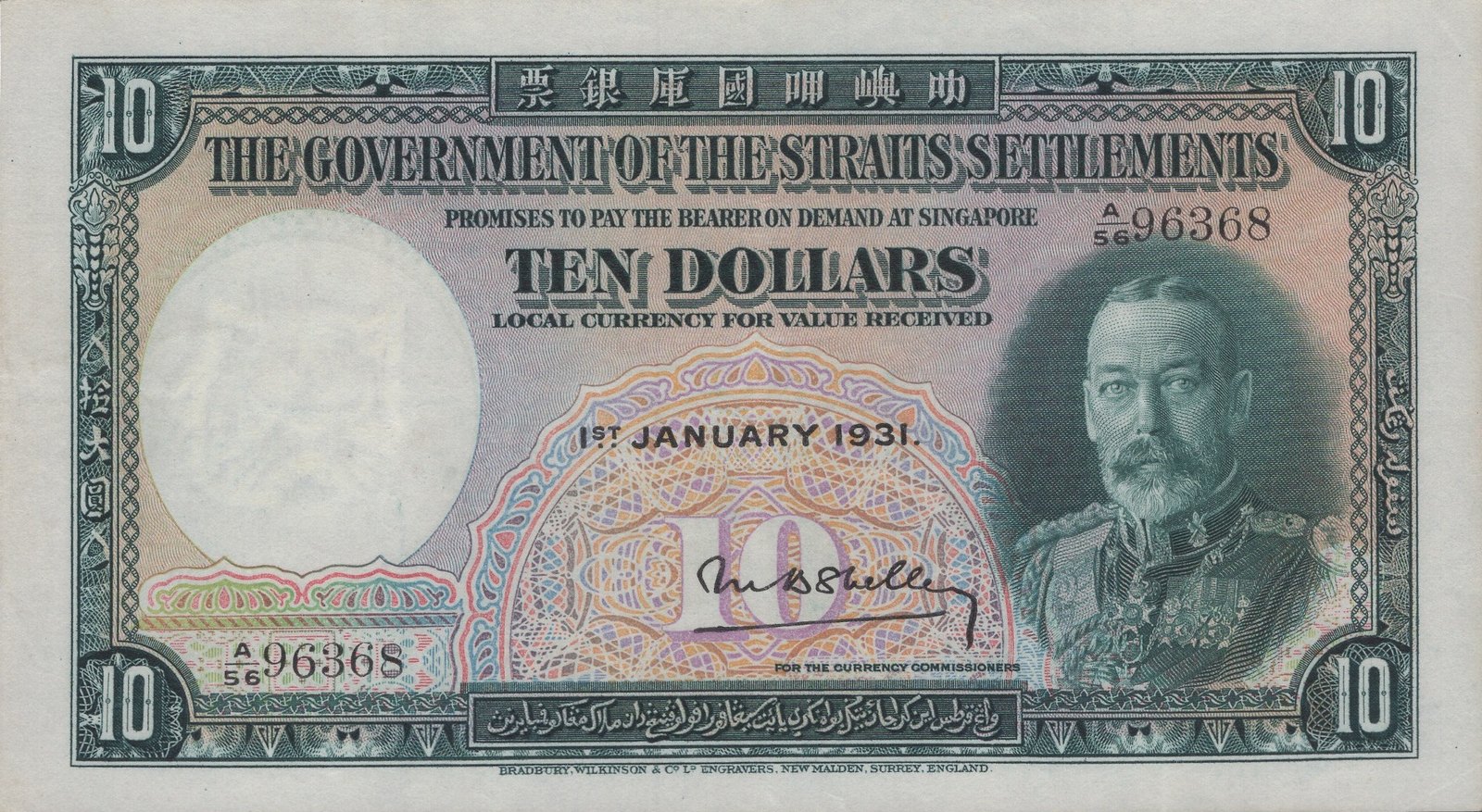
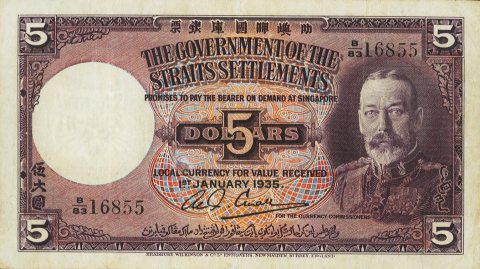
The last series was printed by Bradbury Wilkinson and Company: the 1 dollar, the 5 dollars and the 10 dollars, each dated 1st January of every year from 1931 to 1935. How the 10 dollars of this series was built up from a photograph of December 1929 is shown in From sketch to note.
After the war, and the end in 1948
The latest dates on Straits Settlements notes are 1st January 1935 on the lower values and 8th December 1933 on the high values. The Monetary Authority of Singapore's History of Currency in Singapore says the Board of Commissioners of Currency, Malaya, was formed in 1938 so that the Straits Settlements and the Malay States could issue one currency together.
After the war the notes from before the invasion were declared legal tender again, except those of less than one dollar and those of 1,000 and 10,000 dollars, whose holders had to prove their right to them (Money in British East Asia, 1957). So the 10 and 25 cents did not circulate again.
Proclamations of 23rd August 1948 declared all notes issued by the Government of the Straits Settlements no longer legal tender after 31st August 1948 (Colonial Office List, 1951). No time limit was set for exchanging them at the offices of the Commissioners of Currency (Money in British East Asia, 1957).
What the sources leave out
- The day in 1899 on which the first notes were paid out is not given on any page.
- The 20 dollars that Anthonisz lists has never been seen.
- The pages say how the reserve rule stood at the start, a few years later and in 1928, but not the years in which it was changed.
- No source is named for the introduction of the 10,000 dollars in October 1922.
- The pages have no circulation figure for any year after 1935, and nothing on how many Straits Settlements notes were handed in after 1948.
Sources
- Chalmers, History of Currency in the British Colonies (1893), as cited on the Pick pages.
- J. O. Anthonisz, Treasurer of the Straits Settlements, on the note issue and the 1 dollar note, as cited on the Pick pages.
- Blue Books of the Straits Settlements for 1917 and 1919, as cited on the Pick pages.
- Annual reports on the Straits Settlements for 1928 and 1935; annual reports on Brunei for 1928 and 1929 and on Kelantan for 1928, as cited on the Pick pages.
- Money in British East Asia (1957), as cited on the Pick pages.
- Colonial Office List, 1951, as cited on the Pick pages.
- Monetary Authority of Singapore, History of Currency in Singapore, https://www.mas.gov.sg/currency/history-of-currency-in-singapore
Member comments
Log in or register to post a comment.