This article brings together the counterfeit and altered notes of the Straits Settlements that have rows in this catalogue, with what the Pick pages say about how each differs from the genuine note. Two auction houses' descriptions are used and named as such. The pictures that show the differences stay on the Pick pages.
The rows on record
| Note | Counterfeit of the date | Row |
|---|---|---|
| 1 dollar of 1906 to 1924 | 10th July 1916 | P-1gx |
| 1 dollar of 1906 to 1924 | 20th June 1921 | P-1hx |
| 5 dollars of 1901 to 1924 | 1st February 1901 | P-3ax |
| 5 dollars of 1901 to 1924 | 8th June 1909 | P-3bx |
| 5 dollars of 1901 to 1924 | 2nd January 1914 | P-3dx |
| 5 dollars of 1901 to 1924 | 10th July 1916 | P-3fx |
| 10 dollars of 1898 to 1924 | 1st February 1901, raised to 50 dollars | P-4cx |
| 10 dollars of 1898 to 1924 | 10th July 1916 | P-4hx |
| 10 dollars of 1898 to 1924 | 5th September 1924 | P-4jx |
| 100 dollars of 1898 to 1909 | 1st February 1901 | P-4Cbx |
| 10 cents of 1917 to 1920 | 1st February 1918 | P-6bx |
| 10 cents of 1917 to 1920 | 1919 to 1920 | P-6cx |
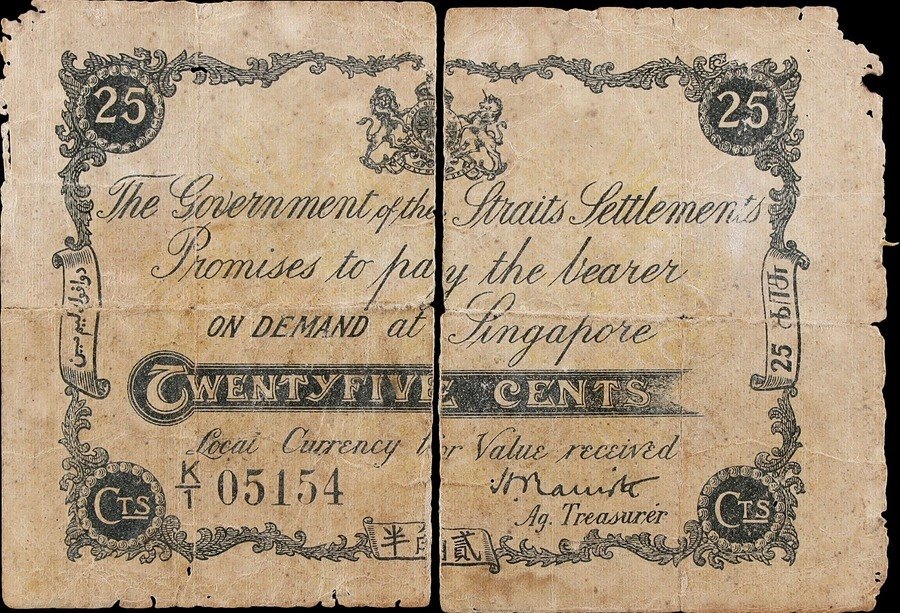
| 25 cents of 1917 | undated | P-7bx |
| 1 dollar of 1925 to 1930 | 1st January 1925 | P-9ax |
| 1 dollar of 1925 to 1930 | 1st September 1927 | P-9bx |
| 5 dollars of 1925 to 1930 | 1st January 1929 | P-10cx |
| 10 dollars of 1931 to 1935 | 1st January 1933 | P-18cx |
| 10 dollars of 1931 to 1935 | 1st January 1935 | P-18ex |
Every value from 10 cents to 10 dollars has at least one counterfeit row, and so has the 100 dollars of 1901. The pages describe some of these pieces in words; the others have a row and no description on the page.
The 5 dollars of 1901 and the forgeries of 1912
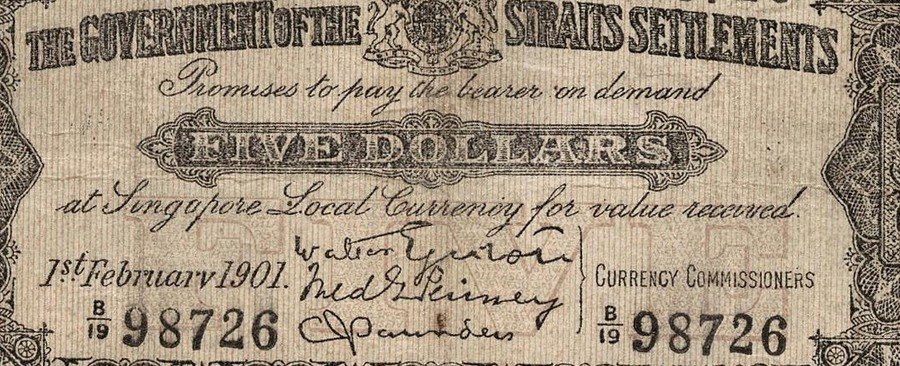
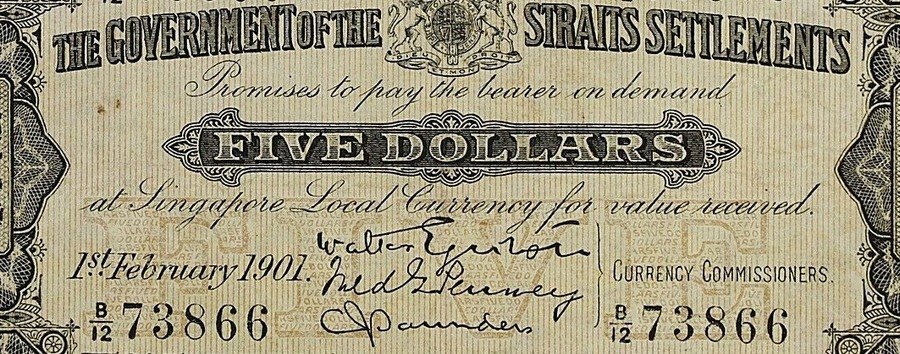
The counterfeit of the 5 dollars of 1st February 1901 is coarsely engraved. Its lettering is heavy and uneven, and the large FIVE underprint across the lower half of the front is a faint, blurred outline. On the genuine note the script is fine and the FIVE is crisp, filled with small lettering. Both counterfeits of this date on record carry the prefix B/19: B/19 98726, and B/19 71527, which is known from enlarged archival photographs made to show how it differs from the genuine note.
The page for the 5 dollars adds that sources mention forgeries of the 5 dollars on a considerable scale in 1912, most likely of the 1909 or 1911 notes. The public then asked for 1 and 10 dollar notes in place of the 5 dollars, not for silver. The page does not say which date was forged in 1912, and the counterfeit rows of 1909, 1914 and 1916 show that more than one date was copied.
A 10 dollars raised to 50
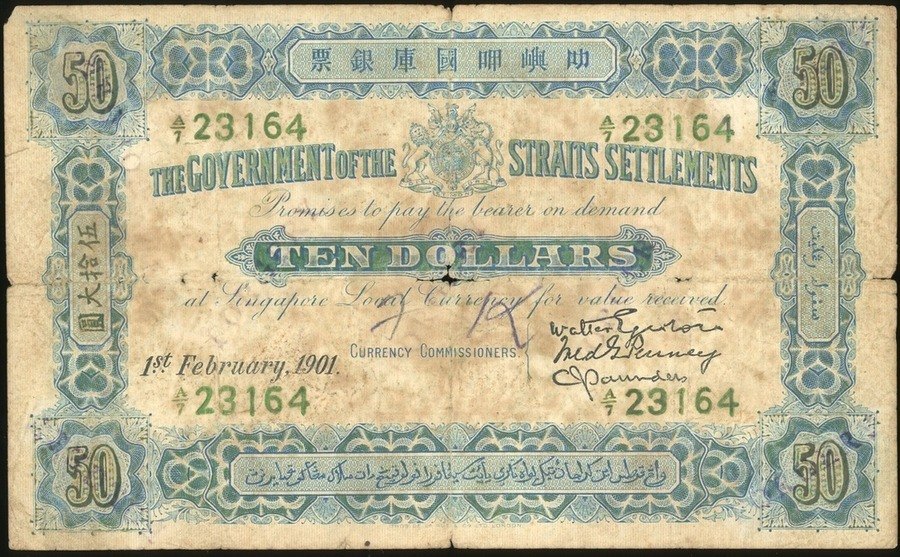
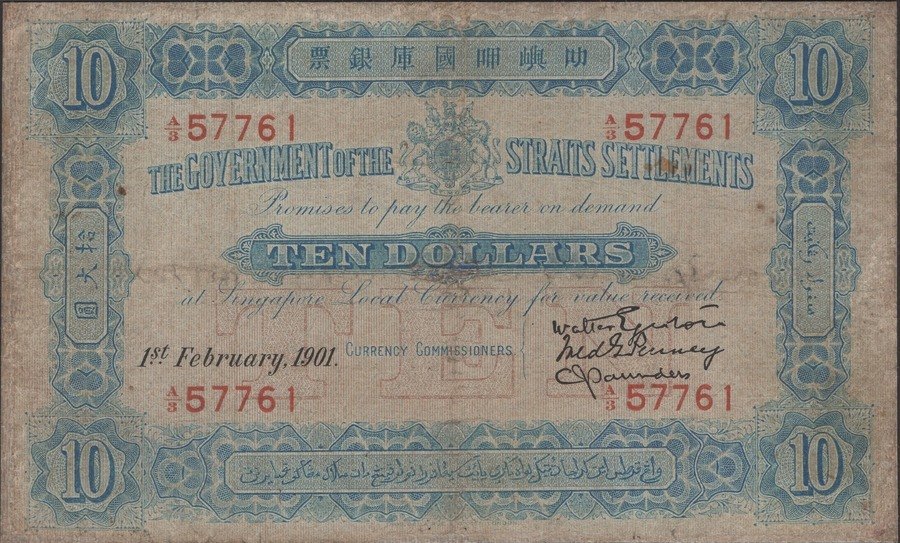
One piece is not a counterfeit but a genuine note altered. It is a 10 dollars of 1st February 1901 fraudulently raised to 50 dollars. The four corner values and the Chinese value in the left panel were altered, but the note is still blue and its centre panel still reads TEN DOLLARS. The true 50 dollars of the same date is green, reads FIFTY DOLLARS at the centre and has a large FIFTY underprint.
The 100 dollars of 1901
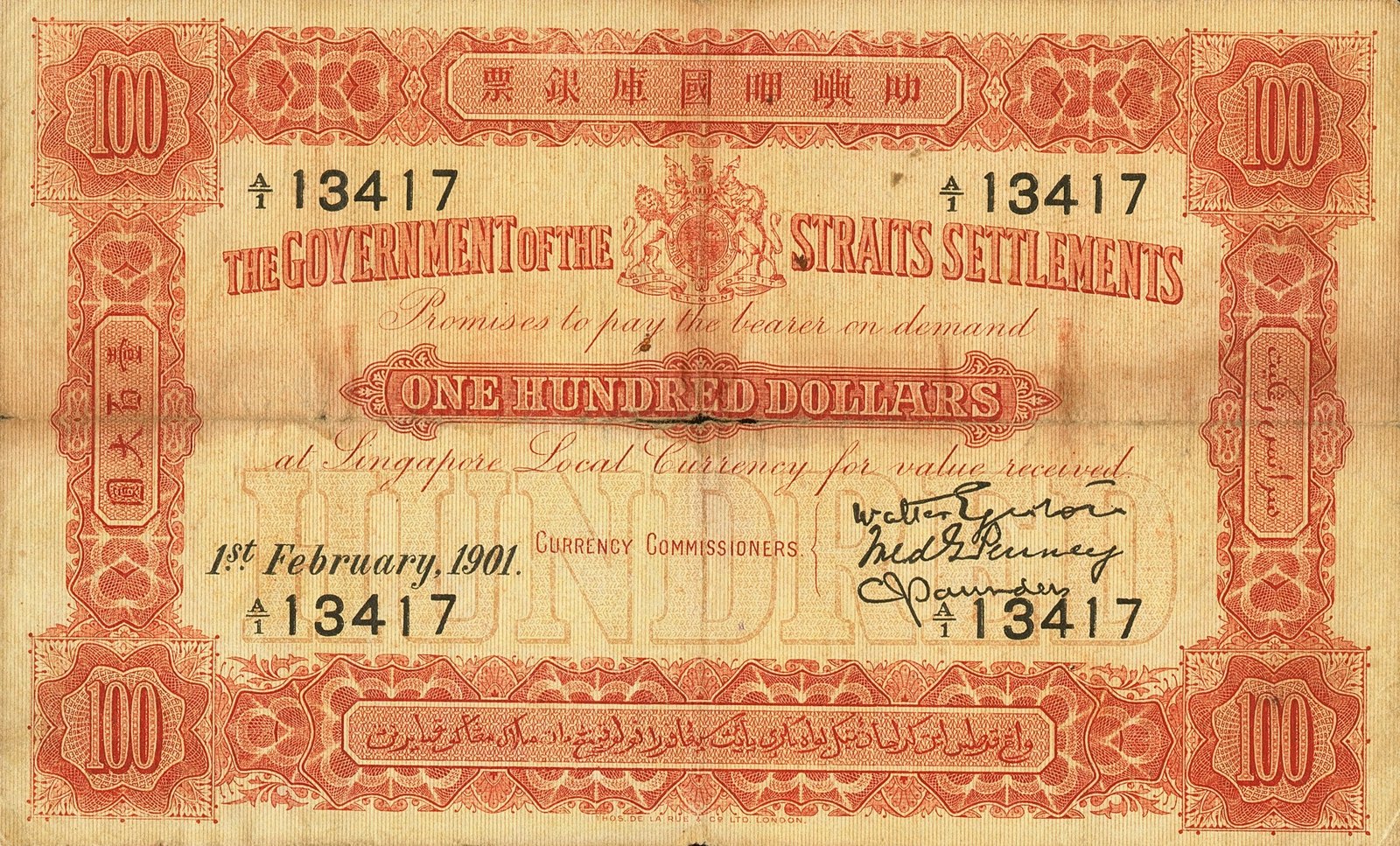
Heritage's description of a counterfeit 100 dollars of 1st February 1901 (20 June 2023, lot 24322) says the underprint and fine details are close to the genuine note, that the piece circulated widely, and that it fails against a strong light, where the watermark is weak beside that of a genuine De La Rue note. The row in the catalogue records the weak watermark.
The small notes of 1917 to 1920
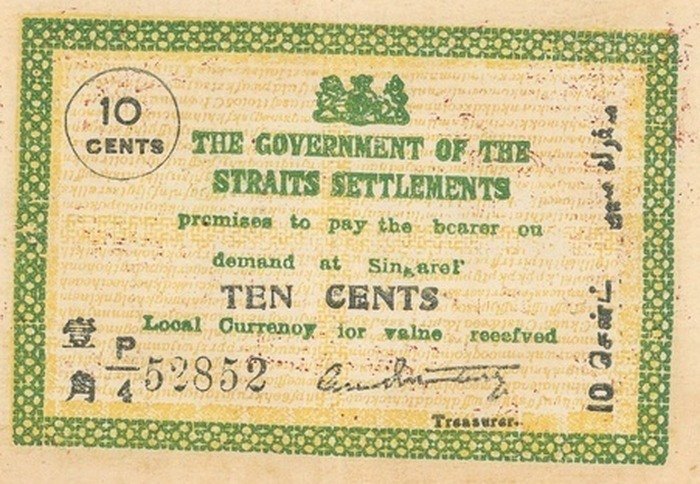
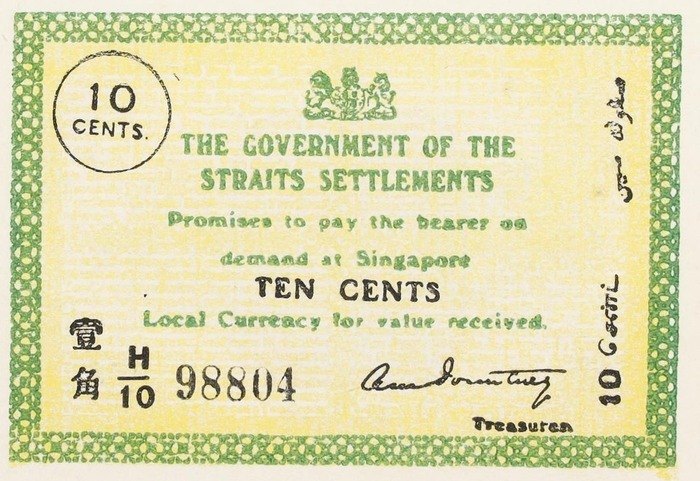
The counterfeit of the 10 cents of 1919 to 1920 is lettered by hand. On the front it reads bcarer ou and ior valne reeefved where the genuine note has bearer on and for value received. On the genuine note the seal on the back holds the day, the month and the year in three small circles; the page shows the seal of the counterfeit beside it.
The counterfeit of the orange 25 cents has almost no underprint. Only faint yellow rays show behind the arms, where the genuine note has a strong orange pattern across the centre of the front.
The 1 and 5 dollars of 1925 to 1930
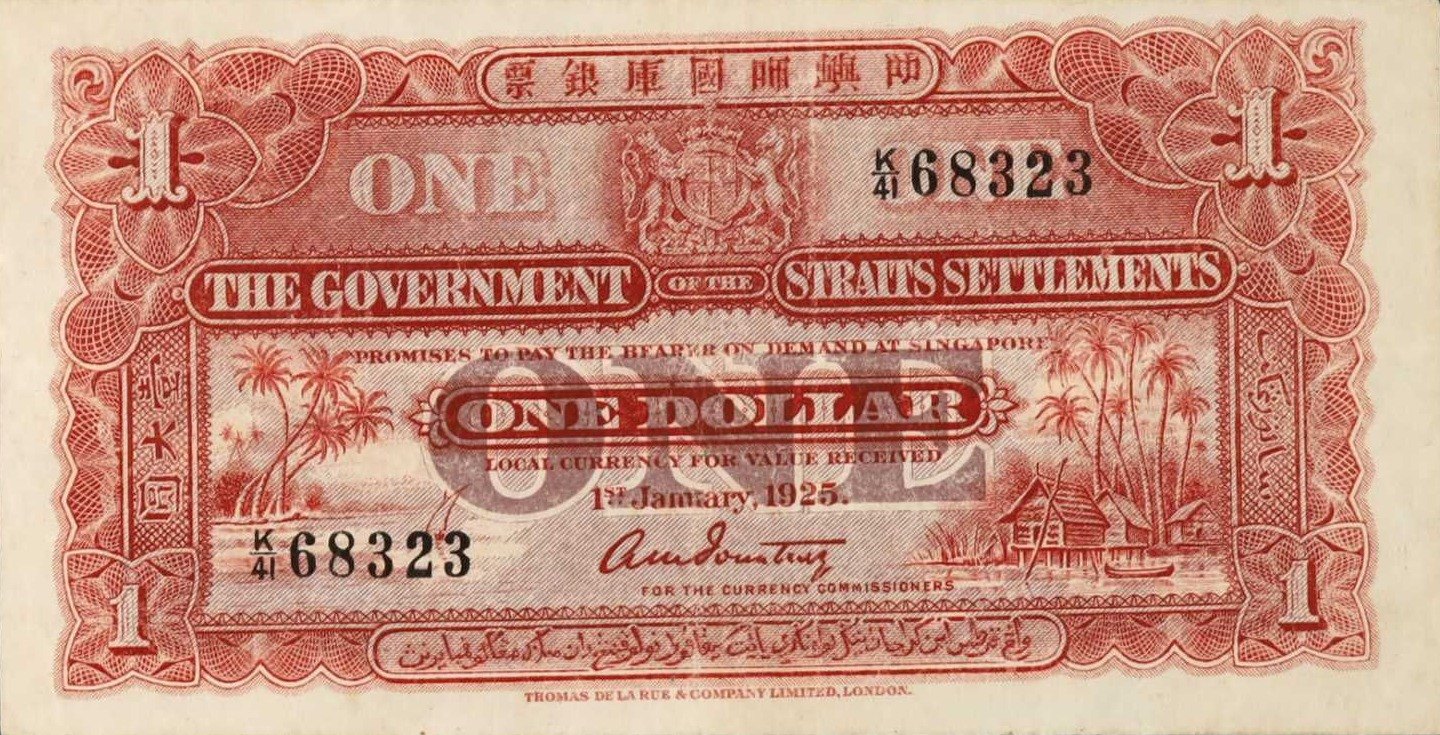
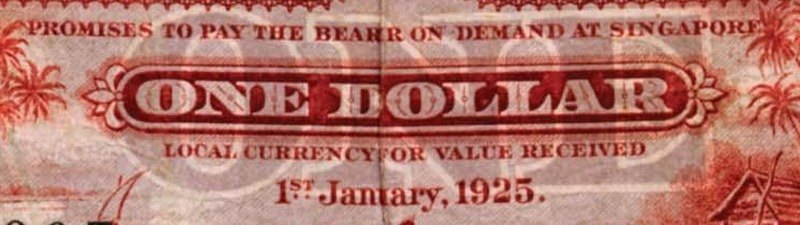
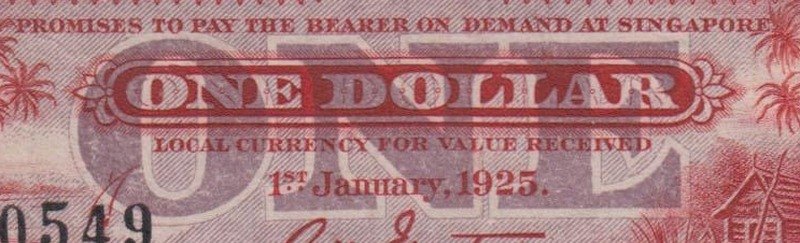
The counterfeit of the 1 dollar of 1st January 1925 gives itself away in the three lines of text at the centre of the front: BEARER is misspelt, CURRENCY FOR is run together as CURRENCYFOR and the month reads Jamiary. The large ONE underprint behind the text is faint on it and bold on the genuine note. The 1 dollar of 1st September 1927 was also counterfeited; some of these pieces are handstamped FORGERY in purple on the front and back. The page does not say who applied the stamp.
Heritage's description of a counterfeit 5 dollars of 1st January 1929 (11 December 2021, lot 26526) says it circulated widely before it was taken out, and lists weak details, imprecise inking and a poor watermark as the differences from the genuine note.
What the pages do not say
No page gives a count of forged notes found, a court case or the name of a forger. The only statement on scale is the one for 1912. For the counterfeits of the 10 dollars of 1931 to 1935 and the 1 dollar of 1906 to 1924 the pages have rows but no description.
Sources
- The Pick pages of the notes named, with their counterfeit rows and pictures.
- The Pick page of the 5 dollars of 1901 to 1924 for the forgeries of 1912, where the page itself says only that sources mention them.
- Heritage Auctions, 20 June 2023, lot 24322 (counterfeit 100 dollars of 1901).
- Heritage Auctions, 11 December 2021, lot 26526 (counterfeit 5 dollars of 1929).
Member comments
Log in or register to post a comment.