In the last years of the First World War the Straits Settlements put paper in place of small silver: notes of 10 cents and 25 cents. Their dates, signers and prefixes are well known. What became of them afterwards is not, and two of the Colony's printed annual reports, for 1922 and for 1928, tell it in figures: how much was still out year by year, of which kind, and how many notes went into the fire. In 1922 alone 19,626,000 notes of 10 cents were destroyed.
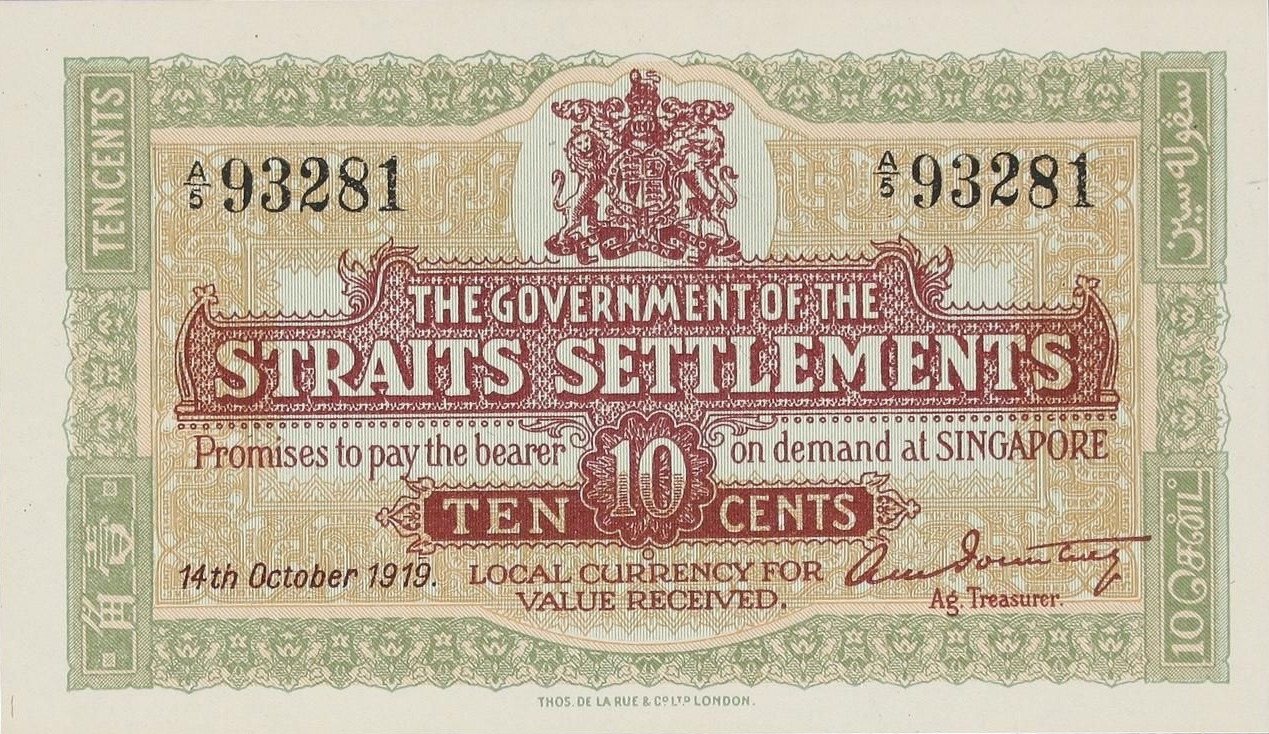
Three small notes
The catalogue has three of them. The 10 cents of 1917 to 1920 is dated on the back, from 1st October 1917 into 1920, and our record gives its printer as the Government Survey Office at Kuala Lumpur. The 25 cents of 1917 is undated and comes from the same office. The 10 cents of 14th October 1919 was printed by Thomas de la Rue and Company and bears the firm's name at the foot.
The 10 and 25 cents notes were legal tender only up to 2 dollars. They came in while the note could not be turned into coin: an order of 7th December 1917, made under two Ordinances of that year, postponed the paying out of coin for currency notes and was renewed every three months through 1919 (Blue Books for 1917 and 1919).
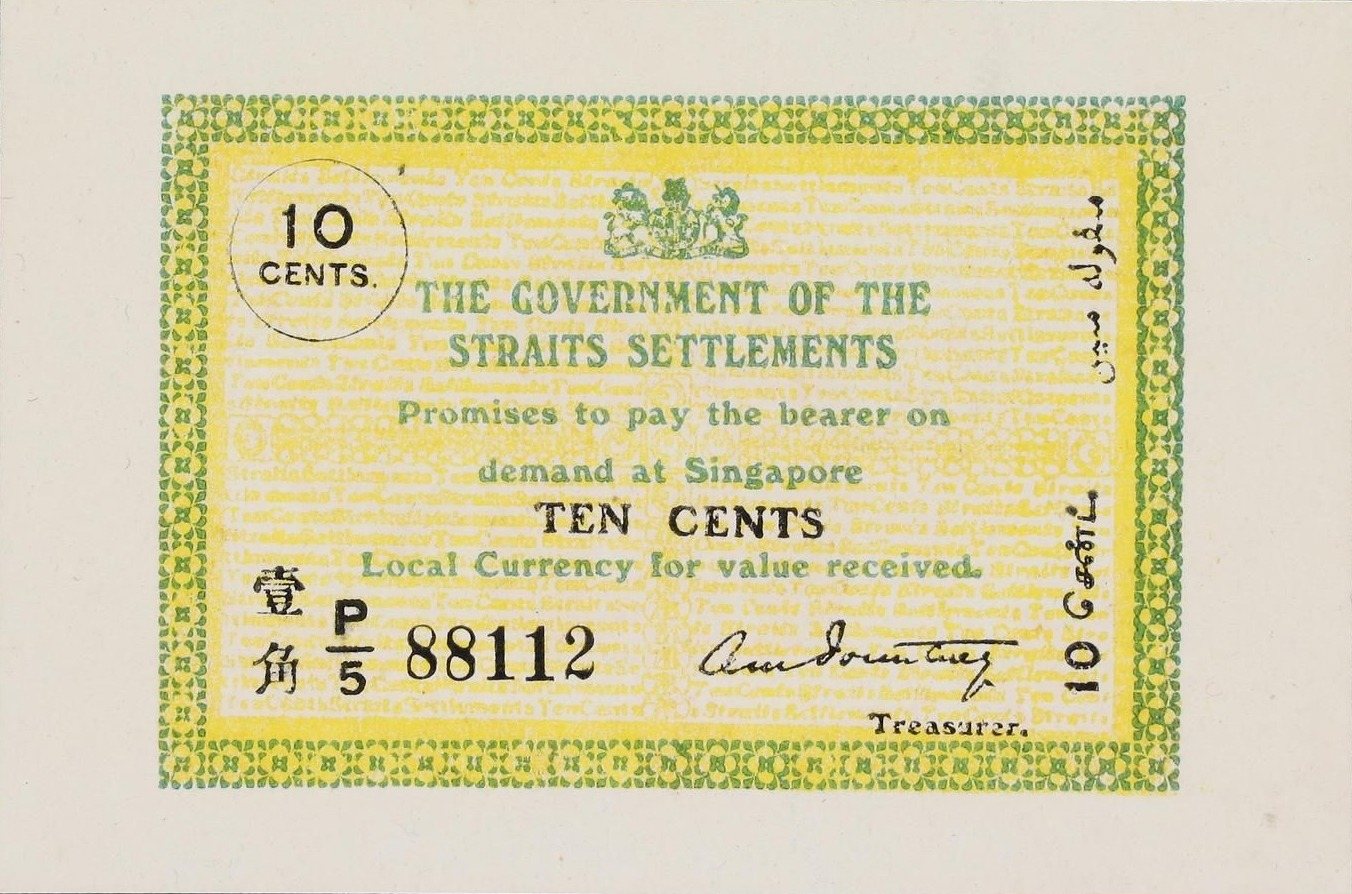
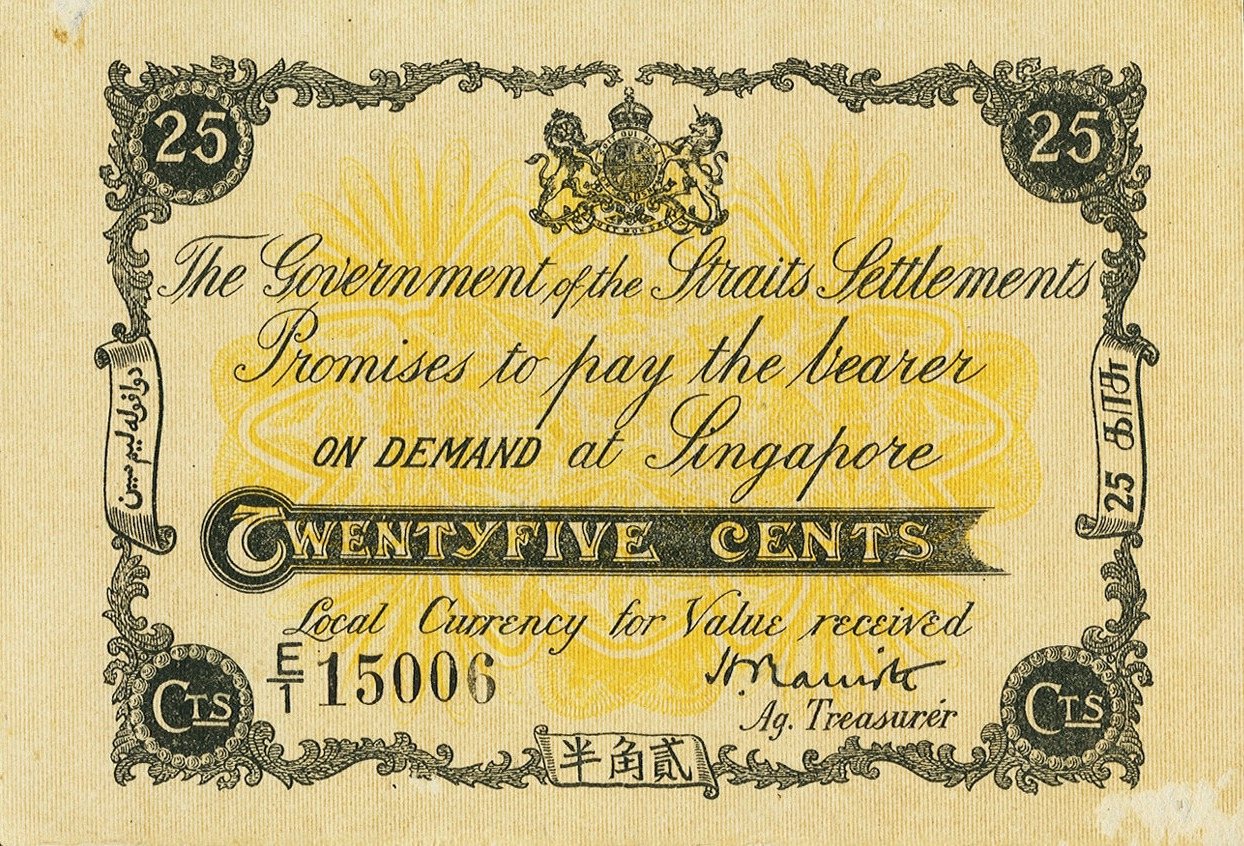
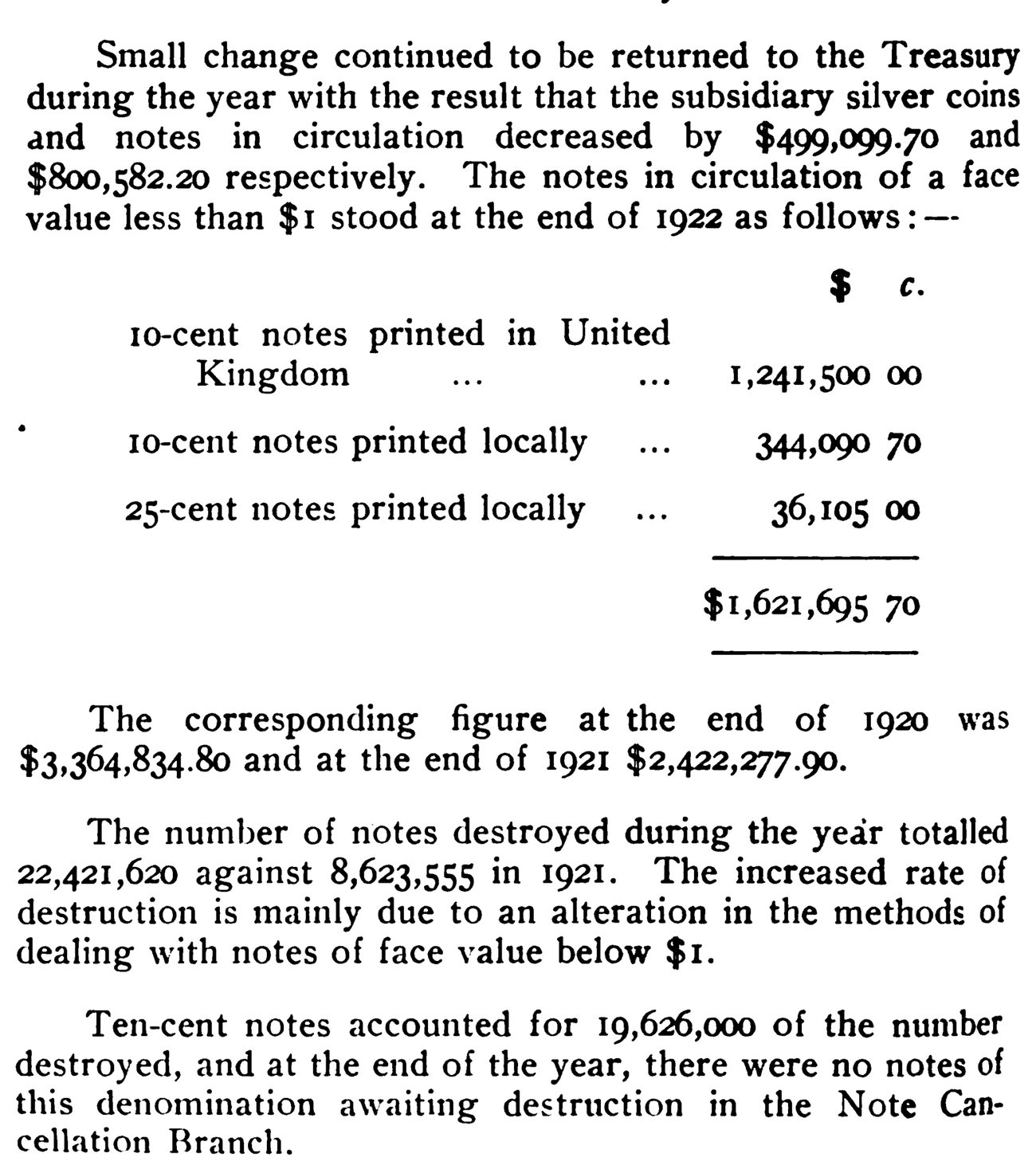
The reports never use a catalogue number. They sort the notes as a Treasury would: "10-cent notes printed in United Kingdom", "10-cent notes printed locally" and "25-cent notes printed locally". That the first is the note of 14th October 1919 and the other two the notes from Kuala Lumpur is our matching, from the printers the catalogue records.
The source
The Colonial Reports - Annual are the yearly printed reports of each colony to the Secretary of State, published in London by His Majesty's Stationery Office, each with a number of its own. We have read two for the Straits Settlements on the page images: the report for 1922, No. 1186, and the report for 1928, No. 1454. Each has a section on currency a few pages long. The figures for 1921, 1925, 1930 and 1935 below are those the catalogue pages already gave from the Colony's annual reports for those years.
Small change comes home, 1920 to 1922
At the end of 1920 notes of less than one dollar worth 3,364,835 dollars were in circulation. A year later it was 2,422,278 dollars, and at the end of 1922 1,621,696 dollars. "Small change continued to be returned to the Treasury during the year", says the report for 1922: the small notes fell by 800,582 dollars and the small silver coins in circulation by 499,100 dollars.
The report then splits the notes by kind, as the report for 1921 had done.
| Notes under 1 dollar in circulation | End of 1921 | End of 1922 |
|---|---|---|
| 10 cents printed in the United Kingdom | 1,872,200 dollars | 1,241,500 dollars |
| 10 cents printed locally | 513,503 dollars | 344,091 dollars |
| 25 cents printed locally | 36,575 dollars | 36,105 dollars |
| Total | 2,422,278 dollars | 1,621,696 dollars |
The subtraction is ours. In 1922 the London 10 cents fell by 630,700 dollars and the local 10 cents by 169,412 dollars, each by about a third. The 25 cents fell by 470 dollars. By the end of 1921 there was little of it left to come in.
Into the fire
The Treasury had a Note Cancellation Branch, and the report for 1922 counts its work. 8,623,555 notes of all values were destroyed in 1921. In 1922 the number was 22,421,620, and "Ten-cent notes accounted for 19,626,000 of the number destroyed". That is nearly nine notes in every ten, and at face value 1,962,600 dollars (our arithmetic).
The report gives the reason for the jump: "an alteration in the methods of dealing with notes of face value below $1". It does not say what the old method was or the new one. The figures show a backlog, though. The 10 cents notes in circulation fell by about 800,000 dollars in 1922, yet almost two million dollars of them were destroyed. More than half must have come in earlier and waited. The report agrees: 12,261,189 notes of all values were awaiting destruction when the year began, 11,864,831 more were presented during it, and of the 1,704,400 left at the end all were notes of one dollar and five dollars. Of the 10 cents, "there were no notes of this denomination awaiting destruction".
A second issue, and the end
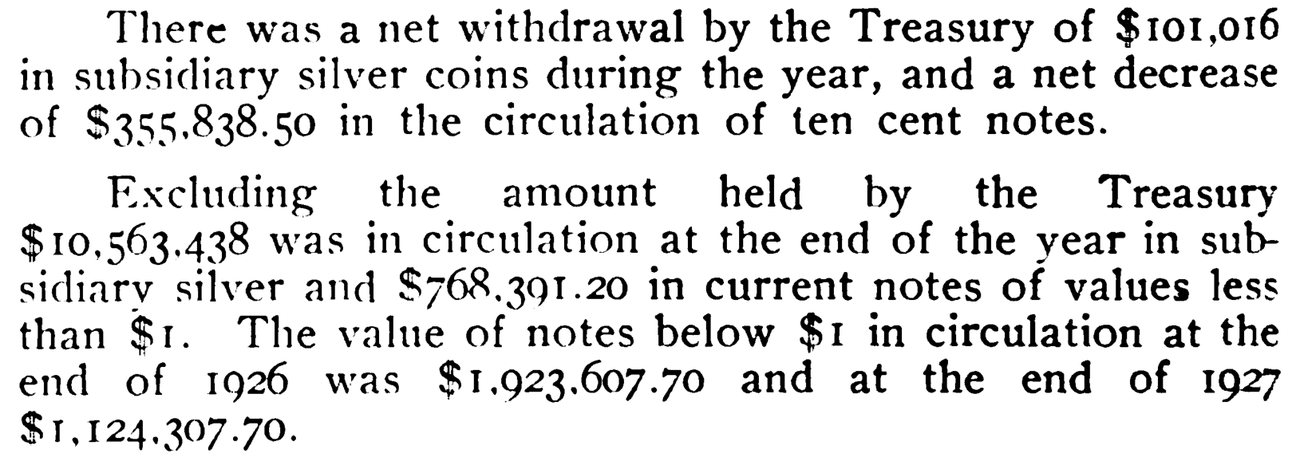
That was not the end of the 10 cents note. The Colony's annual report for 1925 shows a net new issue of 871,855 dollars of 10 cents notes in that year, and the total of small notes back up at 2,411,805 dollars at the end of it. The report for 1928 then gives the fall.
| End of year | Notes under 1 dollar in circulation |
|---|---|
| 1920 | 3,364,835 dollars |
| 1921 | 2,422,278 dollars |
| 1922 | 1,621,696 dollars |
| 1925 | 2,411,805 dollars |
| 1926 | 1,923,608 dollars |
| 1927 | 1,124,308 dollars |
| 1928 | 768,391 dollars |
| 1935 | 722,824 dollars 50 cents |
For 1928 the report speaks of "a net decrease of $355,838.50 in the circulation of ten cent notes". The two year-end totals differ by 355,916 dollars 50 cents, which is 78 dollars more; the report does not say so, but 25 cents notes handed in would account for it.
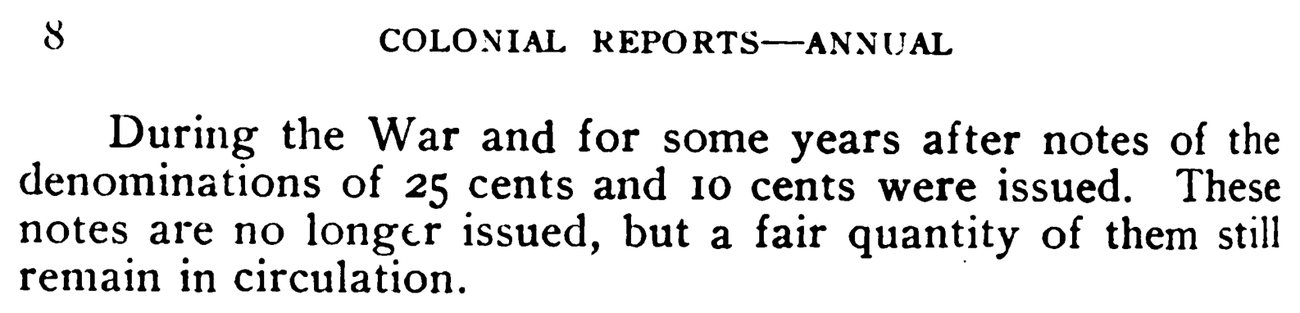
In its general account of the currency the same report closes the matter in two sentences: "During the War and for some years after notes of the denominations of 25 cents and 10 cents were issued. These notes are no longer issued, but a fair quantity of them still remain in circulation."
After that the figure hardly moves. The report for 1935 still counts 722,824 dollars 50 cents outstanding, with only about 600 dollars' worth a year being handed in. Much of the "fair quantity" of 1928 was never brought back.
Against the whole issue
The small notes were many pieces and little money. All the currency notes in circulation came to 84,596,807 dollars at the beginning of 1922 and 72,944,005 dollars at the end of it, so the small notes were just over 2 per cent of the value. At the end of 1927 the circulation was 117,805,415 dollars and at the end of 1928 115,636,274 dollars; the small notes were then well under 1 per cent.
Counted in pieces it looks different. In 1927 the Colony destroyed 26,697,813 notes worth 140,666,694 dollars, and in 1928 20,542,740 notes worth 87,133,550 dollars. The 22,421,620 notes of 1922 are a number of the same order, but 19,626,000 of them were worth 10 cents each.
What the reports do not say
Neither report gives the day on which the issue of the small notes stopped. The report for 1928 says only that they "are no longer issued"; the last new issue we can show is that of 1925. The reports for 1923, 1924, 1926 and 1927 were not among those we read, so the year-end totals for 1923 and 1924 are missing, and so is any split by kind after 1922. We cannot say whether the 10 cents notes put out in 1925 were the London note, the local one or both.
The reports count dollars, not pieces, for the notes in circulation, and they name no printer, no order for notes and no number printed. The "alteration in the methods" of 1922 is not described. The Colony's annual reports for the missing years would fill the table. The Treasury's own papers on the Note Cancellation Branch, and the correspondence about the supply of 10 cents notes in 1925, would settle the rest.
Member comments
Log in or register to post a comment.