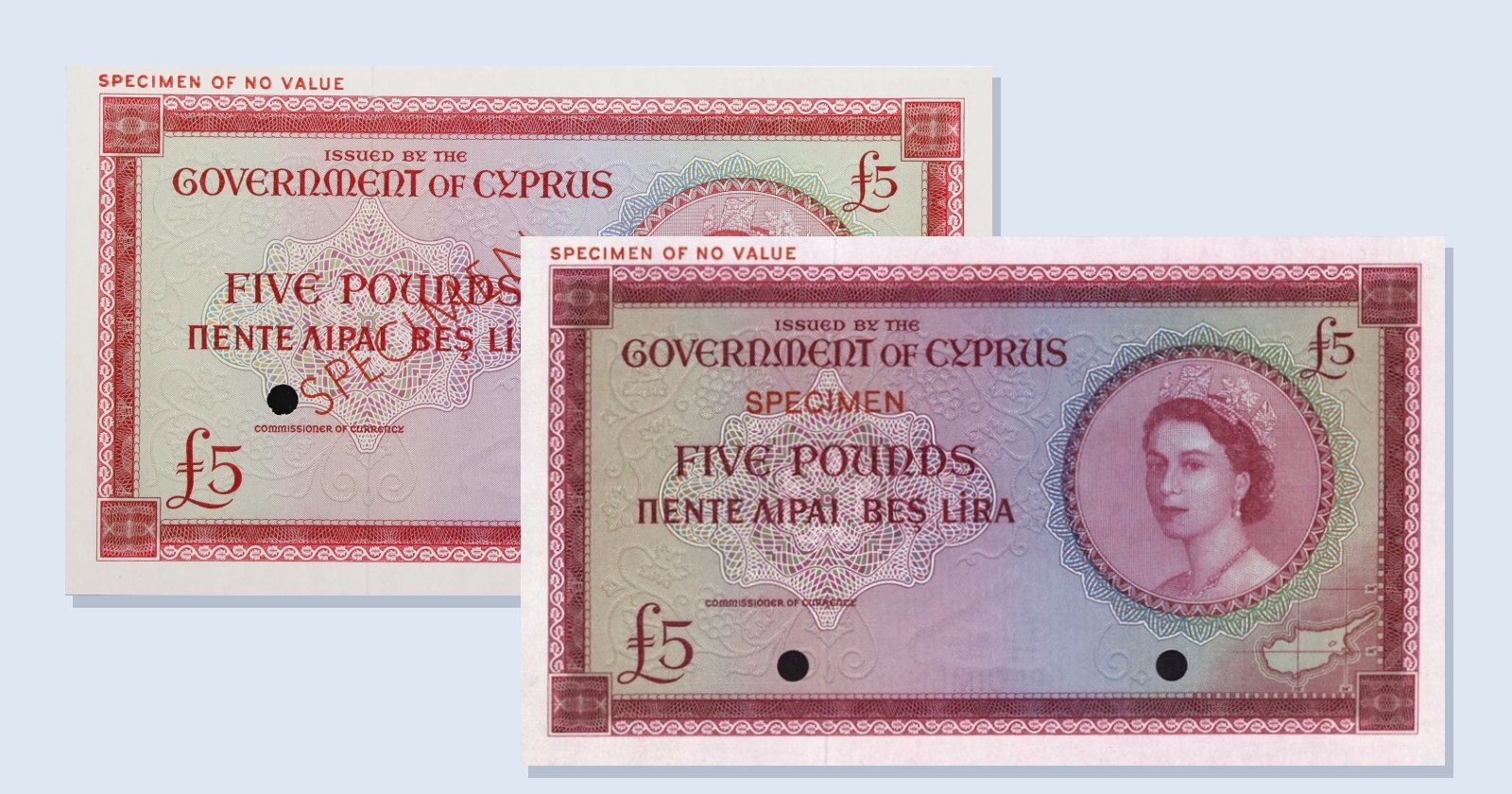
In 1955 Cyprus gave up the pound of 180 piastres for a decimal pound of 1,000 mils. Bradbury Wilkinson printed four new notes for the change — 250 mils, 500 mils, 1 pound and 5 pounds — each with Queen Elizabeth II above a map of the island, and they went into circulation on 1 August 1955. They were the last design of the colonial Government of Cyprus.
Before the colours were settled, the printer made colour trials: finished notes printed in colours other than the issued ones, overprinted as specimens, punched so they could never be spent, and numbered on the back. Every catalogue lists one colour trial for each of the four values. Laying every recorded piece side by side shows that the 5 pounds has two, and that they are easy to tell apart once you know where to look.
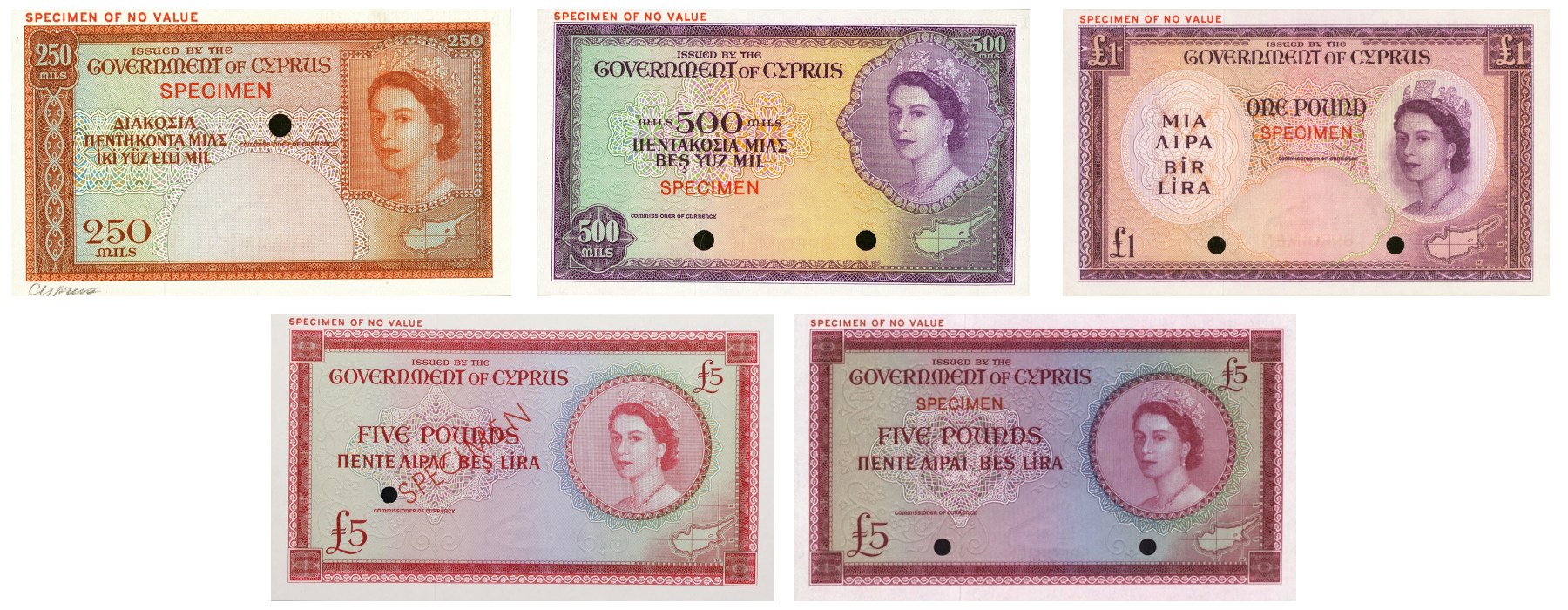
What a 1955 colour trial looks like
All of them share the same marks:
- no date, no signature and no serial number
- SPECIMEN OF NO VALUE in red at the upper left of the front and the back
- a red SPECIMEN overprint across the note
- a specimen number printed in black at the upper left of the back
- one or two punch holes
- colours that were never used for the issued notes: the 250 mils in brown (issued in blue), the 500 mils in purple (issued in green), the 1 pound in purple and rose (issued in brown) and the 5 pounds in red (issued in green)
The 5 pounds: two kinds
Comparing the photographs of every piece in this catalogue, the 250 mils, 500 mils and 1 pound trials each look alike. The 5 pounds pieces fall into two groups that never mix, and two things separate them clearly, and a third points the same way.
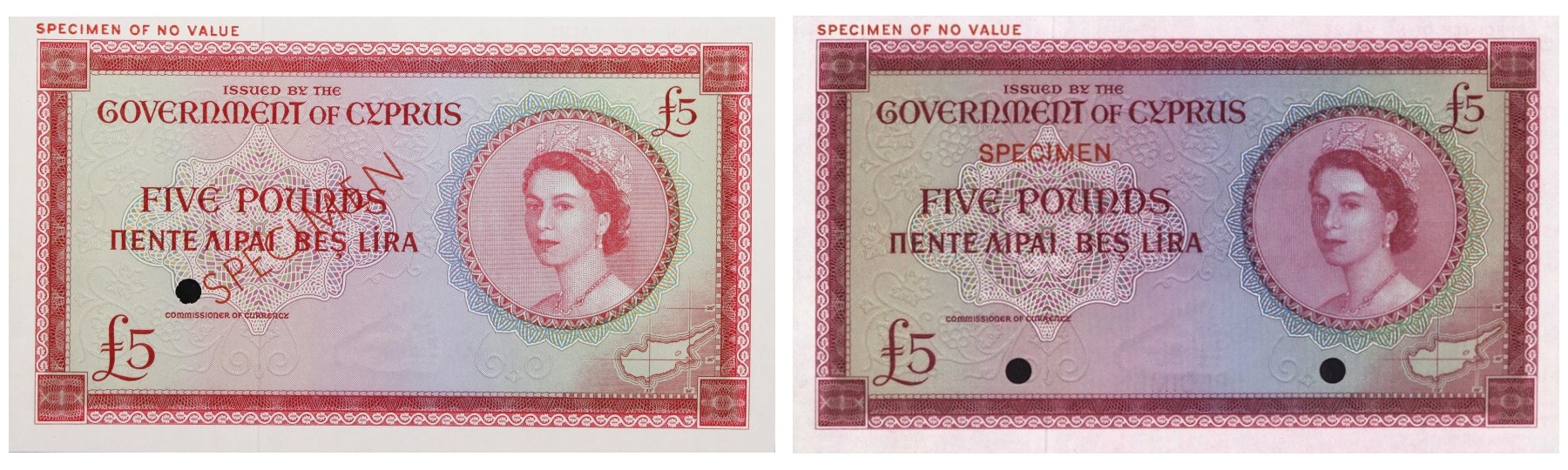
1. The SPECIMEN overprint
On one kind the red SPECIMEN runs diagonally across the front, through FIVE POUNDS and down past the signature space, and diagonally again across the arch on the back. On the other it is set horizontally, in neat capitals just above FIVE POUNDS on the front and inside the arch on the back.
2. The punch holes
The diagonal kind has one punch hole, beside the signature space on the front (it shows on the wreath at the right of the back). The horizontal kind has two, low on the note at the left and right, the same as the 500 mils and 1 pound trials.
3. The back
The back gives a further hint, though not proof on its own. Look at the plain background between the frame and the two wreaths:
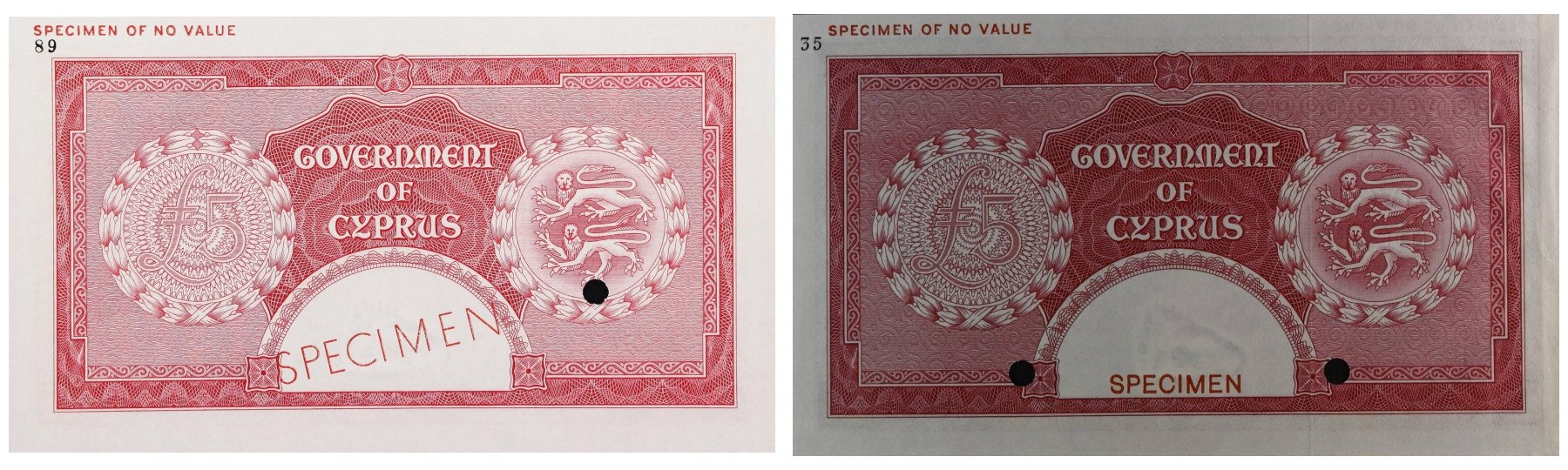
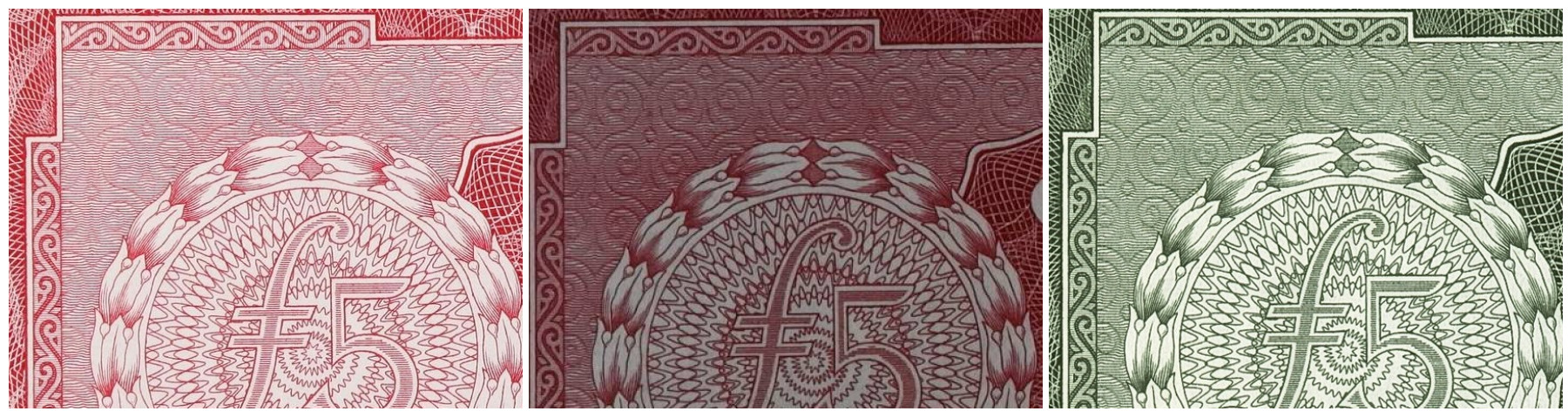
On both kinds the background is engraved in fine wavy lines with a pattern of curling scroll ornaments worked into them, the same as on the issued notes. What differs is how strongly the scrolls show. On the horizontal kind they stand out clearly, and the whole back is printed in a deeper red; a sharp photograph shows the fine lines and the scrolls together. On the diagonal kind the scrolls are only a faint ghost in the lines. That may come from a lighter inking of the back rather than a different plate, and photographs alone cannot settle which, so the overprint and the punch holes remain the tells to rely on. The fronts carry the same design on both.
That last point is worth stating because Cyprus had changed its Turkish lettering only a few years before. The George VI notes up to 1951 give the Turkish value in Arabic letters (P-22, P-23, P-25); the 1952-1954 notes give it in the Latin letters Turkey adopted in 1928 (P-29, P-31, P-32). Every 1955 note and trial uses the Latin letters.
Which came first?
It is not settled, and no printer's record has been found that would settle it, so the catalogue lists the two side by side without calling either the first.
How to tell them apart
- Diagonal SPECIMEN, one punch hole; scrolls faint on the back — P-36cts
- Horizontal SPECIMEN above FIVE POUNDS, two punch holes; scrolls clear on the back — P-36cts
The overprint and the punch holes show on both sides, so either side is enough. The look of the back's background is a useful hint, but only beside them.
A collector putting together the colour trials of this issue therefore needs five pieces, not four.
Every Elizabeth II colour trial of Cyprus, in order
| # | Pick | Value | Colour | Overprint and punch holes |
|---|---|---|---|---|
| 1 | P-33cts | 250 Mils | brown | horizontal SPECIMEN, one hole |
| 2 | P-34cts | 500 Mils | purple | horizontal SPECIMEN, two holes |
| 3 | P-35cts | 1 Pound | purple and rose | horizontal SPECIMEN, two holes |
| 4 | P-36cts | 5 Pounds | red | horizontal SPECIMEN, two holes |
| 5 | P-36cts | 5 Pounds | red | diagonal SPECIMEN, one hole |
Each variety page carries the photographs; the serial register and the sales history of every trial are there for NumiCrown Pro members.
The other printer's material of the 1955 issue is not colour trials: plate proofs of each value in its issued colour (250 mils, 500 mils, 1 pound, 5 pounds) and die proofs in black on white. Before 1955, Cyprus colour trials are few: a uniface trial of the front frame of the 1920 1 shilling (P-14), and partial trials of the back panel of the George VI 1, 2 and 5 shillings (P-20, P-21, P-22).
Help us narrow it down
If you own one of these 5 pounds trials, check the overprint, the punch holes and the background of the back, and tell us. A piece that mixes the two kinds — a diagonal overprint with two holes, or a horizontal one with a single hole — would change what is written here.
Member comments
Log in or register to post a comment.