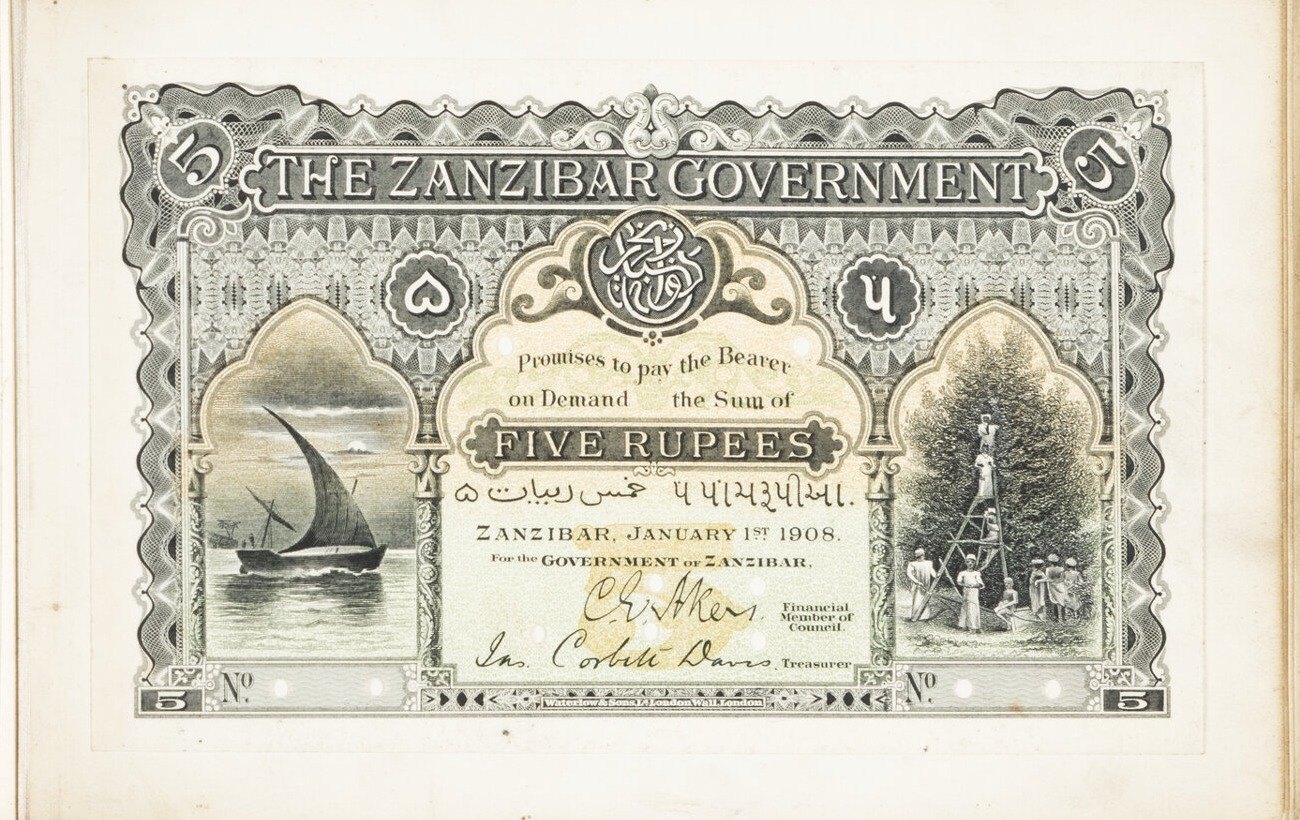
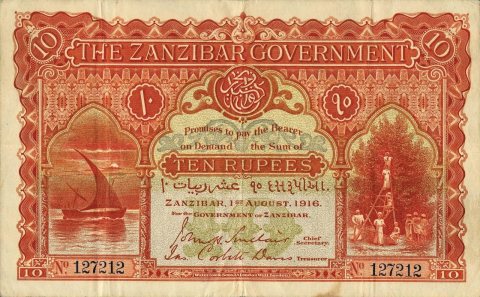
The notes of Zanzibar rested on decrees of the Sultan, not on ordinances. This article sets the decrees out in order of time, from the texts kept in the Johns Hopkins currency board archive and from what the Zanzibar Blue Books, the annual reports and the Colonial Office's Economic Surveys say of them. It says for each how it was read, and it ends with the points on which the law, as far as it has been found, is silent. The notes themselves are described in The Zanzibar Government's notes, 1908 to 1936.
The decrees at a glance
| Decree | Date | What it did | Read from |
|---|---|---|---|
| Currency Decree, No. 3 of 1908 | Gazette supplement of 11th March 1908 | set up the Board; notes of 5, 10, 20 and 100 rupees; legal tender in Zanzibar, Pemba and the islands near them | the decree, on the page |
| Zanzibar Currency Decree, 1916, No. 3 of 1916 | 14th February 1916 | consolidated the law; Chief Secretary in place of the Financial Member of Council; notes of 5, 10, 20, 50 and 100 rupees and multiples of 100 | the revised text to 28th February 1922 (Cap. 51), machine-read; Blue Book for 1916 |
| Zanzibar Currency (Amendment) Decree, 1920, No. 7 of 1920 | in force at 3 p.m. on 5th July 1920 | repealed section 4 of the Decree of 1916 | the decree, machine-read |
| Amending Decree, No. 1 of 1922 | 1922 | named as an amendment in the revised text of 1922 | the revised text only |
| Currency Decree, 1935, No. 21 of 1935 | passed 16th December 1935 | East African Currency Board notes legal tender; the Zanzibar notes to be exchanged and, after notice, to cease | the decree, machine-read; annual reports for 1935 and 1936 |
No. 3 of 1908: the Board and four values
The Currency Decree, No. 3 of 1908, was printed in a supplement to the Gazette of 11th March 1908. Sections 3 and 5, read on the page, provide for:
- a Board of the Financial Member of Council, the Treasurer and two others, one of them a British official;
- notes of 5, 10, 20 and 100 rupees;
- the signatures of the Commissioners, the Financial Member or the Treasurer on the notes, or facsimiles of them;
- notes that were legal tender in Zanzibar, Pemba and the adjacent islands.
The Red Book for 1922-23 (p. 261) puts it in one sentence: the Currency Board was constituted in 1908 under a Decree of the Sultan to control and regulate the currency of the Protectorate.
Marissa Licursi's working paper on the Board, kept in the same archive (file SAE0044, p. 3), gives the values of 1908 as 5, 10, 20 and 100 rupees "and multiples of 100". The decree as read on the page gives the four values only. Both are recorded here. The catalogue's page for the 50 rupees follows the decree: no 50 rupees in 1908.
Two more things are known of the Decree of 1908 from other sources. Gene Hessler (I.B.N.S. Journal, volume 38, No. 3, 1999, p. 14) writes that it fixed the coin portion of the Note Guarantee Fund at 50 per cent of the notes in circulation. The Zanzibar Blue Book for 1916 names it as the authority for the profit on the notes: the income of the invested part of the Fund, less the cost of the issue and less 1 per cent of the cost of the securities, set aside against depreciation.
The same day, 11th March 1908, appears in the annual report for 1920, which says the sovereign had been legal tender at 15 rupees from that day.
The date on the notes. The first notes are dated 1st January 1908, ten weeks before the Gazette supplement that printed the decree. No source read gives the day on which the first note was paid out.
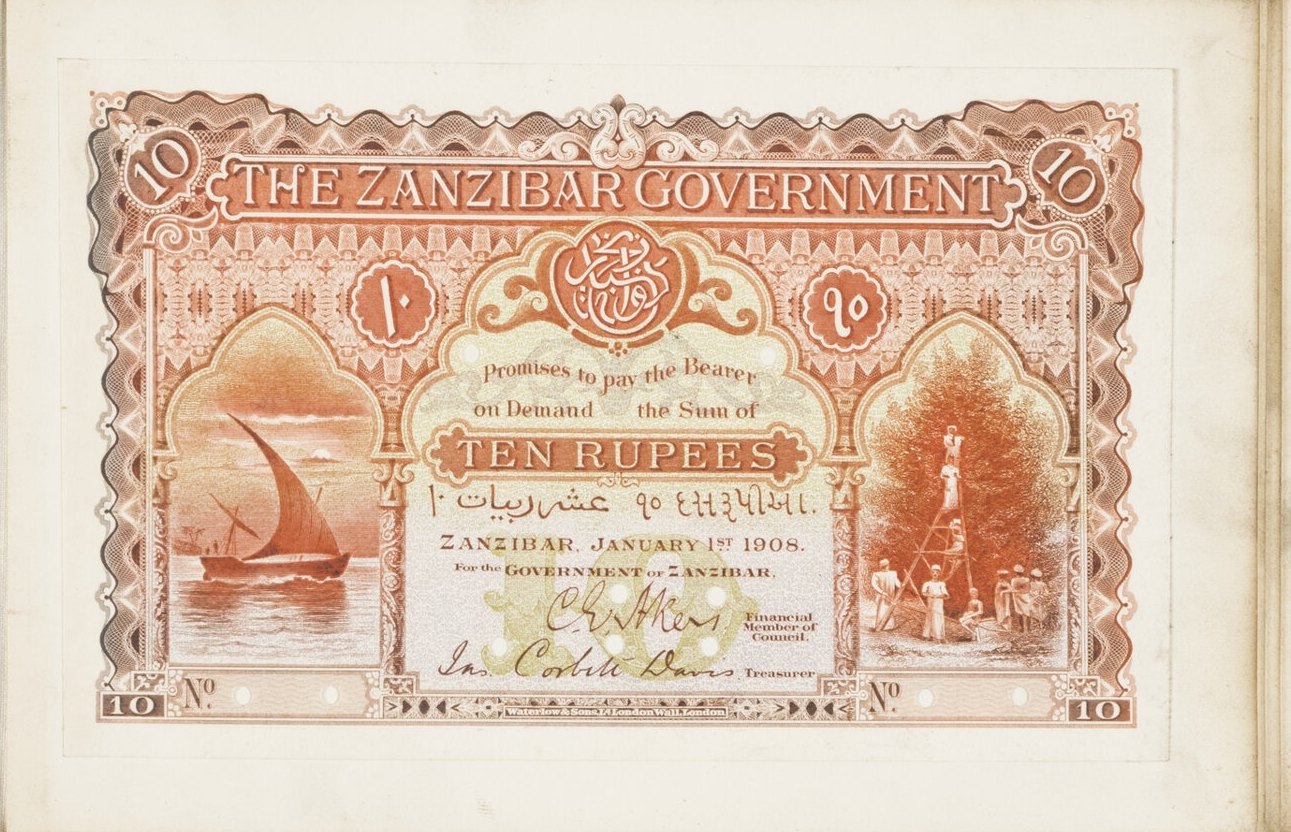
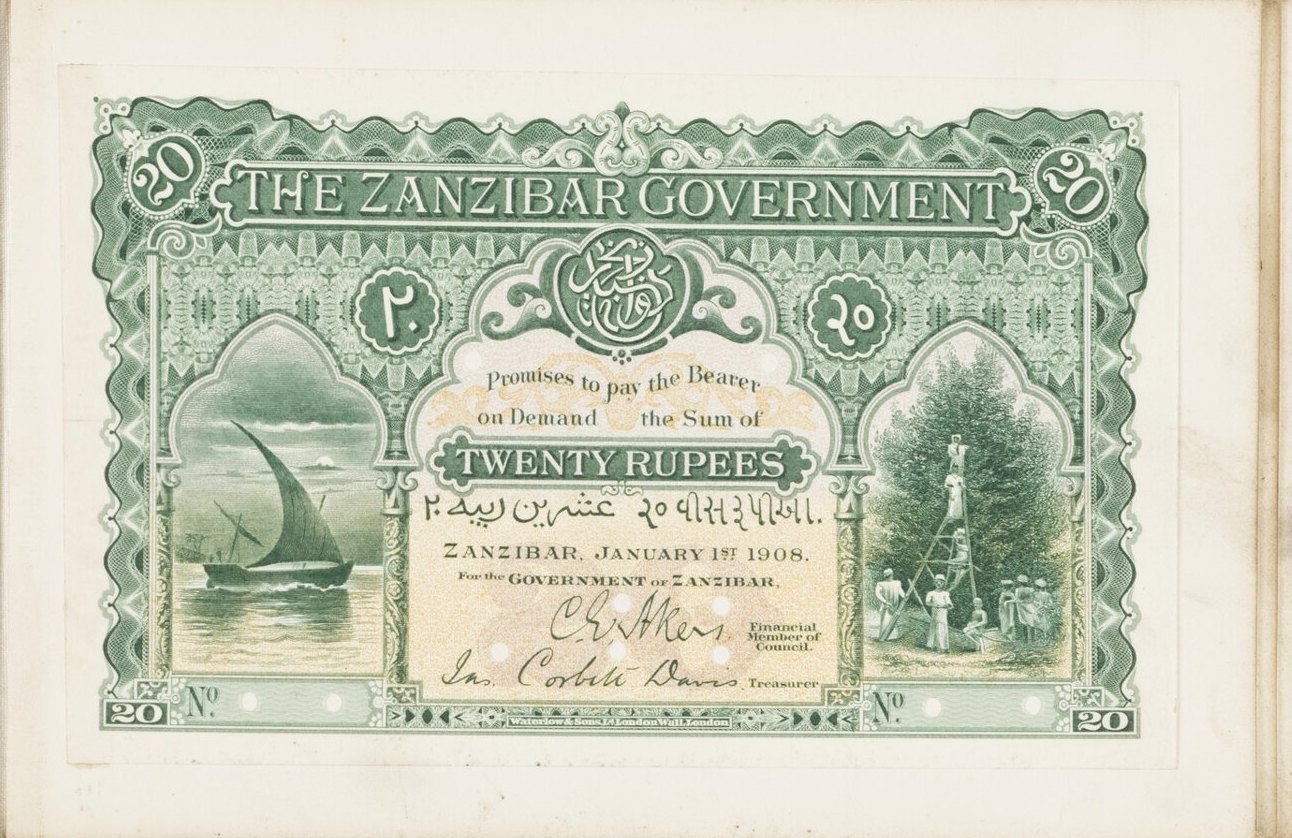
Another account. Dr. David Lott, in Bank Note Reporter of March 1985 (p. 26), writes that Zanzibar began to issue notes of 5, 10, 20, 50, 100 and 500 rupees in 1908, in response to an Order in Council of 1905 that allowed notes of 5, 10, 50 and any multiple of 50 rupees. That wording is the one Dr. Lott gives a few lines earlier for the East Africa Protectorate. The Decree of 1908 names neither a 50 nor a 500 rupees. Dr. Lott adds that no report of the Zanzibar Board had been found for the article.
No. 3 of 1916: the Chief Secretary, the 50 rupees and multiples of 100
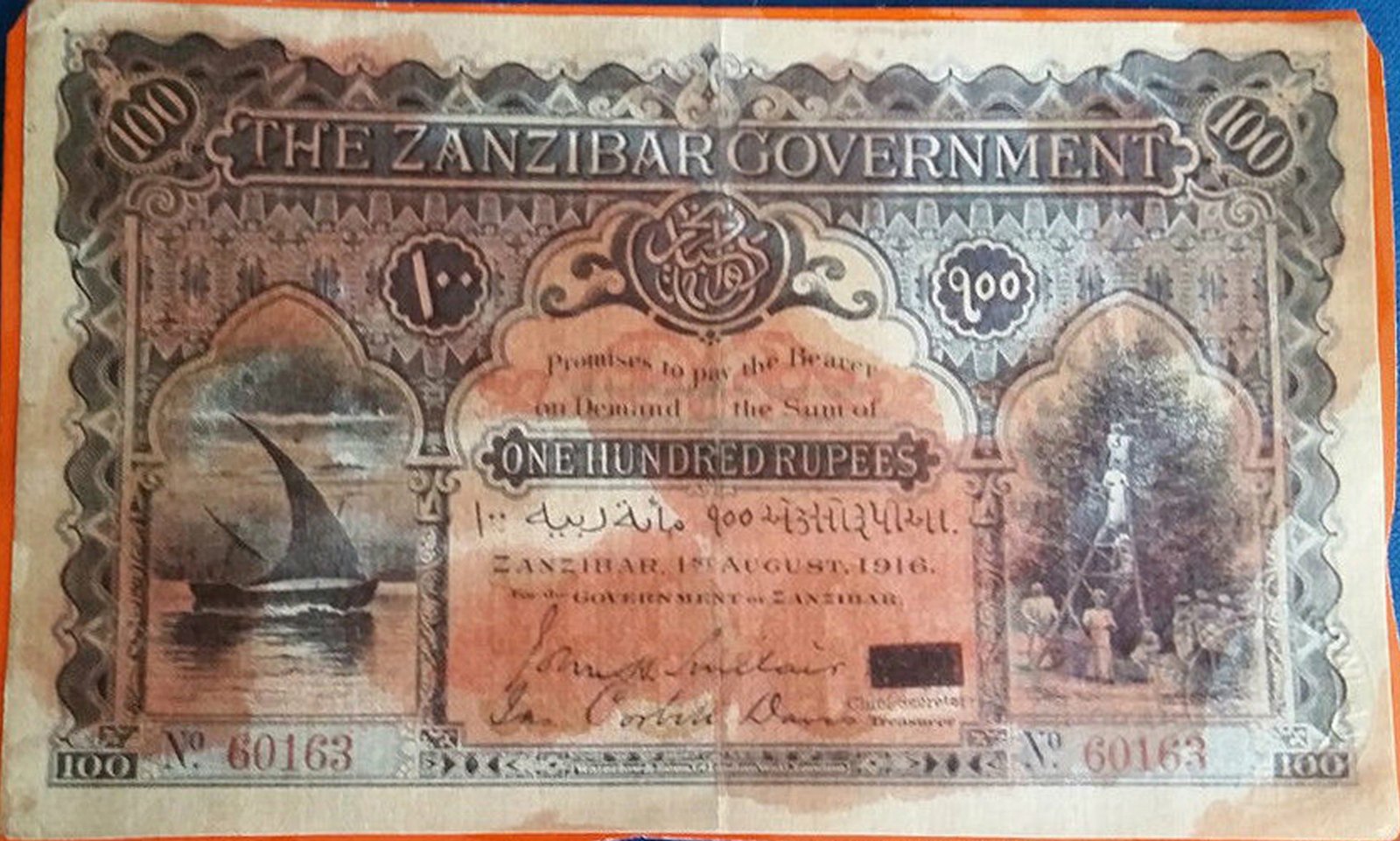
The Zanzibar Blue Book for 1916 lists the law in its year's legislation: "The Zanzibar Currency Decree, 1916", No. 3 of 1916, of 14th February, a decree to consolidate and amend the laws relating to currency, sent to England on 8th March. The text held is the revised one, with the laws as they stood on 28th February 1922, where the decree is Cap. 51. It provides for:
- a Board of the Chief Secretary, the Treasurer and one member of the commercial community nominated by the British Resident;
- notes of 5, 10, 20, 50 and 100 rupees and multiples of 100.
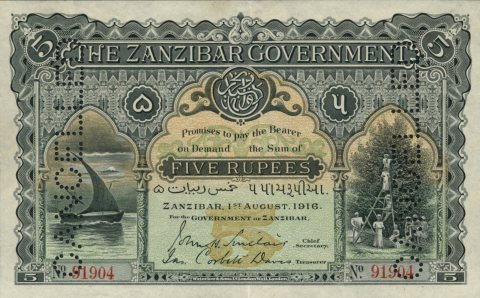
Licursi's working paper (Appendix A, p. 19) agrees and adds that the notes were to be printed, kept, issued and cancelled under regulations of the Resident. Hessler (1999, p. 14) quotes the definitions: the Chief Secretary and the Treasurer each mean the person for the time being discharging the functions of that office. That wording matters for the signatures, because both signers of the notes dated 1st August 1916 were away from their posts for part of that year, as the article on the officers shows.
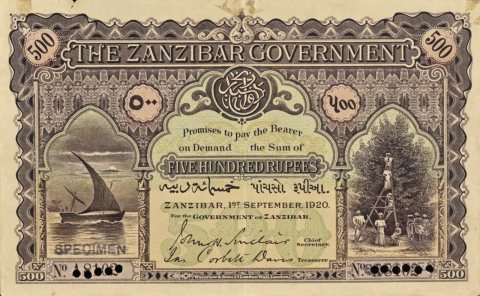
This decree is the reason for the handstamped title on the first notes of 1916, and the authority for the 50 rupees and, as a multiple of 100, for the 500 rupees. A notice of 28th February 1916 under the decree fixed the coin portion of the Note Guarantee Fund. The Blue Book does not print the proportion. Hessler gives 40 per cent.
No. 7 of 1920: section 4 repealed at 3 p.m.
The Zanzibar Currency (Amendment) Decree, 1920, No. 7 of 1920, repealed section 4 of the Decree of 1916 and came into force at 3 p.m. on 5th July 1920. The file does not hold the section it repealed.
The annual report for 1920 says that the demonetisation of the sovereign had become necessary and that "this step was taken without notice on 5th July". The day is the same. Whether section 4 was the section on the sovereign is not stated by either source, and it is left open here.
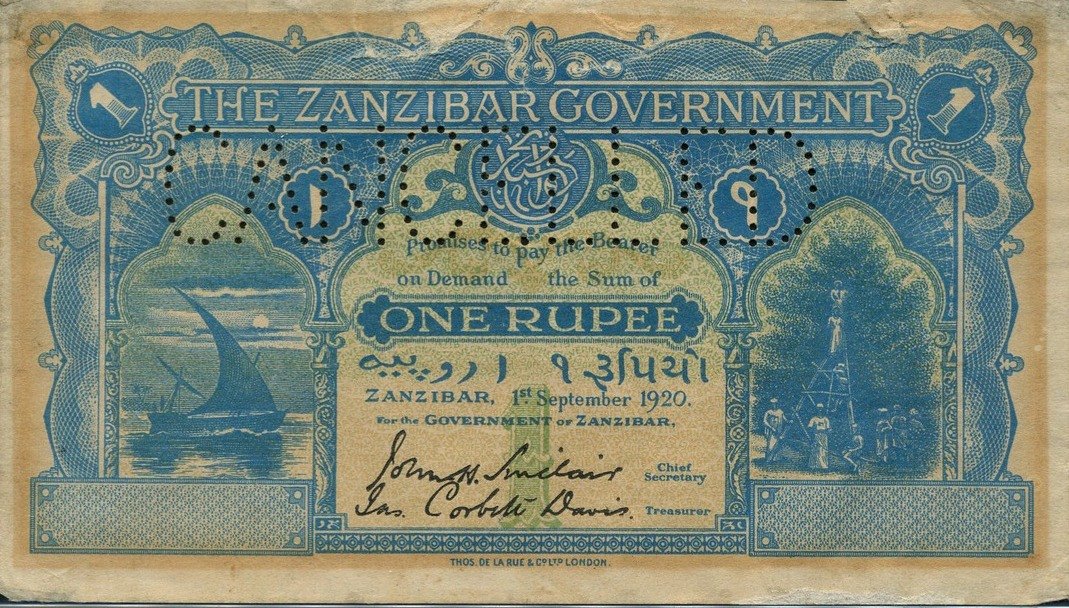
Eight days later, on 13th July 1920, the Crown Agents asked Thomas de la Rue for a million notes of 1 rupee (Hessler, 1999, p. 13). Nothing in the decree of 5th July, as far as it is held, speaks of a 1 rupee.
1922: an amendment and a new penalty
The revised text of February 1922 names two amending decrees, No. 7 of 1920 and No. 1 of 1922. Hessler's list of dates (1999, p. 15) has a Zanzibar Currency Amendment Decree No. 1 that forbade dealing in legal tender except at its face value. The list sets it among the entries for the early 1920s, and the layout of the machine-read page does not show the year for certain.
The annual report for 1922 (No. 1163, p. 10) says that the criminal law "was augmented by the imposition of a punishment of two years' imprisonment for the unwarranted possession of any imitation of a currency note." The report names no decree for it. No report or gazette read records a forged Zanzibar note.
The 1 rupee: no authority found
The 1 rupee is dated 1st September 1920. The Decree of 1916 allowed 5, 10, 20, 50 and 100 rupees and multiples of 100. The revised text of February 1922, which takes in the amendments of 1920 and 1922, still lists no 1 rupee. No decree, notice or regulation that allowed the value has been found. The annual reports and Blue Books leave the 1 rupee out of their lists of values until the report for 1928. The note exists, was printed in a million pieces and circulated: only the paper that allowed it is missing from what has been read.
The names of the law and of the Board
The sources do not use one name.
| Source | The law | The body |
|---|---|---|
| Red Book for 1922-23 | a Decree of the Sultan, 1908 | Currency Board; Commissioners of Currency |
| Blue Book for 1927 | Board of Currency Commissioners | |
| Blue Book for 1932 | Currency Decree, Cap. 51, Revised Laws | Currency Commission |
| Annual report for 1935 | Cap. 94 of the Revised Laws, replaced by No. 21 of 1935 | the old Currency Board |
| Annual report for 1936; Economic Survey (1936) | Currency Decree 1935 | "Zanzibar Currency Board notes" |
Cap. 51 and Cap. 94 are both given for the chapter of the Revised Laws that held the currency decree. The first is from the revised text of 1922 and the Blue Book for 1932, the second from the annual report for 1935, read as text only. Whether the laws were renumbered in between, or one figure is misread, is not known.
No. 21 of 1935: the end of the rupee
An Economic Survey of the Colonial Empire (1933), Colonial No. 109, published in 1935, says it had lately been decided to put the coin and notes of the East African Currency Board in place of the currency then in use, and that it was hoped to begin on 1st January 1936.
The annual report for 1935 (No. 1766) says a Currency Decree was passed on 16th December 1935. It adopted the British East African shilling and made the Board's notes legal tender in Zanzibar from 1st January 1936. The report gives the law as the Currency Decree, No. 21 of 1935. The decree itself, read as machine-read text, provides that:
- the notes of the East African Currency Board are legal tender in Zanzibar;
- the Zanzibar Government notes stay legal tender, at one rupee for 1 shilling 50 cents, until a day fixed by proclamation, and that day must be at least three months after the proclamation is published;
- the Treasurer exchanges them;
- the decree comes into force on a day set by the British Resident.
So the old notes could not lose their standing on the day the new ones came in. The annual report for 1936 (p. 28), read on the page, gives the outcome: the Board's notes and coin became legal tender on and from 1st January 1936, and the British Indian rupee silver, the Seyyidieh copper pice and the "Zanzibar Currency Board notes" ceased to be legal tender on and from 6th April 1936. The same report says the notes were exchanged with little objection. The proclamation that fixed 6th April has not been seen.
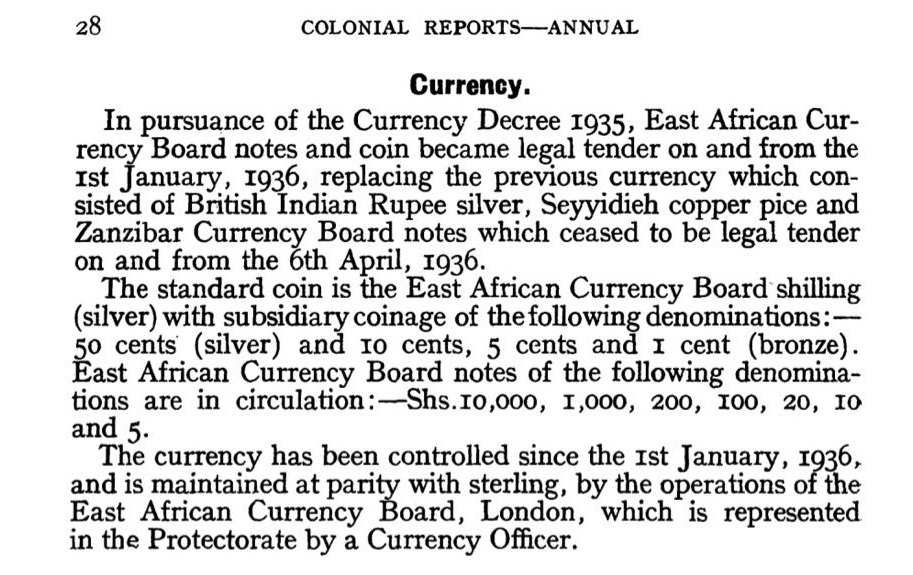
The rate fits the coin. An Economic Survey of the Colonial Empire (1935), Colonial No. 126, says the silver rupee of British India, worth 1s. 6d., was the standard coin of the Protectorate until 31st December 1935. One shilling and sixpence is 1 shilling 50 cents.
The Colonial Office List records the last officer of the change: L. Tester, Treasurer and Comptroller of Customs of Zanzibar from November 1934, was Currency Officer from January 1936. The Zanzibar Blue Book for 1947 still names the Currency Decree, 1935, as the authority for the Board's coin and notes in the Protectorate.
Earlier accounts put the end on one day. Hessler (1999, p. 15) and Jonathan Callaway (I.B.N.S. Journal, volume 62, No. 1, 2023, p. 18) both write that the notes were withdrawn and demonetised in 1936, and Percy Siganporia (I.B.N.S. Journal, volume 55, No. 4, 2016, p. 43) gives 1st January 1936 for the change to the shilling. The decree and the report of 1936 show two days, three months apart.
What has not been found
- The day in 1908 on which the first notes were issued.
- Section 4 of the Decree of 1916, repealed on 5th July 1920.
- Any authority for the 1 rupee of 1920.
- The text of the amending Decree, No. 1 of 1922, and the decree of 1922 that made the penalty for imitation notes.
- The proclamation that fixed 6th April 1936, and any count of the notes exchanged.
The Zanzibar Gazette would answer most of these. It has not been read for the catalogue.
Sources
- Currency Decree, No. 3 of 1908 (supplement to the Gazette, 11th March 1908), sections 3 and 5; Currency Decree, No. 3 of 1916, in the Laws revised to 28th February 1922, Cap. 51; Zanzibar Currency (Amendment) Decree, 1920, No. 7 of 1920; Currency Decree, 1935, No. 21 of 1935: all in the Digital Archive on Currency Boards of the Institute for Applied Economics, Johns Hopkins University.
- Marissa Licursi, working paper on the Zanzibar Currency Board (file SAE0044), pp. 3 and 19, Digital Archive on Currency Boards, Institute for Applied Economics, Johns Hopkins University.
- Zanzibar Protectorate Blue Books for 1916, 1927, 1932 and 1947.
- Colonial Reports, Annual: Zanzibar for 1920 (pp. 5 to 6), 1922 (No. 1163, p. 10), 1935 (No. 1766) and 1936 (p. 28).
- An Economic Survey of the Colonial Empire: (1933), Colonial No. 109, 1935; (1935), Colonial No. 126, 1937; (1936), Colonial No. 149, 1938.
- The Red Book 1922-23, handbook and directory for Kenya, Uganda, Tanganyika and Zanzibar, p. 261.
- The Dominions Office and Colonial Office List for 1935, 1936 and 1940, record of services of L. Tester.
- Gene Hessler, "The Paper Money (and Coins) of Zanzibar", I.B.N.S. Journal, volume 38, No. 3 (1999), pp. 13 to 15.
- Percy Siganporia, "Zanzibar 10 Rupees: A Study", I.B.N.S. Journal, volume 55, No. 4 (2016), p. 43.
- Jonathan Callaway, "Zanzibar and its Rare and Iconic Banknotes", I.B.N.S. Journal, volume 62, No. 1 (2023), p. 18.
- Dr. David Lott, "East African paper money has tangled history", Bank Note Reporter, March 1985, p. 26.
Member comments
Log in or register to post a comment.