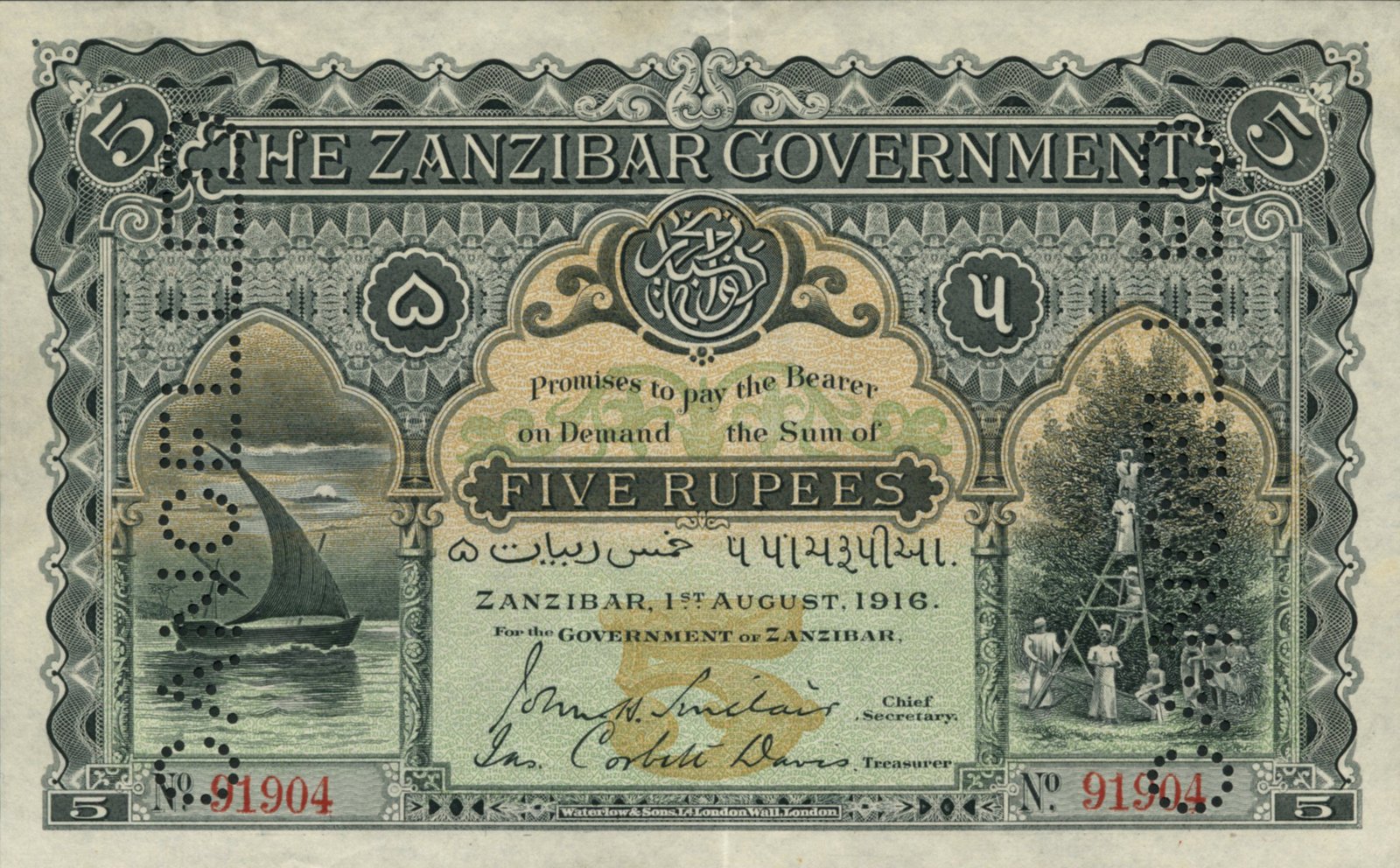
Most of what is printed about the notes of Zanzibar goes back to four writers: Dr. David Lott in Bank Note Reporter in 1985, and Gene Hessler, Percy Siganporia and Jonathan Callaway in the I.B.N.S. Journal in 1999, 2016 and 2023. All four were read against the catalogue in November 2026. This article sets out what each one wrote, what each one counted, and which statements the official volumes and the notes recorded since have borne out or overturned. The numbers on the notes are treated in the article on the serial numbers and the handstamped title.
The writings
| Year | Writer | Where | What it gives |
|---|---|---|---|
| 1985 | Dr. David Lott | "East African paper money has tangled history", Bank Note Reporter, March 1985, p. 26 | three paragraphs on Zanzibar; the Gazette notice of 2nd February 1922 |
| 1999 | Gene Hessler | "The Paper Money (and Coins) of Zanzibar", I.B.N.S. Journal, volume 38, No. 3, pp. 6 to 15 | the first list of recorded numbers; the De La Rue order of 1920; dates of officers; circulation by year |
| 2015 and 2017 | Bank Note Reporter | "Zanzibar set sells in private treaty", August 2015, p. 74; a further report, October 2017, p. 64 | the set of six cancelled notes, pictured |
| 2016 | Austin Mattox | letter to the editor, I.B.N.S. Journal, volume 55, No. 3 | a 5 rupees of 1908 newly found |
| 2016 | Percy Siganporia | "Zanzibar 10 Rupees: A Study", I.B.N.S. Journal, volume 55, No. 4, pp. 43 to 44 | the four forms of the 10 rupees |
| 2023 | Jonathan Callaway | "Zanzibar and its Rare and Iconic Banknotes", I.B.N.S. Journal, volume 62, No. 1, pp. 17 to 21; first printed in Spink Insider, spring 2022 | a count of issued notes by date and signature; colours and sizes |
Lott, 1985: one specimen seen
Dr. Lott's article is on East Africa as a whole. Of Zanzibar it says that the Protectorate began to issue notes of 5, 10, 20, 50, 100 and 500 rupees in 1908, under an Order in Council of 1905, and that a 1 rupee was added on 1st September 1920. The writer had found no report of the Zanzibar Board and had seen one Zanzibar note only, a 20 rupees specimen dated 1st February 1928.
The article is remembered for one sentence: that the Gazette of 2nd February 1922 recorded a 500 rupees note, numbered A5376 and dated 1st July 1909, as withdrawn and cancelled, so that there may have been a series of that date. The page of the 500 rupees tells it as a notice of 1922 and does not add a date of 1909. Hessler repeated it in 1999 in a footnote (p. 13). Callaway's table of 2023 does not.
Hessler, 1999: the first census
Hessler had visited Zanzibar in the autumn of 1964, six months after the revolution, with a group of musicians on a tour for the United States State Department, and writes of looking in the bazaar for old Zanzibar notes and coins and finding none. The article's two pages of "observations and statistics" (pp. 12 to 13) are the first printed list of numbers recorded on the notes.
| Value | Issued notes listed | Specimens listed |
|---|---|---|
| 1 rupee | 9 lines in all | |
| 5 rupees | 16 | 3 |
| 10 rupees | 8 | 3 |
| 20 rupees | 2 | 8 |
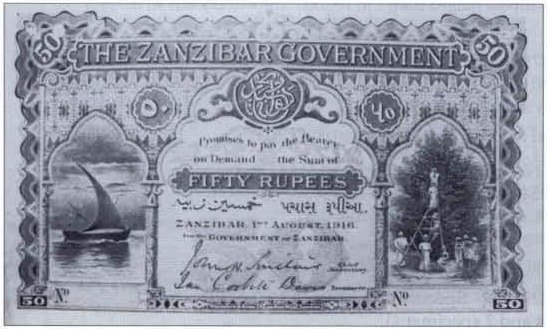
| 50 rupees | 2 | 2 |
| 100 rupees | 2 | 3 |
| 500 rupees | none | 4 |
The totals are the article's own. Hessler's "specimens" cover what the catalogue calls proofs as well: unless the list says otherwise, they have neither numbers nor zeros.
The list says where the pieces were held: a presentation book at the Royal Mint with the specimens of 1908, the Crown Agents in London for specimens of the 50, 100 and 500 rupees, and the British Museum for one 20 rupees specimen of 1928. For the 50 rupees it cites a picture in R. E. Darley-Doran's "History of Currency in the Sultanate of Oman" (1990, p. 71).
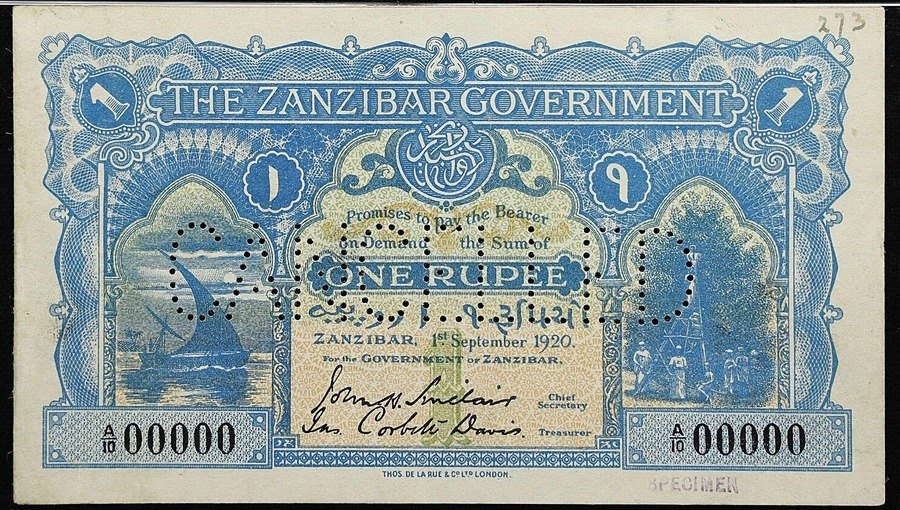
The 1 rupee order. Hessler found the making of the 1 rupee in the printer's letters, and gives records at the National Postal Museum in London for the three printings. On 13th July 1920 the Crown Agents told Thomas de la Rue that a million 1 rupee notes were urgently needed and asked for designs and for prices by two methods of printing. On 26th July the firm sent a design and advised surface printing because of the hurry, in blue with green and orange, on paper like that of the East Africa florin. The plate was to cost £55 and a working plate £18, and the notes 30 shillings a thousand. On 7th August the firm was told to proceed, and then to engrave the two titles in the same size and to put "For the" before "Government of Zanzibar". On 6th September a specimen with secret marks went to the Crown Agents. Hessler could not find the mark on any note. The article suggests, without proof, that the engraver was Leonard V. Phillips, who engraved Zanzibar stamps for the same firm.
The conjecture on numbers. Hessler offered, as a personal conjecture, that the numbers ran on from one value to the next, and guessed at bands: 5 rupees from 1 to 100,000, 100 rupees from 50,001 to 100,000, 10 rupees from 100,001 to 150,000, 20 rupees from 150,001 to 200,000, and 50 rupees with the prefix A up to 50,000.
Siganporia, 2016: the 10 rupees
Siganporia's study takes one value, the 10 rupees, and divides it into four forms.
| Form | Date | Signers and titles | Digits in the number |
|---|---|---|---|
| First issue | January 1st 1908 | Akers, Financial Member of Council; Davis, Treasurer | 5 |
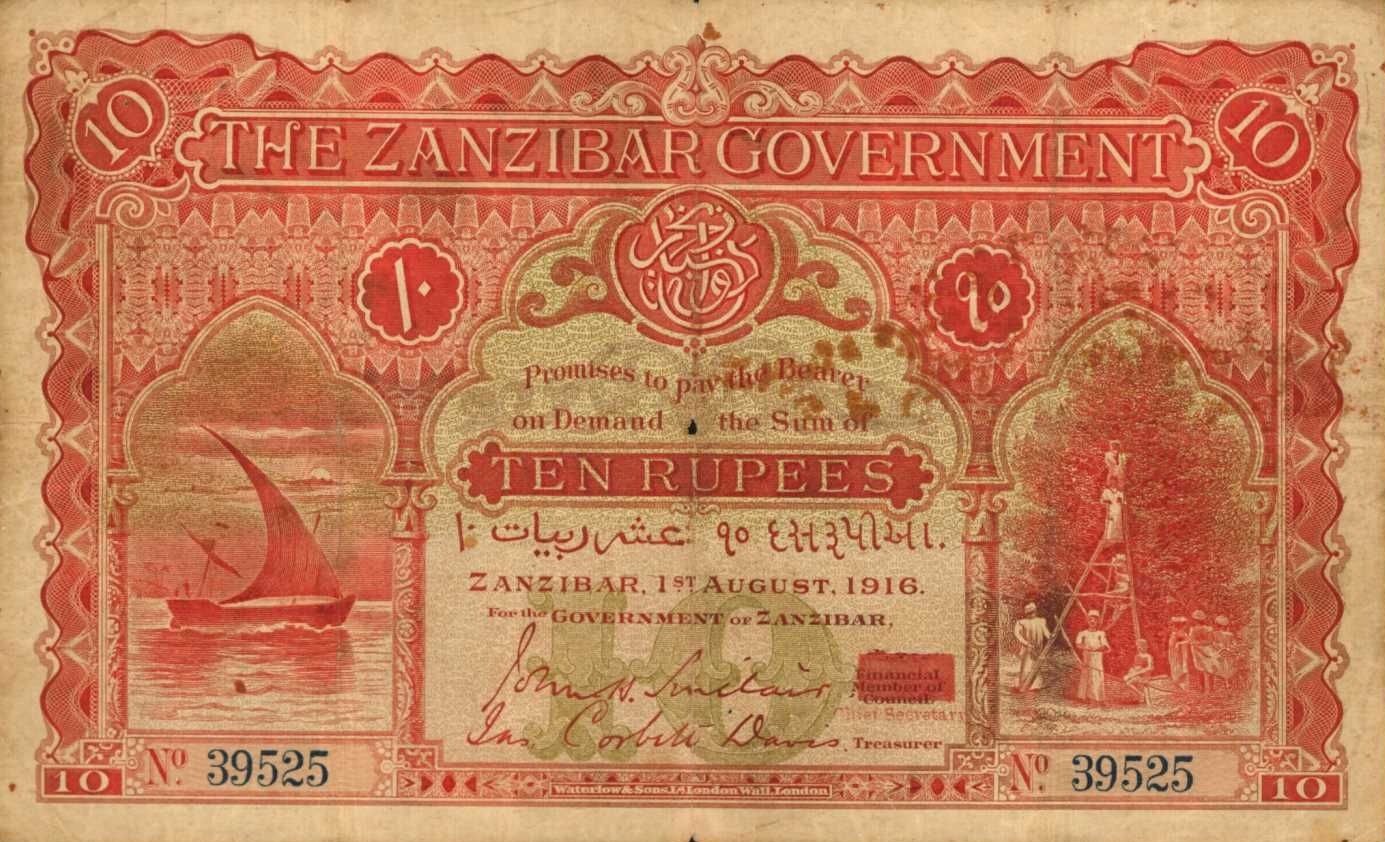
| Interim issue | 1st August 1916 | Sinclair, old title blocked out in red and Chief Secretary handstamped in red below it; Davis | 5 |
| Second issue | 1st August 1916 | Sinclair, Chief Secretary printed; Davis | 6 |
| Third issue | 1st February 1928 | Crofton, Chief Secretary; Cox, Treasurer | 6 |
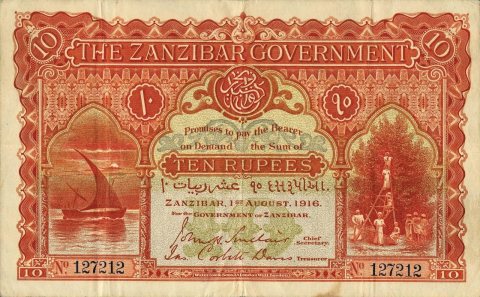
Two observations in it are new. Only the notes of 1908 write the month before the day. And no note with the printed title had been seen with a number of five digits. Both hold on every 10 rupees the catalogue records: the notes of 1908 run from 20780 to 34674, the handstamped notes are 39525 and 39619, and the notes with the printed title begin at 102077.
The study pictures four notes: 34674 and the cancelled 126273 by courtesy of Spink, 39612 from the writer's own collection, and 129280. The red bar and red handstamp it describes are proved by the photograph of 39525 on the catalogue's page.
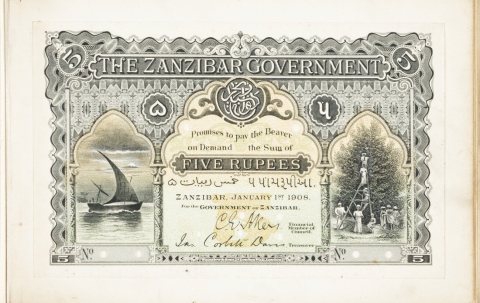
In the same year a letter from Austin Mattox in the I.B.N.S. Journal (volume 55, No. 3) told of a 5 rupees dated 1st January 1908 that a man had brought to a coin shop with a few other notes kept from a grandfather. The note pictured with the letter is numbered 8840.
Callaway, 2023: ninety notes
Callaway's article draws on records of auctions and private sales over more than thirty years, and thanks Hessler, the British Museum, the British Library and a number of collectors and dealers. Its table counts the issued notes seen, those later cancelled by punch holes among them, by date and signature.
| Value | Hessler, 1999 | Callaway, 2023 |
|---|---|---|
| 1 rupee | 9 | 20 |
| 5 rupees | 16 | 33 |
| 10 rupees | 8 | 21 |
| 20 rupees | 2 | 5 |
| 50 rupees | 2 | 3 |
| 100 rupees | 2 | 6 |
| 500 rupees | none | 2 |
| All | 90 |
By date, Callaway's 33 notes of 5 rupees are 11 of 1908, 6 of 1916 with the title overstamped, 13 of 1916 with it printed and 3 of 1928. The 21 of 10 rupees are 2, 3, 7 and 9 in the same order. The 20 rupees is recorded as an issued note only with the date of 1916, and the 6 of 100 rupees are 1 of 1908, 1 overstamped and 4 with the printed title. Callaway says the count is unlikely to be complete.
The article also gives the sizes, the full colours of every value, the reading of the Arabic panel, and the three printings of the 1 rupee. It reports two 1 rupee specimens in the British Library numbered A/10 00000, and takes them to show that the whole order of a million was printed and delivered, though the issued notes seen all fall in the first printing. The catalogue's pages took the sizes, colours and design notes from this article and left out the inference about delivery.
What has been confirmed and what overturned
| Statement | Writer | What the records now show |
|---|---|---|
| Notes of 50 and 500 rupees were issued in 1908 | Lott | The Currency Decree, No. 3 of 1908, provides for 5, 10, 20 and 100 rupees. The 50 rupees came with the Decree of 14th February 1916. |
| There may have been a series dated 1st July 1909 | Lott | No note of that date is recorded. The Gazette of 2nd February 1922 has not been read. Open. |
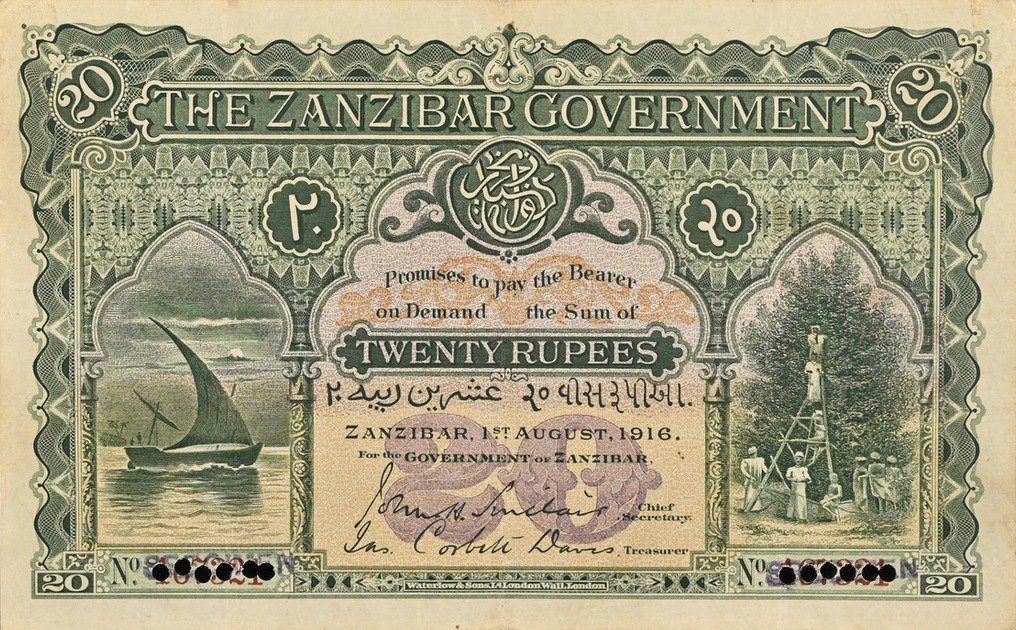
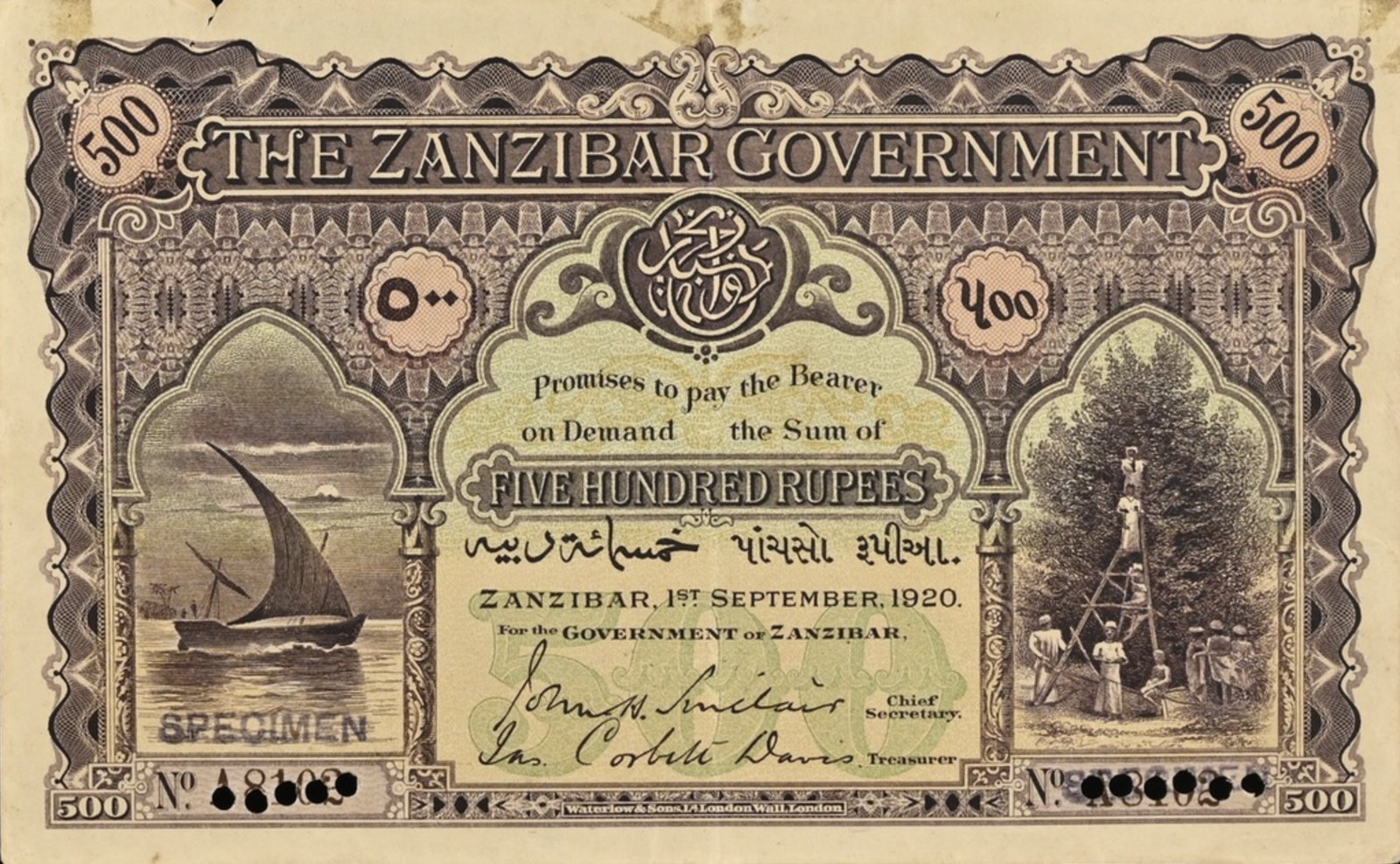
| No circulating 500 rupees is known to survive | Hessler | Two are recorded, A 6793 and A 8102, both in Callaway's table. |
| The 10 rupees were numbered from 100,001 to 150,000 | Hessler | The 10 rupees of 1908 recorded run from 20780 to 34674. |
| The numbers ran on across the values | Hessler | The bands were wrong, but no block recorded for one value overlaps another's. The catalogue's pages say so. |
| A100798 is the only note above 1 rupee seen with a prefix | Hessler | Notes of 50, 100 and 500 rupees with the prefix A are recorded. Hessler's own list has a 50 rupees read in part as A20???. |
| The 20 rupees is grey and the 500 rupees black | Hessler | Callaway gives green and mulberry, and the photographs on the catalogue's pages agree with Callaway. |
| 39619 is a 5 rupees of 1916 | Hessler; Callaway opens the 5 rupees with the printed title at 39619 | The catalogue records 39619 as a 10 rupees with the handstamped title. Callaway's own line for that 10 rupees ends at 39619. |
| The 100 rupees with the printed title runs from A14401 | Callaway | The catalogue's page gives A 14401 as mentioned by sources. No note of that number is recorded, and the next is A 74384. |
| Sinclair was Chief Secretary from 1916 | Callaway | The Colonial Office List gives 1st January 1914 and the Zanzibar Blue Book for 1918 gives 25th March 1914. |
| The notes were withdrawn and demonetised when the shilling came in | Hessler, Siganporia, Callaway | The annual report for 1936 gives 1st January 1936 for the new currency and 6th April 1936 for the end of legal tender. |
| Waterlow's archive was destroyed in the London Blitz | Siganporia | Given without a reference. Hessler in 1999 wrote only that Waterlow's records, if they survive, had not been made available. Callaway in 2023 wrote that print runs appear not to survive in the Crown Agents' archives. |
The officers' dates are compared one by one in the article on the Board's officers, and Hessler's table of circulation in the article on the yearly figures.
Two leads the writers leave
The issue of the I.B.N.S. Journal that holds Siganporia's study also has Richard Scott Morel's account of the Crown Agents' Philatelic and Security Printing Archive at the British Library (volume 55, No. 4, p. 36). It says the archive holds every value of the Zanzibar issue of 1908 to 1928 and pictures the 500 rupees specimen of 1st September 1920 numbered 00000. The archive's requisition books are described in the same article. They have not been read for the catalogue, and they are the likeliest place for the printing figures of the Waterlow values that no writer has found.
Hessler's list of works names an article by R. H. Crofton, who signed the notes of 1928, "A century of currency", in the Zanzibar Gazette of 24th October 1925. It has not been read either.
Sources
- Dr. David Lott, "East African paper money has tangled history", Bank Note Reporter, March 1985, p. 26.
- Gene Hessler, "The Paper Money (and Coins) of Zanzibar", I.B.N.S. Journal, volume 38, No. 3 (1999), pp. 6 to 15.
- "Zanzibar set sells in private treaty", Bank Note Reporter, August 2015, p. 74, and the report of the second sale, Bank Note Reporter, October 2017, p. 64.
- Austin Mattox, letter to the editor, I.B.N.S. Journal, volume 55, No. 3 (2016).
- Percy Siganporia, "Zanzibar 10 Rupees: A Study", I.B.N.S. Journal, volume 55, No. 4 (2016), pp. 43 to 44.
- Richard Scott Morel, "World Paper Money Resources at the British Library: The Crown Agents' Philatelic and Security Printing Archive", I.B.N.S. Journal, volume 55, No. 4 (2016), p. 36.
- Jonathan Callaway, "Zanzibar and its Rare and Iconic Banknotes", I.B.N.S. Journal, volume 62, No. 1 (2023), pp. 17 to 21.
- Currency Decree, No. 3 of 1908, and Currency Decree, No. 3 of 1916; the Colonial Office List for 1922; the Zanzibar Blue Book for 1918; the annual report on Zanzibar for 1936, p. 28.
- The catalogue's pages for the 1, 5, 10, 20, 50, 100 and 500 rupees.
Member comments
Log in or register to post a comment.