This article puts side by side what the catalogue's pages record of the serial numbers of Zanzibar's notes, value by value, and what follows from them. It then gathers the open questions about the 50 and 500 rupees, the proofs, specimens and colour trials, and the statements of the auction houses about how many notes survive. The history of the issue is told in The Zanzibar Government's notes, 1908 to 1936.
One run of numbers across the values
The numbers recorded do not overlap between the values. The blocks of the 5, 10, 20 and 100 rupees are separate, which suggests one series across the values and not a series for each value. Set in order of number, the figures on the pages for the notes without a prefix fall like this:
| Numbers | Value | Date on the notes | Title |
|---|---|---|---|
| 1005 to 9175 seen, 10434 mentioned | 5 rupees | 1st January 1908 | Financial Member of Council |
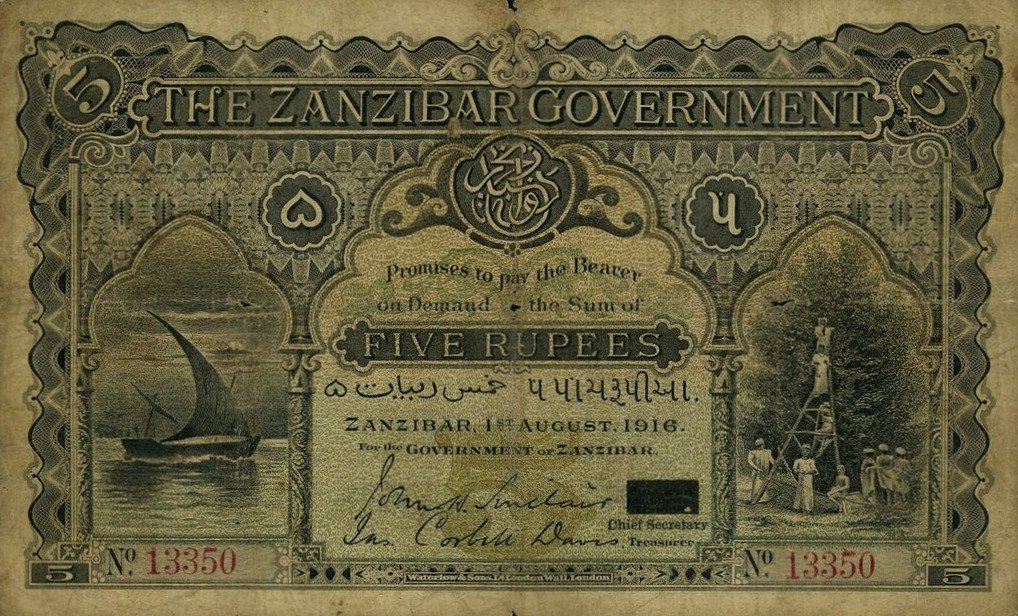
| 13350 seen, up to 19277 mentioned | 5 rupees | 1st August 1916 | Chief Secretary, handstamped |
| 20780 to 34674 seen | 10 rupees | 1st January 1908 | Financial Member of Council |
| 39525 and 39619 seen | 10 rupees | 1st August 1916 | Chief Secretary, handstamped |
| 60163 mentioned | 100 rupees | 1st August 1916 | Chief Secretary, handstamped |
| 66473 mentioned | 100 rupees | 1st August 1916 | Chief Secretary, printed |
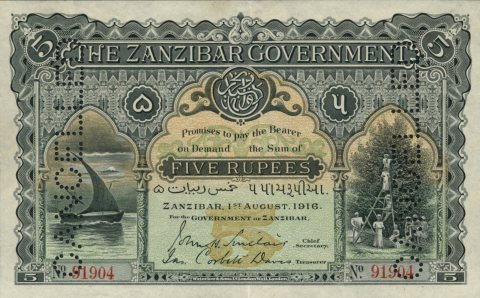
| 74493 to 90182 seen, up to 91904 mentioned | 5 rupees | 1st August 1916 | Chief Secretary, printed |
| 93836 to 99327 seen | 5 rupees | 1st February 1928 | Chief Secretary |
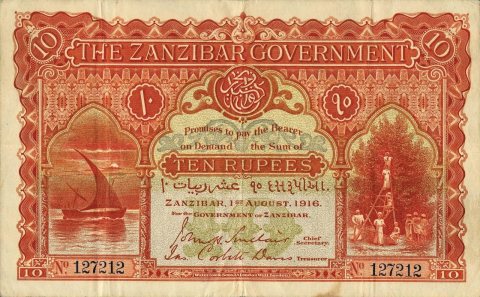
| 102077 mentioned, 120699 and 127212 seen | 10 rupees | 1st August 1916 | Chief Secretary, printed |
| 128106 to 134775 seen, 135914 mentioned | 10 rupees | 1st February 1928 | Chief Secretary |
| 152954 mentioned | 20 rupees | 1st August 1916 | not stated; filed with the handstamped notes by its number |
| 155915 mentioned | 20 rupees | 1st August 1916 | Chief Secretary, handstamped |
| 160036 mentioned, 164484 to 167321 seen | 20 rupees | 1st August 1916 | Chief Secretary, printed |
In the table, seen means a note recorded on the catalogue's pages, and mentioned means a number the pages give only as mentioned by sources.
Within each value the numbers rise from one date to the next. The pages give no number for a 20 rupees of 1908 or of 1928, and none for a 100 rupees of 1908, so those places in the run are not known.
The prefix A
After 99327 the 5 rupees of 1st February 1928 takes the prefix A. The prefix A numbers of the 5, 50, 100 and 500 rupees are also separate from one another on the pages:
- the 50 rupees is recorded from A 21323 to A 24774, and sources also mention a part-read number beginning A 20;
- the 100 rupees with the printed title is seen up to A 78151, and sources mention A 14401 to A 74384;
- the 500 rupees seen has the prefix A; the one number the pages give is A5376, from the Gazette notice of 1922 treated below.
No number given for one value is given for another. The 50 rupees numbers do lie between the lowest and the highest numbers given for the 100 rupees. The pages give no prefix A number for the 5 rupees.
The handstamped title of 1916
The Currency Decree of 14th February 1916 put the Chief Secretary in place of the Financial Member of Council on the Currency Board, beside the Treasurer and a member of the commercial community. Sources give 1913 for the passing of Zanzibar from the Foreign Office to the Colonial Office, when the post of Chief Secretary was created, and date Sinclair's appointment to it 1914 or 1916: the Colonial Office List gives 1st January 1914 and the Zanzibar Blue Book for 1918 gives 25th March 1914. Davis had been Treasurer since 25th October 1906 and was Financial Member of Council and Treasurer from 28th July 1910 until that post was abolished on the transfer (Colonial Office List for 1922).
On the notes dated 1st August 1916 the first printing still carried the old title, Financial Member of Council. It was blocked out with a solid bar, black on the 5 rupees and red on the 10 rupees, and Chief Secretary was added by handstamp. On the 10 rupees the handstamp is also in red, just below the bar. Later notes have Chief Secretary printed.
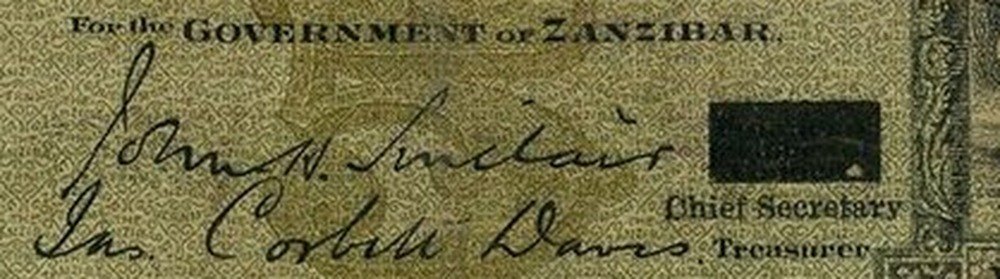
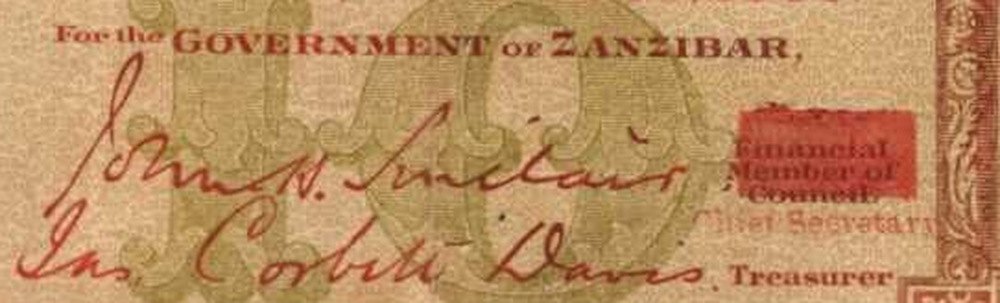
The serial number tells the two forms apart, as the table shows: on each value the handstamped notes carry the lower numbers. On the 20 rupees the number 152954 is mentioned without its title, and the catalogue files it with the handstamped notes by its number. On the 100 rupees the handstamped form is known to the pages from one mentioned number, 60163.
Crofton was appointed Chief Secretary on 31st January 1928, the day before the date on the last notes, and Cox had been Treasurer since 20th November 1922 (Zanzibar Blue Books for 1927 and 1932). By then the title was printed.
The 1 rupee: numbers within the first batch
The 1 rupee has its own numbering, with the prefixes A/1 to A/10 and 100,000 notes to a prefix. One million were printed in three batches in late 1920; the batches are set out in the first article. Every issued note recorded on the page falls in the first batch, from A/1 00350 up to A/3 42916. The specimen with an all-zero serial number carries the prefix A/10, in the last batch. Whether the second and third batches reached circulation is not stated by any source on the page.
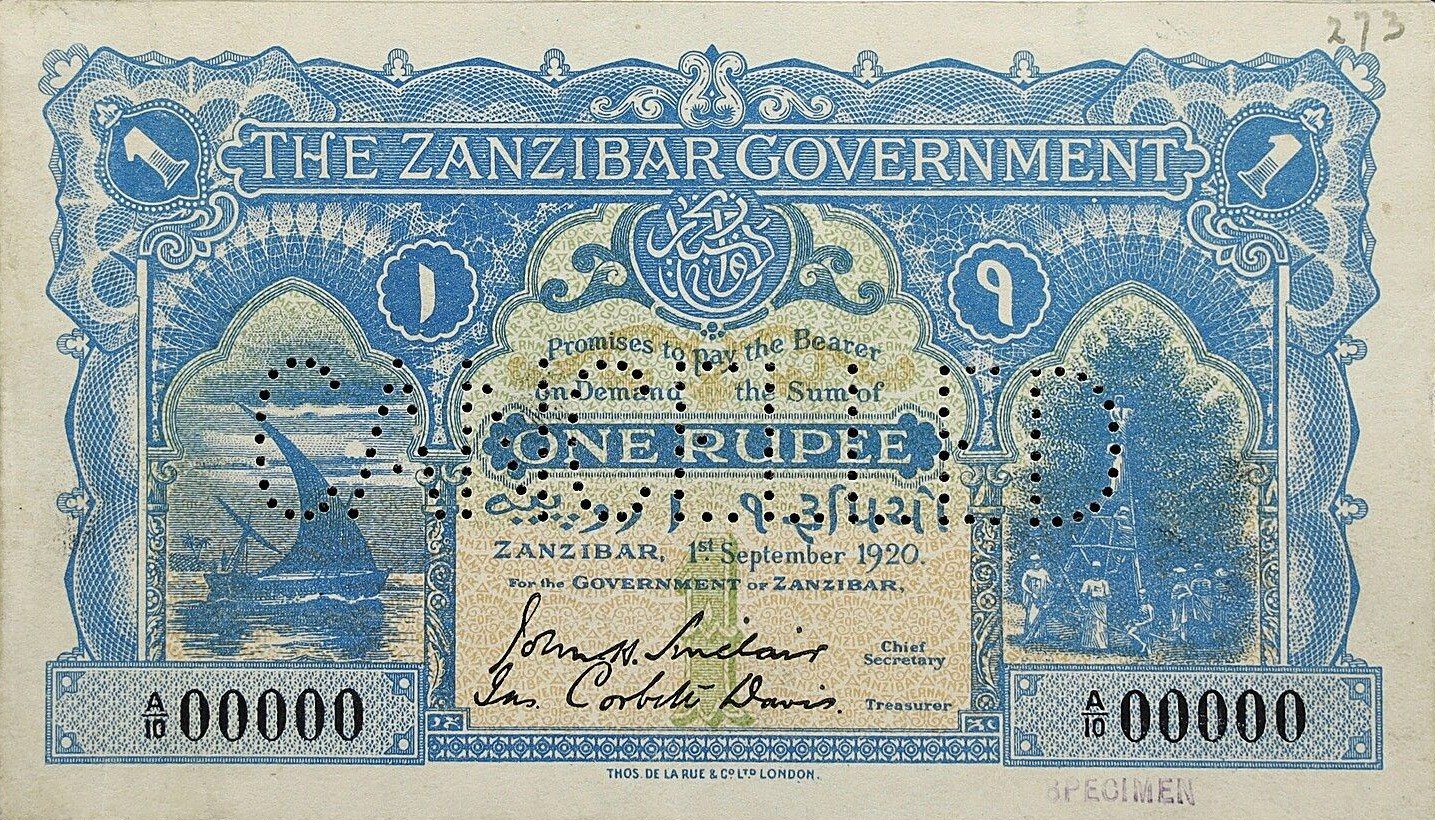
Spink's description of lot 219 in its sale of 16 January 2026 says A/1 00350 is the lowest number recorded for the 1 rupee, the previous lowest known being A/1 18707. Spink had offered A/1 18707 on 4 October 2013 (lot 687), where it is described as from the collection of Mel Steinberg.
The 50 and 500 rupees: dates not settled
The 50 rupees. Sources mention a date of 1st January 1908 for the 50 rupees, which is not confirmed. The Currency Decree of 1908 provided for notes of 5, 10, 20 and 100 rupees and none of 50 rupees, and the presentation album of 1908 holds those four values only. The 50 rupees was added by the Decree of 14th February 1916, and the Admiralty's handbook of the Protectorate, compiled during the First World War, lists it among the six values of the issue.
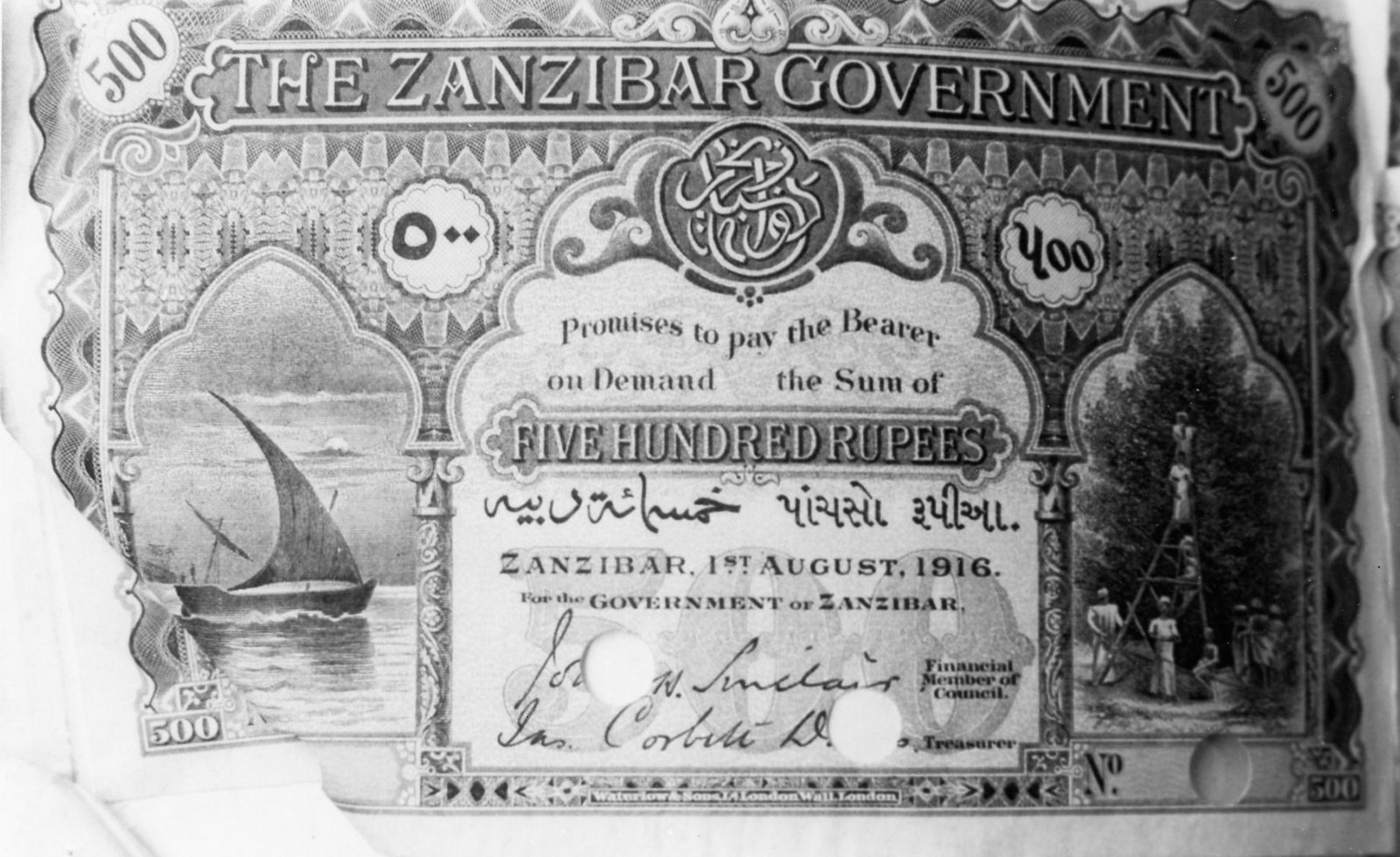
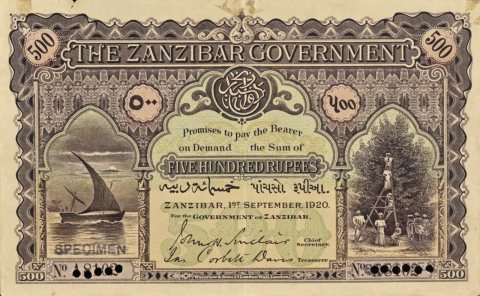
The 500 rupees. Sources mention a first date of 1st August 1916, known only from a specimen in an official holding and not from any issued note. The notes seen are dated 1st September 1920. The Zanzibar Blue Book for 1916 and the Admiralty's handbook both list a 500 rupees, so the value was part of the issue, or at least provided for, before 1920. Kerry Rodgers, in "Zanzibar set sells in private treaty" (Numismatic News, 9 October 2017), writes that the 50 rupees was added in 1916 and the 500 rupees in 1920. For the 500 rupees that agrees with the issued notes and not with the Blue Book for 1916. Both are given here, and the question stays open.
The Gazette notice of 1922
Dr. David Lott, writing in Bank Note Reporter in March 1985, reports that the Gazette of 2nd February 1922, presumably the Zanzibar Government Gazette, gives a 500 rupees note numbered A5376 and dated 1st July 1909 as withdrawn and cancelled. Dr. Lott suggests there may have been a series of that date. No Zanzibar note of 1909 is known. The first notes are dated 1st January 1908, and the 500 rupees is recorded only with the dates 1st August 1916 and 1st September 1920. The date fits no known printing and may be a slip in the notice or in the reading of it.
Proofs, specimens and colour trials
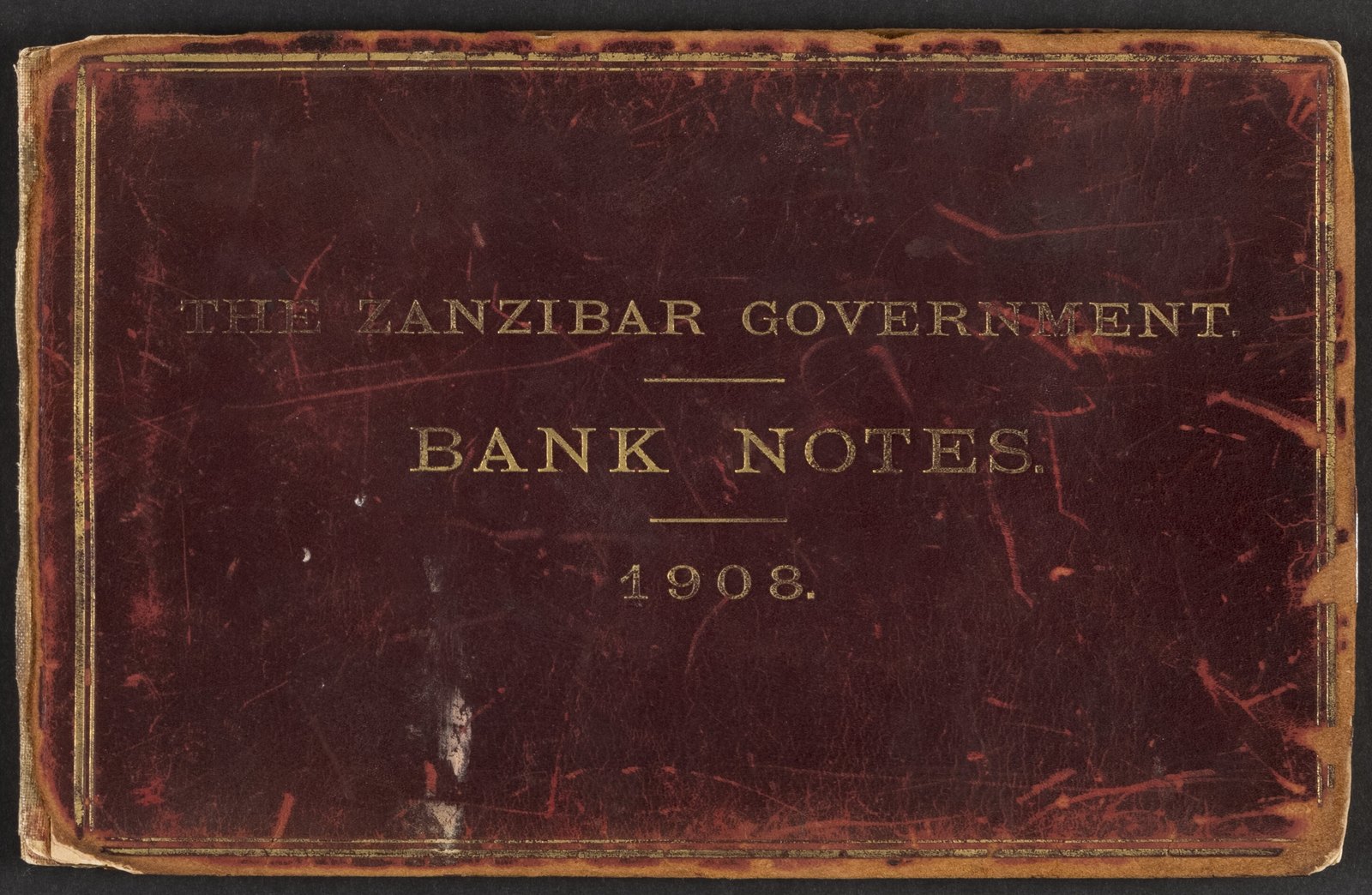
The catalogue lists a proof or a specimen for every value. For 1908 the pages name one object, the presentation album. Spink's description of lot 1406 in its sale of 13 April 2011 gives it as bound in brown leather with gold trim and titled THE ZANZIBAR GOVERNMENT-BANK NOTES-1908, holding the 5, 10, 20 and 100 rupees of 1908, each with small perforations and fixed at the left margin to card. Spink described an album of the same four values in nearly the same words, without the binding and the title, on 4 October 2013 (lot 700, the Ibrahim Salem Collection of African Banknotes). Heritage Auctions offered an album of the same four values on 15 November 2022 (lot 24277, the Ibrahim Salem Collection of Islamic Countries), calls the pieces proofs with punched holes in place of serial numbers, each mounted on its own page, and notes that the 1, 50 and 500 rupees came after 1908 and so are absent. None of the three descriptions says whether it is the same album as the others.
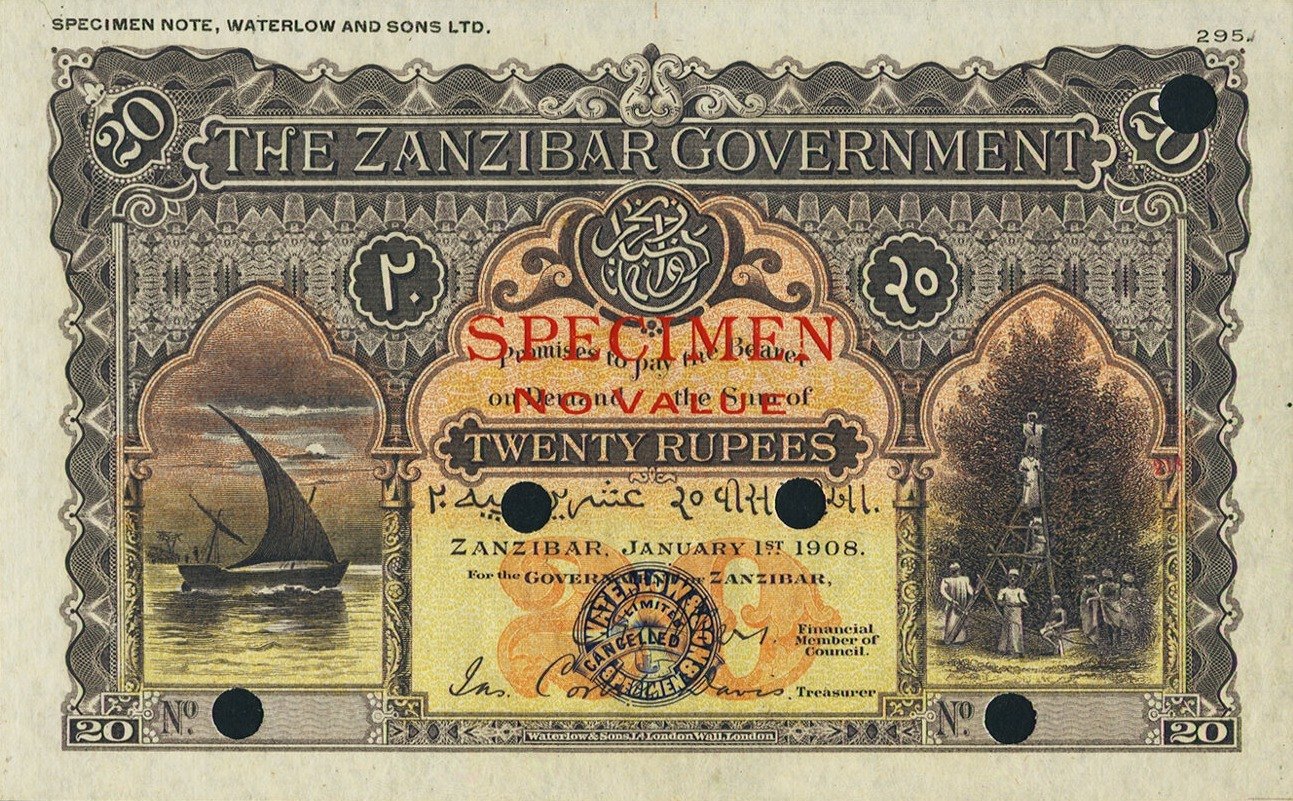
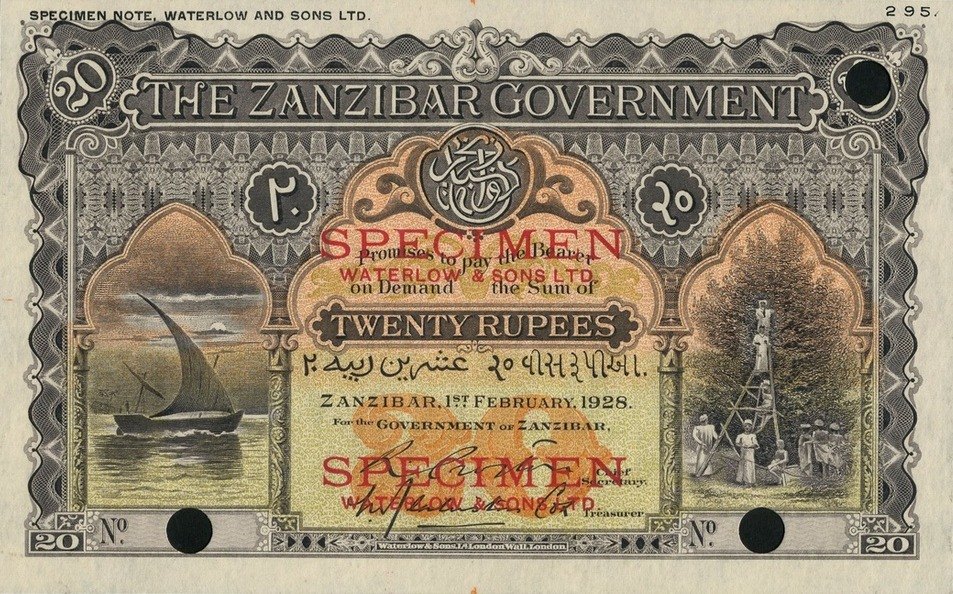
Colour trials are listed for the 20 rupees only, with the dates 1st January 1908 and 1st February 1928. Sources suggest that the colour trials came from the commercial specimen books Waterlow gave its salesmen. Heritage Auctions (23 April 2020, lot 28579) says instead that Waterlow made its colour trial of 1908 as a presentation piece. Spink (17 April 2019, lot 1272) says of the colour trial dated 1928 that the date usually met is 1908 and that this piece may be the only one of its date still in being. Spink had offered a colour trial of the 1928 date on 29 September 2009 (lot 2051), and the two descriptions do not say whether it was the same piece.
A set of six cancelled notes, 5 to 500 rupees, is described by Kerry Rodgers in Numismatic News of 9 October 2017. The article says the notes are issued notes perforated CANCELLED twice, all dated 1st August 1916 except the 500 rupees of 1st September 1920; that Spink first sold the set by private treaty in 2015; and that it was sold again by private treaty in 2017 through Trusted Traditions with Stack's Bowers and Spink. It adds that the set cannot have come from the Waterlow archive, which it says was destroyed in the London blitz. Stack's Bowers (13 January 2024, lot 60505) says that a set brokered in 2017 held no 1 rupee.
How many survive, as each source puts it
No official count of the notes left unredeemed is on the pages. What follows are the statements of the houses, each a claim of that house at that date.
- All values. Stack's Bowers says that only about 500 of the notes printed from 1908 to 1928 are known to survive: on 12 January 2017 (lot 1405), on 5 August 2020 (lot 30360) and on 16 August 2021 (lot 30505). The house names no source for the figure. On 13 January 2024 (lot 60505) the same house says PMG had graded 37 Zanzibar notes across all values.
- 1 rupee. The PMG count for the issued note is given as 4 by Stack's Bowers on 4 May 2020 (lot 50423), as six by Heritage Auctions on 23 March 2023 (lot 24545) and as nine by Heritage Auctions on 15 October 2026 (lot 24829).
- 5 rupees. Heritage Auctions gives three graded by PMG on 9 January 2020 (lot 28414) and 13, across the three dates, on 15 October 2026 (lots 24830 and 24831). On 23 April 2020 (lot 28578) the house says six different examples had come to auction in the 15 years before. Spink (28 April 2022, lot 319) calls 1005 possibly the lowest number known for the value.
- 10 rupees. Heritage Auctions gives ten graded by PMG across the three dates on 16 October 2025 (lot 24500). Stack's Bowers (5 August 2020, lot 30360) says it knew of only one other 10 rupees dated 1916. Heritage Auctions (7 September 2017, lot 28489) says its note of 1928 came from the same pack as the note numbered 129974 from the Ruth W. Hill Collection, which the house had offered on 24 April 2014 (lot 21722). Spink offered 129991 on 2 October 2019 (lot 170).
- 20 rupees and above. Heritage Auctions (17 August 2018, lot 28221) says its colour trial of 1908 was the only piece of its type in the PMG census. Spink's description of lot 320 in its sale of 14 January 2022 tells of an issued 100 rupees found in the Zanzibar region, once backed on paper, in the same sale.
The counts above rise with time, so each belongs to its date.
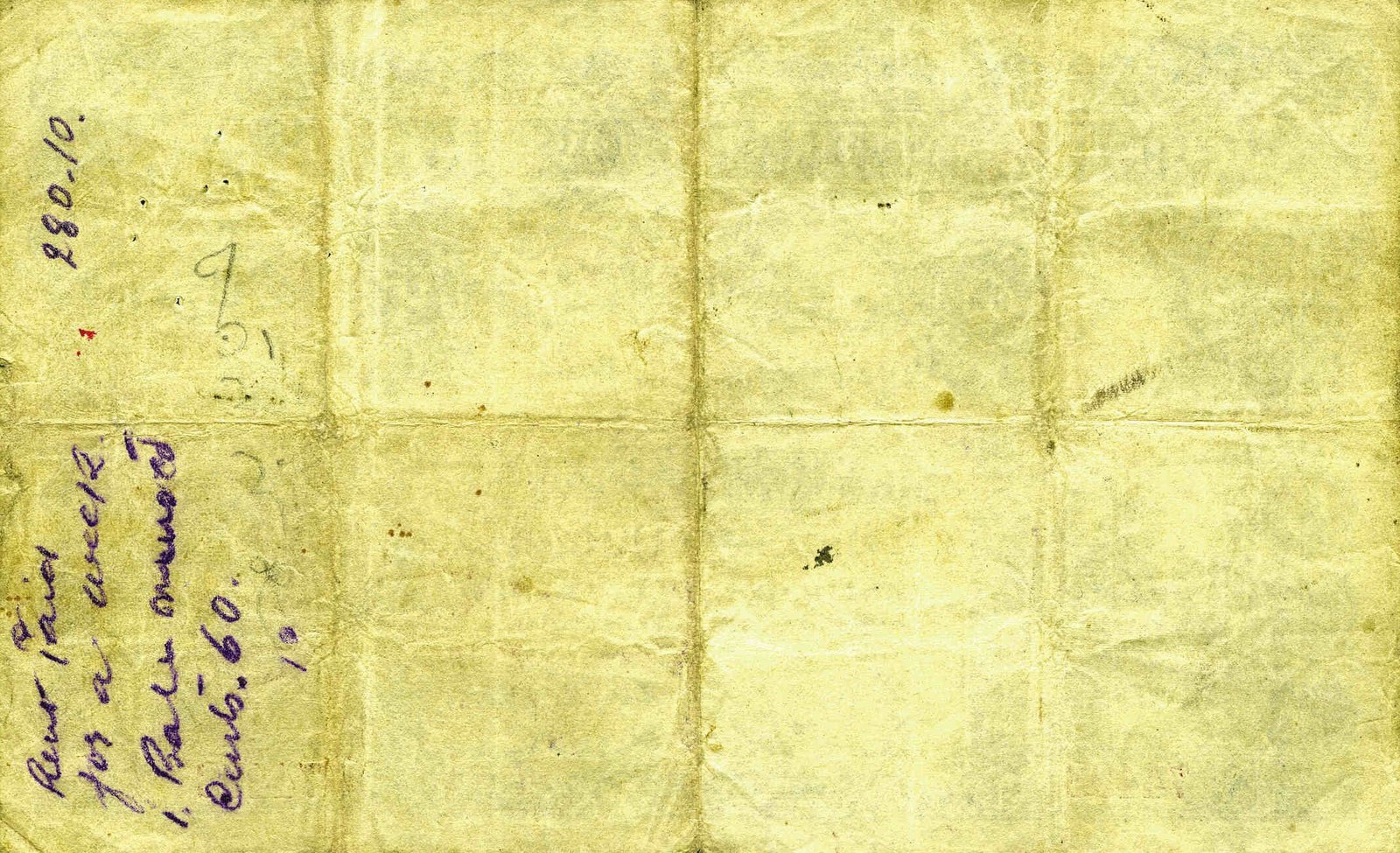
Provenances given by the houses for single notes: the 5 rupees of 1908 numbered 4695 is given as from the Amon Carter collection, Spink 1997 (Spink, 27 September 2017, lot 2877), and the 5 rupees of 1916 numbered 74493 is given as from the collection of Mel Steinberg, with "Rent paid for a week" written on the back (Spink, 4 October 2013, lot 688).
Sources
- The catalogue's seven note pages for Zanzibar, with the sources they cite: the Zanzibar Currency Decrees of 1908 and 1916, the Zanzibar Blue Books for 1916, 1918, 1927 and 1932, the Colonial Office List for 1922, and the Admiralty's handbook of the Protectorate.
- Dr. David Lott, in Bank Note Reporter, March 1985, as cited on the page of the 500 rupees.
- Kerry Rodgers, "Zanzibar set sells in private treaty", Numismatic News, 9 October 2017, first printed in Bank Note Reporter.
- Spink, lot descriptions: 29 September 2009, lot 2051; 13 April 2011, lot 1406; 4 October 2013, lots 687, 688 and 700; 27 September 2017, lot 2877; 17 April 2019, lot 1272; 2 October 2019, lot 170; 14 January 2022, lot 320; 28 April 2022, lot 319; 16 January 2026, lot 219.
- Heritage Auctions, lot descriptions: 24 April 2014, lot 21722; 7 September 2017, lot 28489; 17 August 2018, lot 28221; 9 January 2020, lot 28414; 23 April 2020, lots 28578 and 28579; 15 November 2022, lot 24277; 23 March 2023, lot 24545; 16 October 2025, lot 24500; 15 October 2026, lots 24829, 24830 and 24831.
- Stack's Bowers, lot descriptions: 12 January 2017, lot 1405; 4 May 2020, lot 50423; 5 August 2020, lot 30360; 16 August 2021, lot 30505; 13 January 2024, lot 60505.
Member comments
Log in or register to post a comment.