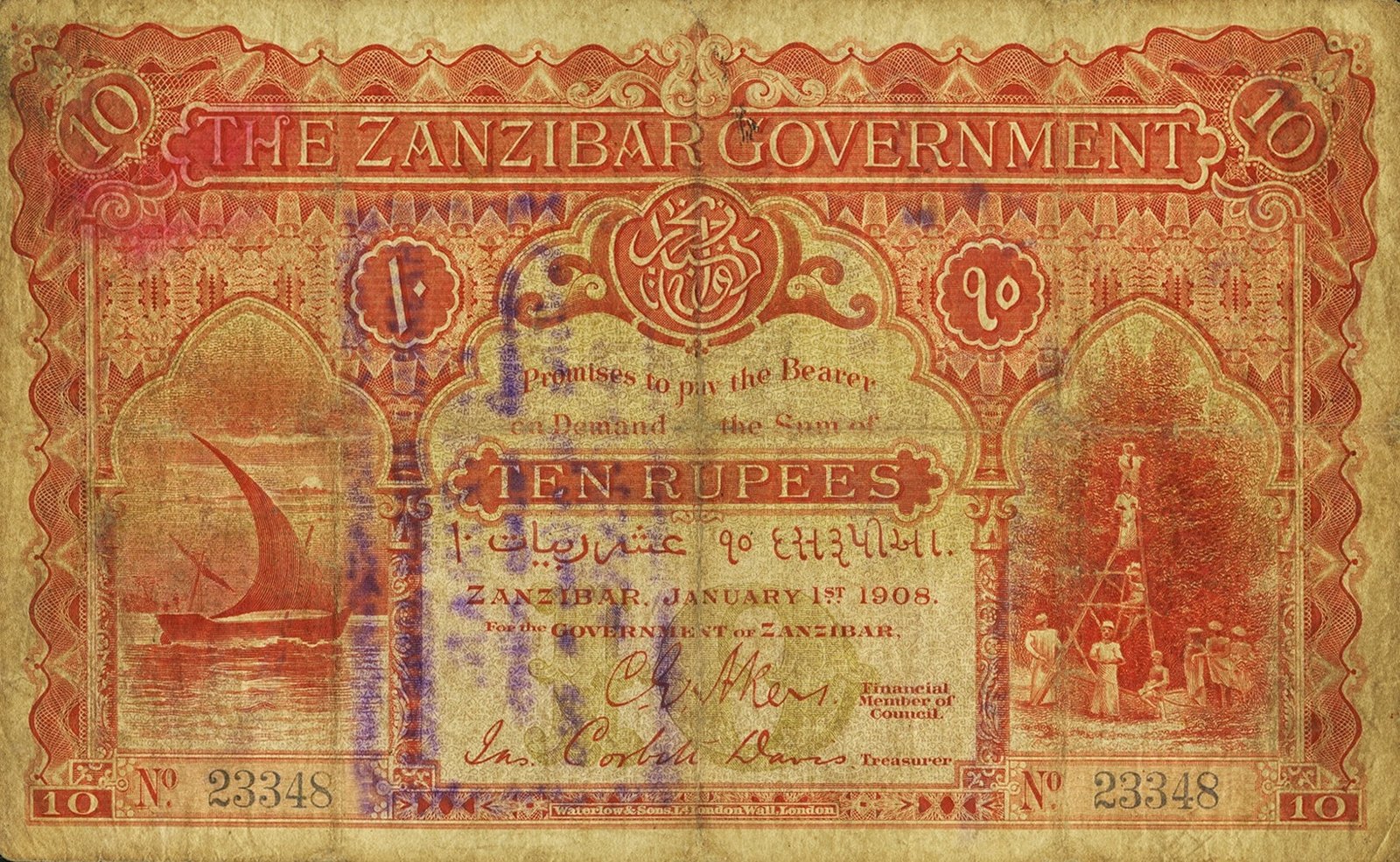
This article sets out the paper money of Zanzibar in order of time, from the first notes dated 1st January 1908 to the day they ceased to be legal tender, 6 April 1936. It is drawn from the catalogue's seven note pages, which rest on the annual reports on Zanzibar, the Zanzibar Blue Books, the Colonial Office List and the Admiralty's handbook of the Protectorate, with a few statements of the auction houses and one answer in the House of Commons, each named where it is used.
The Currency Decree of 1908
The notes were issued under the Zanzibar Currency Decree of 11 March 1908. The Zanzibar rupee replaced the Zanzibar ryal and stayed at par with the Indian rupee until 1936. The Decree of 1908 provided for notes of 5, 10, 20 and 100 rupees, and none of 50 rupees.
The first notes are dated 1st January 1908 and carry two signatures with the titles Financial Member of Council and Treasurer. They are the 5 rupees, the 10 rupees, the 20 rupees and the 100 rupees. A presentation album of 1908 holds those four values only. All four were printed by Waterlow and Sons. Sources mention that printing figures for the Waterlow values have not survived, so the number printed of any value from 5 to 500 rupees is not known.
The design
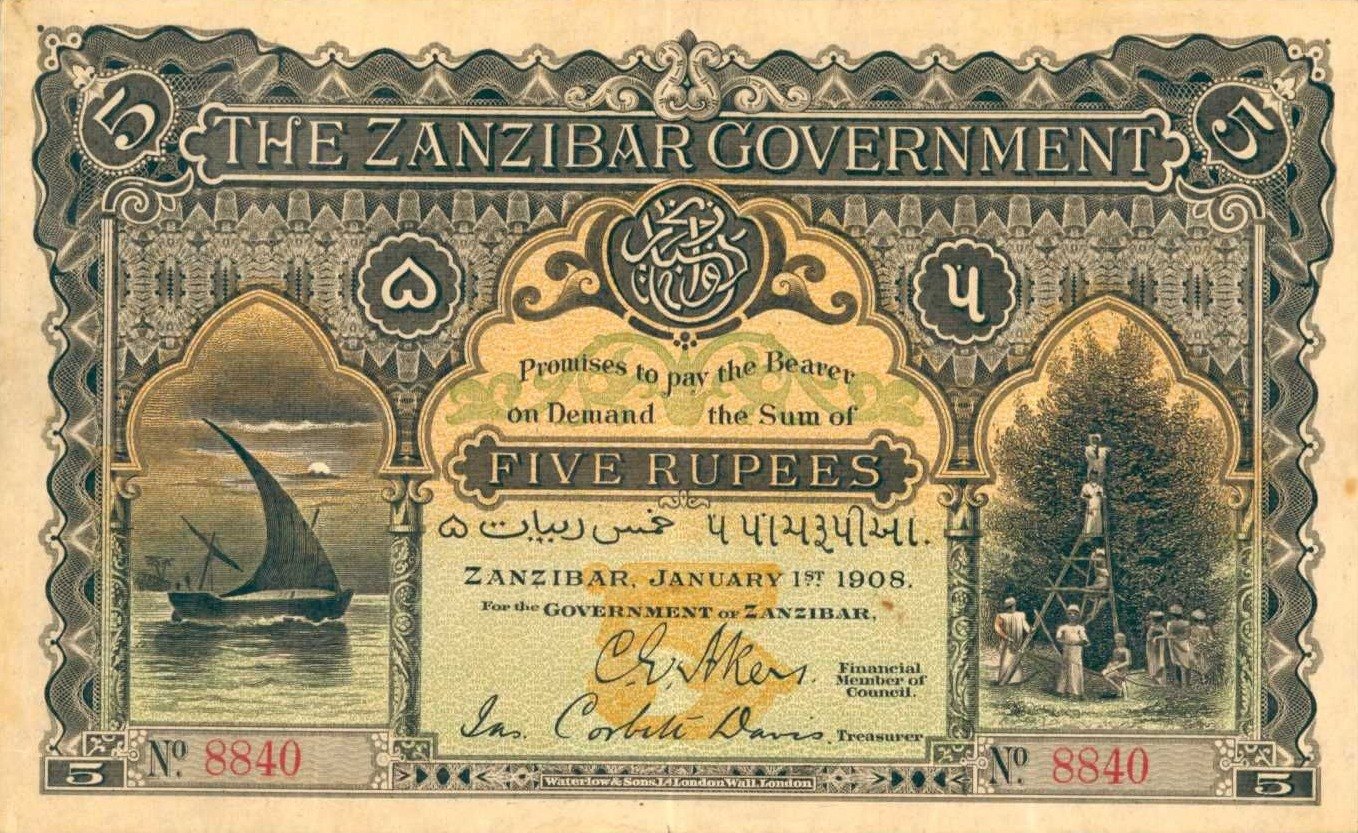
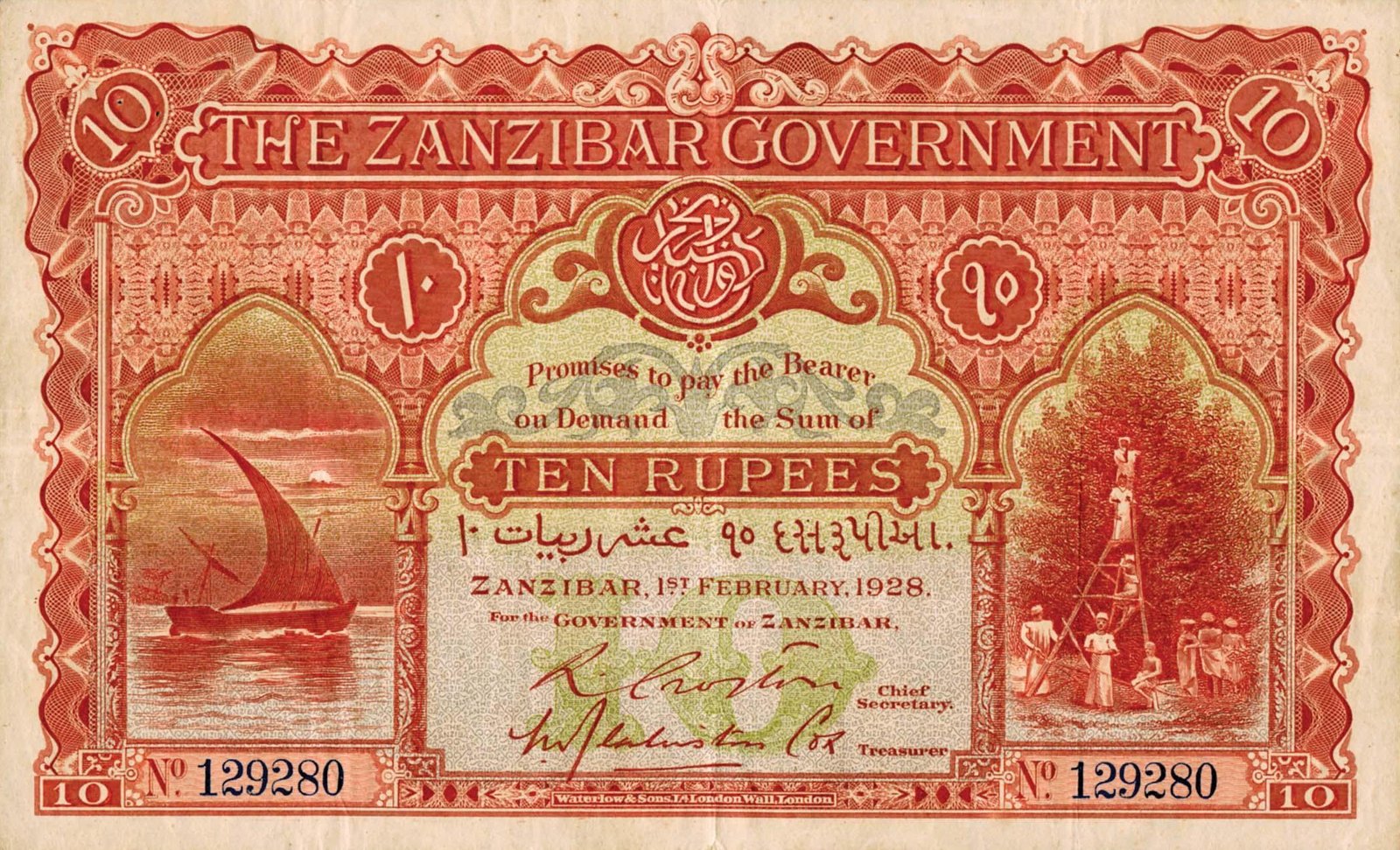
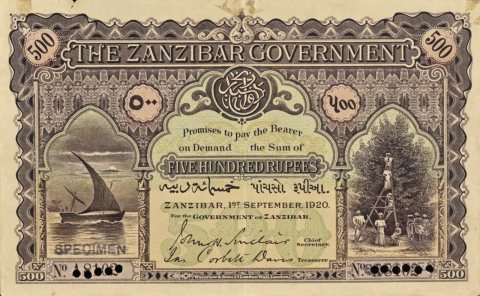
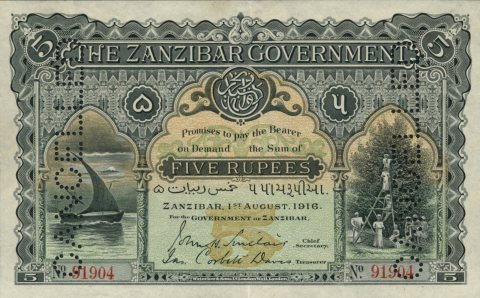
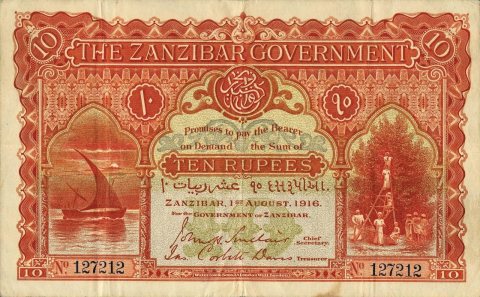
All the notes are uniface and share one design. An Arab dhow is at the left and workers harvesting a clove tree are at the right: the sea trade and the farming of an island that was once the world's largest grower and exporter of cloves. The workers use a tripod ladder to pick the cloves. The value is repeated in Arabic and Gujarati, the numerals appear in Latin, Arabic and Gujarati, and the round panel at the top centre reads al-sultanat zanjibar (the Sultanate of Zanzibar).
Sources mention a size of 180 x 110 mm for all the values from 5 to 500 rupees, which are told apart by colour:
| Value | Colour | Serial numbers |
|---|---|---|
| 5 rupees | Dark grey on a pale green and orange underlay | Red |
| 10 rupees | Red on a pale green underlay | Blue |
| 20 rupees | Green on a pale orange and mauve underlay | Red |
| 50 rupees | Brown on a pale blue, green and yellow underlay | Blue |
| 100 rupees | Blue on a pale pink and brown underlay | Red |
| 500 rupees | Mulberry on a pale green and yellow underlay | Brown |
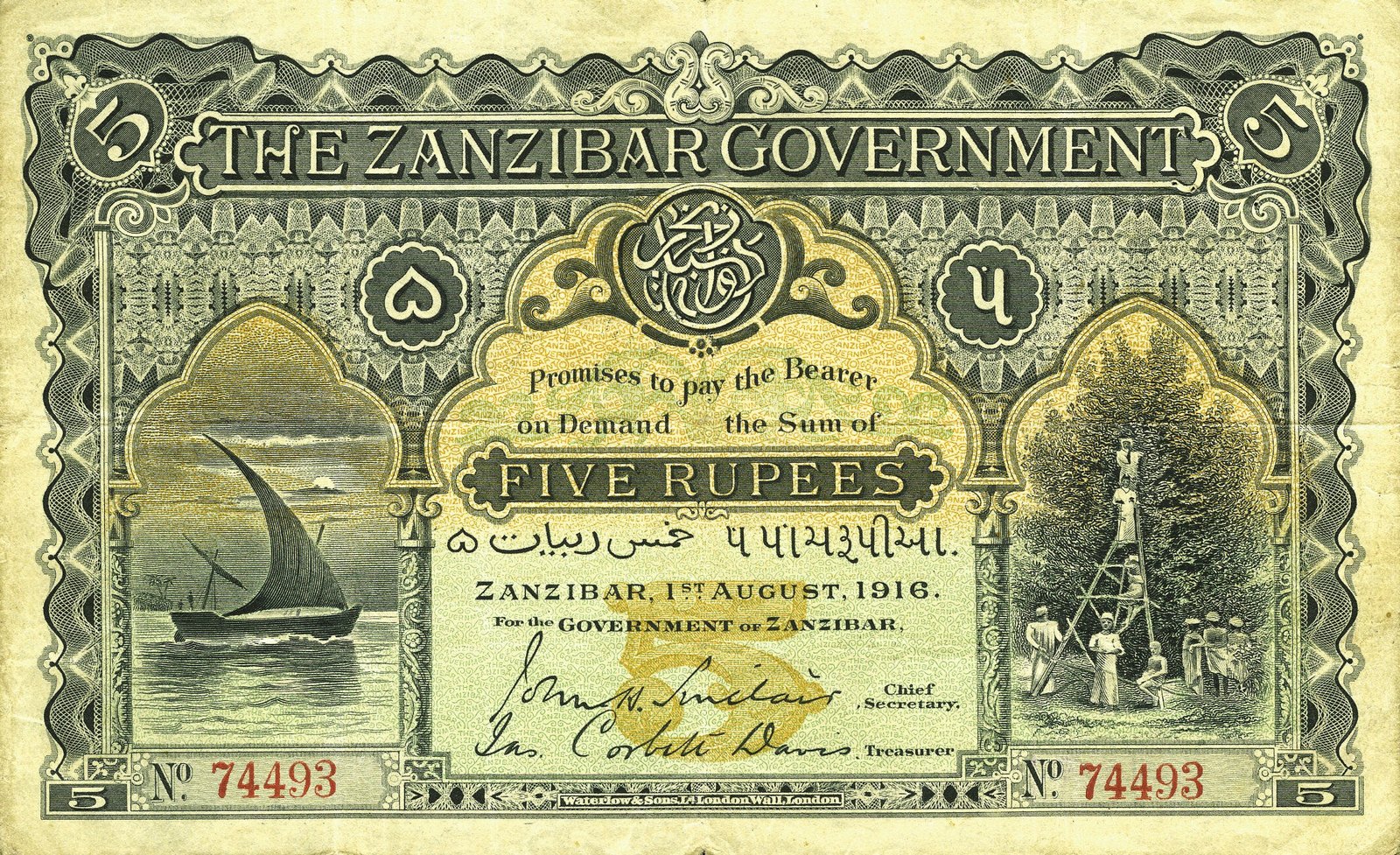
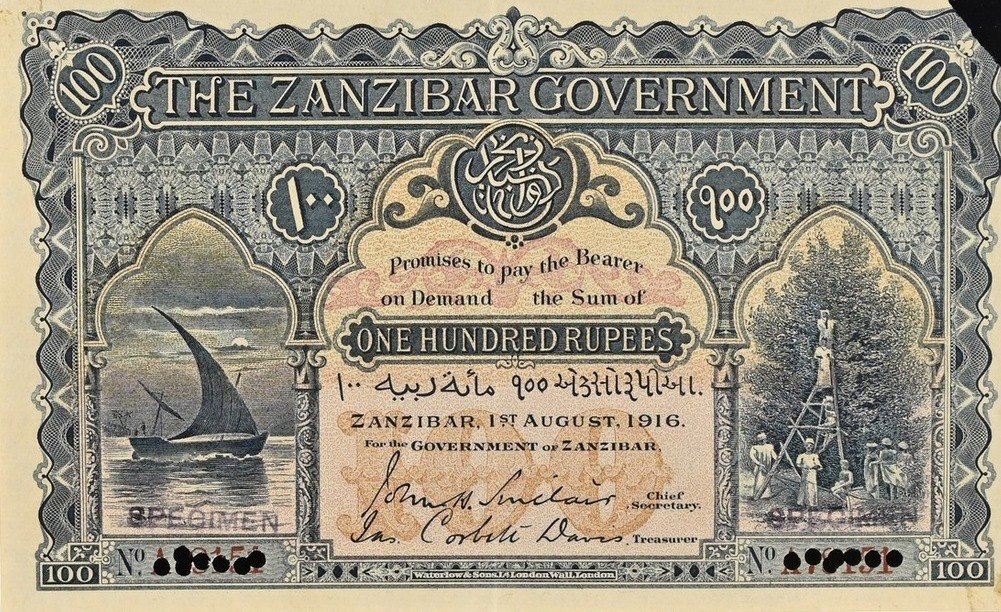
Heritage Auctions, in its description of lot 24829 in the sale of 15 October 2026, reads the three languages on the notes as standing for three parts of the island's society: the British administration, the Arab Sultanate and the Indian merchants, Gujarati traders among them. That is the house's reading. The catalogue's sources do not say why the languages were chosen.
The Decree of 1916 and the higher values
The Currency Decree of 14th February 1916 (Decree No. 3 of 1916) allowed notes of 5, 10, 20, 50 and 100 rupees and multiples of 100. It also put the Chief Secretary in place of the Financial Member of Council on the Currency Board, beside the Treasurer and a member of the commercial community.
The 50 rupees was added by this Decree and is dated 1st August 1916. The 500 rupees, the highest value, rests on the Decree's allowance of multiples of 100. The Zanzibar Blue Book for 1916 lists notes of 5, 10, 20, 50, 100 and 500 rupees as legal tender under the Zanzibar Currency Decree, 1916. The Admiralty's handbook of the Protectorate, compiled during the First World War and published in 1920, lists the same six values. So a 500 rupees was part of the issue, or at least provided for, before the notes dated 1920. Sources mention a first date of 1st August 1916 for the 500 rupees, known only from a specimen in an official holding and not from any issued note. The notes seen are dated 1st September 1920.
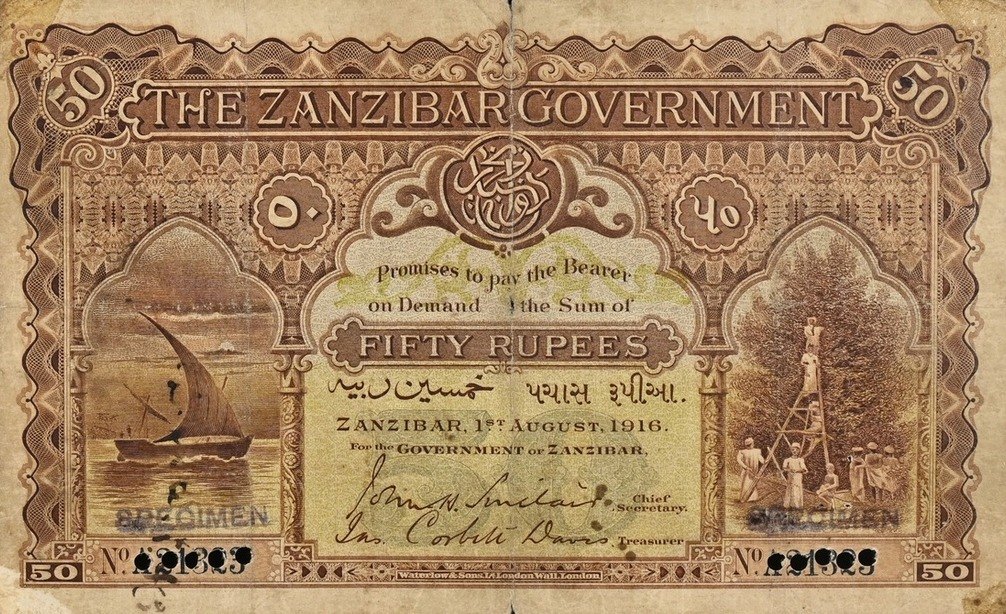
The 5, 10, 20 and 100 rupees were printed again with the date 1st August 1916. The first printing of that date still carried the old title, which was blocked out and replaced by a handstamp. How to tell the two forms apart is set out in the article on the serial numbers and the handstamped title.
The signers and their offices
The catalogue's pages give the offices and the dates of appointment from official lists, and they do not all agree.
- Davis had been Treasurer since 25th October 1906, and was Financial Member of Council and Treasurer from 28th July 1910 until that post was abolished on the transfer of Zanzibar to the Colonial Office (Colonial Office List for 1922). Davis signs as Treasurer on the notes of 1916 and 1920.
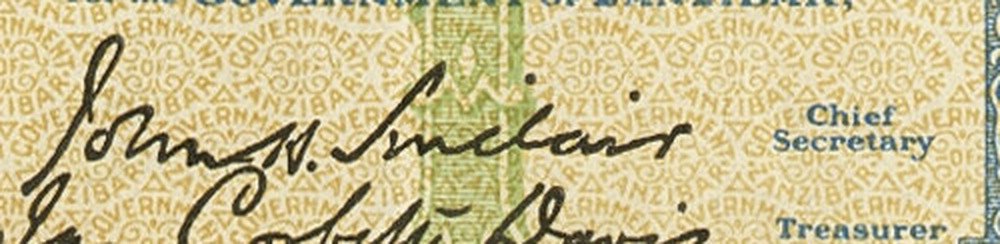
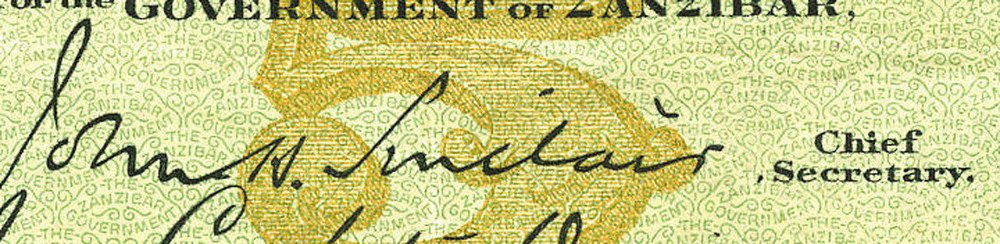
- Sinclair signs as Chief Secretary. Sources give 1913 for the passing of Zanzibar from the Foreign Office to the Colonial Office, when the post of Chief Secretary was created, and date Sinclair's appointment to it 1914 or 1916. The Colonial Office List gives 1st January 1914. The Zanzibar Blue Book for 1918 gives 25th March 1914.
- Crofton was appointed Chief Secretary on 31st January 1928, the day before the date on the notes that bear the Crofton signature, and Cox had been Treasurer since 20th November 1922 (Zanzibar Blue Books for 1927 and 1932).
The pages do not name the Financial Member of Council who signed in 1908. The auction houses do: Heritage Auctions (15 November 2022, lot 24277) gives Charles Edmond Akers and James Corbett Davis, and Spink (13 April 2011, lot 1406) reads the signatures in the album of 1908 as C. Akers and J. Corbitt Davis. The houses differ on the Treasurer's first name: Spink's descriptions of 1916 and 1920 notes give Jasper Corbett Davis (for example 16 January 2026, lot 219). Heritage Auctions gives the signers of 1928 in full as Richard Hayes Crofton and Norman Blakiston Cox (15 November 2022, lot 24278), and the Chief Secretary of 1916 as John Houston Sinclair (23 October 2021, lot 28550). These full names are the houses' and have not been checked here against an official list.
The 1 rupee of 1920
The 1 rupee was the smallest value and the last added. It is dated 1st September 1920, the date also found on the issued 500 rupees. It was printed by Thomas de la Rue to the Waterlow design, in blue on a light green and orange underlay with black serial numbers, and in a smaller size (sources mention 122 x 70 mm against 180 x 110 mm). The Sinclair signature on it has a dot over the second i where the Waterlow notes have a line.
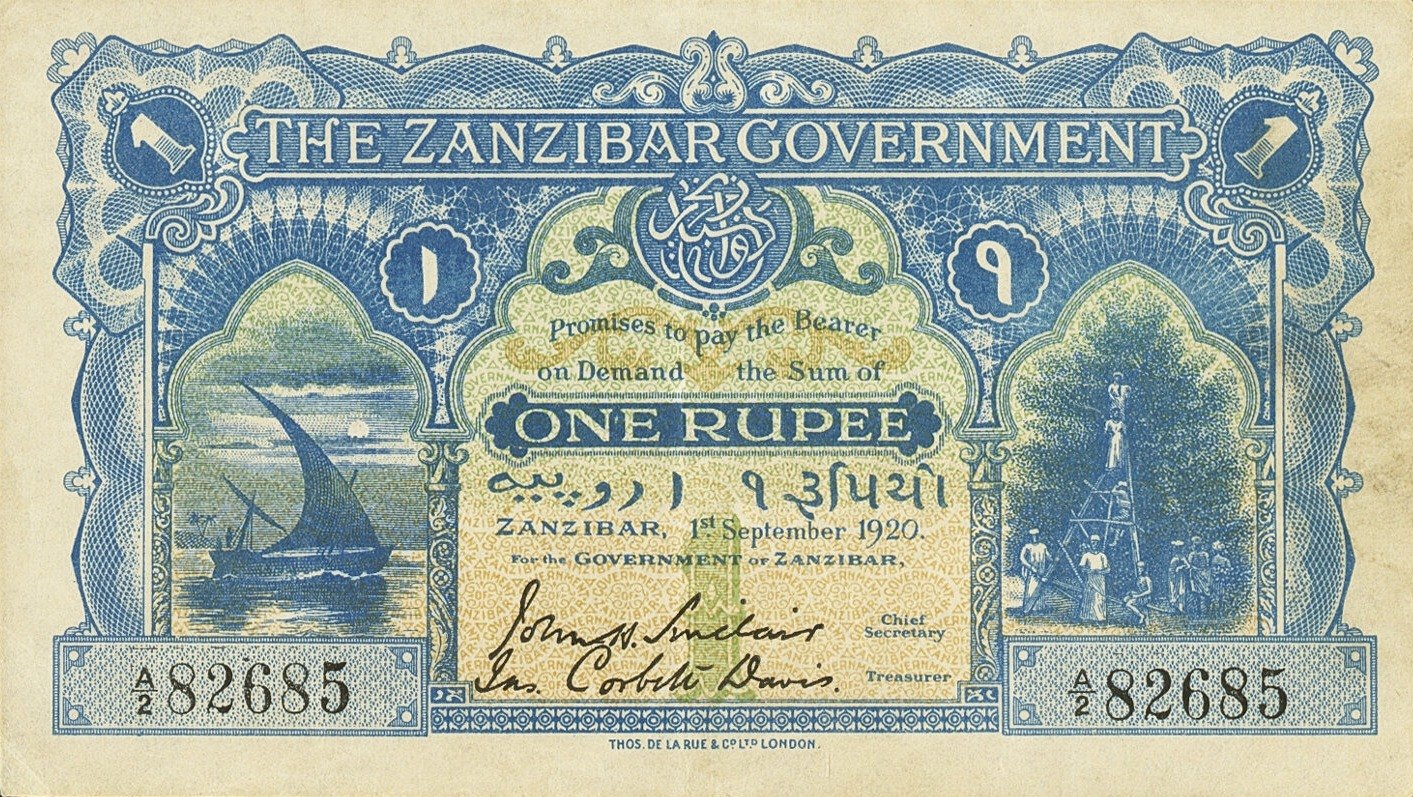
Sources mention an urgent order from the Crown Agents in July 1920, surface printed for speed on paper like that of the East Africa florin. The go-ahead came on 7th August 1920 and a specimen with secret marks followed on 6th September 1920. One million notes were printed in late 1920 in three batches:
| Printed | Numbers | Notes |
|---|---|---|
| 21st October 1920 | A/1 00001 to A/3 50000 | 250,000 |
| 7th December 1920 | A/3 50001 to A/5 100000 | 250,000 |
| 22nd December 1920 | A/6 00001 to A/10 100000 | 500,000 |
The 1 rupee is the only value for which a printing figure is known. Heritage Auctions (23 March 2023, lot 24545) thinks it plausible that the value was made because coin was short after the rise in the price of silver during the First World War. The house offers that as a likelihood, and the catalogue's sources give no reason for the order beyond its urgency.
The notes in circulation and their backing
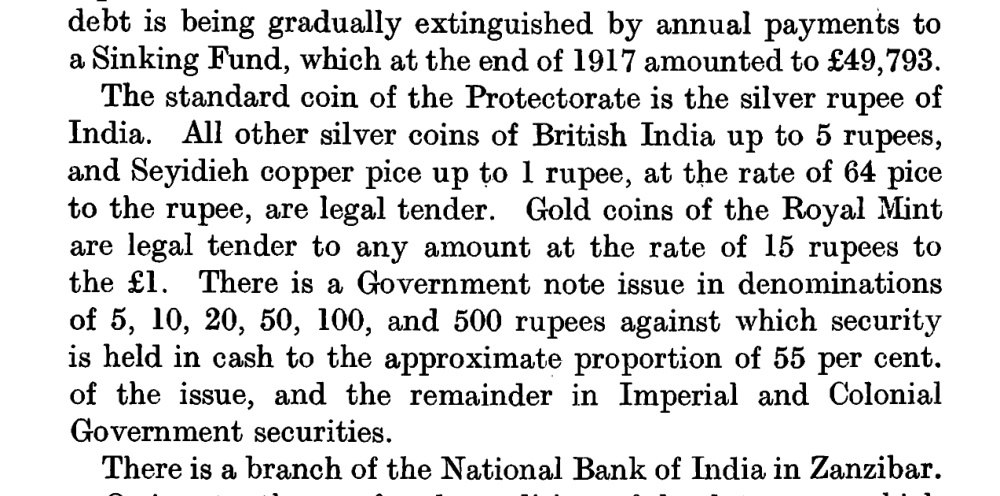
The annual reports on Zanzibar give the Government notes in circulation at four year ends:
| End of year | Notes in circulation |
|---|---|
| 1913 | 1,470,000 rupees |
| 1922 | 4,416,490 rupees |
| 1925 | 3,791,000 rupees |
| 1934 | 3,050,000 rupees |
The pages hold no figure for the other years, and none by value.
The Admiralty's handbook says cash was held against about 55 per cent of the issue and Imperial and Colonial Government securities against the rest. The annual report for 1922 gives about 52 per cent of the issue backed by cash and 48 per cent by Colonial and Indian Government securities. The same report records that in 1922 possessing an imitation of a currency note was made punishable with two years' imprisonment. The pages record no case of forgery.
The last date, 1st February 1928
The last date on the notes is 1st February 1928, with the signatures of Crofton and Cox and the titles Chief Secretary and Treasurer. The catalogue lists issued notes of that date for the 5, 10 and 20 rupees only. The 50 rupees is listed with the date 1st August 1916 alone, the 100 rupees with 1908 and 1916, and the 500 rupees with 1916 and 1920.
The withdrawal of 1936
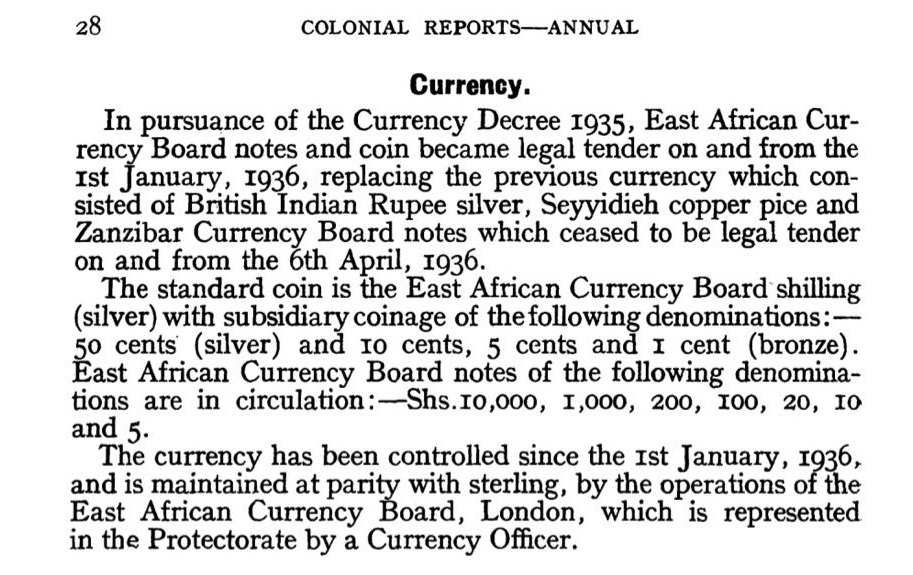
From 1 January 1936 the notes of the East African Currency Board became legal tender in Zanzibar. The Zanzibar notes were exchanged at 1 shilling 50 cents to the rupee, and the annual report on Zanzibar for 1936 says that, under the Currency Decree 1935, they ceased to be legal tender on 6 April 1936.
In the House of Commons on 11 November 1936, answering a question put to the Secretary of State for the Colonies, Mr. Ormsby-Gore said that the East African Currency Board operated in Kenya, Uganda and Tanganyika and "has this year extended to Zanzibar" (House of Commons Debates, volume 317, columns 851 to 852).
The pages do not say how many notes were handed in, or how many were still outstanding when legal tender ended. Stack's Bowers (16 August 2021, lot 30505) says that only about 500 of the notes printed from 1908 to 1928 are known to survive. What each source says about the survivors is gathered in the second article.
Sources
- The annual reports on Zanzibar, as cited on the catalogue's note pages: the figures for the end of 1913, 1922, 1925 and 1934, and the reports for 1922 and 1936 by name.
- The Zanzibar Blue Books for 1916, 1918, 1927 and 1932, as cited on the note pages.
- The Colonial Office List, including the List for 1922, as cited on the note pages.
- The Admiralty's handbook of the Protectorate, compiled during the First World War and published in 1920, as cited on the note pages.
- The Zanzibar Currency Decree of 11 March 1908, the Currency Decree of 14th February 1916 (Decree No. 3 of 1916) and the Currency Decree 1935, as cited on the note pages.
- House of Commons Debates, 11 November 1936, volume 317, columns 851 to 852.
- Heritage Auctions, lot descriptions: 23 October 2021, lot 28550; 15 November 2022, lots 24277 and 24278; 23 March 2023, lot 24545; 15 October 2026, lot 24829.
- Spink, lot descriptions: 13 April 2011, lot 1406; 16 January 2026, lot 219.
- Stack's Bowers, lot description: 16 August 2021, lot 30505.
Member comments
Log in or register to post a comment.