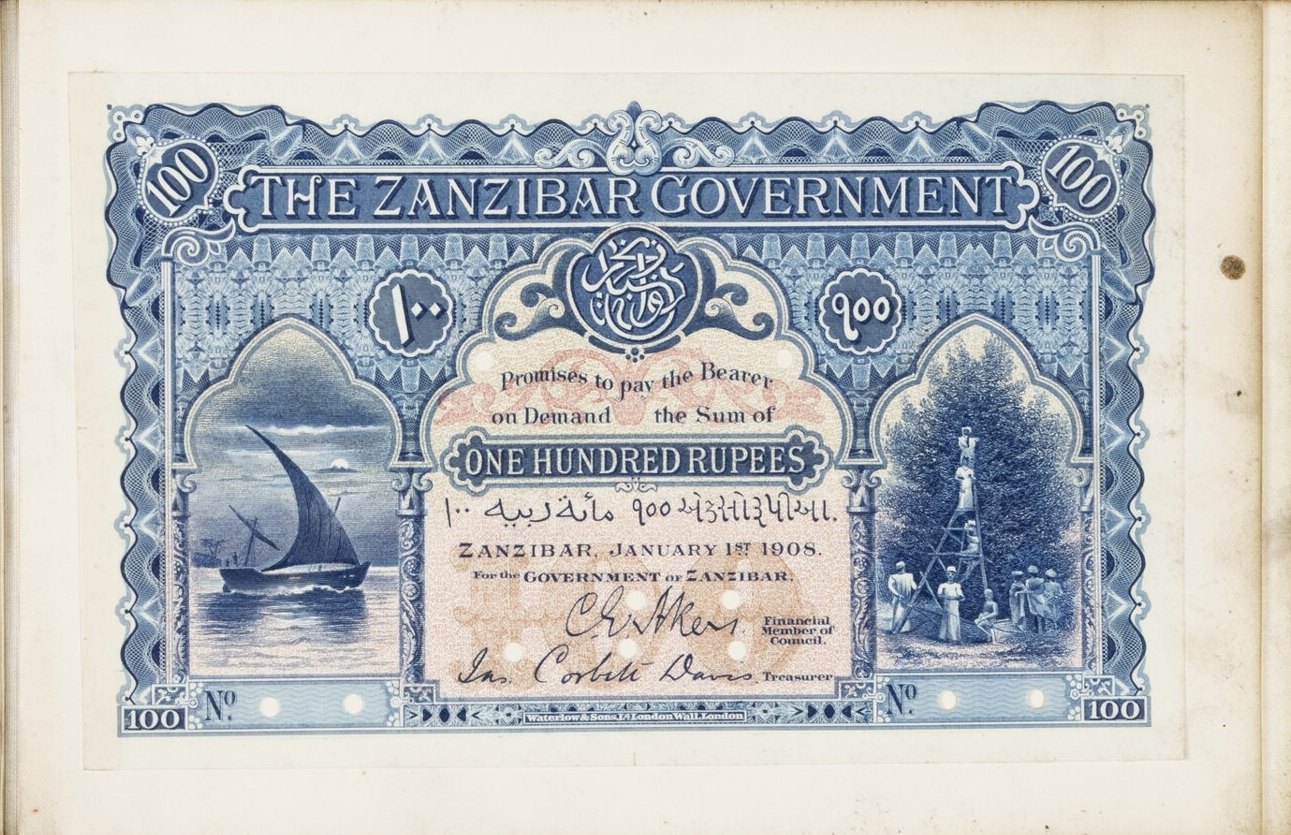
The Pick pages of Zanzibar give the Government notes in circulation at four year ends. The official volumes read for the catalogue, and one collector's table, hold more than twenty. This article sets every figure found against its source, shows how each was read, and marks the two years in which the sources differ. It then gathers what the same sources say of the cover held against the notes and of the values in issue. The story of the notes themselves is told in The Zanzibar Government's notes, 1908 to 1936.
Where the figures come from
Three kinds of source give a figure.
- The annual reports on Zanzibar (Colonial Reports, Annual). The reports for 1913, 1920, 1922, 1925, 1934 and 1935 give the value of notes in circulation on 31st December. The reports for 1928, 1929, 1931, 1932 and 1933 list the values of the notes and give no amount.
- The Zanzibar Blue Books, in the table headed "Estimated Amount of Paper Money in Circulation". The Blue Books for 1916, 1917, 1918, 1919, 1927 and 1932 were read. They are held as machine-read text only, and the tables of 1927 and 1932 were printed sideways, so the text of them came out upside down. Each reading is marked below.
- Gene Hessler, "The Paper Money (and Coins) of Zanzibar", I.B.N.S. Journal, volume 38, No. 3 (1999), p. 15, prints a table headed "Annual Amounts of Zanzibar Paper Money, Rupees in Circulation" for 1909 to 1932. The table names no source for its figures. The article's list of works names the Blue Books, the Colonial Reports and two books of R. H. Crofton, "Statistics of the Zanzibar Protectorate, 1893-1920" (London, 1921) and "Statistics of the Zanzibar Protectorate" (Zanzibar, 1929).
The official sources write the amounts in the Indian manner, as Rs. 14,70,000 for 1,470,000 rupees. They are given here as printed.
The table, 1909 to 1935
| 31st December | Official source, as printed | How it was read | Hessler's table of 1999 |
|---|---|---|---|
| 1909 | none read | 1,510,500 | |
| 1910 | none read | 1,832,500 | |
| 1911 | none read | 2,829,000 | |
| 1912 | none read | 3,871,995 | |
| 1913 | Rupees 14,70,000 (annual report for 1913, p. 7) | on the page | 1,476,000 |
| 1914 | none read | 1,244,220 | |
| 1915 | none read | 1,342,220 | |
| 1916 | Rs. 16,65,715, private banks Nil (Blue Book for 1916, p. 76) | text only | 1,665,715 |
| 1917 | Rs. 20,92,49?, the last figure lost (Blue Book for 1917, p. 76) | text only | 2,092,490 |
| 1918 | Rs. ?1,75,490, the first figure doubtful, perhaps 31,75,490 (Blue Book for 1918, p. 82) | text only | no line for 1918 |
| 1919 | not legible (Blue Book for 1919, p. 71) | text only | 3,557,490 |
| 1920 | Rs. 3,557,490 (annual report for 1920, pp. 5 to 6) | text only | 3,557,490 |
| 1921 | none read | 3,974,490 | |
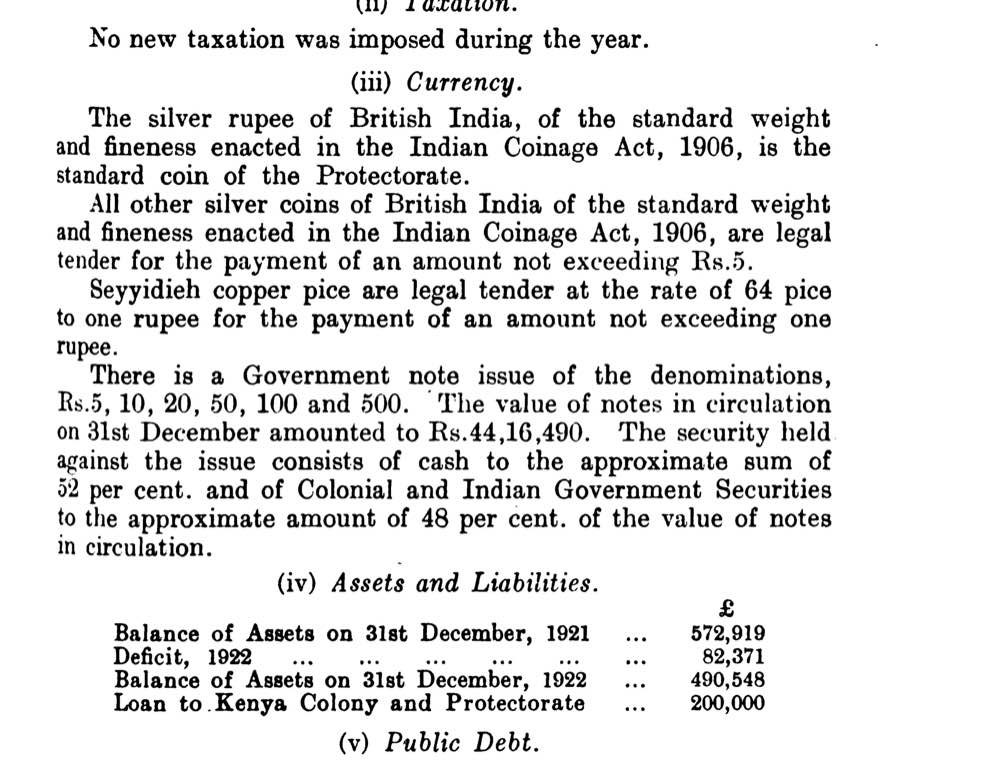
| 1922 | Rs. 44,16,490 (annual report for 1922, No. 1163, p. 5) | on the page | 4,416,490 |
| 1923 | none read | 4,604,440 | |
| 1924 | none read | 4,854,440 | |
| 1925 | Rs. 37,91,000 (annual report for 1925, p. 5) | on the page | 3,901,440 |
| 1926 | none read | 3,037,440 | |
| 1927 | about Rs. 24,04,81?, the column uncertain (Blue Book for 1927) | text only, upside down | 2,404,440 |
| 1928 | no amount given (annual report for 1928, No. 1434, p. 3) | on the page | 2,798,815 |
| 1929 | no amount given (annual report for 1929, No. 1480, p. 3) | on the page | 2,966,815 |
| 1930 | none read | 2,394,815 | |
| 1931 | no amount given (annual report for 1931, No. 1587, p. 22) | text only | 2,628,815 |
| 1932 | Rs. 26,07,051 (Blue Book for 1932, p. 68); no amount in the annual report, No. 1623 | text only, upside down, made out figure by figure | 2,607,051 |
| 1933 | no amount noted (annual report for 1933, p. 24) | text only | the table ends at 1932 |
| 1934 | Rs. 30,50,000 (annual report for 1934, No. 1706, p. 29) | on the page | |
| 1935 | Rs. 22,60,735 (annual report for 1935, No. 1766) | text only |
"On the page" means the printed page was read as a picture. "Text only" means the figure was read from machine-read text and has not been checked against the printed page.
Where the two agree and where they differ
Hessler's figures and the official ones agree to the rupee for 1916, 1920, 1922 and 1932, though the Blue Book figure for 1932 was made out from upside-down text and every digit of it still has to be checked on the page. For 1917 the Blue Book's figure, with its last digit lost, fits Hessler's 2,092,490. For 1927 the Blue Book's damaged reading shares its first four digits with Hessler's 2,404,440 and no more can be said until the page is seen.
Two years differ.
- 1913. The annual report for 1913 (p. 7), read on the page, says: "The value of notes in circulation on 31st December, 1913, amounted to Rupees 14,70,000." Hessler has 1,476,000.
- 1925. The annual report for 1925 (p. 5), read on the page, gives Rs. 37,91,000. Hessler has 3,901,440, which is 110,440 rupees more.
Neither difference is explained by the sources. The annual report's figures for these two years are round thousands, and Hessler's are not. The catalogue's pages use the annual reports.
Two more points in Hessler's table need care. It has no line for 1918, and it gives the same amount, 3,557,490, for 1919 and for 1920. The annual report for 1920 gives that amount for 31st December 1920. Whether a line of the table slipped by a year cannot be told from the text held.
Jonathan Callaway, in "Zanzibar and its Rare and Iconic Banknotes" (I.B.N.S. Journal, volume 62, No. 1, 2023, p. 20, first printed in Spink Insider, spring 2022), writes that notes in circulation came to 1.5 million rupees after a year and reached their highest point, 4.8 million, in 1924. Both figures match Hessler's lines for 1909 and 1924. Dr. David Lott, in Bank Note Reporter of March 1985 (p. 26), writes only of a circulation that was once four to five million rupees.
The run of the figures
Taking Hessler's table for the years the official volumes do not cover, the issue passed 1.5 million rupees within two years of the first notes, reached 3,871,995 at the end of 1912, and then fell by more than half in a year, to the 1,470,000 of the annual report for 1913. It stayed below 1.7 million through 1916, doubled by 1920, and stood at 4,416,490 at the end of 1922, three times the figure of 1913. Hessler's highest line is 4,854,440 for 1924. From 1926 to 1932 Hessler's figures lie between 2,394,815 and 3,037,440. The annual report for 1934 gives 3,050,000, and the report for 1935 gives 2,260,735 on the last day before the notes of the East African Currency Board became legal tender.
No source read says why the figure fell in 1913 or rose after 1916. The annual report for 1920 records that the sovereign, legal tender at 15 rupees since 11th March 1908, was demonetised without notice on 5th July 1920.
The cover held against the notes
The same sources say how the notes were secured.
| Year | Cash or coin | Securities | Source |
|---|---|---|---|
| 1908 | coin portion of the Note Guarantee Fund fixed at 50 per cent of the notes in circulation | Hessler, 1999, p. 14, giving the Zanzibar Currency Decree of 1908 | |
| 1913 | about two-thirds | about one-third, Indian Rupee paper and Colonial Government securities | annual report for 1913, p. 7 |
| 1916 | coin portion fixed at 40 per cent; elsewhere on the same page, cash about 60 per cent | about 40 per cent, War Loan, Indian rupee paper and Colonial Government securities | Hessler, 1999, p. 14 |
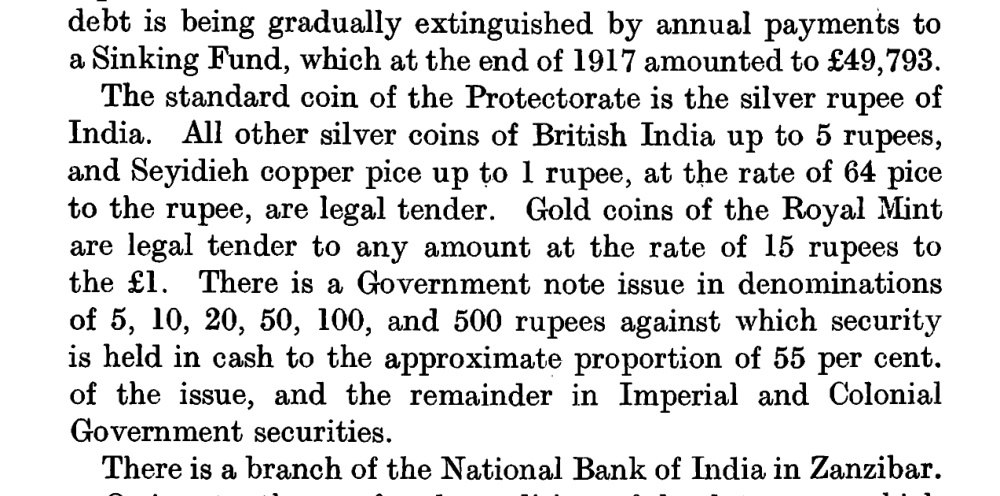
| about 1917 | about 55 per cent | the remainder, Imperial and Colonial Government securities | the Admiralty's handbook of Kenya and Zanzibar, 1920, p. 517 |
| 1920 | about 68 per cent | about 32 per cent, War Bonds and Colonial Government securities | annual report for 1920, pp. 5 to 6 |
| 1922 | about 52 per cent | about 48 per cent, Colonial and Indian Government securities | annual report for 1922, p. 5 |
| 1925 | about 60 per cent | about 40 per cent, Colonial and Indian Government securities | annual report for 1925, p. 5 |
The Zanzibar Blue Book for 1916 records a notice of 28th February 1916 under the Zanzibar Currency Decree, 1916, "fixing the proportion of the coin portion of the Note Guarantee Fund". The Blue Book does not print the proportion, and the month is read from the entry above it. Hessler gives 40 per cent for 1916 and, a few lines on, cash of about 60 per cent: the two statements stand together in the article without comment. The Admiralty's handbook says its material was collected during the war, and the paragraph that holds the 55 per cent also gives revenue figures for 1917.
The Blue Book for 1916 also says what became of the income. The profit on the notes was the income of the invested part of the Note Guarantee Fund, less the cost of the issue and less 1 per cent of the cost of the securities, which went to a depreciation fund. It names the Currency Decree, 1908, as the authority. By the Blue Book for 1932 the 1 per cent charge had gone.
The values each source lists
The reports and Blue Books also list the values of the notes, and the lists changed slowly.
| Source | Values listed |
|---|---|
| Annual report for 1913, p. 7 | Rupees 5, 10, 20, 30, 50 and 100 |
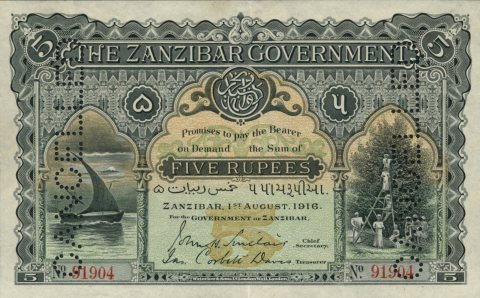
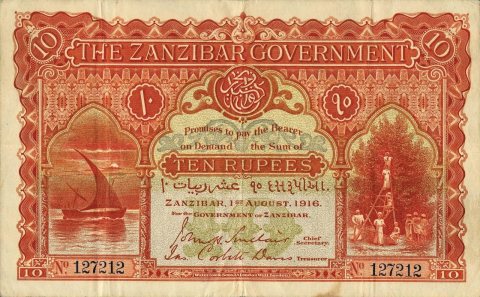
| Blue Books for 1916 to 1919 | Rs. 5, 10, 20, 50, 100 and 500 |
| Admiralty's handbook, 1920, p. 517 | 5, 10, 20, 50, 100 and 500 rupees |
| Annual reports for 1920, 1922 and 1925 | Rs. 5, 10, 20, 50, 100 and 500 |
| The Red Book for 1922-23, p. 261 | Rs. 5, 10, 20, 50, 100 and 500 |
| Blue Book for 1927 | Rs. 5, 10, 20, 50, 100 and 500 |
| Annual reports for 1928, 1929, 1931, 1932, 1933, 1934 and 1935 | Re. 1, Rs. 5, 10, 20, 50, 100 and 500 |
| Blue Book for 1932 | Rs. 1, 5, 10, 20, 50, 100 and 500 |
| An Economic Survey of the Colonial Empire (1932), p. 65 | Rupees 1, 5, 10, 20, 50, 100 and 500 |
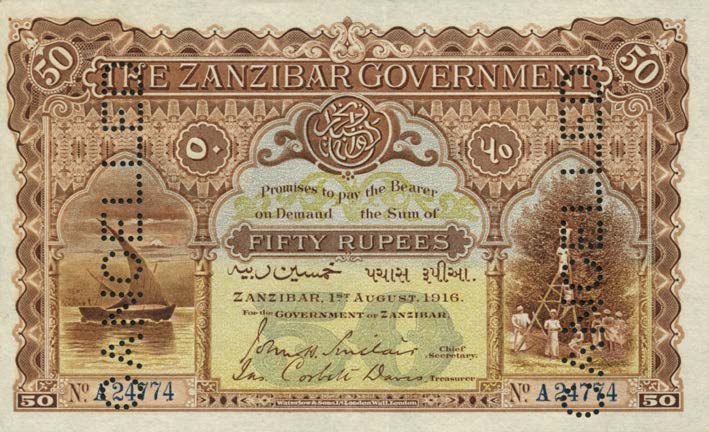
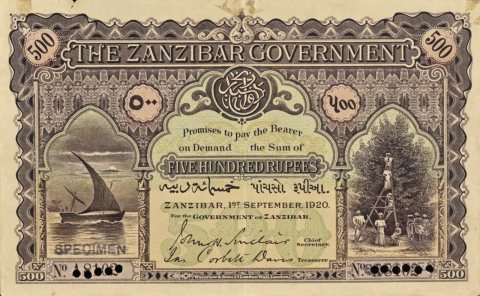
Two things stand out. The report for 1913 names a 30 rupees, which no other source knows, and a 50 rupees three years before the Decree of 1916 that added it. The catalogue treats the 30 as a slip of the printer or compiler, and holds that a list with such a slip cannot outweigh the Decree of 1908 and the presentation album of 1908, neither of which has a 50 rupees. The same report lists no 500 rupees, which first appears in the Blue Book for 1916.
The 1 rupee, dated 1st September 1920 and printed in late 1920, is missing from every list read up to the Blue Book for 1927 and present in every list from the annual report for 1928. The reports give no reason. The list was most likely a sentence carried from year to year, a habit described in What an annual report can tell you about a banknote, and what it cannot. The total of 1922 does not settle whether 1 rupee notes were counted: 4,416,490 rupees can be made up with them or without them.
After the rupee: the East African notes in Zanzibar, 1946 to 1948
From 1st January 1936 the notes in use were those of the East African Currency Board. The annual reports on Zanzibar give the Board's notes in circulation in the Protectorate for three years.
| 31st December | East African Currency Board notes in Zanzibar | Coin | Source |
|---|---|---|---|
| 1946 | £442,140 | annual report for 1946, p. 18 | |
| 1947 | £363,700 (Shs. 7,274,000 in the Blue Book) | £186,047 | annual report for 1947, p. 59; Blue Book for 1947, p. 103 |
| 1948 | £215,650 | £192,669 | annual report for 1948, p. 104 |
All three were read as text only. The Blue Book for 1947 names the Currency Decree, 1935, as the authority and lists the Board's notes of 1, 5, 10, 20, 100, 200, 1,000 and 10,000 shillings as legal tender. The annual report for 1946 (p. 23) says of the war-time 1 shilling notes of East Africa that they "were not popular with the public and were withdrawn from circulation as from the 1st April, 1946."
What the figures do not tell
- Nothing by value. No volume read gives the Zanzibar notes in circulation by denomination, so the share of the 100 and 500 rupees in these totals is not known.
- Nothing printed, cancelled or destroyed. No source read gives a number of notes printed for any Waterlow value, or a count of notes cancelled or burnt.
- Nothing left unredeemed. The notes ceased to be legal tender on 6th April 1936. No source read says how many of the 2,260,735 rupees outstanding at the end of 1935 were handed in.
- Half the years. For 1909 to 1912, 1914, 1915, 1921, 1923, 1924, 1926 and 1928 to 1931 the only figure is Hessler's, without a source.
The Board's own monthly abstracts were printed in the Zanzibar Gazette. Marissa Licursi's working paper on the Zanzibar Board, in the Digital Archive on Currency Boards of the Institute for Applied Economics at Johns Hopkins University (file SAE0044), gathers them in a workbook for 1908 to 1935, as totals without denominations. Those tables were not copied for this article. They would test every line above, and the two years in doubt first.
Sources
- Colonial Reports, Annual: Zanzibar for 1913 (p. 7), 1920 (pp. 5 to 6), 1922 (No. 1163, pp. 5 and 10), 1925 (p. 5), 1928 (No. 1434, p. 3), 1929 (No. 1480, p. 3), 1931 (No. 1587, p. 22), 1932 (No. 1623), 1933 (p. 24), 1934 (No. 1706, p. 29), 1935 (No. 1766), 1946 (pp. 18 and 23), 1947 (p. 59) and 1948 (p. 104).
- Zanzibar Protectorate Blue Books for 1916 (p. 76), 1917 (p. 76), 1918 (p. 82), 1919 (p. 71), 1927, 1932 (p. 68) and 1947 (p. 103).
- The Admiralty, "Handbook of Kenya Colony and the Kenya Protectorate (Protectorate of Zanzibar)", 1920, p. 517.
- The Red Book 1922-23, handbook and directory for Kenya, Uganda, Tanganyika and Zanzibar, p. 261.
- An Economic Survey of the Colonial Empire (1932), Colonial No. 95, 1934, p. 65.
- Gene Hessler, "The Paper Money (and Coins) of Zanzibar", I.B.N.S. Journal, volume 38, No. 3 (1999), pp. 14 to 15.
- Jonathan Callaway, "Zanzibar and its Rare and Iconic Banknotes", I.B.N.S. Journal, volume 62, No. 1 (2023), p. 20.
- Dr. David Lott, "East African paper money has tangled history", Bank Note Reporter, March 1985, p. 26.
- Marissa Licursi, working paper on the Zanzibar Currency Board and its workbook (files SAE0044), Digital Archive on Currency Boards, Institute for Applied Economics, Johns Hopkins University.
Member comments
Log in or register to post a comment.