Twice before the First World War the Falkland Islands Government printed, in its yearly report to London, a small table of its own paper money: how much of each value was in the hands of the public on the last day of the year. We have read the reports for 1909, 1912 and 1921 against the catalogue. They show a note issue of a few thousand pieces, a 5 shillings note that stood at exactly 452 notes in both counts, no 10 shillings at all before 1921, and then the arrival of the George V notes, with the numbers received and the numbers paid out in their first weeks.
The source
The Colonial Reports - Annual are the printed yearly reports of each colony to the Secretary of State, sold to the public by H.M. Stationery Office, each with a number of its own. Three are used here: No. 645, Falkland Islands, 1909; No. 764, Falkland Islands, 1912; and No. 1157, Falkland Islands, 1921. Each has a short passage on the currency inside its chapter on finance.
These are not the Treasury's note books. The books kept in Stanley follow every note by its number, from the day it went out to the day it was cancelled, and the catalogue pages already rest on them. The reports do something the books do not do on any one page: they strike a balance at the year's end and say what was outside the Treasury.
The end of 1909
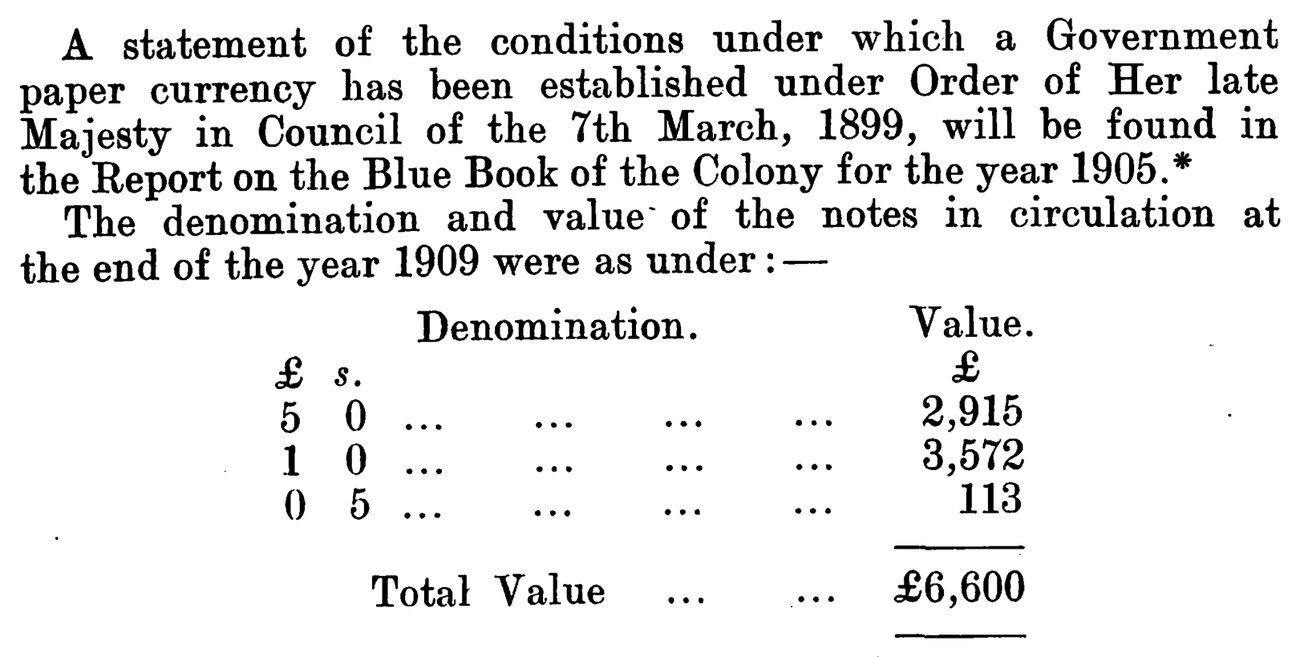
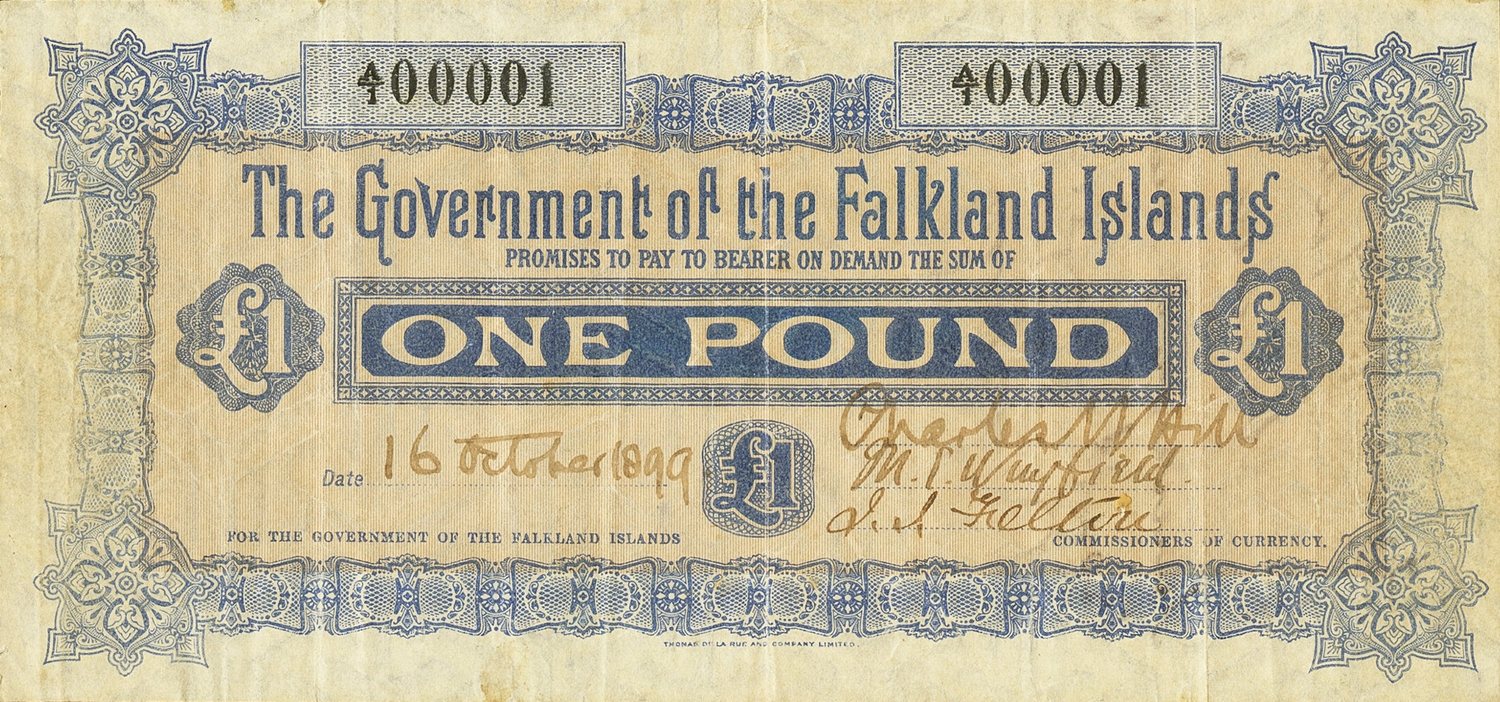
The report for 1909 says the paper currency was "established under Order of Her late Majesty in Council of the 7th March, 1899", and sends the reader to the report for 1905 (No. 490) for the conditions. The first notes are dated 16th October 1899. Then comes the table, by value only: 2,915 pounds in 5 pounds notes, 3,572 pounds in 1 pound notes and 113 pounds in 5 shillings notes, 6,600 pounds in all.
The numbers of notes are our arithmetic: 583 notes of 5 pounds, 3,572 of 1 pound and 452 of 5 shillings, 4,607 notes together.
The end of 1912
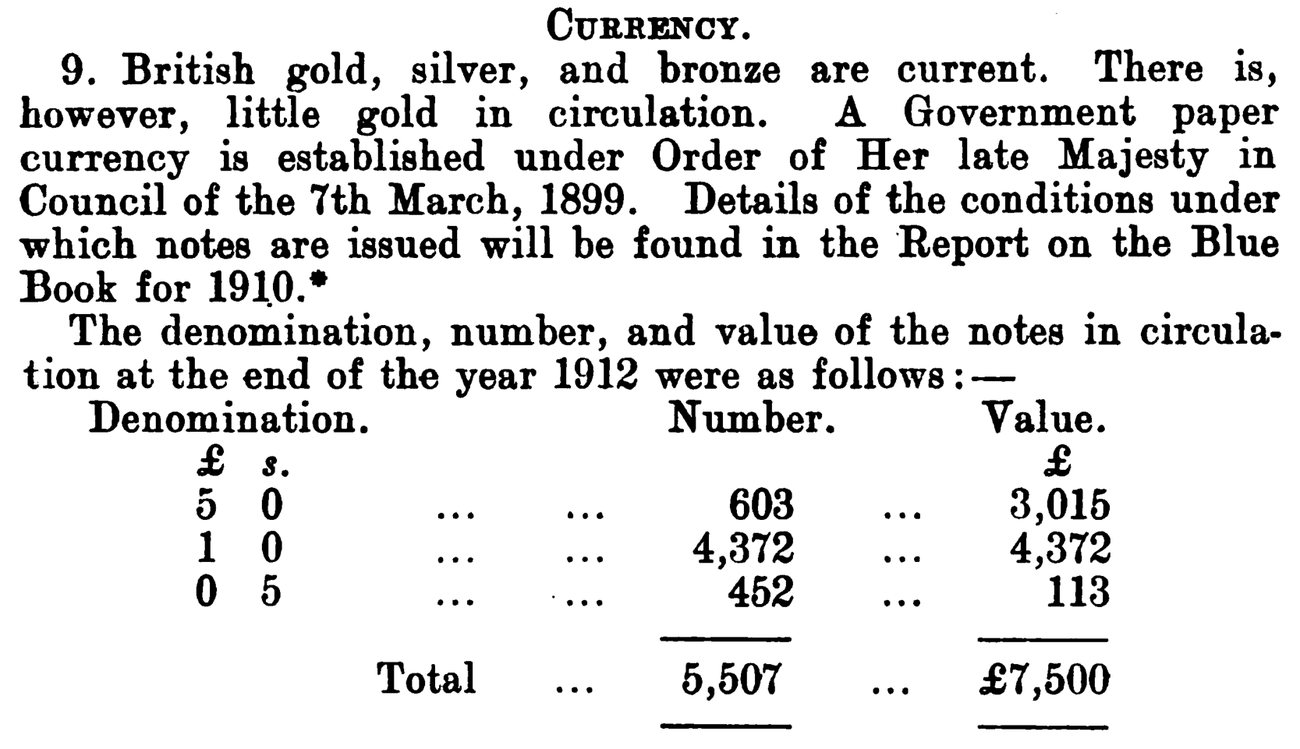
The report for 1912 gives the number of notes as well as the value. It also says what else passed in the Colony: "British gold, silver, and bronze are current", but there was "little gold in circulation".
| 31st December 1909 | 31st December 1912 | |
|---|---|---|
| 5 pounds | 583 notes (2,915 pounds) | 603 notes (3,015 pounds) |
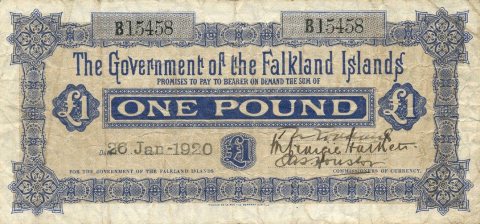
| 1 pound | 3,572 notes (3,572 pounds) | 4,372 notes (4,372 pounds) |
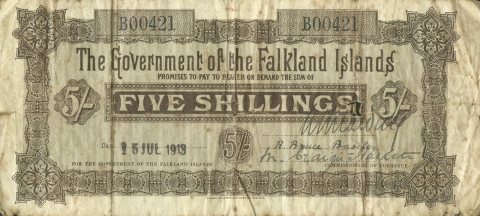
| 5 shillings | 452 notes (113 pounds) | 452 notes (113 pounds) |
| All notes | 4,607 notes (6,600 pounds) | 5,427 notes (7,500 pounds) |
In three years the circulation grew by 900 pounds: 800 more notes of 1 pound and 20 more of 5 pounds. The 5 shillings did not move by a single note.
That is 5,427 notes worth 7,500 pounds. The report prints the total of the number column as 5,507, while its three lines add up to 5,427; the values agree with the numbers line by line and add correctly to 7,500 pounds, so the slip is in the printed total.
No 10 shillings
Neither table has a line for 10 shillings. The catalogue keeps a page for a 10 shillings of this first series only because older lists name one; no such note has been seen, and the Treasury's issue books of 1899 to 1920 record only 5 shillings, 1 pound and 5 pounds notes. The two reports are a second official witness, and of a different kind: a count of what the public held, with three values and no more.
Beside the Treasury's books
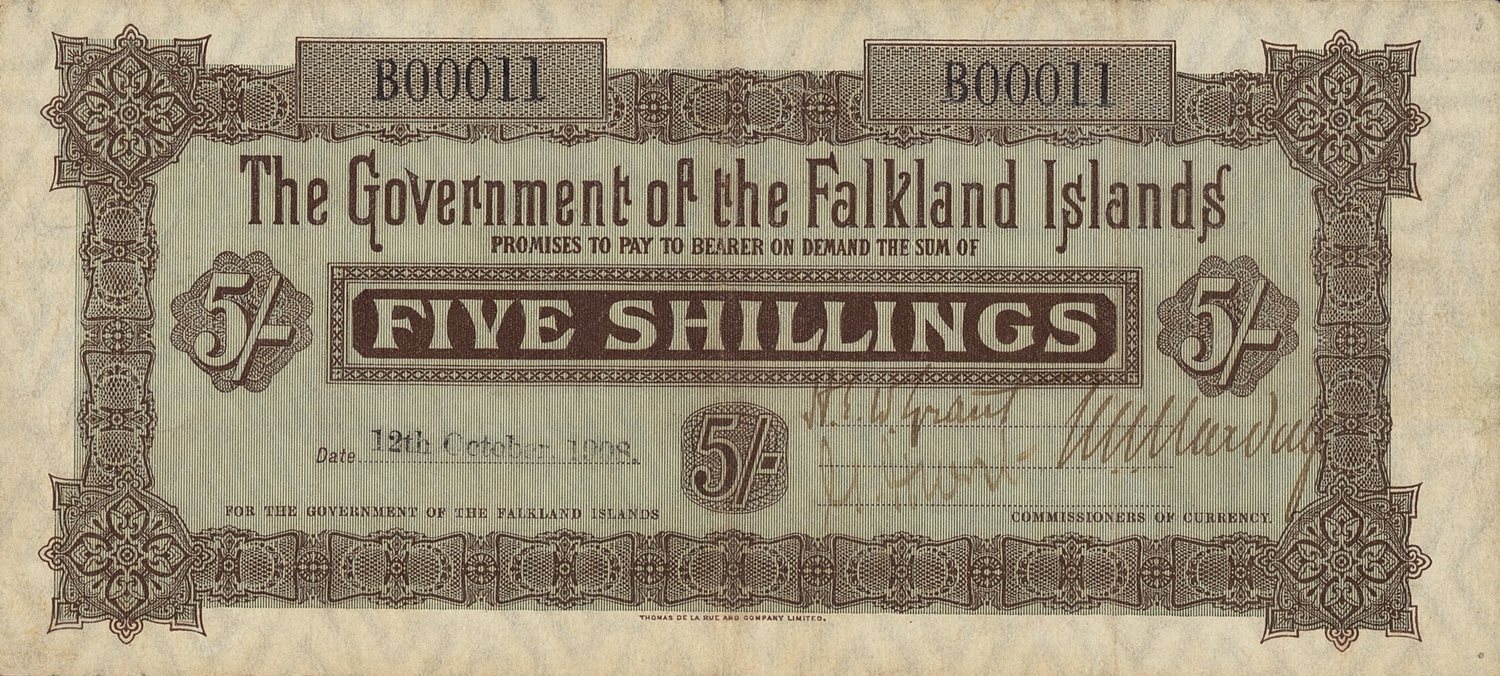
The books say what went out. Of the first, green 5 shillings, 1,001 notes were issued on 12th January 1901, and the report for 1901 already said that they "do not find favour among the people, and quickly return to the Treasury". Of the brown 5 shillings that replaced it in 1904, 400 notes were issued before the rest of that printing was burnt unissued in October 1908, and the B notes followed from 16th October 1908. So more than 1,400 notes of 5 shillings had been issued before the first count, and 452 were out when it was made.
The counts also stand just before the best known event in the books. In October and November 1914, for fear of a raid by the German cruiser squadron, many notes were burnt and the gold reserve was sent to London; the notes were replaced after the Battle of the Falkland Islands, and 400 notes of 5 pounds were issued on 8th December 1914, the day of the battle. The table of 1912 is the nearest count we have of the circulation before it.
And they can be set against the end of the story. In 1966 the Treasury stopped counting the early notes still outstanding as a liability:
| In circulation, end of 1912 | Still out in 1966 | |
|---|---|---|
| 5 pounds | 603 | 14 |
| 1 pound | 4,372 | 169 |
| 5 shillings | 452 | 60 |
The two columns are not the same notes: the figure of 1966 takes in notes issued after 1912 as well. It is 243 notes in all.
The fund behind the notes
The report for 1909 lists the Colony's invested funds at cost for five years. The Currency Note fund stood at 3,000 pounds at the close of 1905 and at 3,300 pounds from 1906 to 1909, with a Currency Note Depreciation fund beside it that grew from 105 to 257 pounds. At the market prices of 31st December 1909 the note fund was worth 2,685 pounds. Three years later the report for 1912 puts its market value at 3,409 pounds, and the depreciation fund at 363 pounds.
By our arithmetic the 3,300 pounds invested at cost is exactly half of the 6,600 pounds of notes in circulation at the end of 1909. The report does not say that half was the rule, nor what was held in coin.
1921: the George V notes arrive
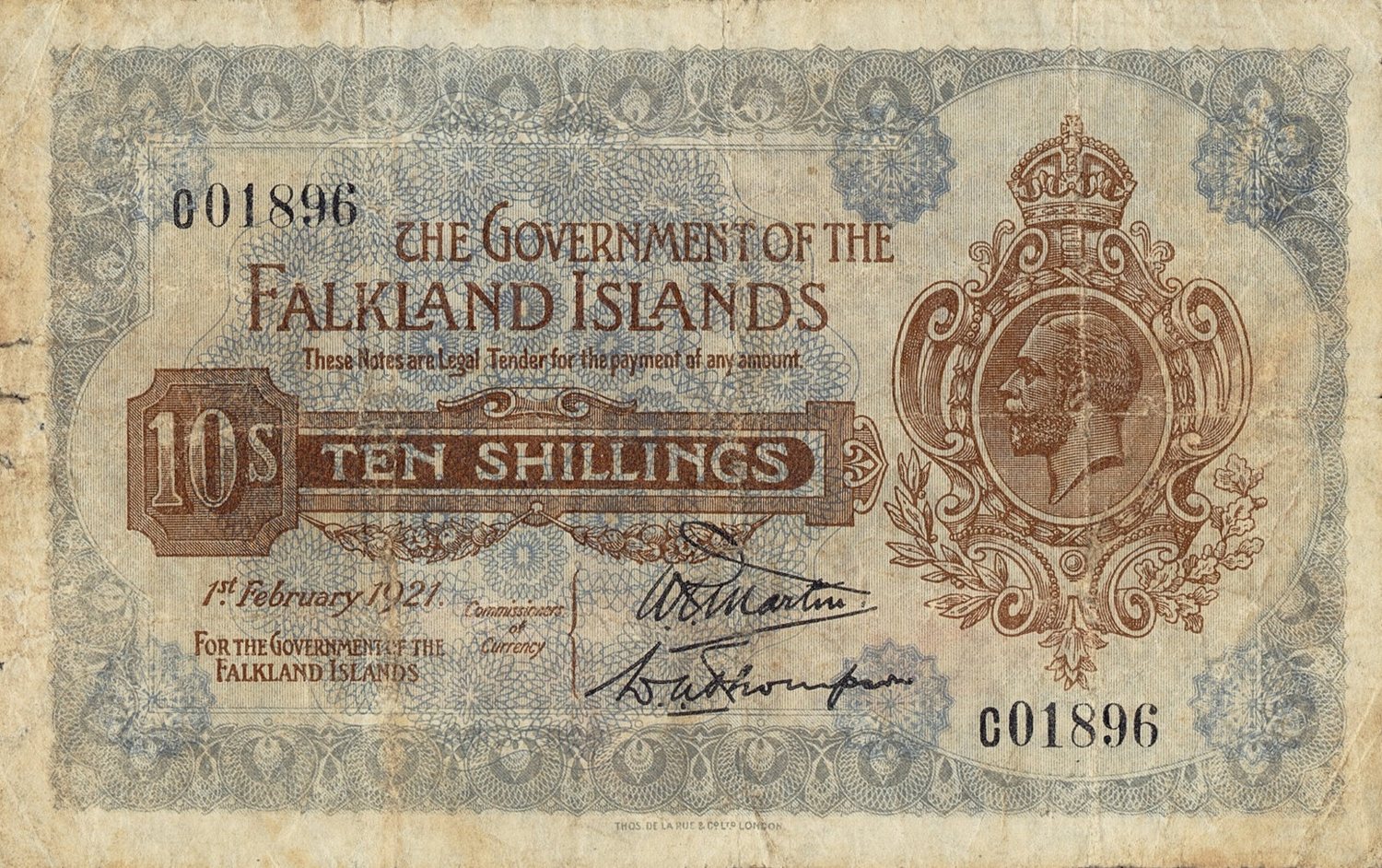
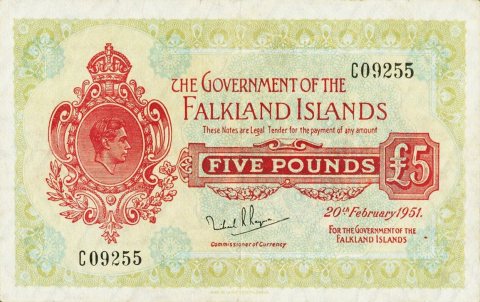
The report for 1921 has no table, but one paragraph does the same work. The legal tender was British sterling and Government notes of 5 shillings, 10 shillings, 1 pound and 5 pounds, and the face value of the notes in circulation on 31st December 1921 was 20,000 pounds. "During the year", it goes on, notes "of a new design were received by the Commissioners from the Crown Agents", and part of them were issued "to replace those withdrawn from circulation for cancellation and destruction".
| Received in 1921 | Issued in 1921 | |
|---|---|---|
| 5 pounds | 2,000 notes | 680 notes |
| 1 pound | 12,000 notes | 6,300 notes |
| 10 shillings | 6,000 notes | 2,000 notes |
By our arithmetic the notes received came to 25,000 pounds at face and the notes issued to 10,700 pounds, a little over half of the 20,000 pounds in circulation at the year's end. The Treasury's registers record that the 1 pound and 5 pounds dated 1st February 1921 were first put into circulation on 17th October 1921 and the 10 shillings on 4th November 1921, so the whole of that issue was made in the last eleven weeks of the year.
The 10 shillings was the new value. No new 5 shillings came with it, although the report still names 5 shillings notes as legal tender.
What the reports do not say
- The conditions of the issue. Both early reports send the reader elsewhere: to the report for 1905 (No. 490) and to the report for 1910 (No. 682). Neither is in the volumes we read. They, and the text of the Order in Council of 7th March 1899, would say what cover the notes were to have.
- The years between. We have counts for 1909 and 1912 only, and a single total for 1921. The circulation went from 7,500 pounds to 20,000 pounds in nine years, across the burning of 1914, and these three reports do not show how.
- The old notes at the end of 1921. The report does not say how many were destroyed or how many were still out.
- Who signed. No Commissioner of Currency is named in any of the three reports.
Member comments
Log in or register to post a comment.