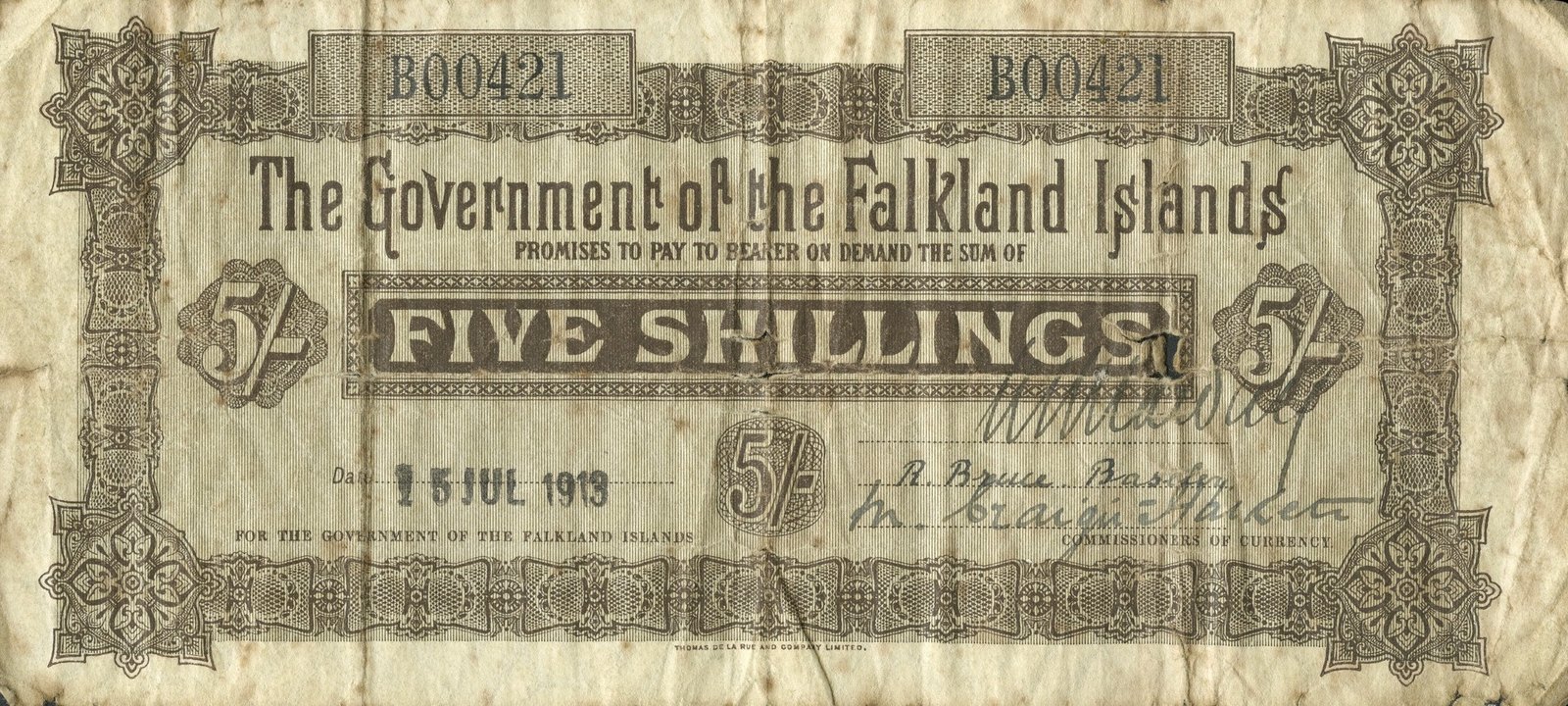
A note of the Falkland Islands that came back worn to the Treasury in Stanley was cancelled, kept in a sealed packet or a safe, and in time burnt. This article follows that work from 1908 to 2001: the yearly figures of notes withdrawn and destroyed that the Falkland Islands Gazette printed in the reports of the Commissioners of Currency, and the rules that said how it was to be done. It rests on the Gazette as read for the catalogue in November 2026, mostly from the text layer of the scans, and on the Treasury's own note books in the Jane Cameron National Archives.
Three single events are told elsewhere and only named here: the notes burnt in October and November 1914 for fear of a German raid, in the article on the first notes; the 10,000 notes of 1 pound ordered in September 1940 and destroyed by fire at the printers before shipment, in the article on the laws; and the notes kept back as specimens or sent to museums, in the article on the Treasury's note books.
The A series replaced, 1908 and 1909
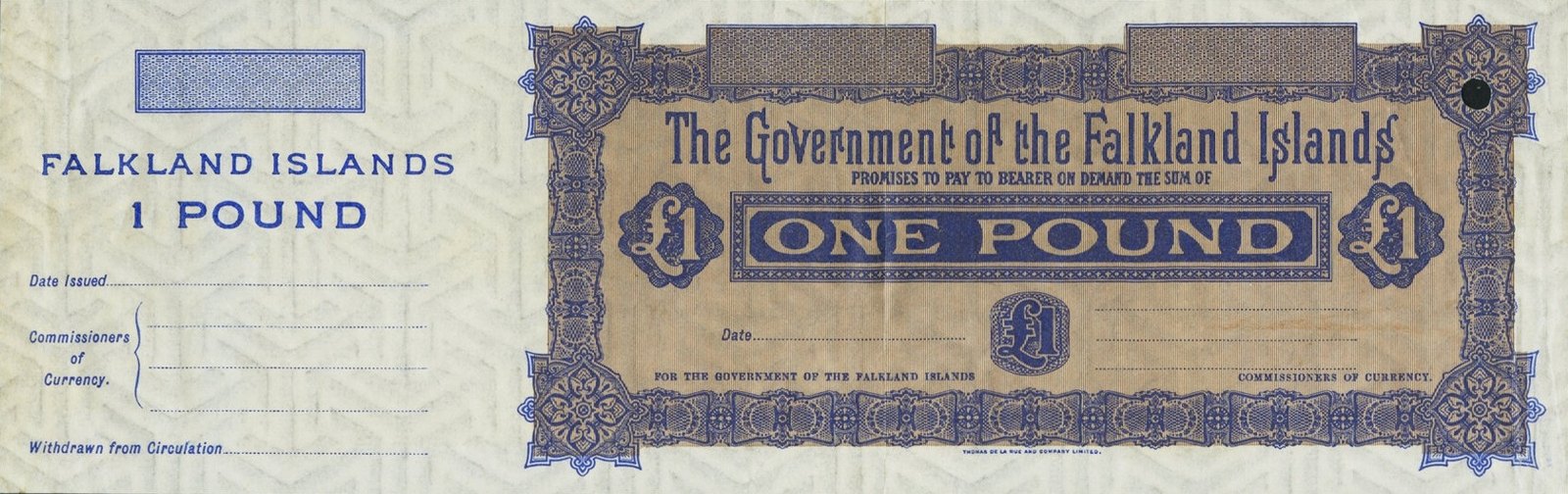
The first large burning came with the change from the A series to the B series. The Commissioners' report for 1908, printed in the Gazette of 1909, records that 2,590 pounds of A notes were withdrawn in that year and replaced by 188 notes of 5 pounds, 1,600 of 1 pound and 200 of 5 shillings of the new B series. Cancelled A notes worth 3,517 pounds, among them 205 notes of 5 pounds, 2,405 of 1 pound and 348 of 5 shillings, were waiting to be destroyed at the end of the year. The Treasury's note issue book adds that unissued stock went too: the 5 pounds A/1 00601 to A/1 01202 are marked "Burnt 19 Oct 1908", and so is the rest of the A/2 printing of the brown 5 shillings.
The report for 1909, dated 11 February 1910, records another 1,725 pounds of A notes withdrawn and replaced by B notes in the year (105 of 5 pounds and 1,200 of 1 pound), and 5,223 pounds of signed A notes destroyed and burnt. Cancelled notes still awaiting destruction included 2 notes of 5 pounds of series A and 15 notes of 1 pound. The report for 1912, of 29 March 1913, says that notes of the A issue were being withdrawn "as opportunity offers", and the report of 30 March 1914 that the notes withdrawn in 1913 were "cancelled and destroyed by fire in my presence", with 581 pounds 5 shillings of A notes still outstanding.
In 1917 the Gazette's report lists 86 pounds of cancelled notes kept "in a sealed packet" in the safe, awaiting destruction.
The yearly figures, 1922 to 1939
From the 1920s the reports give, year by year, what was withdrawn and destroyed. The table copies them as the Gazette records them; the year is the year of the report's figures.
| Year | What the report records |
|---|---|
| 1922 | notes worth 5,490 pounds withdrawn, cancelled and replaced by new notes (Colonial Report for 1922) |
| 1924 | old notes worth 1,857 pounds "cancelled and destroyed by fire by the Commissioners": 156 of 5 pounds (series B and C), 1,054 of 1 pound (series A, B and C), 40 of 10 shillings and 12 of 5 shillings |
| 1926 | cancelled notes worth 800 pounds, withdrawn in 1925, destroyed |
| 1927 | damaged notes worth 850 pounds destroyed and 1,200 pounds awaiting destruction; the unsigned B note forms worth 8,125 pounds (1,100 of 5 pounds, 2,500 of 1 pound, 500 of 5 shillings) destroyed |
| 1930 | damaged notes withdrawn and destroyed: 19 of 5 pounds of series C, 9 of 1 pound of series B and 551 of series C, and 290 of 10 shillings of series C, 800 pounds in all |
| 1931 | damaged notes worth 5,003 pounds withdrawn and replaced |
| 1932 | 1,300 pounds withdrawn and replaced |
| 1933 | 3,300 pounds withdrawn and replaced |
| 1934 | 3,090 pounds withdrawn and replaced |
| 1935 | 3,020 pounds withdrawn and replaced |
| 1936 | 1,000 pounds withdrawn and replaced |
| 1937 | 1,000 pounds withdrawn and replaced |
| 1939 | damaged notes worth 670 pounds withdrawn |
For 1931 to 1939 the figures are of notes withdrawn; as read, these reports do not say when they were burnt. The report for 1929 lists among its costs a "Fee for sorting damaged notes", a Note Register and Minute Book, and the cost of new notes. The B note forms destroyed in 1927 had been counted in the safe on 1 January 1923 and again at the end of 1924.
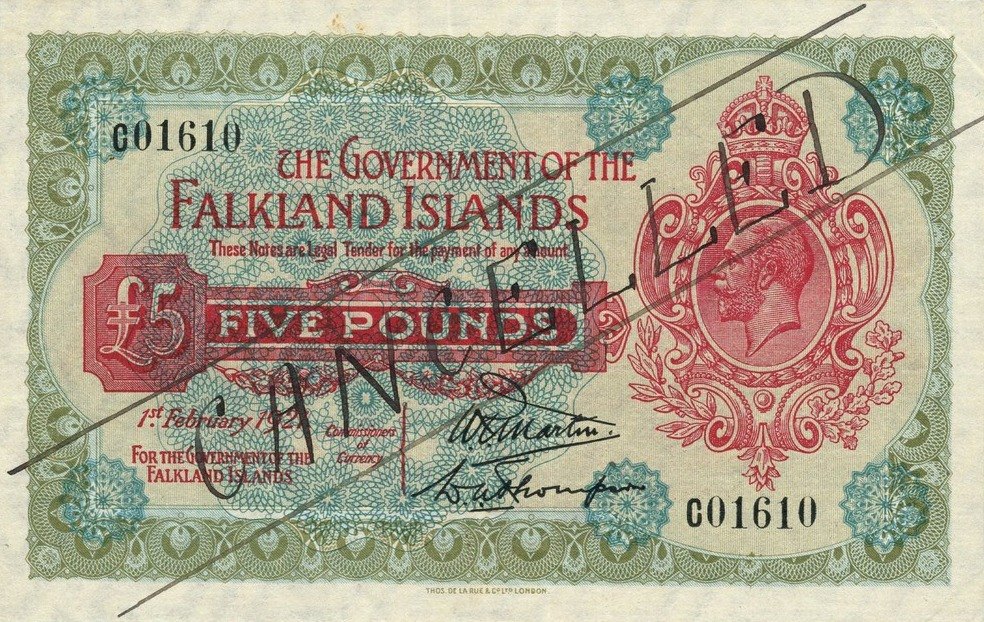
The notes destroyed were nearly all of the C series by 1930, the notes of King George V: the 10 shillings, the 1 pound and the 5 pounds.
The rules of 1939
The Falkland Islands Currency Notes Rules of 6 April 1939 set down the procedure: the bundling of cancelled notes in hundreds and their burning in an incinerator before two Currency Officers, the re-issue of used notes before new ones, and the registers, with the later changes to the registers in 1944, 1956 and 1965, are told in the article on the currency laws. Two readings of the Board of Survey that was to check the stocks of notes differ. The reader of the Gazette for 1939 has a Board of at least two members, none of them a Currency Officer or an officer of the Treasury, to examine the stocks at least once a year and report to the Colonial Secretary. The reader of the bound laws has rule 21 of the same Rules calling for a survey every quarter and at least one surprise survey a year. The Currency Notes (Amendment) Rules made on 15 December 1965, as the Gazette prints them, laid down that notes were to be "destroyed by burning" before at least two Currency Officers.
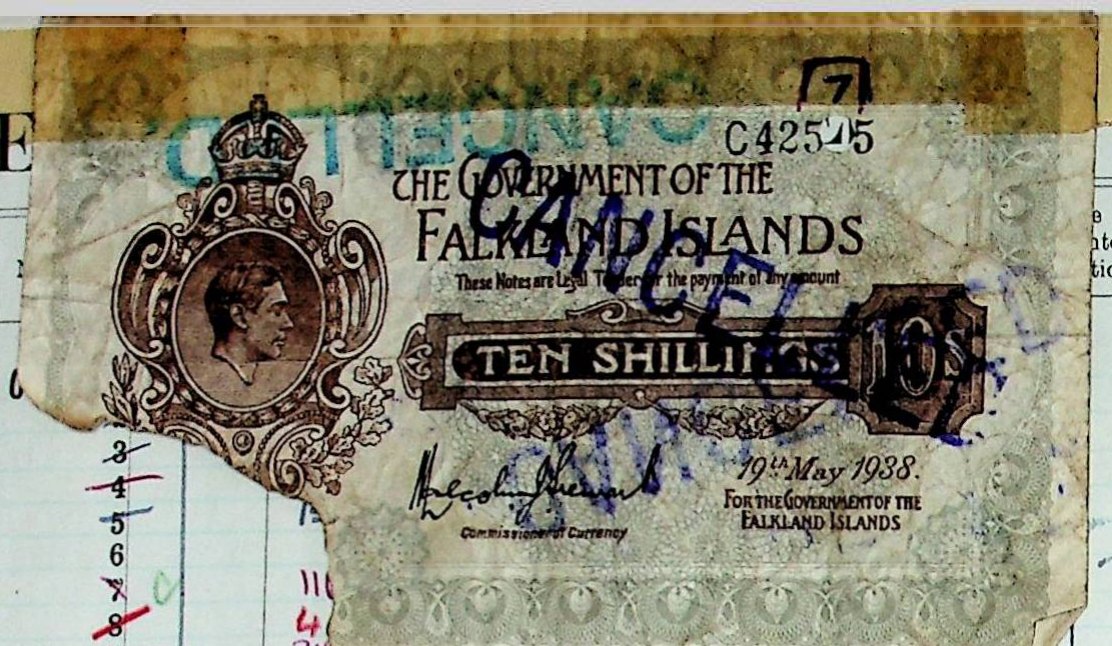
The Treasury's registers themselves show the marks of this work. From 1931 the clerks wrote a batch code in the cancellation column, the number of the batch in the year followed by the two figures of the year: in the key written in the register of 10 shilling notes GOV-TCU-11-1, p. 3, the code 132 is the first batch of 1932, of 23 April 1932. That key covers the codes of 1931 to 1956; the later codes have no key in the books. Where a code was struck out and "Stet" written beside it, the cancellation was withdrawn.
The war and after, 1944 to 1971
The figures of the war years are of withdrawals, not burnings. The Gazette records 15,000 pounds of notes withdrawn in 1944 and 5,296 pounds 10 shillings in 1946, the second sum "invested in the Colony's Reserve Fund". The reports on the Note Security Fund of the 1950s and 1960s then say what became of the notes taken in:
| Year to 30 June | What the report says |
|---|---|
| 1957 | decreases of 25,660 pounds: "£19,000 returned to the reserve stocks and £6,660 destroyed as unfit for re-issue" |
| 1958 | decreases of 8,343 pounds, "all of which were destroyed as unfit for further use" |
| 1959 | soiled notes worth 12,354 pounds withdrawn; new notes worth 6,647 pounds 10 shillings put into circulation |
| 1966 | 32,346 pounds withdrawn, "largely for purposes of destruction owing to their soiled state" |
| 1969 | increases of 44,000 pounds and decreases of 37,900 pounds |
The report for the year to 30 June 1966 also took out of the account the early notes that had never come back: 2 notes of 5 pounds, 57 of 1 pound and 31 of 5 shillings of series A, and 12, 112 and 29 of series B, to be regarded as "irretrievably lost or held as collectors' pieces". The same notes had stood in every table since the 1930s; the 31 and 29 notes of 5 shillings stand unchanged in every table read from 1924 to 1946. The write-off is told more fully in the article on the first notes.
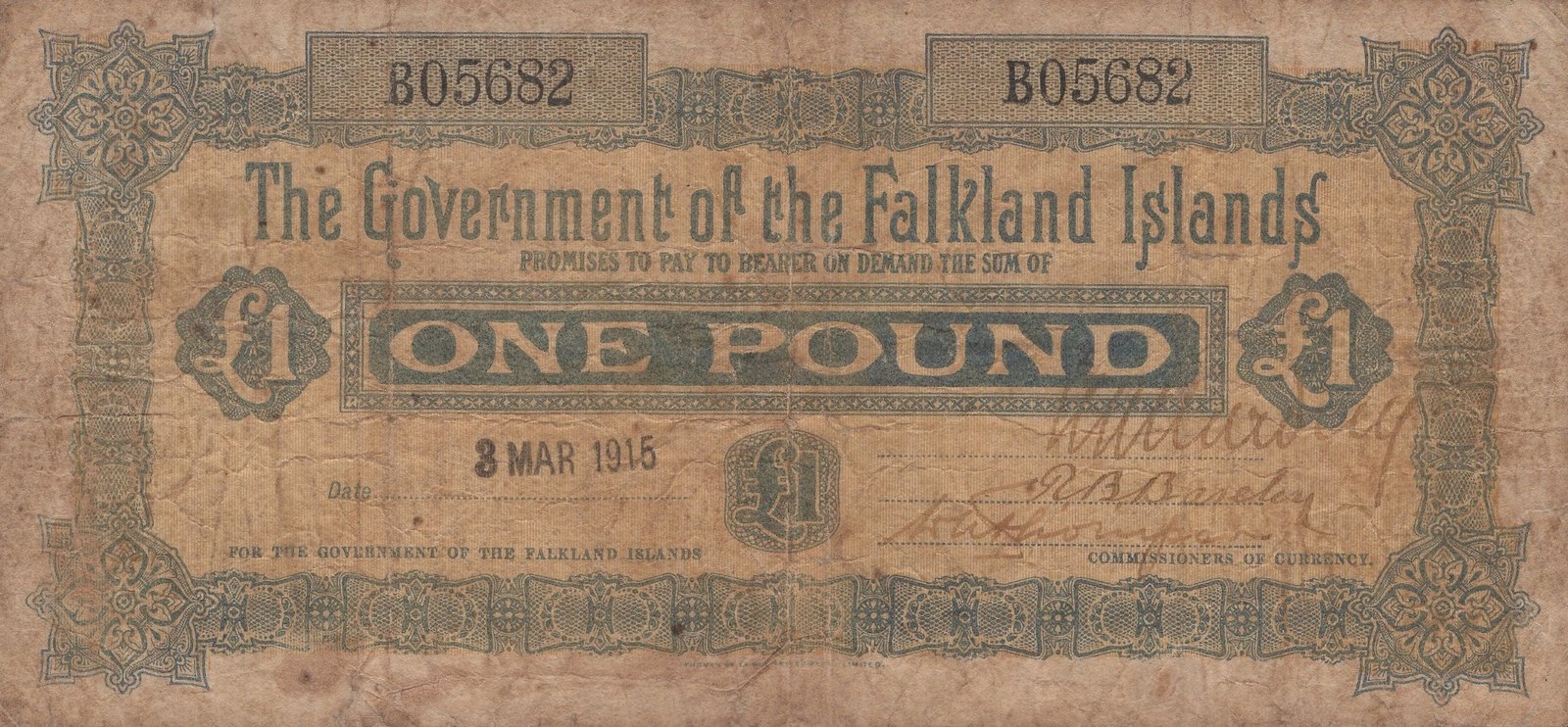
Not every note that went back to the Treasury was destroyed. The report of 1957 shows 19,000 pounds returned to the reserve stocks. A note that went out, came back and went out again leaves no trace in these figures.
The Currency Ordinance 1987 and the shredding rules of 2001
The Currency Ordinance 1987 settled the question of a note lost or spoilt in the holder's hands. Its section 11, as the Gazette for 1987 prints it, says that no one may recover "the value of any lost, stolen, mutilated or imperfect note".
The Currency Notes Regulations 2001 (S.R.&O. No. 14 of 2001), made on 25 June 2001 and published on 28 June 2001, replaced rule 19 of the Currency Notes Rules "to simplify the procedure for destroying currency notes which are withdrawn from circulation". From then on the notes chosen for destruction were cross-cut shredded into pieces not larger than 20 mm by 2 mm and burnt in the presence of a Commissioner of Currency and two currency officers, who signed a certificate of the face value destroyed, by value, for the Financial Secretary. The currency officers who did this work are named in lists printed in the Gazette almost every year from 1950 to 2020.
What the records do not give
- No list of the serial numbers destroyed in any year appears in the Gazette. The Treasury's registers record each note's cancellation, but those seen end in February 1967.
- The readers of the Gazette copied the figures of notes destroyed for a few years only, and the reports on the fund cease to be printed in the Gazette after the one for 31 December 1975; the Gazettes of 2000 to 2021 print no accounts of the Currency Fund.
- Of the worn notes destroyed, only the figures for 1924 and 1930 are divided by value.
- Where the notes were burnt, beyond the incinerator of the Rules of 1939, is not stated.
Sources
- The Falkland Islands Gazette, 1909 to 2001: the reports of the Commissioners of Currency for 1908, 1909 and 1912 and the report of 30 March 1914; the reports on the Currency Note Fund and the Note Security Fund, 1917 to 1969; the Currency Notes Rules of 6 April 1939; the Currency Notes (Amendment) Rules of 15 December 1965; the Currency Ordinance 1987; the Currency Notes Regulations 2001; Jane Cameron National Archives, Stanley.
- Colonial Report on the Falkland Islands for 1922.
- The Falkland Islands Currency Notes Rules 1939, rule 21, in the bound Ordinances, Rules and Regulations of 1933 to 1939, Jane Cameron National Archives.
- The Treasury's note issue books, 1899 to 1920, and registers of currency notes, GOV-TCU-11-1 and others, 1921 to 1967, Jane Cameron National Archives.
Member comments
Log in or register to post a comment.