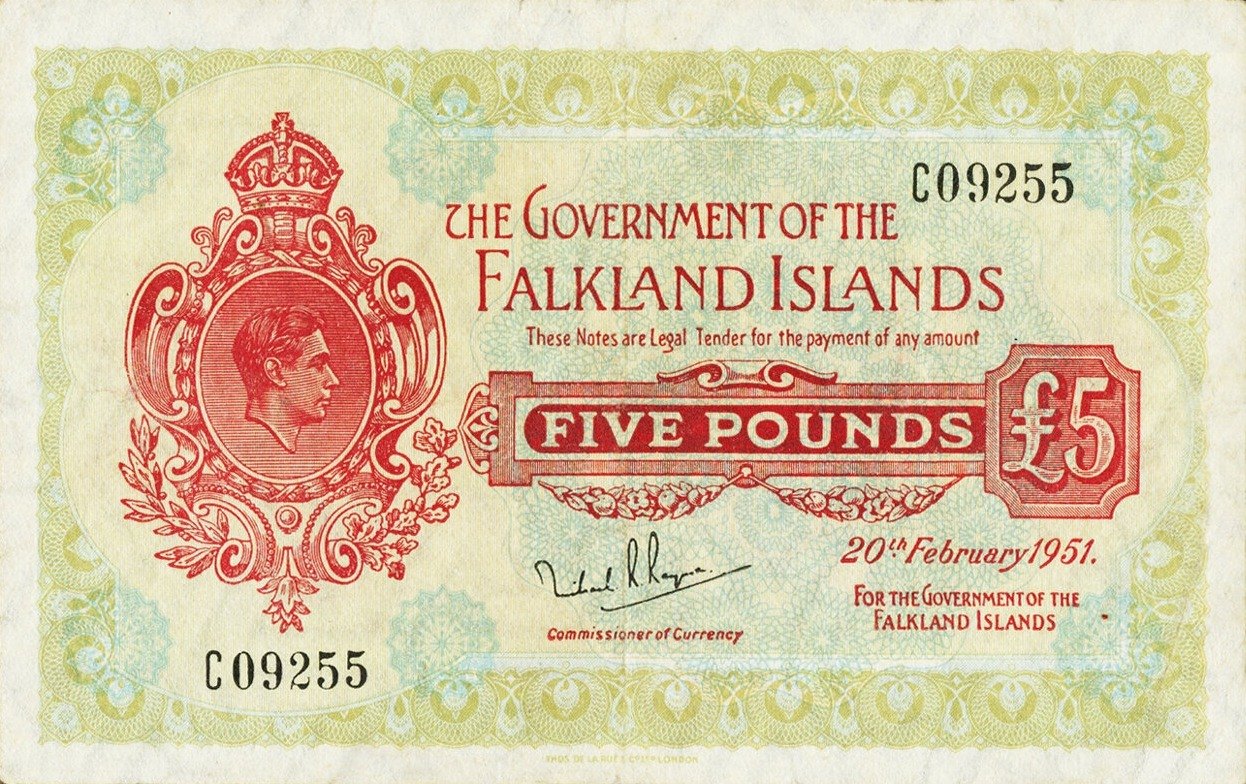
This article gathers what the collectors' press said of the notes of the Falkland Islands from 1974 to 2025, in the Journal of the International Bank Note Society (IBNS) and in Bank Note Reporter, sets it beside what the Treasury's books and the Falkland Islands Gazette have since shown, and lists the named collections and old sale catalogues in which the notes appeared. It rests on the readings of these journals and catalogues made for the catalogue in November 2026; no sale price is given here.
Before 1899: the handwritten notes of 1844
The earliest paper of the colony is known only from print. Chalmers' History of Currency in the British Colonies (1893), pp. 147 and 148, read on the page images, gives a table of the temporary paper currency the Governor issued in 1844 for want of coin, 1,000 pounds in all:
| Value | Notes issued |
|---|---|
| half a dollar | 210 |
| 1 dollar | 130 |
| 5 dollars | 170 |
| 10 dollars | 43 |
| 25 dollars | 64 |
| 50 dollars | 30 |
| 1 shilling and 8 pence | 1 |
Chalmers prints the total of the table as 1,000 pounds and gives no total of the notes. It reckons the dollar at 4 shillings and 4 pence and quotes the Governor's letter of 2 April 1844: "The notes are of the most primitive character, written by hand at some trouble". The Governor signed them "on the part of the Colonial Government"; a trader leaving the colony could exchange them for a Treasury bill; and holders had until 31 March 1845 to present them. A footnote, read in the text layer only, says that all but about 30 pounds' worth were redeemed. The book does not name the Governor.

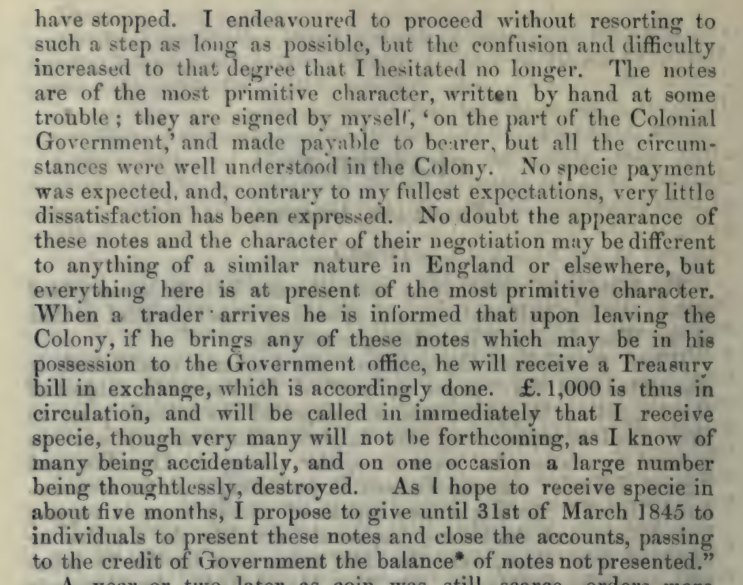
The journals took the story up more than once. The cover text of IBNS Journal 14:1 (1975) mentions the handwritten notes of 1844. Roger Outing's article "Beyond Rarity" in IBNS Journal 41:1 (2002) gives the same values and numbers, totalled there as 648 notes for 1,000 pounds, and cites Chalmers, but dates the notes to 1842. Chalmers' text and the Governor's letter that it quotes give 1844, though the chapter itself is headed "(1842.)" and opens with coin received in 1842. No note of either year is known to the catalogue. The Governor's outward despatch books for 1843 to 1845 are listed in the Falkland Islands archives and may hold the letter of 2 April 1844 itself; they have not been read, so the year 1842 is left as an open point.
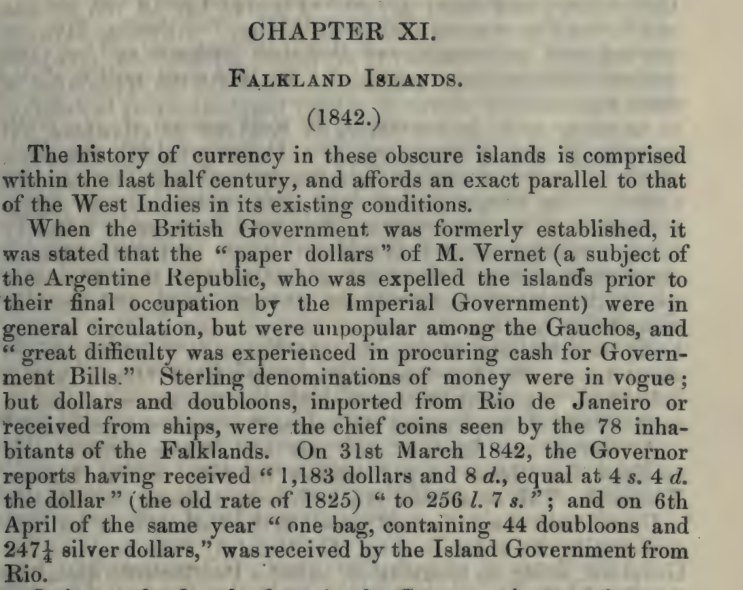
One other paper that collectors met is not a Government note of the colony. A Southeastern Currency mail-bid advertisement in Bank Note Reporter of November 1981 pictured a Falklands 2 pesos of about 1828; the reading of that issue identifies it as the Argentine issue of Vernet, which the catalogue does not list. Chalmers too records that the "paper dollars" of Vernet were in circulation when the British Government was established.
The 1970s: the first surveys
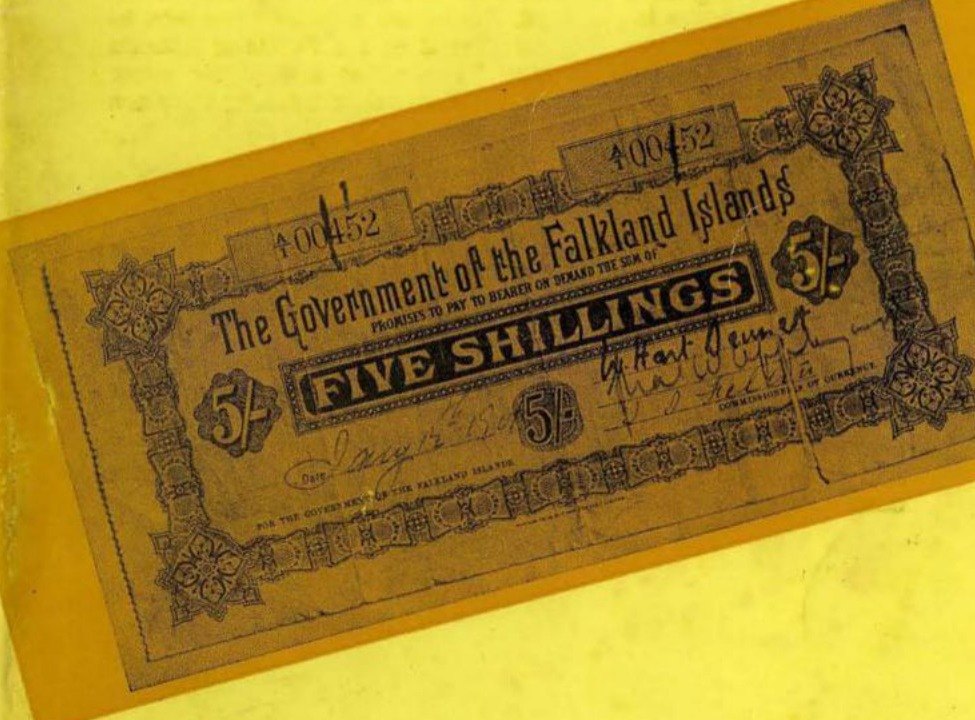
Roger V. McNeice wrote a short survey of the Falkland Islands issues in Bank Note Reporter of January 1974, p. 18, which, as read for the catalogue, agrees with it. A year later the front cover of IBNS Journal 14:1 (1975) showed a green 5 shillings of 12 January 1901, signed by hand by Hart-Bennett, Appleyard and Felton, with a pen stroke drawn down through each serial number.
Brian Kemp's survey "Note Issues of the Falkland Islands" in IBNS Journal 14:2 (1975), pp. 106 and 107, made three statements on p. 107 that later sources have not borne out:
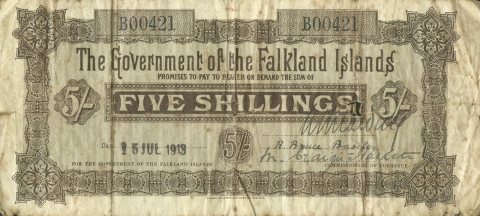
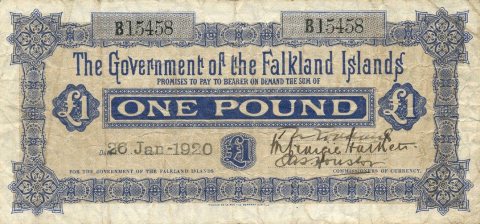
- It gives the first Government notes of 1899 as 5 shillings, 10 shillings, 1 pound and 5 pounds. The Treasury's issue books of 1899 to 1920 record no 10 shillings, the Colonial Reports for 1909 and 1912 count none, and the catalogue's 10 shillings of the first series has never been seen. The Colonial Report for 1905 says that the Order in Council of 1899 allowed notes of 10 shillings.
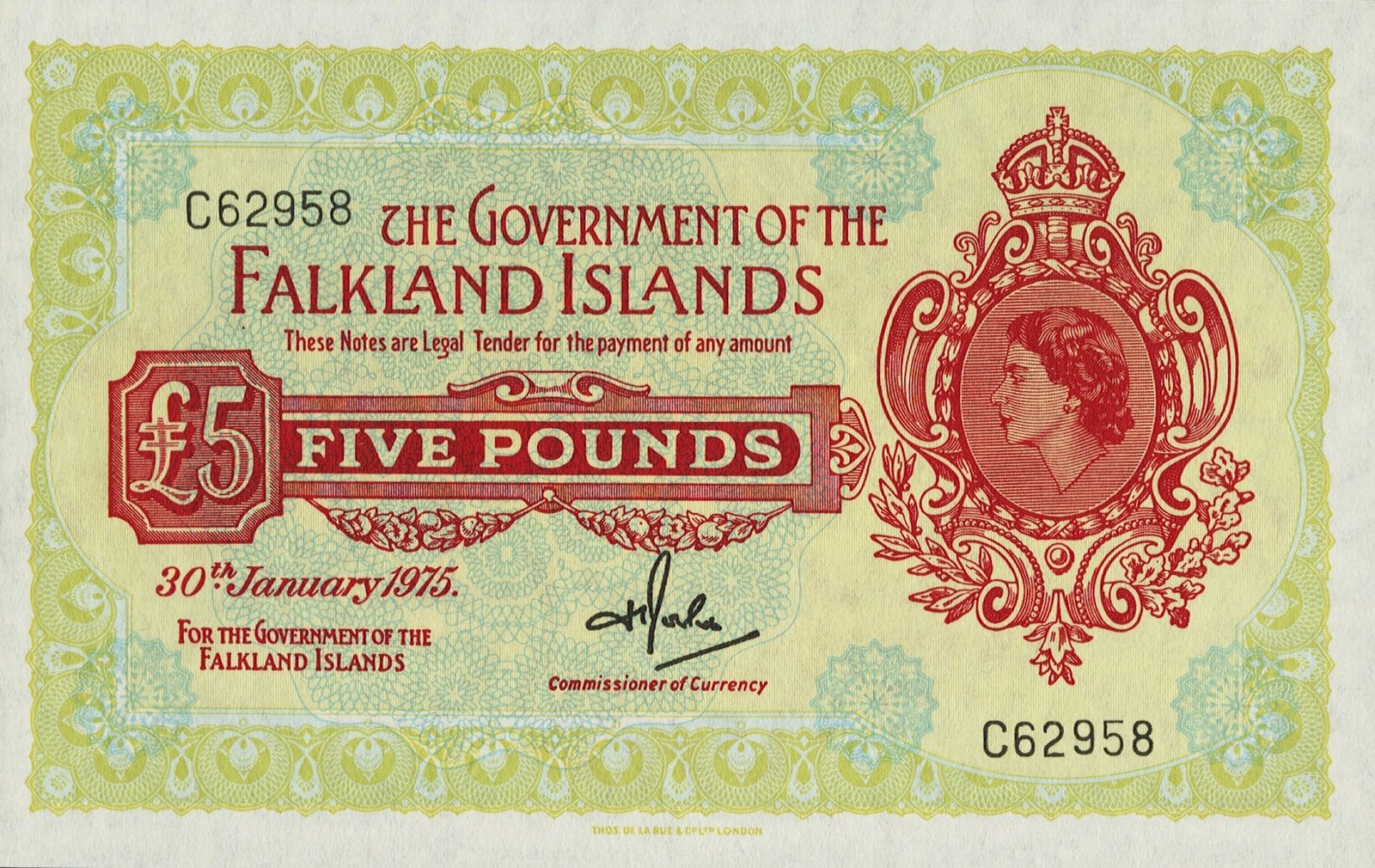
- It says that the George VI series dated 19 May 1938 comprised 10 shillings, 1 pound and 5 pounds, and that in 1951 a 5 pounds only was issued. Every 5 pounds of King George VI known to the catalogue is dated 20 February 1951.
- It says that "the new decimal notes" were released on 25 September 1969. That is the date printed on the 50 pence; the value became lawful only on 15 February 1971, under the Currency Notes (Amendment) Rules 1970.
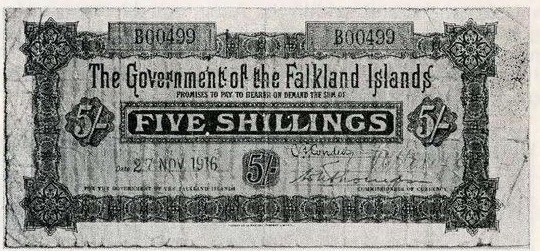
The same survey reports that a 5 shillings of 1901 "has come onto the market recently".
The 1980s and 1990s: new notes in the news
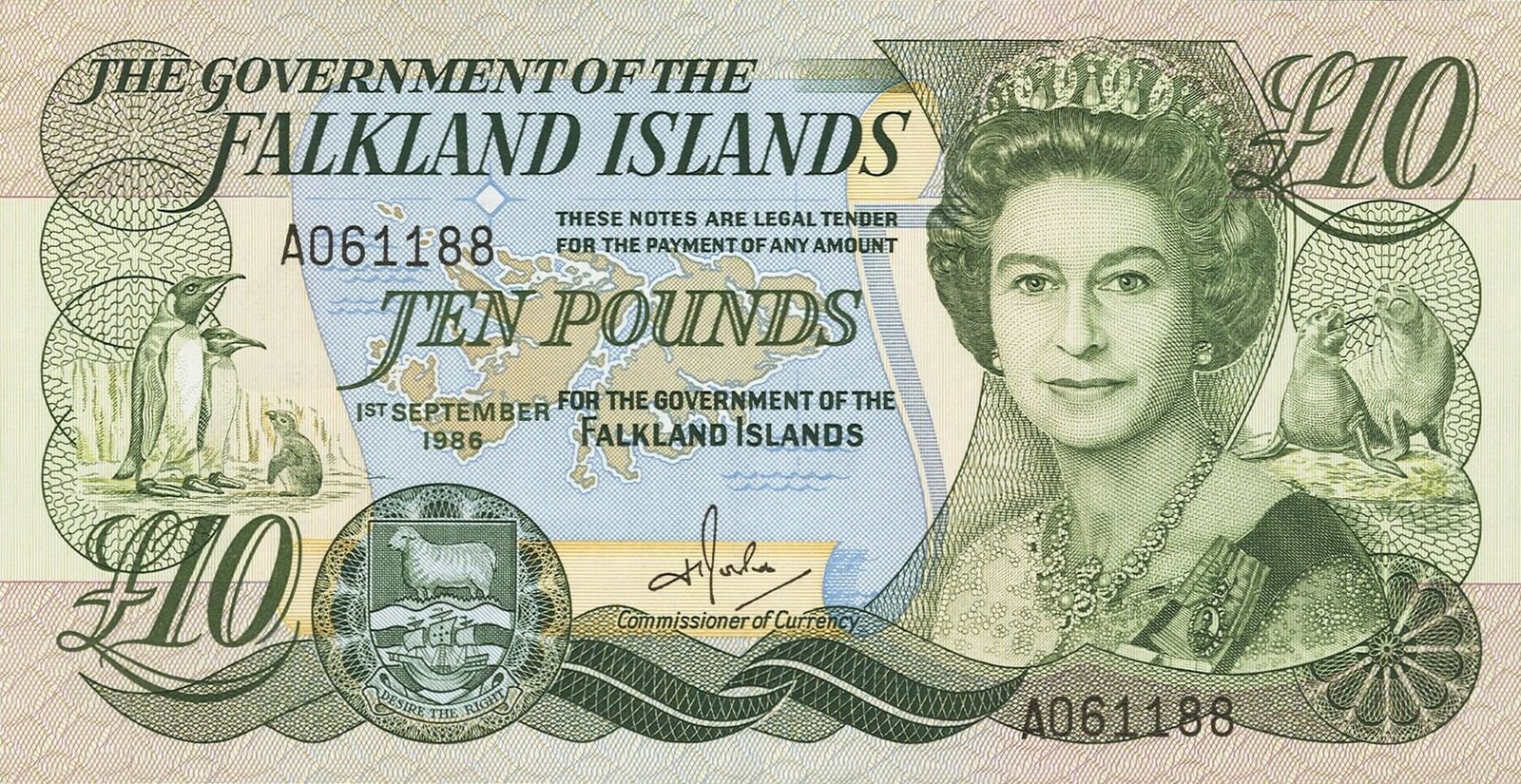
Bank Note Reporter followed the notes of the 1980s as they appeared. Its issue of July 1984, p. 3, under the heading "Falklands mark British rule", pictured the 5 pounds of 14 June 1983. Colin Bruce's column in February 1984 pictured a 1 pound of 20 February 1974, and the World Paper Money Update pictured a 1 pound of 15 June 1982 (March 1984), a 10 pounds of 1982 (September 1984), a 1 pound of 1927 (October 1984), the 1 pound of 1 October 1984 (September 1985) and the 10 pounds of 1 September 1986 (January 1988).
The 50 pounds of 1 July 1990 is pictured in the issue of May 1991, p. 44, and on the front page of the World Currency Section in November 1991, p. 30. That fits the Gazette: in December 1990 the Currency Notes (Validation) Bill described the 50 pounds as printed but not yet in circulation.
One report cannot be placed. Bank Note Reporter of November 1986, p. 1, reporting the October sales in London, says that "a shilling note of the Falkland Islands, 1932" was sold. The catalogue has no 1 shilling; the note was probably a 10 shillings of 10 February 1932, but the report does not name the house. The same newspaper reported in December 1977 and February 1978 a 10 shillings of 1932 sold by Stanley Gibbons in London on 6 December 1977, a sale the catalogue does not hold.
The 2000s: designers, portraits and archives
Later articles turned to how the notes were made.
- Peter Symes, "The Portraits of Queen Elizabeth II on World Bank Notes", IBNS Journal 44:2 (2005), identifies the profile on the notes of 1960 to 1982 as a 1952 photograph by Dorothy Wilding (p. 15) and the portrait of the 1983 design as Peter Grugeon's photograph for the Silver Jubilee of 1977, engraved by De La Rue (p. 20).
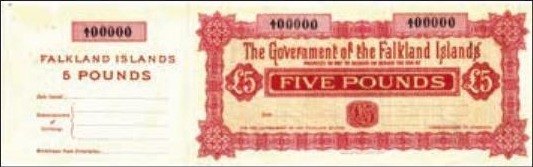
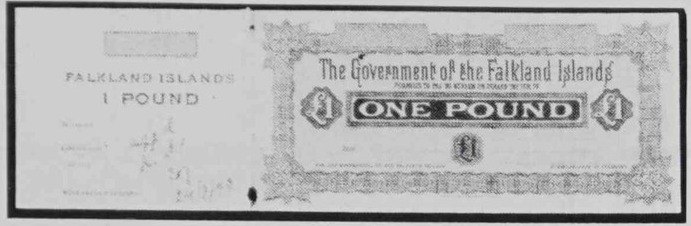
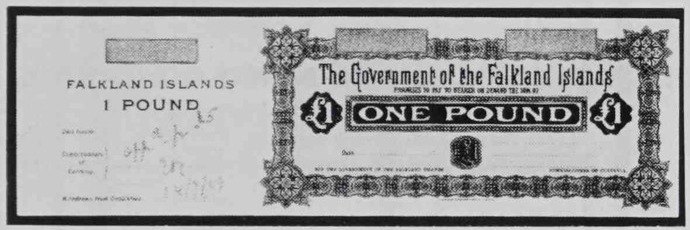
- Richard Scott Morel's article on the Crown Agents' Philatelic and Security Printing Archive at the British Library, IBNS Journal 55:4 (2016), p. 35, fig. 13, pictures an unissued red colour trial of the 5 pounds of the first series with its counterfoil. The catalogue's page had said that no such trial had been seen; it now records the trial.
- Mark D. Tomasko's article on Brian White, IBNS Journal 57:4 (2018), pp. 25 and 26, says that White used one engraved master die for every value of the 1983 design, the values in figures and words being added by surface printing, with no value on the backs, and that the 50 pounds came later in the same family.
- The New issues pages of IBNS Journal 64:4 (2025), pp. 57 and 58, quoting the issuer, describe the polymer notes of 14 August 2025 as having a clear window with a king penguin, iridescent ink and features seen under ultraviolet and infrared light, printed by De La Rue, and picture issued notes numbered with a single A and six figures. The chapter news of the same issue, p. 71, reports a member showing the new King Charles series, including a replacement note with the prefix Z.
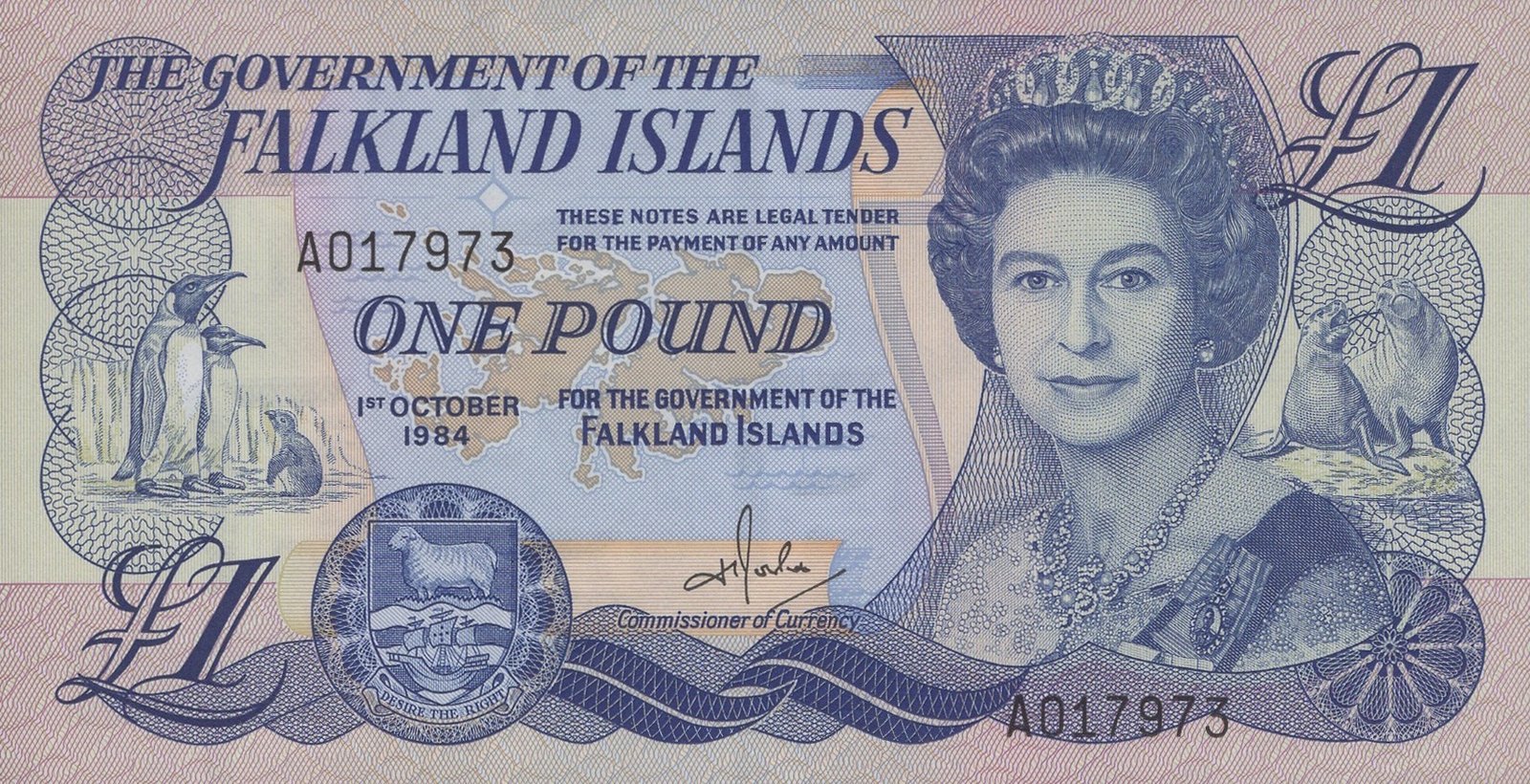
Kerry Rodgers' preview of the Spink sale of October 2013, "Spink October sale taking shape", in Bank Note Reporter of September 2013, p. 73, adds a detail of provenance: the 1 pound of 1899 and the 5 shillings of 1901, both numbered 1, "arrived from Argentina in an envelope marked Billetes Islas Malvinas". What the houses later wrote of the same two notes, the annotation to Mansell at Gallegos and the envelope, is told in the article on the first notes.
Yao's working paper on the Falkland Islands, Studies in Applied Economics No. 320 of the Johns Hopkins Institute for Applied Economics, sets out the Order of 1899 and the Ordinance of 1930 and agrees with the catalogue on the 5 shillings of 1901 and the burning of 1914. Two of its statements do not fit the notes: p. 7 says that the last 10 shillings notes were issued "from 1967" and circulated as 50 pence, and p. 9 that a commemorative 1 pound was issued in 1983, where the commemorative of 1983 is the 5 pounds.
The old sale catalogues
The older catalogues read for the catalogue hold Falklands notes in a few lots each, most of them the George VI and Queen Elizabeth II notes of 1938 to 1982. They are listed here by house and date with the lots.
| Date | House and sale | Lots | What was offered |
|---|---|---|---|
| 5 December 1974 | Harmer-Rooke, New York: the Albert I. Donn collection | 114 | 10 shillings and 1 pound of 1938, 5 pounds of 1960 |
| 9 June 1975 | Glendining, London, catalogued by Spink and Son: the R. J. Ford collection | 246 to 252 | 10 shillings of 1932, 1938 and 1960; 1 pound of 1938 and 1967; 5 pounds of 1951 and 1960 |
| 31 October 1975 | Henry Christensen, mail auction, Madison, New Jersey | 1223 to 1225 | 10 shillings of 1960, 1 pound of 1967, 50 pence of 1969 |
| 6 December 1975 | Henry Christensen, New York International Numismatic Convention | 925 and 926 | 10 shillings and 1 pound of 1938 |
| 18 July 1979 | NASCA, New York: the London collection, second volume | 3100 to 3104 | 1 pound of 1938 and 1967, 5 pounds of 1960, 50 pence of 1969 and 1974 |
| 28 May 1980 | NASCA, New York: the George Thomas collection | 1383 | 1 pound of 1938, 5 pounds of 1960 |
| 10 December 1980 | NASCA, New York: the Stockholm collection | 1594 and 1595 | the notes of 1938 to 1975, among them the 10 pounds of 1975 |
| 7 December 1981 | NASCA, New York: the Stanley Gibbons collection, part II | 723, 724 and 2047 | 1 pound of 1938, 5 pounds of 1951, 10 shillings of 1938 and later notes |
| 22 March 1982 | NASCA: the Stanley Gibbons sale, part III, mail bid | 3240 and 3241 | a proof of the 1 pound with approval writing on its stub, and a colour trial of the 1 pound in red |
| 20 December 1982 | Herbert I. Melnick, Bellmore, New York: the Stanley Gibbons collection, part V | 2442 and 2443 | 1 pound of 1938 and 1967, 5 pounds of 1960, 50 pence of 1969 |
| 9 November 1989 | Spink, London, sale 73: the Amon Carter collection | 367 | 10 shillings of 10 February 1932 |
| 15 July 1993 | R. M. Smythe, Memphis, sale 119 | 7273 | 1 pound of 1938 in a mixed lot |
| 22 February 1999 | R. M. Smythe, Chicago, mail bid sale 185 | 5688 and 5776 | 5 pounds of 1983; a group of 1 pound and 50 pence notes |
| 2 December 2003 | R. M. Smythe, New York, sale 234 | 1940 to 1942 | runs of the 50 pence of 1969 |
| 15 January 2009 | R. M. Smythe, New York: the Collector's Series | 2711 to 2714 | the 1 pound, 5 pounds, 10 pounds and 50 pence of 1967 to 1982, every date |
| 13 April 2011 | Spink, sale 11014: the Peter Griffiths collection | 154 | 10, 20 and 50 pounds of 1986, 1984 and 1990 |
| 27 January 2016 | Spink, New York, sale 323 | 1086 | five notes of 1974 to 2005 |
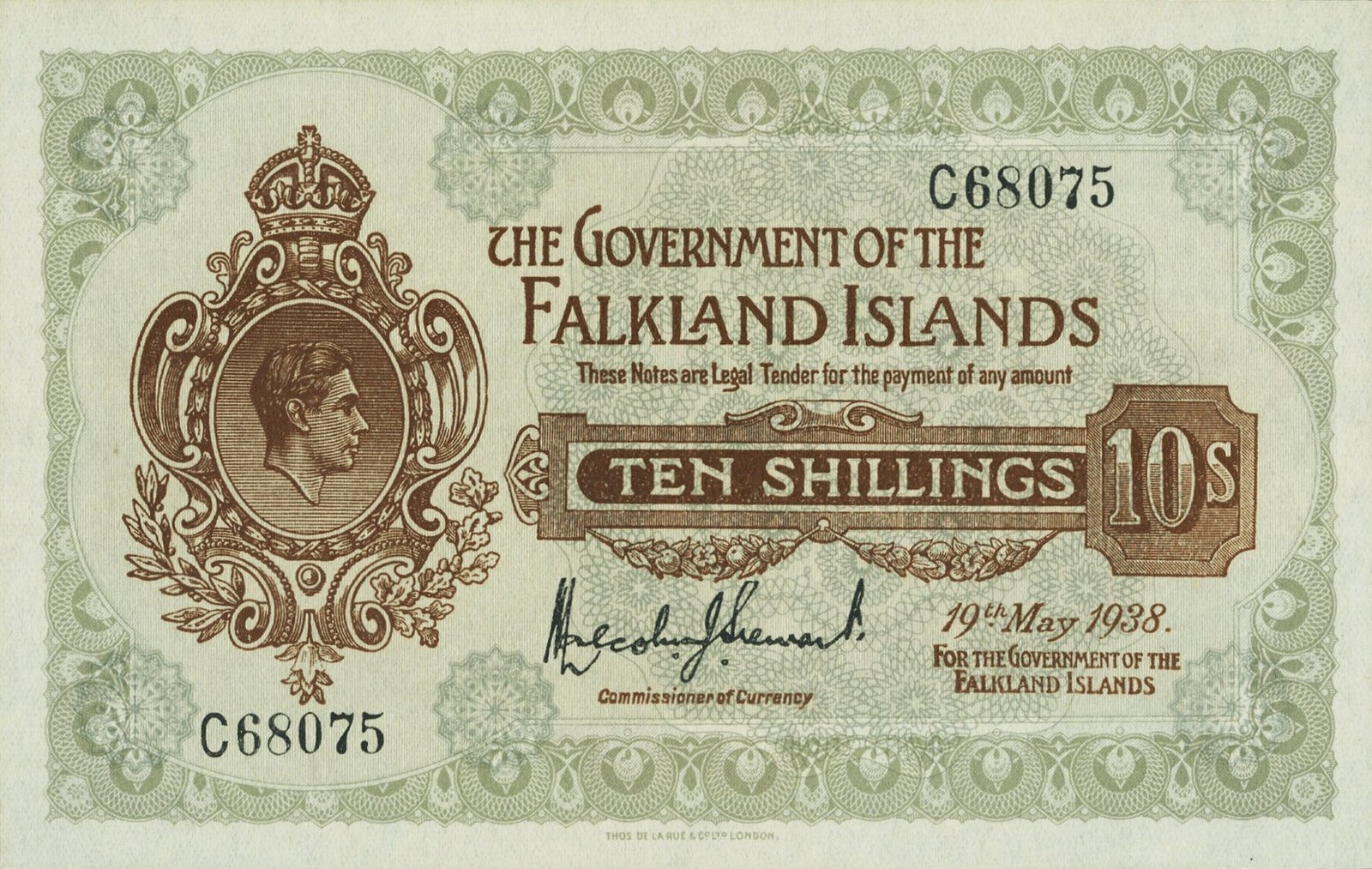
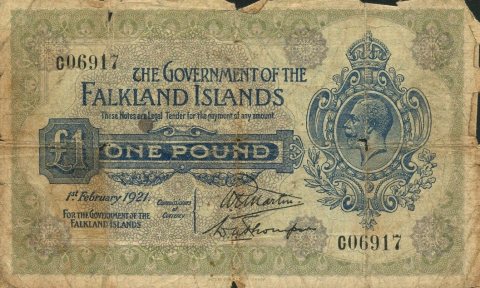
The early notes of 1899 to 1920 are nearly absent from these sales: only the proof and the colour trial of the Stanley Gibbons sale of 1982 come from that series. The George V notes appear only as the 10 shillings of 1932 in the Ford sale of 1975 and the Amon Carter sale of 1989, the same note, as told below; Bank Note Reporter adds the one sold by Stanley Gibbons in 1977.
Named collections of recent years
Several collections sold since 2014 can be traced by name through the sale records and the houses' descriptions.
- Ruth W. Hill. The handwritten inventory of the Ruth W. Hill collection, scanned in 42 volumes, has one sheet of Falkland Islands notes in the volume "Faeroe Islands to France (Vichy)", with 13 lines, from the 10 shillings of 1938 to the 5 pounds of 1983. The latest notes in the inventory are dated 1994, and Ruth W. Hill died in January 1995. Every sheet carries a date of 14 or 15 January 2014 and a signature, and the Falklands notes were sold by Heritage in June and September 2014.
- Omar Waddington. Spink sold the Waddington notes on 30 January 2020, lots 461 to 473. PMG's online gallery of the collection holds 12 Falkland Islands notes. Several were sold again by Heritage in March 2022 and one by Spink in 2024, lot 208.
- Ibrahim Salem. Spink offered part one of the Salem collection of British Commonwealth notes on 17 April 2019 (lots 439 to 445, among them the 5 shillings of 1901 and the 1 pound of 1899 numbered 1, and the 10 shillings of 1921), and Heritage the Salem collection of World Peninsulas and Islands on 9 May 2023 (lots 28229 and 28230, the two notes numbered 1).
- Joanne and Edward Dauer. Heritage's sale of the Dauer collection on 24 April 2020 included, as ex Dauer, the 5 pounds of 1951 (lot 26098), the 5 pounds of 1960 and 1975 (lots 26100 and 26101), the 10 pounds of 1975 (lot 26102) and two 1 pound notes of 1967 and 1977 in a lot with a note of Ceylon (lot 26077).
- Don Allen, Thomas Collup and the Meadows collection. Stack's Bowers offered notes of 1938 to 1975 from the Don Allen collection in January 2022 (lots 20248 to 20251 and 21409 to 21411), Heritage a 1 pound of 1938 from the Thomas Collup collection on 9 November 2023 (lot 24259), and Stack's Bowers notes of 1974 to 1990 from the Meadows collection in September 2025 and January 2026 (lots 72316, 32474 and 32476).
Two notes followed from the Treasury to the sale room
The Treasury's registers in the Jane Cameron National Archives make it possible to follow a few single notes from the day they went out.
The 10 shillings of 10 February 1932 numbered C 12878 was put into circulation on 4 April 1938, according to the register GOV-TCU-11-3, which records no cancellation. It was lot 246 of the Ford sale at Glendining on 9 June 1975 and lot 367 of the Amon Carter sale at Spink on 9 November 1989, where Spink described a small hole at the upper right.
The green 5 shillings numbered A/1 00452 was issued on 12 January 1901, the day of the first 5 shillings notes, according to the Treasury's note issue book GOV/TCU/3. It is the note on the cover of IBNS Journal 14:1 in 1975, with the pen strokes through its numbers. Spink sold it on 30 September 2014, lot 566, and called it the note pictured in the Pick catalogue.
Sources
- Robert Chalmers, A History of Currency in the British Colonies (London, 1893), pp. 147 and 148.
- IBNS Journal 14:1 (1975), front cover; 14:2 (1975), Brian Kemp, "Note Issues of the Falkland Islands", pp. 106 and 107; 41:1 (2002), Roger Outing, "Beyond Rarity"; 44:2 (2005), Peter Symes, pp. 15 and 20; 55:4 (2016), Richard Scott Morel, p. 35; 57:4 (2018), Mark D. Tomasko, pp. 25 and 26; 64:4 (2025), pp. 57, 58 and 71.
- Bank Note Reporter: January 1974, p. 18 (Roger V. McNeice); December 1977 and February 1978; November 1981; February, March, July, September and October 1984; September 1985; November 1986, p. 1; January 1988, p. 28; May 1991, p. 44; November 1991, p. 30; September 2013, p. 73 (Kerry Rodgers).
- Yao, working paper on the Falkland Islands, Studies in Applied Economics No. 320, Johns Hopkins Institute for Applied Economics, pp. 7 and 9.
- Sale catalogues: Harmer-Rooke, 5 December 1974; Glendining, 9 June 1975; Henry Christensen, 31 October and 6 December 1975; NASCA, 18 July 1979, 28 May 1980, 10 December 1980, 7 December 1981 and 22 March 1982; Herbert I. Melnick, 20 December 1982; Spink, 9 November 1989, 13 April 2011, 30 September 2014, 27 January 2016, 17 April 2019, 30 January 2020 and lot 208 of 2024; R. M. Smythe, 15 July 1993, 22 February 1999, 2 December 2003 and 15 January 2009; Heritage, 2014, 24 April 2020, March 2022, 9 May 2023 and 9 November 2023; Stack's Bowers, January 2022, September 2025 and January 2026.
- The Ruth W. Hill collection inventory, 42 volumes; PMG's gallery of the Omar Waddington collection.
- The Treasury's note issue book GOV/TCU/3 and register GOV-TCU-11-3, Jane Cameron National Archives, Stanley.
Member comments
Log in or register to post a comment.