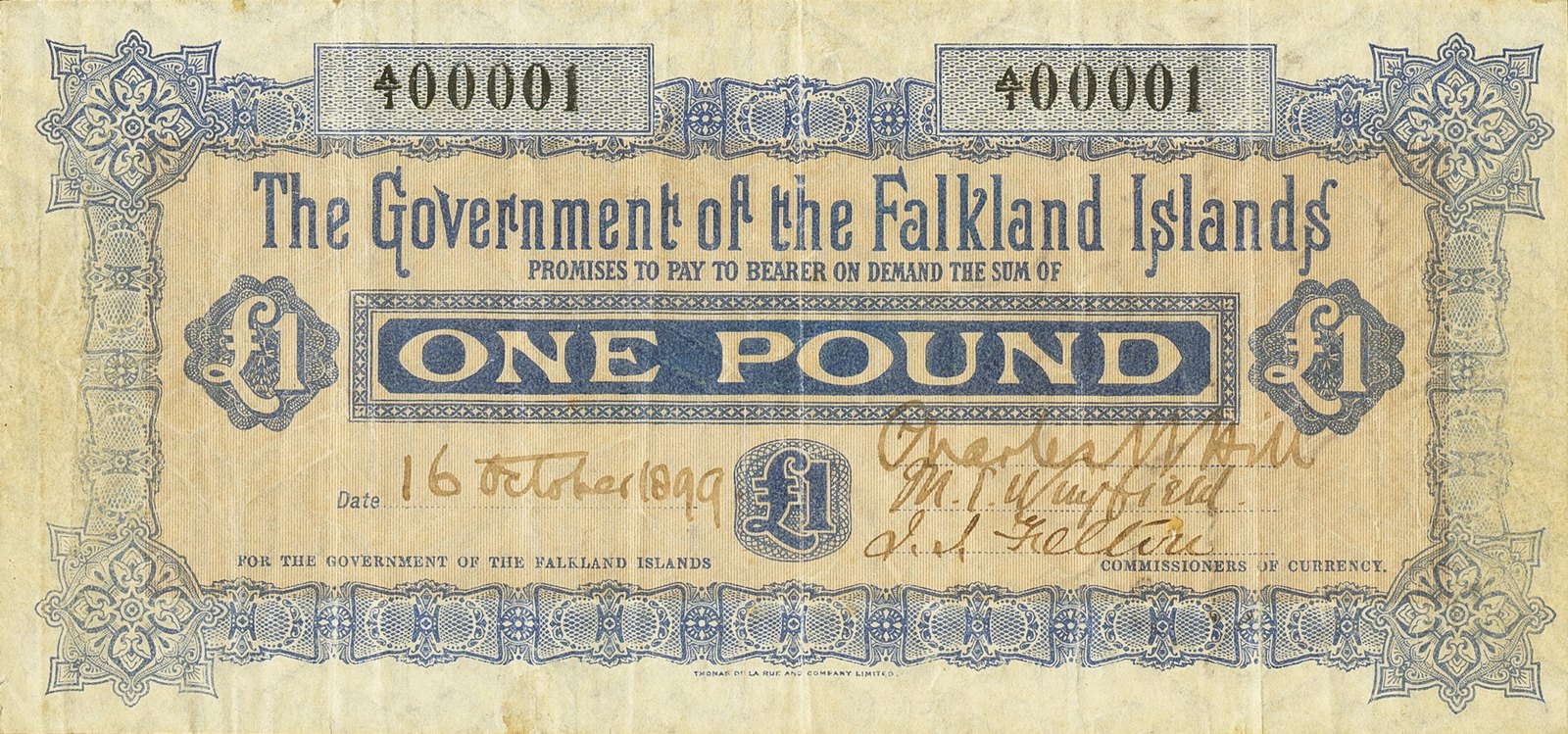
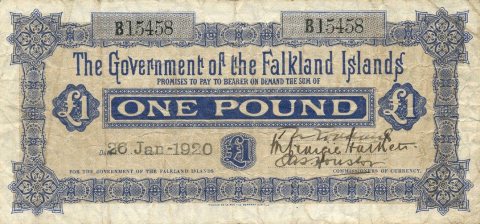
The first printed notes of the Falkland Islands were issued from 16 October 1899 to 1920 and were signed by hand by three Commissioners of Currency. This article gathers what the Falkland Islands Gazette, the Colonial Reports and the Treasury's note issue books in the Jane Cameron National Archives say about them, and what the auction houses have written about the approval proofs and the first numbers. The serial ranges and the rules for placing a note on a row stay on the pages of the green 5 shillings, the brown 5 shillings, the 1 pound and the 5 pounds.
Before 1899: the handwritten notes of 1844
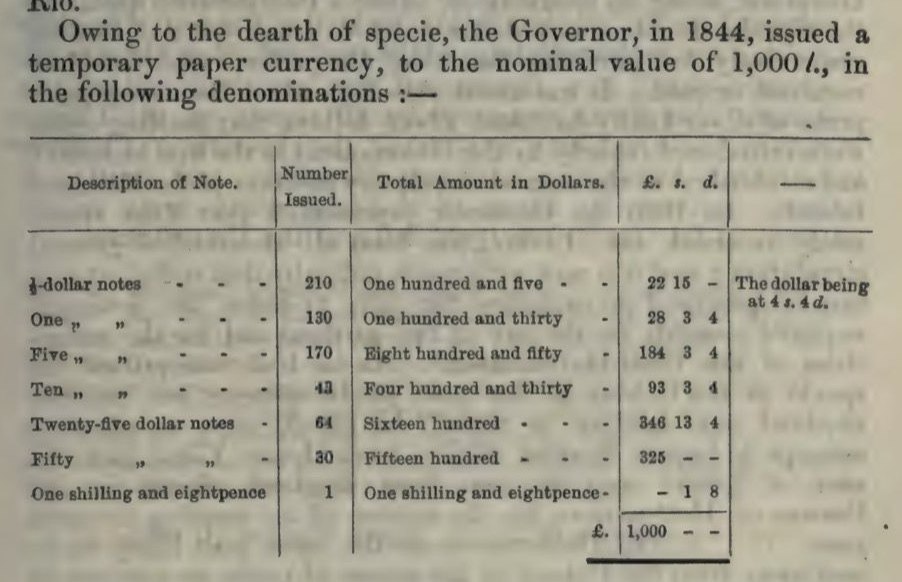
An earlier, temporary issue is known only from the records. Chalmers' History of Currency in the British Colonies (1893) says that in 1844, for want of coin, the Governor issued handwritten notes worth 1,000 pounds, signed by the Governor "on the part of the Colonial Government" and payable to bearer, in values from half a dollar to 50 dollars. Holders had until 31 March 1845 to present them, and all but about 30 pounds' worth were redeemed.
The Order of 1899 and the board of three
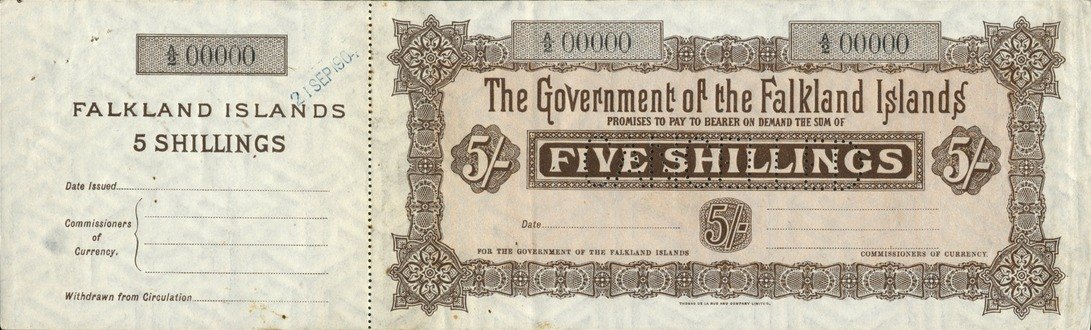
The Government paper currency was set up under an Order in Council of 7 March 1899. The Gazette for 1899 prints the proclamation of Governor Grey-Wilson, countersigned by Charles W. Hill as Acting Colonial Secretary, that brought the Currency Note Order into force on 16 October 1899. The notes of 1899 to 1920 were printed with counterfoils that were detached on issue, and some, perhaps all, are perforated along the left edge. The specimen of the brown 5 shillings still has its counterfoil, date-stamped 21 SEP 1904. The first 1 pound note is dated by pen 16 October 1899, and the Treasury's issue book has the first 5 pounds notes put into circulation from that day.
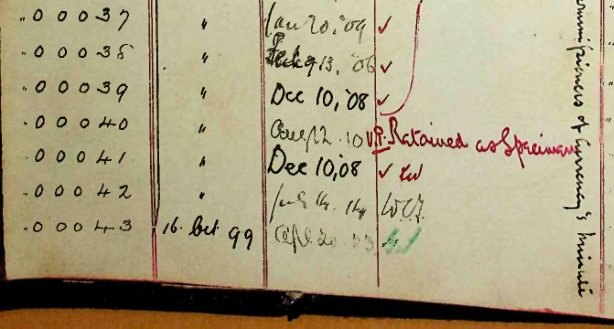
The notes were issued by a board of three Commissioners of Currency: the Colonial Secretary, the Treasurer and one person named by the Governor, as the Colonial Report for 1905 puts it. Each month the board published a statement of the Currency Note Fund in the Gazette, signed by all three. The first statements, for January and February 1900, show 1,000 pounds of notes in circulation and are signed by Charles W. Hill, M. E. Wingfield and J. J. Felton.
Who signed, by the Gazette
The names under the monthly statements show who sat on the board in each period. They are the Gazette's record of the board, not readings of notes.
| Statements for | Signed by |
|---|---|
| January and February 1900 | Charles W. Hill, M. E. Wingfield, J. J. Felton |
| June and July 1900 | Charles W. Appleyard, Vere Packe, J. J. Felton |
| August to November 1900 | W. Hart Bennett, Charles W. Appleyard, J. J. Felton |
| February to September 1901 | W. Hart Bennett, Vere Packe, J. J. Felton |
| October 1901 to April 1902 | W. Hart Bennett, W. A. Thompson, J. J. Felton |
| March 1904 to April 1905 | W. Hart Bennett, W. A. Thompson, W. A. Harding |
| July to December 1905 | W. A. Thompson, W. A. Harding, G. Hurst |
| January to March 1906 | H. E. W. Grant, W. A. Thompson, W. A. Harding |
| April to December 1908 | H. E. W. Grant, G. Hurst, W. A. Harding |
| November 1909 to February 1911 | W. A. Thompson, W. A. Harding, M. Craigie-Halkett |
| August 1911 to June 1912 | T. A. V. Best, W. A. Thompson, W. A. Harding |
| June to October 1913 | M. Craigie-Halkett, R. B. Baseley, W. A. Harding |
| June 1914 to March 1915 | W. A. Thompson, W. A. Harding, R. B. Baseley |
| December 1915 to March 1917 | C. F. Condell, W. A. Thompson, W. A. Harding |
| April 1917 to March 1918 | C. F. Condell, W. A. Thompson, Jas. Houston |
| signed from 2 September 1918 to 6 March 1919 | W. A. Thompson, Jas. Houston, T. N. Goddard |
| signed from 14 May 1919 to 24 February 1920 | M. Craigie-Halkett, Jas. Houston, T. N. Goddard |
| signed from 24 May to 17 November 1920 | M. Craigie-Halkett, R. B. Baseley, H. H. R. Gresham |
Four points in the Gazette bear on names read from the notes.
Appleyard. The green 5 shillings of January 1901 is signed Hart-Bennett, Appleyard and Felton. The Gazette for 1900 shows that C. W. Appleyard was acting Colonial Secretary from 1 June 1900, until W. Hart Bennett arrived, and then acting Treasurer. The monthly statements for August to November 1900 are signed by Hart-Bennett, Appleyard and Felton, as on the notes. The statements from February 1901 carry the name of Vere Packe in place of Appleyard's.
Hurst. George Hurst signs the notes of 1908 with Grant and Harding. The Gazette records that W. A. Thompson, the Treasurer, was granted twelve months' leave and that Hurst was to act as Colonial Treasurer from 30 March 1908. Hurst had already acted as a Commissioner from 19 July 1905 and from 25 April 1907.
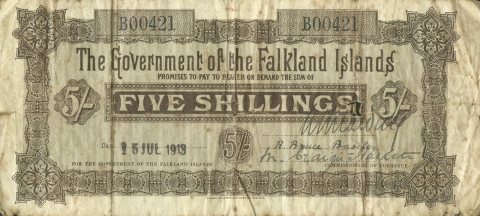
The board of 1913. The notes of 1913 are signed Harding, Baseley and Craigie-Halkett. The Gazette shows that M. C. Craigie-Halkett was made an acting Commissioner on 22 March 1913, during the absence of the Colonial Secretary, and acting Colonial Treasurer from 12 May 1913, and that R. B. Baseley was appointed to act as a Commissioner on 14 May and again on 21 August 1913. The statements of June to October 1913 carry the same three names.
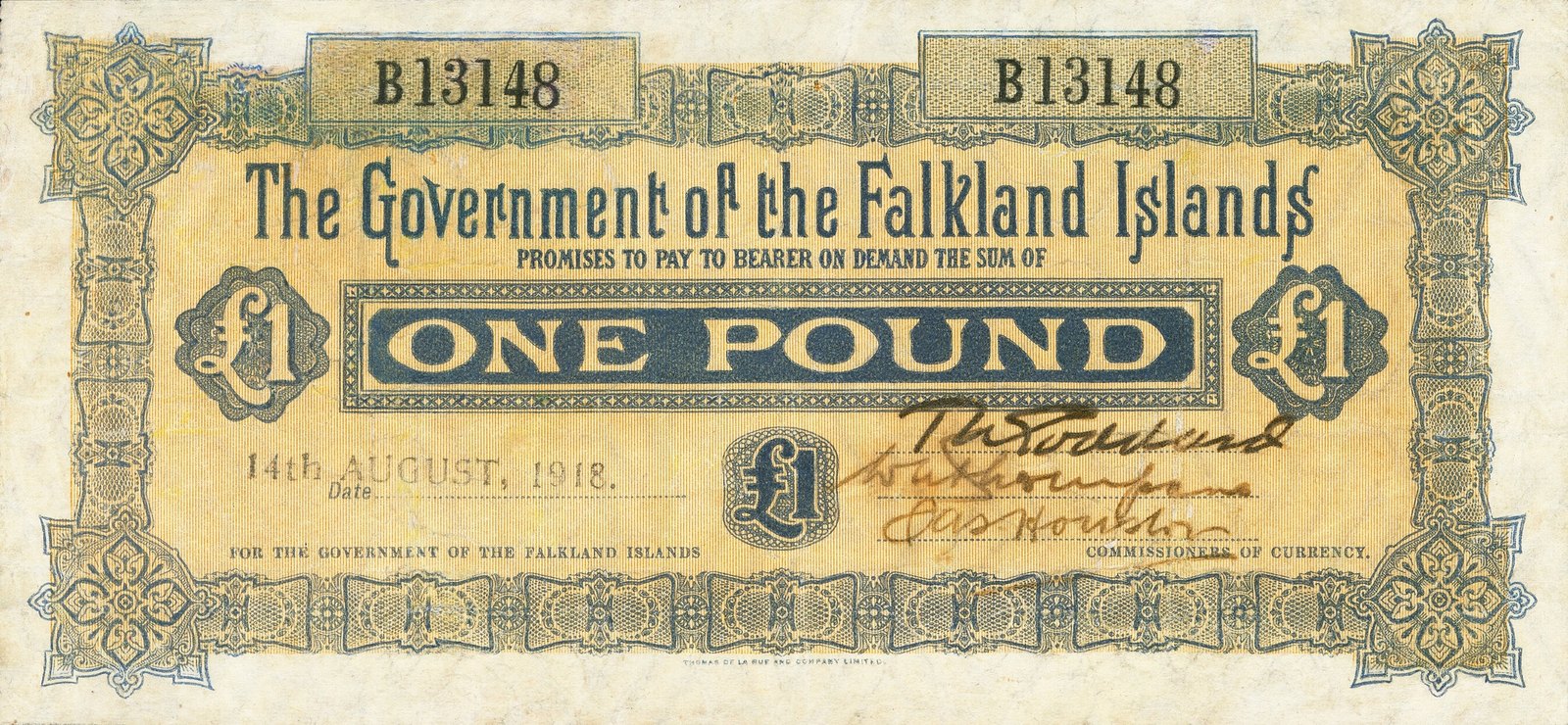
The notes dated 14 August 1918. The 1 pound notes of that date are signed St. Johnston, Thompson and Houston, read from B 13148. The Gazette shows that these three cannot all have signed on one day. T. R. St. Johnston was appointed Colonial Secretary on 12 April 1919 and took office only on 15 September 1919. The Treasurer, Thompson, was on leave from 3 April 1919 to 25 December 1920. Yet the Treasury's issue book gives 14 August 1918, the date on the notes, as their date of issue. The papers do not say when the signatures were added. The Gazette adds that St. Johnston left the colony on 1 April 1920, and that James Houston had been a Commissioner since 25 April 1917.
Stack's Bowers' description of a 1 pound of 28 August 1915 (29 August 2025, lot 30256) reads its signatures as Condell, Harding and Thompson, the board of the statements from December 1915. The same description says that Condell arrived at Stanley in March 1915, which the Gazette for 1915 bears out, that Thompson was born in the Bahamas in 1872 and came to the Falklands in 1901, and that the counterfoils were kept when a note was issued and joined to the note again when it was redeemed. The Gazette records Thompson's appointment as Treasurer and a Currency Commissioner on 21 October 1901. The rest is Stack's Bowers' statement.
The green and the brown 5 shillings
The Colonial Report for 1900 records that a supply of 5 shillings notes, "designed more particularly to meet the needs of the country districts", was ordered from England that year but that none were put into circulation. The Treasury's issue book has them issued on 12 January 1901. The report for 1901 says that they went out but "do not find favour among the people, and quickly return to the Treasury". An audit printed in the Gazette for 1904 found 350 pounds of signed 5 shillings notes lying in the safe, withdrawn from circulation.
The Colonial Report for 1904 records that a brown 5 shillings replaced the green one that year. A report of 8 March 1906 in the Gazette gives the reason: by lamplight the green notes "were liable to be mistaken for one Pound Notes". The Treasury's issue book shows only A/2 00001 to A/2 00400 of the brown note issued. The rest of the A/2 printing was burnt unissued in October 1908.
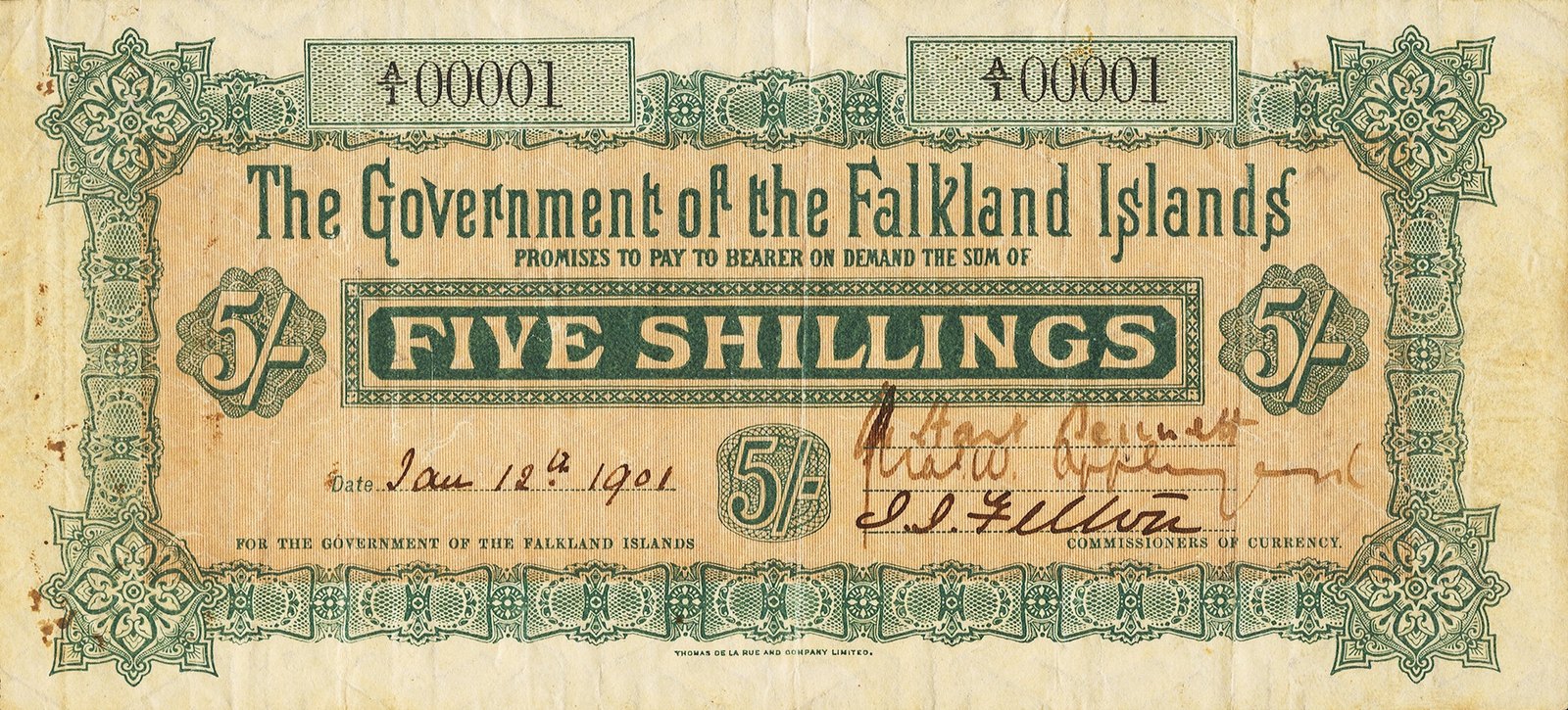
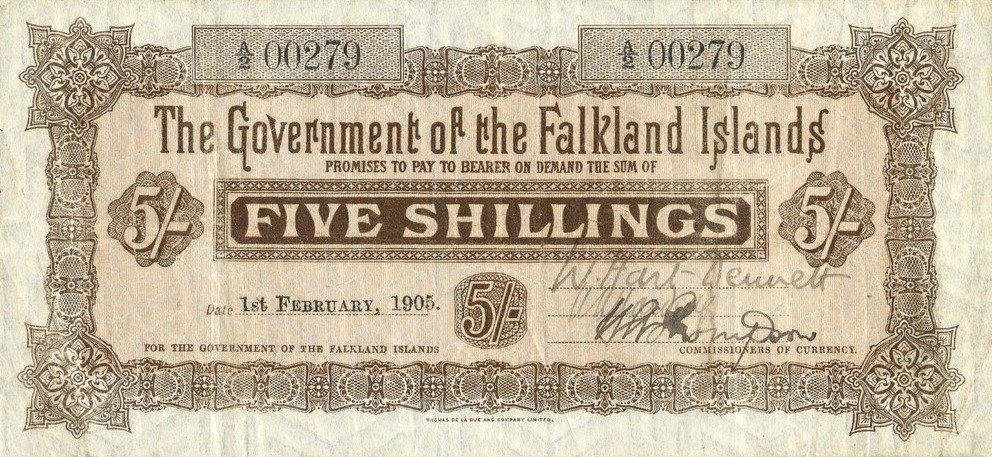
How many 5 shillings were printed is told differently. Heritage (9 May 2023, lot 28229) says that only 2,000 of the green note were printed. The Gazette's report of 8 March 1906 gives the notes received by the end of 1905 as 1,000 of 5 pounds, 5,000 of 1 pound and 6,000 of 5 shillings, the 5 shillings including the fresh issue in the new colour, and does not divide the 6,000 between the two colours.
The B series of 1908
The report for 1908, printed in the Gazette for 1909, records that the Commissioners received "a new series of overprinted notes": 1,000 of 5 pounds, 5,000 of 1 pound and 1,000 of 5 shillings. These are the notes with the prefix B. What the report means by overprinted is not explained. In 1908 notes of the A series were withdrawn and replaced by 188 of 5 pounds, 1,600 of 1 pound and 200 of 5 shillings of the new series, and the issue books show the unissued A notes burnt in that year: the 5 pounds A/1 00601 to A/1 01202 in October 1908, and the 5 shillings above A/1 01100.
The Gazette for 1913 says that notes of the A issue were being withdrawn "as opportunity offers". Later deliveries were small. The report for 1919 records new note forms received in that year, and a report in the Gazette for 1924 counts unsigned forms of the B series still in the safe: 1,100 of 5 pounds, 2,500 of 1 pound and 500 of 5 shillings. The report for 1927 records that these forms were destroyed.
The page of the 1 pound says that the depth of the underprint colour varies considerably between printings. Heritage (5 January 2017, lot 27403) says that the number-one 1 pound of 1899 and B 15458 differ distinctly in appearance.
1914: the notes burnt before the battle
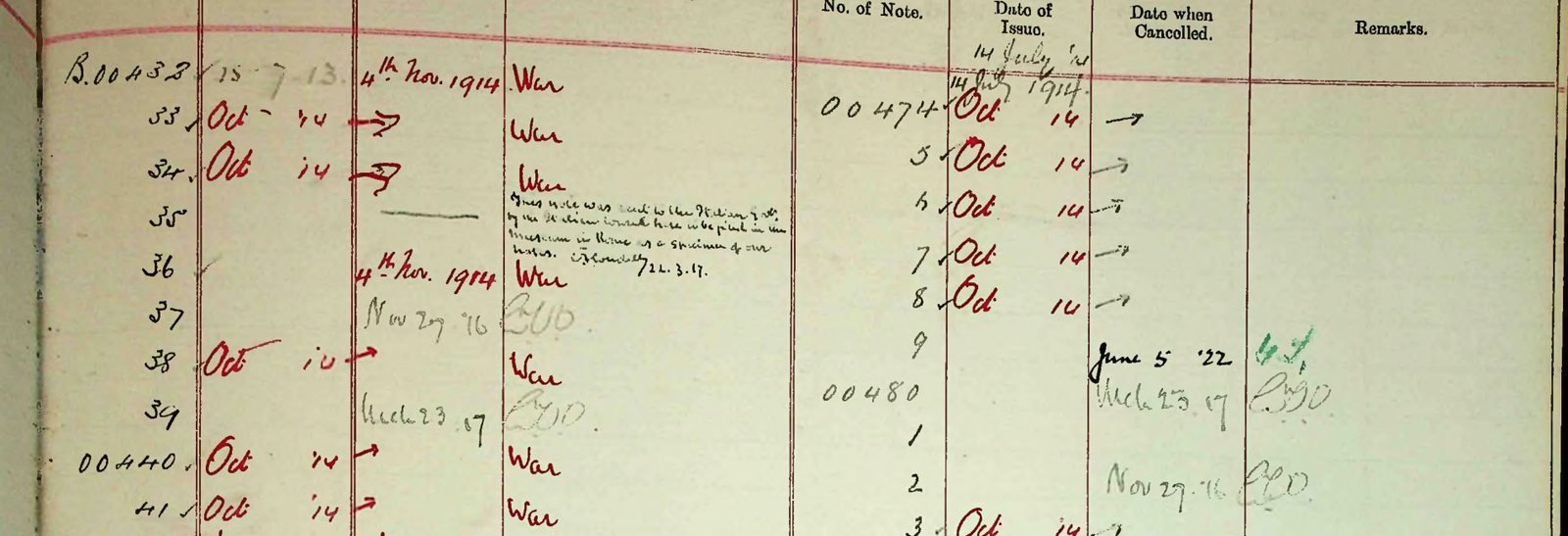
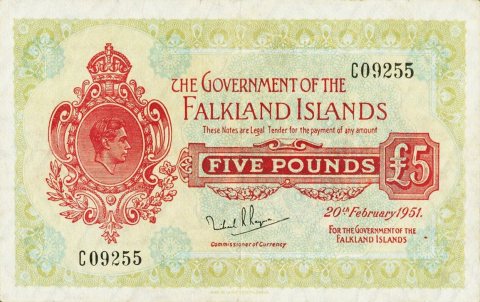
The Colonial Reports and the Treasury's note issue book record that in October and November 1914, for fear of a raid by the German cruiser squadron, many notes were burnt and the gold reserve was sent to London. The Gazette for 1915 puts the gold at 3,750 pounds and says that the notes in circulation fell from 7,500 pounds to 6,456 pounds 10 shillings. The notes were replaced after the Battle of the Falkland Islands, and 400 notes of 5 pounds, B 00538 to B 00937, were issued on 8 December 1914, the day of the battle.
One 5 pounds note of that month has a story of its own. The report of the Falkland Islands Museum printed in the proceedings of the Legislative Council for 1991 lists, on loan to the museum, the 5 pounds note presented by Admiral Sturdee to Private Chris Andreasen of the Falkland Islands Defence Force for sighting the German fleet in December 1914. Its number is not given.
Pieces described by the auction houses
Approval proofs and colour trials
The houses have described several pieces from the printer's side of the work. Each statement below is the house's own.
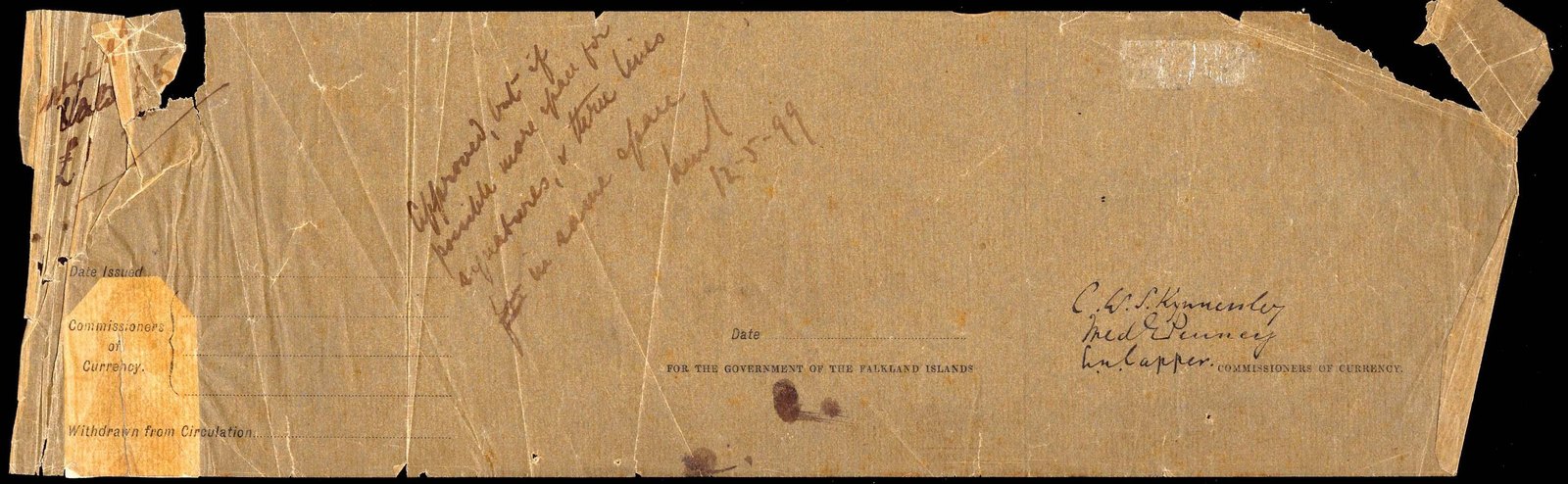
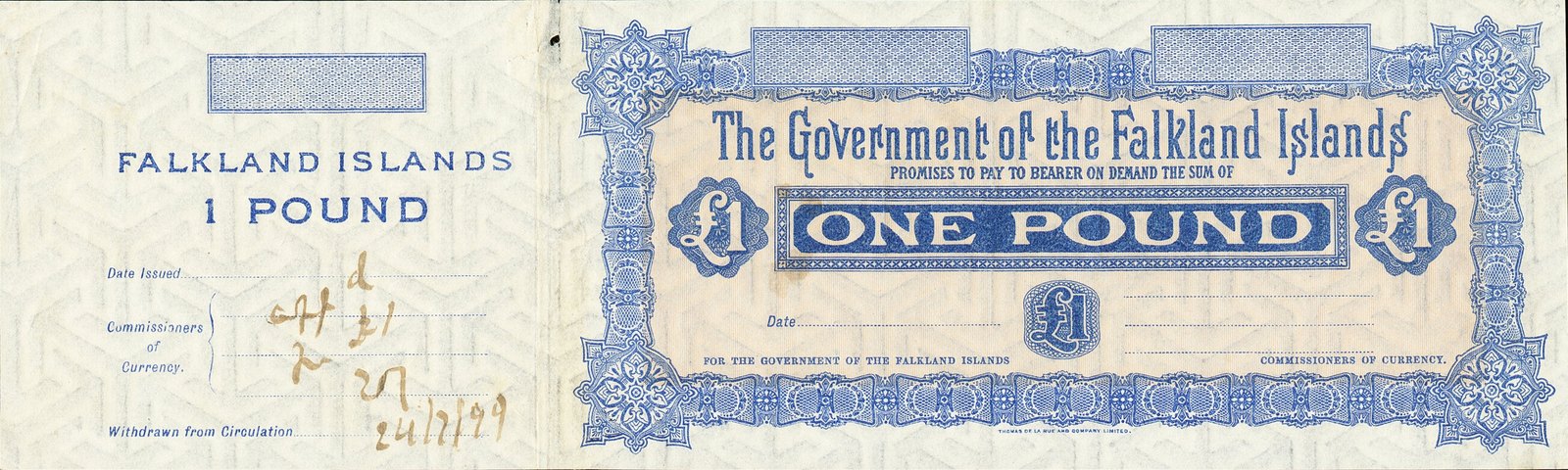
- Spink (14 June 2007, lot 115) and Heritage (13 January 2022, lot 28165) describe a proof of the 1 pound with its counterfoil, on which is written in ink that it is approved for the 1 pound, with the date 24/7/99. That is earlier than the first issued note of 16 October 1899.
- Lyn Knight (November 2022, lot 107992) describes a proof of three pages for the 5 shillings and the 1 pound. One page, dated 1899, carries the words "Approved, but if possible more space for signatures", and another a handwritten date that the house reads as 9.8.1900.
- Spink (10 April 2013, lot 449) describes a colour trial of the 1 pound in green on a peach underprint, the colours of the 5 shillings of 1901, dated by hand 8/8/00, with a tracing paper overlay showing the value 5 shillings, signed as approved and dated 9/8/1900.
- Spink (10 April 2013, lot 451) describes a colour test on a 5 shillings, blue on pink, mounted on a sheet headed Appendix B and dated 5th May 1913, with part of a letter exchange between the Government and De La Rue on the cost and printing of the 5 shillings of 1901.
- Heritage (5 January 2017, lots 27403 and 27404) offered an unsigned 1 pound and 5 pounds with counterfoils; the house wrote that they are remainders or, as it believed, colour trials.
On the 5 pounds, sources mention an unissued colour trial in red with its counterfoil. It has all-zero serial numbers on note and counterfoil, no date and no signature; the remainder is also red but has blank number panels.
The number-one notes
The first 1 pound, A/1 00001 of 16 October 1899, and the first 5 shillings, A/1 00001 of 12 January 1901, both survive. Heritage (9 May 2023, lots 28229 and 28230) says that both are annotated on the back as from J. J. Felton to Mansell, named on the 1 pound as manager of the National Bank of Argentina at Port Gallegos, and that the original envelope came with them. The Gazette records that W. A. Harding was made a Commissioner in place of J. J. Felton on 24 March 1903.
Spink (17 April 2019, lot 440) reads the signatures on the 1 pound as Charles Hill, M. Muirfield and J. J. Felton. The Gazette's statements of early 1900 name the second Commissioner as M. E. Wingfield, who was acting Treasurer.
Heritage says in the same sale that as few as 3,100 notes of the 1899 date are reported to have been printed, signed and issued. The Treasury's issue books record the 1 pound as A/1 00001 to A/1 04483, less A/1 04301 to A/1 04400 which were never issued. Stack's Bowers (29 August 2025, lot 30256) estimates that about 20,000 of the 1 pound were issued over two decades. The size of the printings is not recorded in any source read.
The end: 1935 and 1966
The notes of the A and B series ceased to be legal tender on 1 January 1935 and were still paid at the Treasury. A few never came back: the Gazette's tables carry the same 31 and 29 notes of 5 shillings, of series A and B, in every table read from 1924 to 1965. In 1966 the Treasury stopped counting the early A and B notes still outstanding (14 of 5 pounds, 169 of 1 pound and 60 of 5 shillings) as a liability, regarding them, in the words of the Falkland Islands Gazette, as "irretrievably lost or held as collectors' pieces". The Gazette's table divides them: 2 of 5 pounds, 57 of 1 pound and 31 of 5 shillings of series A, and 12 of 5 pounds, 112 of 1 pound and 29 of 5 shillings of series B.
The counts of these notes in circulation year by year are in the article on the notes in circulation, and the Treasury's books themselves are described in the article on the note books.
Sources
- The Falkland Islands Gazette, 1899 to 1927 and 1967: the proclamation of 16 October 1899, the monthly statements of the Currency Note Fund, the appointment notices of the Commissioners, and the yearly reports on the fund.
- The Treasury's note issue books, 1899 to 1920, Jane Cameron National Archives, Stanley.
- Colonial Reports, Falkland Islands, for 1900, 1901, 1904, 1905, 1914 and 1915.
- Robert Chalmers, A History of Currency in the British Colonies (1893).
- Proceedings of the Legislative Council of the Falkland Islands, 1991 (report of the Falkland Islands Museum).
- Auction descriptions: Spink, 14 June 2007, lot 115; 10 April 2013, lots 449 and 451; 17 April 2019, lot 440. Heritage, 5 January 2017, lots 27403 and 27404; 13 January 2022, lot 28165; 9 May 2023, lots 28229 and 28230. Lyn Knight, November 2022, lot 107992. Stack's Bowers, 29 August 2025, lot 30256.
Member comments
Log in or register to post a comment.