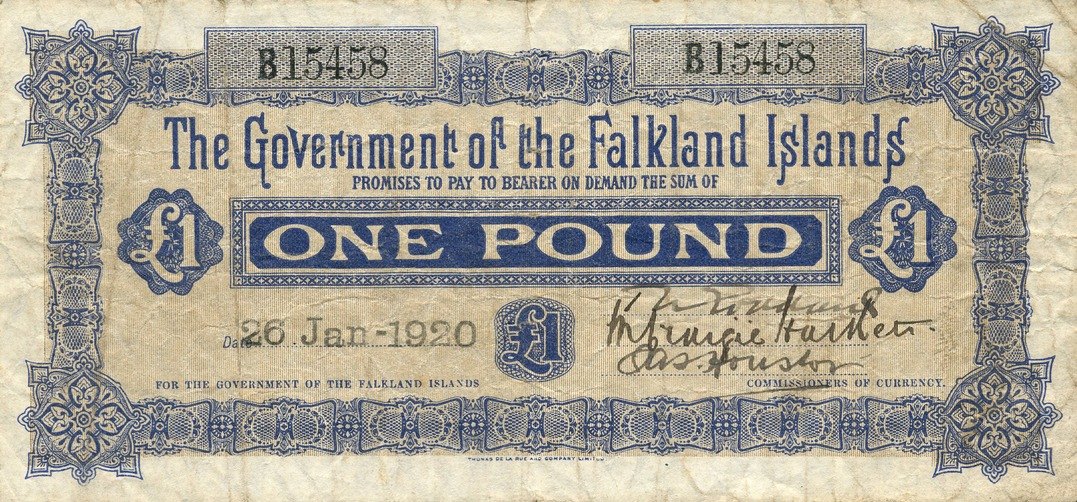
Each year the Government of the Falkland Islands sent the Colonial Office a Blue Book of returns and a Colonial Report, and both had a few lines on the currency. This article reads them through for the paper money, from the first report on the notes, for 1899, to the report for 1974 and 1975. It rests on the Blue Books of 1854 to 1944 and the bound Colonial Reports of 1887 to 1975 in the Jane Cameron National Archives, as they were read for the catalogue on 6 November 2026.
Nearly every figure here was read in the text layer of the scans, not on the page images, and the scans are no longer on this computer. Where the reading was unsure, this is said. The figures that the Falkland Islands Gazette printed for the same years are in the article on the notes in circulation, and the reports for 1909, 1912 and 1921 are read closely in an earlier article. Where the reports and the Gazette disagree, both are given below.
The first years, 1899 to 1905
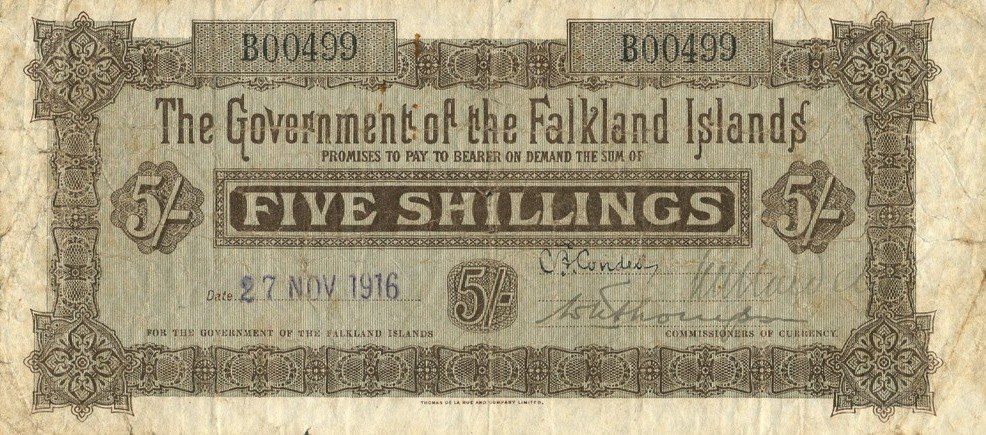
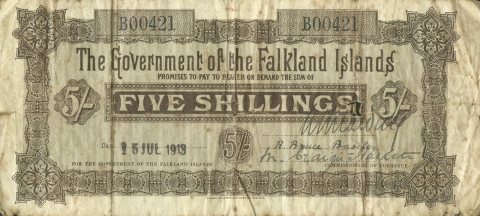
The report for 1899 says that a Government paper currency had been provided for, redeemable in specie at the Treasury, that the notes were proclaimed legal tender in October, and that 1,000 pounds of 5 pound and 1 pound notes were issued that day "as an experiment". The report for 1900 records 500 pounds of each value issued in the year, 1,000 pounds of each then in circulation, and a supply of 5 shillings notes for the country districts. The report for 1901 has 500 pounds more of each issued, 1,500 pounds of each in circulation, and some 5 shillings notes put into circulation, which did not find favour and quickly came back to the Treasury.
The Blue Book for 1901 tells the year in two places. Its currency return lists "Government Notes of £5, £1 and 5/-", gives the authority as an Order of the Governor in Council of 16 October 1899, and, in a rough text layer, has 1,500 pounds in notes of 5 pounds and 1,500 pounds in notes of 1 pound, as the report does. Its account of the Commissioners of Currency to 31 December 1901, signed by W. A. Thompson, Colonial Treasurer, on 31 March 1902, gives the notes issued as 4,500 pounds. That figure was read in the text layer only.
The report for 1902 gives a cash reserve in the Treasury of 2,500 pounds, 50 per cent of the notes in circulation; the Blue Book for 1902 has 5,000 pounds of notes issued and 2,500 pounds of the Note Fund invested. The report for 1904 gives 6,000 pounds in circulation in notes of 5 pounds, 1 pound and 5 shillings, a gold reserve of 3,000 pounds and the rest of the Guarantee Fund invested, and records that a new brown 5 shillings was issued in place of the green one. The report for 1905 sets out the rules: the currency rests on the Order in Council of 7 March 1899; the board is the Colonial Secretary, the Treasurer and one other person named by the Governor; notes may be of 5 shillings, 10 shillings, 1 pound, 5 pounds and multiples of 5 pounds; and at least half of the notes in circulation is kept in coin.
The notes by value, 1906 to 1919
From 1906 the reports give the notes in circulation by value. The value of each kind is given for some years and the number of notes for others; the table copies each year as the record gives it.
| End of year | 5 pounds | 1 pound | 5 shillings | Total |
|---|---|---|---|---|
| 1906 | 2,920 pounds | 3,567 pounds | 113 pounds | 6,600 pounds |
| 1907, 1908 and 1909 | 2,915 pounds | 3,572 pounds | 113 pounds | 6,600 pounds |
| 1911 and 1912 | 603 notes | 4,372 notes | 452 notes | 7,500 pounds |
| 1913 | 3,015 pounds | 4,372 pounds | 113 pounds | 7,500 pounds |
| 1914 | not divided | not divided | not divided | 3,399 notes, 6,456 pounds 19 shillings |
| 1915 | not divided | not divided | not divided | 6,690 notes, 10,000 pounds |
| 1916 | 770 notes | 6,100 notes | 200 notes | 10,000 pounds |
| 1917 | 924 notes | 7,318 notes | 168 notes | 12,000 pounds |
| 1918 | 905 notes | 10,436 notes | 156 notes | 15,000 pounds |
| 1919 | 7,525 pounds | 10,436 pounds | 39 pounds | 18,000 pounds |
The table for 1910 is garbled in the text layer. Three figures differ from the Gazette. The report for 1914 gives the total at the end of 1914 as 6,456 pounds 19 shillings, where the Gazette's report printed in 1915 has 6,456 pounds 10 shillings. The report for 1917 has 924 notes of 5 pounds, the Gazette 928. And the report for 1914 gives 5,507 notes at the end of 1913: the same total that the report for 1912 prints for that year, where its three figures make 5,427, as the earlier article shows. For 1918 the report's 905 notes of 5 pounds agree with its own total; for 1919 the Gazette's readings are unclear, as the article on the notes in circulation explains.
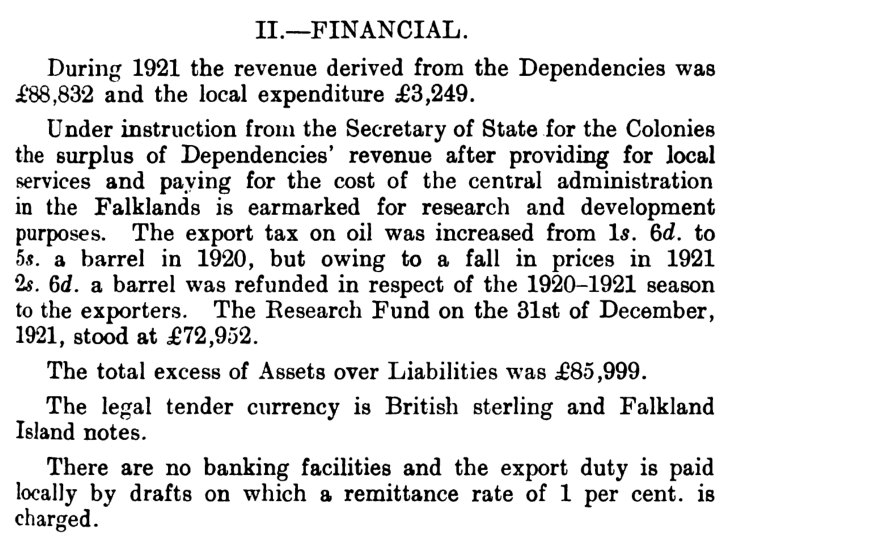
The reserve, in the reports' words
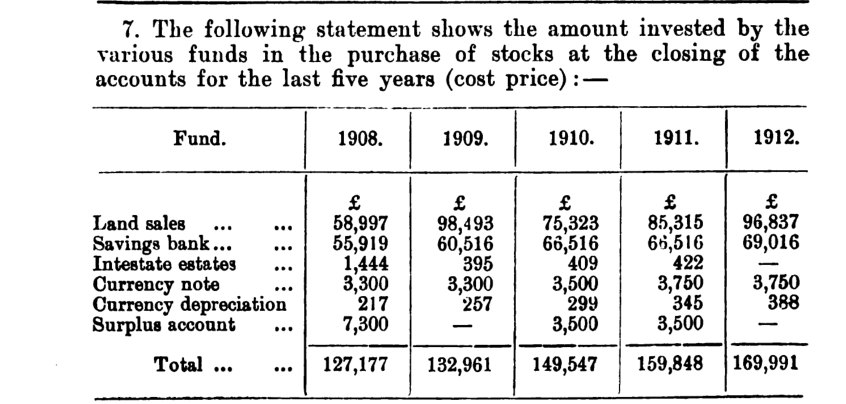
The report for 1910 sets out the rules of the Order at length: half the coin is kept "by the Commissioners in the Colony", the rest forms an Investment Fund, and 1 per cent a year of its cost goes to a Depreciation Fund until that fund reaches a tenth of the Investment Fund. The report for 1913 gives the Currency Note Fund as 3,750 pounds and the Depreciation Fund as 388 pounds.
The war changed where the coin was kept. The report for 1914 says that in November 1914, expecting a raid by enemy cruisers, "a large number of currency notes were destroyed" and the Commissioners' gold was sent to London and placed on deposit with the London and Westminster Bank. The report for 1915 says that on 1 January 1915 the whole coin reserve of 3,750 pounds was with the Crown Agents in London; that the rise in circulation that year came partly from the re-issue early in the year of notes destroyed for war reasons and partly from the raising of the limit from 7,500 to 10,000 pounds; and that when the issue was raised, 2,500 pounds was placed in the Commissioners' safe in the colony and 2,500 pounds left in London. In 1916 the coin reserve was 5,000 pounds, half in the colony and half in London, the securities had cost 5,248 pounds 13 shillings and 5 pence (248 pounds 13 shillings and 5 pence advanced from revenue), and the Depreciation Fund was raised "to meet war conditions" from 388 to 891 pounds. In 1917 the coin reserve was 6,000 pounds, 2,500 pounds in the safe and 3,500 pounds with the Crown Agents. In 1919 the coin portion and the investment portion stood at 9,000 pounds each, the Depreciation Fund at 890 pounds 15 shillings and 7 pence, and "No notes were withdrawn during the year".
The fund made money. The report for 1914 carries the Commissioners' profit of 112 pounds to general revenue, and that for 1915 a profit of 109 pounds. The report for 1920 gives the income from securities as 726 pounds and the spending as 135 pounds, and that for 1921 an income of 802 pounds and spending of 302 pounds; the reader of the reports thought the spending of 1921 likely to include the new notes.
The issue raised and lowered, 1915 to 1938
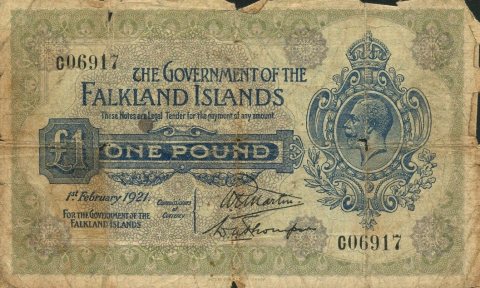
The reports follow the limit of the issue. It went from 7,500 to 10,000 pounds in 1915, to 12,000 pounds in 1917, to 15,000 pounds in 1918 and to 18,000 pounds in 1919. The report for 1920 has it raised to 20,000 pounds and names the legal tender as British sterling and the 5 shillings, 1 pound and 5 pounds notes of the Falkland Islands Government. The report for 1921 is the first to name a 10 shillings: 2,000 notes of 5 pounds, 12,000 of 1 pound and 6,000 of 10 shillings of a new design were received from the Crown Agents.
From then on the reports give the total and, from 1924, an estimate of the coin in circulation beside it.
| End of year | Notes in circulation | Coin or specie in circulation | What the report adds |
|---|---|---|---|
| 1921 | 20,000 pounds | the notes of the new design received | |
| 1922 | 20,000 pounds | somewhat above the needs of the colony; notes worth 5,490 pounds withdrawn, cancelled and replaced; 12,000 pounds invested with the Crown Agents and 8,000 pounds in coin with the Commissioners | |
| 1923 | 18,000 pounds | reduced during the year from 20,000 pounds | |
| 1924 | 18,000 pounds | 5,000 pounds | |
| 1925 | 18,000 pounds | 3,000 pounds | |
| 1926 | 20,000 pounds | 2,500 pounds | raised by 2,000 pounds |
| 1927 | 20,000 pounds | 3,000 pounds | "the maximum authorised" |
| 1928 | 24,000 pounds | 3,000 pounds | "twice increased" during the year |
| 1929 | 24,000 pounds | 3,000 pounds | coin portion fixed at one-third by the Proclamation of 15 March 1929 |
| 1930 | 24,000 pounds | 3,000 pounds | notes of 10 shillings, 1 pound and 5 pounds under the Currency Notes Ordinance 1930 |
| 1931 | 24,000 pounds | ||
| 1932 | 22,000 pounds | 2,000 pounds | |
| 1933 | 22,000 pounds | 2,000 pounds | |
| 1934 | 22,000 pounds | 3,000 pounds | |
| 1935 | 22,000 pounds | 3,000 pounds | |
| 1936 | 24,000 pounds | 3,000 pounds | |
| 1937 | 22,000 pounds | 3,000 pounds | |
| 1938 | 24,500 pounds | 3,000 pounds |
The report for 1930 is the first to leave the 5 shillings out of the wording. For the end of 1937 the Gazette's figures give 26,000 pounds, where the report has 22,000 pounds as read; which is right was not settled.
Banks, remittances and the Dependencies
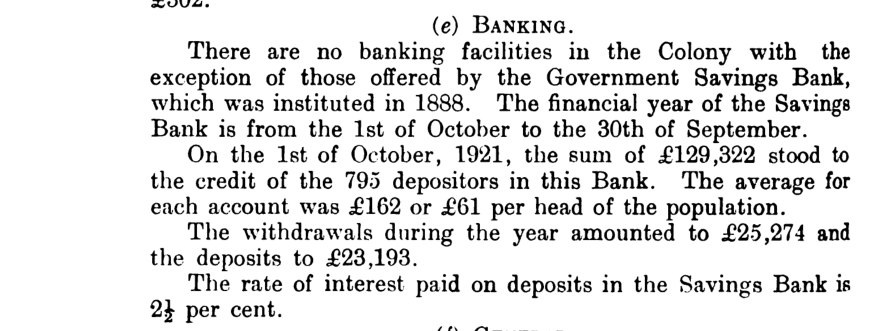
The reports say plainly that there was no bank. The report for 1923 knows only the Government Savings Bank and advises against sending cheques. From 1931 the reports say that remittances could be made through the Commissioner of Currency and the Crown Agents at 1 per cent, and that the Falkland Islands Company acted as bankers for the farm stations. The report for 1947 names the Estate Louis Williams beside the Company, and that for 1952 and 1953 says that the two ran agencies of Lloyds Bank and Hambros Bank. The report for 1954 and 1955 still has no commercial bank, the Treasury remitting at 1 per cent.
The sections on South Georgia and the Dependencies in the reports of 1931 to 1938 give British sterling and Falkland Islands notes as legal tender there, with the services of the Commissioner of Currency available through the Magistrate at Grytviken.
The Blue Books add the laws. The Blue Book for 1936 lists the Imperial Counterfeit Currency (Convention) Act 1935 as extended to the colony and its Dependencies, and the report for 1937 the Forgery Ordinance extending the Forgery Act 1913. The Blue Books for 1943 and 1944 list the notes as "£5, £1 and 10/- Falkland Islands notes issued under Ordinance No. 11 of 1930", with no 5 shillings.
The notes in circulation, 1943 to 1975
No reports for 1939 to 1942 were found in the bound volumes. The Blue Books for 1943 and 1944 give 69,296 pounds and about 54,000 pounds (one digit unsure), and the reports of the years after the war give these totals:
| End of year | Notes in circulation | Coin | Source |
|---|---|---|---|
| 1946 | 47,000 pounds | 6,000 pounds | report for 1946 |
| 1947 | 49,000 pounds | 6,500 pounds | report for 1947 |
| 1949 | 53,500 pounds | 6,500 pounds | report for 1949 |
| 1950 | 56,166 pounds | 6,500 pounds | report for 1950 and 1951 |
| 1951 | 67,660 pounds | 6,150 pounds | report for 1950 and 1951 |
| 1952 | 69,666 pounds (last digit 6 or 0) | report for 1952 and 1953 | |
| 1953 | 75,666 pounds (last digit 6 or 0) | report for 1952 and 1953 | |
| 1955 | 86,343 pounds | report for 1954 and 1955 | |
| 1957 | 86,738 pounds 10 shillings | reports of 1956 to 1965 | |
| 1959 | 85,491 pounds 10 shillings | the same | |
| 1961 | 92,704 pounds | the same | |
| 1963 | 100,801 pounds | the same | |
| 1965 | 110,346 pounds | the same | |
| 1967 | 128,400 pounds | reports of 1966 to 1975 | |
| 1969 | 102,600 pounds | the same | |
| 1971 | 102,600 pounds | the same, as printed | |
| 1973 | 127,700 pounds | the same | |
| 1975 | 181,700 pounds | the same |
Five of these agree to the pound with the reports on the Note Security Fund printed in the Gazette for 31 December: 1959, 1961, 1963, 1967 and 1975. Two do not. For the end of 1946 the Gazette has 49,000 pounds against the report's 47,000 pounds. And the report's 102,600 pounds for 1969 is the figure the Gazette gives for 30 June 1969; the report for 1970 and 1971 prints the same figure again for 1971.
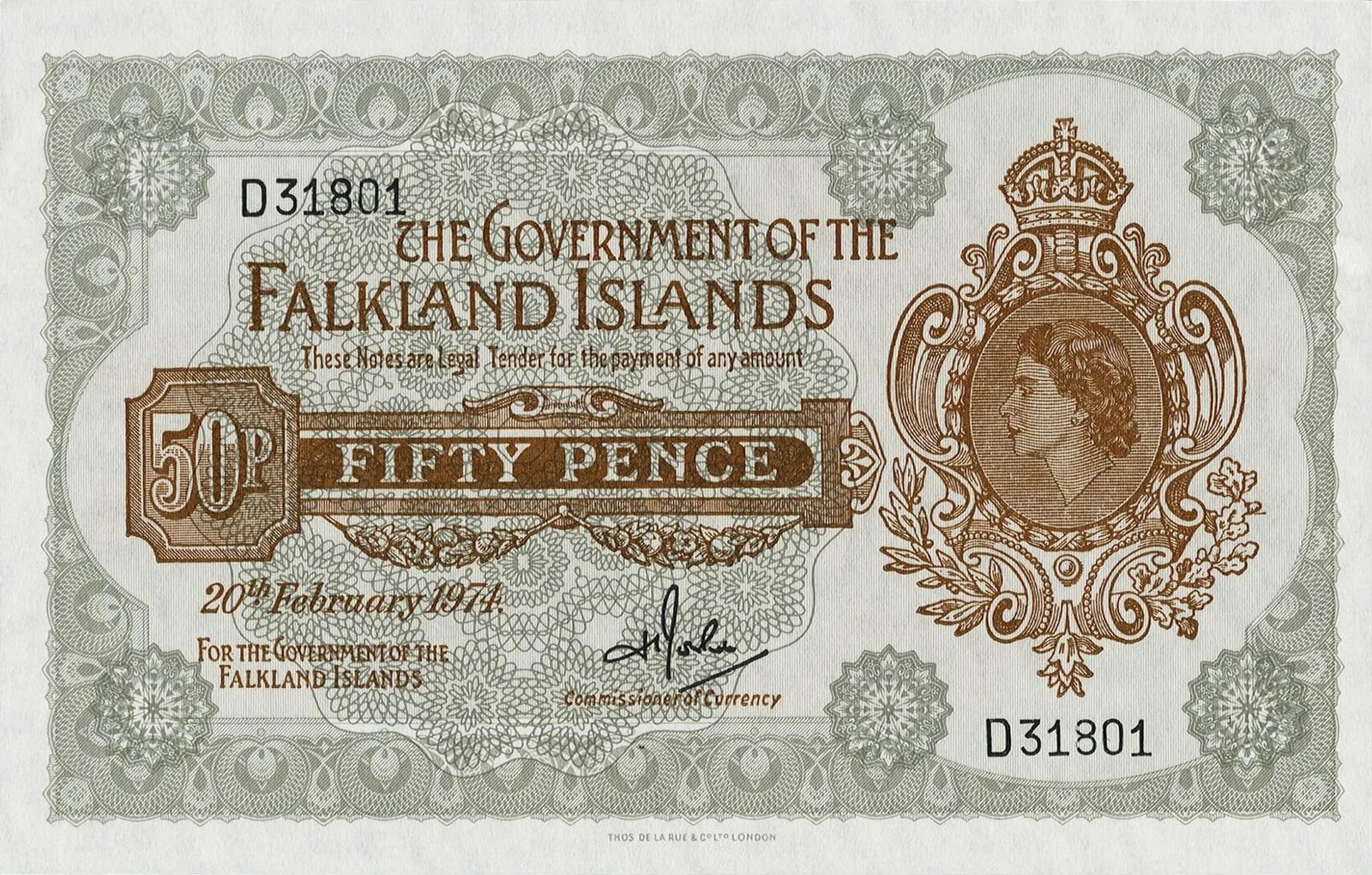
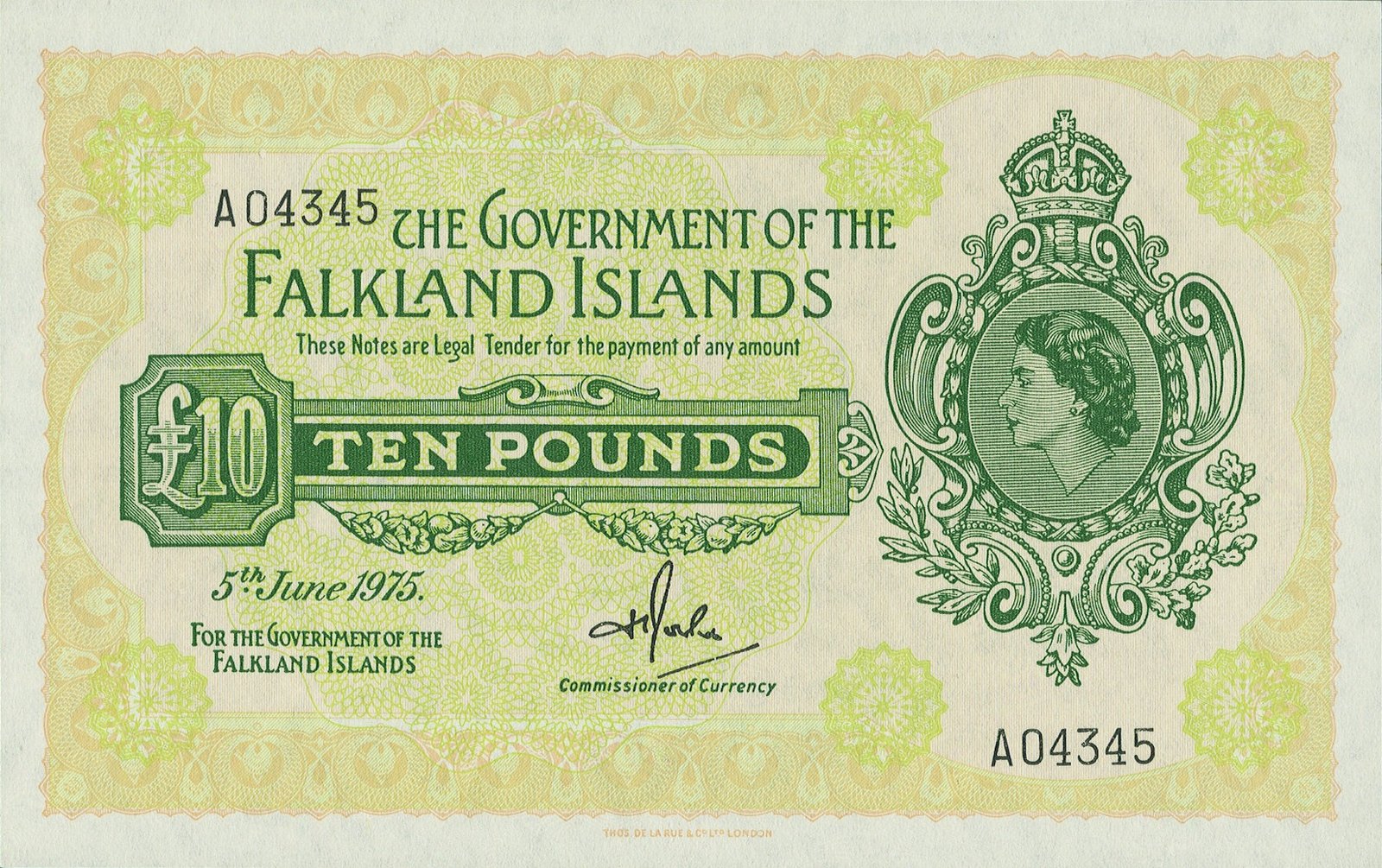
The values named change with the notes. The reports to 1969 list notes of 5 pounds, 1 pound and 10 shillings. The report for 1968 and 1969 says that the colony "will decimalise its currency" with the United Kingdom and that the Dependencies would follow at the same time; that for 1970 and 1971 says that the colony decimalised "in line with that of the United Kingdom on 15th February 1971", under the Decimal Currency Ordinance 1971 (No. 1 of 1971), applied to the Dependencies by the Application of Colony Laws Ordinance 1971, and lists 5 pounds, 1 pound and 50 pence. The report for 1974 and 1975 is the first to list the 10 pounds. It also records "the first ever issue of Falkland Islands coins", of 10, 5, 2, 1 and half pence, with the Queen's portrait and wildlife, first put into circulation in the colony on 2 July 1975.
The office in the Blue Books
The civil establishment lists of the Blue Books name "Commissioner of Currency" only against the Treasurer, among the extra offices of W. A. Thompson, in the books of 1905 to 1919; the Colonial Secretary's entry does not name it. The Blue Book for 1916, read on the page image, lists Thompson as "Treasurer, Collector of Customs, Receiver of Wrecks, Registrar of Shipping, Commissioner of Currency, Manager, Savings Bank", with a guarantee bond as Colonial Treasurer dated 2 July 1902 for 400 pounds, reduced from 500 pounds in 1908. The council lists of the Blue Books, also read on the page images, give the officers who signed as Commissioners; they are set out in the article on the Commissioners.
What the reports and Blue Books do not say
- No printer is named in the currency passages of any volume: not Waterlow, De La Rue or Bradbury.
- No report pictures a note or gives a serial number, and none divides the notes by their printed date.
- No reports for 1939 to 1942 were found in the volumes, and the volumes end with the report for 1975, so 1982 is outside them.
- No table of the notes in circulation by value was found in the reports after 1919; for later years the values are in the Gazette.
Sources
- Blue Books of the Falkland Islands, 1897 to 1944 (in particular 1901, 1902, 1905, 1914 to 1919, 1936, 1943 and 1944), Jane Cameron National Archives, Stanley.
- Colonial Reports on the Falkland Islands, 1899 to 1974-75, in the bound volumes 1887 to 1910, 1911 to 1930, 1931 to 1938, 1947 to 1955, 1956 to 1965 and 1966 to 1975, Jane Cameron National Archives.
- The Falkland Islands Gazette, 1915, 1938 and 1947 to 1976, for the figures compared.
Member comments
Log in or register to post a comment.