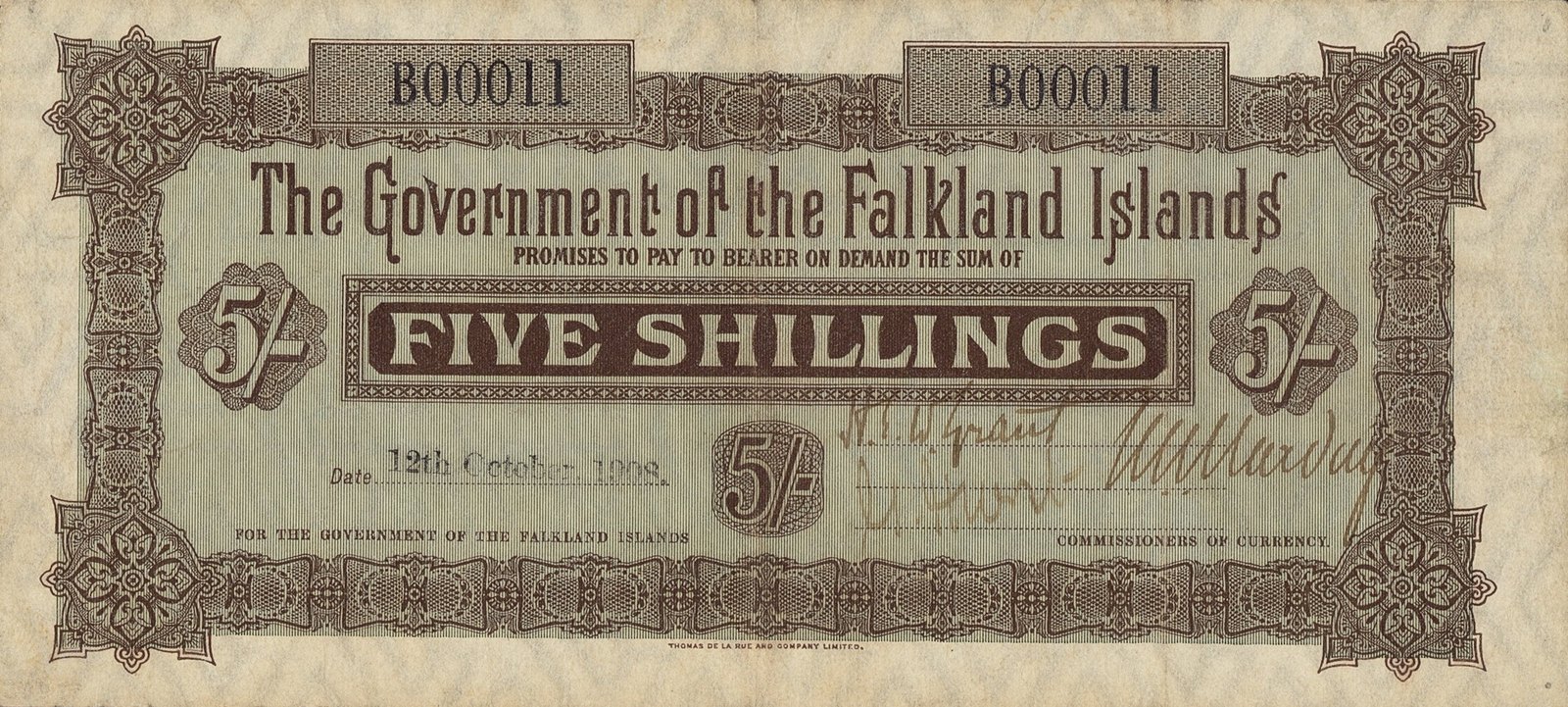
The Commissioners of Currency of the Falkland Islands had to publish what they had issued. From 1900 the Falkland Islands Gazette printed a monthly statement of the notes in circulation, and the yearly reports on the note fund divide the total by value and, from 1908, by series. This article sets the figures out in three tables, 1904 to 1923, 1924 to 1946 and 1954 to 1975, and compares them with the Colonial Reports and the Estimates. An earlier article reads the Colonial Reports for 1909 to 1921 on their own.
The figures are those of the Gazette as read from the scans in the Jane Cameron National Archives. Where the text of a scan is unclear this is said. No total here has been worked out afresh.
The first years, 1900 to 1903
The monthly statements give only the total. The first, for January and February 1900, show 1,000 pounds of notes in circulation. The total was 2,000 pounds in July 1900, 3,500 pounds in February and March 1901, 4,500 pounds in April 1902 and 5,000 pounds in June 1902. An auditor's report of 5 November 1902 is the first to divide it: of the 5,000 pounds, 2,500 pounds were in notes of 5 pounds, 2,000 pounds in notes of 1 pound and 500 pounds in notes of 5 shillings.
The hand-signed notes, 1904 to 1923
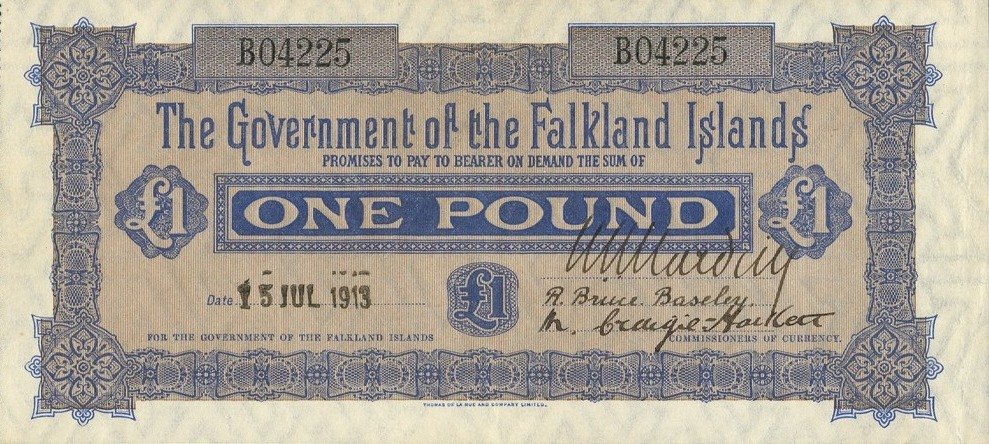
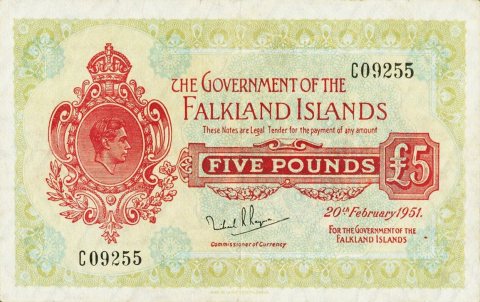
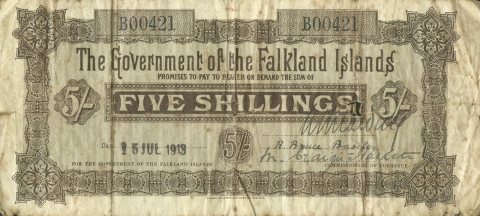
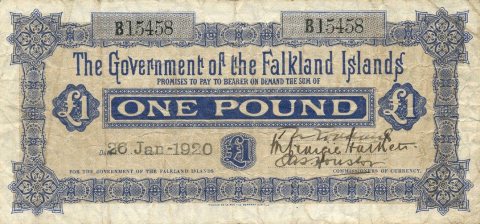
The table gives the number of notes of each value. The notes are those of the 5 pounds, the 1 pound and the two 5 shillings, the green and the brown, and from 1921 the new notes of the C series with the King's portrait.
| Date | 5 pounds | 1 pound | 10 shillings | 5 shillings | Total value |
|---|---|---|---|---|---|
| 11 July 1904 | 599 | 2,855 | none | 600 | 6,000 pounds |
| 31 December 1905 | 598 | 2,860 | none | 600 | 6,000 pounds |
| 31 December 1907 | 583 | 3,572 | none | 452 | 6,600 pounds |
| 31 December 1908 | 583 | 3,572 | none | 452 | 6,600 pounds |
| 31 December 1909 | 583 | 3,572 | none | 452 | 6,600 pounds |
| 31 December 1910 | 583 | 3,972 | none | 452 | 7,000 pounds |
| 31 December 1911 | 603 | 4,372 | none | 452 | 7,500 pounds |
| 31 December 1912 | 603 | 4,372 | none | 452 | 7,500 pounds |
| 31 December 1913 | 603 | 4,372 | none | 452 | 7,500 pounds |
| 31 December 1914 | 809 | 2,352 | none | 238 | 6,456 pounds 10 shillings |
| 31 December 1915 | 871 | 5,587 | none | 232 | 10,000 pounds |
| 31 December 1916 | 770 | 6,100 | none | 200 | 10,000 pounds |
| 31 December 1917 | 928 | 7,318 | none | 168 | 12,000 pounds |
| 31 December 1918 | unclear in the scan | unclear in the scan | none | 156 | 15,000 pounds |
| 31 December 1919 | unclear in the scan | unclear in the scan | none | 156 | 18,000 pounds |
| 31 December 1920 | 1,481 | 12,566 | none | 116 | 20,000 pounds |
| 1 January 1922 | 1,445 | 11,751 | 2,000 | 96 | 20,000 pounds |
| 31 December 1922 | 1,445 | 11,755 | 2,000 | 80 | 20,000 pounds |
| 31 December 1923 | 1,209 | 10,944 | 1,988 | 68 | 18,000 pounds |
The text layer of the scan for 1915 reads the 1 pound figure as 6,587; 5,587 is the figure that agrees with the printed total. For the end of 1918 and of 1919 the scans give two different readings of the 5 pounds figure. The 1 pound figure of each year hangs on it, and the text of the scans has 10,436 notes of 1 pound in both years, so neither figure is entered here.
The A and B series side by side
From 1908 the reports divide each value by series. At the end of 1908 there were 395 notes of 5 pounds of series A and 188 of series B, 1,972 and 1,600 of 1 pound, and 252 and 200 of 5 shillings. A year later the 5 pounds stood at 290 and 293 and the 1 pound at 772 and 2,800. At the end of 1920 the A series still had 712 notes of 5 pounds, 97 of 1 pound and 33 of 5 shillings in circulation, beside 769, 12,469 and 83 of series B. Three years later, at the end of 1923, the Gazette counts 2 notes of 5 pounds, 71 of 1 pound and 31 of 5 shillings of series A, and 119, 867 and 37 of series B. The notes of the C series had taken their place: 1,088 of 5 pounds, 10,006 of 1 pound and 1,988 of 10 shillings.
Beside the Colonial Reports
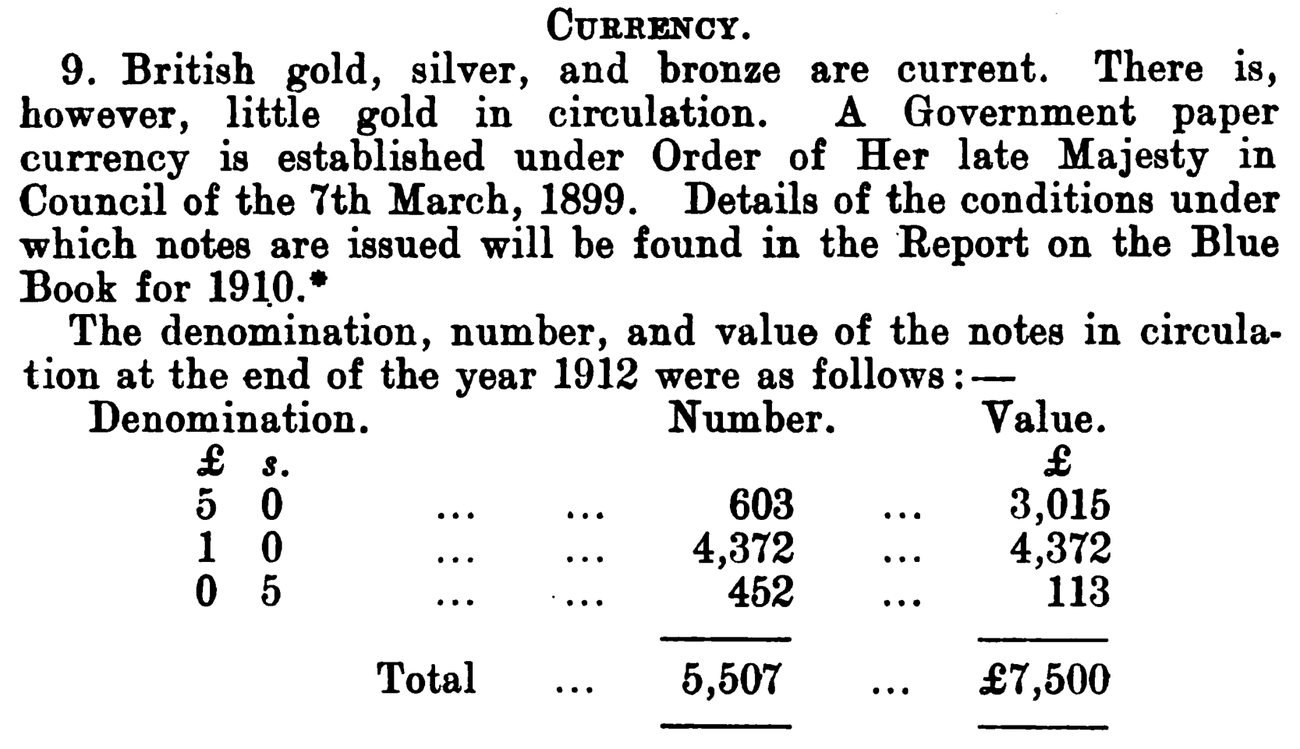
The Colonial Reports count the same notes by value. At the end of 1909 there were 2,915 pounds in 5 pounds notes, 3,572 pounds in 1 pound notes and 113 pounds in 5 shillings notes, 6,600 pounds in all, that is 583, 3,572 and 452 notes (report for 1909). At the end of 1912 there were 603 notes of 5 pounds, 4,372 of 1 pound and 452 of 5 shillings, worth 7,500 pounds: 5,427 notes, though the report prints the total as 5,507 (report for 1912). Neither report counts a 10 shillings note. The Gazette agrees with both years, and it shows that the figures of the end of 1909 had stood unchanged since the end of 1907.
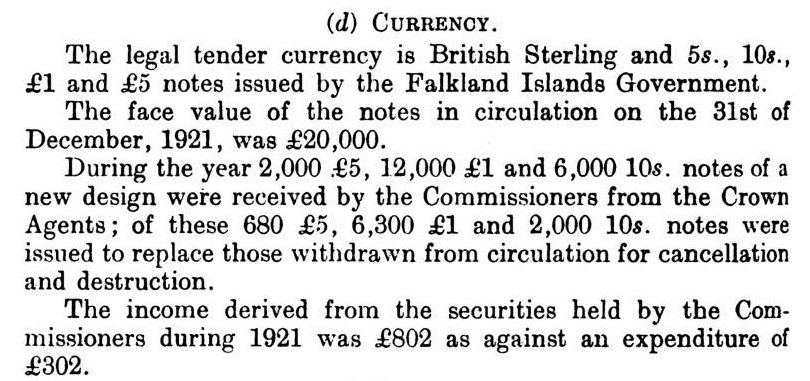
The Colonial Report for 1921 records the notes of the new design received in that year, 2,000 of 5 pounds, 12,000 of 1 pound and 6,000 of 10 shillings. By the end of the year 680 of the 5 pounds, 6,300 of the 1 pound and 2,000 of the 10 shillings had been issued, to replace old notes withdrawn for cancellation and destruction, and 20,000 pounds of notes of all kinds were in circulation on 31 December 1921. The Gazette's table for 1 January 1922 has the same three figures for the C series.
Beside the Estimates
The yearly Estimates carry a footnote under the Currency Note Fund with the total of notes in circulation: 10,000 pounds in the Estimates for 1916 and for 1917, 12,000 pounds for 1918, 15,000 pounds for 1919, and 20,000 pounds in circulation in 1920, as the Estimates for 1921 put it. These agree with the table.
1914 and the war
The fall at the end of 1914 has its reason in the report printed in the Gazette for 1915. Because of warlike operations the gold reserve of 3,750 pounds was sent to London and it was decided to destroy a considerable number of notes; the circulation fell from 7,500 pounds to 6,456 pounds 10 shillings. The Colonial Reports and the Treasury's note issue book date this to October and November 1914 and give the fear of a raid by the German cruiser squadron as the cause. The Treasury's issue book has 400 notes of 5 pounds put into circulation on 8 December 1914, the day of the Battle of the Falkland Islands.
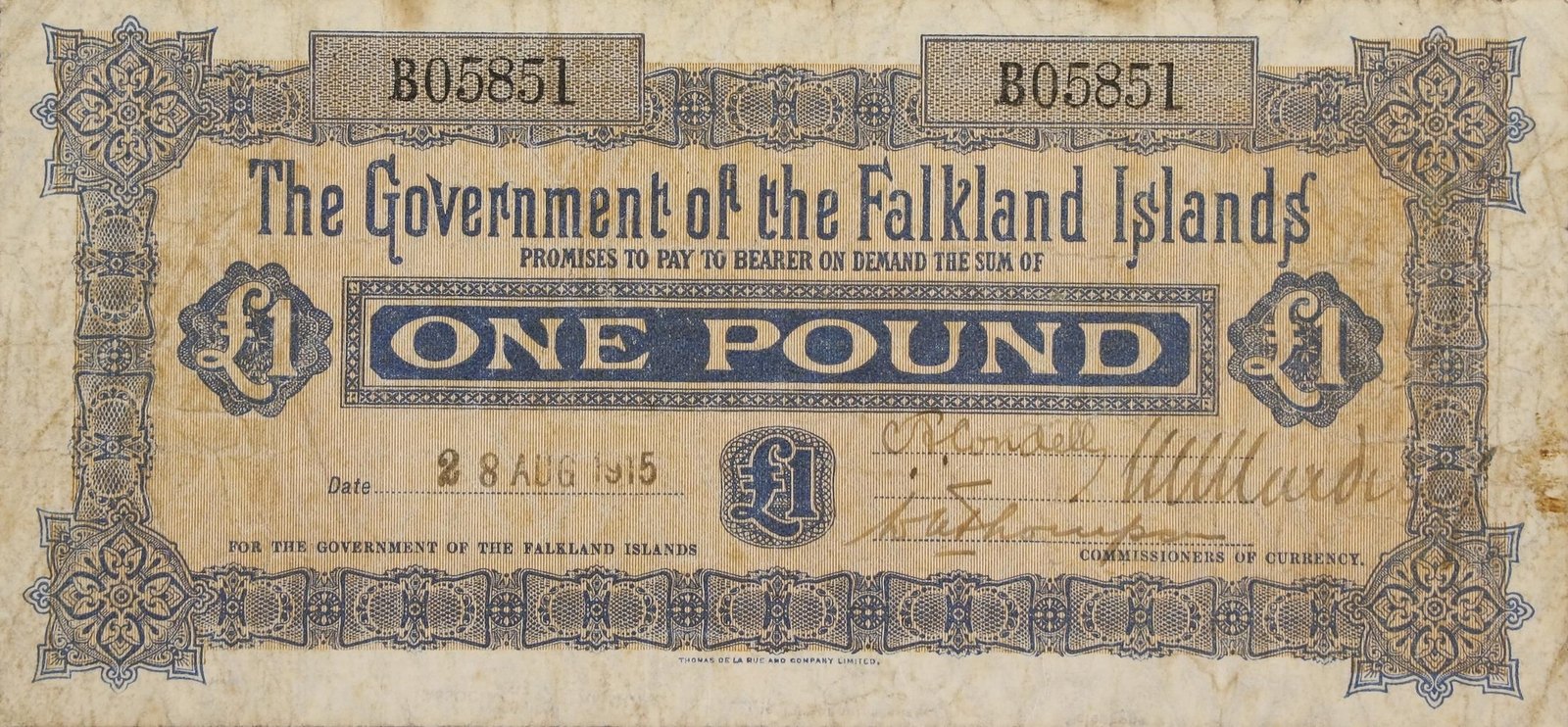
The issue then grew step by step. The Gazette records that on 28 August 1915 the fund was raised from 7,500 to 10,000 pounds by 63 notes of 5 pounds and 2,185 of 1 pound. It was raised to 15,000 pounds in 1918, to 18,000 pounds in 1919 and to 20,000 pounds in 1920. In 1923, 2,000 pounds of notes withdrawn were not replaced, and the issue fell to 18,000 pounds.
The C series, 1924 to 1946
From 1924 nearly all the notes in circulation were of the C series, which in the Gazette's tables covers the notes of King George V and, without any new letter, those of King George VI. The table gives the number of C notes of each value at the end of each year for which a report was read.
| 31 December | 5 pounds | 1 pound | 10 shillings | Total value of all notes |
|---|---|---|---|---|
| 1924 | 1,086 | 10,503 | 2,020 | 18,000 pounds |
| 1927 | 1,293 | 11,711 | 2,688 | 20,000 pounds |
| 1928 | 1,432 | 14,620 | 3,534 | 24,000 pounds |
| 1929 | 1,499 | 14,279 | 3,694 | 24,000 pounds |
| 1930 | 1,560 | 14,128 | 3,404 | 24,000 pounds |
| 1931 | 1,620 | 13,716 | 3,622 | 24,000 pounds |
| 1932 | 1,514 | 12,535 | 3,178 | 22,000 pounds |
| 1933 | 1,498 | 12,640 | 3,144 | 22,000 pounds |
| 1934 | 1,434 | 12,669 | 3,730 | 22,000 pounds |
| 1935 | 1,437 | 12,686 | 3,682 | 22,000 pounds |
| 1936 | 1,616 | 13,859 | 3,576 | 24,000 pounds |
| 1937 | 1,762 | 15,280 | 3,276 | 26,000 pounds |
| 1938 | 1,648 | 14,441 | 3,096 | 24,500 pounds |
| 1939 | 1,499 | 15,271 | 3,928 | 25,000 pounds |
| 1940 | 1,959 | 21,672 | 4,526 | 34,000 pounds |
| 1941 | 2,173 | 24,102 | 4,526 | 37,500 pounds |
| 1942 | 2,648 | 44,523 | 8,527 | 62,296 pounds 10 shillings |
| 1943 | 2,648 | 49,523 | 12,527 | 69,296 pounds 10 shillings |
| 1944 | 2,408 | 38,323 | 7,327 | 54,296 pounds 10 shillings |
| 1945 | 2,408 | 38,323 | 7,327 | 54,296 pounds 10 shillings |
| 1946 | 2,194 | 35,690 | 4,156 | 49,000 pounds |
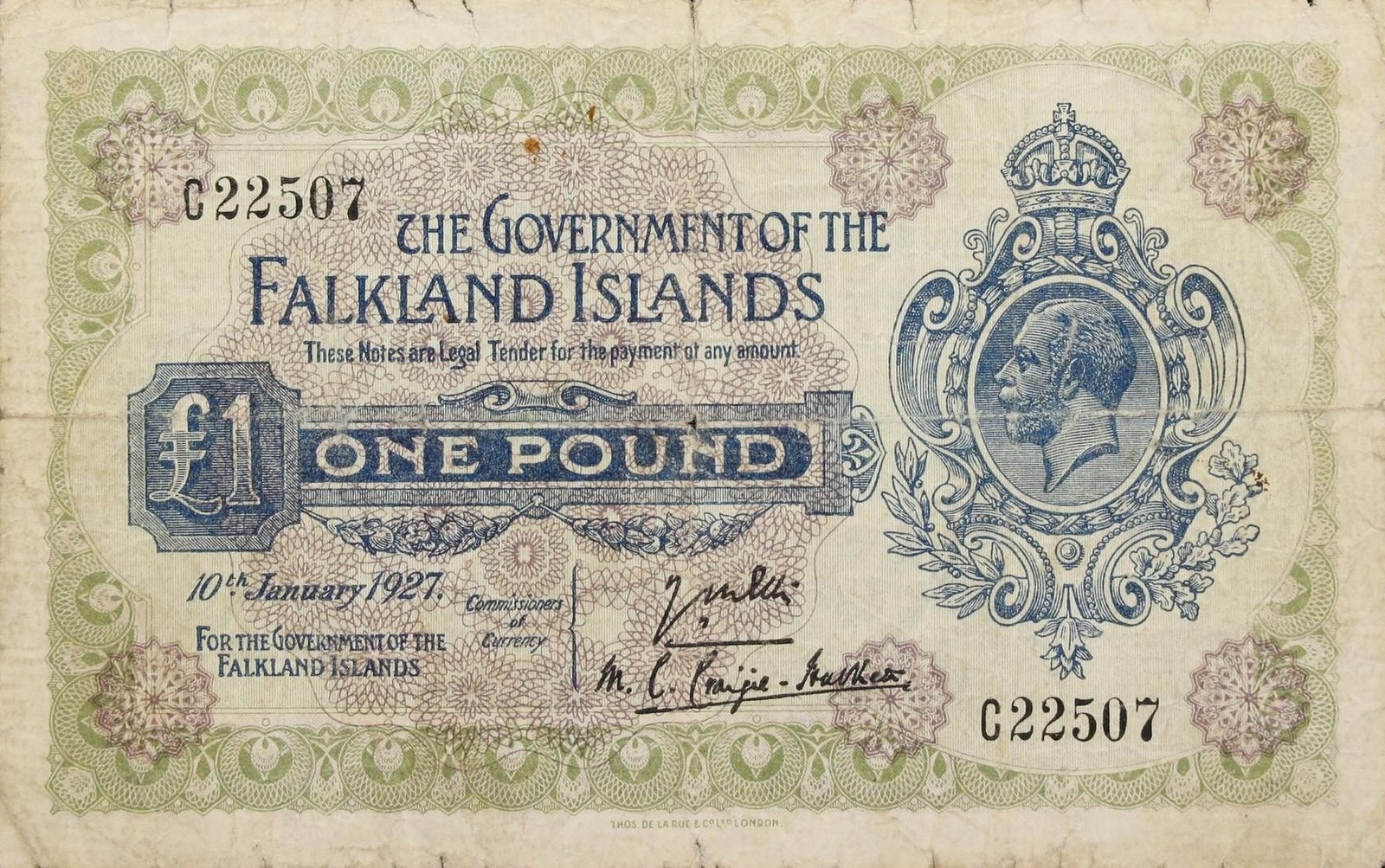
The text of the scan for 1943 reads the 1 pound figure as 40,523, and that for 1946 the 5 pounds figure as 2,195; the values printed beside them agree with 49,523 and 2,194, which are entered here. The Gazette for 1938 prints the total for the end of 1937 as 28,000 pounds in the text of the scan; the figures and the next report give 26,000 pounds.
The Gazette gives no reason for the rise of 1942 and 1943, when the 1 pound notes in circulation went from 24,102 to 49,523. It does record the fall: 15,000 pounds of notes were withdrawn in 1944 and 5,296 pounds 10 shillings in 1946.
The old notes are in every one of these tables. At the end of 1924 there were still 2 notes of 5 pounds, 71 of 1 pound and 31 of 5 shillings of series A in circulation, and 74, 591 and 29 of series B. From June 1932 the 5 pounds stand at 2 and 12 and the 5 shillings at 31 and 29, and they do not change again. The 1 pound of series A stands at 57 from that date, and the 1 pound of series B falls slowly, to 120 at the end of 1946.
1954 to 1975: by value and series
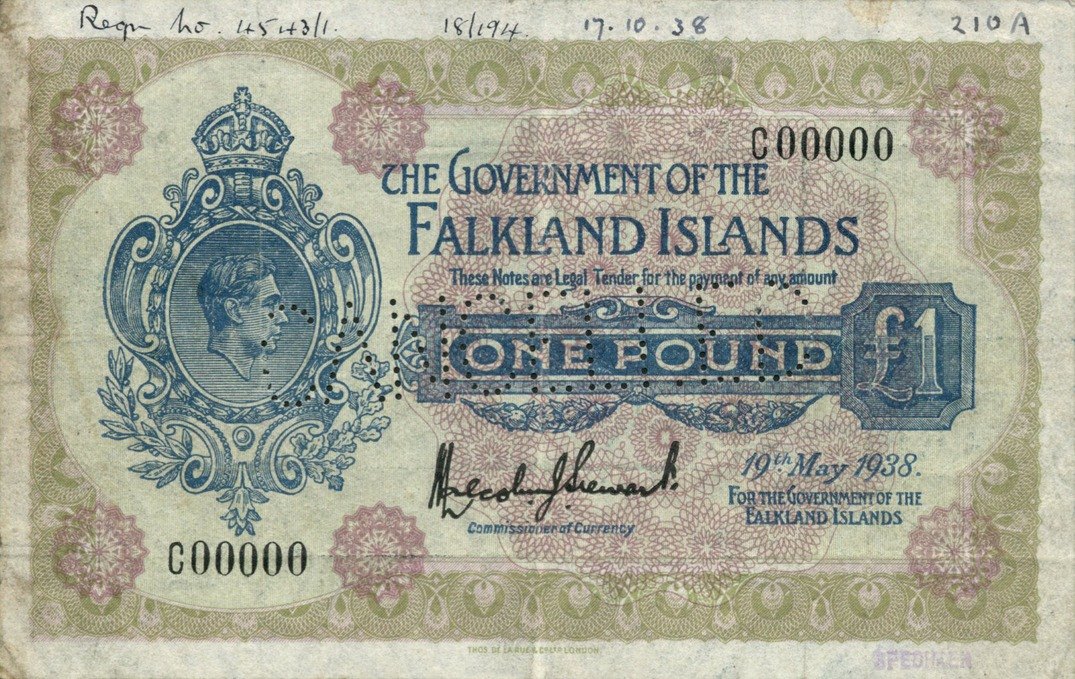
The reports on the Note Security Fund in the Gazette of the 1950s and 1960s give the face value of the notes in circulation under each series letter. The table gives pounds. Under C stand the 5 pounds and 10 shillings of every date from 1921 on. The 1 pound is entered under its series letters C, D and E; the 1 pound of 19 May 1938 runs through all three.
| Date | 5 pounds C | 1 pound C | 1 pound D | 1 pound E | 10 shillings C | 50 pence D | Total |
|---|---|---|---|---|---|---|---|
| 31 March 1954 | 18,025 | 42,343 | 21,000 | none | 8,031 | none | 89,661 |
| 31 March 1955 | 13,610 | 16,788 | 38,461 | none | 3,730 | none | 72,843 |
| 30 June 1957 | 25,050 | 9,584 | 36,304 | none | 4,691 | none | 75,883 |
| 30 June 1960 | 33,395 | 4,986 | 33,800 | none | 5,171 pounds 10 shillings | none | 77,606 pounds 10 shillings |
| 31 December 1962 | 54,780 | 2,813 | 37,266 | none | 4,287 | none | 99,400 |
| 30 June 1965 | 64,690 | 1,349 | 28,535 | none | 4,272 | none | 99,100 |
| 30 June 1966 | 60,560 | 1,187 | 19,704 | 1,997 | 4,052 | none | 87,500 |
| 31 December 1967 | 93,835 | 737 | 9,136 | 19,860 | 4,832 | none | 128,400 |
| 30 June 1970 | 66,115 | 715 | 2,486 | 14,394 | 3,990 | none | 87,700 |
| 31 December 1970 | 78,830 | 713 | 2,173 | 17,672 | 4,012 | 500 | 103,900 |
| 30 June 1971 | 70,190 | 711 | 1,867 | 13,245 | 3,054 pounds 50 pence | 1,432 pounds 50 pence | 90,500 |
| 31 December 1975 | 147,765 | 706 | 1,468 | 23,102 | 2,102 | 6,557 | 181,700 |
The totals to 1965 also hold the old notes of series A and B, which the reports enter each year at the same values: 10 and 60 pounds in notes of 5 pounds, 57 and 112 pounds in notes of 1 pound from 1955, and 7 pounds 15 shillings and 7 pounds 5 shillings in notes of 5 shillings.
Four things in these reports touch the catalogue.
- The A and B notes written off. The report for the year to 30 June 1966 takes them out of the account: 2 notes of 5 pounds, 57 of 1 pound and 31 of 5 shillings of series A, and 12, 112 and 29 of series B, to be regarded as "irretrievably lost or held as collectors' pieces".
- Series E in 1966. A 1 pound of series E is in circulation by 30 June 1966. The Treasury's registers put the change from prefix D to prefix E in December 1965, on notes dated 19 May 1938.
- The 1 pound of series C after 1967. These notes ceased to be legal tender on 1 January 1967, yet 737 pounds of them were still counted at the end of that year and 706 pounds at the end of 1975.
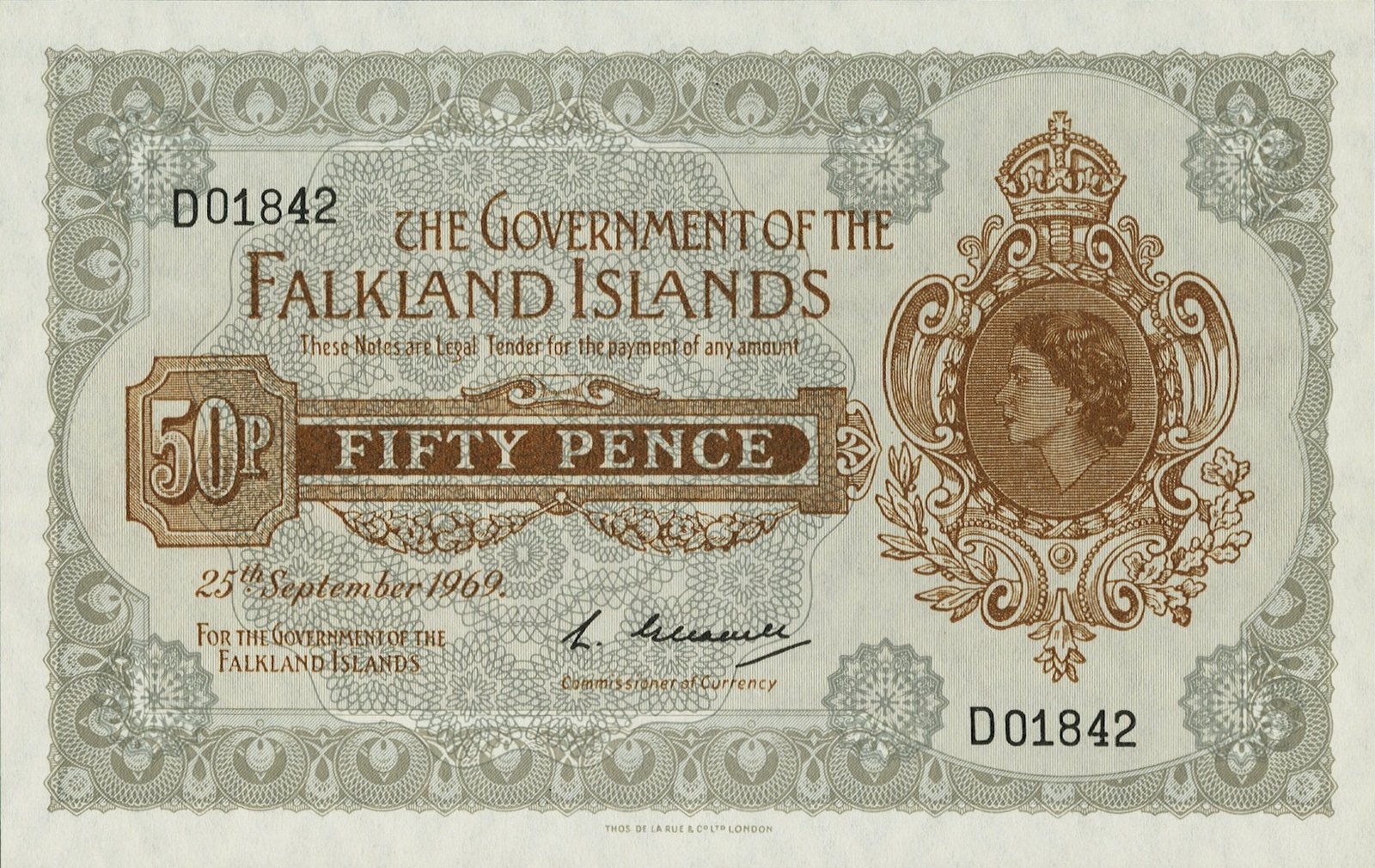
- The 50 pence before decimal day. The report for 31 December 1970 already counts 1,000 notes of 50 pence as in circulation, though the value became lawful only on 15 February 1971. The report does not explain it. The report for 31 December 1975 lists no 10 pounds, though that value had been lawful since 1 July 1975.
What the Gazette does not give
No breakdown by value was found for 1925 and 1926, for 1947 to 1953, or for most half-years between 1971 and 1975, and the reports cease to be printed in the Gazette after the one for 31 December 1975. The tables never divide the notes by their printed date, and they give no serial numbers. The Treasury's own books, which do, are described in the article on the note books. The laws under which the figures were published are in the article on the currency laws.
Sources
- The Falkland Islands Gazette, 1900 to 1976: the monthly statements of the Currency Note Fund, the yearly reports of the Commissioners of Currency and of the auditor, the half-yearly abstracts under the Currency Notes Ordinance, and the reports on the Note Security Fund.
- Colonial Reports, Falkland Islands, for 1909, 1912, 1914, 1915 and 1921.
- Estimates of the Falkland Islands for 1916 to 1921.
- The Treasury's note issue books and registers, Jane Cameron National Archives, Stanley.
Member comments
Log in or register to post a comment.