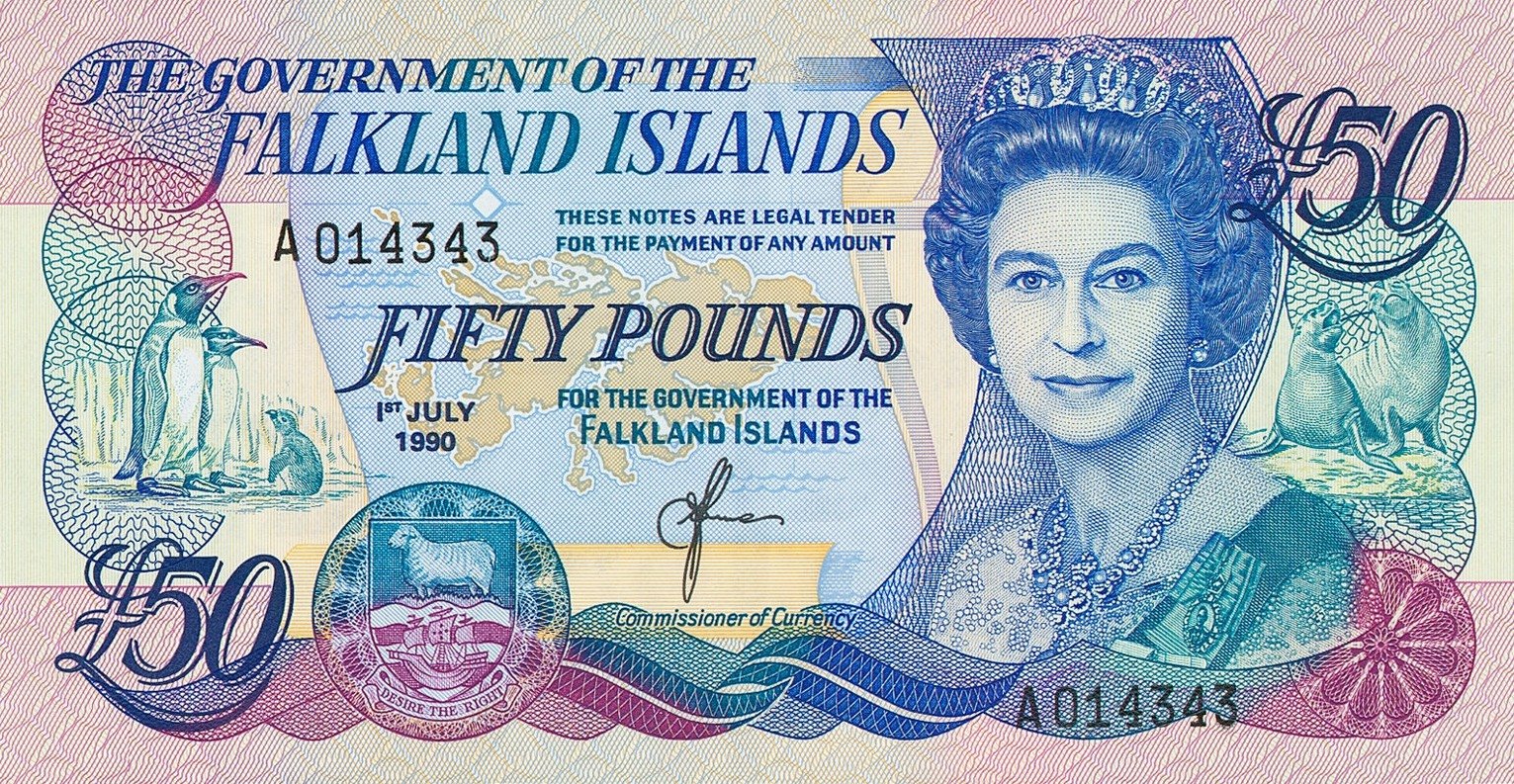
The notes of the Falkland Islands have been issued under three laws: an Order in Council of 1899, the Currency Notes Ordinance of 1930 and the Currency Ordinance of 1987. This article sets out what each said about the notes, and the rules, proclamations and notices made under them, as they stand in the bound ordinances, the Falkland Islands Gazette and the proceedings of the Legislative Council, all in the Jane Cameron National Archives. The notes themselves are followed in the article on the Government notes of 1899 to 2025.
The Order in Council of 1899
The yearly Estimates name the first law in a footnote to the Currency Note Fund: the Order in Council of 7th March 1899. The Gazette for 1899 prints the proclamation that brought the Falkland Islands Currency Note Order, 1899, into force on 16 October 1899. The text of the Order itself was not found in the volumes read.
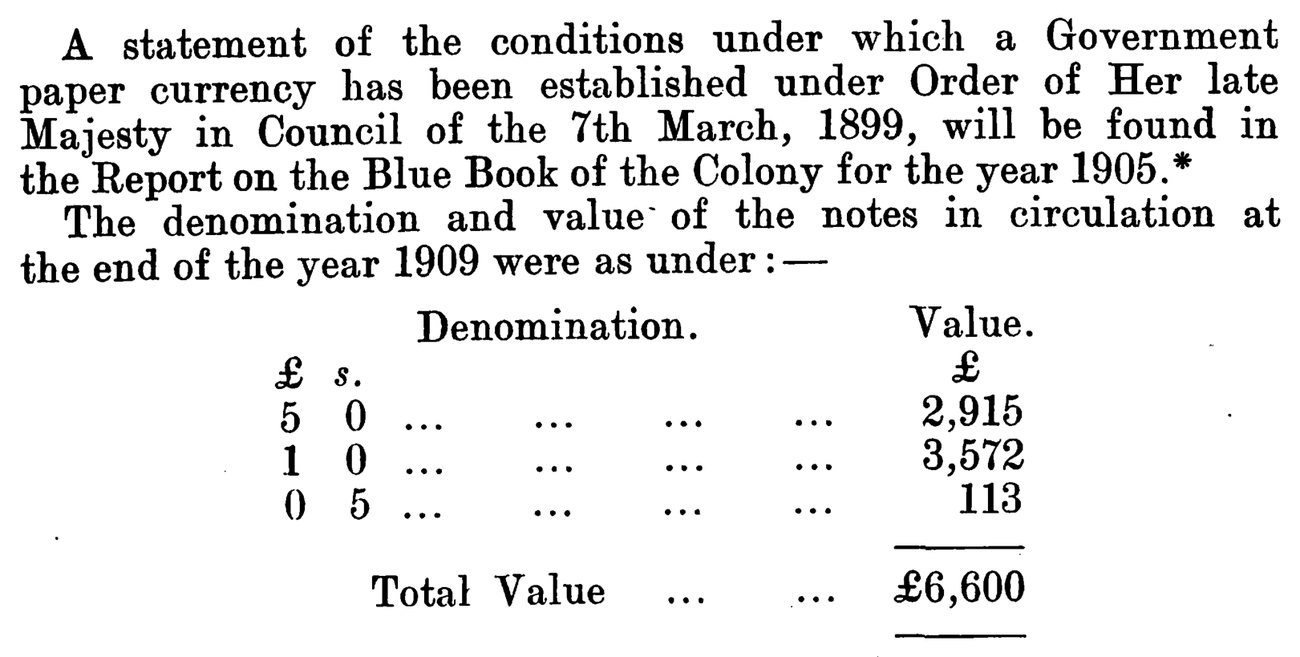
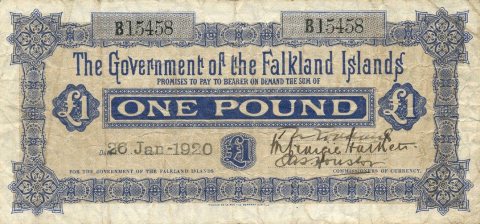
Under the Order the notes were issued by a board of Commissioners of Currency, and the notes of 1899 to 1920 were signed by three of them, those of 1921 and 1927 by two. Behind the notes stood a Note Guarantee Fund, held partly in coin and partly in investments. The share kept in coin was changed several times:
- The first monthly statements in the Gazette, for January and February 1900, show 1,000 pounds of notes in circulation and 667 pounds in coin.
- A proclamation of 1 July 1902 lowered the coin portion from two-thirds to one-half.
- The Falkland Islands Currency Note (Temporary Amendment) Order, 1918, brought into force by a proclamation of 15 August 1918, allowed part of the coin portion to be kept in the United Kingdom during the war.
- The Falkland Islands Currency Note (Amendment) Order, 1920, in force from 1 October 1920, revoked the Order of 1918 and allowed up to two-thirds of the coin portion to be kept in the United Kingdom.
- Proclamation No. 3 of 1929, of 15 March 1929, set the coin portion at one-third of the notes in circulation.
The Gazette for 1932 records that in 1931 the coin portion, 8,000 pounds in coin, was sent to the Crown Agents for sale.
The Currency Notes Ordinance of 1930
Ordinance No. 11 of 1930 was passed by the Legislative Council on 7 October 1930 and assented to on 10 October 1930. Its stated aim was to place the issue of currency notes upon a permanent basis. Proclamation No. 4 of 1931 brought it into force on 19 May 1931. Its main points:
- The Treasurer for the time being is the Commissioner of Currency. One Commissioner took the place of the board, and the notes dated 10 February 1932 carry one signature where those of 1921 and 1927 carry two.
- The values, form, design, plates and paper of the notes are to be approved by the Secretary of State.
- The notes are legal tender for any amount. The notes of the C series dated 1 February 1921 and 10 January 1927, issued under the Order of 1899, are deemed to be issued under the Ordinance.
- Notes are issued against sterling lodged with the Crown Agents in London, pound for pound.
- A Note Security Fund takes over the Note Guarantee Fund. It is held by the Crown Agents and kept at 110 per cent of the notes in circulation, and it bears the cost of printing and carrying the notes.
- Forgery of a note is punishable with 15 years.
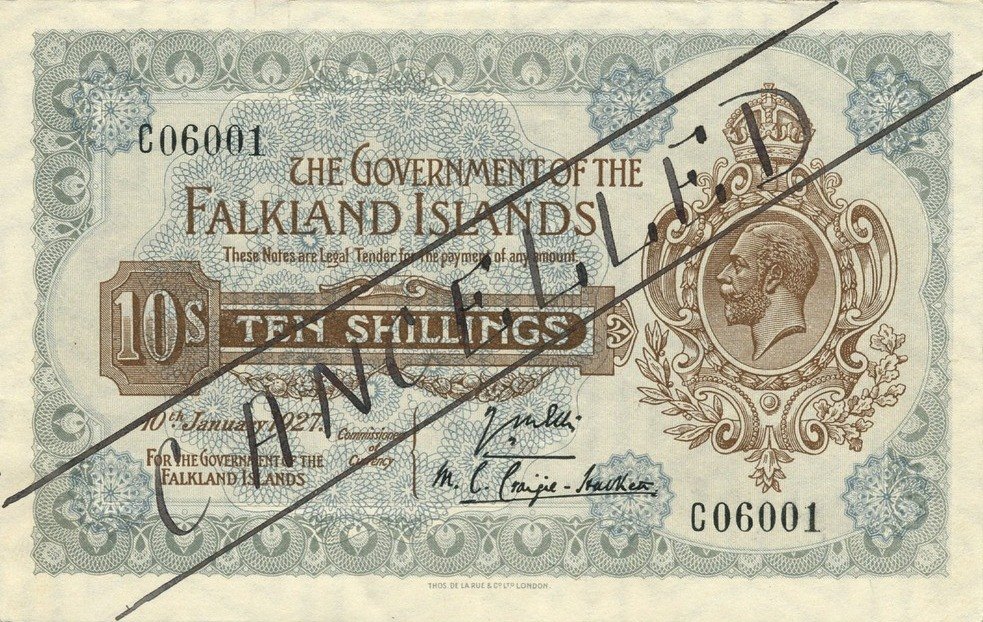
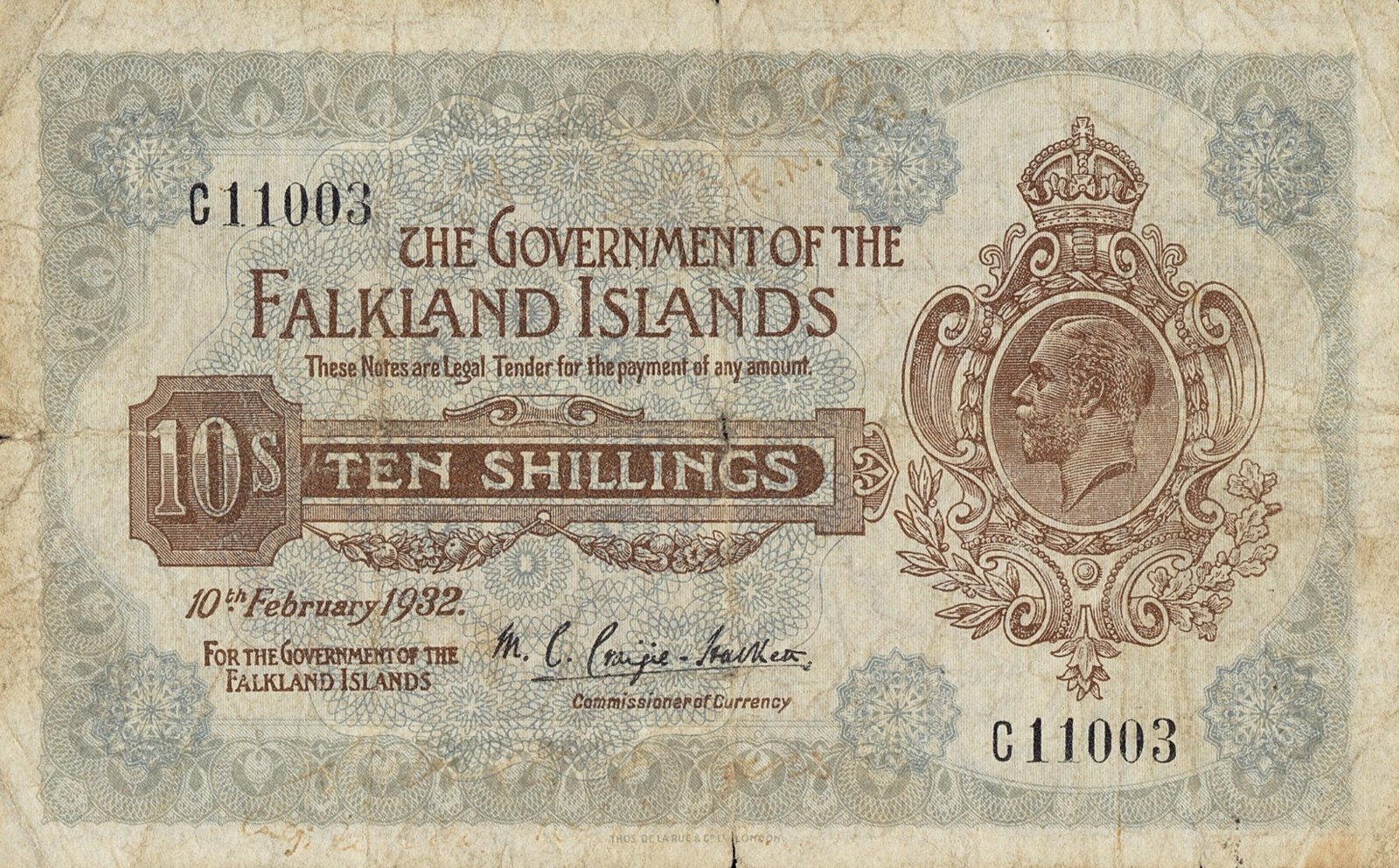
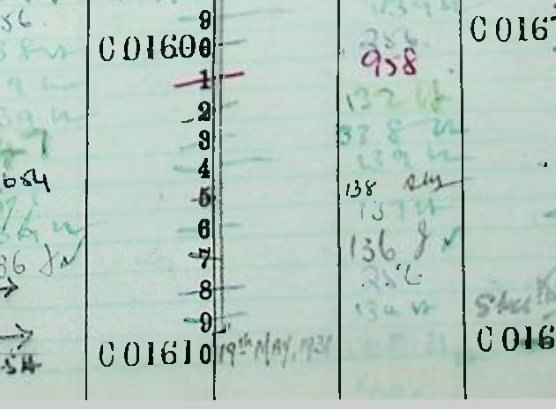
The registers of the Treasury show that the three notes recorded as cancelled by hand across the front, a 10 shillings, a 1 pound and a 5 pounds, were all put into circulation on 19 May 1931, the day the Ordinance came into force.
Ordinance No. 18 of 1954, in operation from April 1955, changed the fund. The Note Security Fund now received only the sterling paid for new notes, and a new Currency Note Income Account took the investment income and bore the cost of printing. It is in the yearly statements of that account, printed in the Gazette, that the printing orders of the 1960s are found.
The Rules of 1931 and 1939: how a note must look
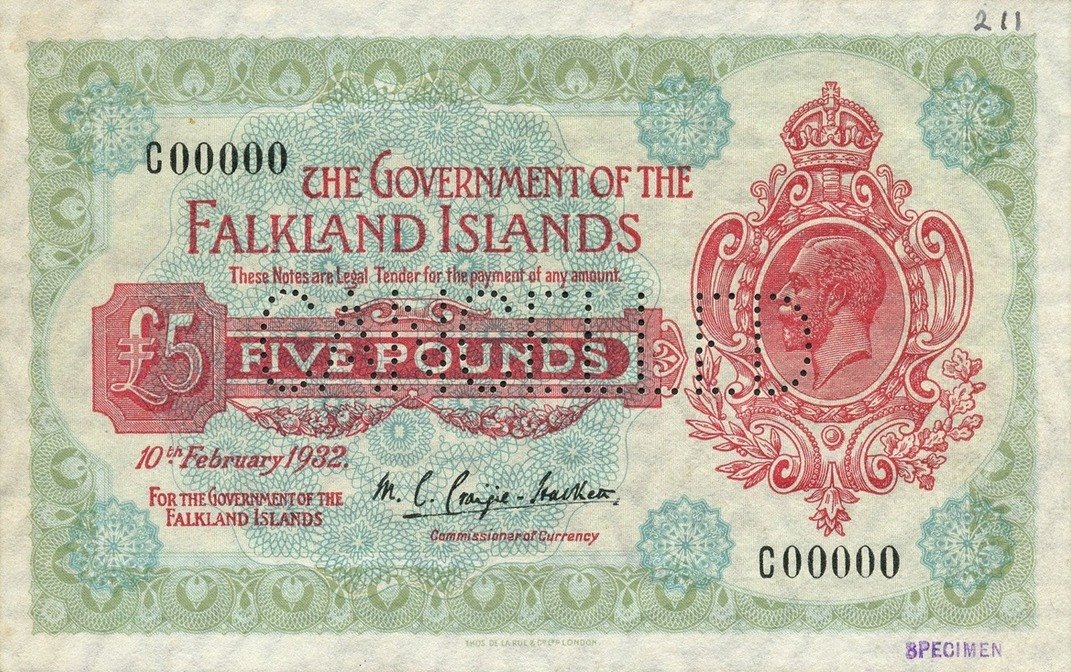
The Currency Notes Rules of 21 September 1931, printed in the Gazette for that year, describe the notes in words. There are three values, 5 pounds, 1 pound and 10 shillings, all of one size, 5 3/4 inches by 3 5/8 inches. The front must show the King's head as an inset, the value in figures and in words, the words that the notes are legal tender for the payment of any amount, a facsimile signature of the Commissioner with the date of issue, and the series letter and serial number at the top left and bottom right. No 5 shillings note is listed.
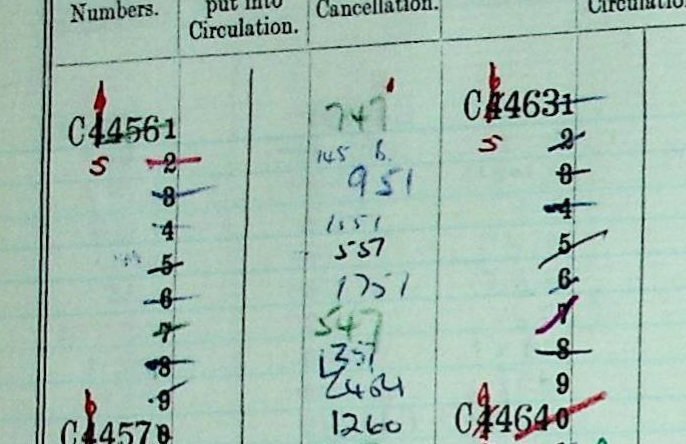
The Falkland Islands Currency Notes Rules of 6 April 1939 repeat the description and add the working rules of the Treasury. Notes on first issue are to go out, as far as possible, in the order of their serial numbers. Used notes are to be re-issued in preference to new ones. Three registers are kept, among them a Register of Currency Note Issues with the serial numbers and the dates of issue and withdrawal. Cancelled notes are bundled in hundreds by series and burnt in an incinerator before two Currency Officers. Later rules changed the registers: by prefix instead of by serial number in 1944, by serial number again in 1956, and by value and series under rules of 15 December 1965.
The A and B notes, 1933 to 1935
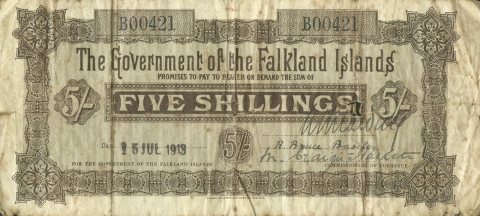
Ordinance No. 8 of 1933 gave the Governor power to make rules for calling in and demonetising the notes issued under the Order of 1899. Rules of 19 December 1933 would have left the notes of the A and B series without any value after 31 December 1934. They were repealed before that day. The Currency Notes (Amendment) Rules of 25 October 1934 withdrew the A and B notes from circulation on 1 January 1935 and ended their legal tender from that date, but provided that any presented at the Treasury in Stanley on or after that day would be paid at face value. The Rules of 1939 repeat this. The notes concerned are the 5 shillings of 1901, the 5 shillings of 1905 to 1916, the 1 pound and the 5 pounds.
The wartime regulations, 1940 to 1947
The Defence (Finance) (Amendment) Regulations of 21 August 1940 forbade bringing Bank of England, Scottish and Northern Ireland bank notes into the colony without a licence. The Defence (Finance) (Amendment) Regulations of 29 March 1941 added a ban on one block of the colony's own notes: no one might import a 1 pound note numbered C 44,001 to C 54,000. The regulation gives no reason. The reason is in a notice in the Gazette of 1 April 1941: 10,000 notes of 1 pound, ordered through the Crown Agents in September 1940, had been destroyed by fire while still with the printers, and the public were warned that any such note was valueless. The Defence (Finance) Regulations of 1947, printed in the Gazette of 1 December 1947, carried the ban forward.
The exchange regulations in the Gazette for 1947 also provided that, two months after their date, British sterling notes would cease to be legal tender in the colony and were to be exchanged at the Treasury for Falkland Islands notes.
New values and the calling in of notes, 1966 to 1984
The Currency Notes (Amendment) Rules of 6 July 1966 gave the Commissioner power to call in any notes on one month's notice in the Gazette, after which they cease to be legal tender, though the Treasury in Stanley still pays for them. The first use followed at once: a Treasury notice of 8 July 1966 announced that the 1 pound notes of the C series would cease to be legal tender from 1 January 1967 and could be exchanged for notes of the D or E series, while the 10 shillings and 5 pounds notes with the letter C stayed legal tender.
Each new value needed a change to rule 10 of the Rules:
| Value | Rules | In force |
|---|---|---|
| 50 pence | Currency Notes (Amendment) Rules 1970, No. 2 of 1970 | 15 February 1971 |
| 10 pounds | Currency Notes (Amendment) Rules 1975, No. 1 of 1975, of 22 May 1975 | 1 July 1975 |
| 20 pounds | Currency Notes (Amendment) Rules 1983, No. 2 of 1983, made 30 September 1983 | 1 January 1984 |
The 50 pence is dated 25 September 1969, the 10 pounds 5 June 1975 and the 20 pounds 1 October 1984. The 15th of February 1971 was the appointed day for decimal currency under the Decimal Currency Ordinance 1971, and the transitional period ended on 31 March 1972. The 50 pounds was never added to rule 10.
The Currency Ordinance of 1987 and the Validation Ordinance of 1991
The Currency Ordinance 1987 was assented to on 5 June 1987 and began on 1 July 1987. The Financial Secretary, moving the Bill in the Legislative Council in May 1987, called the Ordinance of 1930 outdated and said that the Bill was based on a draft proposed by the Bank of England. The Ordinance names the Falkland Islands pound, at parity with sterling, as the unit. It provides for not less than two and not more than three Commissioners of Currency, one of whom is the Financial Secretary, with the sole right to issue notes and coins, and a Currency Fund in place of the Note Security Fund. Notice No. 4 of 5 February 1988 named the holders of the offices of Government Secretary and Superintendent of Posts and Telecommunications as the other two Commissioners.
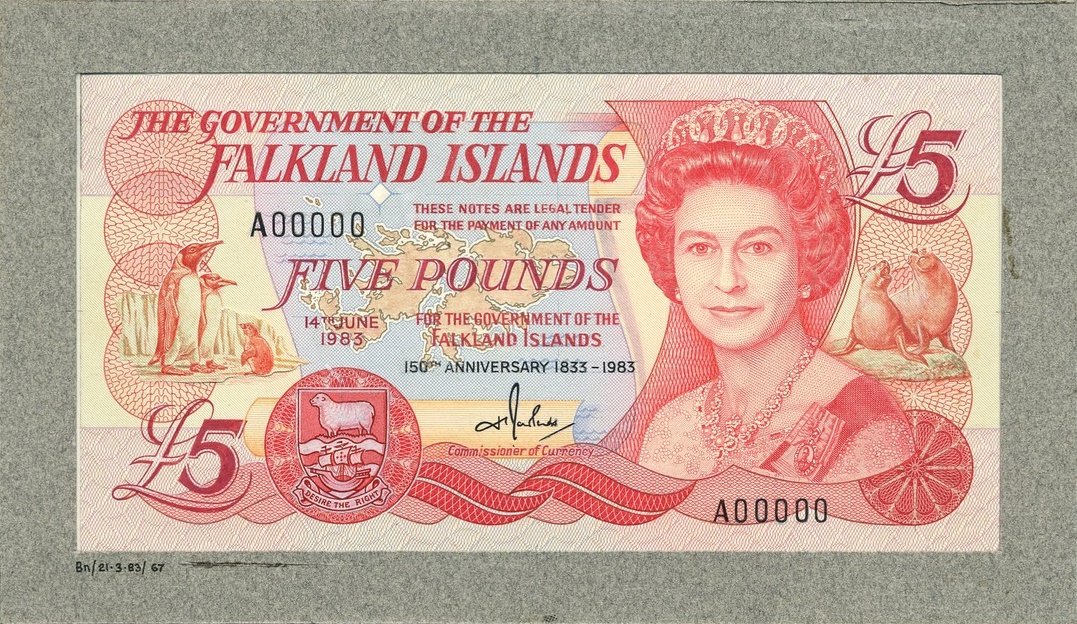
Two faults in the notes then came to light. The notes issued on and after 14 June 1983, beginning with the 5 pounds of that date, were smaller than the size laid down in the Rules. And the 50 pounds, which in December 1990 had been printed but was not yet in circulation, was not a value named in the Rules and bore the facsimile signature of only one of the Commissioners. The Currency Notes (Validation) Bill was passed on 8 January 1991 under a certificate of urgency and became Ordinance No. 6 of 1991, which declared all these notes valid.
The notices of 1990 and 1992, and the orders of 2004 and 2010
Notice No. 43 of 19 December 1990 declared that the 1 pound notes dated 1 October 1984, numbered A 000001 to A 200000, would cease to be legal tender from 1 February 1991.
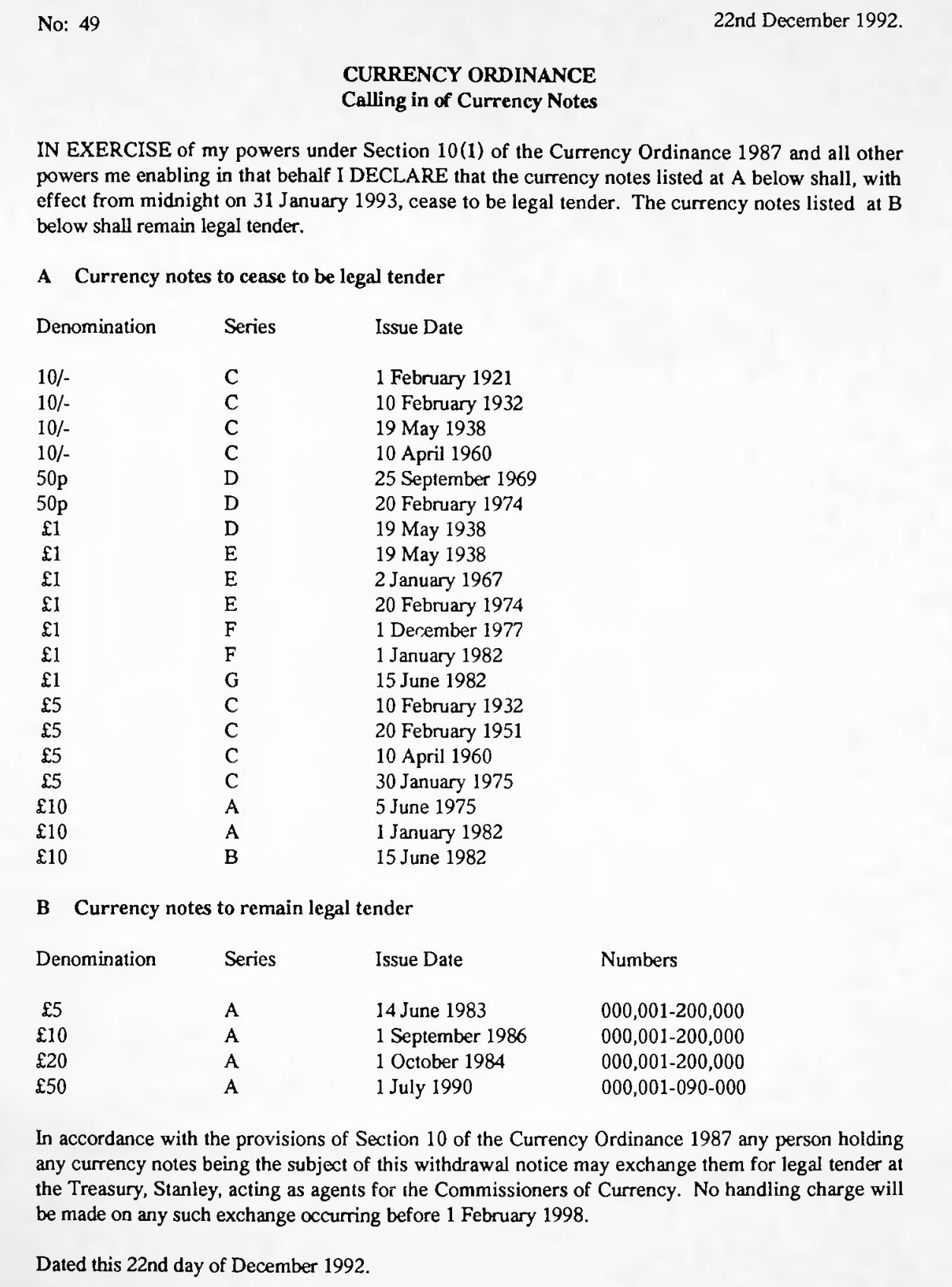
Notice No. 49 of 22 December 1992, made by the Governor under the Ordinance of 1987, called in every older note still outstanding. Its list A names the notes that ceased to be legal tender from midnight on 31 January 1993, by value, series letter and date:
- 10 shillings, series C: 1 February 1921, 10 February 1932, 19 May 1938, 10 April 1960.
- 50 pence, series D: 25 September 1969, 20 February 1974.
- 1 pound: series D and E of 19 May 1938; series E of 2 January 1967 and 20 February 1974; series F of 1 December 1977 and 1 January 1982; series G of 15 June 1982.
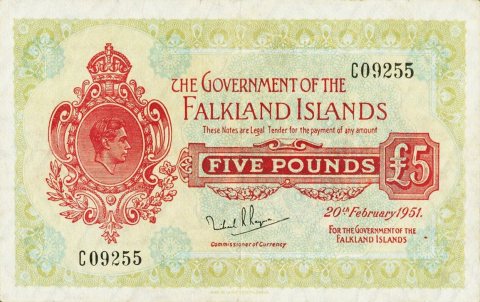
- 5 pounds, series C: 10 February 1932, 20 February 1951, 10 April 1960, 30 January 1975.
- 10 pounds: series A of 5 June 1975 and 1 January 1982; series B of 15 June 1982.
The list does not name the notes dated 10 January 1927, nor the 5 pounds of 1 February 1921. The 1 pound notes of the C series had already ceased to be legal tender on 1 January 1967. Its list B names the notes that stayed legal tender, with their numbers: the 5 pounds of 14 June 1983, the 10 pounds of 1 September 1986 and the 20 pounds of 1 October 1984, each 000,001 to 200,000 of series A, and the 50 pounds of 1 July 1990, 000,001 to 090,000.
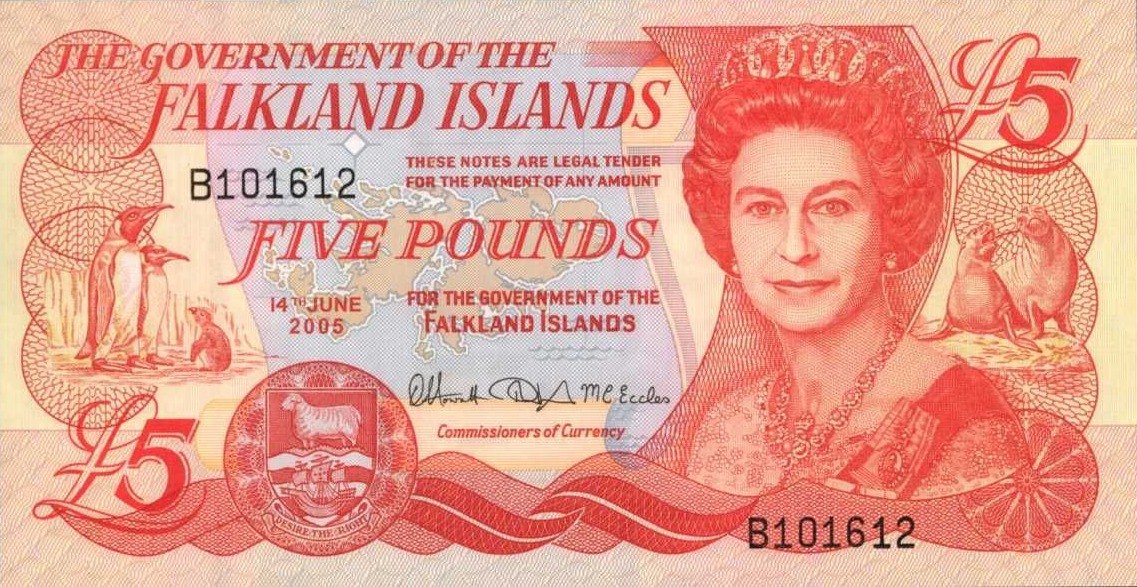
The later printings were provided for by orders. The Currency Notes Regulations Order 2004 provided for 200,000 notes of 5 pounds, numbered from B 000001 and printed by De La Rue, with the issue date 14 June 2005 and the signatures of D. F. Howatt, P. T. King and M. C. Eccles. The Currency Notes Order 2010 provided for 200,000 notes each of 10 pounds and 20 pounds, numbered from B 000001 and printed by De La Rue, with the issue date 1 January 2011, and describes them as very similar in design to the 10 pounds of 1986 and the 20 pounds of 1984.
When each note ceased to be legal tender
| Notes | Ceased to be legal tender | By |
|---|---|---|
| A and B series, 1899 to 1920 | 1 January 1935, still paid at the Treasury | Currency Notes (Amendment) Rules 1934 |
| 1 pound, series C | 1 January 1967 | Treasury notice of 8 July 1966 |
| 1 pound of 1 October 1984 | 1 February 1991 | Notice No. 43 of 19 December 1990 |
| The notes of list A, 1921 to 1982 | 1 February 1993 | Notice No. 49 of 22 December 1992 |
What was not found
The text of the Order of 1899 and of the Amendment Order of 1920 is not in the volumes read. No rule was found that added the 50 pounds to the lawful values before the Validation Ordinance. The Gazette prints no notice announcing the first issue of any new design.
Sources
- Bound ordinances, rules and regulations of the Falkland Islands, 1920 to 1975, and the revised Laws of the Falkland Islands of 1950 (Cap. 15), Jane Cameron National Archives, Stanley.
- The Falkland Islands Gazette, 1899 to 2010: proclamations of 16 October 1899, 1 July 1902 and 15 August 1918; the Currency Notes Rules of 21 September 1931; the notice of 1 April 1941; the Treasury notice of 8 July 1966; the Currency Ordinance 1987; Notice No. 4 of 5 February 1988; the Currency Notes (Validation) Bill of December 1990 and Ordinance No. 6 of 1991; Notice No. 43 of 19 December 1990; Notice No. 49 of 22 December 1992; the Currency Notes Regulations Order 2004; the Currency Notes Order 2010.
- Estimates of the Falkland Islands, 1916 to 1921 (footnotes to the Currency Note Fund).
- Proceedings of the Legislative Council of the Falkland Islands, 1987 and 1991.
- The Treasury's registers of currency notes, Jane Cameron National Archives.
Member comments
Log in or register to post a comment.