This article follows the notes of the Falkland Islands in order of time, from the first Government notes of 16 October 1899 to the polymer notes of 14 August 2025. It is drawn from the catalogue pages of the notes, which rest on the Treasury's own note books in the Jane Cameron National Archives, the Colonial Reports and the Falkland Islands Gazette, and from the Gazette and the bound ordinances of the colony. A few statements of auction houses are given, each as that house's own.
Three longer articles take single subjects further: the first notes of 1899 to 1920, the currency laws of 1899 to 2010 and the notes in circulation from 1900 to 1975. An earlier article describes the Treasury's own note books of 1899 to 1967.
One issuer, one printer
Every note in the catalogue was issued by the Government of the Falkland Islands, and the catalogue pages give Thomas de la Rue and Company, later De La Rue, as the printer of every issue. The Falkland Islands Gazette names no printer in any year from 1899 to 1999; in its accounts the notes are received from the Crown Agents.
| Issue | Values | Dates on the notes | Signatures |
|---|---|---|---|
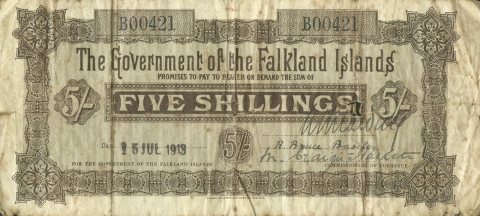
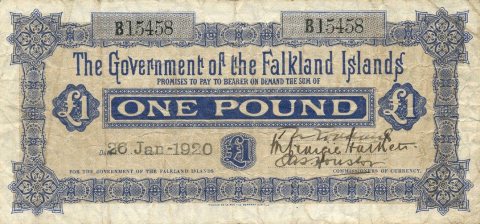
| 1899 to 1920 | 5 shillings, 1 pound, 5 pounds | written, printed or stamped, from 16 October 1899 to 28 June 1920 | three Commissioners of Currency, by hand |
| King George V | 10 shillings, 1 pound, 5 pounds | 1 February 1921, 10 January 1927, 10 February 1932 | two Commissioners in 1921 and 1927, one Commissioner in 1932 |
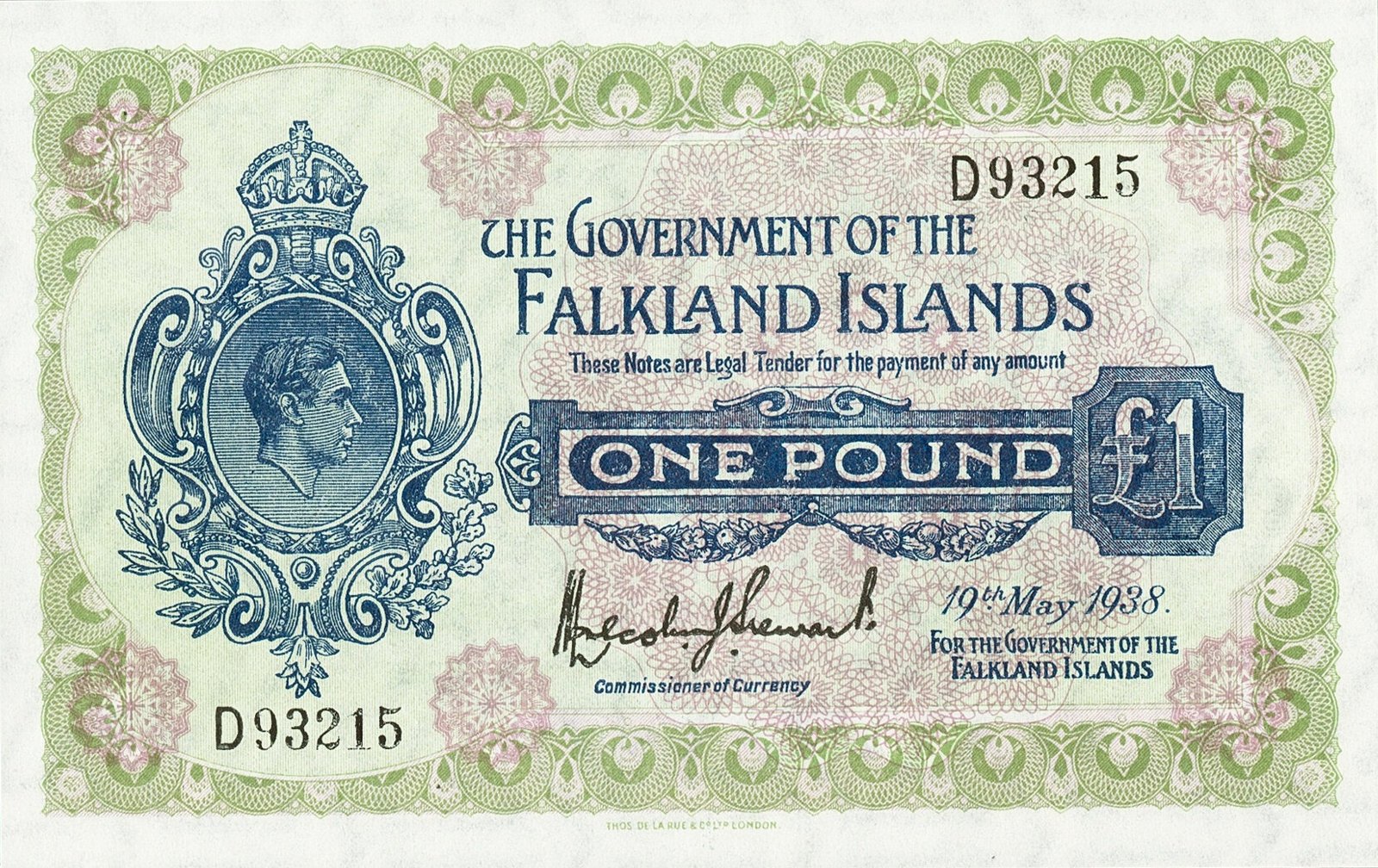
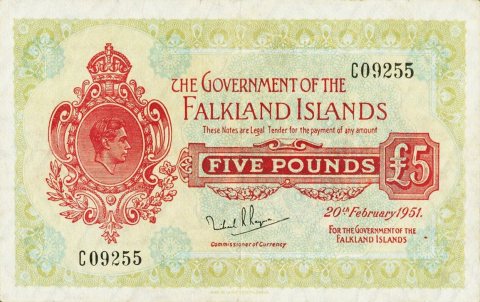
| King George VI | 10 shillings, 1 pound, 5 pounds | 19 May 1938; 20 February 1951 (5 pounds) | one Commissioner |
| Queen Elizabeth II, first design | 10 shillings, 50 pence, 1 pound, 5 pounds, 10 pounds | from 10 April 1960 to 15 June 1982 | one Commissioner |
| Queen Elizabeth II, design of 1983 | 1, 5, 10, 20 and 50 pounds | 14 June 1983, 1 October 1984, 1 September 1986, 1 July 1990 | one printed signature |
| The same design, later printings | 5, 10 and 20 pounds | 14 June 2005, 1 January 2011 | three Commissioners |
| Polymer notes | 5, 10 and 20 pounds | 14 August 2025 | not stated on the catalogue pages |
The early notes, 1844 to 1920
The handwritten notes of 1844
An earlier, temporary issue is known only from the records. Chalmers' History of Currency in the British Colonies (1893) says that in 1844, for want of coin, the Governor issued handwritten notes worth 1,000 pounds, signed by the Governor "on the part of the Colonial Government" and payable to bearer, in values from half a dollar to 50 dollars. Holders had until 31 March 1845 to present them, and all but about 30 pounds' worth were redeemed. No such note is recorded in the catalogue.
The hand-signed notes of 1899 to 1920
The Government paper currency was set up under an Order in Council of 7 March 1899. A proclamation printed in the Falkland Islands Gazette brought the Currency Note Order into force on 16 October 1899, the date written on the first notes. Three values were issued: the 1 pound and the 5 pounds from 16 October 1899, and a green 5 shillings from 12 January 1901, replaced in 1904 by a brown 5 shillings. Each note was signed by hand by three Commissioners of Currency and was printed with a counterfoil that was detached on issue.
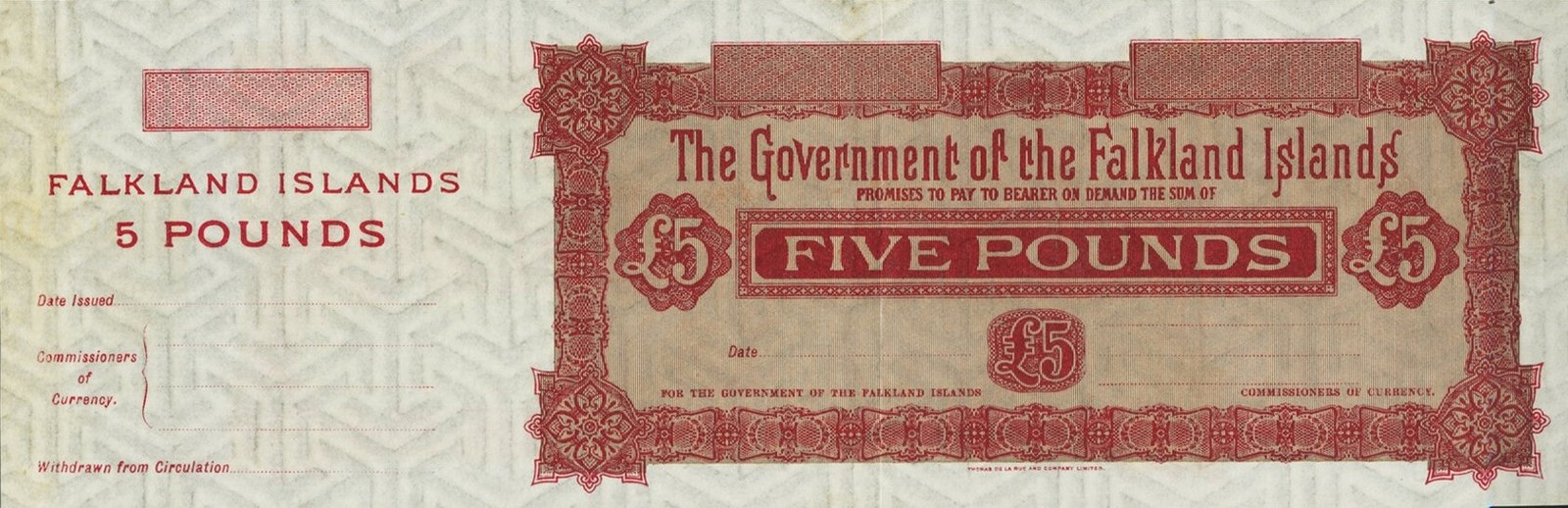
The catalogues also list a 10 shillings in this series. The Treasury's issue books of 1899 to 1920 record only 5 shillings, 1 pound and 5 pounds notes, and the Colonial Reports for 1909 and 1912 count no 10 shillings. No such note has been seen.
The first notes carry the prefix A/1, and the brown 5 shillings A/2. A second series with the prefix B followed from 1908. The notes of both series ceased to be legal tender on 1 January 1935 but were still paid at the Treasury. The story of these notes, their signers, their proofs and the burning of notes in 1914 is told in the article on the first notes.
King George V, 1921 to 1932
The Colonial Report for 1921 records the arrival of a new design with the King's portrait: 2,000 notes of 5 pounds, 12,000 of 1 pound and 6,000 of a new value, the 10 shillings. By the end of that year 680 of the 5 pounds, 6,300 of the 1 pound and 2,000 of the 10 shillings had been issued, to replace old notes withdrawn for cancellation and destruction. The notes carry the prefix C.
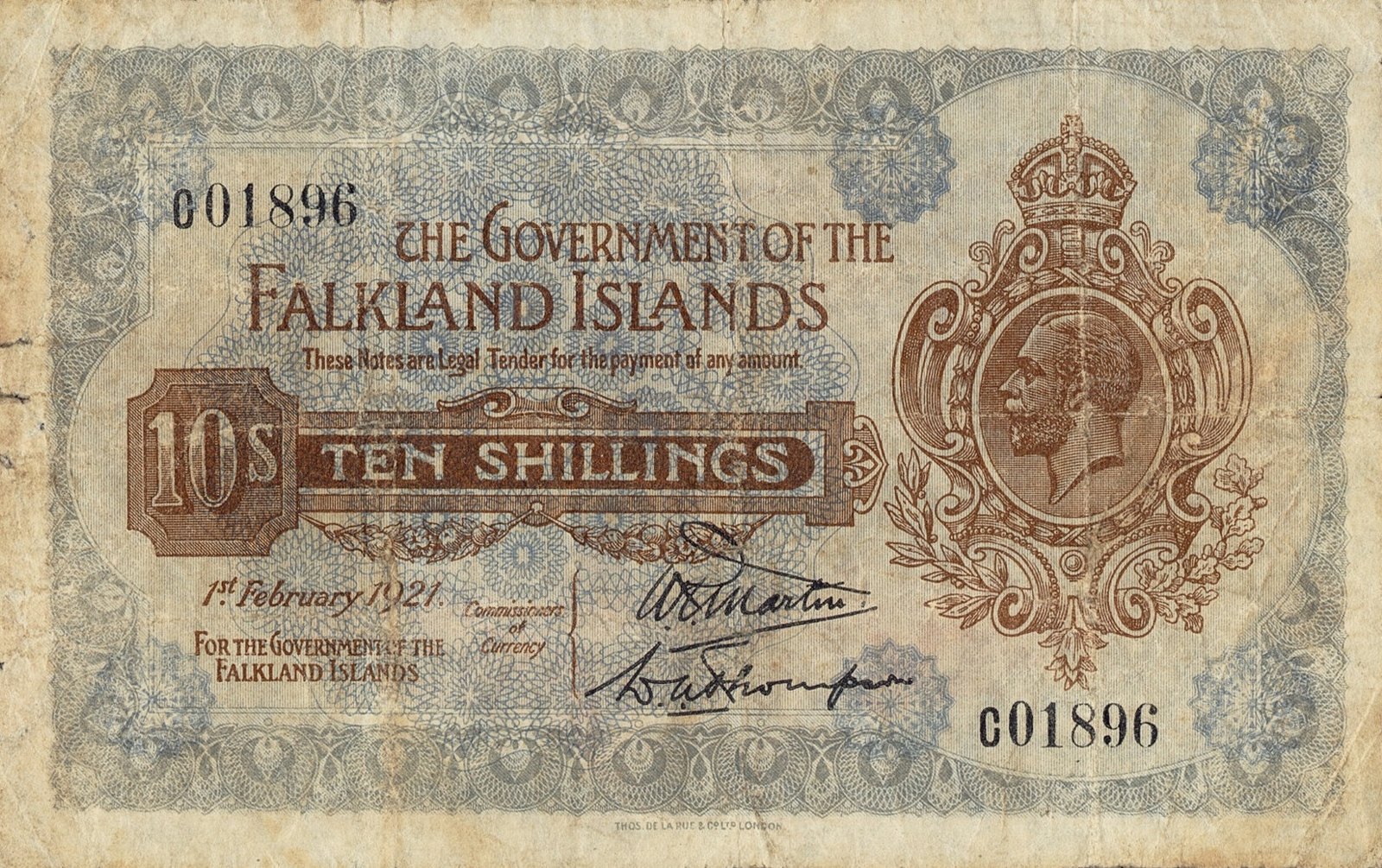
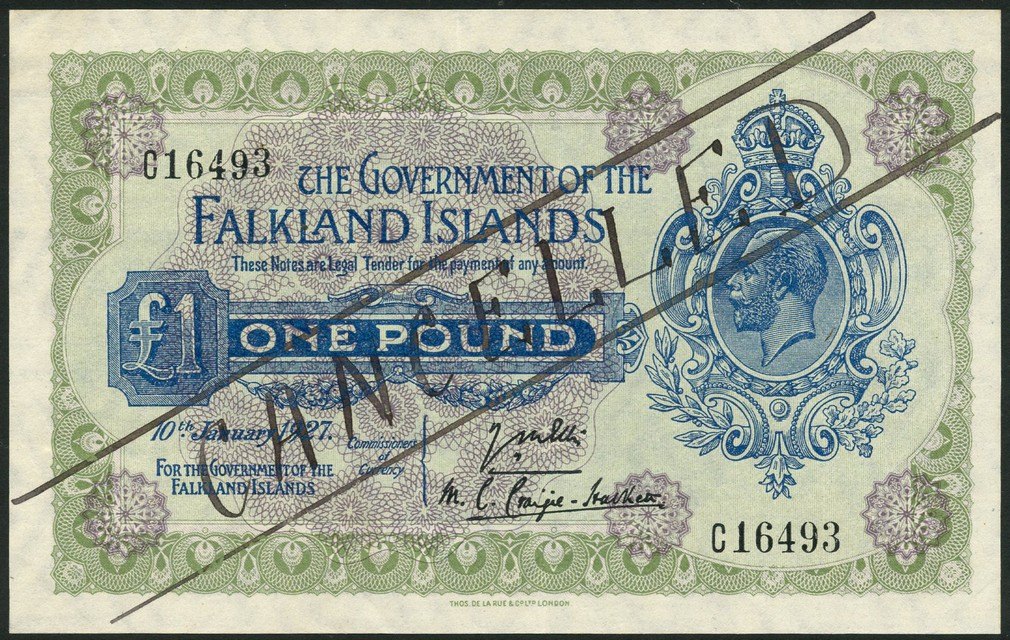
All three values are dated 1 February 1921. The Treasury's registers show that the date on a note is not the day it was issued. The 1 pound and 5 pounds of 1921 were first put into circulation on 17 October 1921 and the 10 shillings on 4 November 1921. The 1 pound dated 10 January 1927 followed on 23 December 1927, but the 10 shillings of that date only on 19 May 1931. The notes dated 10 February 1932 went out from 23 June 1933 (10 shillings), 21 March 1934 (5 pounds) and 22 August 1934 (1 pound), and the 5 pounds of that date was still being issued in April 1942.
The Gazette's yearly accounts of the Commissioners add the deliveries. The account for 1927 records the cost of 12,000 notes of 1 pound received from the Crown Agents. The report for 1930 records 3,000 notes of 10 shillings received. The report for 1932 records 2,000 notes of 5 pounds, 10,000 of 1 pound and 5,000 of 10 shillings received and placed in the reserve. The Gazette does not say which printed date each delivery carried.
The notes of 1921 and 1927 carry two signatures, as Commissioners of Currency, and those of 1932 only one. The change follows the Currency Notes Ordinance of 1930, which came into force on 19 May 1931 and made the Treasurer the only Commissioner. Three notes that had circulated and were cancelled by hand across the front are recorded, one of each value; the registers show that all three were put into circulation on 19 May 1931.
Heritage (23 October 2021, lot 28208) and Spink (17 April 2019, lot 441) both say that only 6,000 of the 10 shillings of 1921 were issued, the figure the Colonial Report gives for the notes received.
King George VI, 1938 to 1951
The 10 shillings and the 1 pound with the portrait of King George VI are dated 19 May 1938. The Falkland Islands Gazette records that this was the last day in office of the Treasurer and Commissioner of Currency, M. J. Stewart, before a leave that began on 20 May 1938. The registers show the 10 shillings beginning at C 14001 and the 1 pound at C 34001, and both first put into circulation on 28 December 1939. The 10 shillings of this date was still being issued in 1966. On the 1 pound, prefix D follows C 100000 and prefix E follows D 100000, in December 1965.
One block of the 1 pound never reached the colony. The Gazette of 1 April 1941 explains that 10,000 notes of 1 pound, ordered through the Crown Agents in September 1940, were destroyed by fire while still with the printers awaiting shipment. As some finished notes might have been taken while the fire was being fought, the numbers C 44001 to C 54000 were declared valueless, and a defence regulation of 29 March 1941, repeated in 1947, forbade bringing them into the colony. The notice does not name the printer.
The 5 pounds of this design is dated 20 February 1951. A note in the Treasury's register records that of 10,000 notes ordered in 1951 only 8,400 were supplied, C 04001 to C 12400, and that they went into circulation from 28 May 1953 to 30 December 1960. The signer, M. R. Raymer, was the Colonial Secretary. The Gazette for 1950 and 1951 shows that the colony then had no Treasurer of its own and that the Colonial Secretary held both offices; J. E. Briscoe became Treasurer on 1 March 1952.

In 1954 to 1955 the Treasury sent specimen notes, which were ordinary issued notes withdrawn and cancelled, to the National Bank in Vienna and one to the police in Paris. The account of the Note Security Fund for that year, printed in the Gazette for 1956, enters both.
Heritage (24 April 2020, lot 26096) says that fewer than 47,000 of the 10 shillings of this design were printed and issued. The Treasury's registers have the notes of 19 May 1938 beginning at C 14001 and those of the next design beginning at C 69001.
Queen Elizabeth II, 1960 to 1982
The 10 shillings and the 5 pounds with the Queen's portrait are dated 10 April 1960. Sources mention that the profile follows a 1952 photograph by Dorothy Wilding. The 10 shillings begins at C 69001, and the archive's title for its register book gives the numbers C 69001 to C 85800; Spink (26 April 2017, lot 1284) says that 16,800 notes were issued in all. The 5 pounds follows on from C 12401 and was first put into circulation on 13 February 1961.
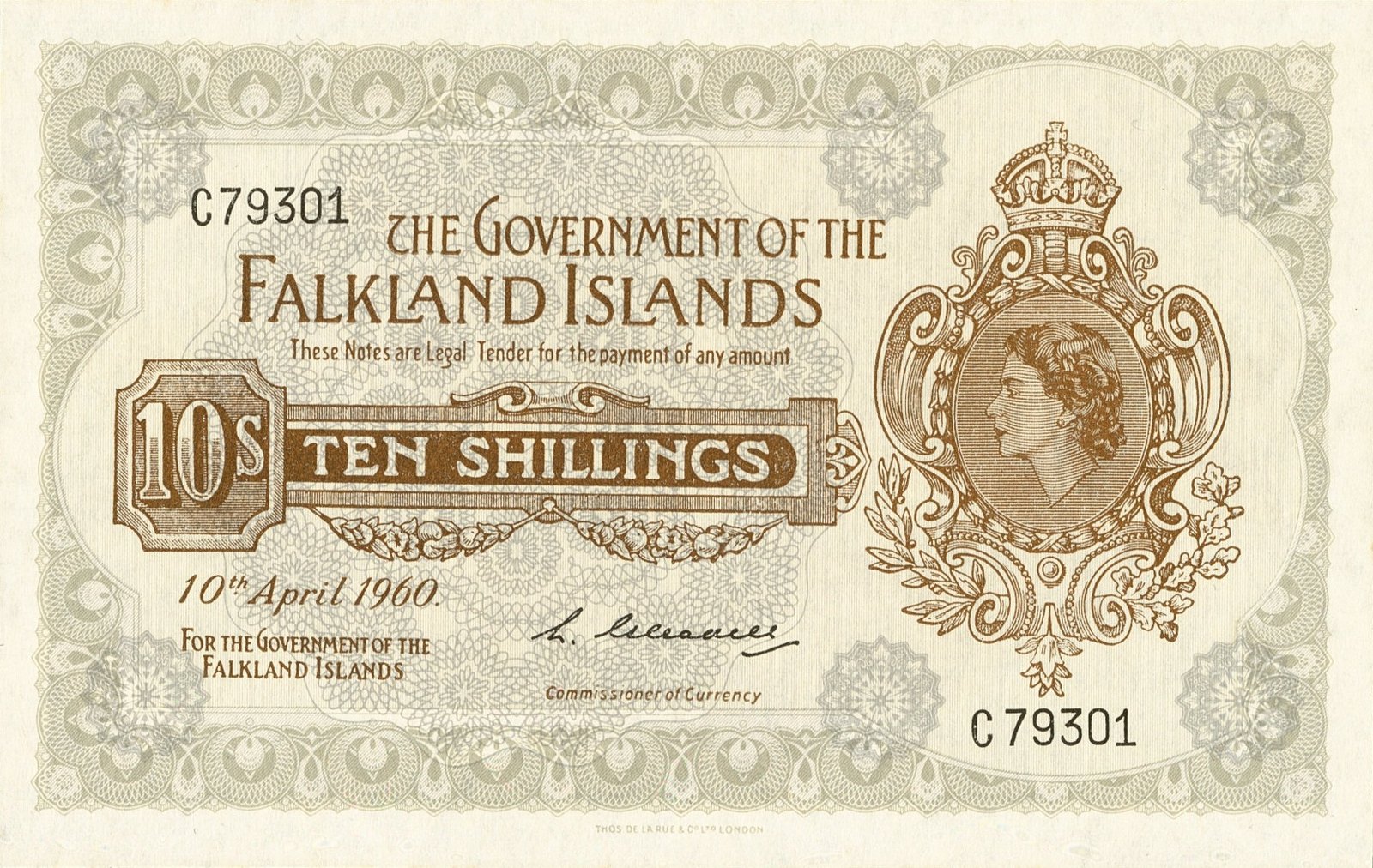
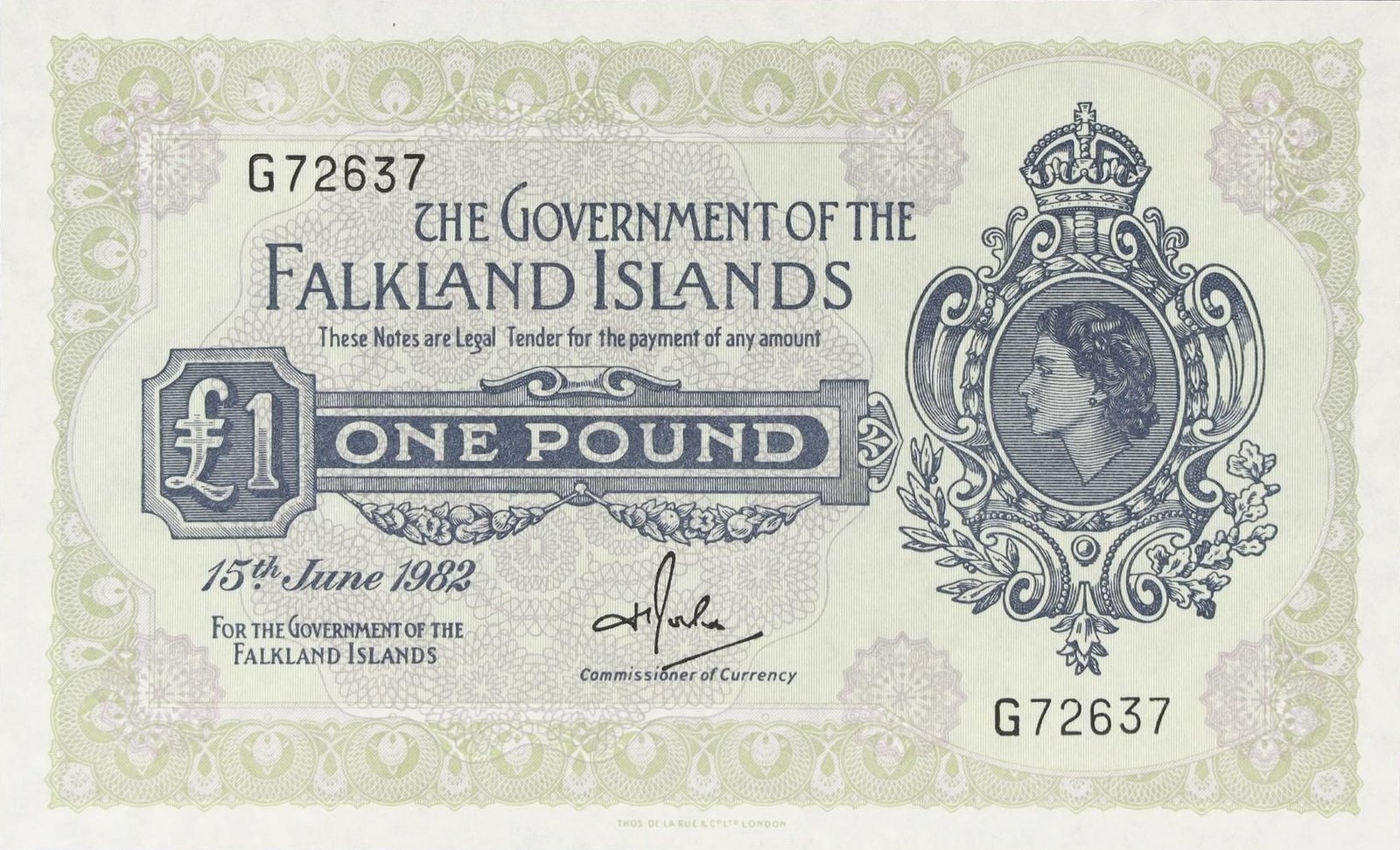
The 1 pound came later and is dated 2 January 1967. A Treasury notice of 8 July 1966, printed in the Gazette, had announced that the 1 pound notes of the C series would cease to be legal tender from 1 January 1967, the day before. Five printed dates followed on three prefixes: 2 January 1967 and 20 February 1974 on E, 1 December 1977 and 1 January 1982 on F, and 15 June 1982 on G.
The 50 pence replaced the 10 shillings when the pound was divided into 100 pence on 15 February 1971. It is dated 25 September 1969, and a second printing 20 February 1974. The 10 pounds was added on 1 July 1975 and is dated 5 June 1975, 1 January 1982 and 15 June 1982.
The Treasury's accounts, printed in the Gazette, give some of the orders: 20,000 notes of 5 pounds printed in 1964 to 1965, 30,000 notes of 1 pound bought in 1967 to 1968, another 30,000 of 1 pound and 20,000 of 5 pounds in 1969 to 1970, and 20,000 notes of 50 pence in 1970 to 1971. The accounts do not say which printed date each order carried. Spink's description of a specimen 5 pounds dated 10 April 1960 with the word Reprint written in its margin (12 February 2021, lot 95) says that the printers were told to reprint because of a shortage of 5 pounds notes. For the 10 pounds of 5 June 1975, Heritage gives two figures: about 47,000 printed and issued, from printer records (24 April 2020, lot 26102), and about 50,000 (6 December 2022, lot 23291).
The Gazette shows who held the Treasurer's office on each date. L. C. Gleadell was Colonial Treasurer from 19 June 1959 and H. T. Rowlands from 14 February 1972; the office was called Financial Secretary by 1973. The notes of 1960, 1967 and 1969 fall in the first term and those of 1974 to 1982 in the second.
The notes of 1982
The last printings of the 1 pound and the 10 pounds are dated 15 June 1982, the day after the liberation of the islands on 14 June 1982. Sources mention that Governor Rex Hunt signed some 1 pound and 10 pounds notes by hand for the British troops. Spink's description of a 1 pound of 15 June 1982 with a handwritten signature of Rex Hunt (12 February 2021, lot 94) says that four notes were signed. The Gazette has no issue between 26 March and 7 July 1982 and says nothing of notes during the occupation.
The last two 50 pence notes issued are recorded by three houses: Heritage (28 April 2017, lot 28305), Spink (4 October 2018, lot 1579) and Stack's Bowers (29 August 2025, lot 30257). All three describe D 69999 and D 70000 of 20 February 1974. Heritage and Stack's Bowers say that the first carries a certificate, typewritten as Heritage has it and dated 19 October 1982, that it is the second-last 50 pence note to be issued by the Government. Spink says that the certificate is signed by Harold Rowlands.
The design of 1983
A new and smaller design came with the 5 pounds of 14 June 1983, a commemorative issue for the 150th Anniversary of English Rule (1833 to 1983). Sources mention that the design, by Brian White of De La Rue, uses one engraved master die for every value, the value in figures and words being added by surface printing, and that the portrait follows Peter Grugeon's photograph for the Silver Jubilee of 1977.
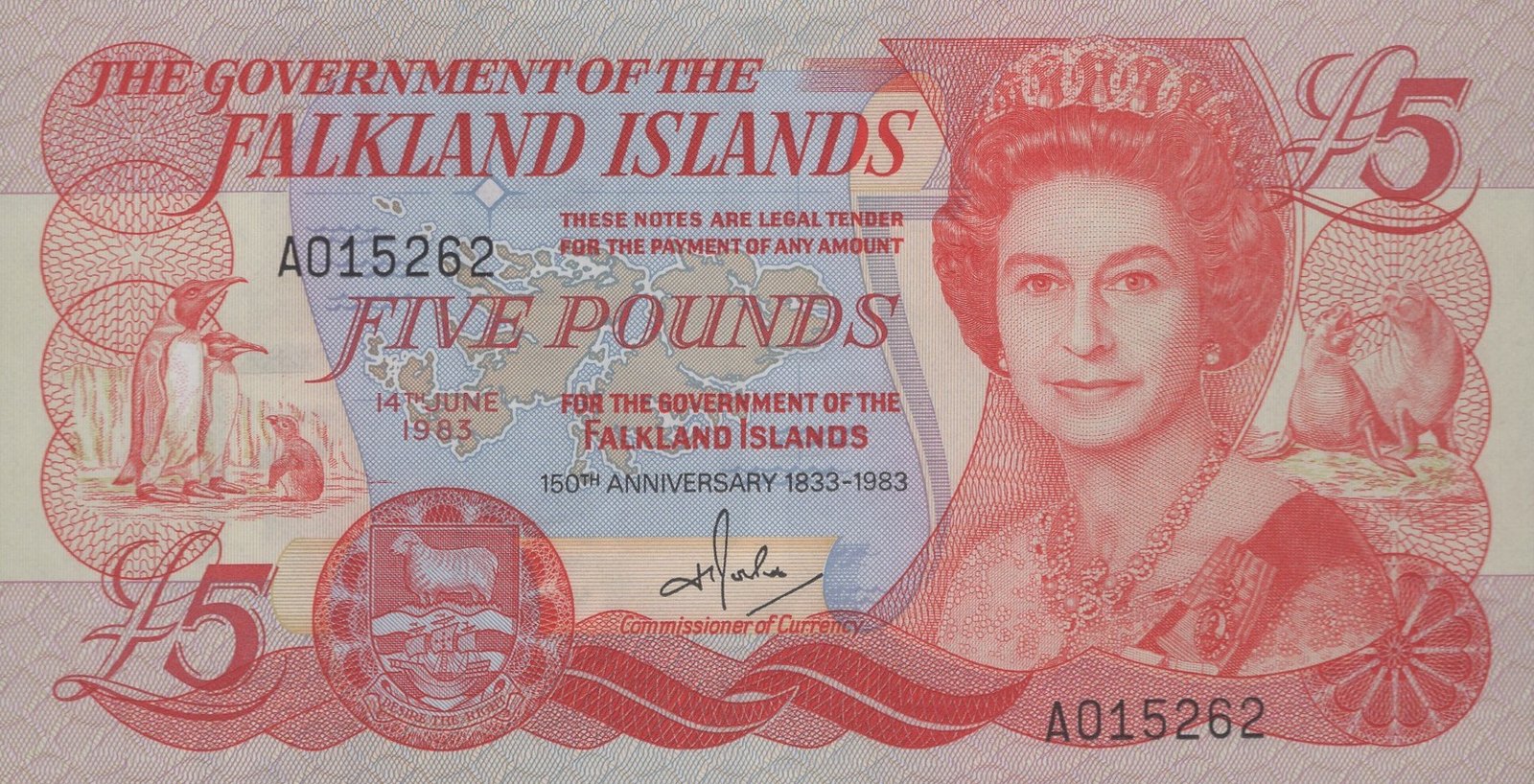
The same design was used for the 1 pound and the 20 pounds of 1 October 1984, the 10 pounds of 1 September 1986 and the 50 pounds of 1 July 1990. The 50 pence was discontinued with this series. The Gazette gives the size of each issue as a range of numbers: 200,000 each of the 1, 5, 10 and 20 pounds, A 000001 to A 200000, and 90,000 of the 50 pounds, A 000001 to A 090000.
The 1 pound was the first to go. Notices in the Gazette announced that it would cease to be legal tender on 1 February 1991, though it could still be exchanged at the Treasury. The 50 pounds was the last to come: in December 1990 the Gazette records that it had been printed but was not yet in circulation. The day of its release was not found.
The same design returned without the commemorative legend on the 5 pounds of 14 June 2005, and on the 10 pounds and 20 pounds of 1 January 2011. These carry three signatures and the prefix B. The orders printed in the Gazette provided for 200,000 notes of each value, numbered from B 000001 and printed by De La Rue. The catalogue page of the 10 pounds says that the notes of 2011 were not introduced into circulation until September 2012; nothing in the Gazette confirms or contradicts that.
The calling in of 1993
A notice of 22 December 1992, printed in the Gazette, called in every older note in one step. From midnight on 31 January 1993 the notes of the George V, George VI and first Elizabeth II designs that it lists ceased to be legal tender, and they were to be exchanged free of charge at the Treasury before 1 February 1998. The notes of the 1983 design, of 5, 10, 20 and 50 pounds, stayed legal tender. The list is set out in the article on the laws.
The polymer notes of 2025
New notes of 5 pounds, 10 pounds and 20 pounds were introduced on Falklands Day, 14 August 2025. There is no 1 pound in the series, as that value has been replaced by a coin, and sources mention that enough of the earlier 50 pounds notes remain to last the next 90 years.
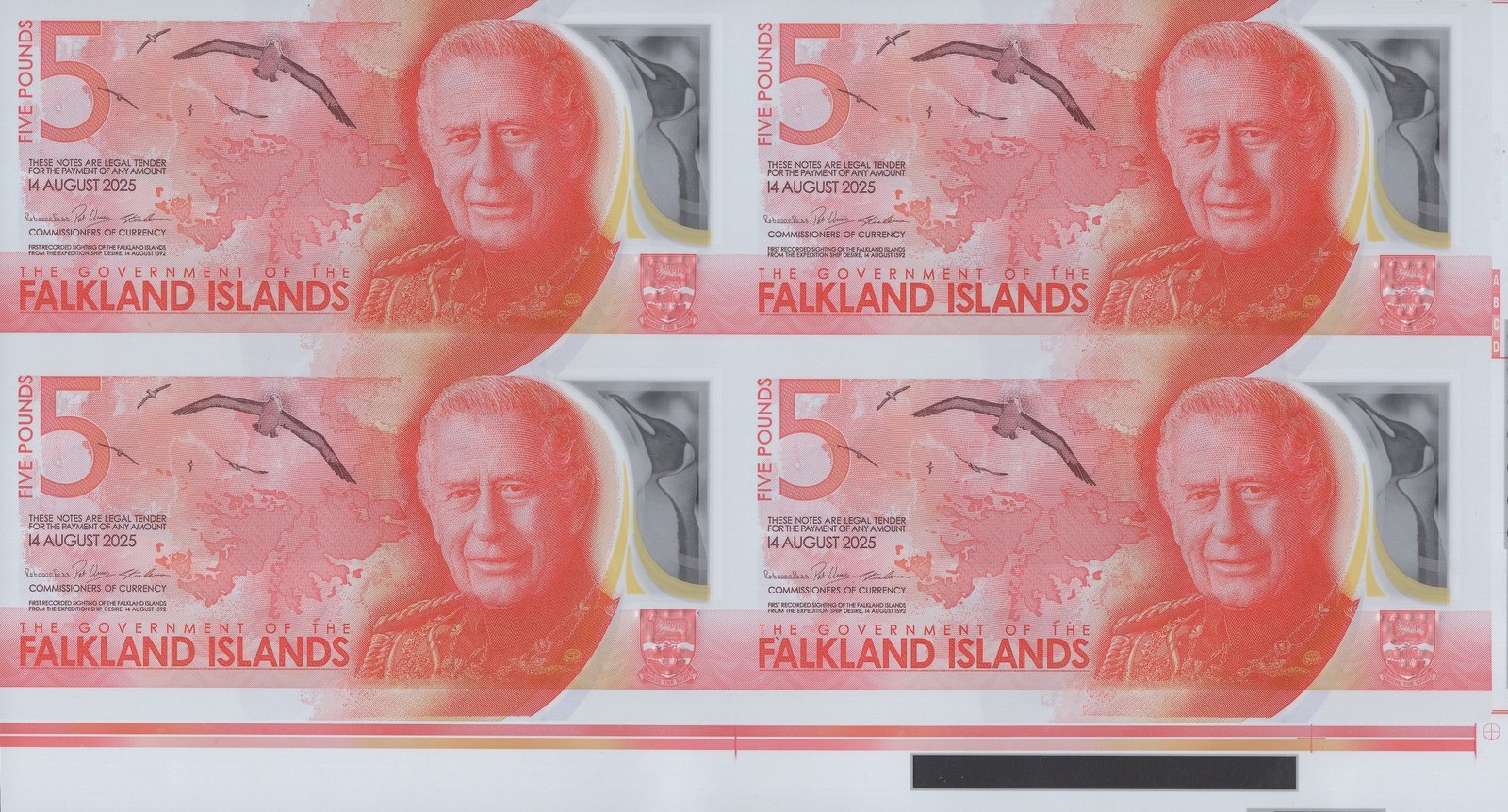
The catalogue pages say that the new notes circulate in parallel with the earlier paper issues. A public service announcement of the Treasury Department, published by the Falkland Islands Government on 4 December 2025, sets an end to that: the old paper notes of 20, 10 and 5 pounds cease to be legal tender from 30 April 2026, the Treasury will still exchange them after that date, and the paper 50 pounds remains legal tender and in circulation.
What the sources do not give
- The size of the printings of 1899 to 1920. The Gazette gives the notes received, the issue books give the numbers issued, and the last issue book of the 1 pound, from B 17070, has not been seen.
- The Treasury's registers after February 1967.
- A Gazette notice announcing the issue of any new design. None was found for 1951, 1960, 1967, 1969, 1975, 1983, 1984, 1986 or 1990.
- Lost or stolen note numbers, and forgeries. No such notice was found in any Gazette from 1899 to 1999.
- Whether the two styles of prefix reported on the polymer 5 pounds, and the prefix AA reported on the 20 pounds, are a change of style.
Sources
- The Treasury's note issue books and registers of currency notes, 1899 to 1967, Jane Cameron National Archives, Stanley.
- The Falkland Islands Gazette, 1899 to 2010, including the proclamation of 16 October 1899, the notice of 1 April 1941, the Treasury notice of 8 July 1966, the accounts of the Note Security Fund and the Currency Note Income Account, and the calling-in notice of 22 December 1992.
- Colonial Reports, Falkland Islands, for 1904, 1909, 1912 and 1921.
- Robert Chalmers, A History of Currency in the British Colonies (1893).
- Currency Notes Regulations Order 2004 and Currency Notes Order 2010, in the Falkland Islands Gazette.
- Falkland Islands Government, Treasury Department, public service announcement of 4 December 2025 on the withdrawal of the old paper banknotes.
- Auction descriptions: Heritage, 28 April 2017, lot 28305; 24 April 2020, lots 26096 and 26102; 23 October 2021, lot 28208; 6 December 2022, lot 23291. Spink, 26 April 2017, lot 1284; 4 October 2018, lot 1579; 17 April 2019, lot 441; 12 February 2021, lots 94 and 95. Stack's Bowers, 29 August 2025, lot 30257.
Member comments
Log in or register to post a comment.