From the first £5 and £1 notes of 16 October 1899 to the last pre-decimal notes of 1967, the Treasury in Stanley wrote every Falkland Islands note it issued into a book: the note's number, the day it went out and the day it came back to be cancelled. The books are in the Jane Cameron National Archives, the Falkland Islands Government archive in Stanley, which scanned them and for a time had the scans online.
We have checked them against every Falklands note recorded in this catalogue. The books give the day each issue went out, account for a block of £1 numbers that is never seen, and record single notes being sent to a museum in Rome and to the national bank in Vienna.
The documents
The archive replaced its website in September 2026, and the scanned files no longer load there. The Wayback Machine had saved 366 of them, 55,325 pages. We downloaded them all and sorted them by subject:
- The Treasury's note books, 1899-1967 (40 files, 1,332 pages). There are two kinds. The issue books of 1899 to 1920 are ruled ledgers headed "Commissioners of Currency"; for each note they give its number, its date of issue and the date it was cancelled, with a column for remarks. The registers of 1921 to 1967 (GOV-TCU-6 to GOV-TCU-14) are printed books of numbered lines, one book for each block of £1, 10 shilling or £5 notes. A date "put into circulation" is bracketed over each run of numbers, and a date of cancellation is entered against each note. All the entries are written by hand.
- Laws and ordinances, 1843-1981: the Currency Note Order of 1899, the Currency Notes Ordinance of 1930 and the rules made under it, the wartime regulations, the decimal laws.
- Blue Books, 1854-1944: the yearly returns of the colony, listing its officers, among them the Commissioners of Currency who signed the notes.
- Colonial Annual Reports, 1887-1975: each has a paragraph on the currency and gives the value of notes in circulation.
- Estimates (budgets), 1883-1999, and the Legislative Council minutes and proceedings, including the debate on the Currency Ordinance of 1987.
- The Falkland Islands Gazette, 1846-2021 (184 files, 51,359 pages), with its general index. It printed the government's official notices, among them every currency order and notice, the appointments of the Commissioners and the Treasury's yearly accounts.
A note's own line in the register
We found 187 of the Falklands notes recorded in this catalogue in the Treasury's books. 184 of them have no cancellation entered against them, as is to be expected of notes that are still in collections. Each one now has an archive record on its variety page, giving the day the Treasury put it into circulation: Noonans' P-1b 10 shillings C 09273, for example, went out on 6 October 1933.
The notes we could not find are ones the scans do not reach: £5 notes above C 31400 (the registers stop in February 1967), 10 shillings above C 74040, and the 5 shillings of 1916.
When each date was really issued
The date printed on a note is not the day it went into circulation, and the gap can be long:
| Note | Printed date | First put into circulation |
|---|---|---|
| 10 shillings, £1 and £5 | 1 February 1921 | 17 October 1921 (£1, £5), 4 November 1921 (10/-) |
| £1 | 10 January 1927 | 23 December 1927 |
| 10 shillings | 10 January 1927 | 19 May 1931 |
| 10 shillings, £1 | 10 February 1932 | 23 June 1933 (10/-), 22 August 1934 (£1) |
| £5 | 10 February 1932 | 21 March 1934 |
| 10 shillings, £1 | 19 May 1938 | 28 December 1939 |
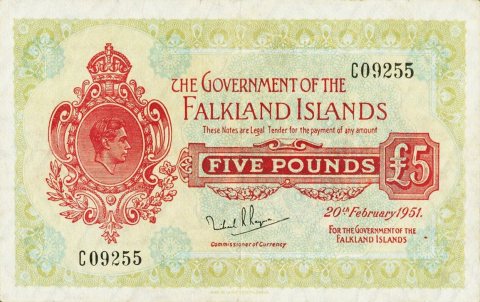
| £5 | 20 February 1951 | 28 May 1953 |
| £5 | 10 April 1960 | 13 February 1961 |
Notes with old dates also went on being issued: £5 notes dated 1921 were still going out in October 1933, £1 notes dated 1932 until February 1939, and 10 shillings dated 1938 until July 1966.
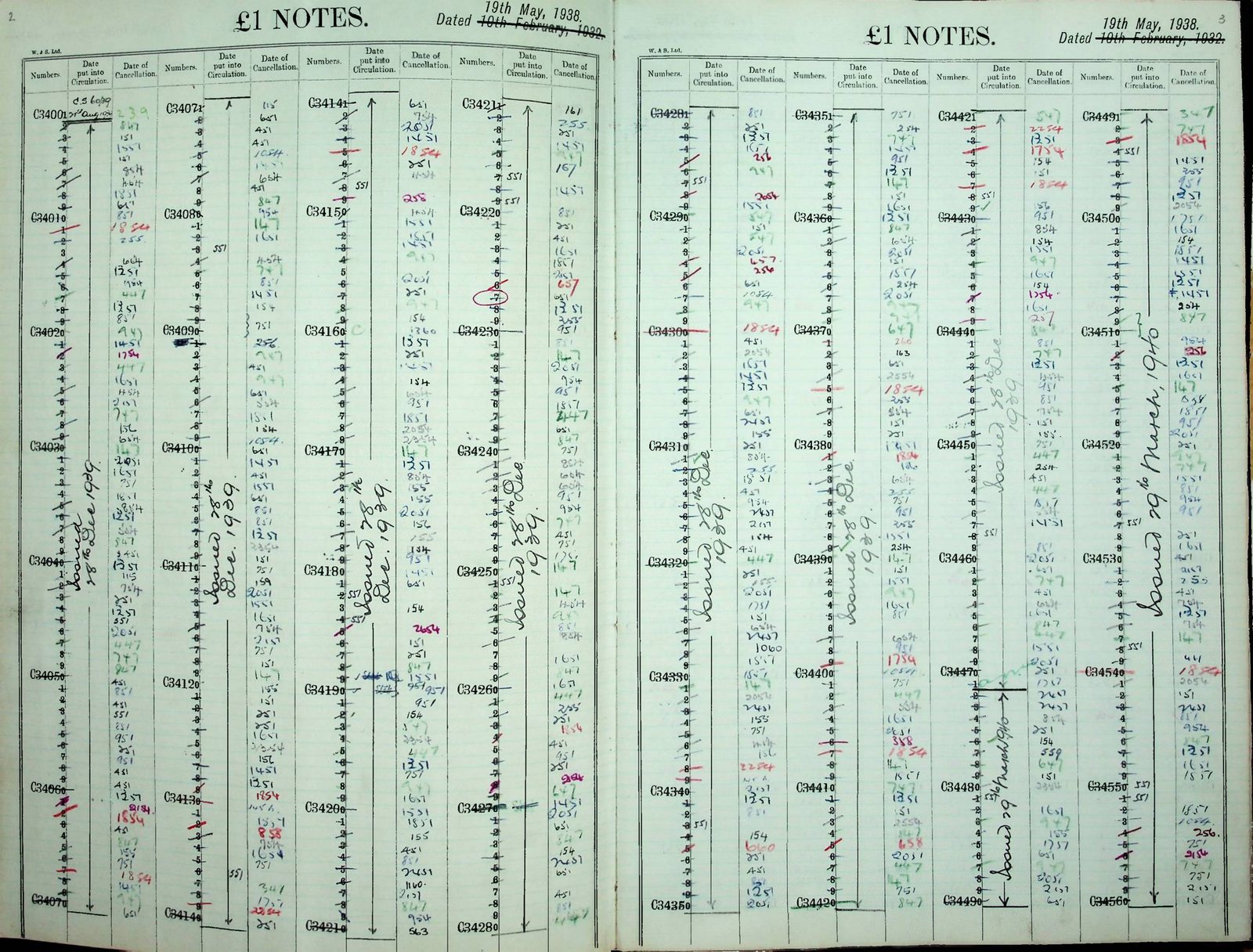
Up to 1938 the registers have the date of the notes they hold printed at the head of each page. When the 1938 notes arrived, the Treasury did not wait for new books and corrected the heading by hand:

The £1 notes C 44001 to C 54000
The registers of £1 notes run from C 00001 to E 14000 with one block missing: there is no register for C 44001 to C 54000. A defence regulation of 29 March 1941 forbade anyone to bring into the colony "any One Pound (£1) Falkland Islands Currency Note bearing the numbers C.44,001 to C.54,000", and the ban was repeated in 1947. Neither gives a reason.
The register book printed for those numbers survives. It was used for the next block instead, with every number corrected by hand in red:
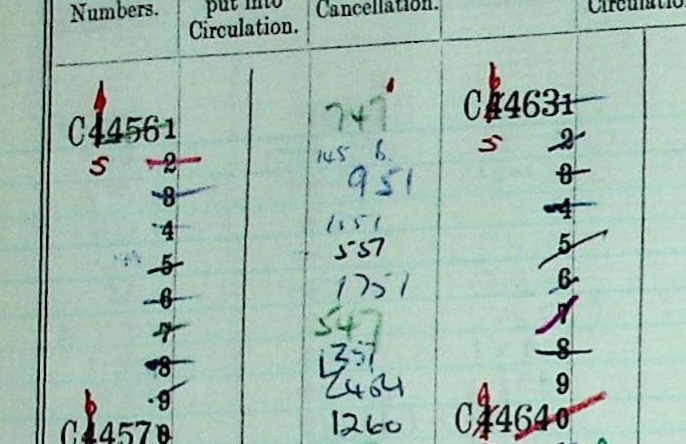
The reason is in the Gazette. A notice of 1 April 1941 says that 10,000 £1 notes, ordered through the Crown Agents in September 1940, never left the printers: "While these notes were still in the hands of the Printers awaiting transhipment they were destroyed by fire." Because some finished notes might have been taken while the fire was being fought, the numbers C 44001 to C 54000 were declared valueless. The notice gives neither the printer nor the date of the fire. A £1 of 19 May 1938 (P-5) numbered between C 44001 and C 54000 would be one of those notes, and should be looked at closely.
Only 8,400 of the 1951 £5 notes
The register of £5 notes that begins in 1953 has a note in the top margin, against C 12400:

Indent 39/51 is the order of 1951. 8,400 notes counted from C 04001 end exactly at C 12400, and the next notes, from C 12401, went out from 13 February 1961, after the new design dated 10 April 1960. The £5 of 20 February 1951 (P-6) therefore seems to run from C 04001 to C 12400 and to have been put into circulation between May 1953 and December 1960. The register prints no note date in these years, so this rests on the order number and the count.
1914: burning the notes before the battle
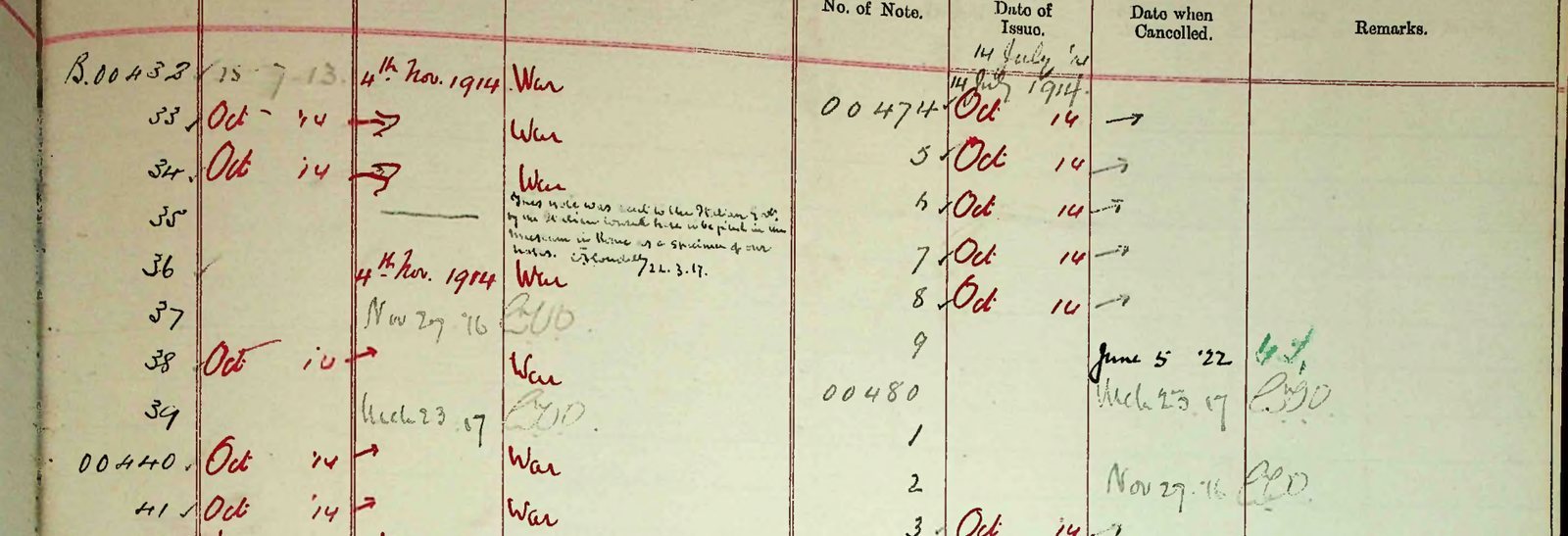
In the issue books of 1899 to 1914, whole pages of notes are cancelled in red ink with the one word "War". A certificate in the book gives the reason. In October and November 1914, when the German squadron under Admiral von Spee was expected to raid the islands, Governor Allardyce had a large number of notes destroyed without the usual formalities, and the gold reserve was sent to London. The squadron was destroyed off the islands on 8 December 1914, and the notes were then replaced: the £5 notes B 00538 to B 00937 were issued that same day.
Notes followed one by one
The remarks column says what became of particular notes:
- Kept as specimens. On 12 August 1910 a £5, a £1 and three 5 shillings notes were cancelled and marked "Retained as Specimen": A/1 00040, A/1 00032, A/1 01095, A/2 00005 and B 00001.
- Sent to a museum. On 16 September 1912 four more were cancelled and marked "(Museum)": £5 A/1 00238, £1 A/1 03920 and 5 shillings A/1 01018 and A/2 00014. The book does not name the museum.
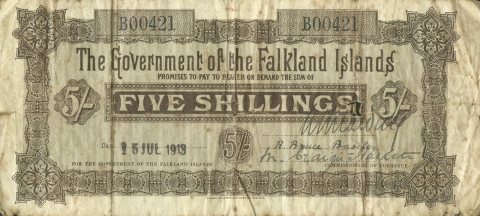
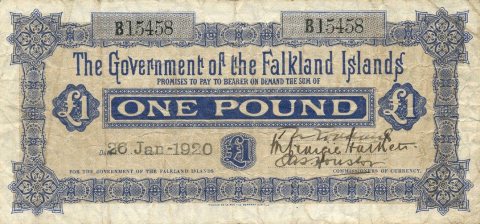
- Sent to Rome. In March 1917 the 5 shillings B 00435 was sent to the Italian government through the Italian consul in Stanley, "to be placed in the Museum in Rome". The consul was James Houston, whose own signature is on the £1 notes of 1918 and 1920.
- Sent to Vienna. On 9 August 1954 two 10 shillings notes were withdrawn, cancelled and "forwarded to the National Bank of Vienna as specimens". Their numbers are not given. The Note Security Fund account for 1954-55, printed in the Gazette, lists the same "Specimen Notes sent to The National Bank, Vienna", and also a specimen note sent to the police in Paris.
- Lost. A minute of April 1910 reports a £5 and a £1 lost; the £1 seems to have come back to the Treasury in 1917.
- Kept in the book. A cancelled 10 shillings of 1938 is still taped into the register of 1955-1960.
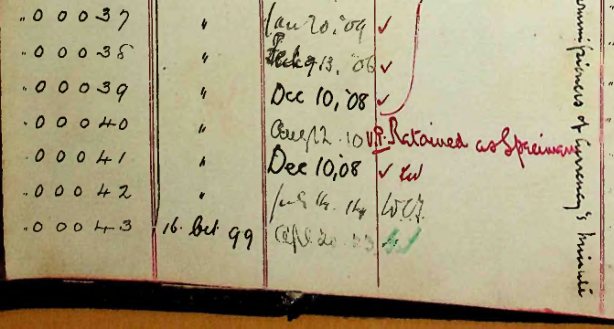
All of these notes are now in this catalogue's serial registers, with the archive given as their source. Where they are today is not known.
Three cancelled notes and 19 May 1931
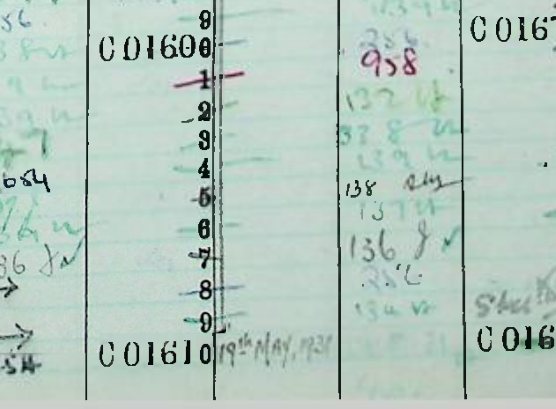
This catalogue records three George V notes with CANCELLED written by hand across the face: the 10 shillings C 06001, the £1 C 16493 and the £5 C 01610. The registers show all three going out on 19 May 1931, the day the Currency Notes Ordinance of 1930 came into force and the Treasurer became the colony's only Commissioner of Currency. They do not say why the notes were cancelled.
What the laws and reports add
- The Currency Note Order in Council of 7 March 1899 set up a Board of Commissioners of Currency: the Colonial Secretary, the Treasurer and one person named by the Governor. That is why the early notes carry three signatures.
- The Colonial Report for 1904 says the brown 5 shillings replaced the green one that year, so that it could be told apart more easily from the other values.
- The 10 shillings was new in 1921: the report for that year records 6,000 received with the new design.
- The Currency Notes Ordinance of 1930 came into force on 19 May 1931; from then on the Treasurer alone signed.
- The notes of 1899 to 1920 stopped being legal tender on 1 January 1935, though the Treasury still paid them.
- The Currency Notes Rules of 1939 set one size for the £5, £1 and 10 shillings: 5¾ by 3⅝ inches.
- The 50 pence note came in with decimal currency on 15 February 1971, and the £10 on 1 July 1975.
- In 1991 the Legislative Council passed a bill to validate every note issued "on or after the 14 June 1983", the day of the commemorative £5.
What the Gazette adds
The Falkland Islands Gazette printed the government's notices, and the currency appears in it from the Order of 1899 to the notes of 2011. It adds these points:
- Why the 5 shillings changed colour. The report printed in 1906 says the green notes "by lamplight were liable to be mistaken for one Pound Notes", which is why the brown one replaced it.
- Who signed. Appleyard, on the first 5 shillings, was C. W. Appleyard, acting Colonial Secretary from June 1900; George Hurst signs the 1908 notes because he was acting Treasurer from 30 March 1908; and in 1913 Craigie-Halkett and Baseley were made acting Commissioners. M. R. Raymer, who signs the £5 of 1951, held the posts of Colonial Secretary and Treasurer together in 1950-51.
- A puzzle of 1918. The £1 notes dated 14 August 1918 are signed by St. Johnston, Thompson and Houston, but St. Johnston only took office as Colonial Secretary on 15 September 1919, and Thompson was on leave from April 1919 to December 1920. The three cannot have signed on one day.
- 19 May 1938, the date on the George VI notes, was the last day in office of the Treasurer, M. J. Stewart, before his leave.
- The early notes written off. In 1966 the Treasury stopped counting the 243 notes of 1899-1920 still outstanding, regarding them as "irretrievably lost or held as collectors' pieces".
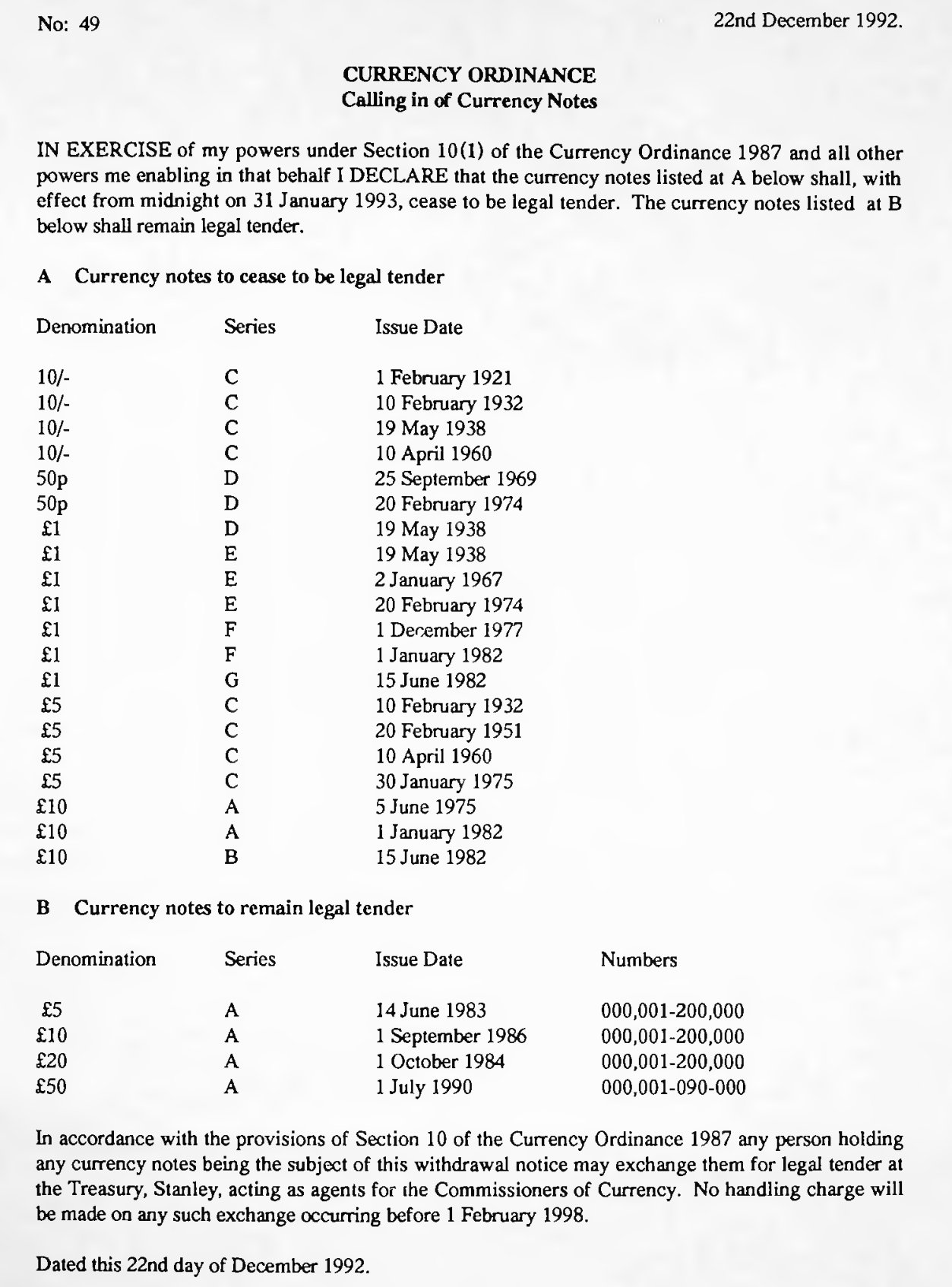
- When the notes stopped. The £1 notes of the C series ceased to be legal tender on 1 January 1967, the £1 of 1984 on 1 February 1991, and every other older note on 1 February 1993.
- The modern issues. The notes of 1983 were smaller than the Rules allowed, and the £50 bears only one Commissioner's signature, so both were made valid by an Ordinance of 1991. The Orders of 2004 and 2010 give 200,000 notes each for the £5 of 2005 and the £10 and £20 of 2011, numbered from B 000001 and printed by De La Rue.
- How many were printed. The Treasury's accounts record 20,000 £5 notes in 1964-65, 30,000 £1 notes in 1967-68 and 20,000 50 pence notes in 1970-71.
The calling-in notice of 22 December 1992 lists every series withdrawn and gives the numbers of the four notes that stayed in use:
No Gazette gives the numbers of lost or stolen notes, mentions forgeries or names the printer of the early notes, and there is no Gazette between 26 March and 7 July 1982.
Dates with no known note
The issue books also record notes of dates that no collection, museum or sale is known to hold, such as £1 notes issued on 21 September 1915, 16 November 1915, 17 March 1916 and 1 May 1918, and £5 notes of 27 November 1916 and 29 August 1919. This catalogue now lists them as varieties of their own, marked as known only from the Treasury's books. If you have one, please tell us.
Not in the scans
Registers after February 1967, a later volume of the £1 book of 1917-1920, and the 5 shillings book after 1914 are not among the archive's scans.
Sources
Every document here is held by the Jane Cameron National Archives, Stanley, Falkland Islands, and is named by the archive's own reference.
- The Treasury's note issue books, 1899-1920: Falkland Islands Currency Note Issue Book, 1899 to 1914, Parts 1 and 2 (GOV/TCU/3), and the Commissioners of Currency Note Issue Books of 1915 to 1920.
- The registers of notes put into circulation, 1921-1967: £1 notes GOV-TCU-6 to GOV-TCU-10, 10 shilling notes GOV-TCU-11 and GOV-TCU-12, £5 notes GOV-TCU-14. The pictures come from GOV-TCU-6-4, GOV-TCU-7-1, GOV-TCU-14-1 and GOV-TCU-14-3.
- Laws and ordinances: the Orders in Council, Proclamations and Regulations of 1900-1914, the bound Ordinances, Rules and Regulations of 1920-1981, and the Laws of the Falkland Islands in force on 31 December 1950.
- The Blue Books, 1854-1944, and the Colonial Annual Reports, 1887-1975.
- The Falkland Islands Gazette, 1846-2021, with the archive's general index of 1850-1998. Among the notices used: the defence regulation of 29 March 1941 and the notice of 1 April 1941 on the £1 notes C 44001 to C 54000; the Treasury Notice of 8 July 1966; the Currency Notes (Validation) Bill of December 1990; Notice No. 49 of 22 December 1992 (pictured); the Currency Notes Regulations Order 2004 and the Currency Notes Order 2010.
The archive made the scans and had them online on its earlier website; the copies used here were saved by the Internet Archive's Wayback Machine. The original books can be seen at the archive in Stanley by appointment: write to [email protected].
Member comments
Log in or register to post a comment.