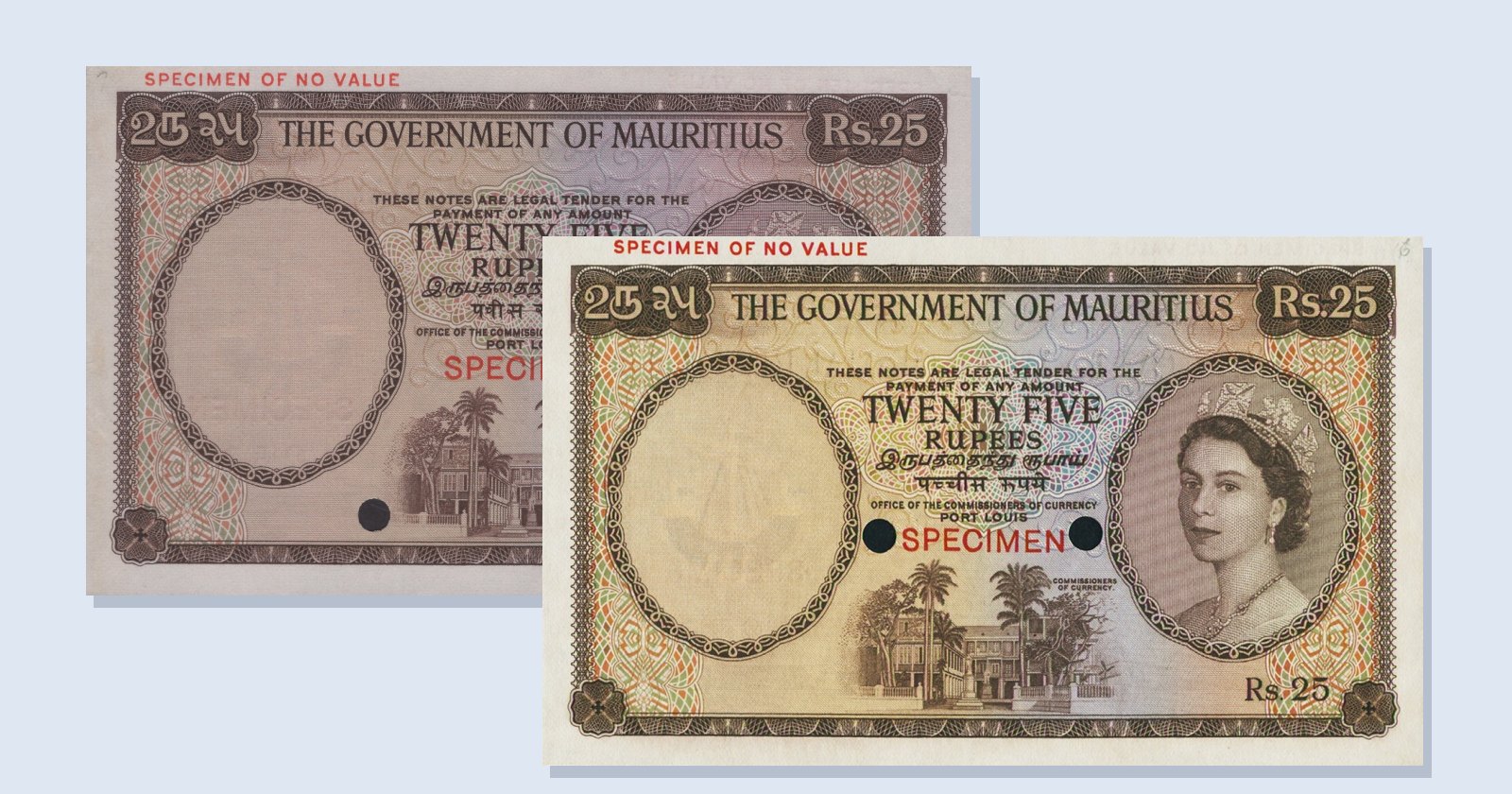
On 15 October 1954 Mauritius issued its first notes with Queen Elizabeth II: 5, 10, 25 and 1,000 rupees, printed by Bradbury Wilkinson. Like the King's notes before them, they give the value in three languages: English, then Tamil, then Hindi. The Hindi line of the first printing carries one of the best-known mistakes on the banknotes of the Empire.
The colour trials of the issue show both the mistake and its correction. Every recorded trial was read against its photograph. The 5 rupees exists in two settings and the 25 rupees in three, and the Hindi line is what separates them.
The mistake in the Hindi line
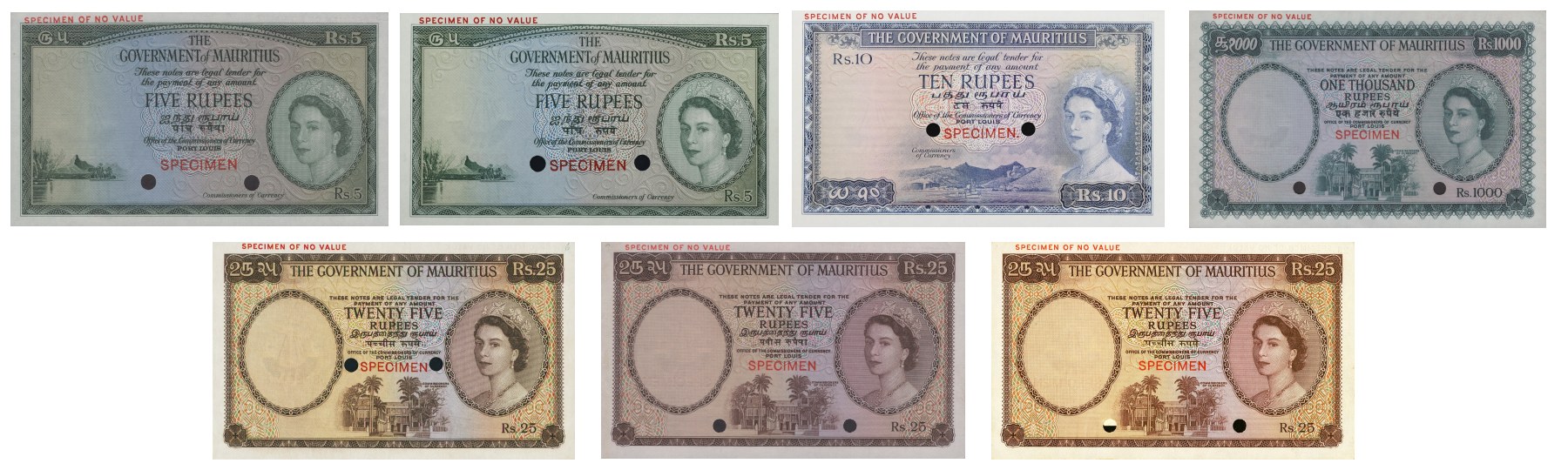
On the first printing, signed by the Commissioners of Currency Hinchey and Harvais, the Hindi denomination uses the singular form of the word rupee, रुपैया (rupaiya). Five rupees should take the plural, रुपये (rupaye). The line was corrected for the next printing, signed by Wilson and Harvais in 1955, and every later note carries the plural.
You do not need to read Hindi to see it. Look at the length of the last word: the singular रुपैया is longer than the plural रुपये. The 10 rupees changes the same way (दस रुपैया to दस रुपये).
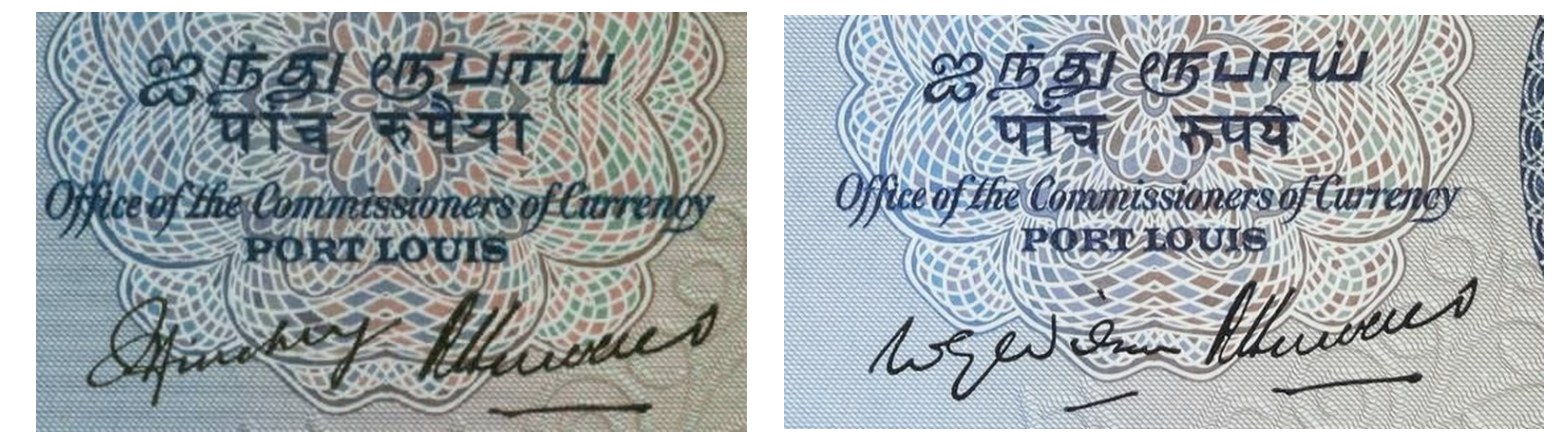
On the 25 rupees the number word was reset too. The first printing spells twenty-five पचीस, with a single च; the corrected notes spell it पच्चीस, with the च doubled into a conjunct, so the word looks tighter and narrower.
What a colour trial is
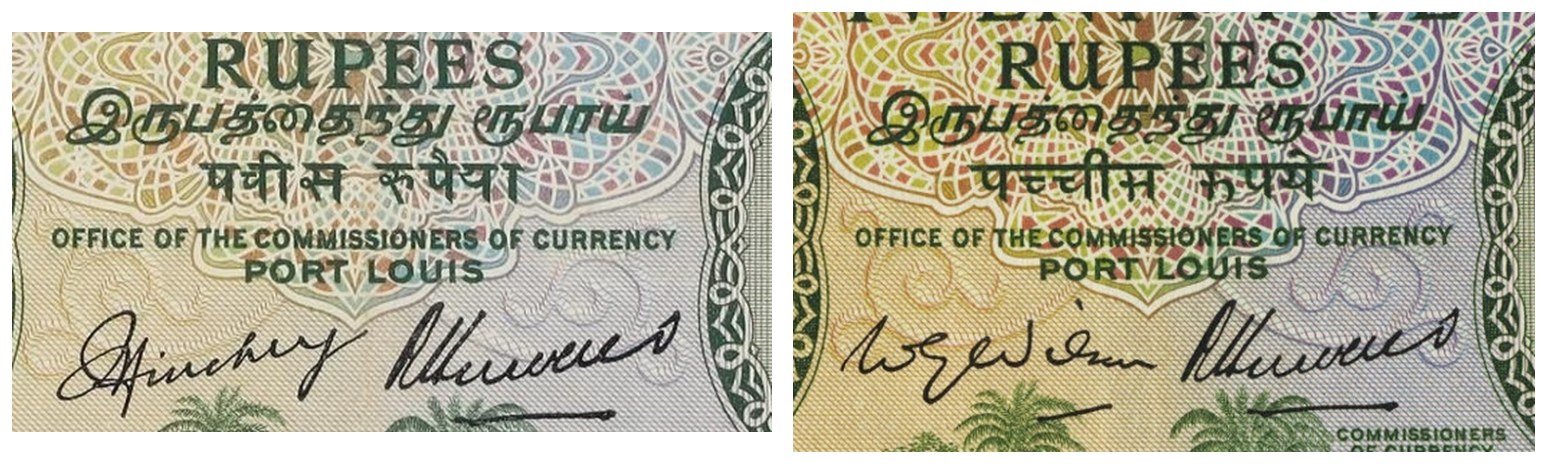
A colour trial is a finished note printed in colours other than the issued ones, so the government could choose. The Mauritius trials have no serial number and no signature; they carry SPECIMEN OF NO VALUE in red at the upper left of both sides, a red SPECIMEN across the note, two punch holes, and a specimen number. The 5 rupees was tried in green, the 10 in blue, the 25 in brown, and the 1,000 with a green front and a brown back.
Which Hindi line does each trial carry? Had all the trials been made before the notes went out, all of them would show the mistake. They do not.
The 5 rupees: two settings
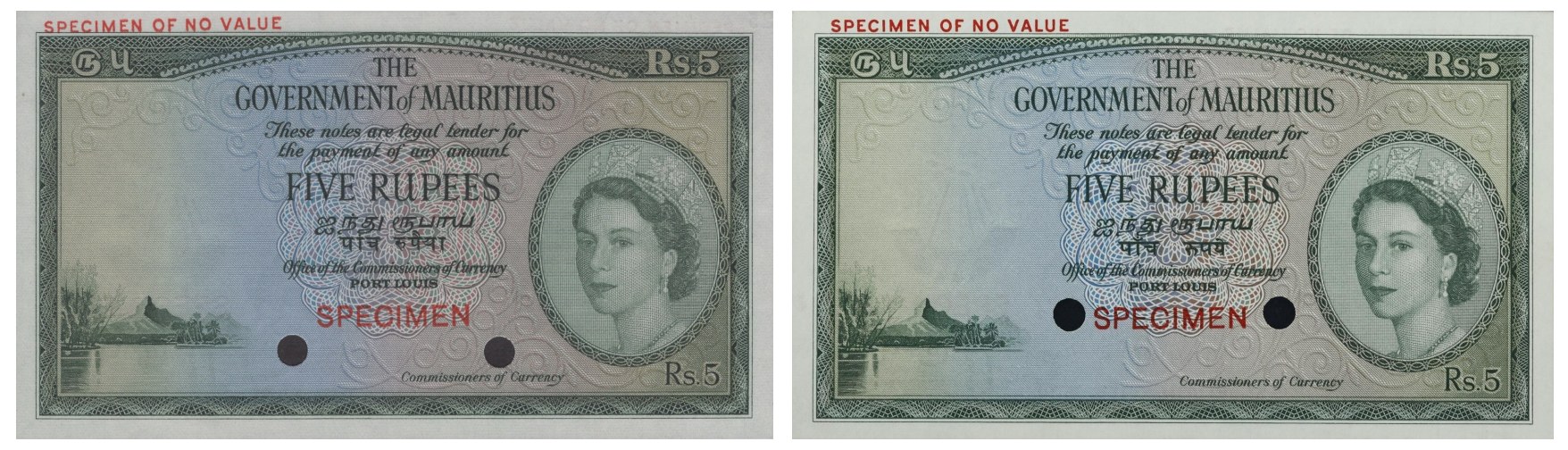
- P-27cts has the first-printing line, पाँच रुपैया, and its two punch holes sit below the red SPECIMEN.
- P-27cts2 has the corrected line, पाँच रुपये, and its punch holes are level with SPECIMEN, one either side of the word.

The two tells always agree. No recorded note has the singular with the level holes, or the plural with the low ones. When a sale shows the note in a holder and the Hindi is too small to read, the punch holes settle it.
The 25 rupees: three settings
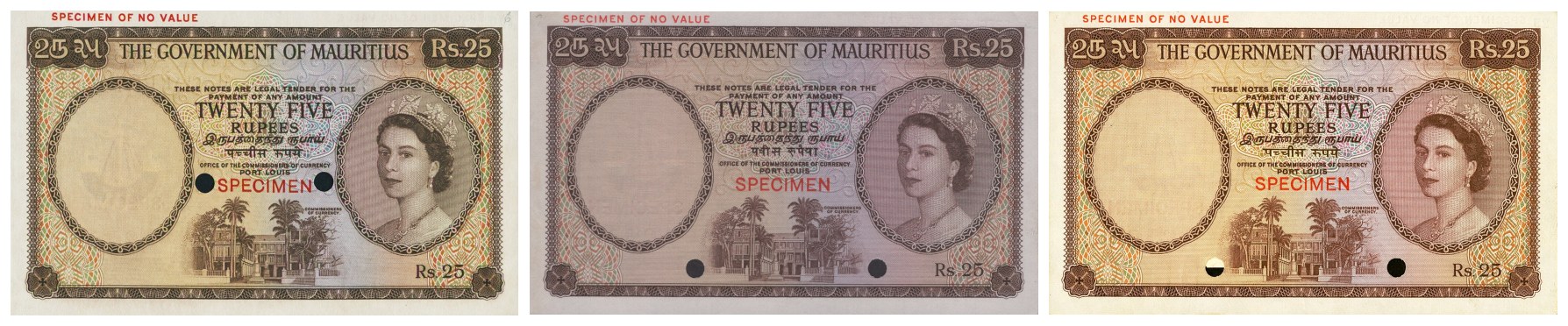

- P-29cts: the corrected line, पच्चीस रुपये, with the conjunct and the plural; punch holes high, one either side of SPECIMEN.
- P-29cts2: the first-printing line, पचीस रुपैया, without the conjunct and in the singular; punch holes low, flanking the foot of the Government House vignette.
- P-29cts3: one note so far. It has the corrected line of P-29cts but the low holes of P-29cts2, so it sits between the other two.
Why the trials show both spellings
The 5 and 25 rupees trials exist with the singular of the first printing and with the corrected plural. Trials printed only before the first notes went out could not show the correction. The likeliest explanation is that trials were still being made after the Hindi had been put right, so they record the line both before and after the change. P-29cts3 has the low punch holes of the first-printing setting but the corrected wording, and may come from the change itself. No printer's record has been found to confirm the order. This is a reading of the evidence, not an established fact.
The 10 and 1,000 rupees: one setting each
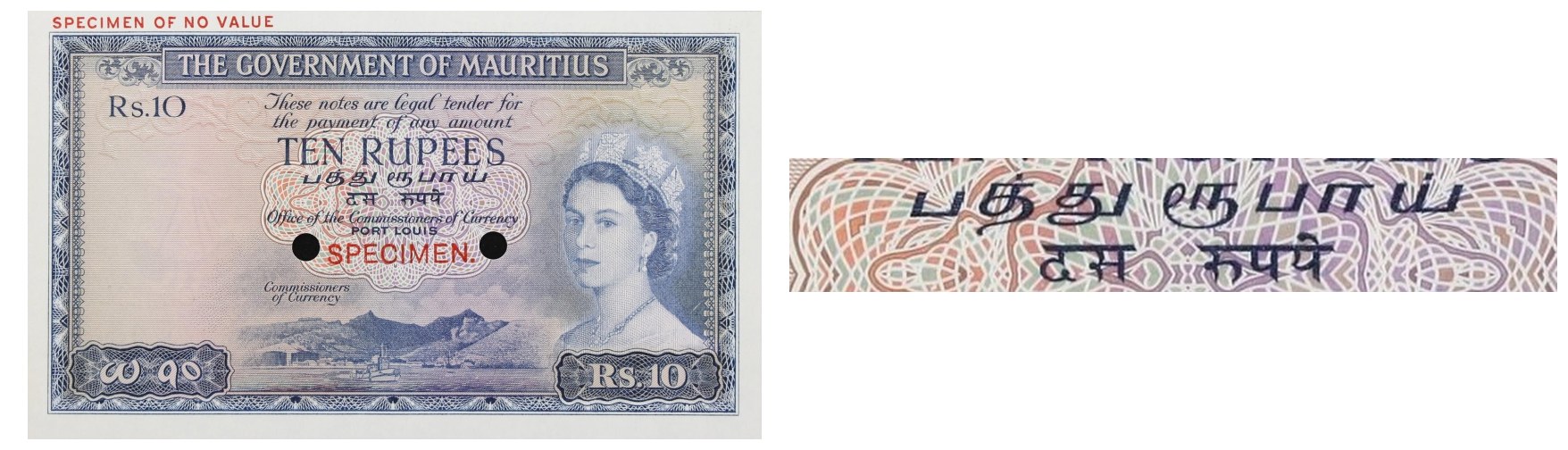
The 10 rupees trial was checked the same way and does not split. Every note read so far has the holes level with SPECIMEN and the corrected line, दस रुपये. No 10 rupees trial with the first-printing mistake is known. One with the singular, or with its holes placed differently, would be new.
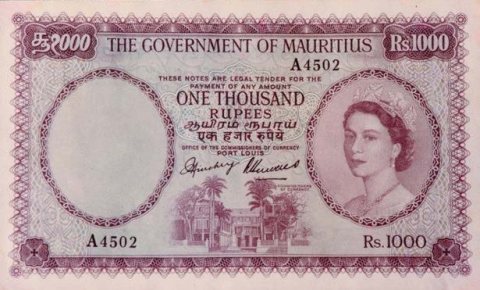
The 1,000 rupees trial, green on the front and brown on the back, is known in one setting. The 1,000 rupees was only ever issued with the first-printing signatures. Its Hindi is a case of its own: spelled like the singular of the other first-printing notes, but ending in the plural.
How to tell them apart
- Find the Hindi line under the Tamil, just below the English value.
- 5 rupees: a longer last word (रुपैया) is P-27cts; a shorter one (रुपये) is P-27cts2. Holes below SPECIMEN, P-27cts; level with it, P-27cts2.
- 25 rupees: a tight first word with the doubled च (पच्चीस) is P-29cts or P-29cts3; a wider one (पचीस) is P-29cts2. Then the holes: high is P-29cts, low with the tight word is P-29cts3, low with the wide word is P-29cts2.
- 10 and 1,000 rupees: one setting each so far, but check anyway.
Every Elizabeth II colour trial of Mauritius, in order
| # | Pick | Value | Colour | Hindi line | Punch holes |
|---|---|---|---|---|---|
| 1 | P-27cts | 5 Rupees | green | singular, as P-27a | below SPECIMEN |
| 2 | P-27cts2 | 5 Rupees | green | plural, as P-27b - P-27e | level with SPECIMEN |
| 3 | P-28cts | 10 Rupees | blue | plural, as P-28b and P-28c | level with SPECIMEN |
| 4 | P-29cts | 25 Rupees | brown | plural with the conjunct, as P-29b and P-29c | high, beside SPECIMEN |
| 5 | P-29cts2 | 25 Rupees | brown | singular without the conjunct, as P-29a | low, at the vignette |
| 6 | P-29cts3 | 25 Rupees | brown | plural with the conjunct, as P-29b and P-29c | low, at the vignette |
| 7 | P-29Acts | 1,000 Rupees | green front, brown back | the 1,000 rupees' own spelling | two |
Each variety page has the photographs and the close-ups of these tells. The serial register and the sales history of every trial are there for NumiCrown Pro members.
Mauritius has two earlier colour trials, both from the George V issue of 1934 and printed by Waterlow: the 5 rupees in brown and the 10 rupees in green. Each is recorded in a single setting.
Member comments
Log in or register to post a comment.