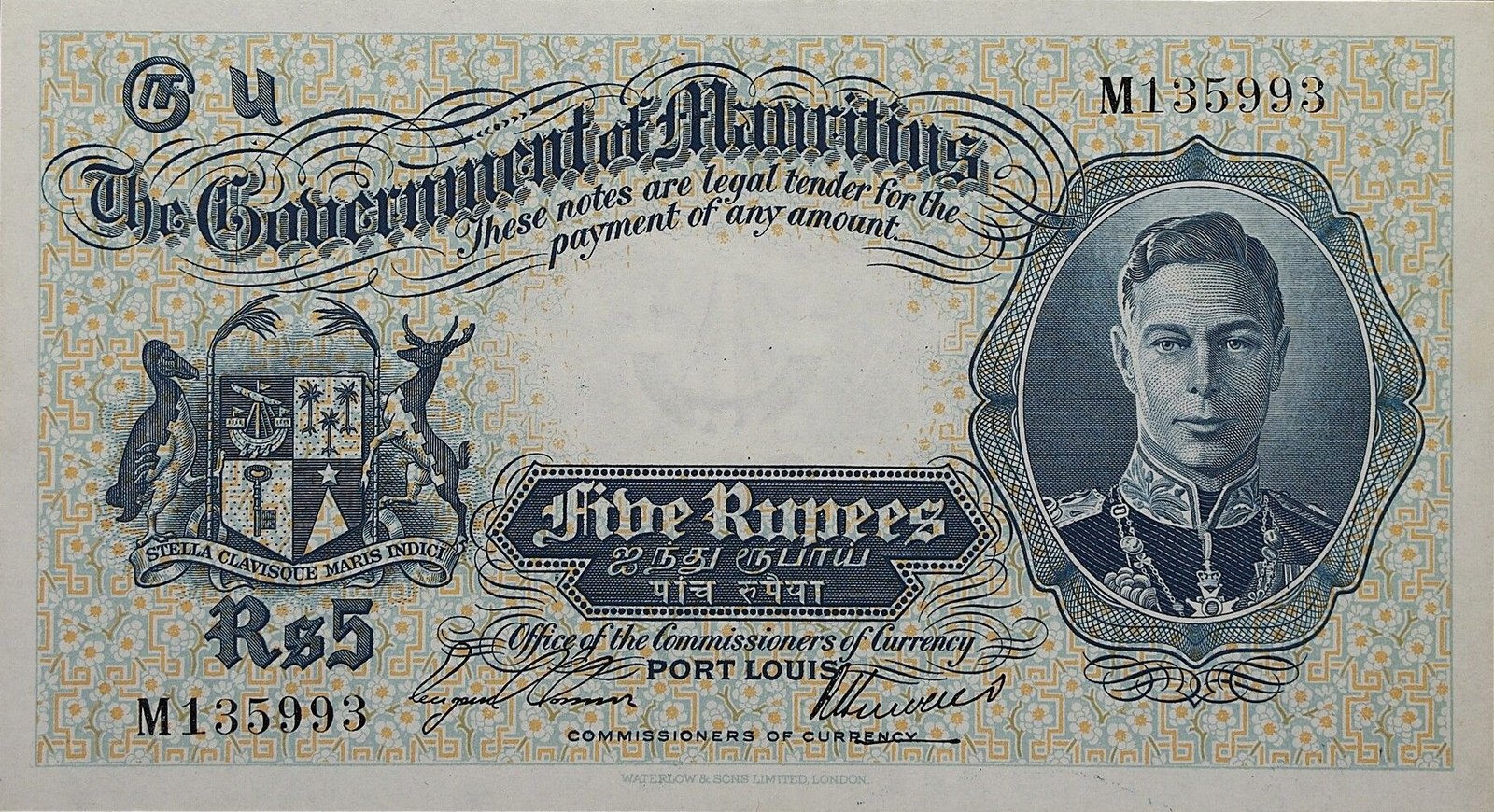
The notes of the Government of Mauritius were signed by two members of a Board of Commissioners of Currency. This article sets out who sat on that Board and when, as far as official papers show it: the statements the Commissioners signed in the Mauritius Government Gazette, the Mauritius Blue Books, two almanacs, the Colonial Office Lists and papers in the National Archives. For the Bank of Mauritius the source is the Bank's own annual reports. The pairs on the notes themselves are set out in the four earlier articles, beginning with The Government of Mauritius notes, 1860 to 1934.
Who the law put on the Board
| From | The Board | Law |
|---|---|---|
| 1849 | The Colonial Secretary, the Auditor General and the Colonial Treasurer | Ordinance 6 of 1849; again Ordinance 10 of 2 May 1864 |
| 1876 | The Colonial Secretary, the Receiver General and the Auditor General | Ordinance 28 of 1876 |
| 1912 | The Colonial Secretary, the Receiver General and the Collector of Customs | after Ordinance 3 of 1912 abolished the post of Auditor General (Mauritius Almanac for 1920) |
| July 1941 | The Accountant General and two other persons holding public offices, chosen by the Governor | Ordinance 38 of 1941 |
The Commissioners' statements of 1935 are signed by the Colonial Secretary, the Treasurer and the Collector of Customs. Under the Ordinance of 1864 every note bore the signatures, or facsimiles, of the Commissioners or any two of them, and a signer had to be in office on the date the note bears.
The Board before the rupee, 1849 to 1876
Bolton's Mauritius Almanac for 1851 names the three Commissioners of the Currency as C. J. Bayley, Colonial Secretary, W. W. R. Kerr, Auditor General, and Rawson W. Rawson, Treasurer and Paymaster General. The rupee notes of those years were signed by a Manager of the Currency: a 5 rupees of 5 June 1848 reported in the IBNS Journal (27:1, 1988, p. 4) is signed Macaulay and Ormsby.
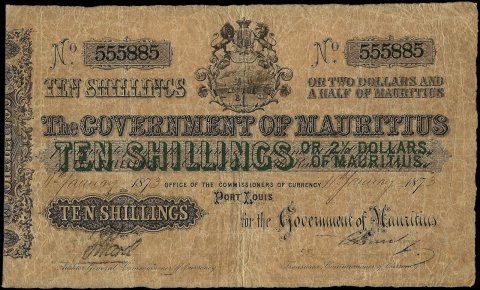
By 1858 the Manager had gone. A Statement of the Financial Officers of 7 October 1858 (National Archives T 1/6213B) is signed by H. Sandwith, Colonial Secretary, Felix Bedingfeld, Treasurer, and W. W. R. Kerr, Auditor General, as Managers or Commissioners of the Currency without salary, an office which under Mr Macaulay had carried a salary of 1,000 pounds a year. Bedingfeld also signed, as Chairman, the report of the committee that planned the 10 shillings and 1 pound notes of 1860. The archive spells the name Bedingfeld in both script and print; Spink's catalogue of 3 October 1996 prints Bedingfield (lot 1071) and Beddingfield (lot 1072).
Kerr changed chairs. The Blue Book accounts of 1847 and 1848 are signed W. W. R. Kerr as Auditor General, and the Statement of Liabilities and Assets of 31 December 1865 is signed W. W. R. Kerr, Treasurer. One point is open. The Mauritius Almanac for 1920 (p. B. 59) lists the head of the Treasury and the Auditor General year by year from 1851 to 1919. It shows Bedingfeld at the Treasury from 1855 to 1859 and Kerr as Auditor General from 1846 to 1859 and at the Treasury in 1862 and 1863 and from 1866 to 1871, while Spink (3 October 1996, lots 1071 and 1072) reads the notes of August 1860 as signed by Kerr as Auditor General and Bedingfeld as Treasurer. The Almanac's list has not been set against a note with a readable signature.
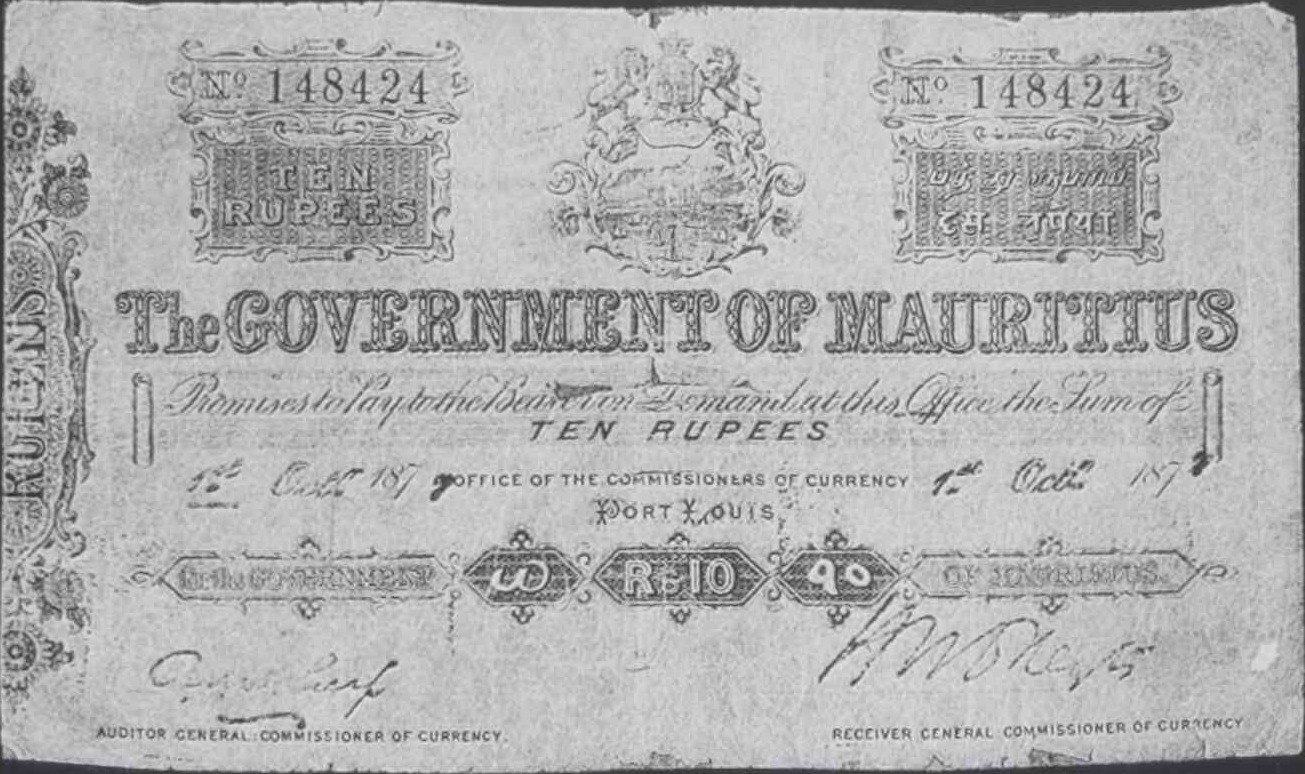
For the first rupee notes of 1876 the Gazette gives one name: H. N. D. Beyts, Receiver General, signed the account of the Commissioners for December 1877 on 3 January 1878.
The Board on the dated statements, 1906 to 1926
The monthly statements in the Gazette carry the Commissioners' signatures. Those read so far:
| Statement signed | Colonial Secretary | Receiver General | Auditor General |
|---|---|---|---|
| 26 December 1906 | Graham Bower | James J. Brown | D. S. MacGregor |
| 24 July 1907 | D. C. Cameron (Acting) | G. A. Banbury | D. S. MacGregor |
| 15 July 1910 | G. Smith | G. A. Banbury | Allan Grannum |
| January 1919 | H. C. Scroggs signs as Receiver General | post abolished | |
| 1923 | A. Grannum | ||
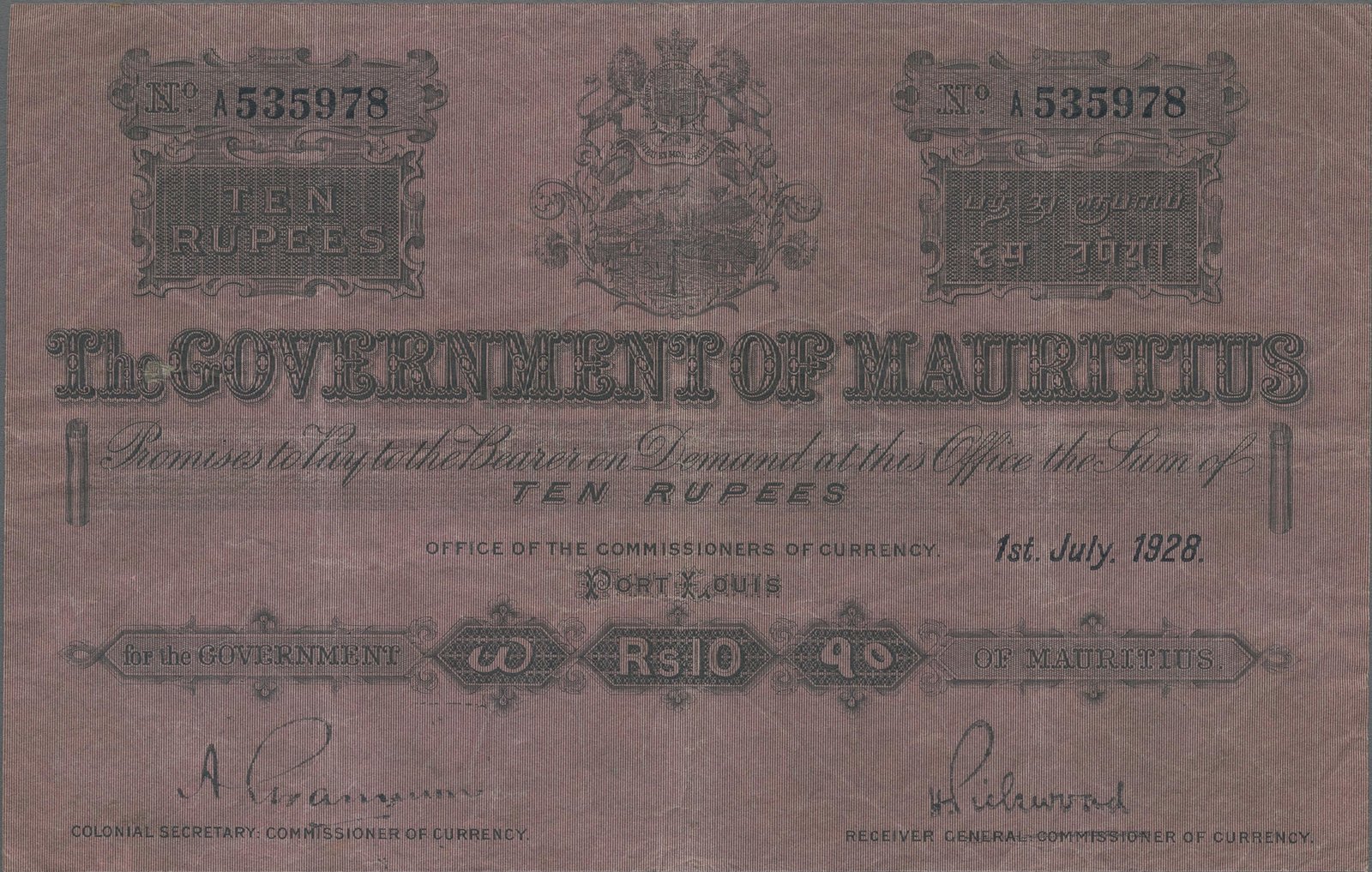
| 1926 | A. Grannum | H. Pickwoad |
The Blue Books and the Colonial Office Lists give the dates of appointment:
| Officer | Office and date | Source |
|---|---|---|
| James John Brown | Receiver General from 1 June 1897; acting Colonial Secretary 1 January to 22 May 1902 | Mauritius Blue Books for 1897 and 1902 |
| George Royer Dick | Auditor General from 29 January 1899 | Mauritius Blue Book for 1902 |
| George Alexander Lethbridge Banbury | Receiver General, 4 February 1907 | Colonial Office List 1912 |
| Edward Allan Grannum | Auditor General, 23 April 1909; Receiver General from 16 January 1912; seat on the Executive Council as Colonial Secretary from 9 August 1923 | Colonial Office List 1922; Mauritius Almanac for 1920; Mauritius Blue Book for 1923 |
| Harold Charles Scroggs | Collector of Customs from 1 November 1910 | Mauritius Almanac for 1920; Colonial Office List 1921 |
| Howell Pickwoad | Receiver General, October 1923; seat on the Executive Council from 21 November 1923 | Colonial Office List 1929; Mauritius Blue Book for 1923 |
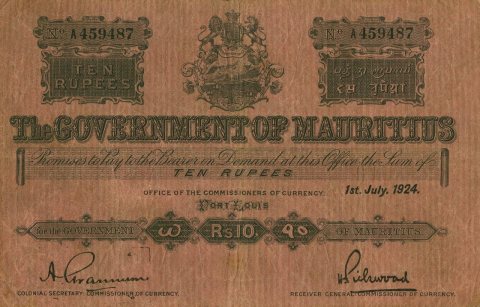
These fit the pairs on the 5 rupees, 10 rupees and 50 rupees of 1907 to 1930: MacGregor and Banbury in 1907, Grannum and Banbury from 1909 to 1911, Scroggs and Grannum from 1913 to 1920, Grannum and Pickwoad from 1924. The term of D. S. MacGregor has not been found in any List or Blue Book read; the Almanac's list (p. B. 59) has MacGregor as Auditor General for 1906 to 1908. The statement of January 1919 has Scroggs signing as Receiver General, where the Almanac's Civil List has Scroggs as Collector of Customs and Grannum as Receiver General; the statement has not been looked at further.
Two officers named in these papers are on no note dated in those years. Captain B. A. Francis acted as Receiver General while Grannum acted as Colonial Secretary, from 8 February to 17 November 1919 (Government Notices 25 and 233 of 1919) and again from 31 December 1919 (Blue Book for 1920). E. B. Denham became Colonial Secretary on 14 December 1920.
1932 to 1937: Evans, Tester and a Treasurer who signs no note
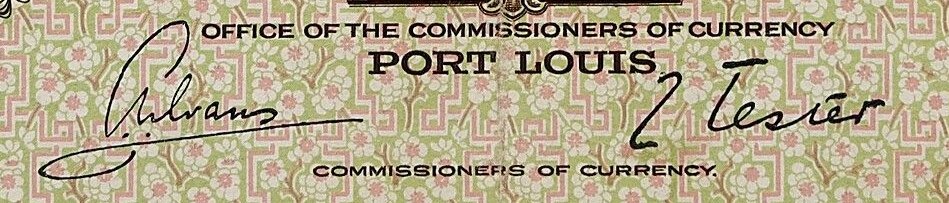
The Colonial Office Lists give Edward Walter Evans as Colonial Secretary from April 1932 and Leslie Tester as Treasurer from July 1932. Tester became Treasurer and Comptroller of Customs of Zanzibar in November 1934. The Lists print the second name as Walter in every year from 1918 to 1937.
The statements in the Gazette then show a different Board. In 1935 they are signed by A. M. Dryburgh, Acting Colonial Secretary, Clive Watts, Treasurer, and B. A. Francis, Collector of Customs. In March 1937 they are signed by E. W. Evans, Colonial Secretary, and Clive Watts, Treasurer.
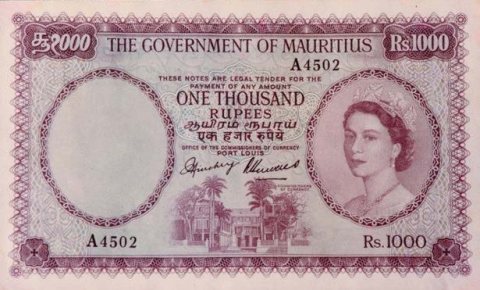
Two questions follow, and neither is settled. Watts was Treasurer from 1935 at the latest to at least March 1937, yet the 5 rupees and 10 rupees of 1934 are recorded only with Evans and Tester: either the later printings kept the first signatures, or a note of Evans and Watts is still to be found. And the catalogue's issued row of the 1,000 rupees dated 1936 is signed Evans and Tester, though Tester had gone to Zanzibar in November 1934. The row is marked "signatures not confirmed; no issued note recorded". Only a picture of an issued note can decide either point.
1941 to 1951: the Accountant General signs
| Statement signed | Who signs | As |
|---|---|---|
| 26 June 1942 | J. K. Ramsden | Acting Financial Secretary |
| 24 January 1946 | Eugene S. O'Connor; S. M. Rich | Acting Financial Secretary; Accountant General |
| June 1947 | O'Connor; Rich | Financial Secretary; Accountant General |
| December 1947 | K. V. MacQuire; R. Harvais | Acting Financial Secretary; Acting Accountant General |
| 14 April 1950 | O'Connor; D. A. Kain | Financial Secretary; Accountant General |
| 29 January 1951 and 18 June 1951 | O'Connor; R. Harvais | Financial Secretary; Accountant General |
The Colonial Office Lists give Sydney Moody as Colonial Secretary from 1939, Sidney Montague Rich as Deputy Accountant General and Accountant General from 1943, Eugene Stanislaus O'Connor as Financial Secretary from 1945, David Andrew Kain as Accountant General from 1949 and Augustin Roger Harvais from 1950. K. S. J. Chamberlain and J. K. Ramsden have no Mauritius post in any List held: there are no Lists for 1941 to 1945, and neither has an entry in those of 1946 to 1950. The signature blocks of the statements of 1940 to 1943 fall on pages that were not scanned, so the Gazette does not date Moody, Chamberlain or Ramsden either, apart from the statement of June 1942.
The catalogue dates the O'Connor and Kain rows of the 5 rupees and 10 rupees ND (1949) and the O'Connor and Harvais rows ND (1950). The statements show Kain still Accountant General on 14 April 1950 and Harvais in the post by 29 January 1951. The reader of the Gazette drew from this that the O'Connor and Harvais notes are most likely of late 1950 or 1951. The day of the change is not in the statements read, and the rows were left as they are. MacQuire and Harvais, the acting pair of December 1947, are not recorded on any note.
1955 to 1962: three Commissioners, two signatures
| Statement signed | Financial Secretary | Accountant General | Third Commissioner |
|---|---|---|---|
| 1 April 1955 | H. J. Hinchey | R. Harvais | G. E. Blackburn |
| 1 December 1955 | D. A. Kain | R. Harvais | G. E. Blackburn |
| 14 February 1958 | W. G. Wilson | R. Harvais | G. E. Blackburn |
| 6 March 1962 | A. F. Bates | J. E. Hermans (Acting) | H. J. Sabben |
| 9 October 1962 | J. D. Greig (Acting) | J. E. Hermans | H. J. Sabben |
The Colonial Office Lists give Herbert John Hinchey as Financial Secretary from 1952, William George Wilson as seconded to the post in 1957, Allan Frederick Bates from 1960 and James Dennis Greig from 1964; Joseph Edgar Hermans as Accountant General from 1961 and Francis Blackburn as Deputy Accountant General from 1961. The statements have the initials G. E. for Blackburn where the List has Francis. The two have not been reconciled.
Set against the 5 rupees, 10 rupees and 25 rupees of 1954, the statements add three things. Kain was Financial Secretary on 1 December 1955, between Hinchey and Wilson, and no note of Kain and Harvais is recorded. Wilson was in office by February 1958, which agrees with the printer's requisitions that date the Wilson and Harvais notes 1957 to 1960. Greig, who signs the notes of 1964 and 1965, was already acting as Financial Secretary in October 1962. H. J. Sabben sat on the Board in 1962 and signs no note.
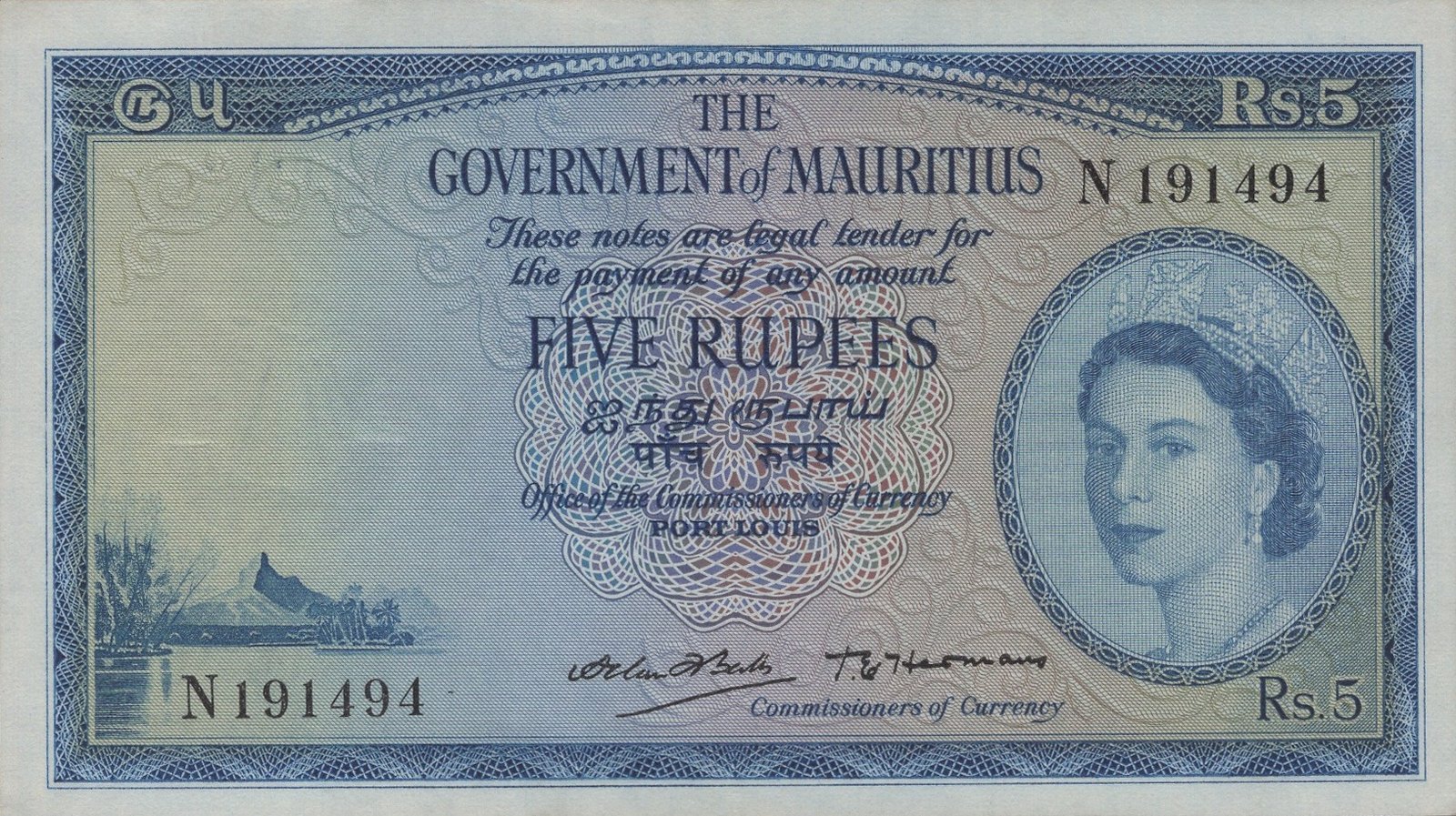
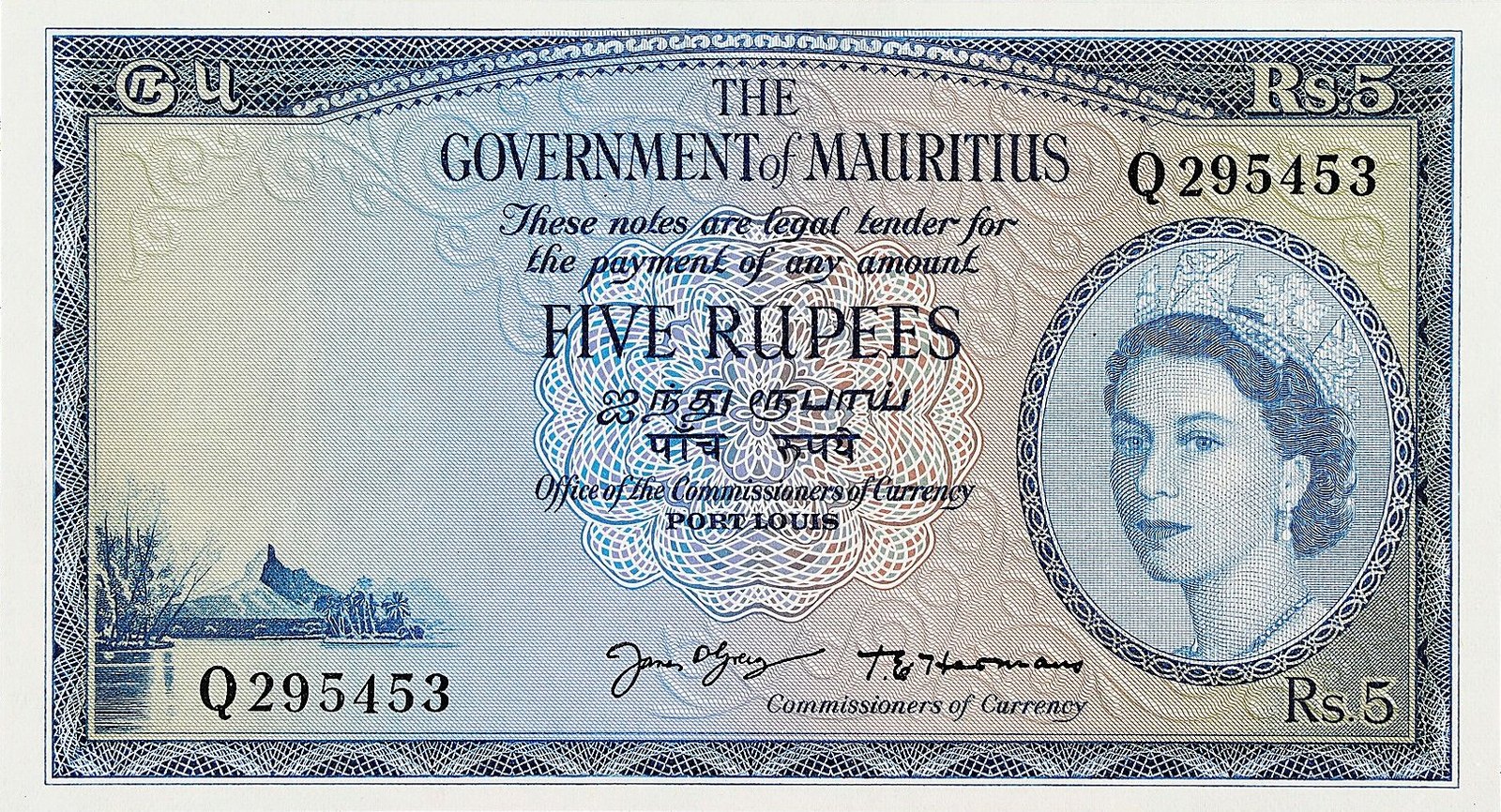
The Gazette also names Currency Officers, who did not sign notes: H. A. Patte and I. C. Nalletamby from 3 January 1947, and P. A. Courtney in place of V. Govinden from 6 May 1955 (General Notice 432).
The Bank of Mauritius, 1967 to 1971
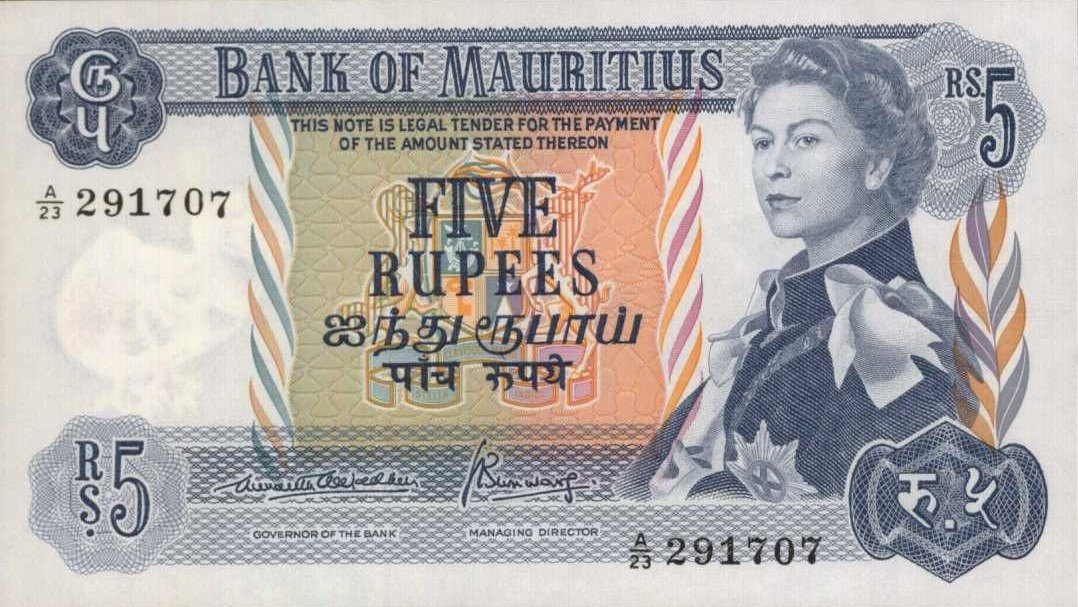
The Bank's notes are signed by the Governor and the Managing Director. The Bank's report for the year ended June 1968 says the first Governor, Aunauth Beejadhur, took office on 1 July 1967. Its list of the Board of Directors reads: "Mr. Donald George Herbert Cook, Managing Director, succeeded by Mr. David Chaloner Keys on the 29th June 1968". The report for 1969 says Cook went back to the Bank of England at the end of a two-year appointment and that Keys, also lent by the Bank of England, was still Managing Director on 30 June 1969. The report for 1971 (p. 67) has "Mr. Goorpersad Bunwaree, Managing Director", with I. Ramphul as Chief Manager. The board lists spell the name Goorpersad.
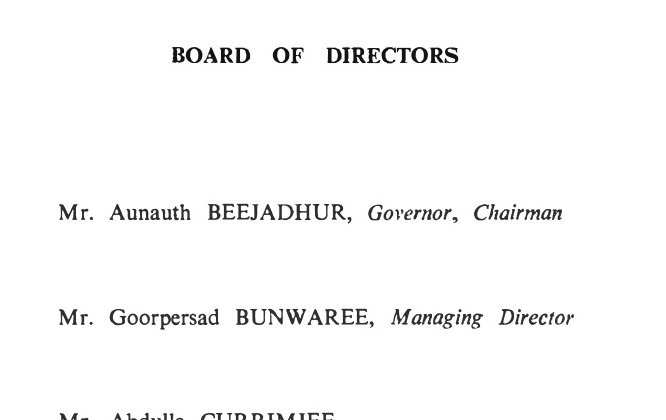
The report for 1970 has not been found, so the day Bunwaree followed Keys is not known. That is why the Beejadhur and Bunwaree row of the 5 rupees has no year, while the Keys rows of the 10 rupees and 50 rupees are dated ND (1968). The last pair, Bunwaree as Governor with Ramphul, is dated ND (1978) in the catalogue. The Bank's reports read do not give the day Bunwaree became Governor, so that year also remains to be checked against the Bank's own record.
What the sources do not give
- No annual report on Mauritius names a Commissioner of Currency, and the Almanac for 1920 names them by office only.
- The Blue Books of 1847 to 1909 in the Johns Hopkins currency board archive hold no civil establishment lists.
- For the sterling notes after 1860 and the rupee notes from 1876 to 1896 the only official list read is the year-by-year list of the Mauritius Almanac for 1920 (p. B. 59), which gives no day of appointment. The signatures as a sale catalogue read them are taken up in Mauritius notes in the collectors' journals and at Spink in 1996.
Sources
- Mauritius Government Gazette: Ordinance 10 of 1864 (7 May 1864); the account for December 1877 (1878, pp. 125 and 126); the Commissioners' statements of 1906, 1907, 1910, 1919, 1923, 1926, 1935, 1937, 1942, 1946 to 1951, 1955, 1958 and 1962; Ordinance 38 of 1941; General Notice 432 of 1955.
- Bolton's Mauritius Almanac for 1851; Mauritius Almanac and Commercial Handbook for 1920, pp. A. 59, B. 14 and B. 59, with its Civil List.
- Mauritius Blue Books for 1847, 1848, 1865, 1897, 1902, 1920 and 1923.
- Colonial Office Lists of 1912 to 1966.
- National Archives, T 1/6213B: Statement of the Financial Officers, 7 October 1858, and the committee report of 12 January 1859.
- Bank of Mauritius annual reports for 1968, 1969 and 1971.
- IBNS Journal 27:1 (1988), p. 4, for the 5 rupees of 5 June 1848; Spink, sale 1138, 3 October 1996, lots 1071 and 1072, for the signatures read on the notes of August 1860.
Member comments
Log in or register to post a comment.