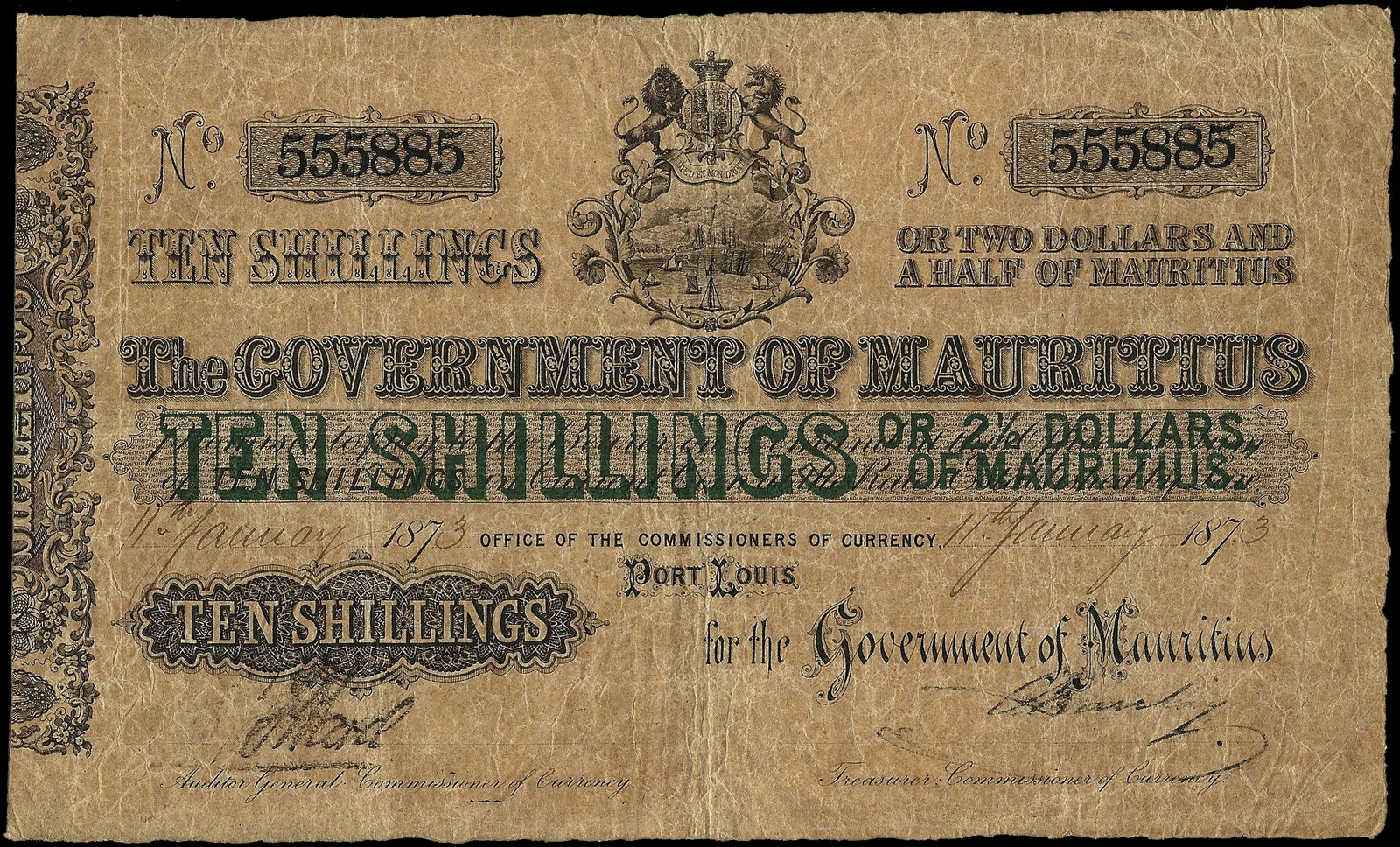
The note pages call the first banknotes Thomas de la Rue ever produced the 10 shillings, 1 pound and 5 pounds of the Government of Mauritius, dated from 13 August 1860. This article follows the two years before them from the papers themselves: a Treasury file of 1858 and 1859 (National Archives T 1/6213B), a Colonial Office file (CO 167/407), a later Treasury memorandum (T 1/8866/1517C), the Mauritius Blue Books and the Government Gazette. The National Archives files were read in the scans held in the currency board archive at Johns Hopkins University, and the page numbers given are those of the scans. The notes as issued are described in The Government of Mauritius notes, 1860 to 1934.
The notes that were to be replaced
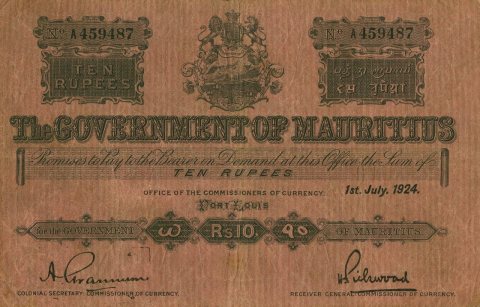
In 1858 the Government's own paper money was its 5 and 10 rupees notes, issued under Ordinances 7 of 1848 and 6 of 1849. A Colonial Office minute of 1858 gives the Currency Commissioners' return of 31 December 1857: notes in circulation 231,836 pounds, backed by specie of 122,236 pounds and investments of 109,600 pounds (CO 167/407, p. 52). The Statement of the Financial Officers of 7 October 1858 says the daily exchange of notes for specie at the Commissioners' counter averaged 18,000 pounds a month.
The Board was by then unpaid. The same Statement is signed by H. Sandwith, Colonial Secretary, Felix Bedingfeld, Treasurer, and W. W. R. Kerr, Auditor General, as Managers or Commissioners of the Currency without salary. It notes that under Mr Macaulay the office had carried a salary of 1,000 pounds a year.
The forged 10 rupees of 1858
Early in 1858 forged Government notes were found in circulation. On 15 February 1858 Mr Hugon of the Immigration Office wrote to the Colonial Secretary that, on hearing of the forgeries, the notes in the chest of the Immigration Department had been examined and 16 Ten Rupee notes had turned out to be forged (T 1/6213B, 12996/59, p. 36). The file holds replies from many other departments, read so far only in the machine-read text, which speak of forged Ten Rupee notes. No serial number is given on any page read.
The Financial Officers' Statement of 7 October 1858 tells the Currency office's side. Bad notes had been taken unwittingly by the Commissioners' cashier. Once the office knew of them, spurious paper was refused and each note was marked with the word "Forged". The officers knew of no earlier attempt at forgery.
A collector's account differs on that last point. Clément Rey, writing in the IBNS Journal in 1988 (27:3-4, p. 84), knew four of the rupee notes, dated April to June 1848, and reported that two of them had forged signatures and had been cancelled. Rey guessed that blank notes had leaked and been filled in. The papers of 1858 neither confirm nor rule that out.
The committee of 12 January 1859
A Special Committee of the Council of Government on the paper currency reported on 12 January 1859. Felix Bedingfeld signed as Chairman. Its proposals (T 1/6213B, 6668, pp. 40 to 42):
- Three denominations: four tenths of the issue at 10 shillings (2 1/2 dollars), four tenths at 1 pound (5 dollars) and two tenths at 5 pounds (25 dollars).
- No higher notes, since payments of 10 pounds and over were made by cheque.
- Notes to the value of 400,000 pounds.
- The old notes to be called in by Proclamation and exchanged at the two banks and the Treasury.
- Three notes of three sizes, the lowest value the smallest.
- The 10 shillings possibly on coloured paper. The committee gave its reason: in the existing currency the higher note was coloured, and the lower could be stained with tobacco juice to look like it.
- The 5 pounds to be told from the 1 pound by a circle at the centre bearing its value and a design.
- Private marks, and Canada Bank Note Tint, against copying by photography.
- 2,000 pounds voted for the printing.
Three drawings were laid before the committee.
Governor Stevenson's despatch of 31 January 1859
Governor Stevenson sent the plan to Sir E. B. Lytton at the Colonial Office on 31 January 1859. The requisition (paras 8 and 9) asked for 160,000 pounds in 10 shillings notes, 160,000 pounds in 20 shillings notes and 80,000 pounds in 5 pounds notes, each also expressed in dollars: 320,000, 160,000 and 16,000 notes. Three sketches of very different designs went with the despatch as Enclosure No. 4, the smallest note to be coloured, with leave to depart from the designs as needed (para 12).
On signatures and numbers the Governor passed on a calculation (paras 15 and 16). The Treasurer's signature, counter-checked by the Auditor's, should be the only signatures on the notes, and the numbers should be printed at the press. By the Treasurer's own computation, signing the notes alone would take about three hours a day for thirteen months.
Para 16 dealt with the old notes. The rupee had since been rated higher than when they were issued, so the Governor proposed a local Ordinance to pay all existing notes at 9 shillings 2 pence and 18 shillings 4 pence, their value at the rating of the rupee at issue, so that holders could not claim more. A paper in the Colonial Office file (CO 167/407, p. 44) puts a figure on the risk: the rupee had been raised by Order in Council from 1 shilling 10 pence to 1 shilling 11 pence, which would have cost 10,000 to 12,000 pounds on withdrawal.
A postscript of 12 February 1859 touched the date. As long as notes were told apart by their numbers, it mattered little what date they bore, provided it was before issue; any date before July or August might be put in at once.
London's answer
Sir E. B. Lytton replied on 17 June 1859 (despatch No. 238). Her Majesty's Government accepted the Colony's preference for a Government note circulation and would send out new notes of the descriptions desired, to be manufactured under its directions with as little delay as possible.
On 6 October 1859 the Colonial Office told the Treasury that the rupee notes of the local Government were not yet called in, and that the new pound notes, recently ordered by the Duke of Newcastle, were not yet ready (T 1/6213B, 10130/59). The review of Mauritius notes in the IBNS Journal of 1996 (35:3, p. 17) says De La Rue received the contract at the end of 1859, on the choice of the Crown Agents. The two statements do not conflict.
What came of the plan
Set beside the notes as the catalogue describes them, the plan was carried out in part.
- The three values and their dollar equivalents are those of the committee.
- The 10 shillings is on brownish-yellow paper and the 1 pound on white, as the committee's remark on colour suggested.
- The notes are dated from 13 August 1860, a year later than the Governor's postscript expected, with part of the date printed.
- The signatures are those of the Auditor General and the Treasurer, by hand or stamped.
- On the three sizes the sources differ. The review in the IBNS Journal (35:3, p. 17) gives 120 by 203 mm for the 10 shillings and 125 by 213 mm for the 1 pound; the size field of the three note pages has 200 by 130 mm for every value.
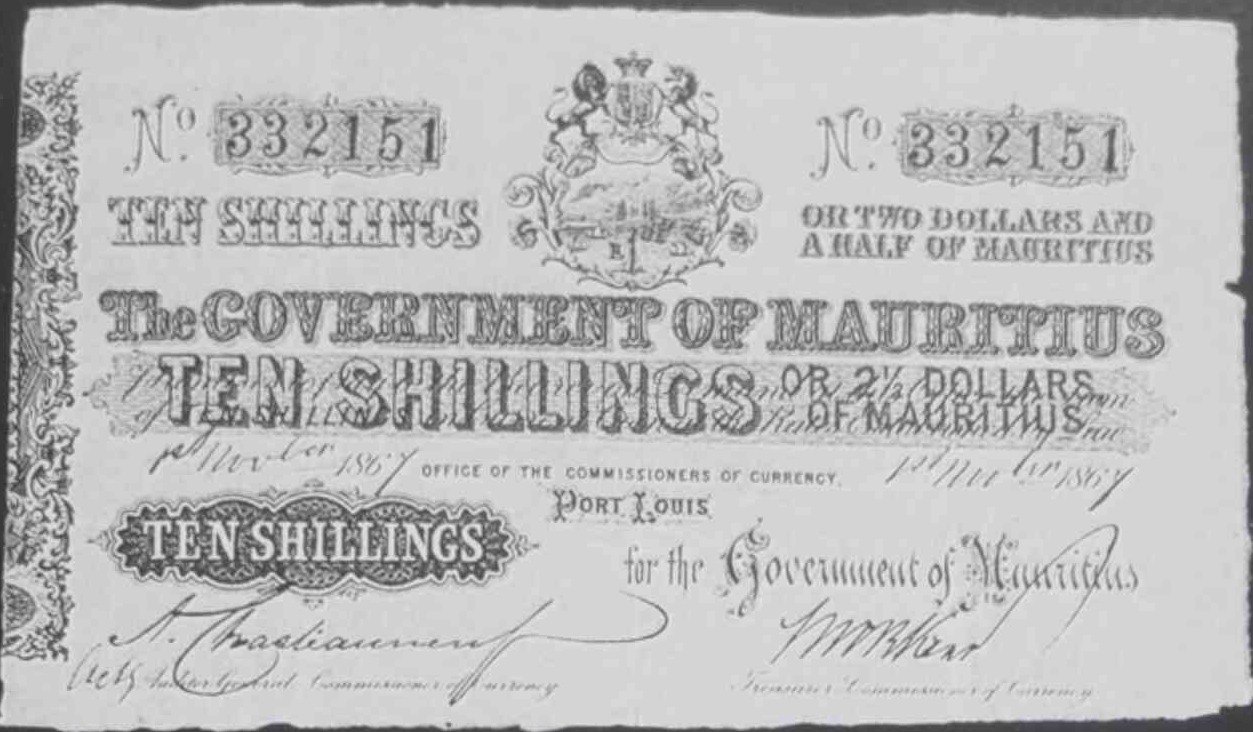
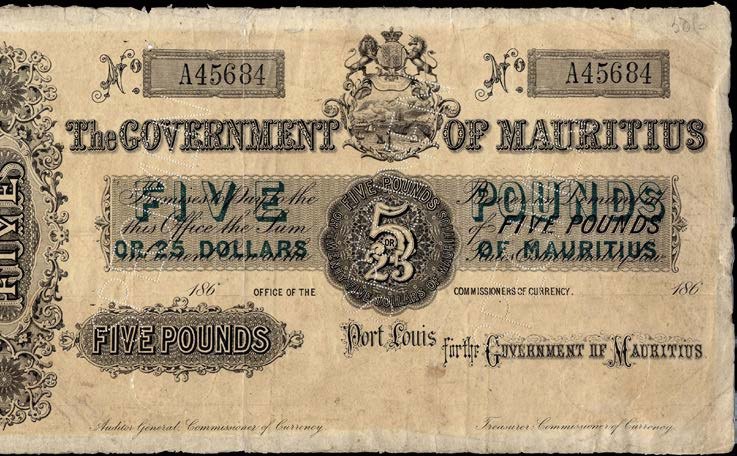
The quantities were passed. The Governor's request was for 320,000 notes of 10 shillings and 160,000 of 1 pound; it is a request, not the order to the printer. Numbers recorded on the notes run well beyond both, so further printings followed. The Blue Book for 1863 (read in the text only) says sums were paid in 1862 for preparing new currency notes.
The law followed the notes. A printed Treasury memorandum says that on the arrival of the new notes Ordinance 7 of 1861 re-constituted the Board of Commissioners of Currency, sent home with despatch 65 of 4 April 1861, and that Ordinance 10 of 1864 re-established it (T 1/8866/1517C, Document 4, p. 16). The Gazette of 7 May 1864 prints that Ordinance: any two Commissioners sign, by hand or in facsimile, and must be in office on the date the note bears.
The exchange was quick. The Blue Books count £210,498 5s 10d of the rupee notes in circulation at the end of 1859, £30,971 8s 4d at the end of 1860 and £3,717 10s 10d at the end of 1861. Of the new notes £210,469 10s were out at the end of 1860 and £293,493 10s a year later. The review in the IBNS Journal says the 1 pound and 10 shillings were issued to the public in August 1860; the note pages give 10 October 1860 for the introduction, from other sources. The papers read here do not give the day.
What the files do not hold
- The three sketches sent with the despatch.
- The order to the printer, the name of the printer and the quantities actually delivered.
- Whether the Ordinance proposed in para 16, to pay the old notes at their value at issue, was passed.
- The numbers of the forged 10 rupees notes of 1858.
- Whether the circle at the centre asked for on the 5 pounds was carried out: the note pages do not describe one.
Sources
- National Archives, T 1/6213B: file 12996/59 (Mr Hugon's letter of 15 February 1858, p. 36; Statement of the Financial Officers, 7 October 1858, pp. 7 to 11); file 6668 (Governor Stevenson to Sir E. B. Lytton, 31 January 1859, with the postscript of 12 February 1859 and the report of the Special Committee of 12 January 1859); Sir E. B. Lytton to Governor Stevenson, No. 238, 17 June 1859; file 10130/59 (Colonial Office to Treasury, 6 October 1859).
- National Archives, CO 167/407, pp. 44 and 52.
- National Archives, T 1/8866/1517C, Document 4, p. 16.
- Mauritius Government Gazette, 7 May 1864 (No. 26), Ordinance 10 of 1864.
- Mauritius Blue Books for 1859 to 1861 and 1863.
- Clément Rey, "The Board of Currency Commissioners of Mauritius - Update", IBNS Journal 27:3-4 (1988), p. 84.
- The review of Mauritius notes, part I (1811 to 1876), IBNS Journal 35:3 (1996), p. 17.
- The catalogue's note pages for the notes as issued.
Member comments
Log in or register to post a comment.