Much of what is repeated about the notes of Mauritius goes back to a few pieces of collectors' writing and to one sale catalogue. This article lists them: the articles in the Journal of the International Bank Note Society (IBNS) from 1977 to 2024, two pieces in Bank Note Reporter, and the catalogue of Spink's sale 1138 of 3 October 1996. For each it gives what was said of the Government notes and what official papers read since then confirm, change or leave open. Sale prices are left out.
The writing, in order of time
| Year | Where | What |
|---|---|---|
| 1977 | IBNS Journal 16:3 | C. Rey on the provisional one dollar notes of 1842 |
| June 1983 | Bank Note Reporter | Fred Schwan, "Mauritius' Military Money", on the wartime 1 rupee, 50 cents and 25 cents |
| 1988 | IBNS Journal 27:1 and Bank Note Reporter, March 1988 | An unsigned report of a 5 rupees of 1848, a type not known before |
| 1988 | IBNS Journal 27:3-4 | Clément Rey, "The Board of Currency Commissioners of Mauritius - Update" |
| 1996 | IBNS Journal 35:3 | A review of Mauritius notes, part I, 1811 to 1876 |
| 1997 | IBNS Journal 36:2 | The review continued, by Rey, from the rupee notes of 1876 to the Bank of Mauritius |
| 1999 | IBNS Journal 38:2 | Griffiths on the rupee of 1876 |
| October 1999 | Bank Note Reporter, p. 84 | "Pettit finds trial 1,000 rupees" |
| 2013 | IBNS Journal 52:2, p. 6 | A letter on the old notes never redeemed |
| 2023 | IBNS Journal 62:4 | The 1842 dollar again |
| 2024 | IBNS Journal 63:3, p. 43 | Griffiths on a Mauritius 100 rupees, with a passage on the series of 1967 |
The pieces on the dollar notes of 1842 and the rupee notes of 1848 concern issues older than the Government notes treated in these articles and are only named here.
The review of 1996 and 1997
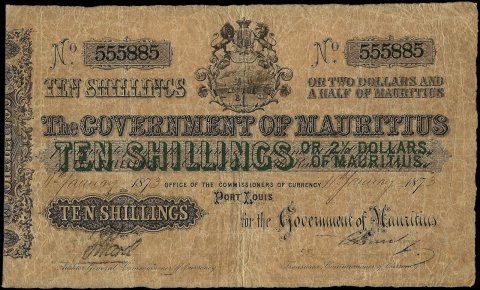
The two parts of the review are the fullest account in print of the notes down to 1967. Part I (35:3, p. 17) gives the sizes of the notes of 1860, 120 by 203 mm for the 10 shillings and 125 by 213 mm for the 1 pound, their watermark, the award of the contract to De La Rue at the end of 1859 on the choice of the Crown Agents, and the statement that the 5 pounds stayed with the banks as a reserve. Chalmers' History of Currency in the British Colonies (1893, p. 368) says the same of the 5 pounds for the years 1865 to 1869. Part I has the 1 pound and 10 shillings issued to the public in August 1860; the note pages keep 10 October 1860 from other sources. No official paper read gives the day.
Part II (36:2, 1997) takes the later notes value by value. Points that agree with the notes recorded since:
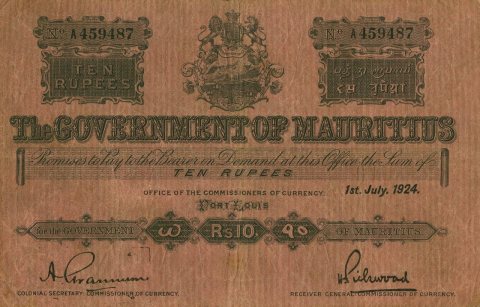
- The dates of the issue of 1907 to 1930, with prefix B from 1920 and prefix C from 1924 on the 5 rupees, and the remark that the 10 rupees never reached A 600000 (p. 12).
- The change of watermark in 1913, when the words begin to run in two straight lines (p. 12).
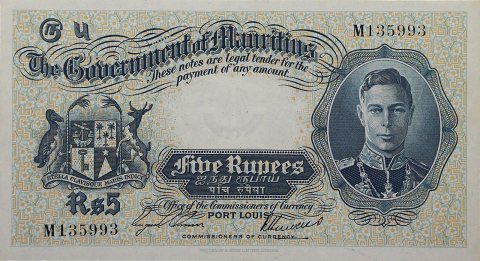
- The caravel watermark of the notes of 1934, seen through the left medallion of the 10 rupees and the centre of the 5 rupees (p. 12).
- The move of the serial number on the 25 and 50 cents from the centre to the lower left, with the change of signers (pp. 14 and 15).
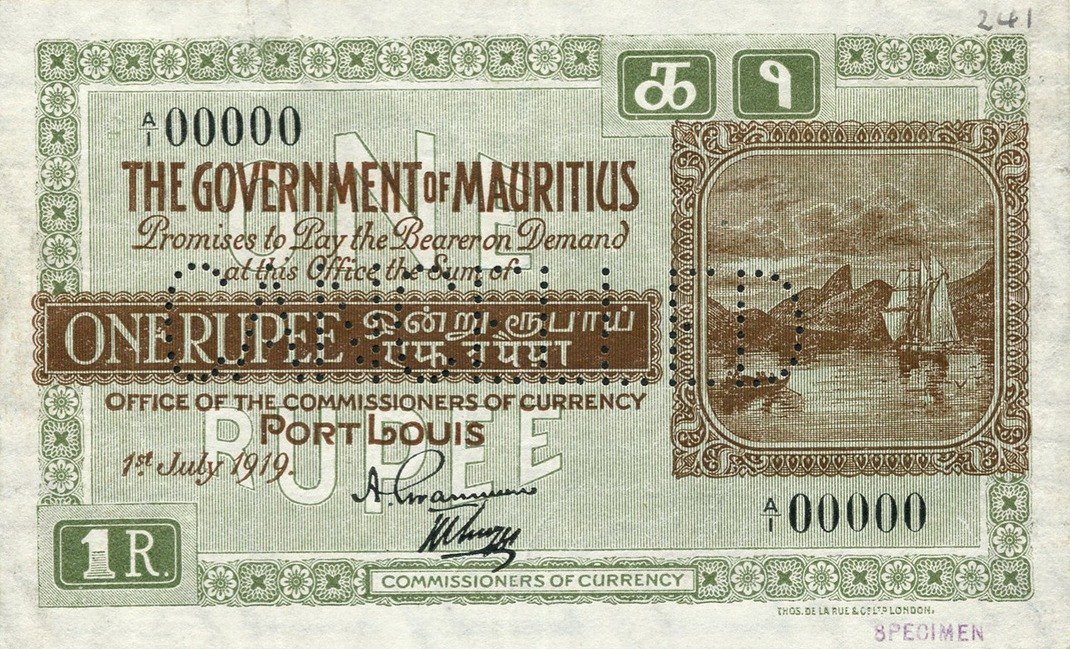
- The printing of the 1 rupee of 1919 by De La Rue in sage-green and deep brown on paper with a geometric watermark (p. 12).
The review also printed, for each pair of signers, the lowest and highest numbers its writer had seen.
Where the review and the official papers part
The 1 rupee of 1919. The review has the Ordinance voted on 29 July 1919, which the Mauritius Almanac for 1920 confirms, and the note put into circulation on 23 April 1920. The note page has 20 April 1920. No archive is cited for either day, and both stand.
The last date of the first rupee type. The review gives 19 November 1902 as the last date, on a 5 rupees. The catalogue's row is dated 17.11.1902. Nothing recorded decides between them.
The emergency 1 rupee of 1942. The review says that more 1 rupee notes and the small-change notes went into circulation on 29 September 1943 and that the provisional notes of 27 March 1942 were then gradually withdrawn. It cites no law. The Mauritius Government Gazette No. 125 of 14 November 1942 prints Proclamation 33 of 9 November 1942, under which the emergency 1 rupee ceased to be legal tender from 1 December 1942. The 29th of September 1943 itself is good for the 25 cents and 50 cents: General Notice 790 of that day announced them.
The end of the small notes. The review gives 30 June 1947 as the last day of legal tender of the 25 and 50 cents. No official source read gives that day. The Blue Book for 1946-47 lists a Proclamation 33 of 1946 on notes of certain denominations ceasing to be legal tender, by title only. For the 1 rupee of 1941 the annual reports on Mauritius for 1952, 1953 and 1954 still list a 1 rupee among the notes in circulation.
A break at D 900000. For the 1 rupee the review puts the change from the second pair of signers to the third between D 899999 and D 900000. A note of the third pair is recorded below that point, and two round numbers look like a boundary that was assumed, not read from notes.
The green 10 rupees. The review (p. 13) warns of George VI 10 rupees notes turned green by chemicals and presumes they were made to pass as colour errors. Heritage (17 October 2024, lot 24306) describes the green notes as a printing of their own. The note page keeps both statements.
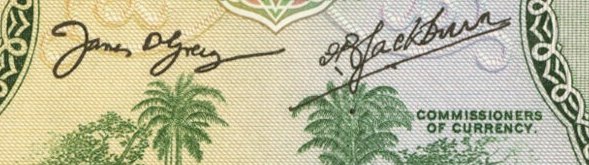
O'Brien. The review (p. 15) names the third pair of signers of the Elizabeth II 10 rupees and 25 rupees as James O'Brien and F. Blackburn, and has James O'Brien with T. E. Hermans on the 5 rupees. The Spink catalogue of 1996 prints the same names. No O'Brien is found in the official lists read. The Colonial Office Lists give James Dennis Greig as Financial Secretary from 1964 and Joseph Edgar Hermans as Accountant General from 1961, and the Commissioners' statement of 9 October 1962 in the Gazette is signed by J. D. Greig as Acting Financial Secretary. The signature on the photographed notes, the review's own plate of a 25 rupees among them, reads closer to Jas. D. Greig, and the catalogue has no O'Brien pair.
Plum-coloured 10 rupees. The review (p. 15) says that a number of 10 rupees of the very first Elizabeth II issue are plum-coloured. The Spink catalogue of 1996 offered one such note, signed Hinchey and Harvais, and stated that only a few hundred were printed. Neither gives a source, and the same review warns of colours changed by chemicals. The catalogue has no row for it.
1968 for 1967. The review calls the first Bank of Mauritius set issued in 1968. The Bank's own report has the notes issued from 4 September 1967.
Schwan in 1983, Pettit in 1999
Fred Schwan's article of June 1983 pictured a 1 rupee signed Chamberlain and Ramsden and a 25 cents and a 50 cents with the number at the lower left, signed Chamberlain and Rich. It named the 50 cents with the number at the centre as the note illustrated in the book by Schwan and Boling. Those are the two forms of the small notes that the printer's specimens later fixed by their number ranges.
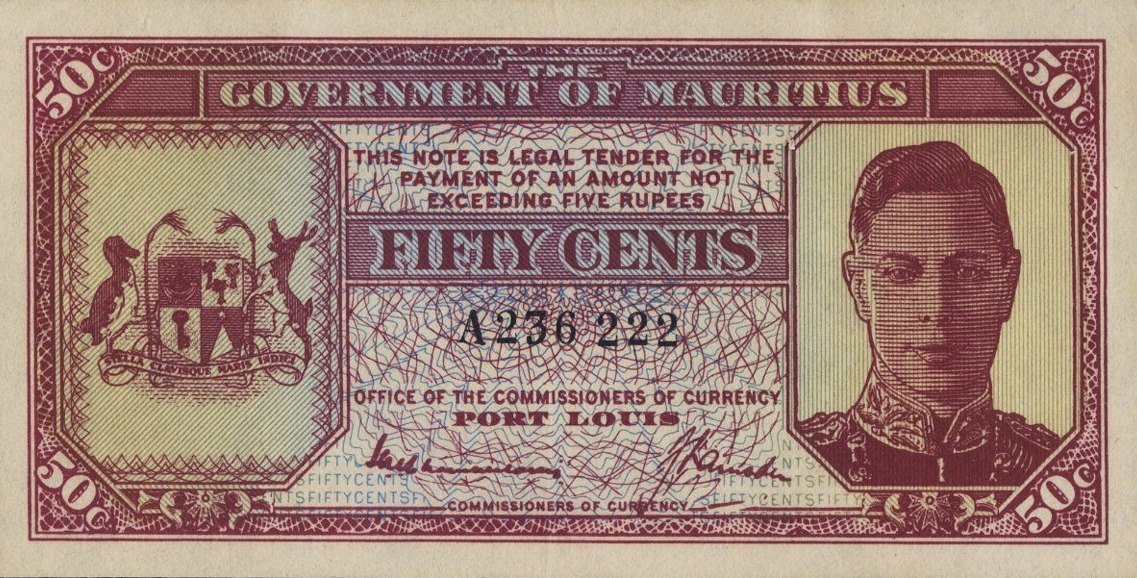
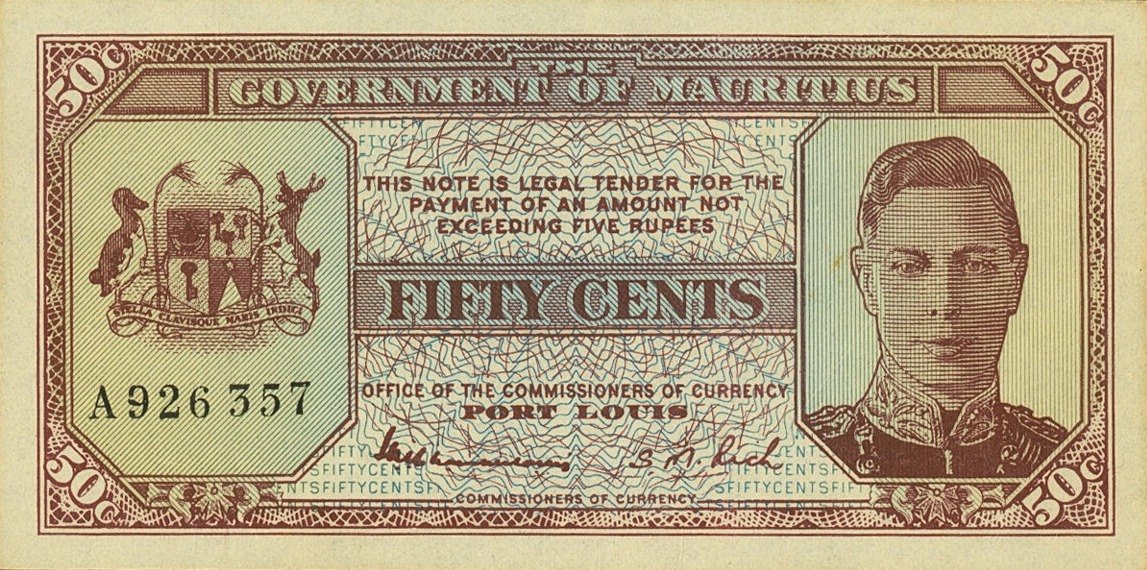
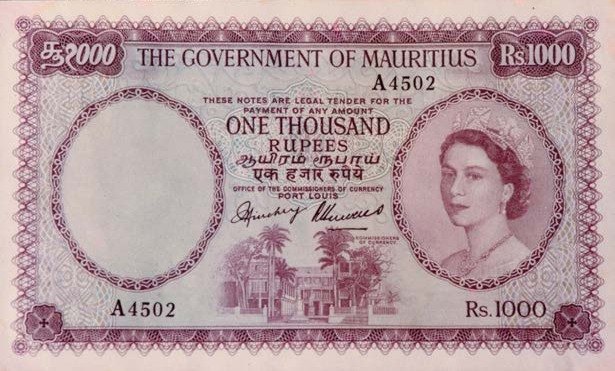
Bank Note Reporter of October 1999 (p. 84) reported a colour trial of the 1,000 rupees of 1954: blue-green, with two punch holes, overprinted SPECIMEN and SPECIMEN OF NO VALUE on face and back, and with the control number 2 on the back. John Pettit of Sydney had found it and sold it privately to a specialist collector of Mauritius notes. The same article says that the issued note pictured in the Standard Catalog of World Paper Money, A 4502, was lent for the purpose by the Government of Mauritius. The note page cites an issued note numbered A 4505 in the Bank of Mauritius virtual museum. Whether these are two notes or one number read two ways is not known.
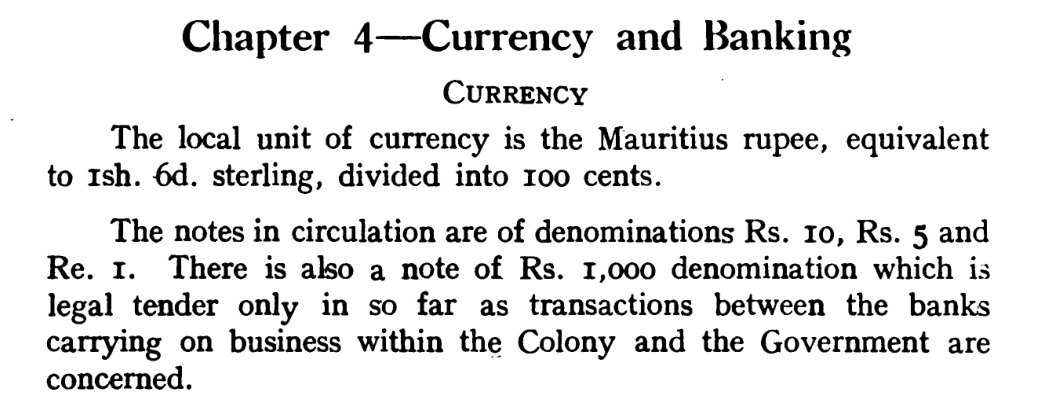
Griffiths in 2024 (63:3, p. 43) adds nothing new on the 1,000 rupees but states the point the Bank's report of 1968 also makes: the value was not replaced in the series of 1967.
The letter of 2013
The letter in IBNS Journal 52:2 printed figures from the old returns: the notes of 1860 outstanding at £210,469 in 1860, £389,126 in 1869, £3,406 in 1896 and £3,383 in 1910, and the rupee notes of 1849 down to £482 at 31 December 1932. The Mauritius Blue Books read since agree for 1860 and 1869 and give £3,640 for 1894 and £3,383 for 1909. The letter dates the 3,383 pounds to 1910 and gives the year 1932 only for the notes of 1849, where the note pages date the 3,383 pounds to 31 December 1932. The full run of figures is in Mauritius notes in circulation, 1849 to 1971.
Spink, 3 October 1996: the "Mauritius" collection
Spink sold the collection as sale 1138, in association with Christie's, at Christie's rooms in Ryder Street, London. The banknotes were lots 1001 to 1123: notes of the Isles de France et de Bourbon (1001 to 1010), the private banks (1011 to 1069), the Government of Mauritius (1070 to 1119) and the Bank of Mauritius (1120 to 1123). Coins and medals followed on 9 October as sale 1139. The catalogue names no owner. Spink's own later catalogue of 8 October 2007 (lot 975) calls it the Clement Rey collection.
The Government lots ran from the sterling notes of 1860 to the Elizabeth II notes, one note to a lot. The catalogue's readings of the signatures matter for the years where no dated official statement of the signers has been read:
| Lot | Note and date, as catalogued | Signers, as Spink read them |
|---|---|---|
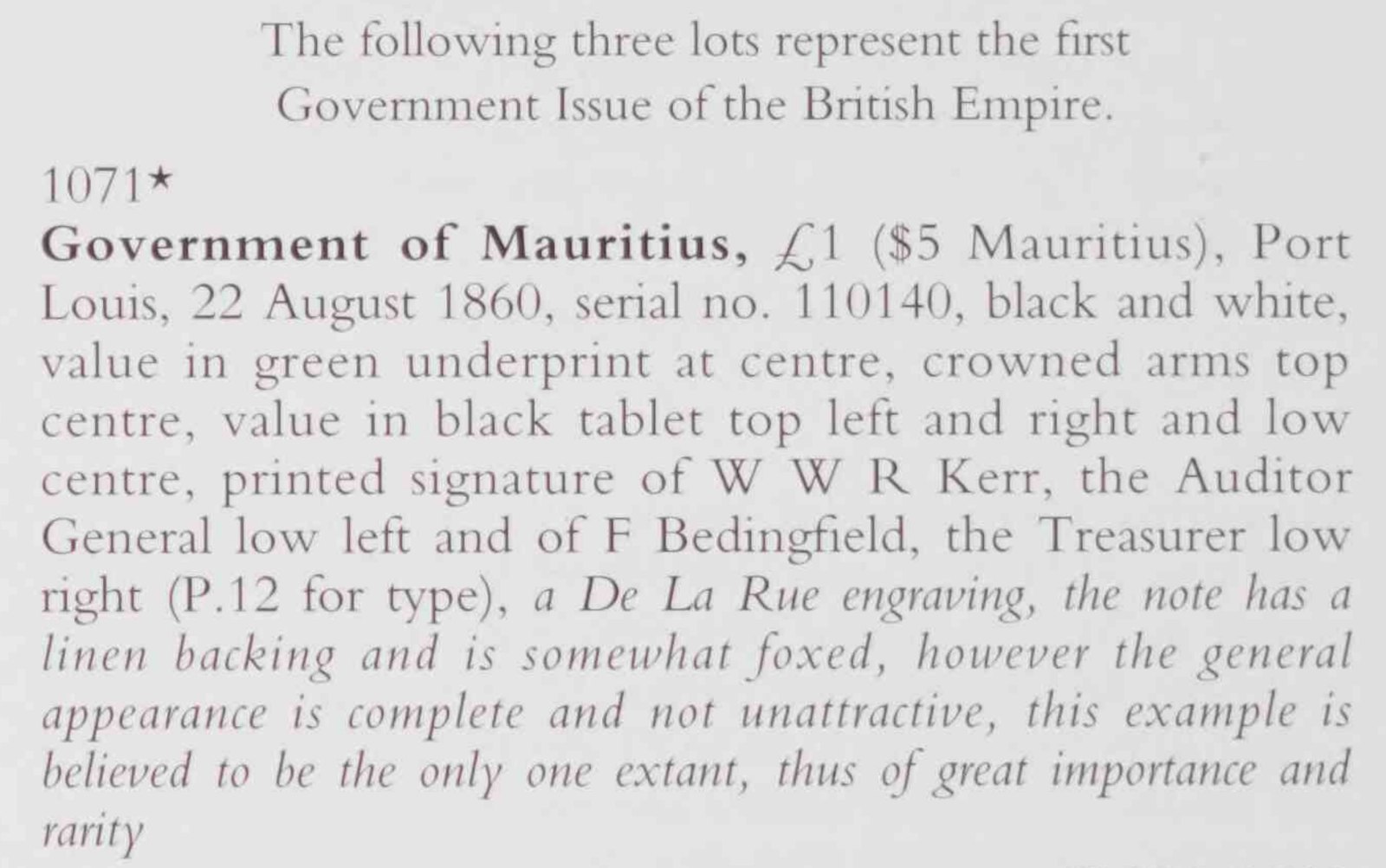
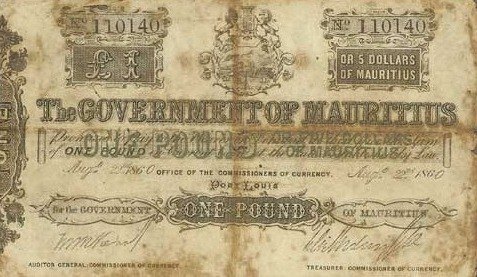
| 1071 | 1 pound, 22 August 1860 | W W R Kerr, Auditor General; F Bedingfield, Treasurer (printed) |
| 1072 | 10 shillings, hand stamped 13 August 1860 | Kerr; Beddingfield |
| 1073 | 10 shillings, manuscript date 1 November 1867 | A Chateauneuf, Acting Auditor General; W W R Kerr, Treasurer (by hand) |
| 1074 | 50 rupees, hand stamped 1 December 1876 | W H Marsh, Auditor General; H N Duverger-Beyts, Receiver General |
| 1075 | 10 rupees, hand stamped 1 October 1877 | G W Snelling, Auditor General; H N Duverger-Beyts, Receiver General |
| 1076 | 5 rupees, hand stamped 5 October 1896 | E C Ashley, Auditor General; G R Dick, Receiver General |
| 1077 | 5 rupees, hand stamped 13 September 1900 | G R Dick, Auditor General; J J Brown, Receiver General |
| 1078 | 5 rupees, printed date 22 February 1911 | E A Grannum, Auditor General; G A L Banbury, Receiver General |
Official papers bear out several of these. The Gazette account for December 1877 is signed H. N. D. Beyts, Receiver General. The Blue Book for 1865 has Kerr signing as Treasurer. The Blue Books give Brown as Receiver General from 1 June 1897 and Dick as Auditor General from 29 January 1899. The archive of 1858 and 1859 spells the Treasurer's name Bedingfeld.
The Mauritius Almanac for 1920 (p. B. 59) lists the head of the Treasury and the Auditor General for each year from 1851 to 1919, without days. It has Kerr at the Treasury from 1866 to 1871 and Chateauneuf as acting Auditor General in 1861, 1868 and 1869; Beyts as Receiver General from 1874 to 1878; Marsh as Auditor General in 1877 and 1878, with Swinburne Ward from 1870 to 1876; Ashley as Auditor General from 1895 to 1898; and Dick as Receiver General in 1897, with Louis Edouard Schmidt from 1887 to 1896. Snelling is not among the names taken from that list. Spink's dates for Marsh (1 December 1876), Chateauneuf (1 November 1867) and Dick as Receiver General (5 October 1896) do not fall within the years the Almanac gives them, and nothing read decides between the list and the readings.
The catalogue made four statements about what survives, each the house's own. It headed the three sterling notes "the first Government Issue of the British Empire". It believed the 1 pound of 22 August 1860 to be the only one in existence; Spink sold the same note again on 8 October 2007 and 24 April 2012. It knew one other 50 rupees of 1876 besides lot 1074, bought by Amon Carter from the collection of Austin Sprake. And it stated that the emergency 1 rupee notes of 27 March 1942 are printed on parts of 10 rupees notes dated 1 July 1924 or 1 October 1930. The last fits a later sale: Lyn Knight's lot 1025 of November 2003, pictured in Bank Note Reporter that month, was described as printed on the back of a 10 rupees dated 1.7.1924.
Two of the catalogue's datings have not lasted. It dates the George V notes "undated (1930)" and the George VI 5 and 10 rupees "undated (1937)"; the annual report on Mauritius for 1934 and the Ordinance of that year put the first in 1934, and the note pages have the second ordered in 1936 and issued from 1942.
The Bank of Mauritius lots included a group of eleven notes showing every pair of signers of the first issue (lot 1121), the same make-up as the set of eleven specimens Spink sold on 24 April 2012 (lot 870).
Sources
- IBNS Journal 16:3 (1977); 27:1 and 27:3-4 (1988); 35:3 (1996), p. 17; 36:2 (1997), pp. 10 to 16; 38:2 (1999), p. 24; 52:2 (2013), p. 6; 62:4 (2023); 63:3 (2024), p. 43.
- Fred Schwan, "Mauritius' Military Money", Bank Note Reporter, June 1983.
- Bank Note Reporter, March 1988; October 1999, p. 84, "Pettit finds trial 1,000 rupees"; November 2003, preview of the Lyn Knight sale at St. Louis.
- Spink, sale 1138, The "Mauritius" Collection of Banknotes, Coins and Medals, 3 October 1996, lots 1001 to 1123.
- Spink, 8 October 2007, lot 975, and 24 April 2012, lots 845 and 870; Heritage Auctions, 17 October 2024, lot 24306.
- Mauritius Government Gazette: account for December 1877; No. 125 of 14 November 1942; General Notice 790 of 29 September 1943; Commissioners' statement of 9 October 1962.
- Mauritius Blue Books for 1865, 1894, 1897, 1902, 1909 and 1946-47; Mauritius Almanac and Commercial Handbook for 1920, p. B. 59; Colonial Office Lists.
- Robert Chalmers, A History of Currency in the British Colonies (1893), p. 368.
- Annual reports on Mauritius for 1934 and 1952 to 1954; Bank of Mauritius annual report for 1968.
- The catalogue's note pages.
Member comments
Log in or register to post a comment.