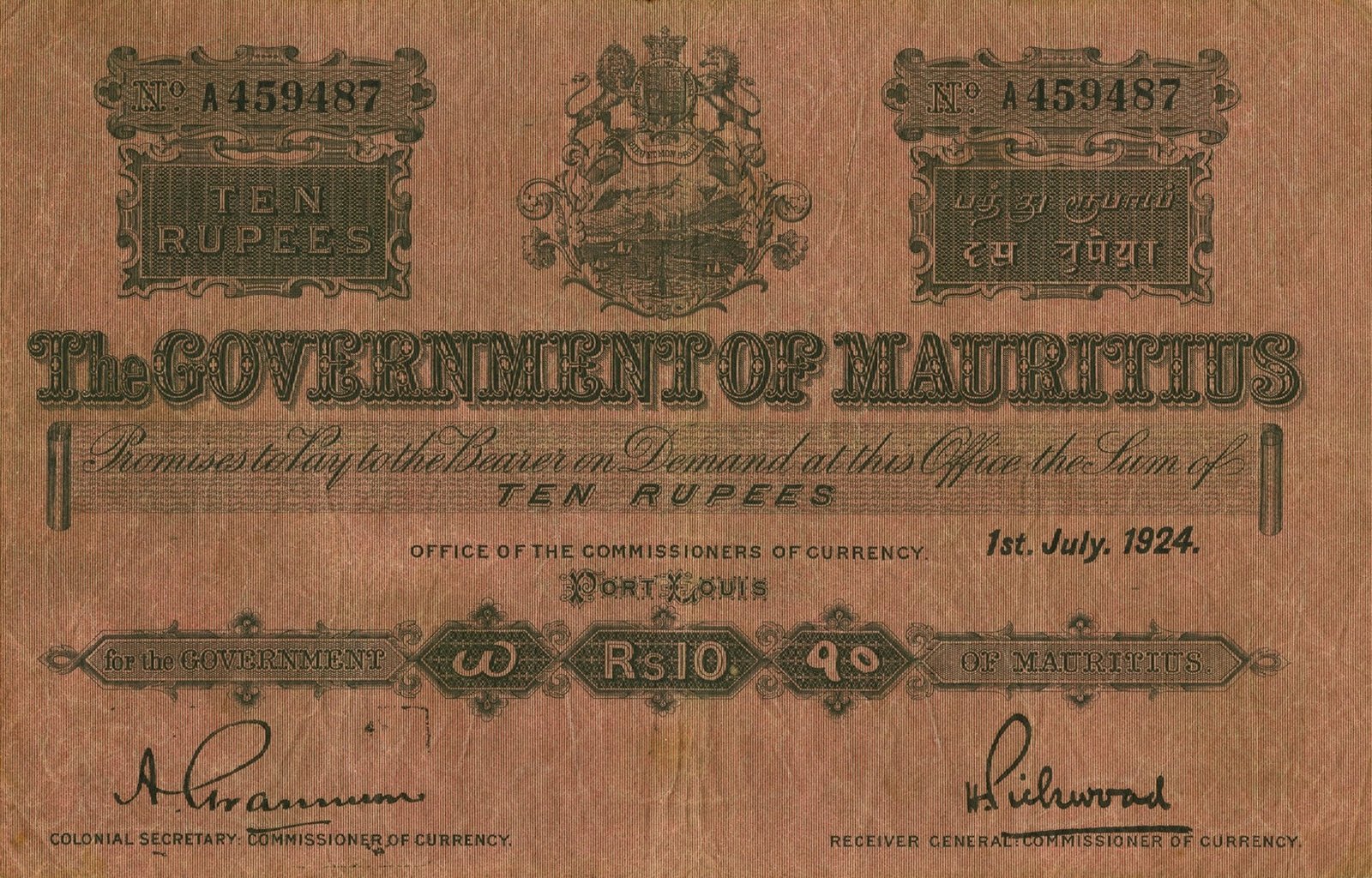
This article gathers the official counts of Mauritius notes in circulation from 1849 to 1971. The figures come from the Mauritius Blue Books, the accounts of the Commissioners of Currency in the Government Gazette, the annual reports on Mauritius, An Economic Survey of the Colonial Empire, Chalmers' History of Currency in the British Colonies (1893), papers in the National Archives and the annual reports of the Bank of Mauritius. Every figure is given as its source gives it.
What the returns count
No return of the Commissioners of Currency ever splits the notes by value. Each Blue Book gives the paper currency in circulation at 31 December by issue only: the rupee notes of 1849, the sterling notes of 1860, the rupee notes of 1876 and bank paper. The Gazette accounts and the annual reports give one total. The first table that divides the Government notes into 5, 10 and 25 rupees is in the Bank of Mauritius report for 1968, and it describes the last month of the old issue.
Some figures below were read on the page image and some only in the machine-read text of a volume. The tables mark the second kind "text".
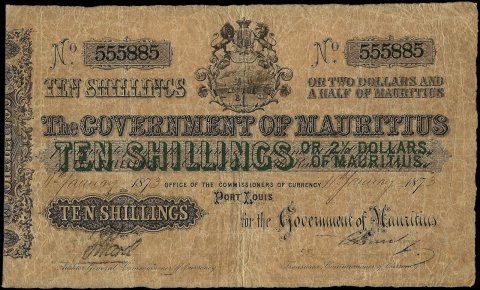
The rupee notes of 1849 and the sterling notes of 1860
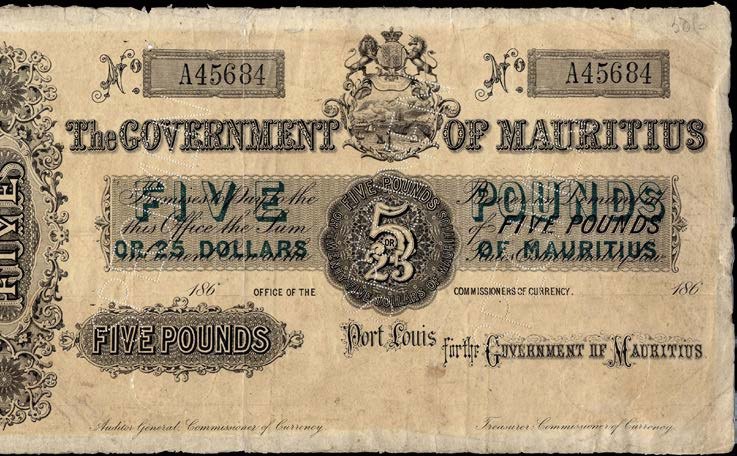
Government notes of 5 and 10 rupees, issued under Ordinances 7 of 1848 and 6 of 1849, came before the notes of 1860. The Blue Book statement of liabilities at 31 December 1849, a handwritten page, has £98,447 14s 2d of them outstanding, including £88,000 of notes advanced to the Mauritius Commercial Bank on deposit. The Governor's report for 1849 says that "the circulation of the notes languishes: the amount now in circulation by the last return is only 77,616l. 19s. 4d."
| 31 December | 5 and 10 rupees of 1849 | 10 shillings, 1 pound and 5 pounds of 1860 | Source |
|---|---|---|---|
| 1850 | £66,349 10s 10d | Blue Book for 1857 | |
| 1851 | £95,693 2s 6d | Blue Book for 1857 | |
| 1852 | £142,826 5s 10d | Blue Book for 1857 | |
| 1853 | £154,647 3s 4d | Blue Book for 1857 | |
| 1855 | £169,563 3s 4d | Blue Book for 1857 | |
| 1857 | £231,836 18s 4d | Blue Book for 1857 | |
| 1858 | £219,884 0s 10d | Blue Book for 1858 | |
| 1859 | £210,498 5s 10d | Blue Book for 1859 | |
| 1860 | £30,971 8s 4d | £210,469 10s | Blue Book for 1860 |
| 1861 | £3,717 10s 10d | £293,493 10s | Blue Book for 1861 |
| 1862 | £3,018 11s 8d | £319,292 10s | Blue Books |
| 1863 | £336,452 10s | Blue Books | |
| 1864 | £2,780 18s 4d | £356,424 | Blue Book for 1864 |
| 1865 | £370,494 10s | Blue Books | |
| 1868 | £643 | £390,781 | Blue Book for 1868 |
| 1869 | £389,126 | Blue Books | |
| 1870 | £390,272 | Blue Books | |
| 1871 | £348,800 10s | Blue Books | |
| 1873 | £333,957 10s | Blue Books | |
| 1874 | £627 17s 6d | £318,028 10s | Blue Book for 1874 |
A Colonial Office minute of 1858 (National Archives CO 167/407) gives the same total for 31 December 1857, 231,836 pounds, and says it was backed by specie of 122,236 pounds and investments of 109,600 pounds. The Blue Book for 1874 adds that £142,719 13s 4d of the sterling notes lay in the Commissioners' vault beside the £318,028 10s in circulation.
A printed Treasury memorandum on Mauritius (National Archives T 1/8866/1517C) gives rounder figures for the sterling notes than the Blue Books: 339,669 pounds by late 1863, about 350,000 pounds in 1864 and 360,000 pounds on 1 January 1869. The Blue Books have £336,452 10s at the end of 1863 and £390,781 at the end of 1868.
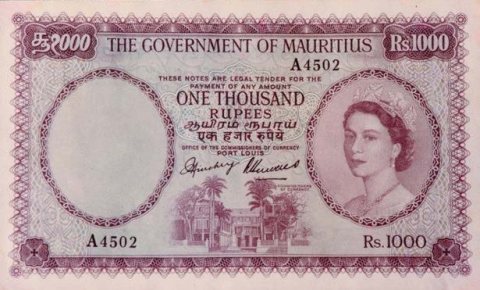
These are the 10 shillings, 1 pound and 5 pounds of the catalogue. A letter in the IBNS Journal (52:2, 2013, p. 6) reads the lumped line of the returns as proof that the 5 pounds was issued; the writer knew the value only as a specimen. The returns never separate the three values, so they do not show how much of the total was in 5 pounds notes.
What was never paid in
After the rupee notes of 1876 came in, the Gazette kept a separate sterling account under Ordinance 10 of 1864. It shows 5,636 pounds 4s 2d of the old notes in circulation on 30 November 1877, 207 pounds 10s withdrawn during December, and 5,428 pounds 14s 2d left on 31 December 1877, the last day for claims under Ordinance 28 of 1876 (Government Gazette, 1878, pp. 127 and 128).
| Year of the return | 5 and 10 rupees of 1849 | Notes of 1860 | Source |
|---|---|---|---|
| 1894 | £483 16s 5d | £3,640 | Blue Book for 1894, p. 31 |
| 1897 | £488 16s 5d | £3,640 | Blue Book for 1897 (text, from a scrambled table) |
| 1909 | about £483 16s | £3,383 | Blue Book for 1908-09 |
| 1919 | £483 6s 2d | £3,382 10s 0d | Blue Book for 1919 (text) |
| 1920 and 1921 | £483 6s 2d | £3,382 10s 0d | Blue Books for 1920 and 1921, p. U 1 |
| 1922 | £482 6s 2d | £3,382 10s 0d | Blue Book for 1922 (text) |
| 1923 | £482 6s 2d | £3,382 10s 0d | Blue Book for 1923, p. 171 |
| 1924 | £482 6s 2d | £3,382 10s 0d | Blue Book for 1924 (text) |
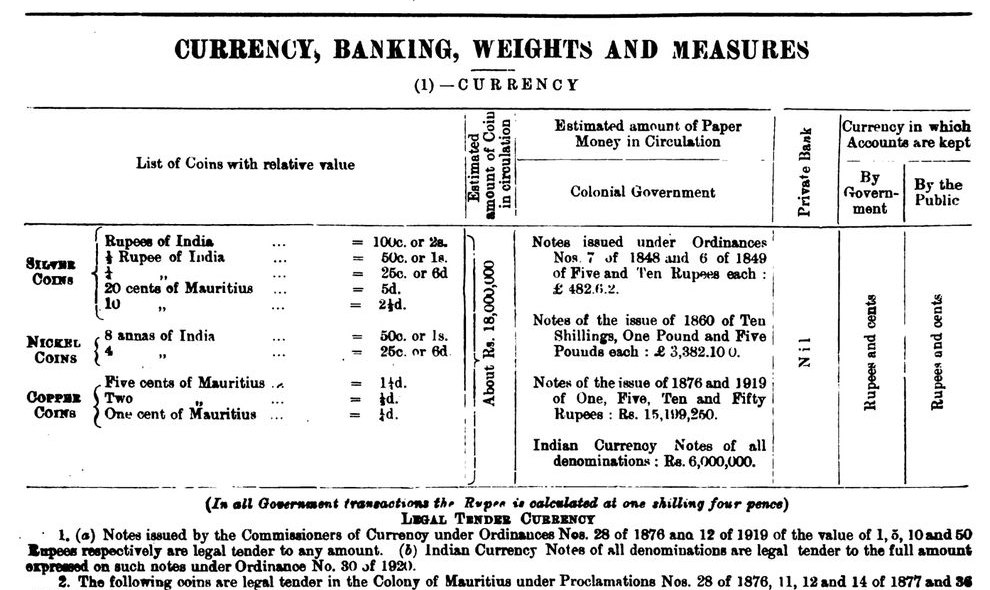
The small differences in the first column (£483 16s 5d in 1894, £488 16s 5d in 1897, £483 6s 2d in 1919) are given as read; the 1897 figure comes from a damaged text and has not been checked on the page. The letter in the IBNS Journal of 2013 gives £3,406 for the notes of 1860 in 1896 and £3,383 in 1910, and £482 for the notes of 1849 at 31 December 1932. The note pages date the 3,383 pounds to 31 December 1932. The returns above show a sum of about 3,383 pounds standing in the Government's books from 1909 on.
The rupee notes, 1877 to 1924
The first monthly account under Ordinance 28 of 1876 that has been read is for December 1877: new currency notes taken on charge during the month 630,000 rupees, notes issued 694,000 rupees and withdrawn 264,800 rupees, 2,530,050 rupees in circulation on 30 November and 2,959,250 on 31 December 1877, with 425 rupees of notes cancelled and destroyed. H. N. D. Beyts, Receiver General, signed it on 3 January 1878 (Government Gazette, 1878, pp. 125 and 126).
| Date | Government notes in circulation, rupees | Source |
|---|---|---|
| 31 December 1877 | 2,959,250 | Government Gazette, 1878, p. 126; report on the colonial possessions for 1877 |
| 31 October 1889 | 3,119,650 | Government Gazette, 1889 |
| 31 December 1891 | 2,668,250 | Chalmers (1893), p. 370 |
| 1894 | 3,016,250 | Blue Book for 1894, p. 31 |
| 31 December 1897 | 3,114,250 | Blue Book for 1897 (text) |
| 31 December 1898 | 3,404,250 | Blue Book for 1898 (text) |
| 31 December 1899 | 3,900,250 | Blue Book for 1899 (text) |
| 30 June 1902 | 3,990,250 | Blue Book for 1902 (text) |
| 30 June 1903 | 4,902,250 | Blue Book for 1903 (text) |
| 30 June 1904 | 4,376,250 | Blue Book for 1904 (text) |
| 1909 | 4,170,250 | Blue Book for 1908-09 |
| 30 June 1911 | 5,080,250 | annual report for 1910-11, p. 7 |
| 30 June 1912 and 1913 | 5,080,250 | annual report for 1913, p. 9 |
| 31 December 1919 | 10,169,000 | Blue Book for 1919 (text) |
| Blue Book for 1920 | 14,206,250 | Blue Book for 1920, p. U 1 |
| Blue Book for 1921 | 20,806,250 | Blue Book for 1921 |
| 31 December 1922 | 19,811,250 | Blue Book for 1922 (text) |
| 31 December 1923 | 15,199,250 | Blue Book for 1923, p. 171 |
| 31 December 1924 | 15,339,250 | Blue Book for 1924 (text) |
Chalmers splits the 2,668,250 rupees of 1891 into what stood behind it: specie in the hands of the Commissioners 1,124,000 rupees and 1,544,250 rupees disbursed for remittances up to that day. The annual reports give the same sum of 5,080,250 rupees for 30 June of 1911, 1912 and 1913, while the specie and investments beneath it change.
From 1905 the Commissioners' balance sheet gives the stock of notes and the part of it still in their hands, not the circulation.
| Date | Stock of notes, rupees | Of which in the Commissioners' hands | Source |
|---|---|---|---|
| 30 June 1905 | 6,876,250 | 3,036,000 | Blue Book for 1905 (text) |
| 30 June 1909 | 7,610,000 | 3,717,750 | Blue Book for 1908-09, p. 14 |
| 30 June 1916 | 7,869,000 | 1,138,750 | Blue Book for 1916 (text) |
| 30 June 1918 | 9,056,500 | 1,360,250 | Mauritius Almanac for 1920, p. A. 60 |
| 30 June 1922 | 21,286,250 | 4,430,000 | Blue Book for 1922 (text) |
| 30 June 1923 | 21,236,250 | 3,725,000 | Blue Book for 1923, p. 64 |

The Blue Book for 1921 gives the stock on 30 June 1921 as 22,494,000 rupees against 12,094,000 a year before. These were the years when Indian notes filled the island, told in The years Mauritius was full of Indian notes, 1920 to 1924.
Yearly averages, 1919-20 to 1932-33
The annual reports give the average value of currency notes in circulation over a year running from July to June. The reports for 1921, 1922 and 1929 add the silver held against them.
| Year | Average notes in circulation, rupees | Average silver held, rupees | Report |
|---|---|---|---|
| 1919-20 | 10,215,903 | 2,436,667 | 1921, p. 7 |
| 1920-21 | 14,635,100 | 6,873,260 | 1921, p. 7 |
| 1921-22 | 20,360,013 | 10,005,494 | 1922, p. 7 |
| 1922-23 | 19,175,588 | 1923-24, p. 7 | |
| 1923-24 | 15,645,126 | 1923-24, p. 7 | |
| 1924-25 | 15,214,048 | 1925-26, pp. 6 and 7 | |
| 1925-26 | 15,460,500 | 1925-26, pp. 6 and 7 | |
| 1927-28 | 14,132,970 | 4,253,750 | 1929, p. 15 |
| 1928-29 | 14,770,750 | 4,391,500 | 1929, p. 15 |
| 1929-30 | 14,747,250 | 1931 (text) | |
| 1930-31 | 7,489,290 | 1931 (text); 1932 | |
| 1931-32 | 7,287,300 | 1932; 1933 | |
| 1932-33 | 7,854,365 | 1933, p. 34 |

The reports do not say why the average halved between 1929-30 and 1930-31. The report for 1933 carries among the liabilities "a sum estimated at Rs.1,000,000 in respect of notes destroyed in circulation by fire, floods, etc."
From the sterling rupee of 1934 to the war
| Date | Notes in circulation, rupees | Source |
|---|---|---|
| 30 June 1933 | 6,213,780 | An Economic Survey of the Colonial Empire (1932), p. 208 |
| 30 June 1934 | 7,300,000 | An Economic Survey of the Colonial Empire (1933), p. 255 |
| 31 December 1934 | 7,922,045 | annual report for 1934, p. 34 (text) |
| 31 December 1934 | 7,923,045 | Commissioners' statement, Government Gazette of 30 March 1935 |
| 31 December 1935 | 8,182,500 | annual report for 1935, p. 34 |
| 31 December 1936 | 9,227,500 | annual report for 1936, p. 37 |
| 31 December 1937 | 9,417,485 | annual report for 1937, p. 56 |
| 31 December 1938 | 8,547,485 | annual report for 1938, p. 61 |
| 30 June 1941 | 10,494,970 | An Economic Survey of the Colonial Empire (1951) (text) |
| 30 June 1942 | 10,984,970 | Commissioners' statement, Government Gazette, 1942 |
For the end of 1934 the annual report has 7,922,045 rupees and the Gazette 7,923,045. The figure for 1935 is for the 5 rupees and 10 rupees only; those for 1936 to 1938 take in the 1,000 rupees of 1936 without saying how much of the total it made. The reports for 1936 to 1938 also give a figure for silver coin beside the notes: 1,875,000, 2,055,000 and 2,255,000 rupees.

1944 to 1967
Each annual report from 1946 gives the Government notes in circulation at the end of its year: 30 June down to the report for 1963, 31 December from the report for 1964.
| Date | Notes in circulation, rupees | Report |
|---|---|---|
| 30 June 1944 | 21,731,970 | 1946 |
| 30 June 1945 | 25,181,970 | 1946 |
| 30 June 1946 | 26,121,855 | 1946 |
| 30 June 1947 | 26,936,625 | 1947 |
| 30 June 1948 | 28,703,625 | 1948 |
| 30 June 1949 | 29,549,625 | 1949 |
| 30 June 1950 | 33,121,625 | 1950 |
| 30 June 1951 | 34,985,497 | 1952 |
| 30 June 1952 | 42,903,000 | 1952 |
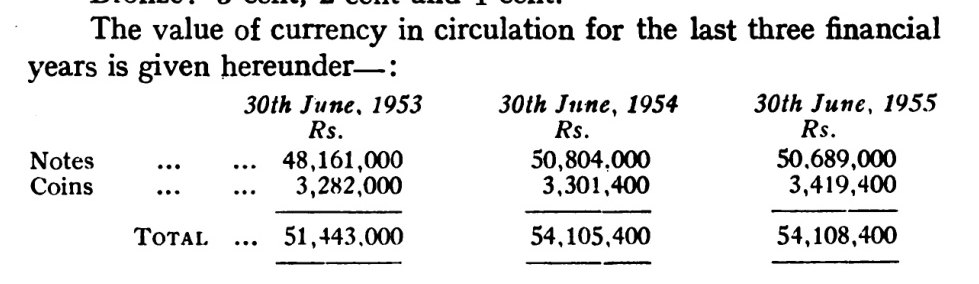
| 30 June 1953 | 48,161,000 | 1953 |
| 30 June 1954 | 50,804,000 | 1954 |
| 30 June 1955 | 50,689,000 | 1955 |
| 30 June 1956 | 48,550,000 | 1956 |
| 30 June 1957 | 52,890,000 | 1957 |
| 30 June 1958 | 57,530,000 | 1958 |
| 30 June 1959 | 61,235,000 | 1959 |
| 30 June 1960 | 64,605,000 | 1960 |
| 30 June 1961 | 68,245,000 | 1961 |
| 30 June 1962 | 68,955,000 | 1962 |
| 30 June 1963 | 71,860,000 | 1963 |
| 31 December 1962 | 77,335,000 | 1964 |
| 31 December 1963 | 95,745,000 | 1964 |
| 31 December 1964 | 92,184,500 | 1964 |
| 31 December 1965 | 93,444,500 | 1965 |
| 31 December 1966 | 92,609,500 | 1966 |
| 31 December 1967 | 94,117,170 | 1967 |
Two other sources touch this run. The Mauritius Blue Book for 1945 (read in the text only) gives 26,121,855 rupees for 31 December 1945, the figure the annual report gives for 30 June 1946, and lists what it covers: notes "of the issue of 1934 of One thousand, Ten, Five and One rupee, 50 cents and 25 cents". The Blue Book for 1946-47 gives 29,793,625 rupees for 31 December 1947 with the same list. The Commissioners' statement in the Gazette gives 93,414,500 rupees for 31 December 1965, where the annual report has 93,444,500.
The Note Security Fund stood at 110.89 per cent of the notes on 30 June 1946, 110 per cent in 1947, 108.97 in 1948, 111.34 in 1949 and 107.7 in 1950 (annual reports for 1946 to 1950).
The accounts also carried the notes of the 1934 issue that had ceased to be legal tender in 1955: 433,592 rupees 50 cents on 30 June 1963 and 422,440 rupees 75 cents on 30 June 1967.

The exchange of 1967 to 1971, month end by month end
The circulation tables of the Bank of Mauritius reports for 1968, 1969 and 1971 give the Bank's own notes by value and the Government notes still out, in thousands of rupees.
| Month end | 5 rupees | 10 rupees | 25 rupees | 50 rupees | All Bank notes | Government notes still out |
|---|---|---|---|---|---|---|
| August 1967 | none | none | none | none | none | 87,399 |
| September 1967 | 22,885 | 24,610 | 5,575 | 5,000 | 58,070 | 26,224 |
| December 1967 | 32,750 | 41,159 | 8,925 | 6,951 | 89,785 | 4,333 |
| June 1968 | 25,850 | 36,214 | 9,329 | 7,700 | 79,093 | 1,930 |
| June 1969 | 22,811 | 36,614 | 10,051 | 10,253 | 79,729 | 811 |
| June 1971 | 23,148 | 42,855 | 12,038 | 19,965 | 98,006 | 639 |
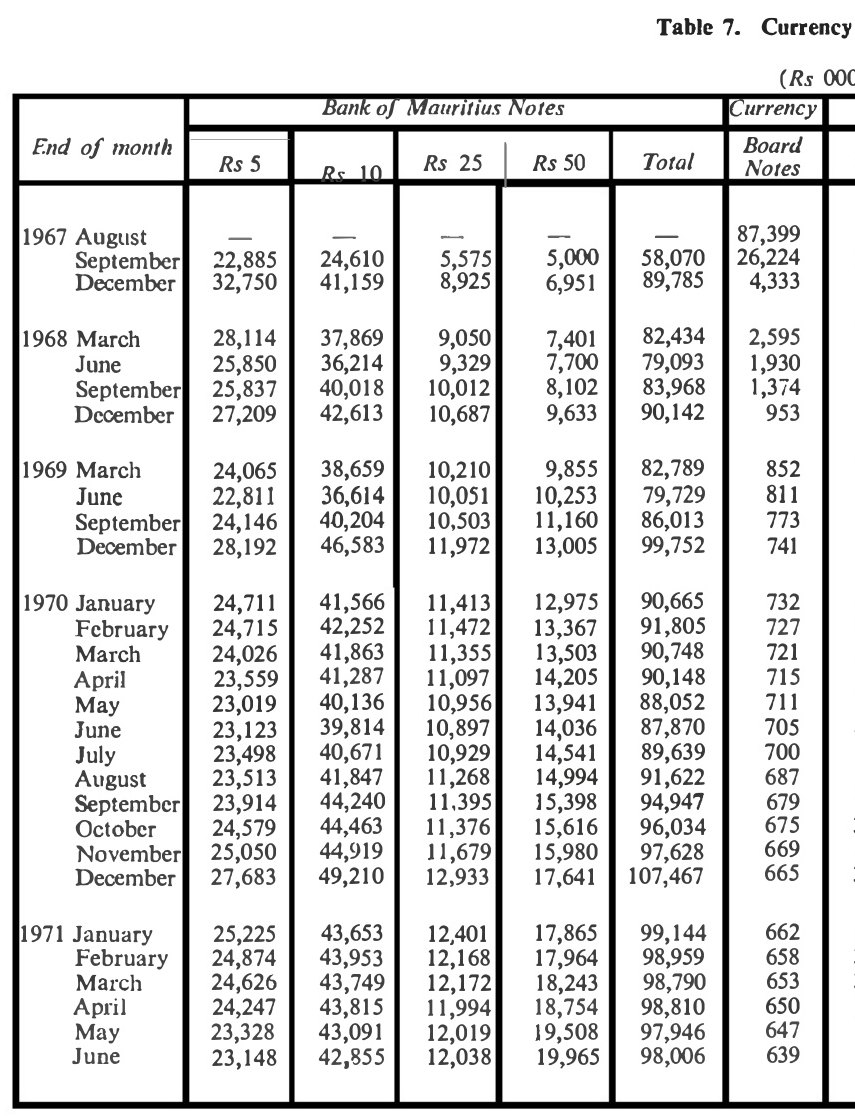
The table of the 1968 report is the only one that splits the Government notes by value: 30,923,000 rupees in 5 rupees, 40,350,000 in 10 rupees and 16,126,000 in 25 rupees at the end of August 1967, and 732,000, 758,000 and 440,000 rupees at the end of June 1968. It has no column for the 1,000 rupees. The report says that 17 per cent of the Government notes came in during the first week of the exchange, 38 per cent by the second and 66 per cent by the fourth. The notes the Bank issued are in The Bank of Mauritius and its first notes, 1967 to 1988.
What the figures do not tell
- No source read gives the number of 1,000 rupees notes issued, of any of the three types.
- No source read gives a figure for the 25 and 50 cents, for the 1 rupee of 1941 or for the emergency 1 rupee of 1942 taken alone.
- The annual reports of 1946 to 1950 name no values at all. No annual report for 1951 is held.
Sources
- Mauritius Blue Books for 1849, 1857 to 1862, 1864, 1868, 1874, 1894, 1897 to 1899, 1902 to 1905, 1908-09, 1916, 1919 to 1924, 1945 and 1946-47.
- Mauritius Government Gazette: the Commissioners' accounts of December 1877 (1878, pp. 125 to 128) and October 1889, and their statements of 1935, 1942 and 1965.
- Reports showing the present state of Her Majesty's colonial possessions, for 1849 and 1877.
- Robert Chalmers, A History of Currency in the British Colonies (1893), p. 370.
- National Archives, CO 167/407 and T 1/8866/1517C, Document 4.
- Mauritius Almanac and Commercial Handbook for 1920, p. A. 60.
- Annual reports on Mauritius for 1910-11, 1913, 1921, 1922, 1923-24, 1925-26, 1929, 1931 to 1938 and 1946 to 1967.
- An Economic Survey of the Colonial Empire, editions of 1932, 1933 and 1951.
- Bank of Mauritius annual reports for 1968, 1969 and 1971.
- A letter on unredeemed Mauritius notes, IBNS Journal 52:2 (2013), p. 6.
Member comments
Log in or register to post a comment.