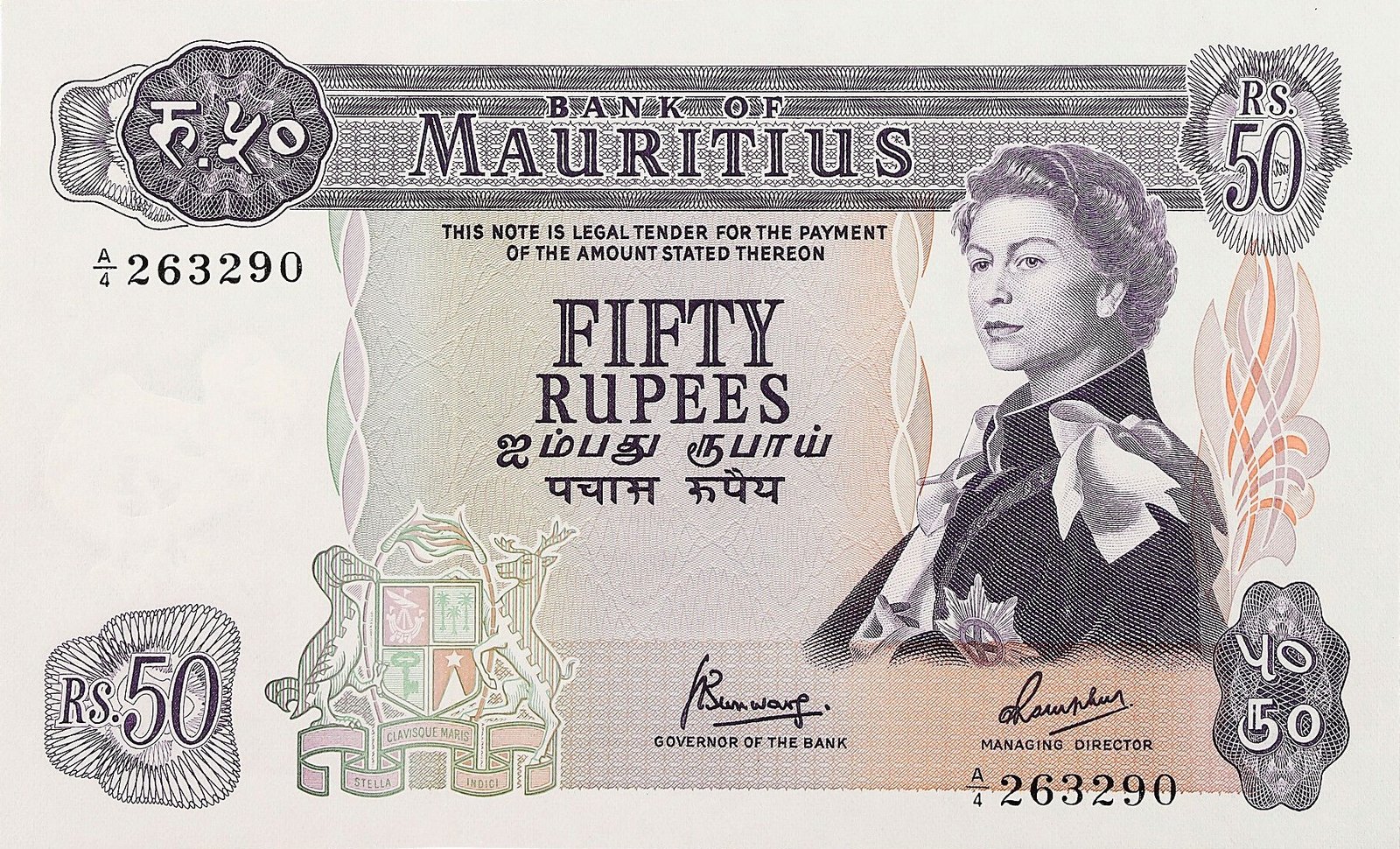
This article covers the first notes of the Bank of Mauritius: the 5, 10, 25 and 50 rupees with the portrait of Queen Elizabeth II, issued on 4 September 1967 and withdrawn in April 1988. It is drawn from the catalogue's note pages for Mauritius, which rest on the Bank's annual reports for 1968, 1969 and 1971, with statements of auction houses and one address by a later Governor of the Bank, each named where it is used.
The Bank and the take-over of 1967
The Bank of Mauritius was established by Ordinance 43 of 1966, proclaimed on 15 October 1966. It began work on 14 August 1967 and opened as the central bank on 1 September 1967. Governor Rameswurlall Basant Roi, opening the Bank's museum at Port Louis on 3 November 2017, described Aunauth Beejadhur, the first Governor, as "a journalist and politician" who was entrusted in 1966 with starting the Bank (address published by the Bank for International Settlements).
Before it issued a note the Bank took over from the Board of Commissioners of Currency the issue and redemption of notes and coin and the securities held against them. Thomas de la Rue won the tender for the new notes. The new issue added a 50 rupees and left out the 1,000 rupees, a note used only for transfers between banks.
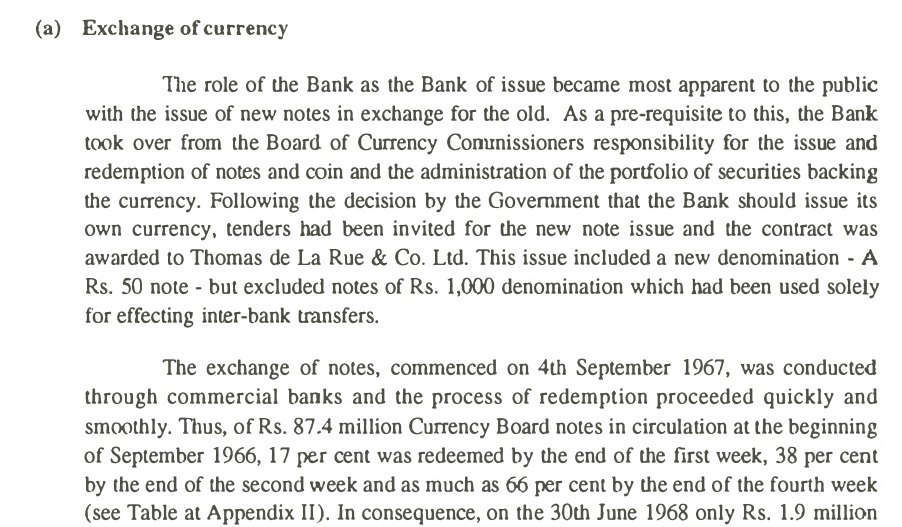
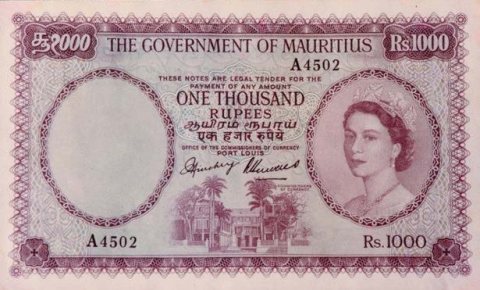
The exchange began on 4 September 1967 through the commercial banks. Of 87.4 million rupees of Government notes, two thirds had come in within four weeks, and 1.9 million rupees was left on 30 June 1968. The Government notes ceased to be legal tender on 14 October 1968 and could after that be exchanged only at the Bank (Bank of Mauritius annual reports for 1968 and 1969). The Government notes themselves are in The Elizabeth II notes of the Government of Mauritius, 1954 to 1968.
The four notes in the Bank's own words
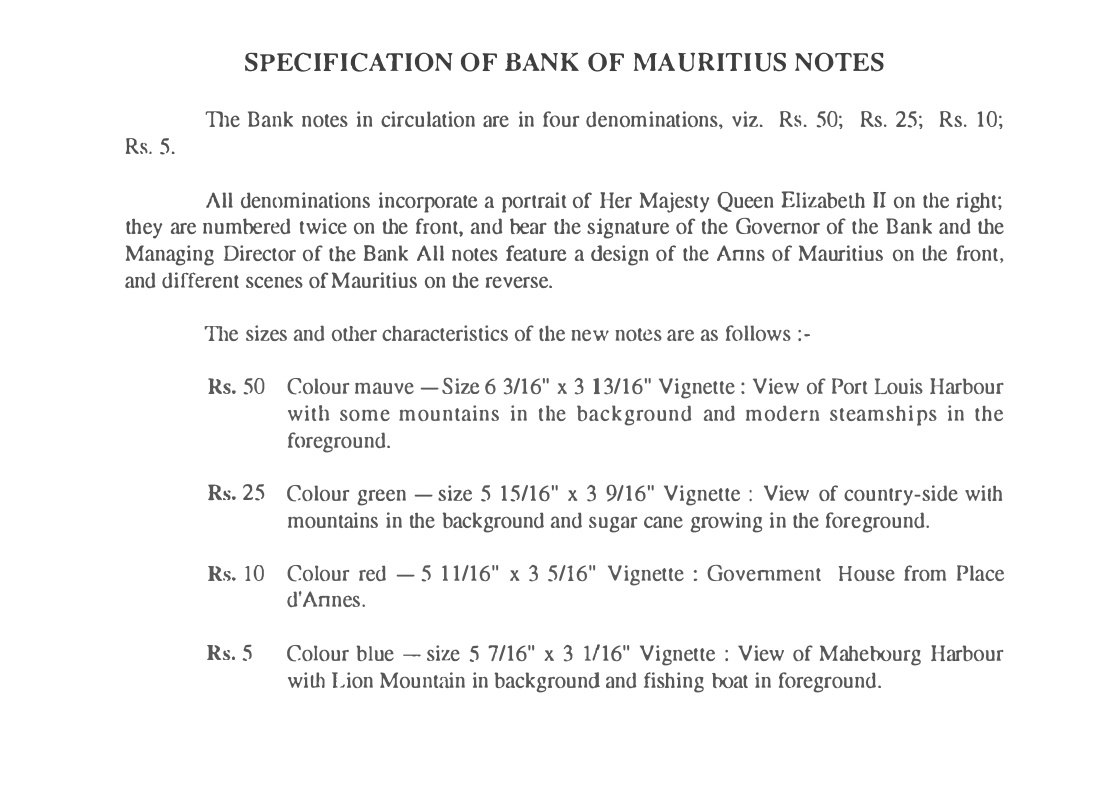
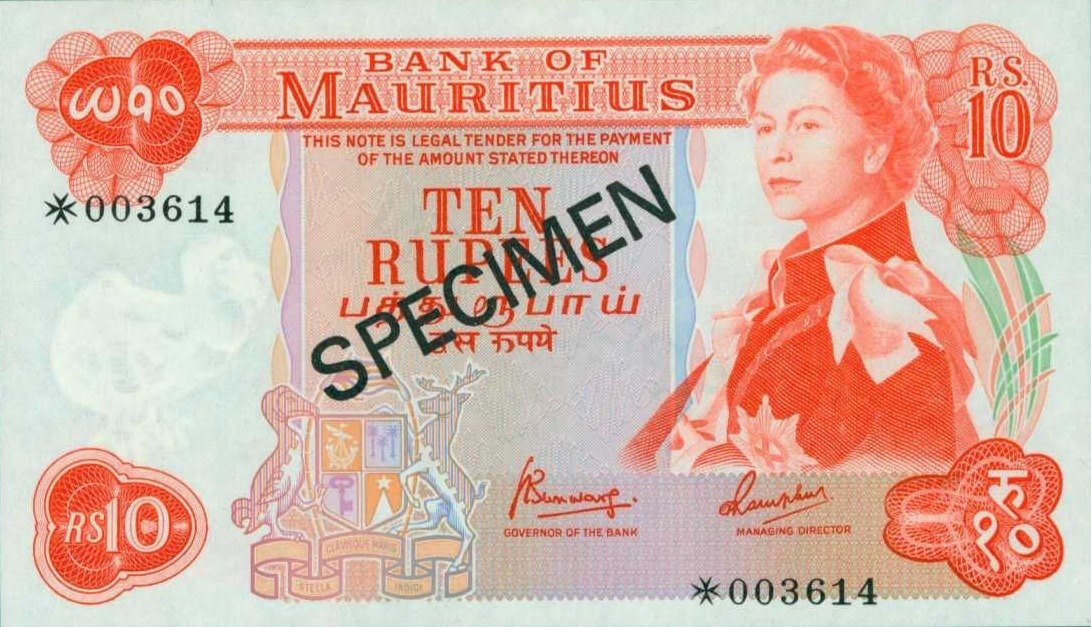
All four notes carry Pietro Annigoni's portrait of Queen Elizabeth II in the robes of the Order of the Garter. Sources mention that the portrait on these notes is De La Rue's own engraving, not the Bradbury Wilkinson one used elsewhere. The Bank's report for 1968 describes each value:
| Value | Colour | Size in the report | View |
|---|---|---|---|
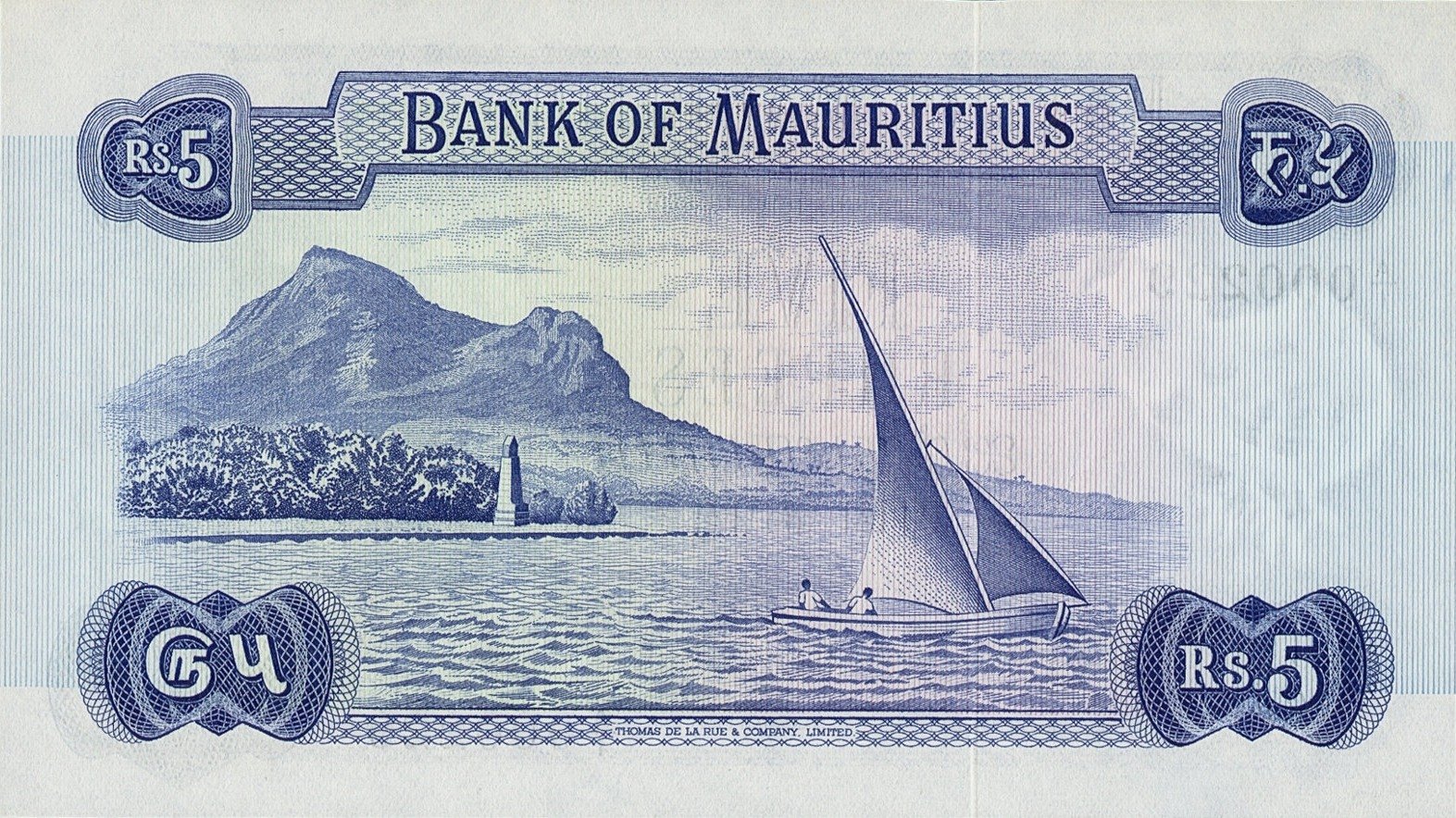
| 5 rupees | blue | 5 7/16 by 3 1/16 inches (about 138 x 78 mm) | Mahebourg harbour, Lion Mountain behind and a fishing boat in front |
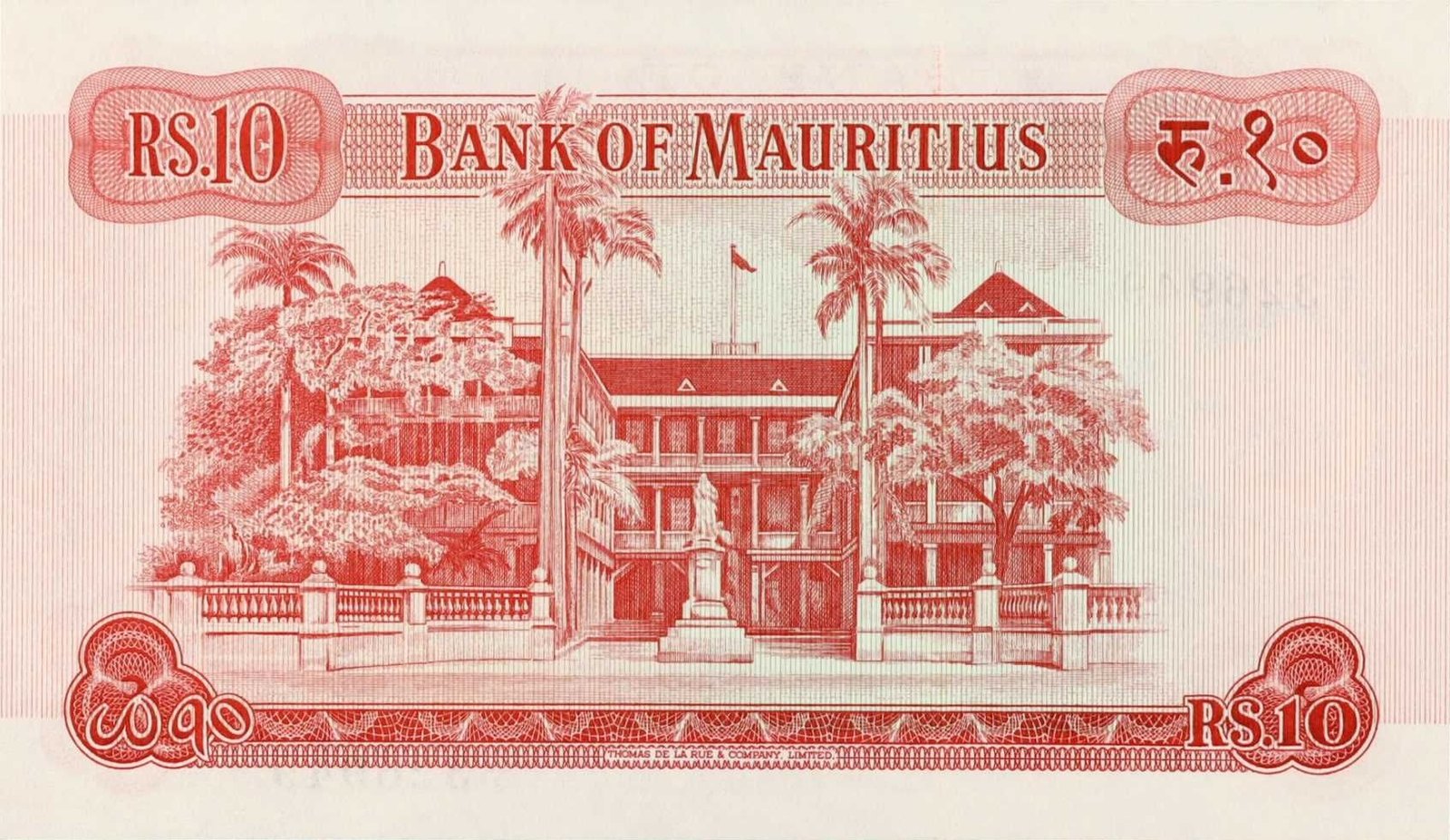
| 10 rupees | red | 5 11/16 by 3 5/16 inches (about 144 x 84 mm) | Government House seen from the Place d'Armes |
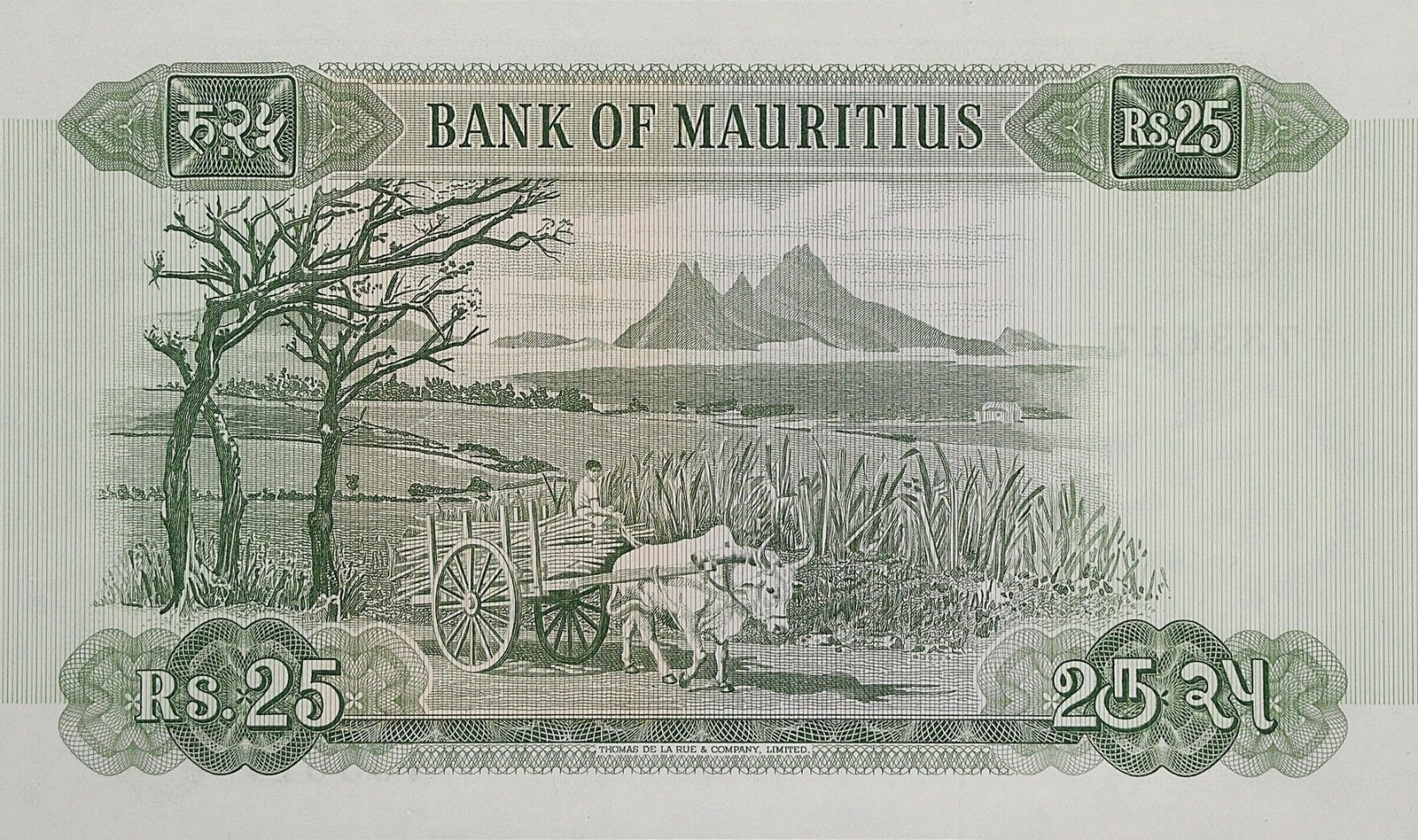
| 25 rupees | green | 5 15/16 by 3 9/16 inches (about 151 x 90 mm) | the countryside, mountains behind and sugar cane growing in front |
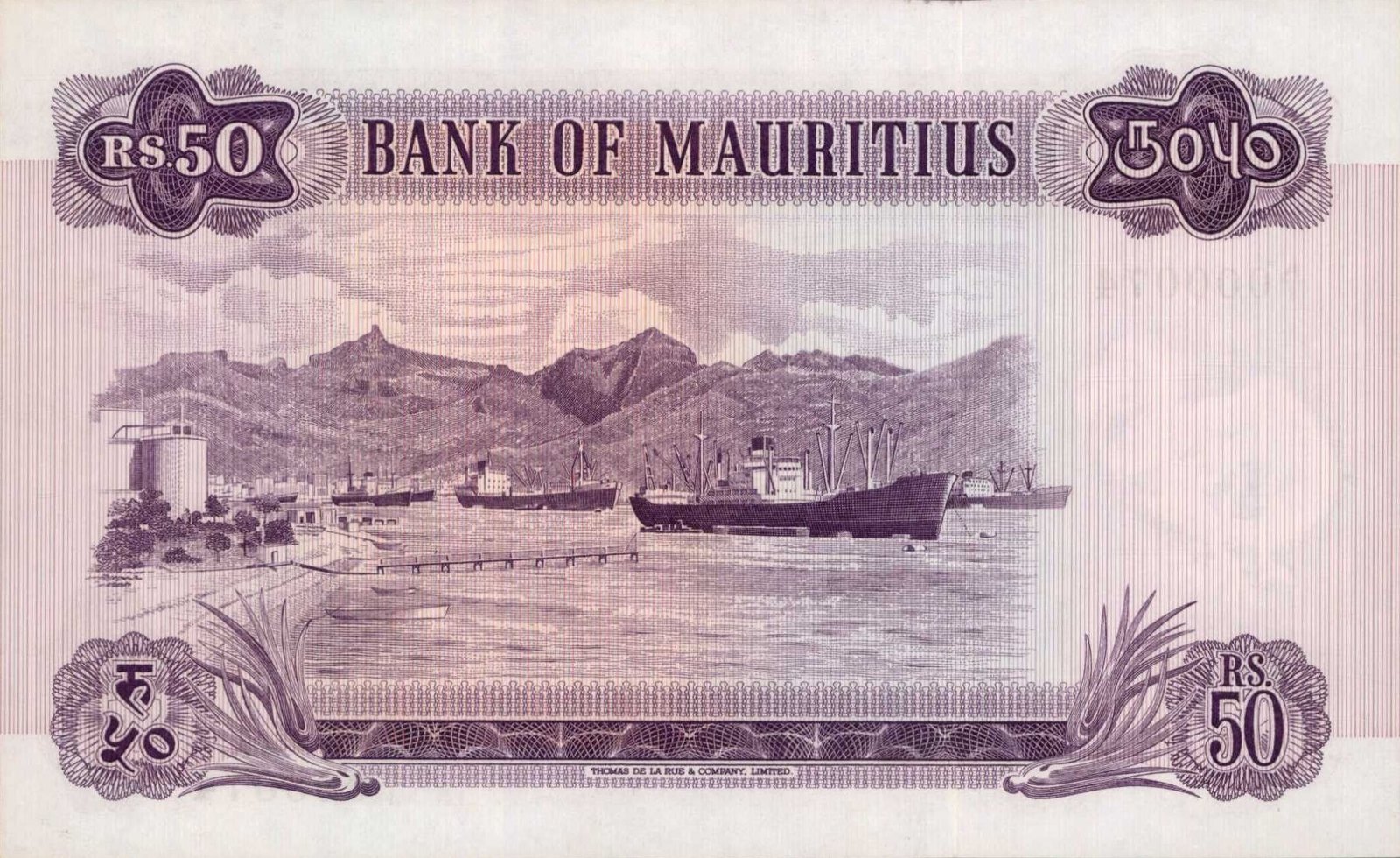
| 50 rupees | mauve | 6 3/16 by 3 13/16 inches (about 157 x 97 mm) | Port Louis harbour, mountains behind and modern steamships in front |
Spink's descriptions of specimen groups (24 April 2012, lots 870 and 871) name the backs more shortly, as a yacht, Government House, an ox cart and Port Louis harbour.
Notes in circulation, 1967 and 1971
| Value | End of September 1967 | End of June 1971 |
|---|---|---|
| 5 rupees | 22.9 million rupees | 23.1 million rupees |
| 10 rupees | 24.6 million rupees | 42.9 million rupees |
| 25 rupees | 5.6 million rupees | 12.0 million rupees |
| 50 rupees | 5.0 million rupees (100,000 notes) | 20.0 million rupees (about 399,000 notes) |
September 1967 was the first month of the issue. The figures are from the Bank of Mauritius annual reports for 1968 and 1971. In June 1971 more 10 rupees notes were out, by value, than notes of any other value. The 50 rupees was a new value.
Four pairs of signers
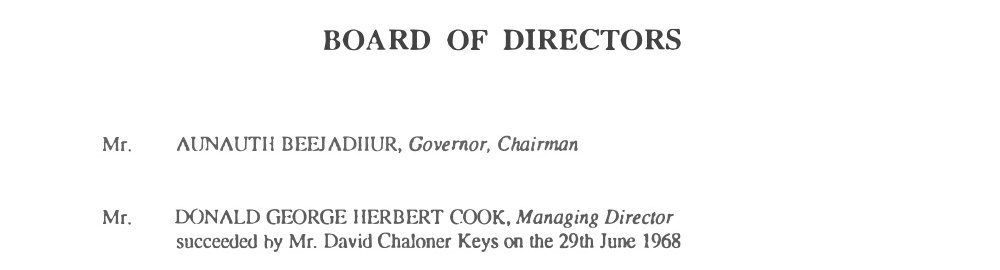
The Governor of the Bank signs at left and the Managing Director at right. Four pairs occur, but no value has all four:
| Pair | 5 rupees | 10 rupees | 25 rupees | 50 rupees |
|---|---|---|---|---|
| Aunauth Beejadhur and D. G. H. Cook | A/1 to A/14 | A/1 to A/8 | A/1 | A/1 |
| Beejadhur and David Chaloner Keys | none recorded | A/9 to A/16 | none recorded | A/1 and A/2 |
| Beejadhur and Goorpersad Bunwaree | A/15 to A/24 | none recorded | none recorded | none recorded |
| Bunwaree, by then Governor, and Indur Ramphul | A/25 to A/54 | A/16 to A/65 | A/2 to A/16 | from A/2 |
Cook was Managing Director until 28 June 1968. Keys followed on 29 June 1968 and was still in office on 30 June 1969. By 30 June 1971 Bunwaree held the post (Bank of Mauritius annual reports for 1968, 1969 and 1971). The Beejadhur and Keys notes therefore date from between the middle of 1968 and 1971, and their rows are dated ND (1968), the year Keys began to sign. The Beejadhur and Bunwaree 5 rupees is later than the Keys notes of the other values. The day Bunwaree took office is not in the reports read, so its rows stay dated ND.
Where two pairs share a prefix, only the signatures place a note: A/16 on the 10 rupees, and A/1 and A/2 on the 50 rupees. On the 50 rupees the numbers recorded so far never interleave. Beejadhur and Cook run to A/1 357541 and Beejadhur and Keys begin by A/1 542404; Beejadhur and Keys run to A/2 407676 and Bunwaree and Ramphul begin by A/2 555620.
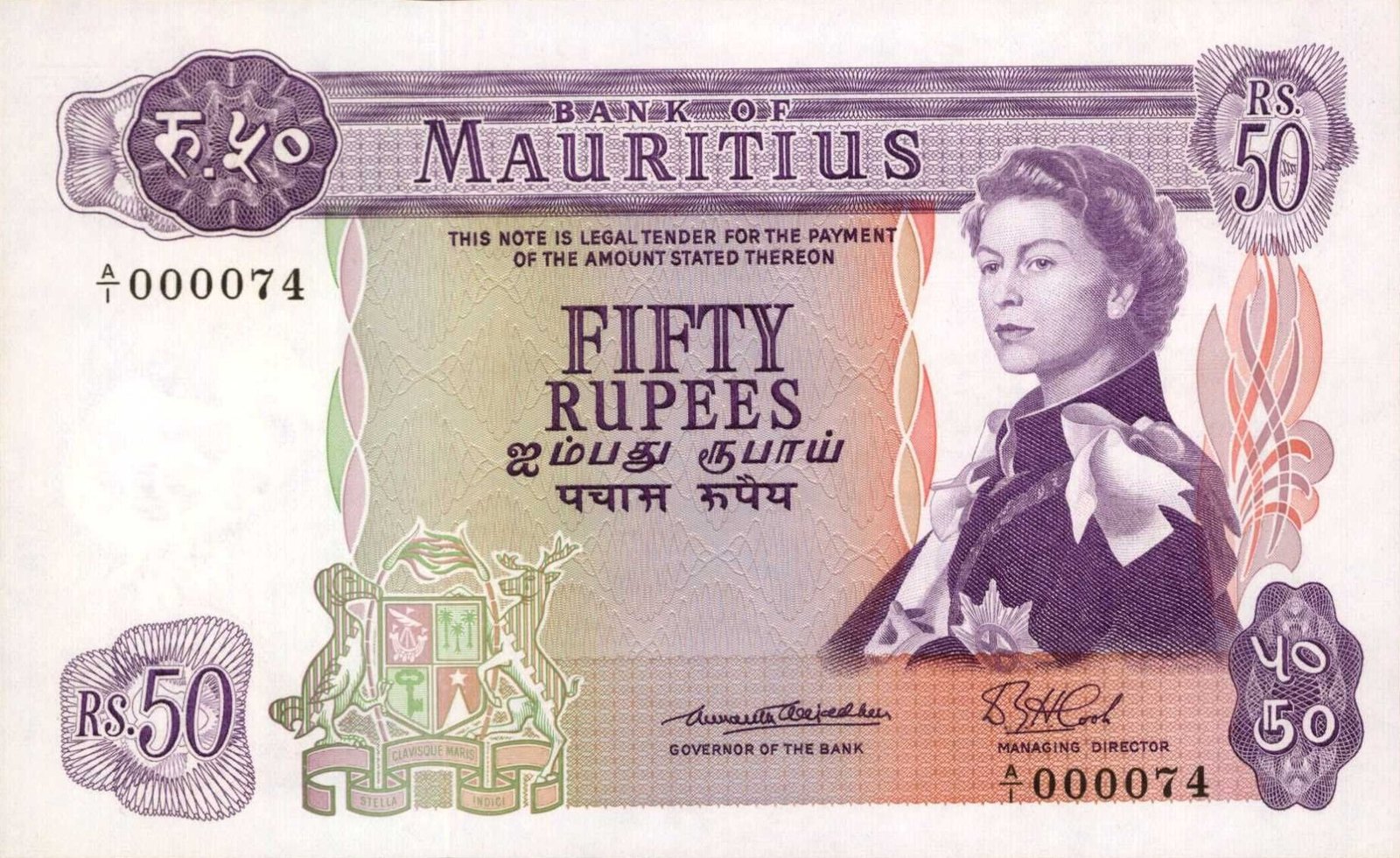
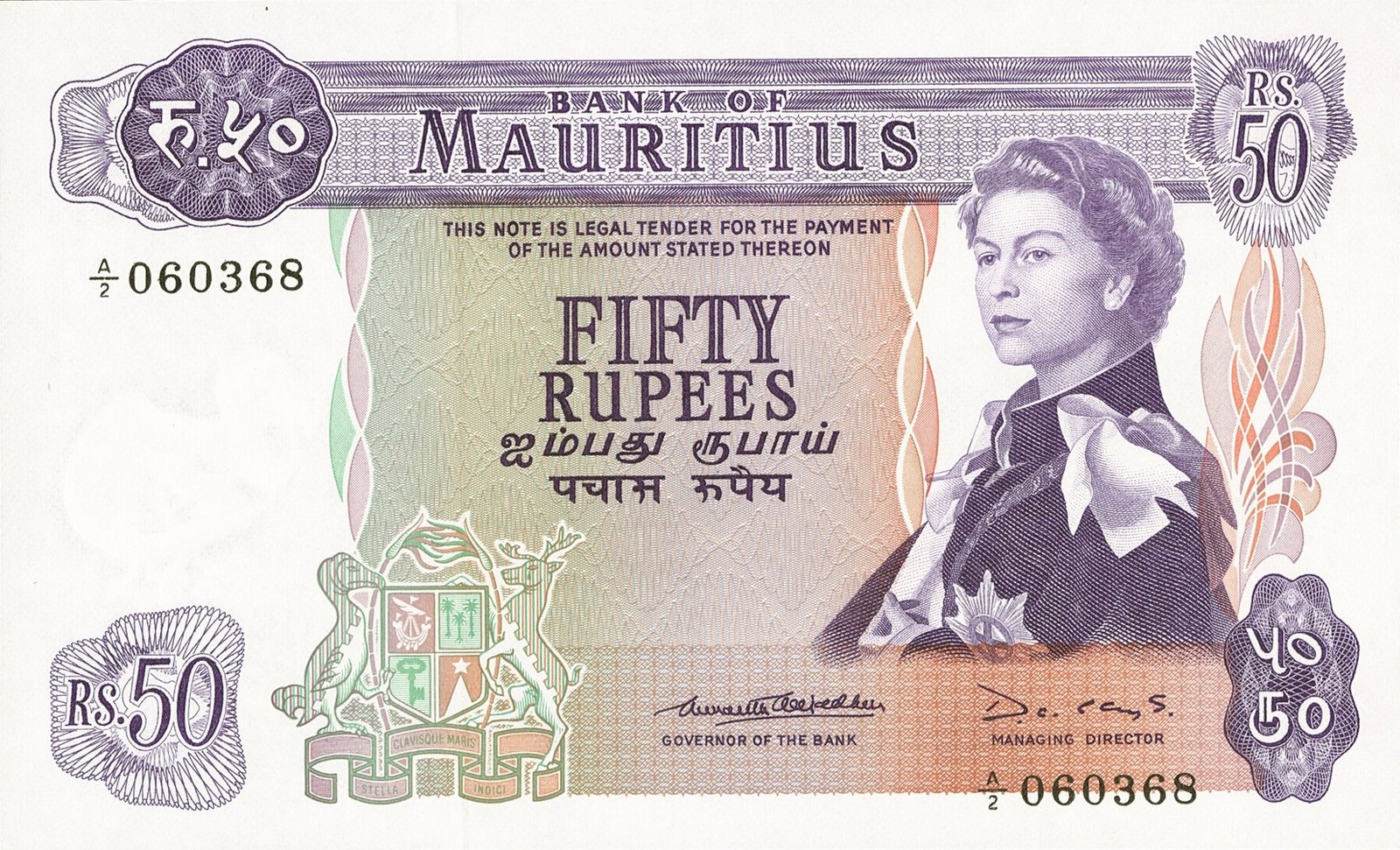
Spink (24 April 2012, lot 870) sold a set of eleven specimens which the house called every signature variety of the issue. Its numbering of the signatures runs from 1 to 4 in the order of the table above, and its prefixes agree with the note pages: A/1, A/15 and A/25 for the 5 rupees, A/1, A/9 and A/16 for the 10 rupees, A/1 and A/2 for the 25 rupees, and A/1, A/1 and A/2 for the 50 rupees.
Replacement notes
Replacement notes carry the prefix Z/1 on every value. On the 5 rupees the prefix is found under two pairs, so the signatures decide. Sources mention two blocks of replacement numbers, Z/1 004,884 to Z/1 019,991 and Z/1 189,431 to Z/1 780,733, and give the first block to the Beejadhur and Cook signature. The note pages disagree with that: Z/1 004892, read from its photograph, carries Beejadhur and Bunwaree, and Z/1 004873 lies just below the block. Z/1 121656 carries the same pair, and the lowest recorded replacement with the Bunwaree and Ramphul signatures is Z/1 185126.
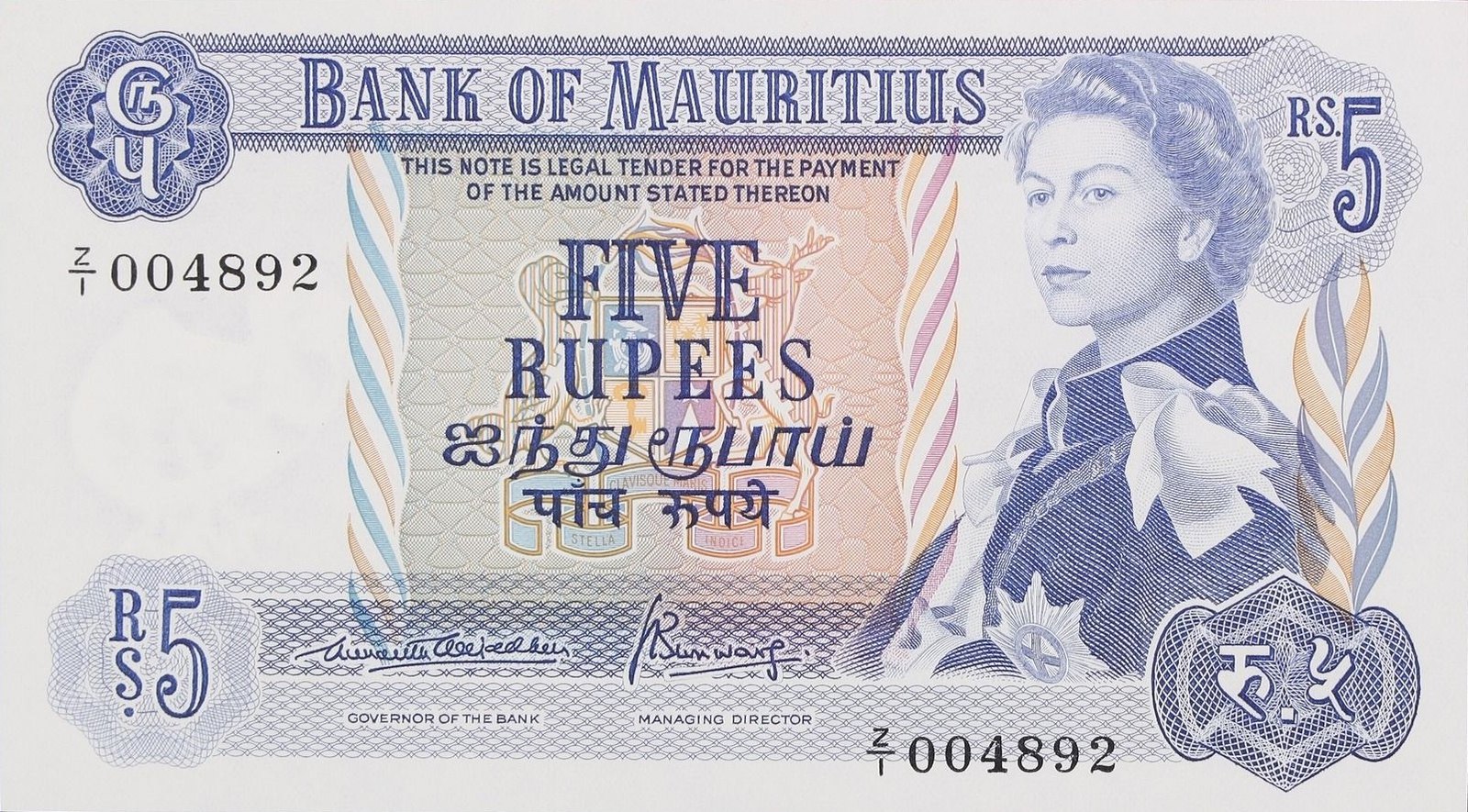
Sources mention a Beejadhur and Cook replacement of the 10 rupees, but every recorded replacement of the 10, 25 and 50 rupees whose signatures have been read is signed by Bunwaree and Ramphul.
The specimen sets of 1978
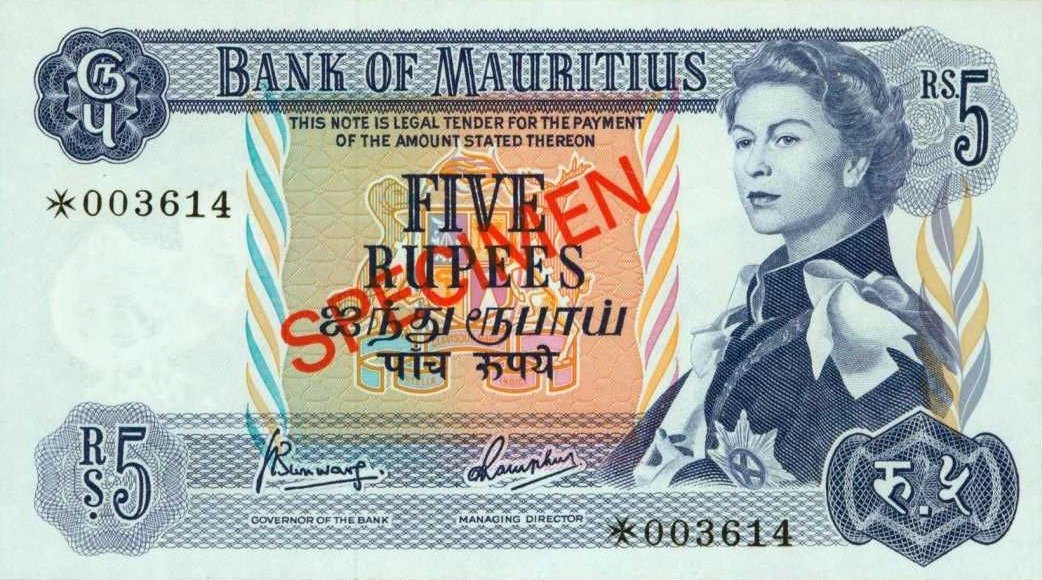
In 1978 Thomas de la Rue made specimen sets of the four notes for the Franklin Mint, with a Maltese cross prefix. The 10 rupees of the set has a black SPECIMEN overprint, where the 5, 25 and 50 rupees have red. Heritage (10 September 2018, lot 29482) describes a set in which all four notes carry the matching number 002378.
Sources
- Bank of Mauritius annual reports for 1968, 1969 and 1971.
- Rameswurlall Basant Roi, address at the opening of the Bank of Mauritius Museum, 3 November 2017, as published by the Bank for International Settlements.
- Spink, 24 April 2012, lots 870 and 871.
- Heritage Auctions, 10 September 2018, lot 29482.
- The catalogue's note pages for the unnamed sources ("sources mention").
Member comments
Log in or register to post a comment.