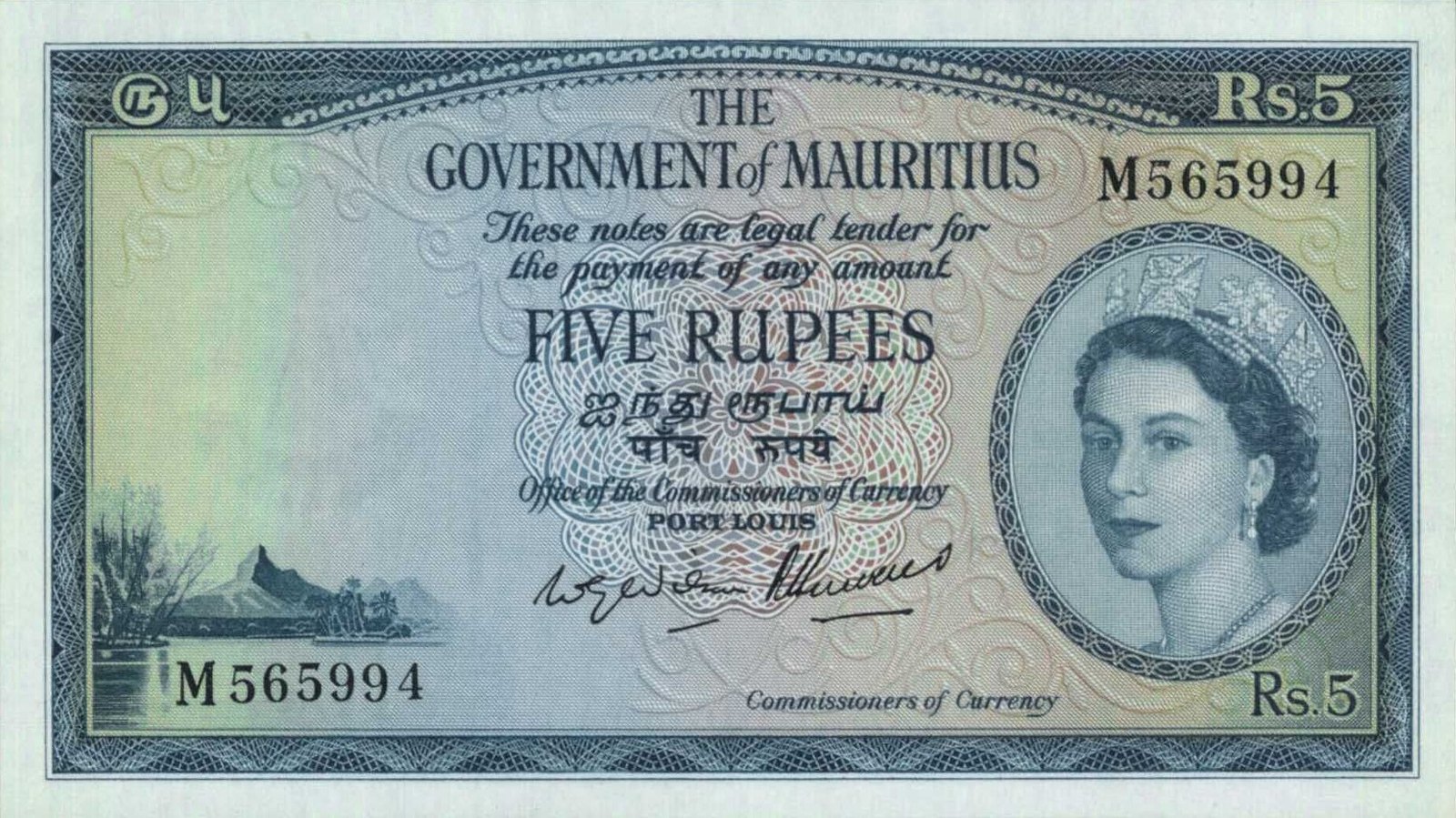
This article covers the Government of Mauritius notes with the portrait of Queen Elizabeth II, printed by Bradbury Wilkinson and Company. It is drawn from the catalogue's note pages, which rest on the annual reports on Mauritius, the Colonial Office Lists, the annual reports of the Bank of Mauritius for 1968 to 1971 and the printer's specimens. Statements of auction houses are added, each with the house, the day of the sale and the lot. The notes before them are in The portrait notes of the Government of Mauritius, 1934 to 1955.
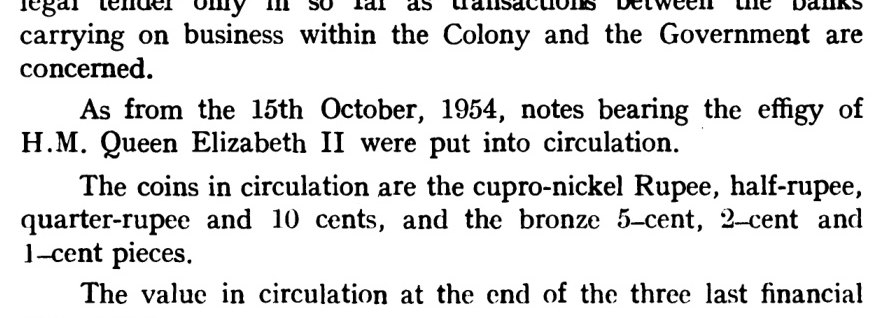
The issue of 15 October 1954
Queen Elizabeth II succeeded King George VI on 6 February 1952, and the new notes came out on 15 October 1954. There are four values: 5 rupees, 10 rupees, 25 rupees and 1,000 rupees. Sources mention that the portrait follows a 1952 photograph by Dorothy Wilding, engraved by Bradbury Wilkinson.
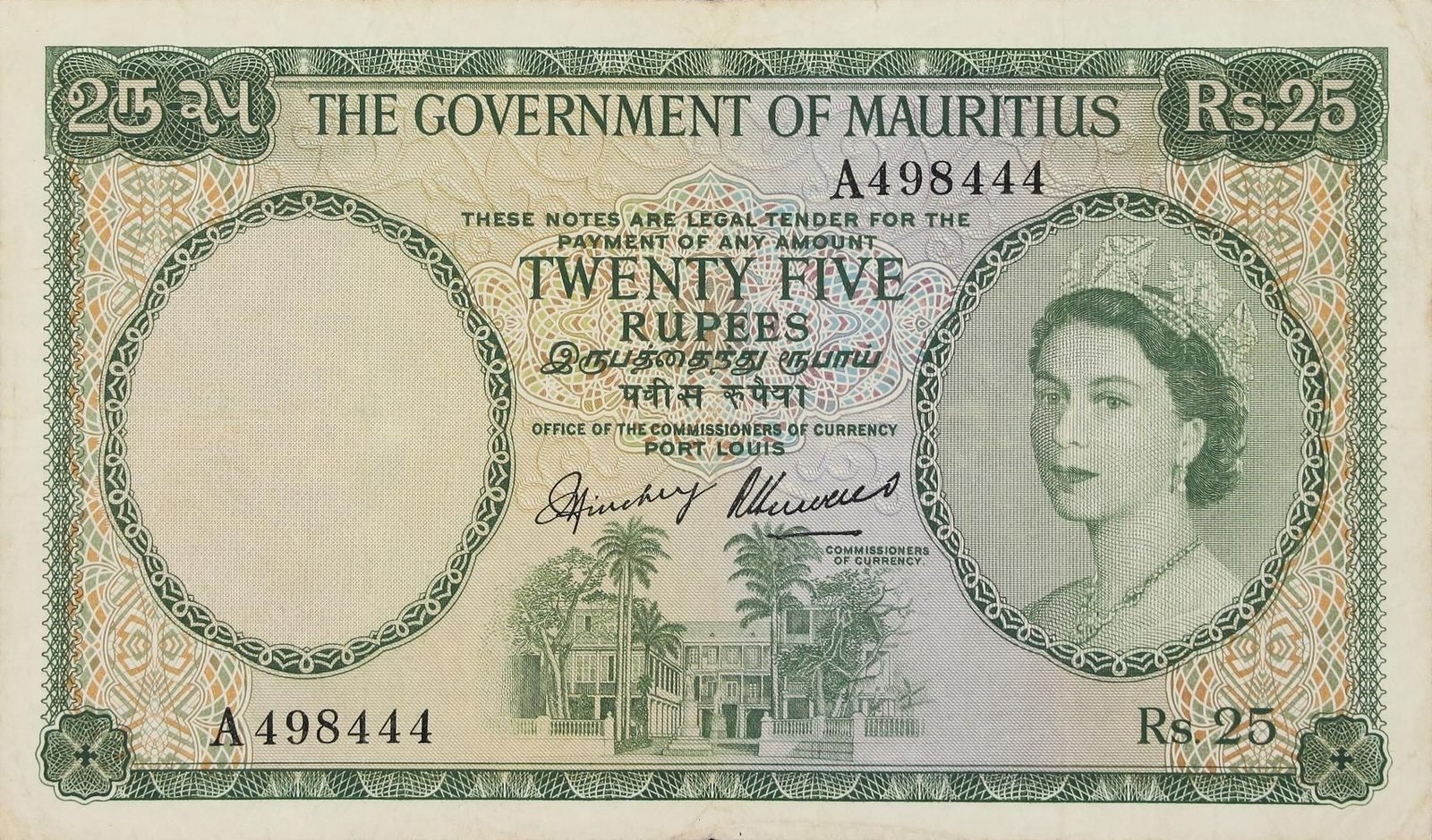
The 25 rupees was a new value. The annual reports list notes of 10, 5 and 1 rupees until 1953 and add the 25 rupees with the notes of 15 October 1954. Heritage (8 December 2023, lot 22301) calls it the highest value of the issue usually seen in circulation.
Special Auction Services (2 May 2024, lot 534) sold a hand-drawn design for the back of the 5 rupees, in pencil, ink and watercolour on paper laid on card, which the house describes as made at Bradbury Wilkinson and signed on the back by Stephen Gooden. With it went a test printing in blue of the back as issued and two test printings in green of the back of the 25 rupees.
The Hindi line
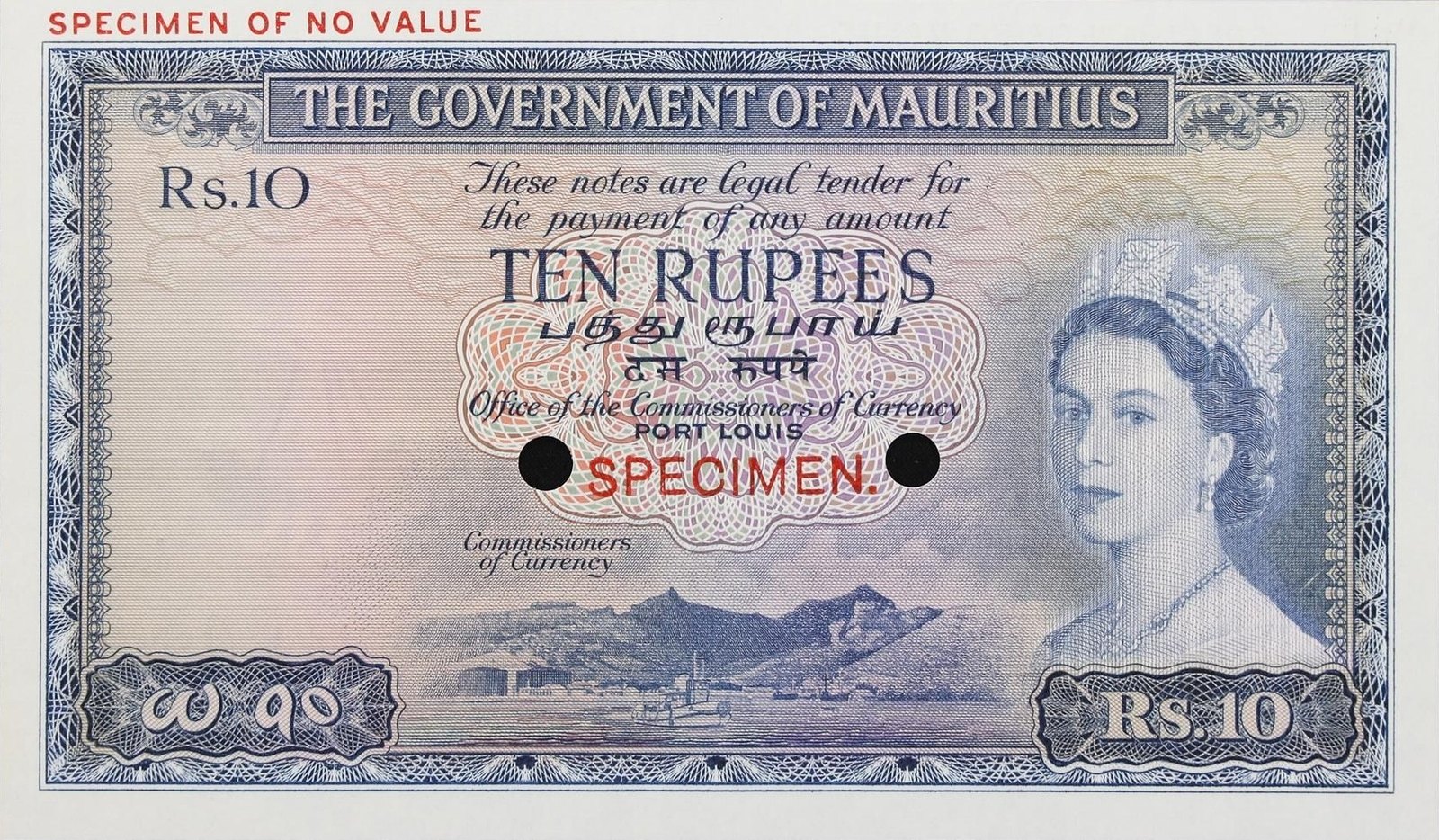
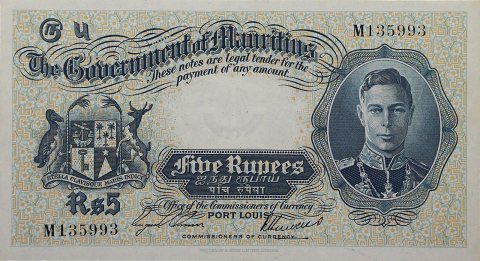
On the first printing, signed Hinchey and Harvais, the denomination in Hindi on the front and back wrongly uses the singular form of the word rupee. The plural appears from the Wilson and Harvais notes onward. The printer's requisition numbers written on the Wilson and Harvais specimens date the corrected notes: 6078/57 on the 10 rupees (1957), 7247/1959 on the 5 rupees (1959) and 8710/60 on the 25 rupees (1960).
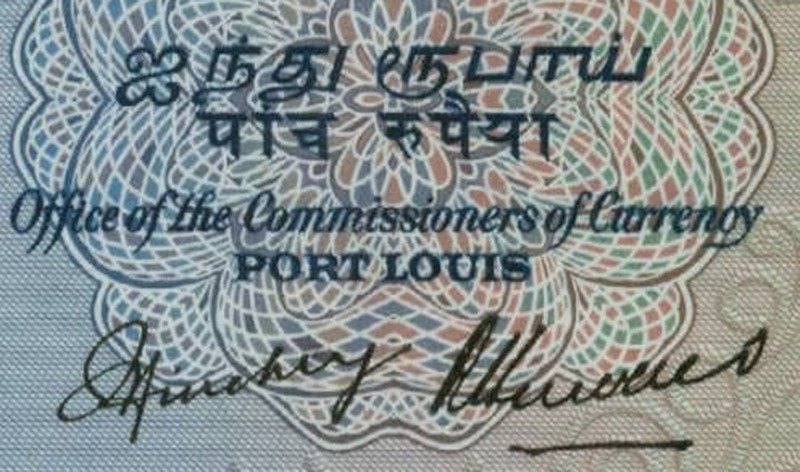
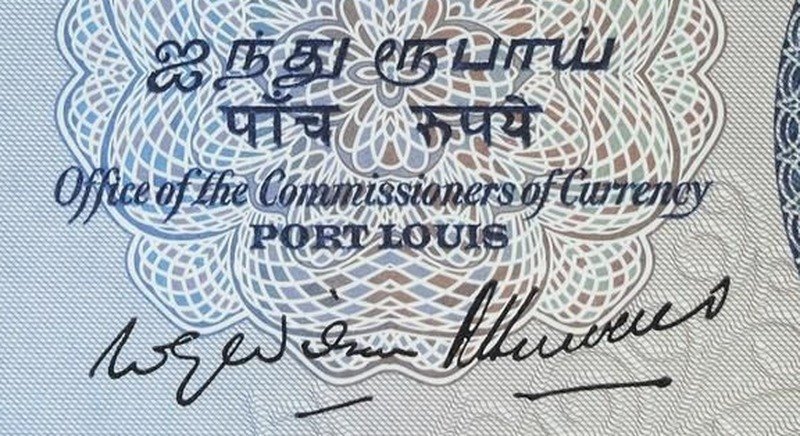
The 1,000 rupees stands apart. Its Hindi denomination is spelled like the singular of the first-printing 5, 10 and 25 rupees but ends in the plural, so it matches neither that singular nor the shorter plural of the corrected notes of 1957 to 1960.
The colour trials show both spellings. They are set out in Singular or plural: the Hindi line that splits the Mauritius 1954 colour trials. Heritage (8 December 2023, lot 22300) makes the same point about the blue colour trial of the 10 rupees: it has no signatures, but its Hindi line is the corrected one, so the house places it with the second or third pair of signers.
The signers and their offices
All sign as Commissioners of Currency. The Colonial Office Lists give Hinchey as Financial Secretary from 1952, Wilson from 1957, Bates from 1960 and Greig from 1964, and Harvais as Accountant General from 1950, Hermans from 1961 and Blackburn as Deputy Accountant General from 1961.
| Pair | 5 rupees | 10 rupees | 25 rupees | 1,000 rupees |
|---|---|---|---|---|
| Hinchey and Harvais | ND (1954), prefixes A to J | ND (1954), prefixes A and B | ND (1954), prefix A | ND (1954), prefix A |
| Wilson and Harvais | ND (1959), K to M | ND (1957), C to E | ND (1960), prefix A | none |
| Bates and Hermans | ND (1962), N | none | none | none |
| Greig and Blackburn | ND (1964), P | ND (1964), F | ND (1964), prefix A | none |
| Greig and Hermans | ND (1965), Q | none | none | none |
The printer's specimens of the 5 rupees carry the approval of the later pairs in the margin: NEW SIGNATURES with the year 1962 on the Bates and Hermans specimen, 8.5.64 on the Greig and Blackburn specimen and on one of the proofs, and 1 NEW SIG on the Greig and Hermans specimen.
Sources mention the name O'Brien with Blackburn on the 10 rupees, in the place of Greig and Blackburn. The signature on the photographed notes reads Greig, so the catalogue has no O'Brien pair.
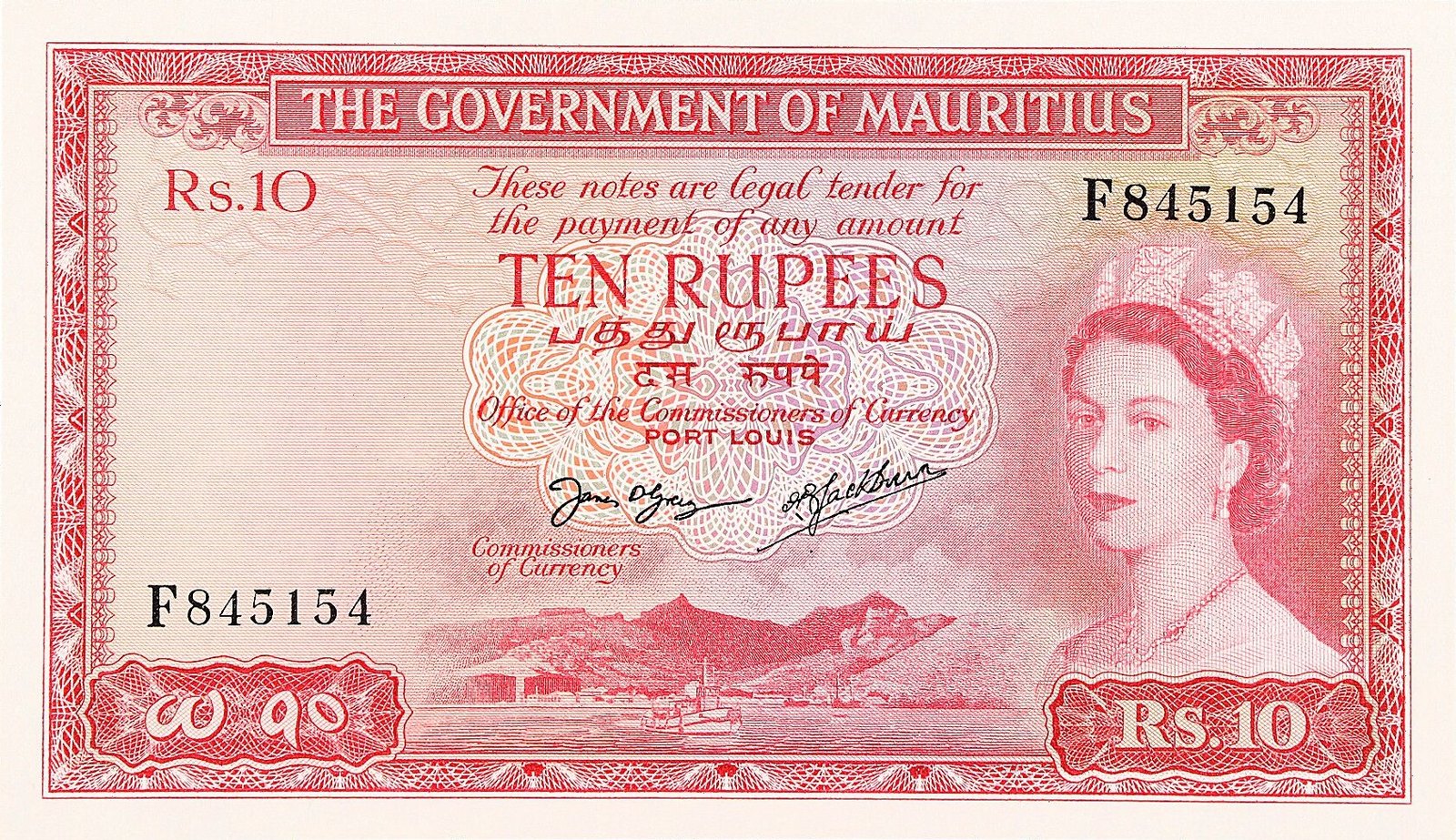
Two auction houses give fuller names than the note pages. Stack's Bowers (28 April 2022, lot 30219) names the second pair as William George Wilson and Augustin Roger Harvais, citing The Banknote Book. Heritage (8 December 2023, lot 22301) names the pair of 1964 as James Dennis Greig and Francis Blackburn.
Prefixes and number ranges
On the 5 rupees each pair has its own prefixes, which do not overlap. One range specimen of each of H 000,001 to J 1,000,000 and P 000,001 to P 1,000,000 has been recorded. Noonans (27 May 2025, lot 398) says only two range specimens were made for each printing.
On the 10 rupees the printer's specimens record A 000,001 to B 500,000 for Hinchey and Harvais, and C 000,001 to C 1,000,000 and D 000,001 to D 1,000,000 for Wilson and Harvais. Notes above B 500,000, B 563933 and B 763330, are recorded with the Hinchey and Harvais signatures, so the B prefix ran on under the first pair.
All three pairs of the 25 rupees use prefix A, and the signatures change at fixed points in the run. The specimens give A 300,001 to A 500,000 to Hinchey and Harvais and A 500,001 to A 700,000 to Wilson and Harvais. The recorded notes agree: the first pair runs to A 498831, the second from A 530609 to A 689866 and the third from A 732939. Heritage (10 November 2023, lot 24444) reads the single prefix as a sign of a small printing.
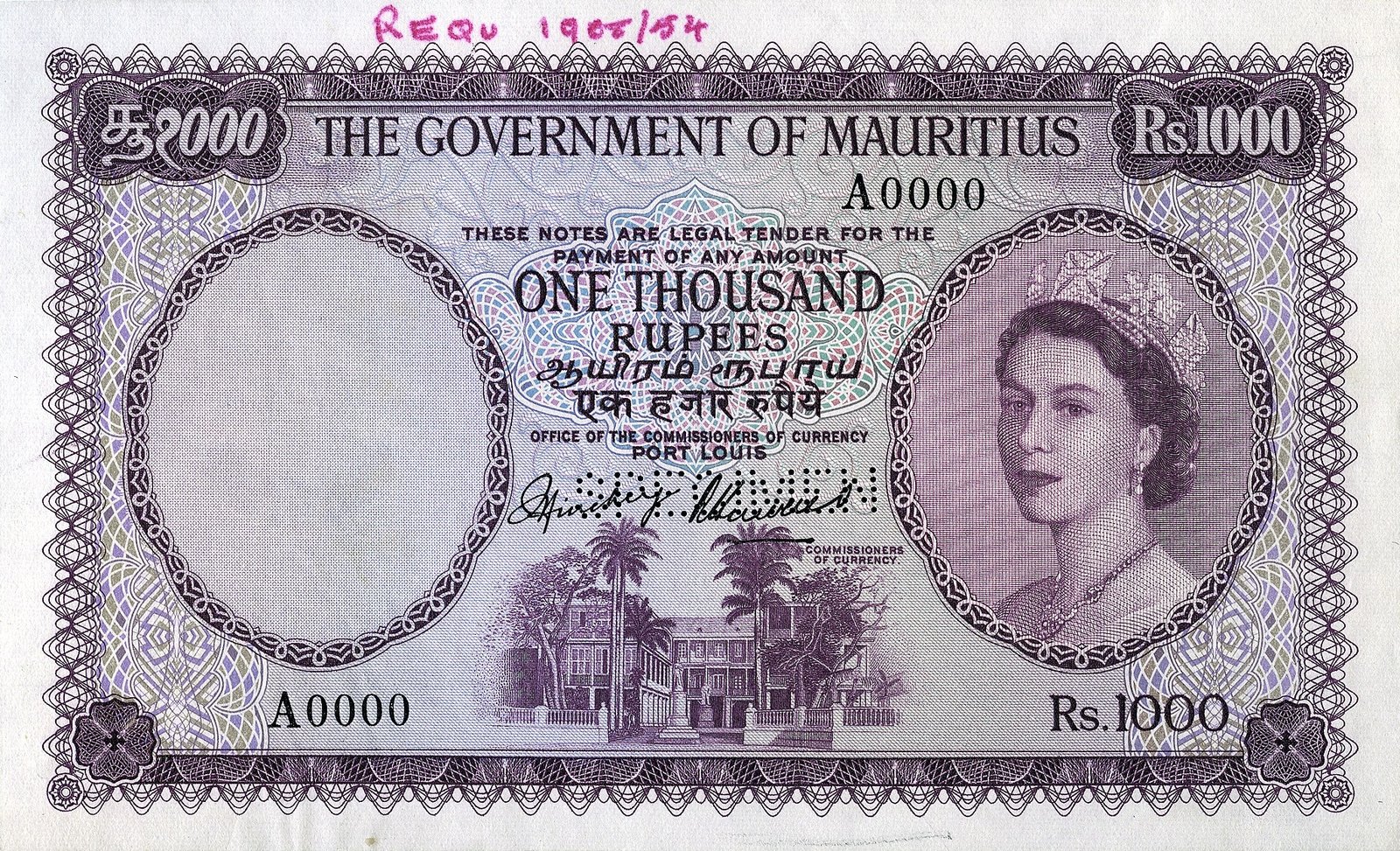
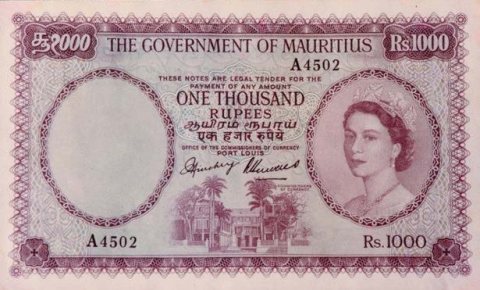
The 1,000 rupees is numbered with the prefix A and four digits, and the printer's specimen carries the range A 0001 to A 5000. Sources mention an issued note numbered A 4505 in the Bank of Mauritius virtual museum.
The 1,000 rupees between the banks
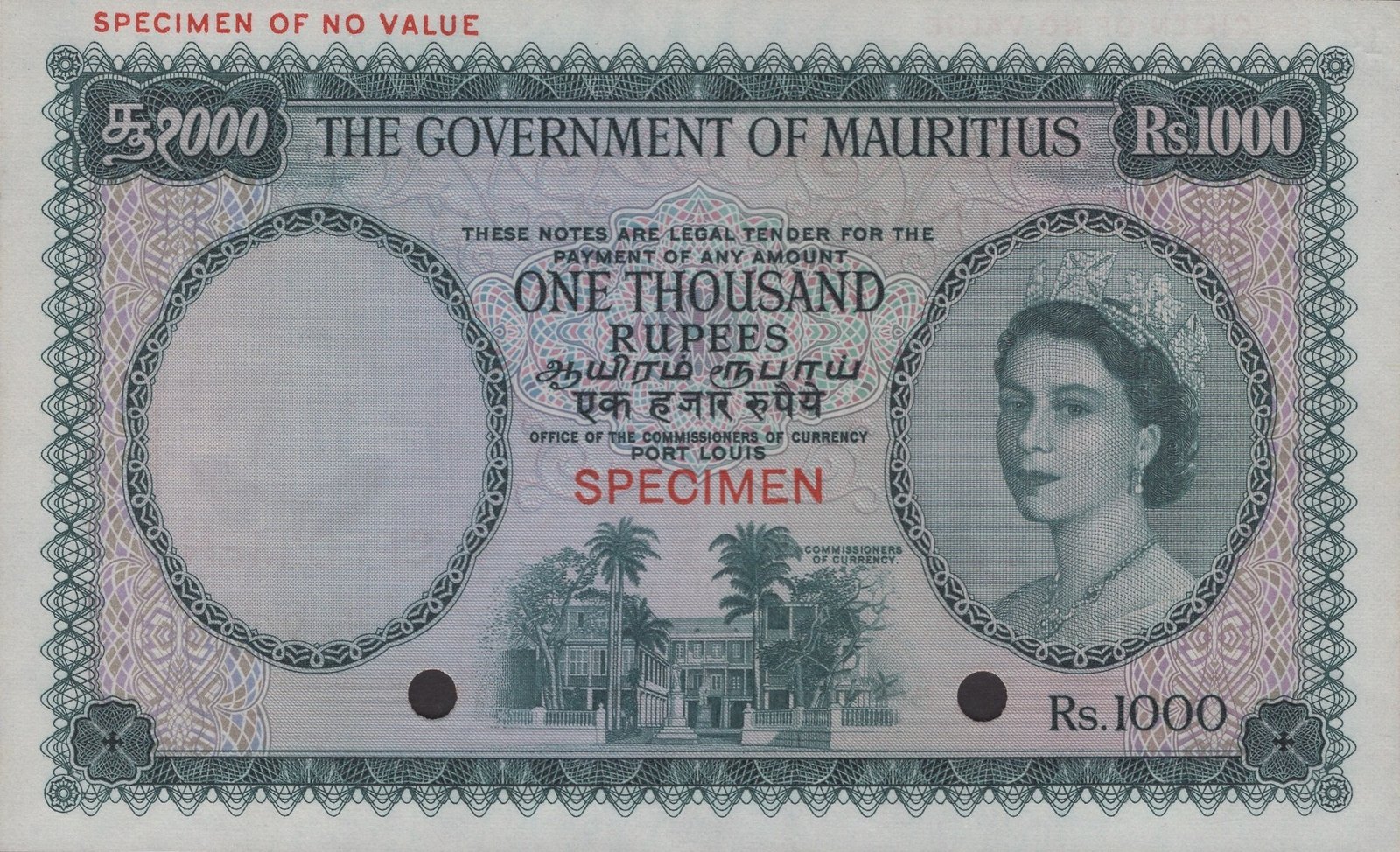
The 1,000 rupees is known only with the signatures of Hinchey and Harvais. It was used between banks only. The annual reports of 1955 to 1963 call it legal tender only between the local banks and the Government, and those of 1964 to 1966 say notes of 1,000 rupees were used between the banks and the Commissioners of Currency. For that reason the Bank of Mauritius left the value out of its first issue in 1967 (Bank of Mauritius annual report for 1968).
The houses do not agree on how many colour trials of the 1,000 rupees exist. Christie's (6 October 2000, lot 546) says there was no colour trial of the value in the Clement Rey collection and that two others were known besides the one it sold, one in private hands and one in an institution. Spink (12 April 2005, lot 939), selling the same piece again, says two are known, one in private hands and one in an institution. The recorded sales show at least two different pieces: the one of 2000 and 2005, and one with stains from old tape along the top margin sold by Spink on 2 October 2013 (lot 1110).
Notes in circulation and the exchange of 1967
Government notes in circulation stood at 50.7 million rupees on 30 June 1955 and at 92.6 million at the end of 1966 (annual reports on Mauritius).
The Bank of Mauritius exchanged the Government notes for its own from 4 September 1967. Its annual reports for 1968 to 1971 give the Government notes still out, value by value:
| Value | End of August 1967 | Ten months later |
|---|---|---|
| 5 rupees | 30.9 million rupees | 732,000 rupees |
| 10 rupees | 40.4 million rupees | 758,000 rupees |
| 25 rupees | 16.1 million rupees | 440,000 rupees |
The Government notes ceased to be legal tender on 14 October 1968 but could still be exchanged at the Bank. 639,000 rupees of all values had still not come in by June 1971. The exchange is told from the Bank's side in The Bank of Mauritius and its first notes, 1967 to 1988.
Sources
- Annual reports on Mauritius up to 1966, as cited on the note pages.
- Colonial Office Lists.
- Bank of Mauritius annual reports for 1968 to 1971.
- The printer's specimens and proofs recorded on the note pages.
- Special Auction Services, 2 May 2024, lot 534.
- Stack's Bowers, 28 April 2022, lot 30219.
- Heritage Auctions, 10 November 2023, lot 24444; 8 December 2023, lots 22300 and 22301.
- Noonans, 27 May 2025, lot 398.
- Christie's, 6 October 2000, lot 546; Spink, 12 April 2005, lot 939, and 2 October 2013, lot 1110.
- The catalogue's note pages for the unnamed sources ("sources mention").
Member comments
Log in or register to post a comment.