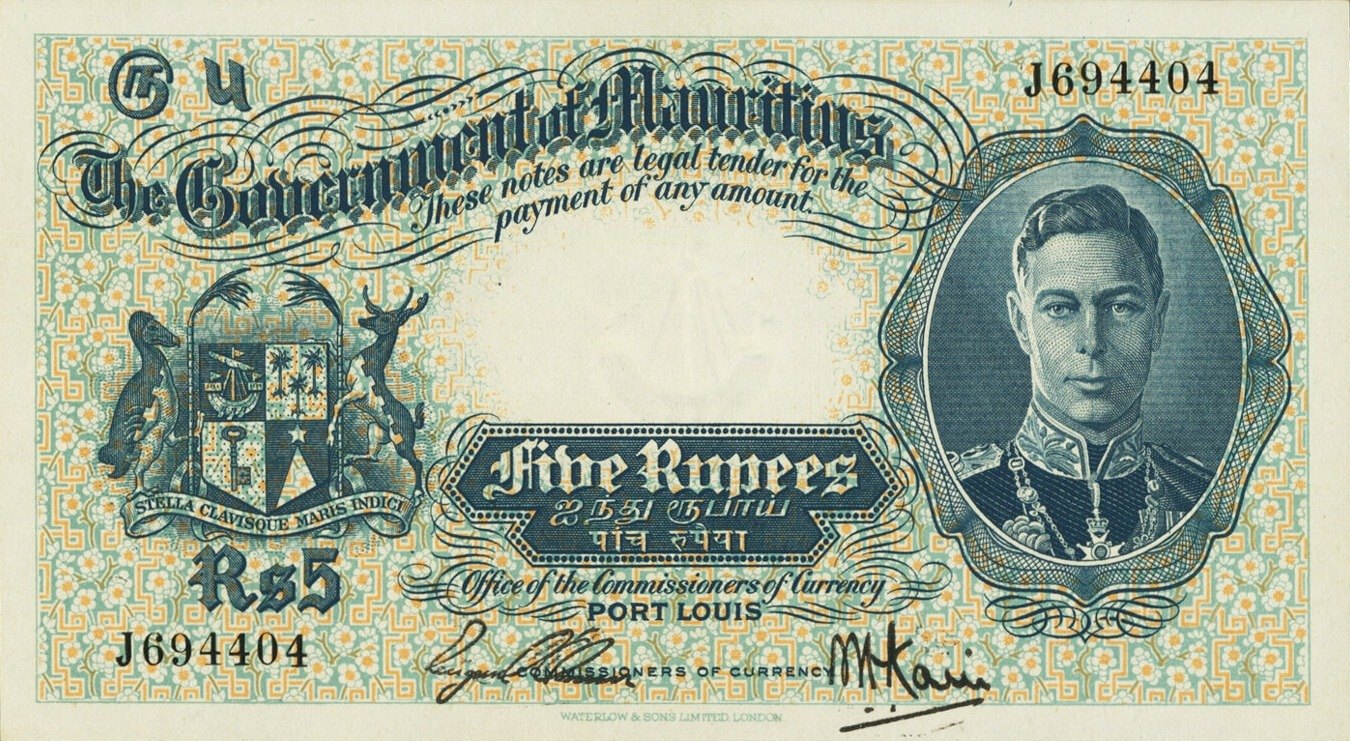
This article covers the notes of the Government of Mauritius with the portraits of King George V and King George VI, from the Ordinance of 1934 to the day they ceased to be legal tender, 1 August 1955. It is drawn from the catalogue's note pages, which rest on the annual reports on Mauritius, the Colonial Office Lists, An Economic Survey of the Colonial Empire and the printers' specimens. Statements of auction houses are added, each with the house, the day of the sale and the lot. The earlier notes are in The Government of Mauritius notes, 1860 to 1934.
The Ordinance of 1934
The portrait notes were issued under the Mauritius Currency Notes Ordinance 1934 (Ordinance 13 of 1934). The Ordinance, enacted in March 1934, put a paper rupee tied to sterling in place of the Indian rupee. The Commissioners of Currency issued notes against sterling lodged with the Crown Agents in London, at 1 shilling 6 pence to the rupee, and a Note Security Fund held by the Crown Agents stood behind the issue. An Economic Survey of the Colonial Empire (1933) gives 1 May 1934 as the day from which the Ordinance took effect.
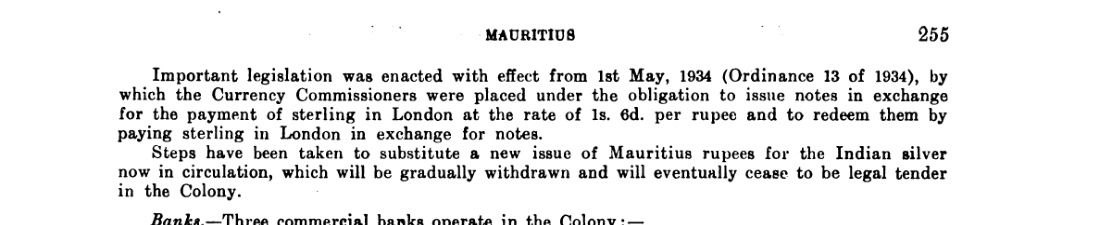
The notes were introduced on 23 August 1934. Proclamation 21 of 1 September 1934 ended the legal tender of every earlier issue on 15 December 1934.
The George V notes of 1934
Bradbury Wilkinson prepared essays for 5, 10 and 20 rupees dated 1st October 1932, but the government chose undated designs by Waterlow and Sons. No 20 rupees followed; that value is treated in Values that were never issued.
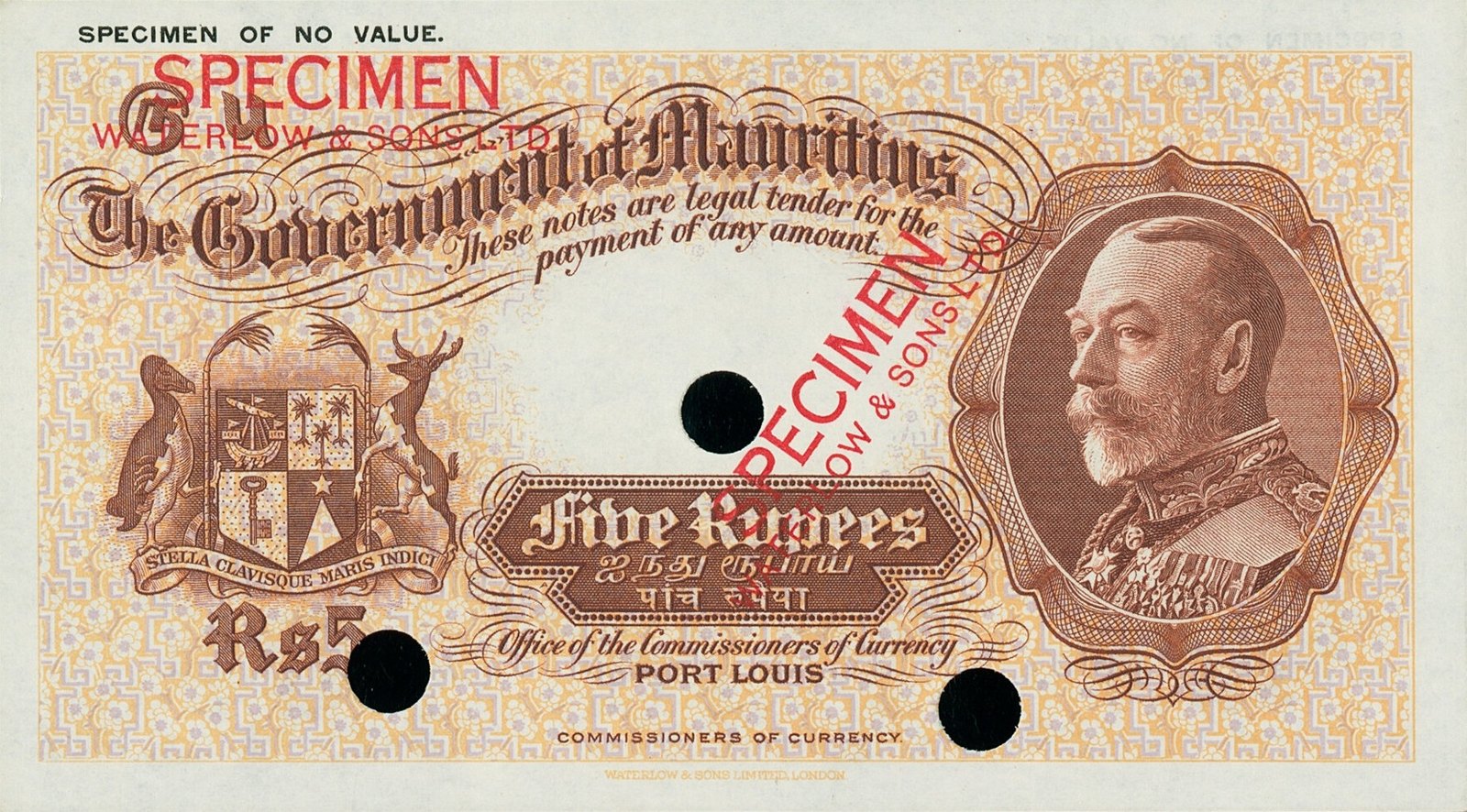
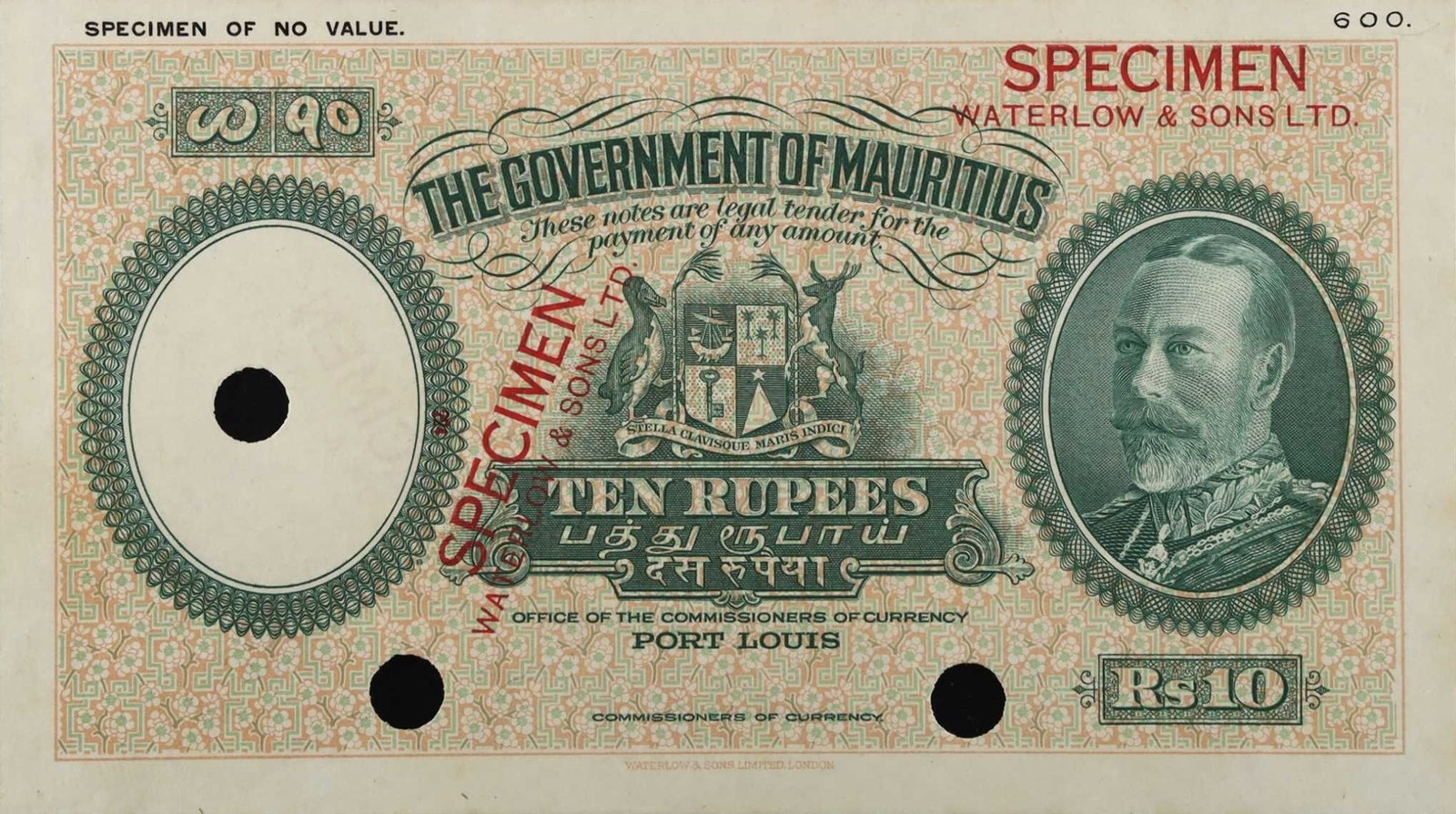
The two values are the 5 rupees and the 10 rupees. Sources mention the date ND (1930) for both. Heritage (10 November 2023, lot 24440) and Stack's Bowers (4 October 2022, lot 41234) use that date in the headings of their descriptions. Sources mention the sailing ship watermark, which shows through the white space at the centre of the 5 rupees and through the white medallion at the left of the 10 rupees.
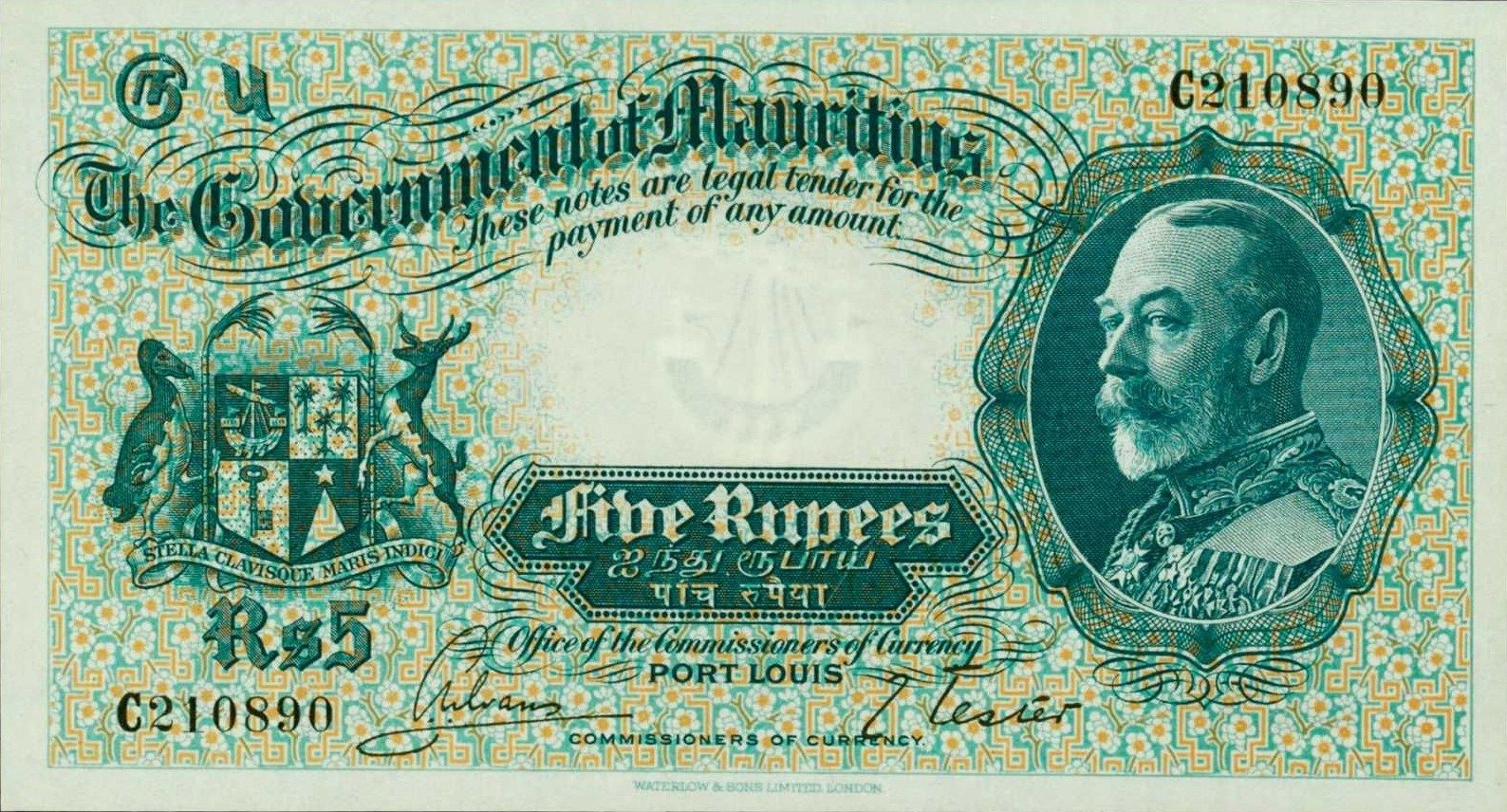
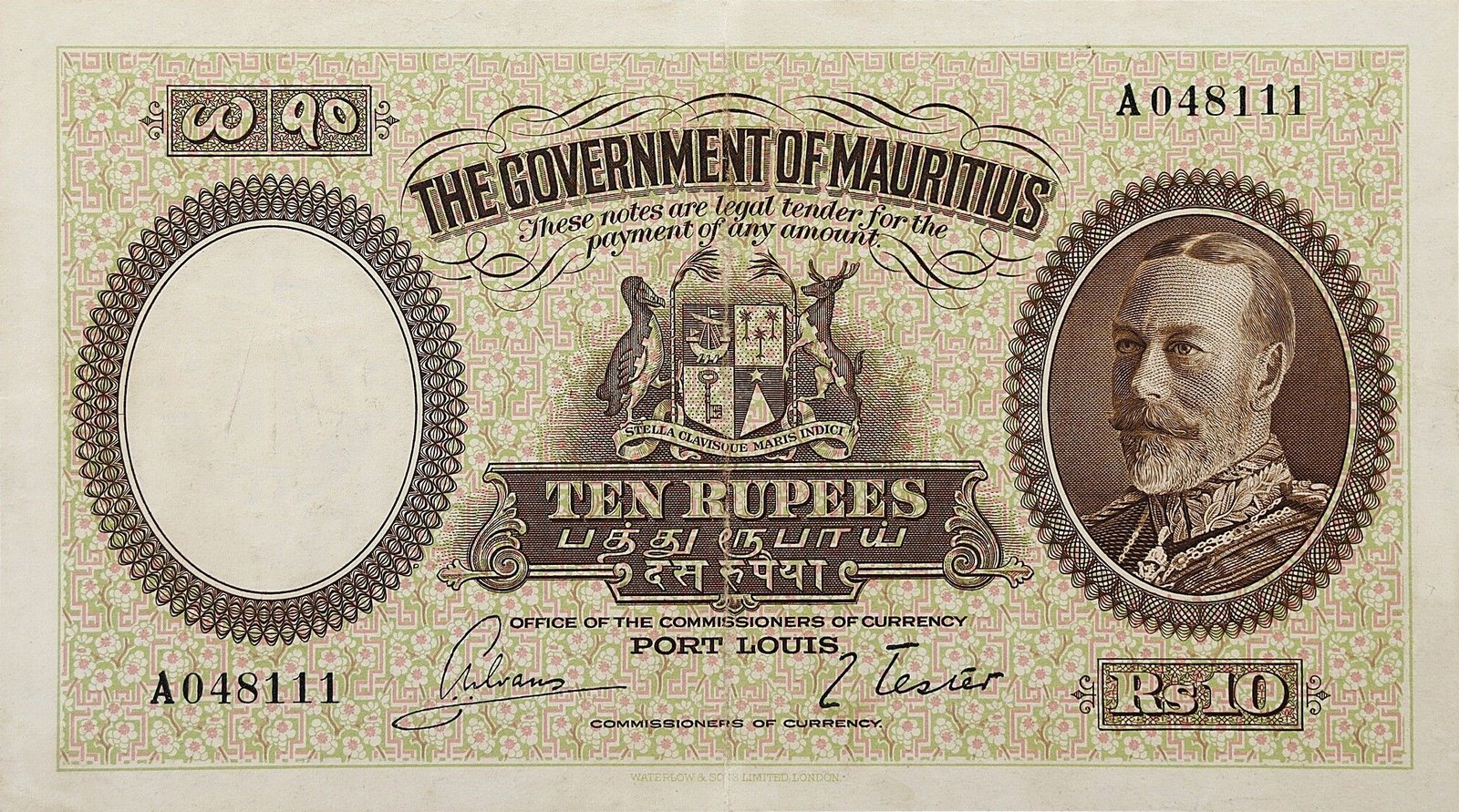
The Colonial Office Lists give Evans as Colonial Secretary of Mauritius from April 1932 and Tester as Treasurer from July 1932 until November 1934, when Tester went to Zanzibar as its Treasurer.
The highest number recorded for the 10 rupees is A 249778, and the George VI 10 rupees carries the same numbering on from A 253458. Heritage (10 November 2023, lot 24440) says prefixes A, B and C were used for the 5 rupees. The same description says that most of the stock had not been issued when King George V died in January 1936, so that the type stayed in circulation until about 1942.
Colour trials of both values exist. Heritage (13 January 2022, lot 28311) describes the trial of the 5 rupees as printed in browns and yellows in place of the blue, yellow and orange of the issued note. Stack's Bowers (4 October 2022, lot 41234) describes the trial of the 10 rupees as dark green where the issued note is maroon, with the back in the same green, red specimen overprints and punch cancellations.
The 1,000 rupees of 1936
A 1,000 rupees dated 1936, printed by Waterlow and not listed under a Pick number, was issued to ease transactions between the banks, and between the banks and the Treasury (annual report on Mauritius for 1936). It was introduced in November 1936. No report read says how many were issued.
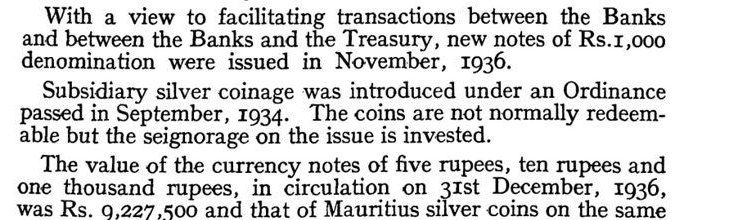
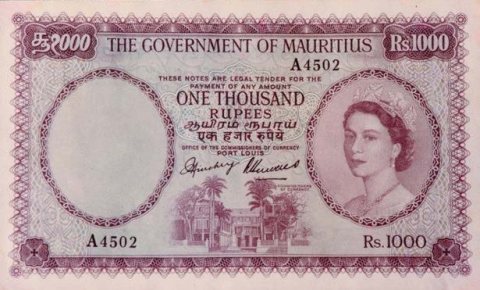
A George VI 1,000 rupees, also without a Pick number, has an issued row and a proof row in the catalogue. The annual reports of 1952 to 1954 say there was a note of 1,000 rupees, "legal tender only in so far as transactions between the banks carrying on business within the Colony and the Government are concerned". They do not say whose portrait it bore, so they do not show whether the George VI note was ever paid out. No issued example has been recorded.
Notes in circulation, 1935 to 1954
| Day | Government notes in circulation, rupees | Values counted |
|---|---|---|
| End of 1935 | 8,182,500 | 5 and 10 rupees, the only notes in circulation |
| End of 1936 | 9,227,500 | 5, 10 and 1,000 rupees |
| End of 1937 | 9,417,485 | 5, 10 and 1,000 rupees |
| End of 1938 | 8,547,485 | 5, 10 and 1,000 rupees |
| 30th June 1944 | 21.7 million | all Government notes |
| 30th June 1954 | 50.8 million | all Government notes |
The figures are those of the annual reports on Mauritius for 1934 to 1938 and of the later annual reports. The reports for 1936 to 1938 give one total for the three values together.
The George VI 5 and 10 rupees
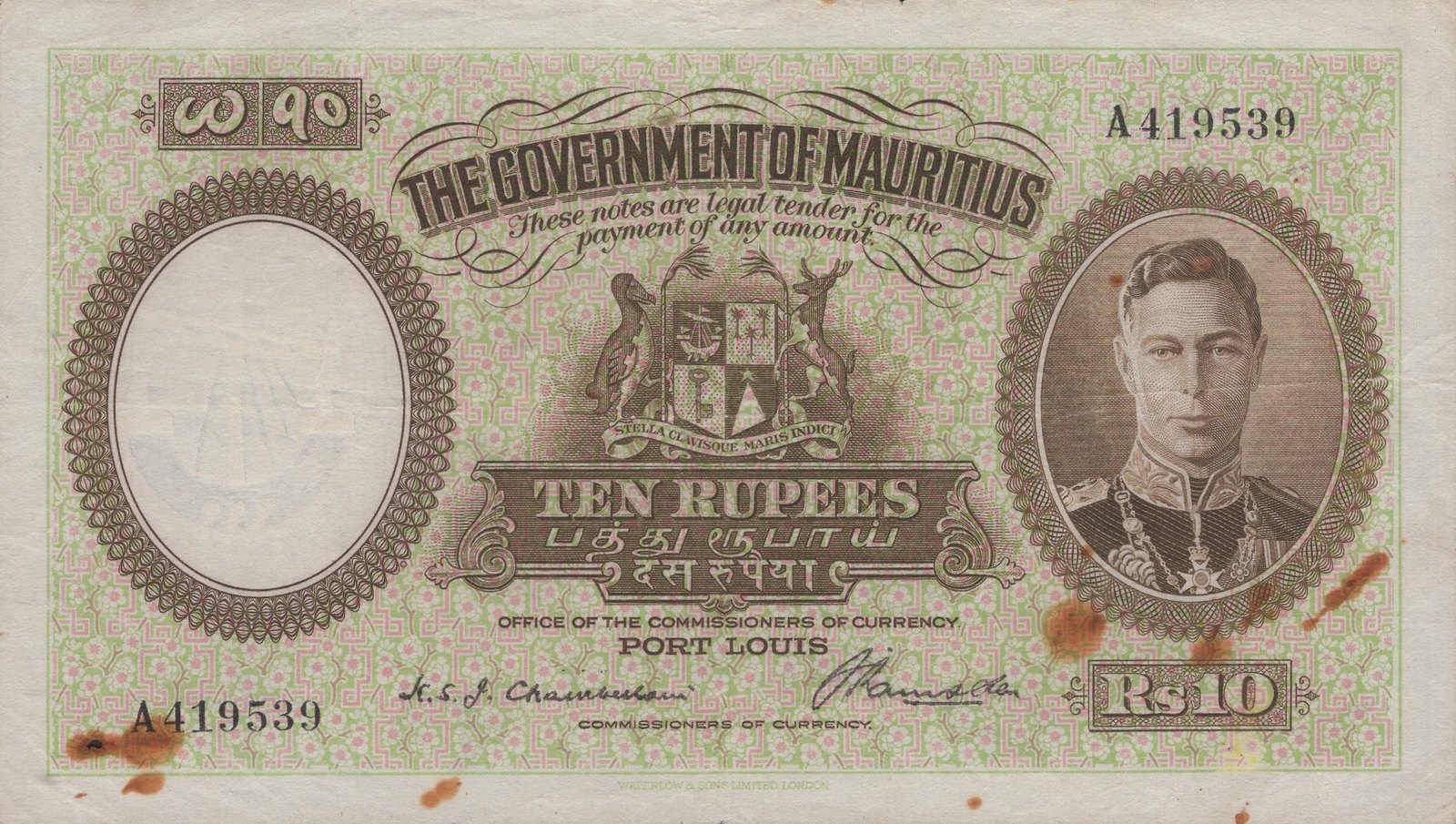
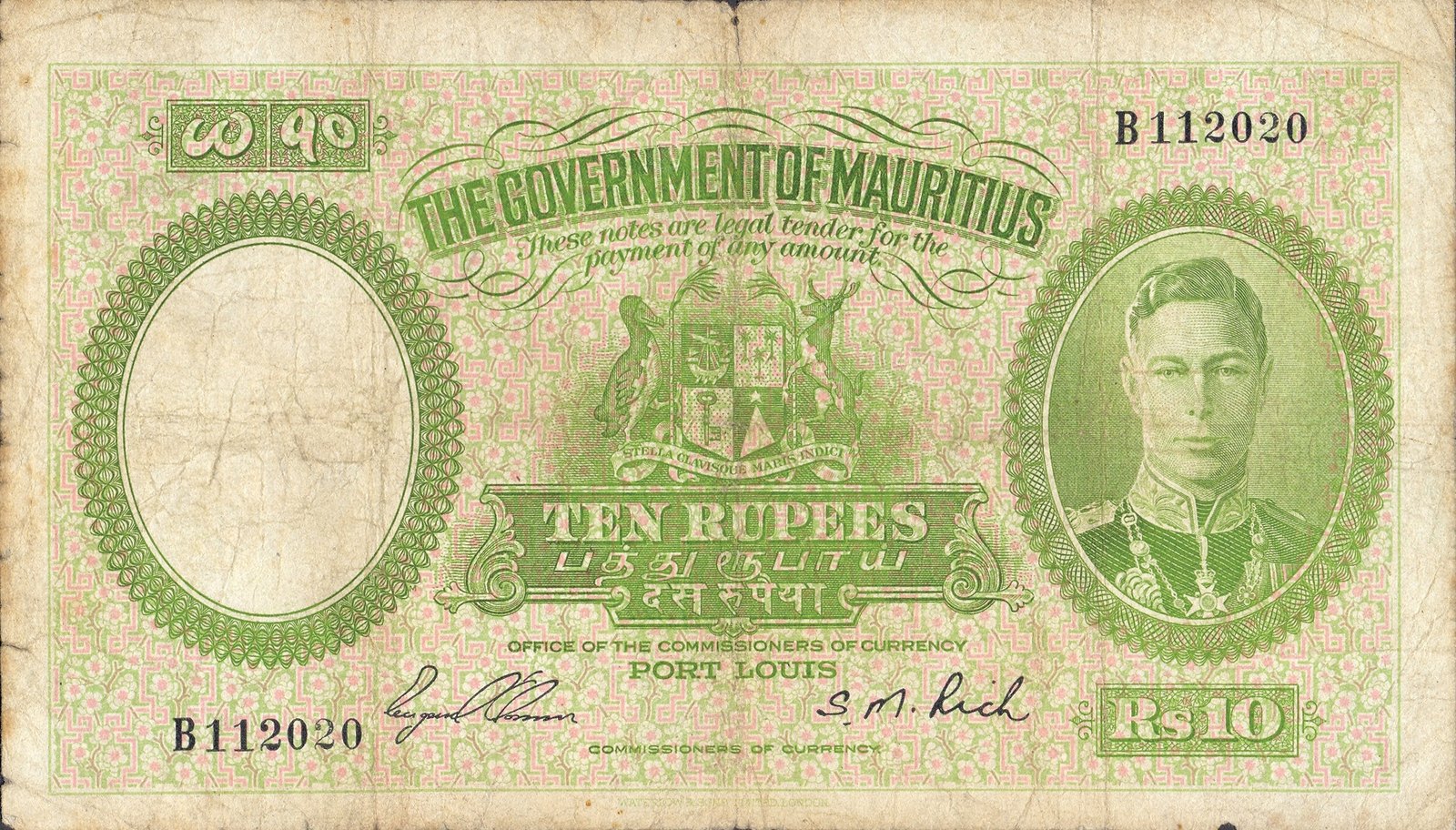
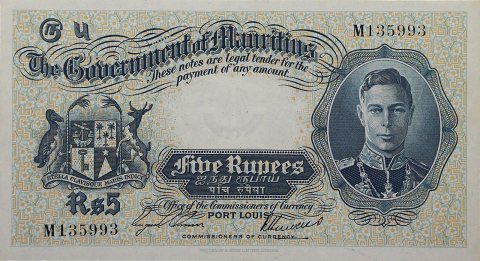
The George VI 5 rupees and 10 rupees are like the George V notes, with the new King's portrait. They were ordered in 1936 but not issued until 1942. Sources mention a date of ND (1937) for them.
From July 1941 the Board of Commissioners of Currency was the Accountant General and two other public officers chosen by the Governor, and the Accountant General is one of the two signers of these notes. Five pairs sign, all as Commissioners of Currency:
| Pair | Row dated | What the Colonial Office Lists give |
|---|---|---|
| Chamberlain and Ramsden | ND (1942) | nothing given on the pages |
| Chamberlain and Rich | ND (1943) | Rich as Accountant General from 1943 |
| O'Connor and Rich | ND (1945) | O'Connor as Financial Secretary from 1945 |
| O'Connor and Kain | ND (1949) | Kain as Accountant General from 1949 |
| O'Connor and Harvais | ND (1950) | Harvais as Accountant General from 1950 |
The notes are undated and each pair carries the numbering on from the one before, so on both values the signatures place a note. Heritage (10 November 2023, lot 24441) says that prefix M is most likely the last prefix of the 5 rupees.
Sources letter the 10 rupees by the colour of the front, a brown and b green, while the catalogue letters it by signature pair. Heritage (17 October 2024, lot 24306) says the note was printed first in brown, then in green and then in brown again, that every brown note has prefix A and every green note prefix B, and that the note it sold has the first of two signature varieties known on green notes. The catalogue files that note under the Chamberlain and Rich pair. The note page gives prefixes A, B and C for the five pairs together. Notes have also been seen with the brown of the front in green, and sources mention that such notes were altered with chemicals to pass as colour errors.
The 1 rupee of 1941 and the emergency note of 1942
The 1 rupee, printed by Thomas de la Rue, was introduced in September 1941 with the signatures of Moody and Ramsden. The Colonial Office Lists give Moody as Colonial Secretary from 1939. Sources mention printing in yellow-green and pinkish mauve on white paper with no watermark, and the date ND (1940).
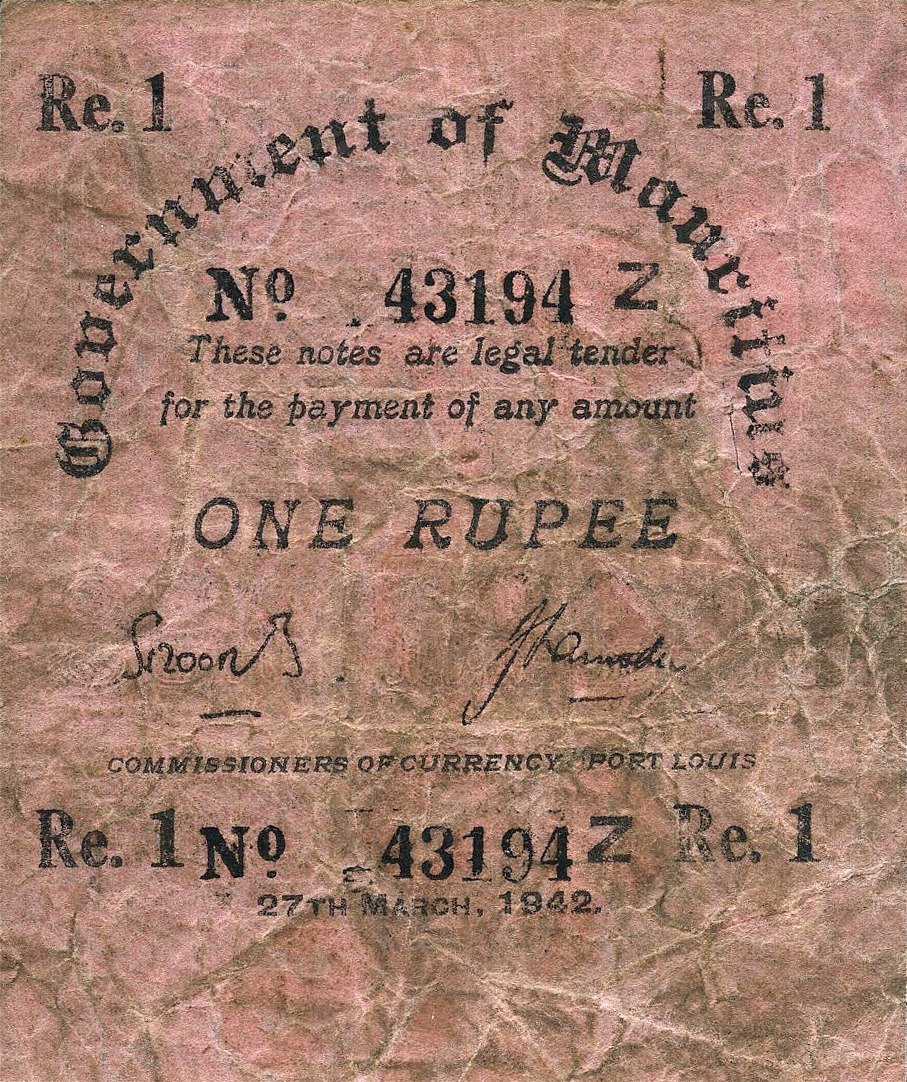
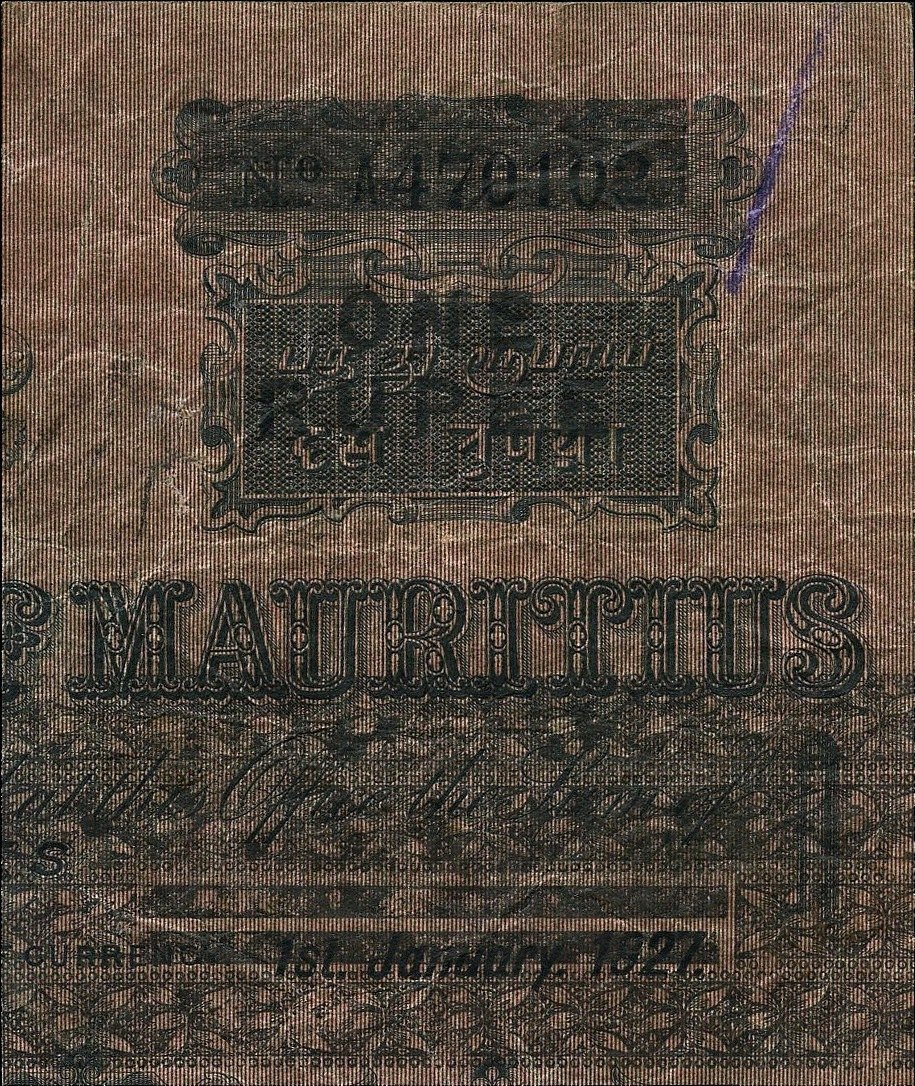
Coin stayed short because it was hoarded during the war. As an emergency measure an emergency 1 rupee was printed locally on the backs of cut-up old 10 rupees notes of the issue of 1907 to 1930, which is why its back shows part of another note. 230,000 were issued from 27 March 1942, and the serial number is followed by the letter Z. The notes were poorly made. They were withdrawn once Thomas de la Rue delivered the 1 rupee with the signatures of Chamberlain and Ramsden in December 1942. The page gives 1 December 1942 for their demonetisation, though sources also mention gradual withdrawal after 29 September 1943. Other notes made from older notes are described in Wartime and occupation: what the design archive keeps from 1914 to 1945.
Sources mention a number range for each pair of the regular 1 rupee: Moody and Ramsden A 000,001 to A 494,000; Chamberlain and Ramsden B 190,001 to D 777,000; Chamberlain and Rich D 909,001 to E 829,000; O'Connor and Rich E 951,001 to G 707,000. One range specimen is not settled. Corne Akkermans (22 September 2016, lot 640, and 21 September 2017, lot 710) calls the range specimen E 060,001 to J 060,000 a Bradbury Wilkinson archive specimen, while the note page has Thomas de la Rue as the printer.
Sources mention 30 June 1947 for the withdrawal of the 1 rupee. The annual reports on Mauritius for 1952, 1953 and 1954 still list a 1 rupee among the notes in circulation, and it ceased to be legal tender on 1 August 1955 with the other notes.
The 25 and 50 cents of 1943 and 1944
The small-change notes, 25 cents and 50 cents, were first issued in September 1943, sources mention on the 29th. Thomas de la Rue printed them on white unwatermarked paper, with nothing on the back. Sources mention a date of ND (1940) for the 25 cents.
The first printing, signed Chamberlain and Ramsden, has the serial number in the centre panel under the value in words. Revised notes followed in 1944 under Ordinance 23 of 1944, signed Chamberlain and Rich, with the number moved to the lower left below the arms and the centre panel altered. The printer's specimens show where the change fell. On the 25 cents the range A 600,001 to B 200,000 has the number at the centre and B 200,001 to B 800,000 has it at the lower left. On the 50 cents the specimens of the first printing carry A 000,001 to A 300,000 and A 300,001 to A 600,000.
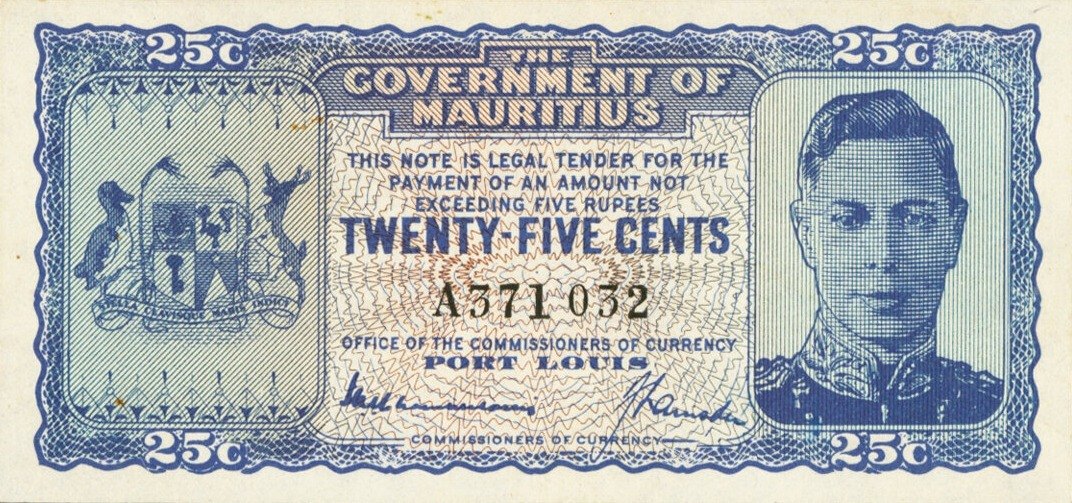
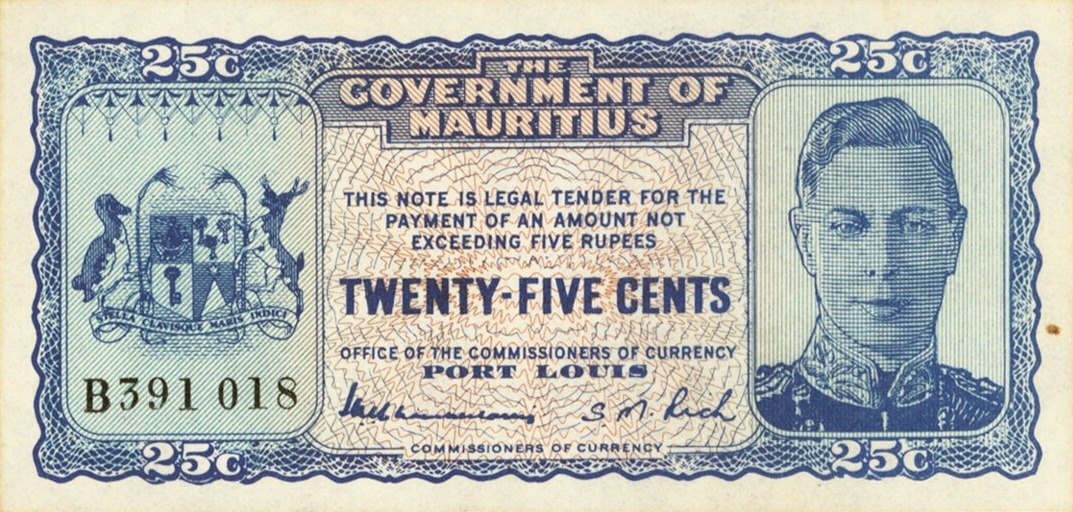
Both values were withdrawn on 30 June 1947.
The end of legal tender, 1955
Proclamation No. 11 of 14 June 1955 declared that the notes issued before 15 October 1954 should cease to be legal tender from 1 August 1955 (annual report on Mauritius for 1955). They could still be presented for payment. The Colony's accounts carried 433,592 rupees 50 cents of demonetised notes of the 1934 issue on 30 June 1963, and 422,440 rupees 75 cents were still out on 30 June 1967 (annual reports for 1963 and 1967).
The notes that replaced them are in The Elizabeth II notes of the Government of Mauritius, 1954 to 1968.
Sources
- Annual reports on Mauritius for 1934 to 1938, 1952 to 1955, 1963 and 1967, and the later annual reports cited on the note pages for 1944 and 1954.
- An Economic Survey of the Colonial Empire (1933).
- Colonial Office Lists.
- The printer's specimens recorded on the note pages.
- Heritage Auctions, 13 January 2022, lot 28311; 10 November 2023, lots 24440 and 24441; 17 October 2024, lot 24306.
- Stack's Bowers, 4 October 2022, lot 41234.
- Corne Akkermans, 22 September 2016, lot 640, and 21 September 2017, lot 710.
- The catalogue's note pages for the unnamed sources ("sources mention").
Member comments
Log in or register to post a comment.