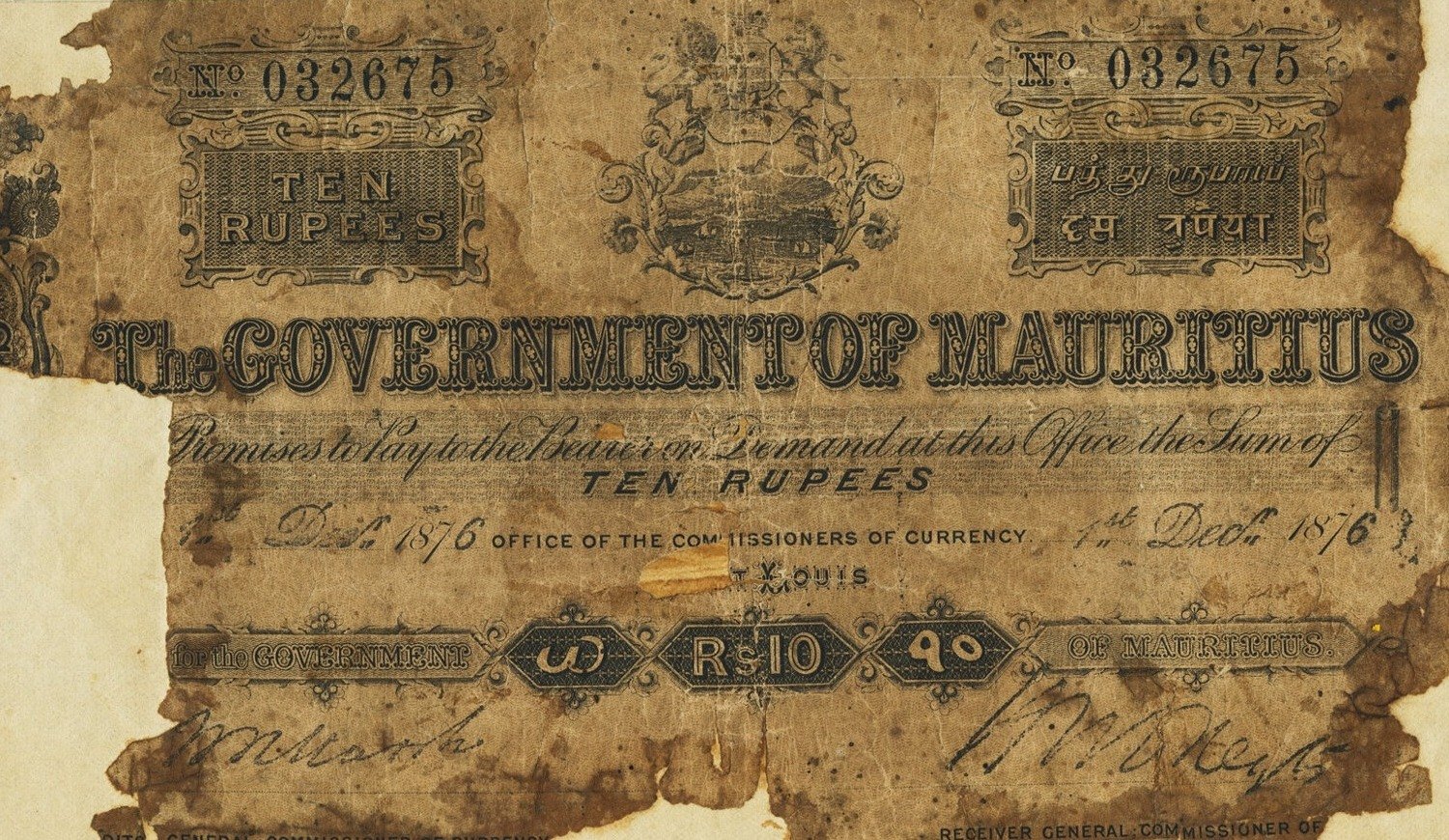
This article follows the notes of the Government of Mauritius from the first issue of 1860 to 15 December 1934, the day the rupee notes described here ceased to be legal tender. It is drawn from the catalogue's note pages, which rest on Chalmers' History of Currency in the British Colonies (1893), the Mauritius Blue Books, the Mauritius Almanac for 1920, the Colonial Office Lists and the annual reports on Mauritius and the Seychelles. Statements of auction houses are added, each with the house, the day of the sale and the lot.
The sterling and dollar notes of 1860
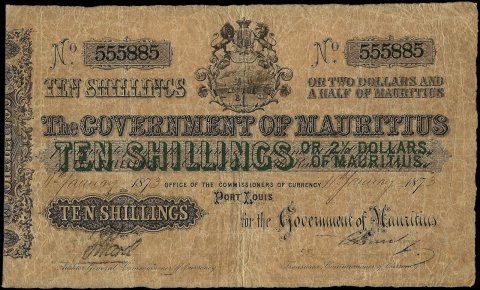
The notes of 1860 carry two values each: 10 shillings or 2 1/2 dollars, 1 pound or 5 dollars and 5 pounds or 25 dollars. They are the first banknotes Thomas de la Rue ever produced. Sources mention that De La Rue received the contract at the end of 1859.
The colony's request of January 1859 was for 400,000 pounds in notes: 320,000 notes of 10 shillings, 160,000 of 1 pound and 16,000 of 5 pounds. The values were chosen by a committee of the Council of Government. The numbers on recorded notes run well past these quantities, so further printings followed.
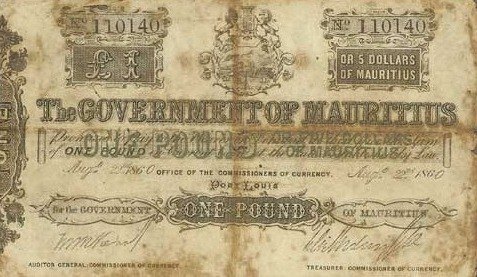
The notes were printed from copper plates on paper from Turner's mill at Maidstone and bound in books of 500, each note with a counterfoil like a cheque. The 10 shillings is printed in black and green on brownish-yellow paper, the 1 pound in black on white paper with the value in words in green. Notes are dated from 13 August 1860, and sources give 10 October 1860 for their introduction. Part of the date is printed and the rest written or printed. The recorded dates of the 10 shillings are 13 August 1860, 1 November 1867 and 11 January 1873; those of the 1 pound are 13 August 1860, 22 August 1860 and 31 December 1869.
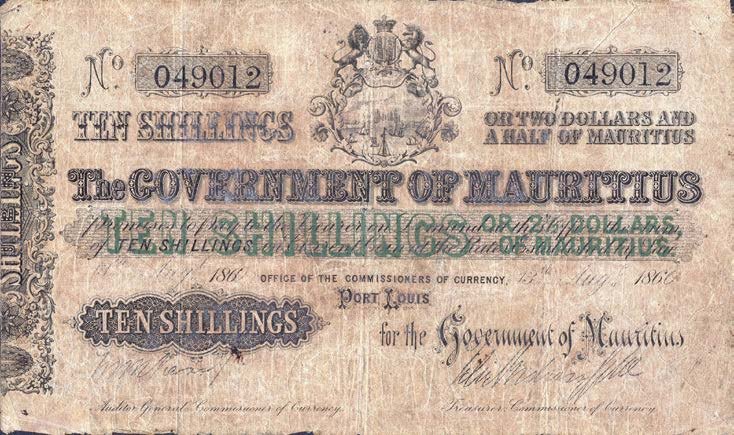
The signatures are those of the Auditor General and the Treasurer, handwritten or stamped. The Board of Commissioners of Currency was re-formed by Ordinance 7 of 1861 and again by Ordinance 10 of 2nd May 1864. Under the Ordinance of 1864 the Board was the Colonial Secretary, the Auditor General and the Colonial Treasurer. Any two of them signed, by hand or in facsimile, and a signer had to be in office on the date the note bears. Spink (24 April 2012, lot 845) reads the signatures on a 1 pound of 22 August 1860, numbered 110140, as W. Kerr, the Auditor General, and F. Bedingfield, the Treasurer. Spink calls that note the only example of its type believed to exist and gives its earlier sale as the Clement Rey collection, Spink 1996, lot 1071 (Spink, 8 October 2007, lot 975).
Sources mention that the 5 pounds, payable in gold, stayed with the banks as a reserve and did not go into general circulation, since gold could be sent to India at a profit of 5 to 6 percent.
Sources also mention a uniface 5 shillings of 1866 with the coat of arms, but not every source lists it. No photograph of that note is known.
The wreck of the Athens, 1865
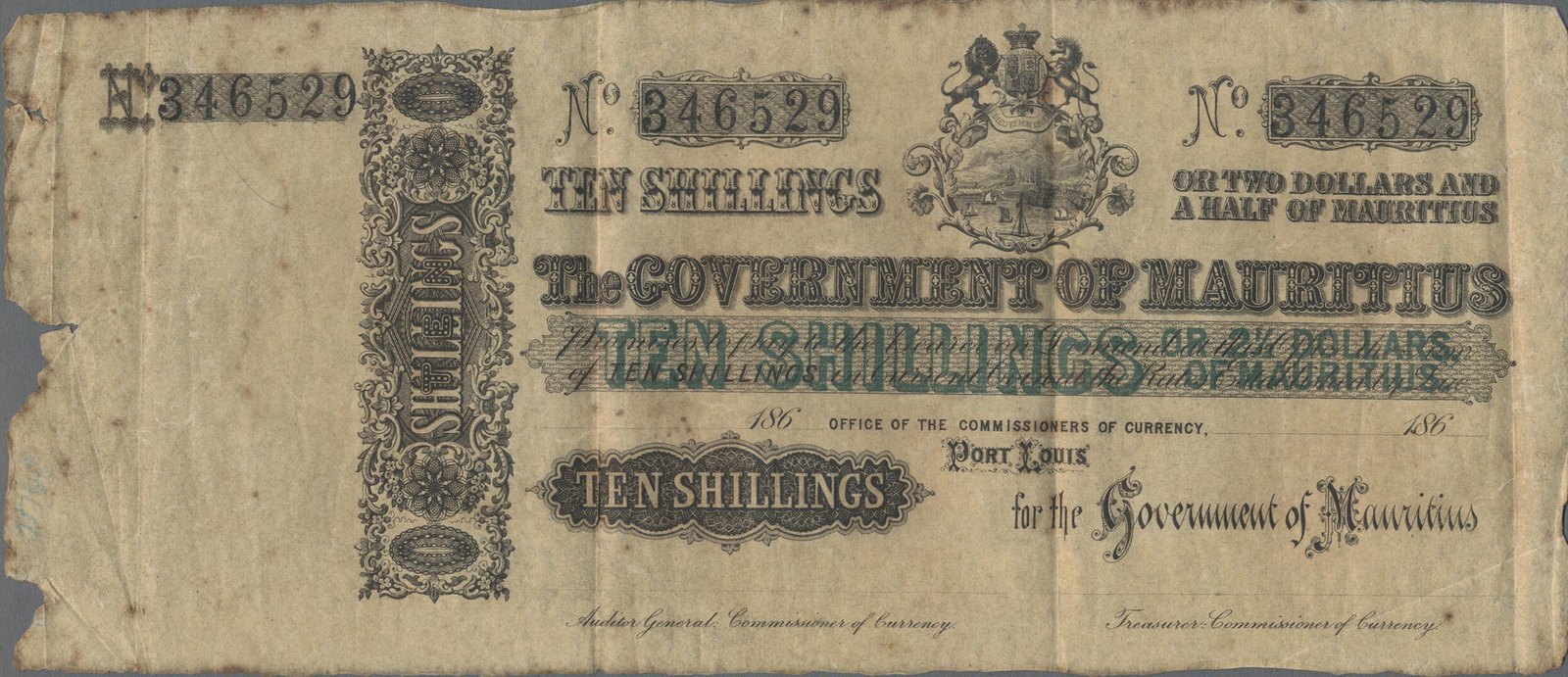
A shipment of the 1860 notes was on board the Royal Mail Ship Athens when the ship was wrecked in a hurricane in Table Bay, South Africa, on 17 May 1865. Some of the unsigned and undated notes were recovered, completed by forgers and presented for payment. The unsigned notes of the 10 shillings are numbered 344001 to 374000 and those of the 1 pound 177001 to 199000. Christoph Gärtner (15 February 2022, lot 304) describes its lot as a 10 shillings without signature and date, numbered 346529, which is inside that range.
What was left of the 1860 notes
Chalmers' History of Currency in the British Colonies (1893) gives the law that ended them. Ordinance 28 of 1876, which brought in the rupee notes, directed that the sterling or "dollar" notes should cease to be legal tender, though a holder could claim their value from the Commissioners of Currency until 31 December 1877. The Mauritius Almanac for 1920 says that notes expressed in pounds or dollars were by then "not legal tender for any purpose whatever", though a holder could still claim their lawful value from the Receiver General.

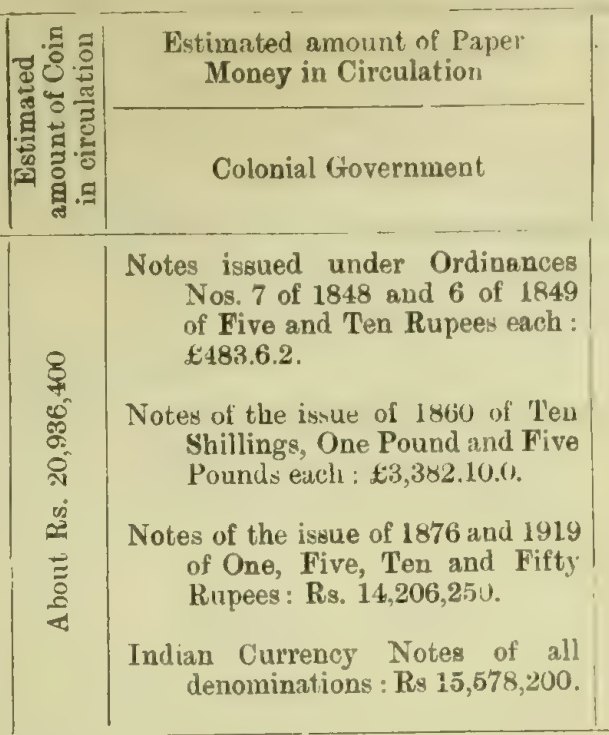
The sum still unpaid hardly moved. The Mauritius Blue Books for 1920 and 1921 set £3,382 10s against the 1860 issue. The note pages give 3,383 pounds as still outstanding on 31 December 1932, so the sum did not change for at least twelve years. Christoph Gärtner (15 February 2022, lot 304) gives the same 3,383 pounds as outstanding when the notes were withdrawn in December 1934. The pages leave open which of the two days the figure belongs to. They say that only a handful of the notes are known.
The rupee notes of 1876
The rupee became the currency of Mauritius by Ordinance 28 of 17 November 1876, after the inflow of Indian rupees that came with Indian immigration. The Mauritian rupee was introduced in 1877 in place of the Indian rupee, sterling and the Mauritian dollar, at one Indian rupee or half a Mauritian dollar. The pound was then worth 10 1/4 rupees.
Chalmers (1893) says that the Ordinance let the Commissioners of Currency issue notes of 5, 10 and 50 rupees on demand in exchange for Indian silver rupees. The three values are the 5 rupees of 1876 to 1902, the 10 rupees of 1876 to 1904 and the 50 rupees of 1876 to 1878, all printed by Thomas de la Rue. The earliest date on all three is 1 December 1876.
Dates and signatures are handwritten on some notes and stamped on others. The counterfoil at the left was cut by hand, so the size can vary by 10 millimetres or so, and the printer's imprint runs vertically beside it. The value is given in English, and at the upper right in Tamil with Hindi below it. The notes have no serial prefix: the numbers run on from one date to the next. Buff paper is recorded for the 10 rupees of 1876 and 1878 and pink paper for 1891 and 1900.
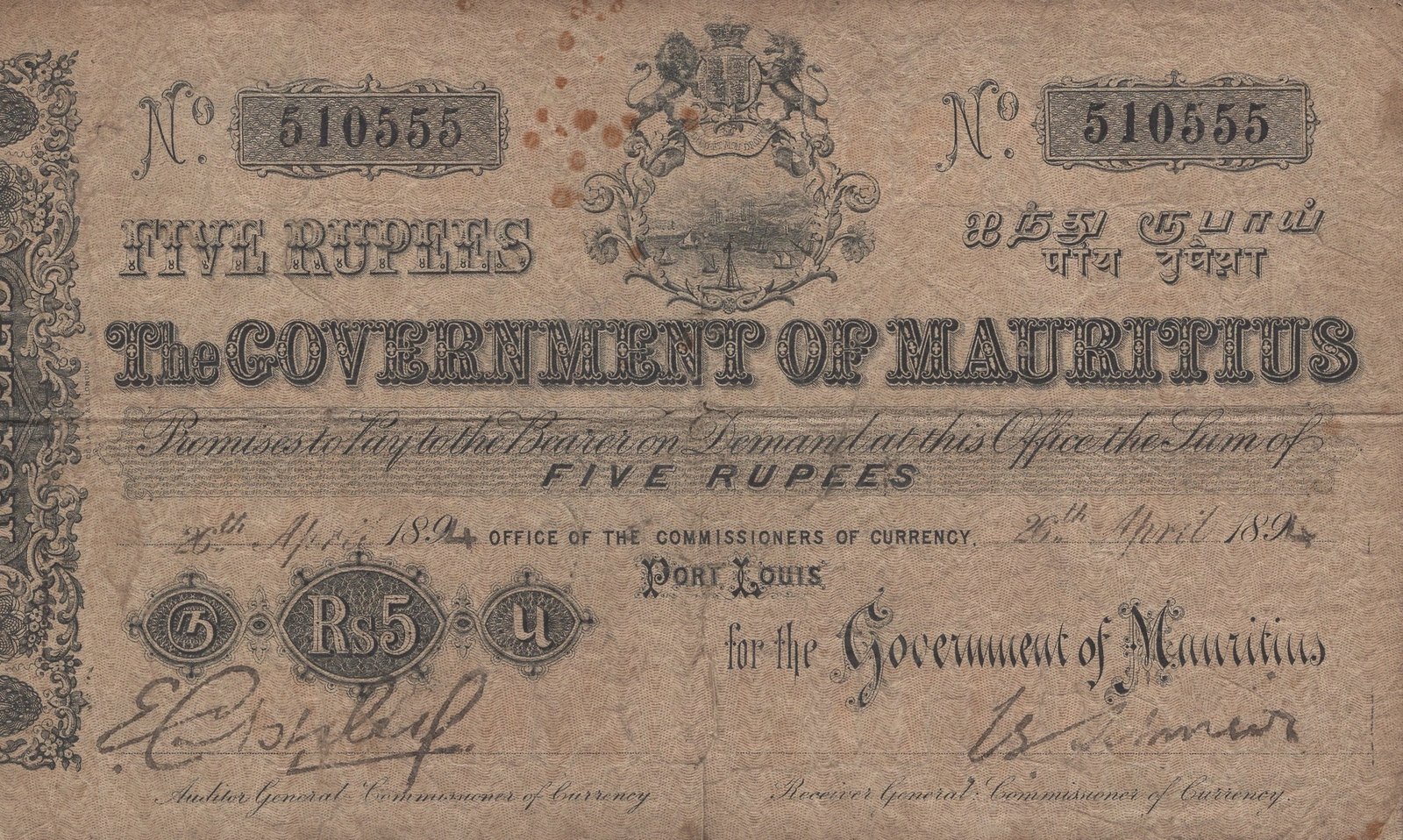
The two signatures are those of the Auditor General and the Receiver General, each as Commissioner of Currency. George R. Dick and James J. Brown sign the notes of 1900 and 1902. The Mauritius Blue Books give Brown as Receiver General from 1 June 1897 and Dick as Auditor General from 29 January 1899. In 1902 Brown acted as Colonial Secretary from 1 January to 22 May, and so had returned to the Receiver General's post by the 5 rupees of 7 August 1902.
Heritage (9 January 2020, lot 28289) says about 568,458 of the 10 rupees were printed and issued between 1876 and 1904. That is the serial number of the recorded note of 29 March 1904, so the figure appears to rest on the highest number seen and not on a printing record.
The notes of 1907 to 1930
A new issue began with the date 19th October 1907: the 5 rupees of 1907 to 1930, the 10 rupees of 1907 to 1930 and the 50 rupees of 1907 to 1920. The dates and signatures are now printed. The watermark reads Government of Mauritius in a circle on the first notes and in a line from 1913.
5 rupees notes A 003001 to A 125000 were lost when the RMS Newark Castle sank on 12 March 1908. A 116247, a note of 19th October 1907 in the British Museum, lies inside that range.
The numbers of the 5 rupees run on from one date to the next. A 000001 to A 323000 cover 1907 to 1911 and A 323001 to A 1000000 cover 1913 to 1919. Prefix B begins with the notes dated 1st January 1920, and B 000001 to B 823000 cover 1920 and 1921. B 823001 to B 1000000 cover 1924 to 1926 and are followed by prefix C. One point is not settled: three recorded notes dated 28th December 1911, A 348296, A 360618 and A 364369, lie above A 323000. Heritage, citing Owen Linzmayer's Mauritius chapter of The Banknote Book, says Thomas de la Rue prepared 323,000 notes for the dates 1907 to 1911 (9 January 2020, lot 28294) and printed 823,000 notes dated 1st January 1920 (13 January 2020, lot 28943). Heritage (9 January 2020, lot 28290) also says that notes dated 1924 went on being issued from time to time until about 1932, beside notes of later dates.
Every recorded 10 rupees carries prefix A, from A 096481 (28th December 1911) to A 561377 (1st October 1930). The paper is lilac on the first notes and on those of 1924 to 1930, and buff from 1914 to 1920. Heritage (9 January 2020, lot 28297) says that printing records and the numbers seen on surviving notes point to a possible total of about 700,000 notes from 1907 to 1934. Heritage (9 January 2020, lot 28295) gives about 335,000 of the 10 rupees as issued between 1927 and 1932. No issued 50 rupees of this issue has been recorded.
Two Heritage descriptions (17 August 2018, lot 28151, and 25 April 2019, lot 28332) say the notes show no printer's imprint and were stamped with the signatures after they reached the island. The note pages say otherwise: on this issue the dates and signatures are printed.
The signers and their titles, 1907 to 1930
Grannum signs under three titles: as Auditor General beside Banbury from 1909 to 1911, as Receiver General beside Scroggs from 1913 to 1920 and as Colonial Secretary beside Pickwoad from 1924 to 1930. The change of 1913 follows the law. The post of Auditor General was abolished in 1912 (Ordinance 3 of 1912), and the Commissioners of Currency were from then the Colonial Secretary, the Receiver General and the Collector of Customs (Mauritius Almanac for 1920).
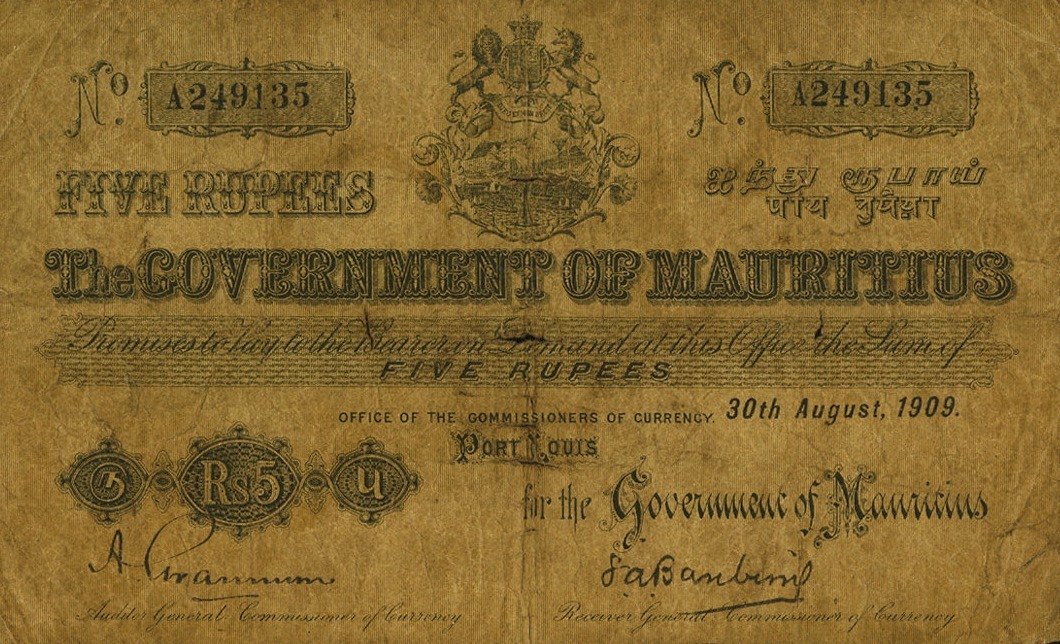
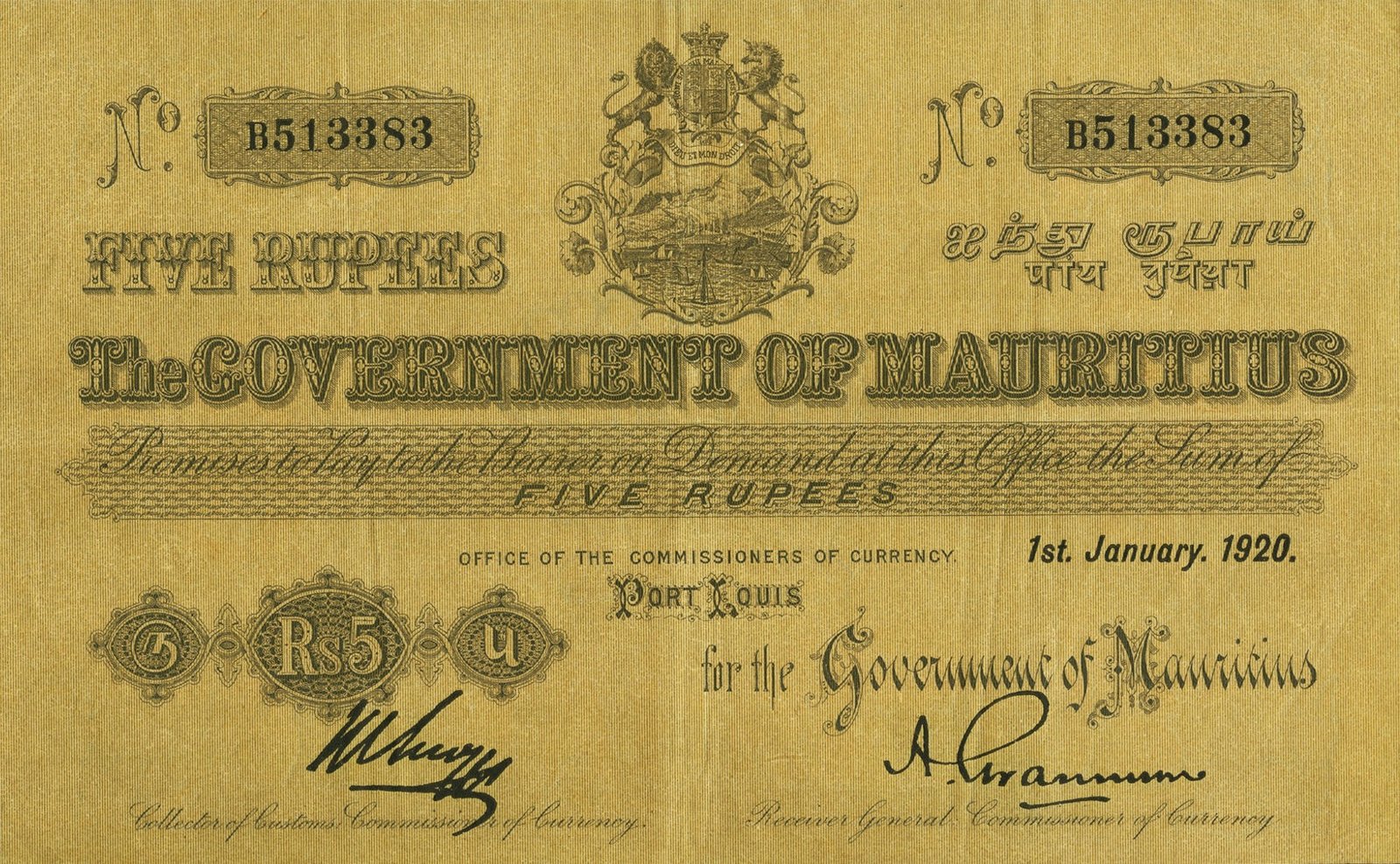
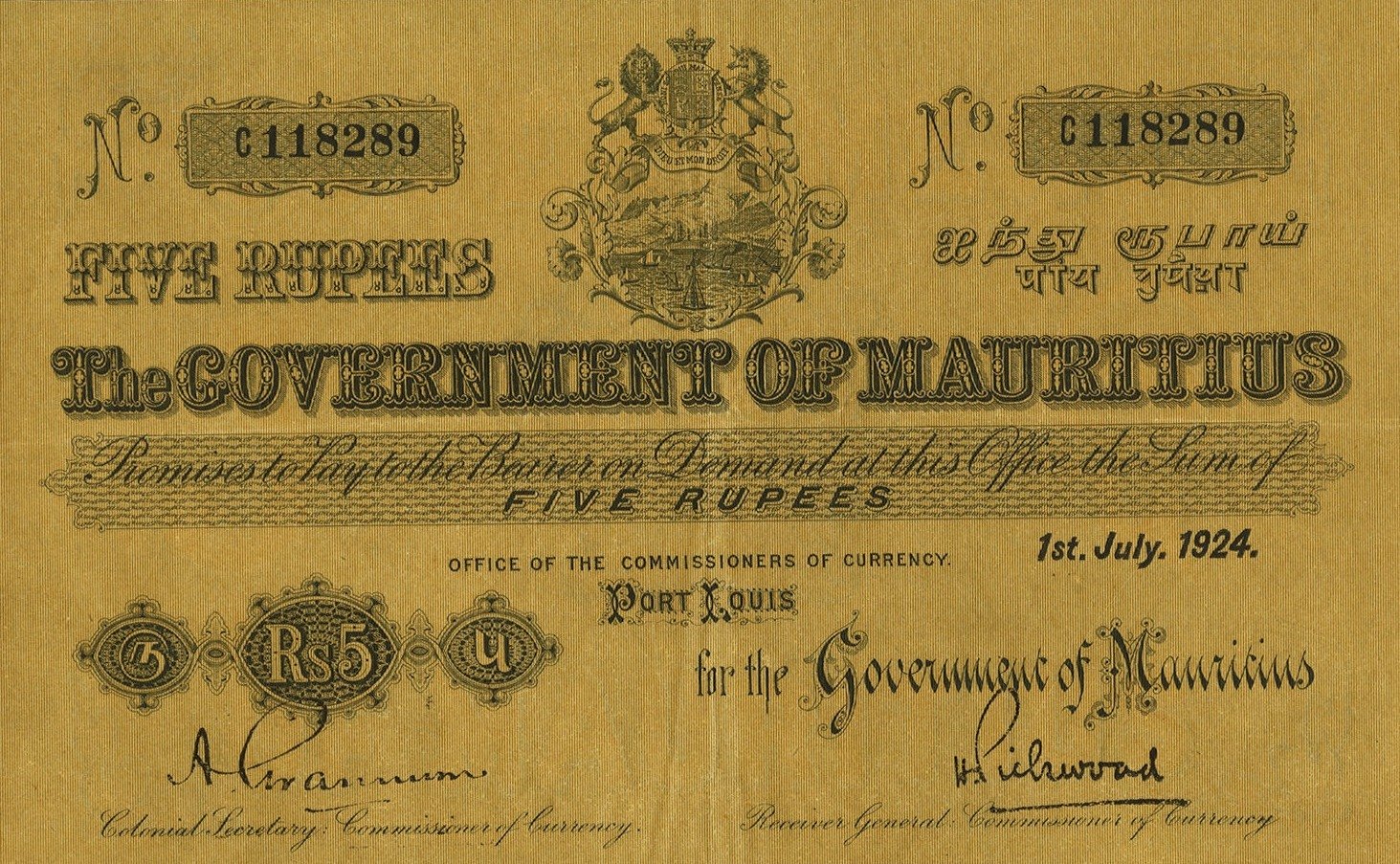
The Colonial Office Lists give Banbury as Receiver General from 4th February 1907, Grannum as Auditor General from 23rd April 1909, Scroggs as Collector of Customs from 1910 and Pickwoad as Receiver General from October 1923. The Mauritius Blue Book for 1923 dates Grannum's seat on the Executive Council as Colonial Secretary from 9th August 1923.
The notes dated 1st January 1920 print Receiver General under Grannum's signature. That was Grannum's own post since January 1912, though on that day Grannum was acting as Colonial Secretary (31st December 1919 to 13th July 1920) and Bertram Alexander Francis was acting as Receiver General (Mauritius Blue Book for 1920). Grannum had already acted as Colonial Secretary from 8 February to 17 November 1919 (Mauritius Almanac for 1920).
The 1 rupee of 1919
The 1 rupee dated 1st July 1919 was issued under Ordinance 12 of 29 July 1919 to ease the shortage of coin after the First World War. The Ordinance, the Paper Currency (Amendment) Ordinance, was published on 31 July 1919 and added the 1 rupee to the 5, 10 and 50 rupees of the law of 1876. The Ordinance forbidding the export of silver was passed the same day. The date on the notes is four weeks earlier than the Ordinance. Grannum and Scroggs sign under the one heading Commissioners of Currency. The note was introduced on 20 April 1920. Sources mention printing by Thomas de la Rue in sage-green and deep brown on white paper with a geometric watermark.
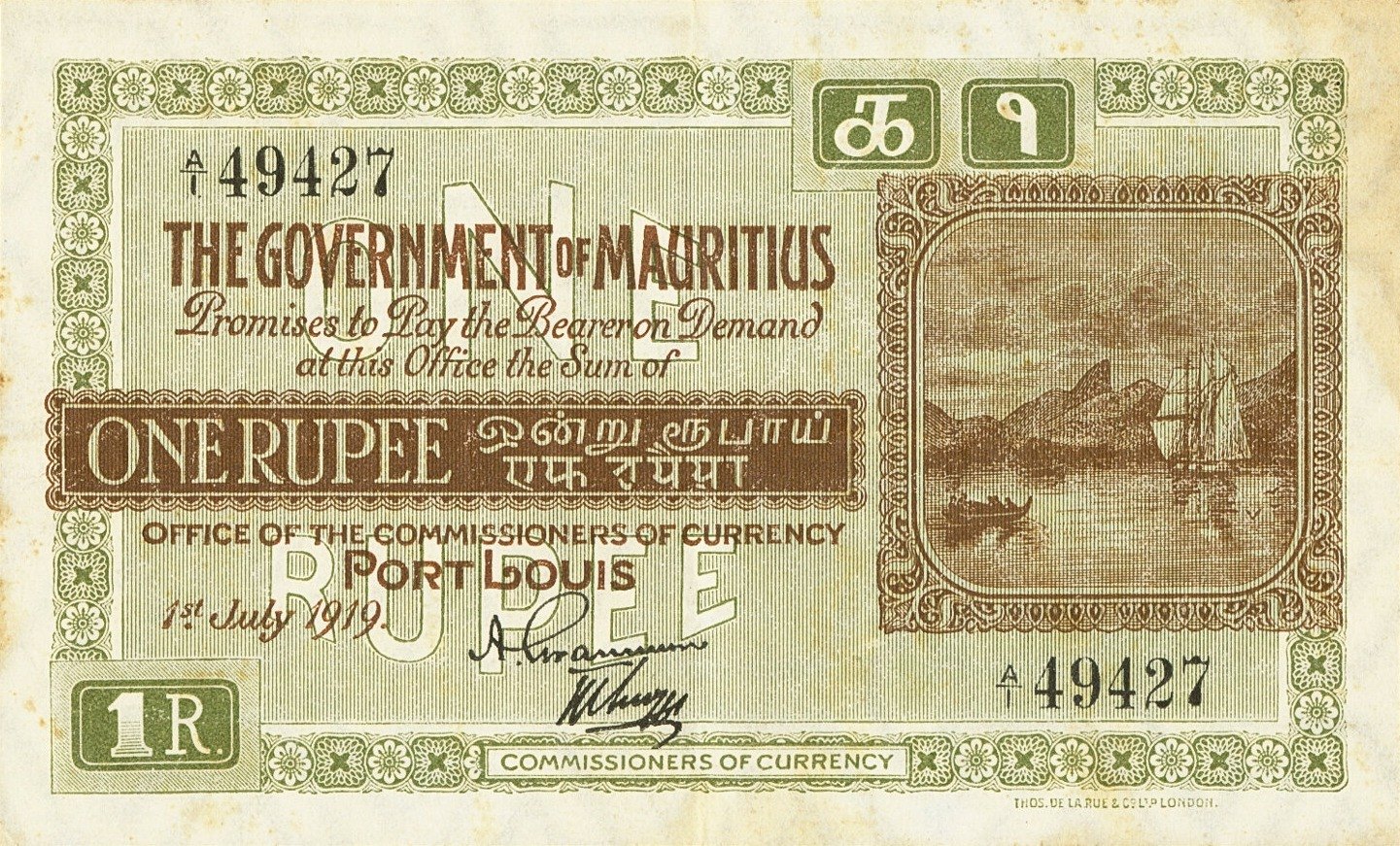
On 20 June 1920 the SS Engineer caught fire and sank at Lourenco Marques, Mozambique. Some notes with prefixes A/11 to A/15 were salvaged. The Mauritius Blue Book for 1923 lists a Proclamation of 10 September 1923, No. 24 of that year, headed "Treasury Notes wrecked on S/S Engineer" (Government Gazette, page 397). The Blue Book gives the title only. Sources mention a second date for the 1 rupee, 1st July 1928, but no note of that date has been recorded.

Notes in circulation, 1877 to 1933
Under the law of 1876 the notes were payable on demand in silver rupees of India. The Commissioners of Currency held at least a third of the issue in coin in Mauritius and invested the rest in England. No bank had notes in circulation in 1920 (Mauritius Almanac for 1920).
| Day | Government notes in circulation, rupees | Source |
|---|---|---|
| End of 1877 | 2,959,250 (issued by then) | Report on the colonial possessions for 1877 |
| 31 December 1891 | 2,668,250 | Chalmers (1893) |
| 31 December 1897 | 3,114,250 | Mauritius Blue Book |
| 30 June 1904 | 4,376,250 | Mauritius Blue Book |
| Blue Book for 1920 | 14,206,250 | Mauritius Blue Book for 1920 |
| Blue Book for 1921 | 20,806,250 | Mauritius Blue Book for 1921 |
| End of 1923 | 15,199,250 | Mauritius Blue Books for 1922 to 1924 |
The figure for the end of 1877, the first full year, is what the Commissioners of Currency had issued by then. Chalmers adds that the average in the years before 1891 was about three million rupees. The figures for 1920 and 1921 are for notes of 1, 5, 10 and 50 rupees.
The annual reports on Mauritius for 1921, 1922, 1923-24, 1925-26, 1929, 1931, 1932, 1933 and 1935 give the average value of Government notes in circulation, in years running from July to June:
| Year | Average, million rupees |
|---|---|
| 1919-20 | 10.2 |
| 1920-21 | 14.6 |
| 1921-22 | 20.4 |
| 1922-23 | 19.2 |
| Each of the three years to 1925-26 | between 15.2 and 15.6 |
| 1927-28 | 14.1 |
| 1928-29 | 14.8 |
| 1929-30 | 14.7 |
| 1930-31 | 7.5 |
| 1931-32 | 7.3 |
| 1932-33 | 7.9 |
Indian notes beside the Colony's own
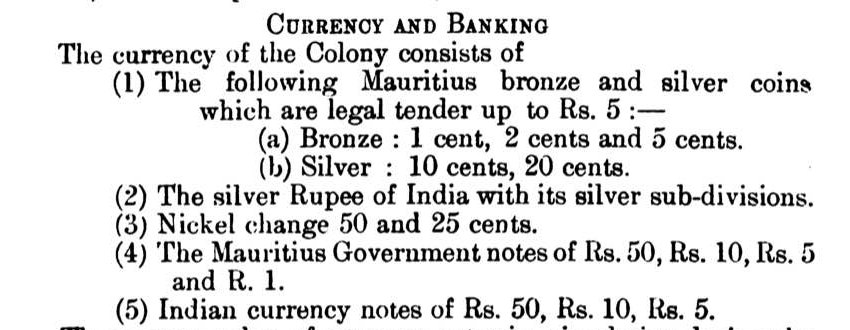
Indian Government currency notes were legal tender beside the Colony's notes under Ordinance 30 of 1920. In 1920 there were more of them in the Colony, 15,578,200 rupees, than of the Colony's own notes (Mauritius Almanac for 1920; Mauritius Blue Books for 1920 and 1921). The Indian notes then fell away. The Blue Books count 10,650,000 rupees of them in the Colony at the end of 1922, 6,000,000 at the end of 1923 and only 93,500 at the end of 1924.
The annual report for 1921 lists Indian notes of 50, 10 and 5 rupees as part of the Colony's currency and says that notes worth 21,234,920 rupees, chiefly Indian, were imported that year. The report for 1922 has Indian notes worth 9,745,672 rupees sent out again. The report for 1929 still lists the notes of the Government of India, of all denominations, as legal tender to any amount. These years have an article of their own: The years Mauritius was full of Indian notes, 1920 to 1924.
Called in, 1934
Proclamation 21 of 1 September 1934 ended the legal tender of every earlier issue on 15 December 1934, after the portrait notes had come out. Those notes are the subject of The portrait notes of the Government of Mauritius, 1934 to 1955.
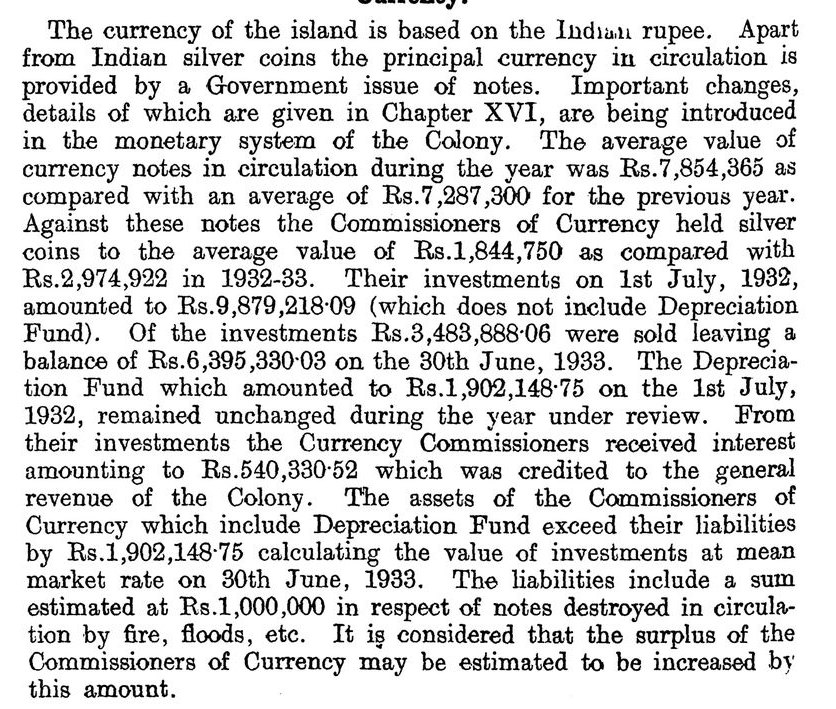
When the old notes were called in, the Commissioners of Currency reckoned that about 1,000,000 rupees of them had been destroyed in circulation by fire and floods and would never be presented. The surplus of the Commissioners' funds, 3,398,185 rupees, passed to the Colony's revenue. These statements stand on the note pages with the annual reports on Mauritius for 1921 to 1935 listed above.
Mauritius notes of 5, 10 and 50 rupees also circulated in the Seychelles. The annual reports on the Seychelles for 1930 to 1934 say they were being replaced there by the Seychelles Government's own notes, and they ceased to be legal tender there on 15th December 1934 (annual report on the Seychelles for 1934).
One later use is recorded. In 1942 old 10 rupees notes of this issue were cut up and printed on the back as the emergency 1 rupee.
Sources
- Robert Chalmers, History of Currency in the British Colonies (1893), as cited on the note pages.
- Report on the colonial possessions for 1877.
- Mauritius Blue Books, as cited on the note pages, among them those for 1920 to 1924.
- Mauritius Almanac for 1920.
- Colonial Office Lists.
- Annual reports on Mauritius for 1921, 1922, 1923-24, 1925-26, 1929, 1931, 1932, 1933 and 1935.
- Annual reports on the Seychelles for 1930 to 1934.
- Spink, 8 October 2007, lot 975, and 24 April 2012, lot 845.
- Auktionshaus Christoph Gärtner, 15 February 2022, lot 304.
- Heritage Auctions, 17 August 2018, lot 28151; 25 April 2019, lot 28332; 9 January 2020, lots 28289, 28290, 28294, 28295 and 28297; 13 January 2020, lot 28943.
- The catalogue's note pages for the unnamed sources ("sources mention").
Member comments
Log in or register to post a comment.