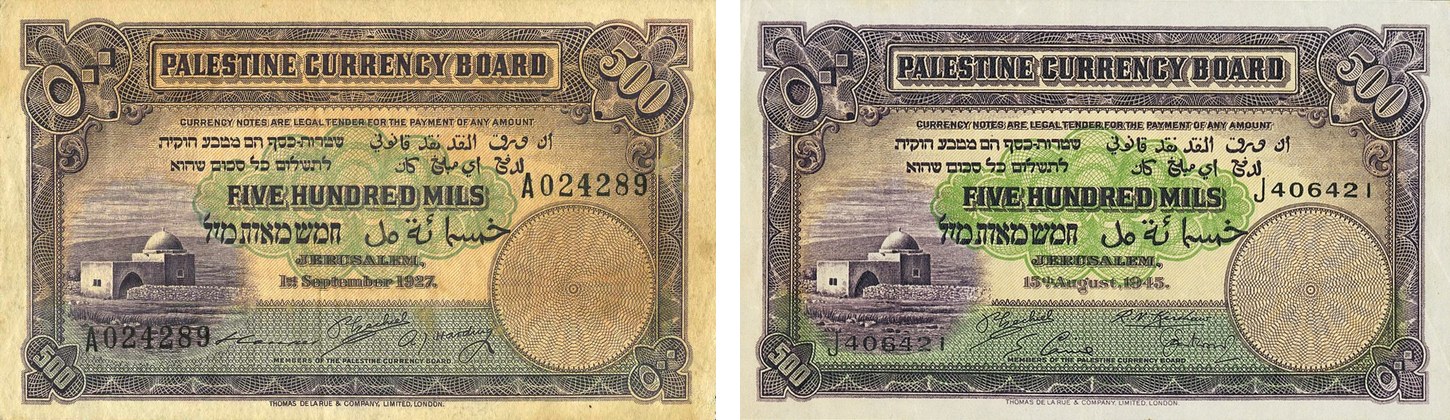
Every note of the Palestine Currency Board carries the printed signatures of the Board's members. The Board's regulations of 2 August 1926 required it: the notes were to be "authenticated by facsimiles of the signature of the members of the Board for the time being". Ten members signed between 1927 and 1945, in seven different sets.
Until now this catalogue could say who signed each date, but not when each signer joined the Board and left it. Howard M. Berlin's book The Palestine Currency Board: Its History and Currency (EconSciences Books, 2025) gives the days. Set beside the dates printed on the notes, they explain every set of signatures, and one or two things about the notes that were never issued.
The seven sets of signatures
| Date on the note | Values | Signatures |
|---|---|---|
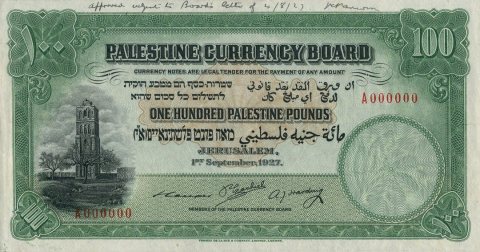
| 1st September 1927 | all six, 500 mils to 100 pounds | Ezechiel, Couper, Harding |
| 30th September 1929 | all six | Ezechiel, Caulcutt, Vernon |
| 20th April 1939 | 500 mils, 1 pound, 5 pounds | Ezechiel, Caulcutt, Downie |
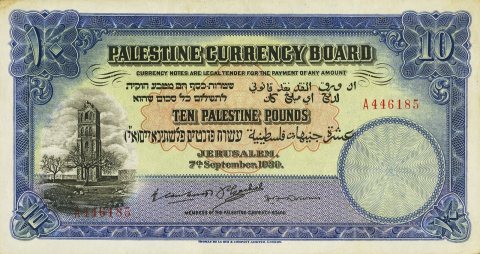
| 7th September 1939 | 10 pounds, 50 pounds | Ezechiel, Caulcutt, Downie |
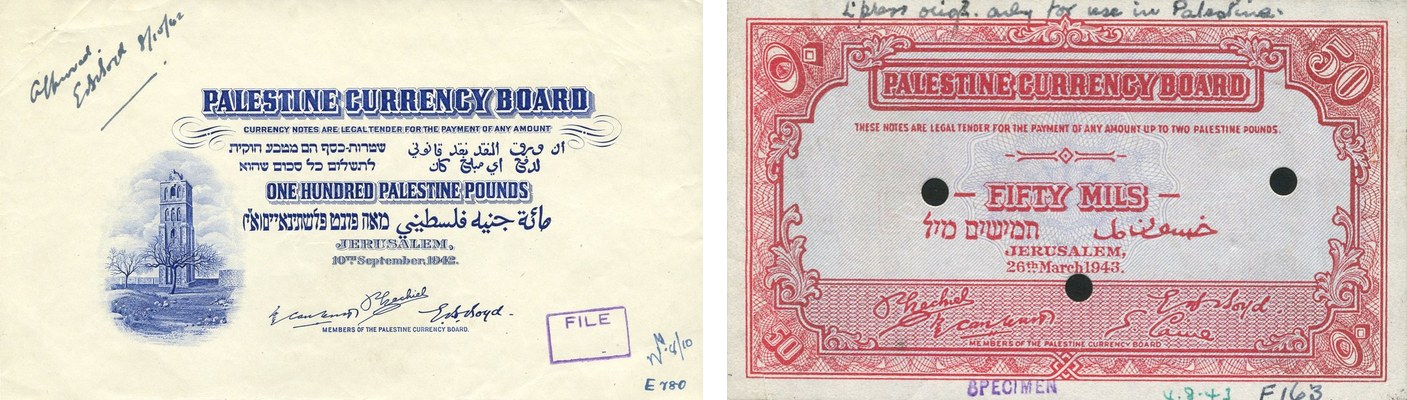
| 10th September 1942 | 100 pounds: a die proof and specimens; no issued note is recorded | Ezechiel, Caulcutt, Boyd |
| 26th March 1943 | the emergency 50 mils, 100 mils and 1 pound, never issued | Ezechiel, Caulcutt, Boyd, Caine |
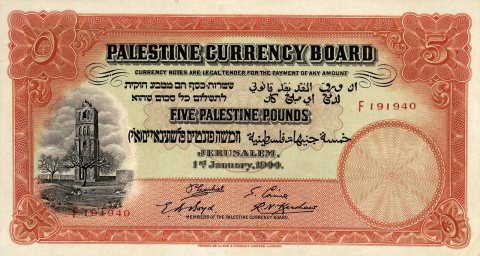
| 1st January 1944 | 1 pound, 5 pounds, 10 pounds | Ezechiel, Caine, Boyd, Kershaw |
| 15th August 1945 | 500 mils | Ezechiel, Kershaw, Caine, Eastwood |
The black proofs of two designs that were never adopted, a 500 mils and a 1 pound dated 15th July 1940, carry the set of 1939.
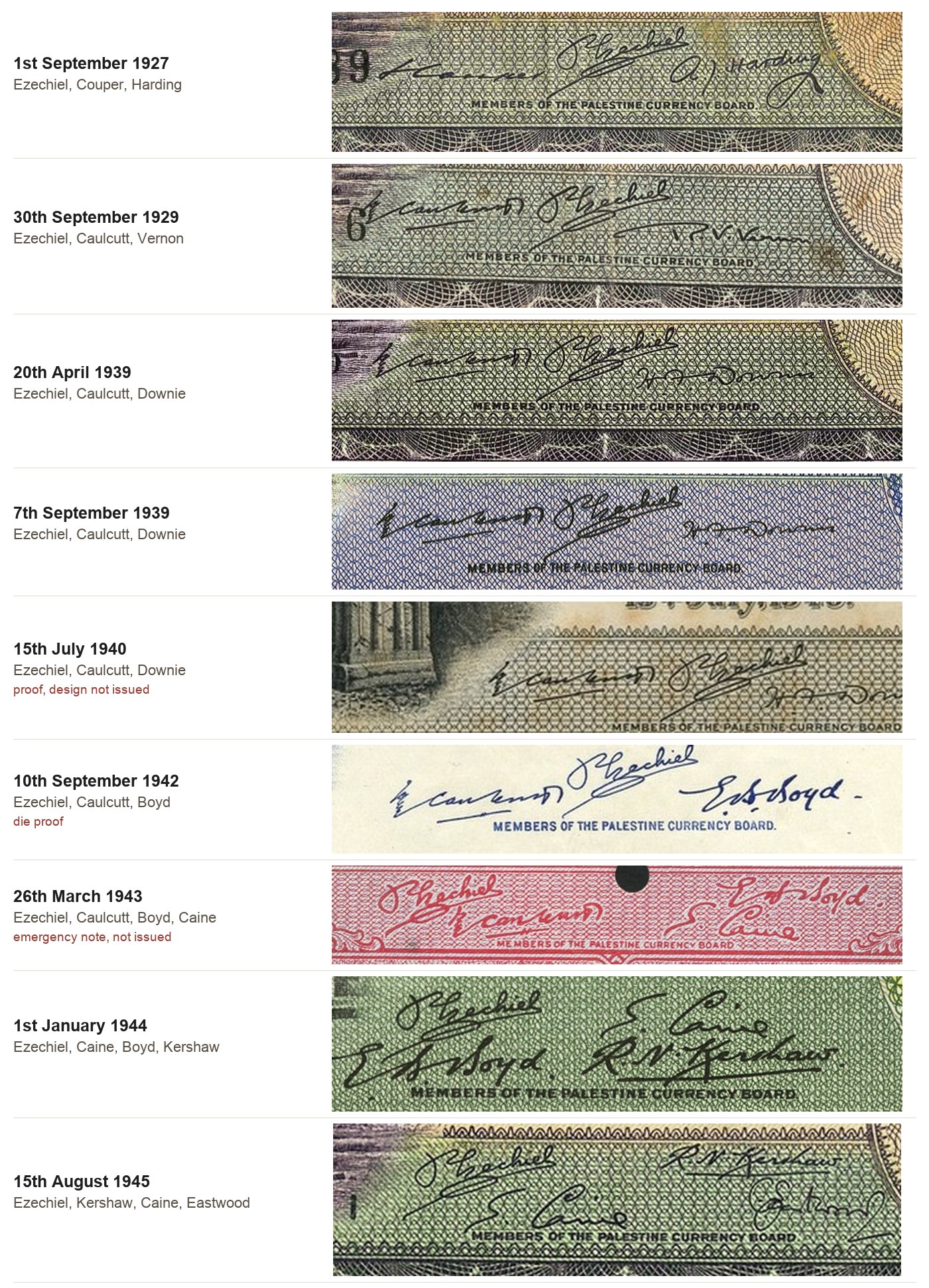
On the notes with three signatures the Chairman's stands in the middle, a little higher than the other two. On the notes with four, the signatures are in two rows of two, the Chairman's at the upper left.
The ten signers
| Signer | On the Board | Signs the notes dated |
|---|---|---|
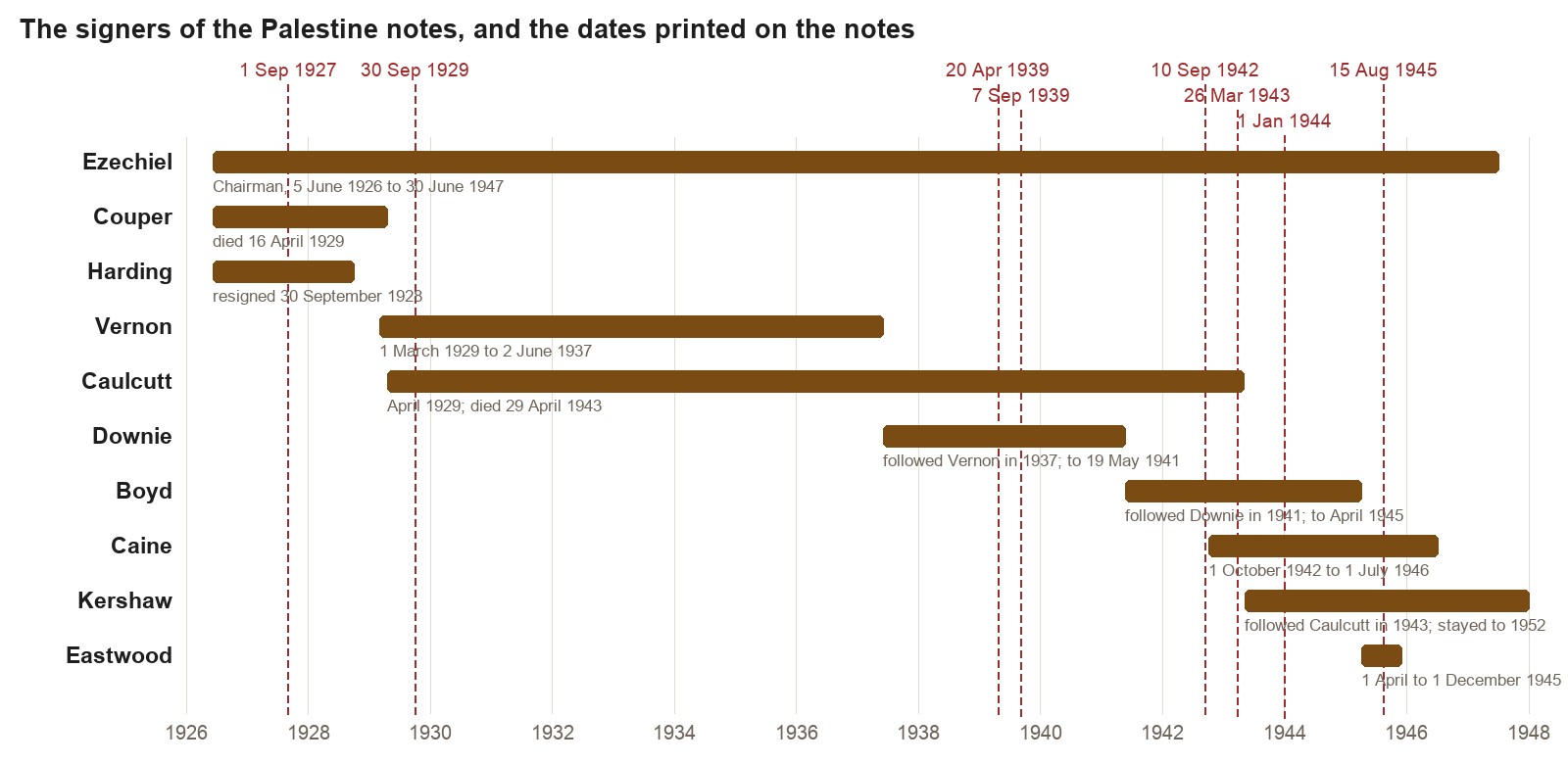
| Percy Hubert Ezechiel, Secretary to the Crown Agents for fifteen years and a Crown Agent from 1920; on the East African Currency Board from 1919 | Chairman from June 1926 to 30 June 1947 | every date |
| Leslie Couper, General Manager of the Bank of British West Africa | June 1926 until Couper's death on 16 April 1929 | 1927 |
| Alfred John Harding of the Colonial Office, later Director of Colonial Audit | June 1926 to 30 September 1928 | 1927 |
| Roland Venables Vernon of the Colonial Office | 1 March 1929 to 2 June 1937 | 1929 |
| John Caulcutt | April 1929 until Caulcutt's death on 29 April 1943 | 1929, 1939, 1942, 1943 |
| Harold Frederick Downie | followed Vernon in 1937, to 19 May 1941; back as Chairman from 1947 to 1952 | 1939 |
| Edmund Blaikie Boyd | followed Downie in 1941, to April 1945 | 1942, 1943, 1944 |
| Sydney Caine, Financial Adviser to the Secretary of State for the Colonies | 1 October 1942 to 1 July 1946 | 1943, 1944, 1945 |
| Raymond Newton Kershaw of the Bank of England | followed Caulcutt in 1943, to 1952 | 1944, 1945 |
| Christopher Gilbert Eastwood | 1 April to 1 December 1945 | 1945 |
What the days explain
- Every date fits. Each date printed on a note falls inside the time on the Board of every member who signs it. Vernon and Caulcutt both joined in the spring of 1929 and sign the notes of 30th September 1929. Downie followed Vernon in 1937 and signs both dates of 1939. Kershaw came after Caulcutt's death in April 1943 and signs from 1st January 1944.
- The first three sign the first report. The Board's report on its first period, printed in The Palestine Bulletin of 10 December 1928 (p. 4), is signed on 24 September 1928 by Ezechiel, Couper and Harding, the three names on the notes of 1st September 1927. Harding left six days later, and Couper died the next spring.
- Three signatures become four in 1942. The Board had three members until Caine was appointed as a fourth on 1 October 1942. The 100 pounds design of 10th September 1942 was dated three weeks earlier and has three signatures; Boyd approved its die proof by hand on 8th October 1942. Everything dated after it has four.
- The emergency notes of 1943 caught a short moment. Ezechiel, Caulcutt, Boyd and Caine sat together for less than seven months, from 1 October 1942 to 29 April 1943. The emergency notes are dated 26th March 1943, five weeks before Caulcutt died.
- Eastwood signs one note only. Eastwood was a member for eight months of 1945. The one date in those months is that of the 500 mils of 15th August 1945, the last date on any Palestine note.
A signature does not date the printing
The date and the signatures were fixed when a printing plate was approved, and the plate went on being used. The 1 pound shows it best. This catalogue records no 1 pound dated between 20th April 1939 and 1st January 1944, yet the Board's yearly figures show the 1 pound notes in circulation rising from 2.8 million on 31 March 1940 to 9.9 million on 31 March 1943. The notes printed in those years can only have carried the date of 1939, and with it the signature of Downie, who had left the Board in May 1941, and from April 1943 that of Caulcutt, who had died.
So the signatures tell you which plate a note comes from, not who sat on the Board when it was printed or issued.
How to use this
Date and signatures go together as in the first table, and no other pairing is recorded in this catalogue. If the date on a note is worn or hard to read, the signatures narrow it down: Couper and Harding mean 1927, Vernon means 1929, Downie means 1939, Eastwood means the 500 mils of 1945.
How sure the days are
The days come from Berlin's book, which gives no footnote for each of them. What is said of Ezechiel's earlier posts is from a London telegram in The Palestine Bulletin of 1 September 1926 (p. 1), which also notes that Couper sat on the West African Currency Board. Ezechiel signs the East African Board's notes as well, and Couper the West African Board's. They agree, year by year, with the members named in the Colonial Office Lists: Ezechiel, Couper and Harding in the Lists for 1927 and 1928; Ezechiel and Vernon in that for 1929; Caulcutt with them from 1930; Ezechiel, Caulcutt and Downie in 1939 and 1940; Ezechiel, Caine and Kershaw in 1946. One small difference: the List's record of Vernon's service gives 1928 where Berlin gives 1 March 1929. The Board's own yearly reports would settle each day; they have not yet been read for this catalogue.
Member comments
Log in or register to post a comment.