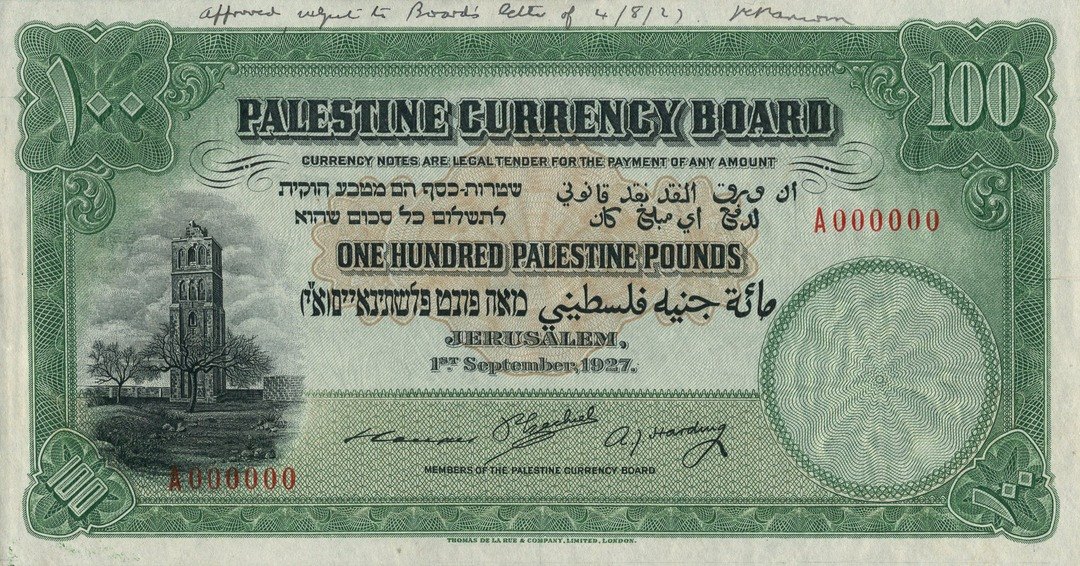
Ten members of the Palestine Currency Board signed its notes, and the article Ten signers, seven sets of signatures gives the days each of them joined and left. This article is about the rest of the office: the plans for a paper money of Palestine before there was a Board, the way the Board was set up, the members and officers who signed nothing, and the money the Board earned and paid over. It is drawn from the Colonial Office Lists, the Palestine Blue Books and the annual reports to the League of Nations, from the Board's first report as The Palestine Bulletin printed it, and from Howard M. Berlin's book of 2025. Each statement names which.
Plans before the Board, 1918 to 1925
Howard M. Berlin (The Palestine Currency Board, 2025) follows the proposals that came before the notes of 1927. Berlin takes the last of them, the meeting of July 1925, from Raphael Dabbah's book of 2005.
| When | Who | What was proposed | Berlin's page |
|---|---|---|---|
| May 1918 | The Anglo Palestine Company | Notes of a half, 1, 5, 10 and 50 Palestine pounds, and small notes of 1, 5 and 25 piastres. The Foreign Secretary refused | pp. 8 and 9 |
| 26th February 1920 | Herbert Samuel | Government notes backed by reserves in London | p. 10 |
| 1924 | The committee appointed by the High Commissioner | Notes of 5 to 1,000 florins | pp. 13 to 16 |
| January 1925 | A committee on the names | The names dinar, sheqel and mithqal. The Secretary of State refused them on 16th April 1925 in favour of pound and mil | pp. 13 to 16 |
| 20th July 1925 | The London committee, at its last meeting | Notes of 500 mils to 100 pounds, 1,500,000 pounds of them, worded as "legal tender for the payment of any amount" and not as a promise to pay, with a picture of a city set on a hill, as on the Palestine Great Seal | pp. 17 and 18 |
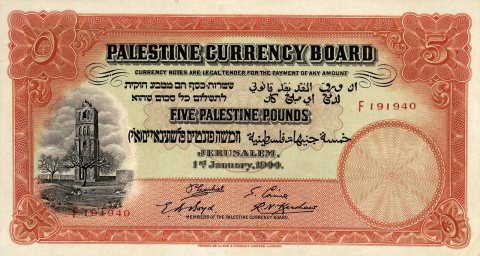
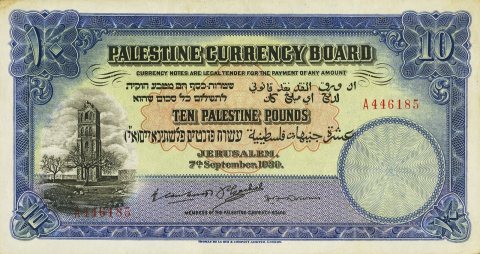
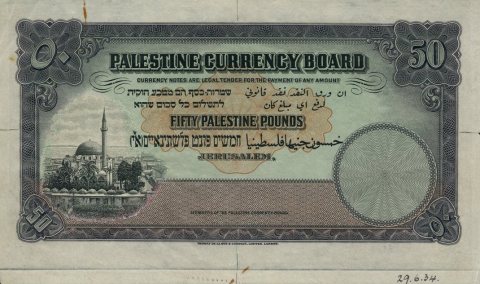
Three of these points can be followed onto the notes. The range settled in July 1925, from 500 mils to 100 pounds, is the range of the notes that were issued: the 500 mils, 1 pound, 5 pounds, 10 pounds, 50 pounds and 100 pounds. The 1,500,000 pounds is the size of the first order as it was first set, before it was raised to 2,160,000 pounds. The city on a hill did not reach the notes: the vignettes chosen were Rachel's Tomb, the Dome of the Rock and the tower at Ramla, with the Tower of David on every back.
The committee of 1924 is on record in official papers too. The Board's first report, printed in The Palestine Bulletin of 10th December 1928, names the committee of March 1924 under the Treasurer, S. S. Davis, and the report on the mandated territories for 1924 says that a committee under the Treasurer recommended a sterling currency under a Board in London.
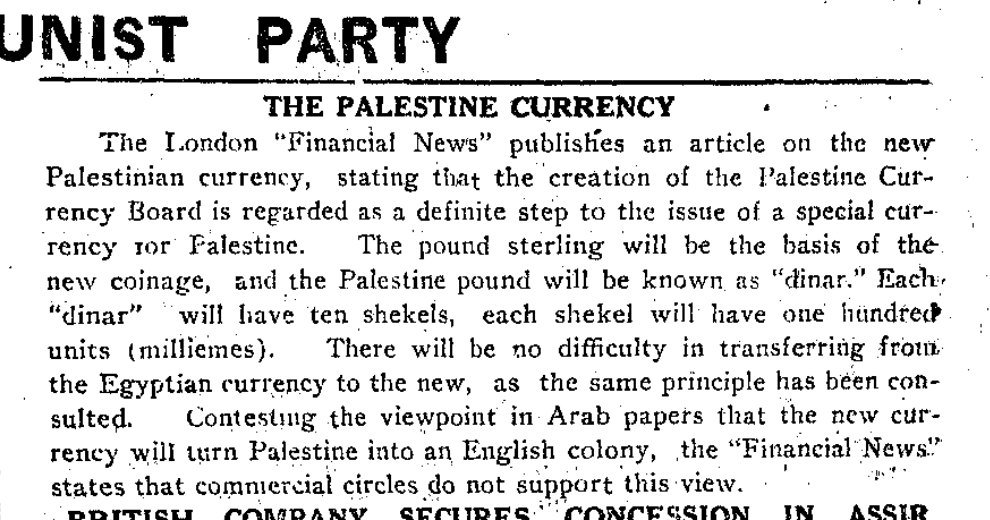
The refused names lived on for a while. The Palestine Bulletin of 14th October 1926 (p. 1), quoting the London Financial News, forecast that the Palestine pound would be called the dinar, of ten shekels of a hundred milliemes each. By Berlin's account the Secretary of State had refused those names on 16th April 1925, and the Board had been constituted on 15th June 1926.
June to September 1926: the Board is set up
The Board's first report says that the Board was constituted by a minute of 15th June 1926. Berlin (pp. 16 and 65) has P. H. Ezechiel as Chairman from 5th June 1926. The 5th of June 1926 is also the date of the Colonial Office letter that invited Leslie Couper to join: Shlomo Tepper pictured that letter in The Shekel (vol. 37 no. 2, 2004), and Berlin pictures it too (p. 22), with the reference C/9146/26 and the signature of J. E. Shuckburgh for the Secretary of State, L. S. Amery. Couper accepted on 8th June. By the letter, and by Berlin (p. 21), a member who was not a civil servant was paid 100 pounds a year.
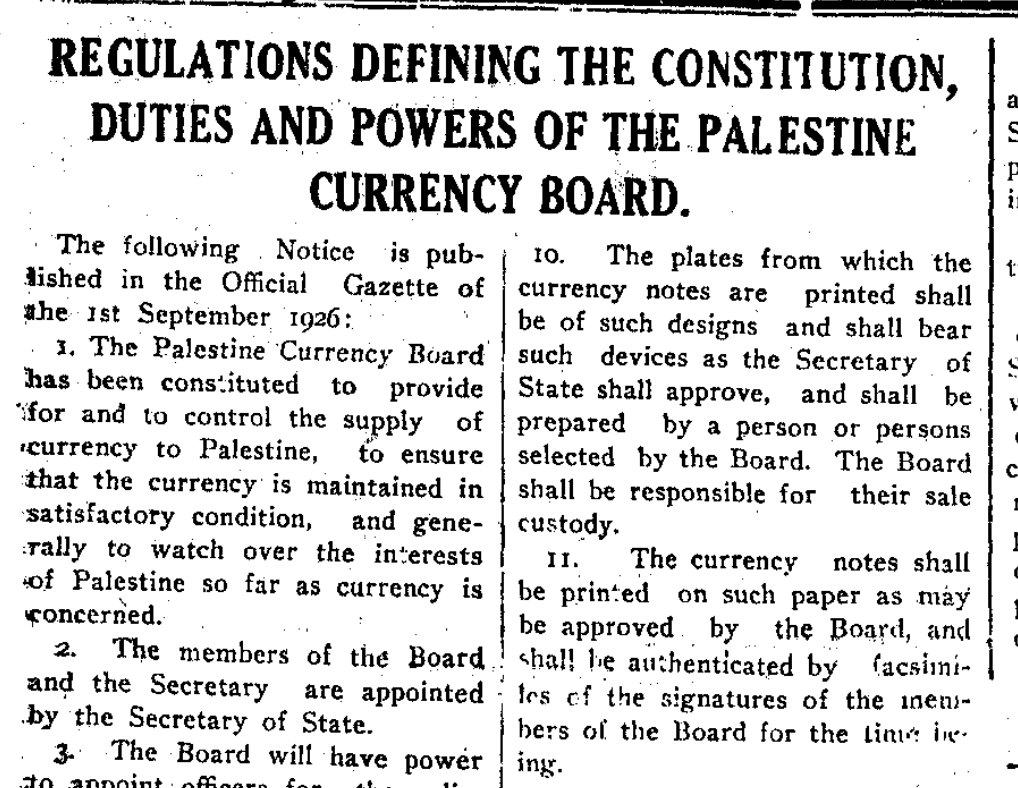
The Board worked under regulations dated 2nd August 1926. The Palestine Bulletin printed them on 3rd September 1926, and Berlin cites them from the Official Gazette of the Government of Palestine, No. 170 of 1st September 1926 (pp. 447 to 449). They stand as Appendix I to the Board's report for the period to 31st March 1928. Under them the notes were to carry facsimiles of the signatures of the members of the Board for the time being, which is why the signatures on the notes change with the membership.
A London telegram in The Palestine Bulletin of 1st September 1926 (p. 1) announced the Board. It describes Percy Hubert Ezechiel as the Third Crown Agent for the Colonies, Secretary to the Crown Agents for fifteen years, a Crown Agent from 1920 and a member of the East African Currency Board since 1919, and it says that Leslie Couper also sat on the West African Currency Board. The telegram calls the third member "Edward John Harding". The Government's memorandum of March 1927, the Board's own report and the notes all have A. J. Harding.

Three more things were fixed in these months:
- The office. A notice of a book on the Board in The Shekel (fourth quarter 2023, pp. 41 to 45) places the Board's office with the Crown Agents at 4 Millbank, London.
- The bank account. The Board's first report says its account was at the Westminster Bank.
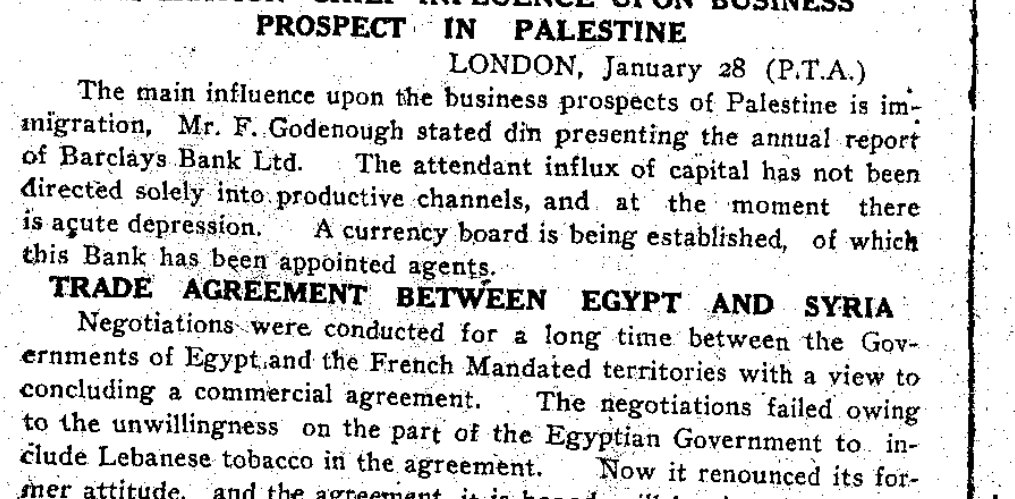
- The agent in Palestine. The annual report to the League of Nations for 1929 (p. 21) says the Board was represented in Jerusalem by a Currency Officer, who was the Treasurer of Palestine or, when the Treasurer was away, the Acting Treasurer, and by an Agent, Barclays Bank (Dominion, Colonial and Overseas), acting under the Currency Officer's supervision. The Palestine Bulletin of 9th February 1927 carries the words of the chairman of Barclays on the bank's appointment.
The members, year by year, in the Colonial Office Lists
The Colonial Office List prints the Board as it stood early in the year of its title. No List for 1941 to 1945 was held when the Lists were read, so the war years are missing from the table.
| List | Members | Secretary and other entries |
|---|---|---|
| 1927 (p. 63) | P. H. Ezechiel (Chairman); L. Couper; A. J. Harding | H. C. Ransom; the Currency Officer is the Treasurer of Palestine |
| 1928 (p. 80) | Ezechiel (Chairman); Couper; Harding | Ransom |
| 1929 (p. 60) | Ezechiel (Chairman); R. V. Vernon | Ransom |
| 1930 (p. 59) | Ezechiel (Chairman); Vernon; J. Caulcutt | Ransom |
| 1931 to 1935 | Ezechiel (Chairman); Vernon; Sir John Caulcutt | J. H. Brown |
| 1936 and 1937 | Sir Percy Ezechiel (Chairman); Vernon; Sir John Caulcutt | J. H. Brown |
| 1939 and 1940 | Sir Percy H. Ezechiel (Chairman); Sir John Caulcutt; H. F. Downie | J. H. Brown |
| 1946 (p. 25) | Sir Percy H. Ezechiel (Chairman); S. Caine; R. N. Kershaw; Trafford Smith | J. H. Brown; the Currency Officer is the Accountant-General of Palestine |
| 1949 (p. 47) | H. F. Downie (Chairman); H. T. Bourdillon; R. Beaumont; R. N. Kershaw; R. C. W. Tunstall (Currency Officer in London) | A. E. W. Gaston; agencies at Amman and in London (the Ottoman Bank and Barclays) |
| 1950 and 1951 | Downie (Chairman); Bourdillon; D. N. Brinson; Kershaw; Tunstall | Gaston; in 1951 the agencies are for redemption only |
| 1952 (p. 21) | Sir Harold Frederick Downie (Chairman); Bourdillon; Kershaw; Tunstall | Gaston |
The List for 1929 names two members only, Ezechiel and Vernon. Couper, who by Berlin's account died on 16th April 1929, is not in the entry as it was read. The Lists were read in their text, not on the printed page. The Lists' records of service have Harding as "member 1926-28" and Director of Colonial Audit in 1928 (List for 1951), Vernon as a member from 1928, and Downie as chairman from 1947 (List for 1950).
Set beside Berlin's days, the Lists agree with one small difference and leave one gap:
- The record of service gives 1928 for Vernon. Berlin gives 1st March 1929.
- Boyd and Eastwood, who sign the notes of 1944 and 1945, are in no List that was read, because the Lists for 1941 to 1945 were not held. Berlin's own book gives Boyd two ends: 1941 to 1944 in its list of members (p. 66) and 1st April 1945 in the text.
Members who signed no note
The last date on any Palestine note is 15th August 1945. Everyone who joined the Board after that signed nothing.
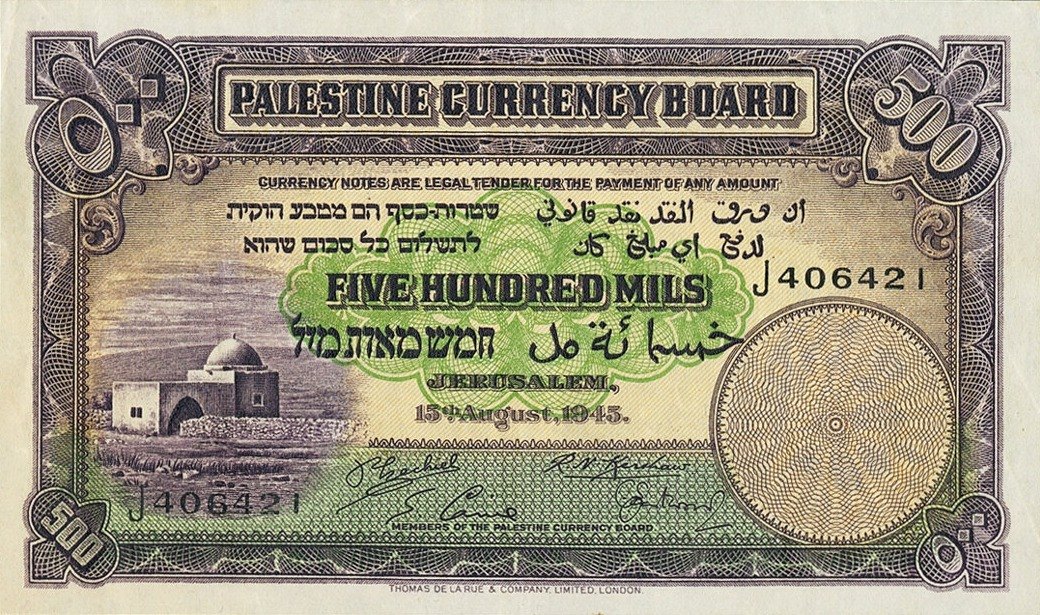
Berlin's book gives these later members: Trafford Smith, from 1945 to 3rd July 1948, who followed Eastwood; J. B. Williams, 1946 to 19th April 1948; H. T. Bourdillon, from 1948; John Gutch, 1948 to 28th March 1949; J. E. Cable, 1949; D. N. Brinson; and J. M. Hunter. An article of 1986 in The Shekel lists fifteen members in all and names six who signed no note: J. Trafford Smith, J. B. Williams, H. T. Bourdillon, J. Gutch, D. N. Brinson and J. M. Hunter.
The Colonial Office Lists for 1949 to 1952 add two names that neither of those lists has: R. Beaumont, and R. C. W. Tunstall as Currency Officer in London. Williams, Gutch, Cable and Hunter are in none of the Lists that were read. A List shows only the Board of one moment early in a year, so a member who came and went between two Lists does not appear.
Downie is the one signer who came back. Downie signs the notes of 1939, retired from the Board on 19th May 1941 by Berlin's account, and returned as Chairman after Ezechiel from 1947 to 1952.
Secretaries, Currency Officers and honorary members
| Office | Who and when | Source |
|---|---|---|
| Secretary | H. C. Ransom of the Crown Agents, to 1st December 1930 | Berlin, pp. 16, 40 and 65; the Lists for 1927 to 1930 |
| Secretary | J. H. Brown, from 1st December 1930 to 1947 | Berlin, pp. 16, 40 and 65; the Lists for 1931 to 1946 |
| Secretary | A. E. W. Gaston, 1947 to 1952 | Berlin, pp. 16, 40 and 65; the Lists for 1949 to 1952 |
| Currency Officer | Steuart S. Davis, Treasurer of Palestine, until 1932, when Davis became Governor of St Helena | Berlin, pp. 42 and 43 |
| Currency Officer | W. J. Johnson, Treasurer, after Davis | Berlin, pp. 42 and 43; the Palestine Blue Book for 1936, in its list of the Executive Council, has William Joseph Johnson as Treasurer and Currency Officer, on the Council from 2nd August 1932 |
| Assistant Currency Officer | A post from 1st April 1933; C. D. Harvey, Senior Assistant Treasurer, held it in 1937 | Berlin, pp. 42 and 43, for the post; the Palestine Blue Book for 1937, in its list of special allowances, for Harvey |
| Currency Officer | The Accountant-General of Palestine | The Colonial Office List for 1946 |
| Honorary members from the Treasury | Phillips, to February 1928; S. D. Waley; H. Brittain; N. E. Young, from 31st January 1934; H. Wilson Smith; S. A. Sidney-Turner, from 22nd March 1938 | Berlin |
The two Blue Book entries for Johnson and Harvey were read in the text of the volumes, not on the printed page, and the record of that reading gives the page of the file (463 for 1936, 488 for 1937) and no printed page number. The Palestine Blue Book for 1928 shows Davis drawing the Currency Officer's allowance from 30th September 1926, more than a year before the first note was issued. Davis also signed the public notice of 1st October 1927 that set the Palestine pound at 97.5 Egyptian piastres and gave the sizes of the notes.
The first honorary member from the Treasury is F. Phillips in Berlin's book and B. Phillips in The Shekel's account of the first Board. The two initials have not been checked against an official paper.
The same people on other boards
The Palestine Board was one of several currency boards run from London, and it shared people with two of them. The telegram of 1st September 1926 has Ezechiel on the East African Currency Board since 1919 and Couper on the West African Currency Board. The catalogue's pages for East Africa have Ezechiel signing that Board's notes with Mercer and Bottomley, and the notes dated Nairobi, 1st January 1933, signed by Bottomley, Ezechiel and Kershaw, the Kershaw who signs the Palestine notes of 1944 and 1945. Its pages for British West Africa have Couper and Harding signing the 10 and 20 shillings of 2nd January 1928 with Mercer, and show from the Colonial Office Lists that the West African Board was Mercer, L. Couper and A. J. Harding in 1927 and 1928 and Mercer, Flood and Wilson from 1930.
So the two names that leave the Palestine notes between the dates of 1927 and 1929 also leave the West African Board between the Lists for 1928 and 1930. Harding resigned from the Palestine Board on 30th September 1928 and became Director of Colonial Audit. Couper died on 16th April 1929 (Berlin, pp. 20 and 40).
The Board's money
The Board's reserve was held in British and colonial government stocks (The Palestine Bulletin, 4th March 1932, p. 2).
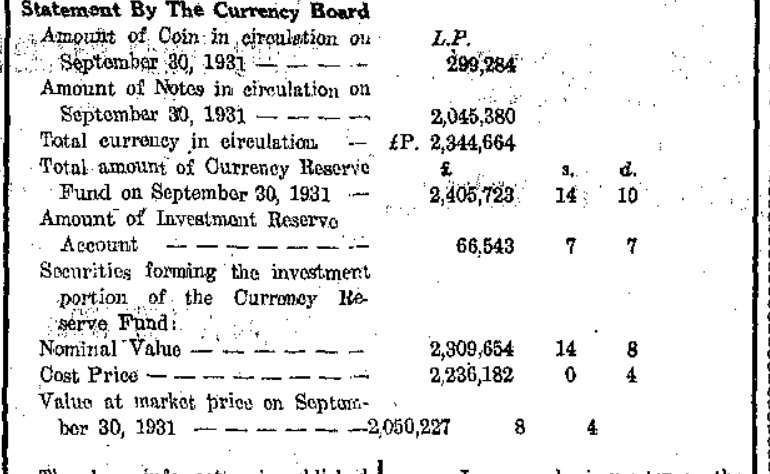
The reserve. The Palestine Blue Book for 1938 gives the Currency Reserve Fund on every 31st March from 1928 to 1938. It stood at 1,816,057 pounds in 1928 against 1,887,348 pounds of coin and notes in circulation, passed the circulation by 1931 (2,421,595 pounds against 2,369,664) and stood at 5,195,341 pounds against 5,009,134 in 1938. The whole table is in Every 31st March from 1928 to 1952: the Palestine Currency Board's yearly figures in full.
The reserve could fall as well as rise. The half-yearly statement of 30th September 1931 showed the investments worth 186,000 pounds less than they had cost, after prices fell that month (The Palestine Bulletin, 4th March 1932, p. 2). That autumn is told in Coin or paper? Two runs on the Palestine currency, 1931 and 1938.
Payments to Palestine. The annual reports to the League of Nations record the Board's contribution to the revenues of Palestine:
| Report for | Contribution, in Palestine pounds | As the report describes it |
|---|---|---|
| 1929 | 10,000 | the first the Board could make |
| 1930 | 20,000 | |
| 1931 | 35,000 | |
| 1932 (January to March) | none | |
| 1933 | 50,000 | |
| 1934 | 90,000 | Palestine's share in the profits |
| 1935 | 110,000 | for the year ended 31st March 1934 |
| 1936 | 115,000 | for the year ended 31st March 1935 |
| 1937 | 80,000 | for the year ended 31st March 1936 |
| 1938 | 80,000 | for the year ended 31st March 1937 |
The newspapers give sums from the Board's side. The Palestine Bulletin of 12th December 1932, from the Board's report for the year to March 1932, has contributions of 10,000, 20,000, 35,000 and 50,000 pounds in the first four years. The League's table has the same four sums, and sets the 50,000 pounds against the report for 1933. The Palestine Post of 6th December 1939, from the report for 1938-39, has 100,000 pounds in each of 1938 and 1939, where the League's reports for 1937 and 1938 have 80,000 pounds. The newspaper and the League's reports do not name their years in the same way, so the two cannot be set side by side year for year until the Board's own reports are read.
The end. When the Board was dissolved on 31st March 1952 its remaining assets, 1,293,383 pounds, passed to the Crown Agents for the Colonies (Berlin, p. 64, from the Board's last report).
What has not been read
- The Board's yearly reports. Twenty-five reports were printed, for the years ended 31st March 1928 to 1952. Berlin cites those for 1928, 1930, 1935 to 1938, 1940, 1945 and 1948 to 1952. Only the first has been read for this catalogue, in the newspaper's printing. They would give each member's day of appointment at first hand.
- The Board's minutes. Berlin (p. 37) cites the thirteenth meeting, of 3rd August 1927, without saying where the minutes are kept.
- The Colonial Office Lists for 1941 to 1945, the years in which, by Berlin's account, Boyd, Caine, Kershaw and Eastwood joined the Board.
- Parliament. Hansard was searched. An oral answer in the House of Commons on 8th November 1928 (column 217) says only that the Board's first report had just been published.
Sources
- The Colonial Office Lists for 1927 (p. 63), 1928 (p. 80), 1929 (p. 60), 1930 (p. 59), 1931 to 1937, 1939, 1940, 1946 (p. 25), 1949 (p. 47), 1950, 1951 and 1952 (p. 21).
- The Palestine Blue Books for 1928 (special allowances), 1936 (Executive Council), 1937 (special allowances) and 1938 (Section XIX, Currency).
- The annual reports to the League of Nations on Palestine for 1929 to 1938; the report on the mandated territories for 1924.
- The Palestine Bulletin, 1st September 1926 (p. 1), 3rd September 1926, 14th October 1926 (p. 1), 9th February 1927, 10th December 1928 (the Board's first report), 4th March 1932 (p. 2) and 12th December 1932. The Palestine Post, 6th December 1939.
- The Report of the Palestine Currency Board for the period to 31st March 1928, Appendix I, the Regulations of 2nd August 1926.
- Howard M. Berlin, The Palestine Currency Board: Its History and Currency, 2025, pp. 8 to 10, 13 to 18, 20, 21, 37, 40, 42, 43, 64, 65 and 66.
- The Shekel: Shlomo Tepper, "About the Palestine Currency Notes", vol. 37 no. 2, 2004; an article of 1986 that lists the members; the notice of a book on the Board, fourth quarter 2023, pp. 41 to 45.
- Hansard, House of Commons, 8th November 1928, column 217.
- The catalogue's pages for East Africa and British West Africa, for the signatures on those Boards' notes.
Member comments
Log in or register to post a comment.