The Palestine Currency Board issued six values of notes, dated from 1927 to 1945. Around them stands a second body of material that never circulated: an essay by a printer who did not get the work, specimens and colour trials, a few notes cancelled for presentation, a whole second series of designs that was set aside, and two preparations for an emergency in the Second World War. This article goes through them in order of time. It rests on the catalogue's pages for Palestine, which describe the pieces from their photographs, and on what the auction houses wrote when the pieces were sold. What a house says is given as that house's statement.
1926: an essay by Bradbury Wilkinson
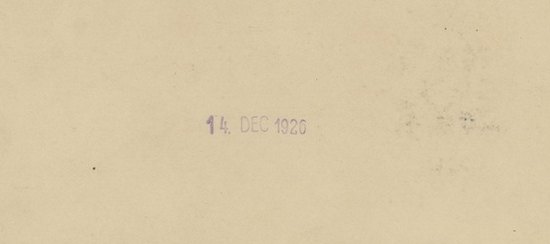
Spink's description of lot 286 in its sale of 30 September 2026 is of a front essay for a 1 pound made by hand by Bradbury Wilkinson. By that description the essay is dated 1st January 1927, has the number 000000, is mounted on a board that is hand-stamped 14th December 1926 on the back, and is built up from separately fixed parts: a view of the Citadel of Jerusalem, guilloche work and lettering.
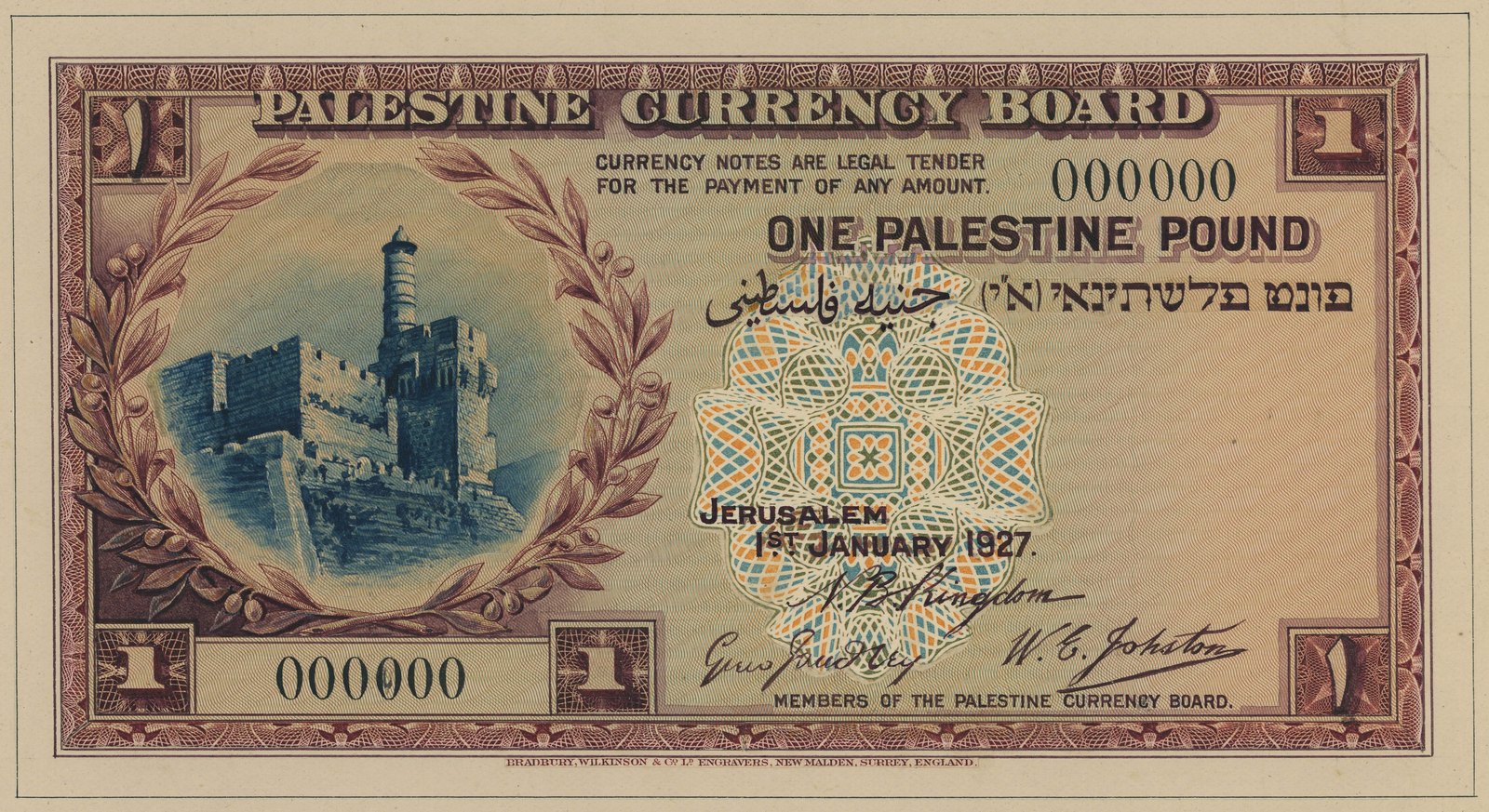
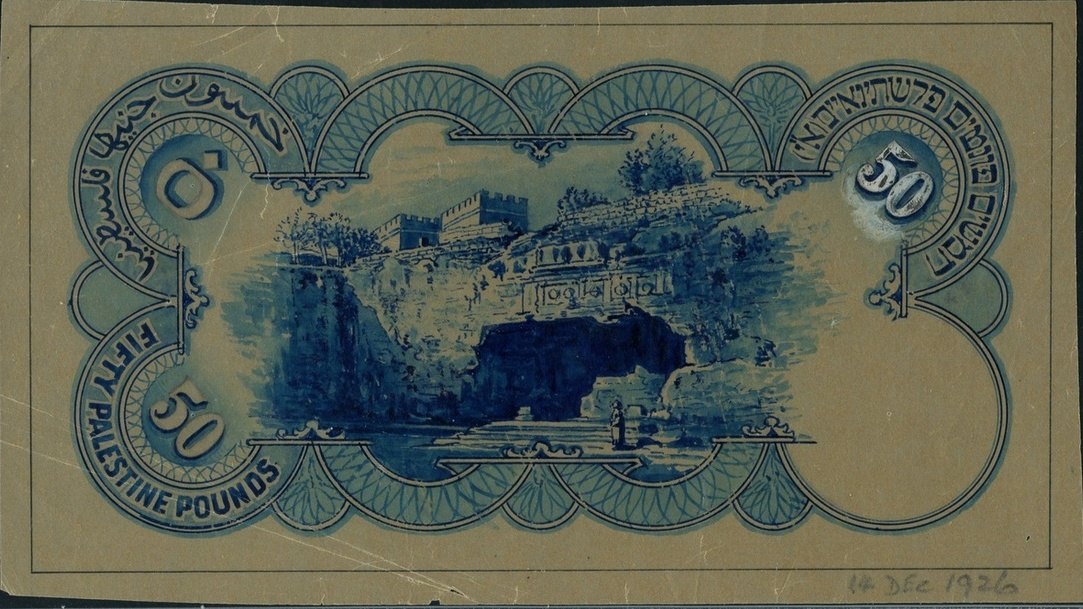
Spink says that three printers were being considered in November 1926 and that on 17th December 1926 the Board approved De La Rue and not Bradbury Wilkinson. Citing Raphael Dabbah's book (pp. 109 to 111), Spink also says that the Board decided at its meetings of November and December 1926 to use one design for the four high values to save cost, and that the Tower of David was being considered as a subject. Howard M. Berlin (The Palestine Currency Board, 2025, p. 35) names the three printers as De La Rue, Bradbury Wilkinson and Waterlow and gives 18th January 1927 as the day the contract went to De La Rue, the lowest of the three. The two days differ and the pages do not settle which is right.
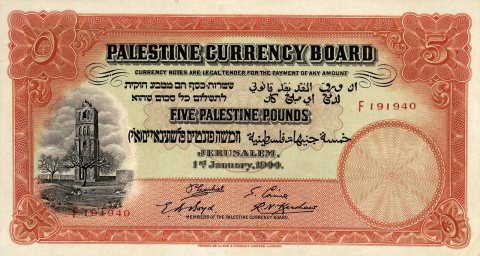
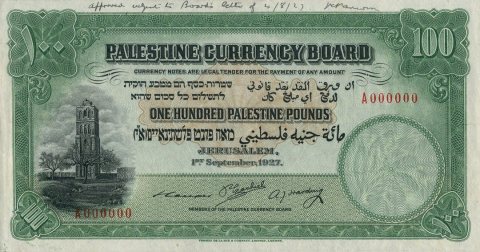
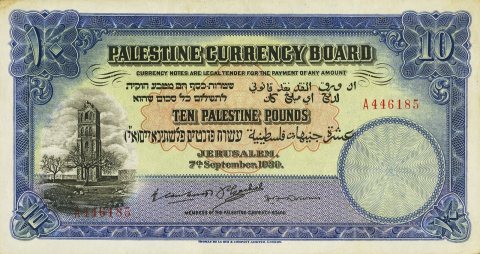
The citadel did reach the notes: every back of the issued series shows the Tower of David. On the essay it is the subject of the front. Spink adds that it offered a 50 pounds essay of 1926 from the Shlomo Tepper Collection in 2018.
1927: specimens and the first colour trials
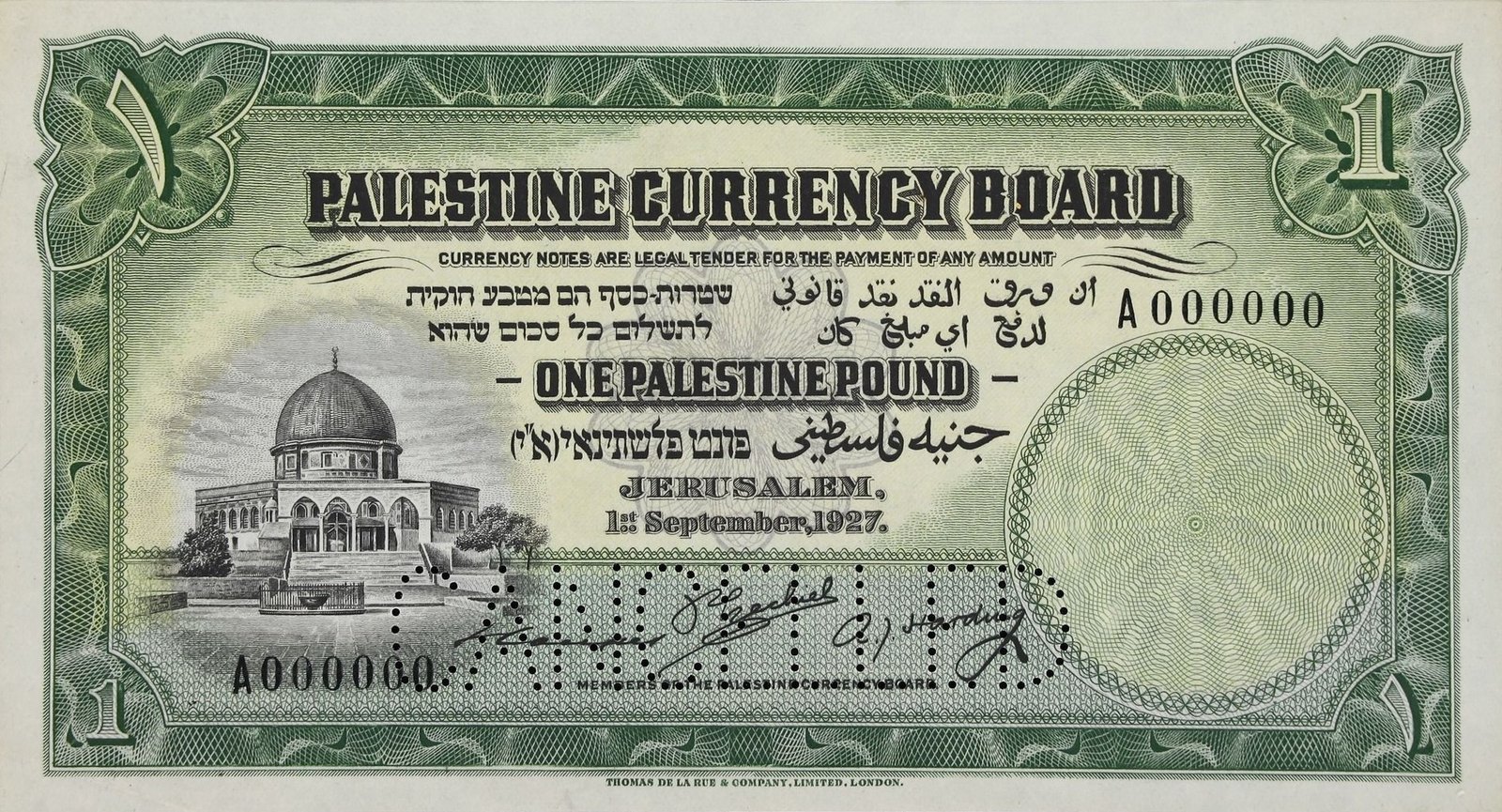
The specimens of the issued series usually have an all-zero serial number and a CANCELLED perforation. The catalogue has specimen rows for every date of every value.
Sources mention that a set of the specimens of 1st September 1927, from 500 mils to 50 pounds, was presented to Leslie Couper, a member of the Board, stayed with the Couper family until 1972 and was sold in the United States in August 1978.
Stack's Bowers (6 May 2026, lot 50014), describing a specimen of the 1 pound of 1st September 1927, says that most specimens appear to have been kept by the Currency Board and later passed to museums or destroyed, and that only a few specimens of that date are believed to be in private collections. Of the 50 pounds of that date the same house (lot 50061) knows of no more than one or two specimens in private hands. That specimen had been part of lot 172 in Sotheby's sale of 19 December 2012 and was later in the Phil Doudar Collection, by the same description.
A colour trial of the 500 mils sold by Christie's (3 May 2001, lot 608) carries the ink date 24/6/27 on its back. That is ten weeks before the date printed on the first notes and four months before the issue. Bank Note Reporter of May 2003 reports a colour trial of the 100 pounds dated 1st September 1927, graded about uncirculated in the preview, sold at Spink's London sale of 9th April 2003. No photograph of it has been seen by the catalogue.
1929: colour trials from a salesman's book
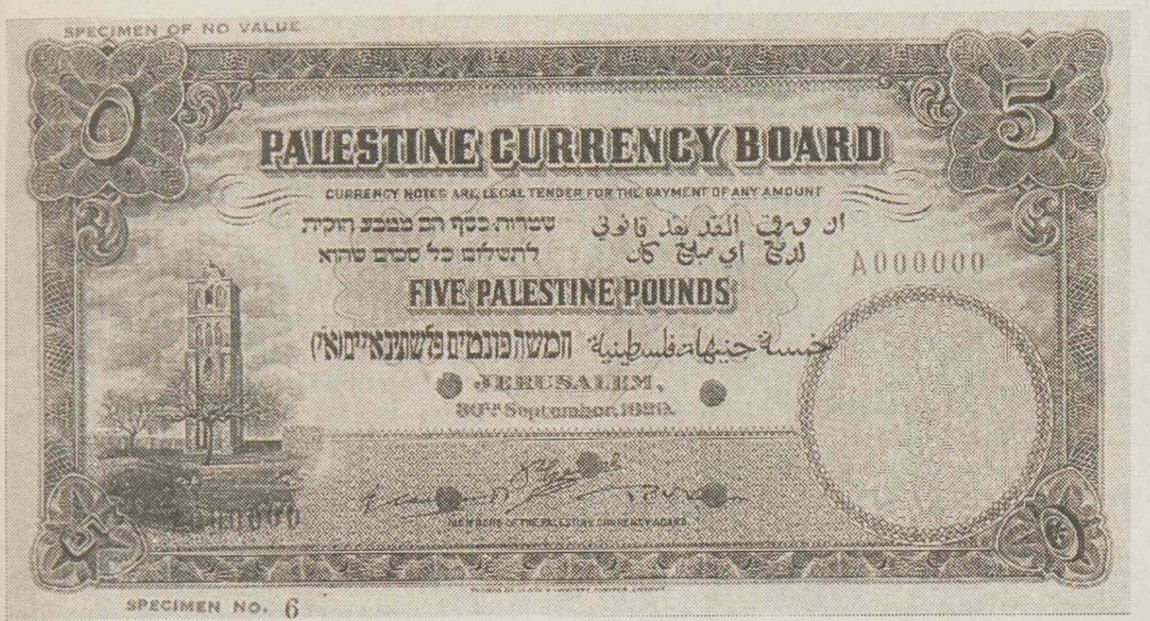
Bank Note Reporter reported in November 1999 that four colour trials of 30th September 1929, the 1, 5, 10 and 50 pounds, came from a De La Rue salesman's specimen book of the early to mid-1930s, in which they were glued in at the left side. The 5 and 50 pounds pictured are each overprinted SPECIMEN No. 6.
One piece of the 50 pounds of 30th September 1929 is printed in orange and numbered A 000000. It has been sold as a colour trial. Sources mention that Raphael Dabbah calls it a presentation note.
1929: notes cancelled for presentation
A few notes of the two high values dated 1st September 1927 have a normal serial number and a CANCELLED perforation. They are not specimens of the usual kind, which have the all-zero number. On the 50 pounds the catalogue records one, A 002575. On the 100 pounds it records one on its register, and Spink names a second, close to the first in number; a photograph of that second note printed in 2024 shows the date 1st September 1927, a CANCELLED perforation and two punch holes.
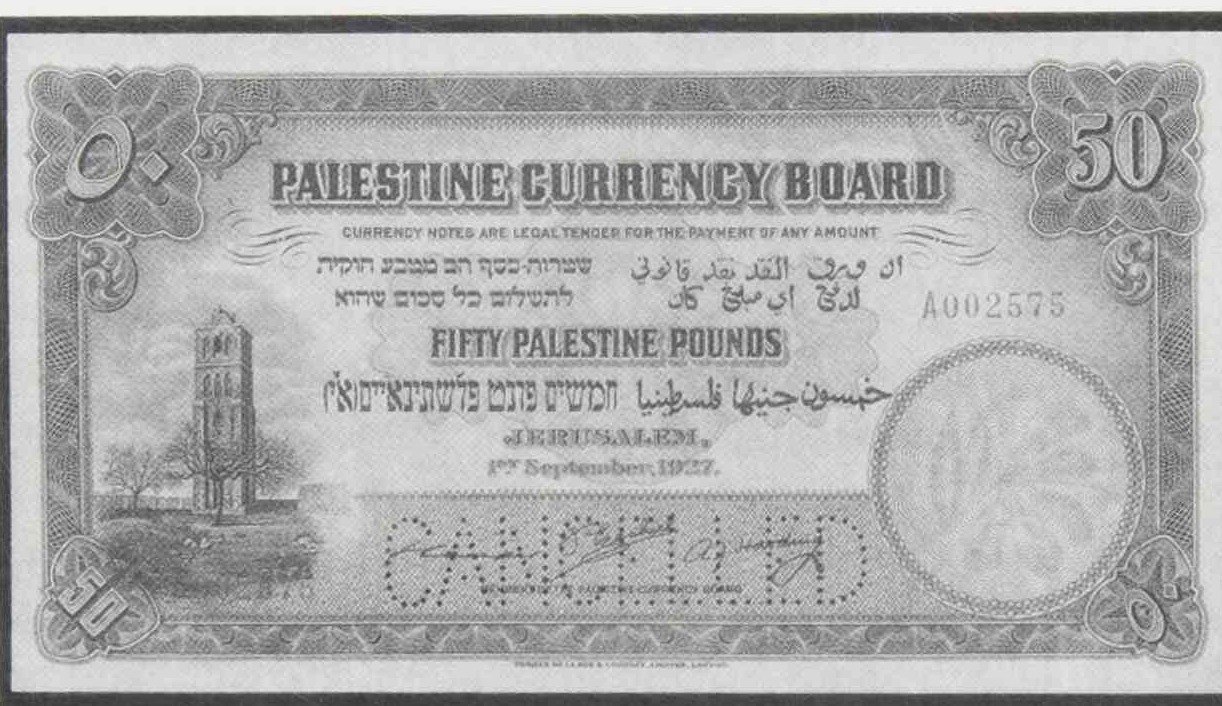
The houses explain them in two ways that nearly agree:
- Stack's Bowers (6 May 2026, lot 50063), citing Raphael Dabbah's book, says such notes were taken from unissued stock in 1929 and cancelled for presentation to local institutions, and treats them as issued notes, not specimens.
- Spink (28 April 2022, lot 257) says they were taken from the reserves because proper specimen notes were lacking, and presented to local officials.
Stack's Bowers adds, of the 100 pounds it sold, that the note had come to light in an anonymous gift to a charity shop in Great Britain and had been Spink's lot 257 of April 2022. The pages name no document of 1929 for the presentation.
These are different from the notes stamped CANCELLED by hand when they were redeemed after 1948, which are described in The notes of the Palestine Currency Board, 1927 to 1952.
1932: the two notes with serial number 1
Shlomo Tepper (I.B.N.S. Journal, vol. 43 no. 1, 2004) records that Pinchas Rotenberg, founder of the Palestine Electric Corporation, gave the 50 and 100 pounds with serial number 1 to the Keren Kayemet L'Yisrael (Jewish National Fund) in 1932, and that both were found again in February 1999 in the Fund's safe deposit box at Bank Leumi in Jerusalem.
Sources mention that the two notes went by registered post from Haifa on 14th June 1932 to Menachem Ussishkin, chairman of the Fund, who kept them in a safe at the Anglo-Palestine Bank as the Fund's property. The 50 pounds carries a handwritten dedication signed by Rotenberg, giving the two notes to the Fund on behalf of the Palestine Electric Company in memory of Baron Edmond de Rothschild. The 100 pounds is clean on both sides. Stack's Bowers (6 May 2026, lots 50061 and 50063) describes both as held permanently in the Fund's collection, which lot 50063 places in Jerusalem.
1933 to 1940: a second series that was set aside
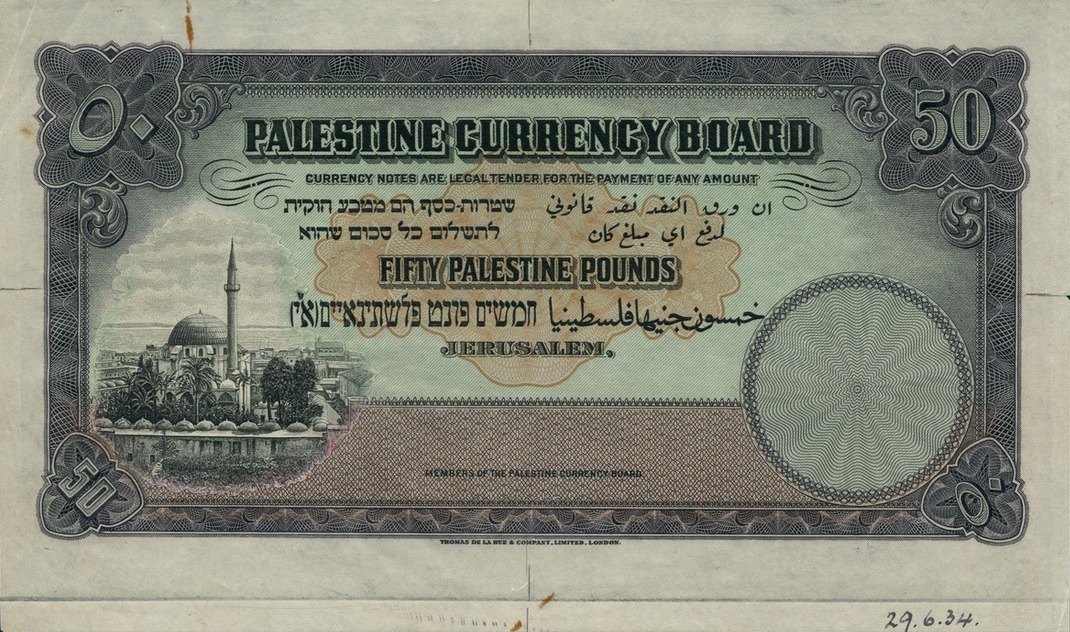
De La Rue worked on a new series for the Board; the days written on the pieces run from 1933 to 1940. None of it was issued. The catalogue has a page for each value, and the pieces carry the day each was pulled, written by hand in the margin.
| Value | Vignette at left | Days written on the pieces |
|---|---|---|
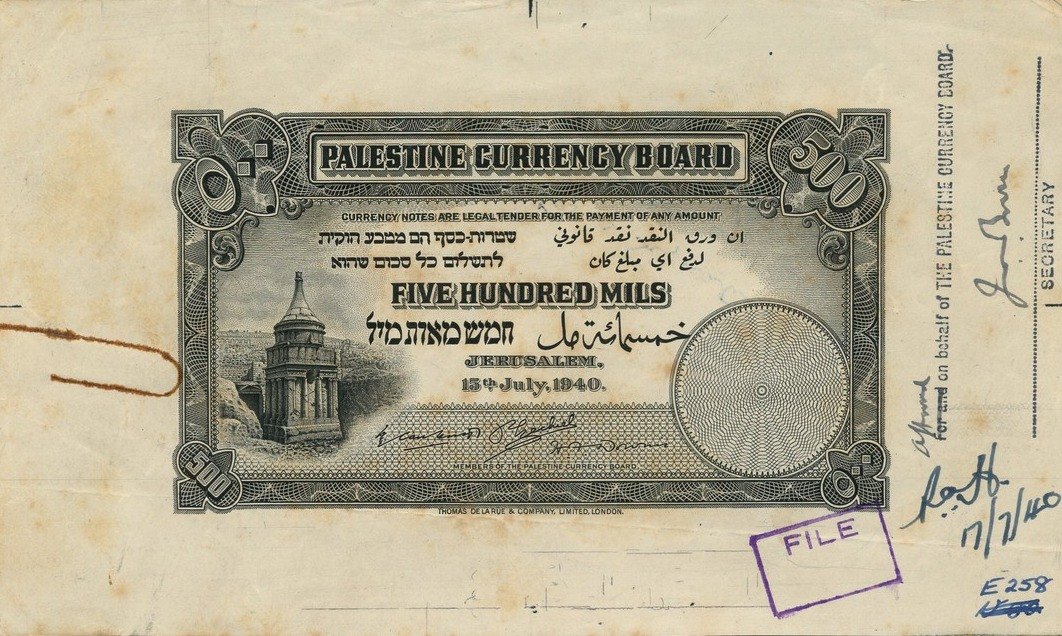
| 500 mils | The Tomb of Absalom | 20.9.33, 18.3.38, and a black die proof dated 15th July 1940 |
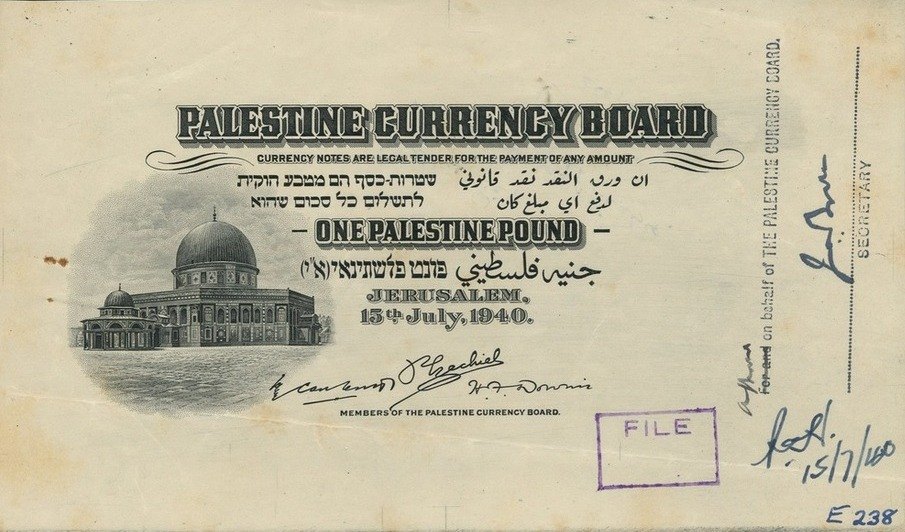
| 1 pound | The Dome of the Rock, from a lower and more frontal viewpoint than on the issued note | 18.3.38, and a black plate proof dated 15th July 1940 |
| 5 pounds | The Church of the Holy Sepulchre | 20.9.33, 29.6.34, 7.4.37 |
| 10 pounds | The Church of the Holy Sepulchre | 29.6.34, 7.4.37, 18.3.38 |
| 50 pounds | The Al-Jazzar Mosque at Acre | 29.6.34, 7.4.37, 18.3.38 |
| 100 pounds | The Al-Jazzar Mosque at Acre | 24.1.36, 7.4.37, 18.3.38 |
The Tomb of Absalom, the Church of the Holy Sepulchre and the Al-Jazzar Mosque appear on no issued Palestine note. The church answers a complaint: when the notes of 1927 came out, Christians in Palestine complained that none of the vignettes stood for their faith, and Howard M. Berlin, who reports it, gives the Church of the Holy Sepulchre as the example (The Palestine Currency Board, 2025, p. 37).
The pieces fall into stages. The earliest, of 20.9.33, are uniface front proofs with all-zero serial numbers: the 500 mils in purple, green and pale orange and the 5 pounds in red-orange and pale green. Proofs without serial numbers follow on 29.6.34, one of the 50 pounds on large-format paper. Colour trials in other colours, without serial numbers, are dated 24.1.36, 7.4.37 and 18.3.38. The 10 pounds is known in blue, pale green and pale pink (18.3.38) and in red-orange, violet and pale green.
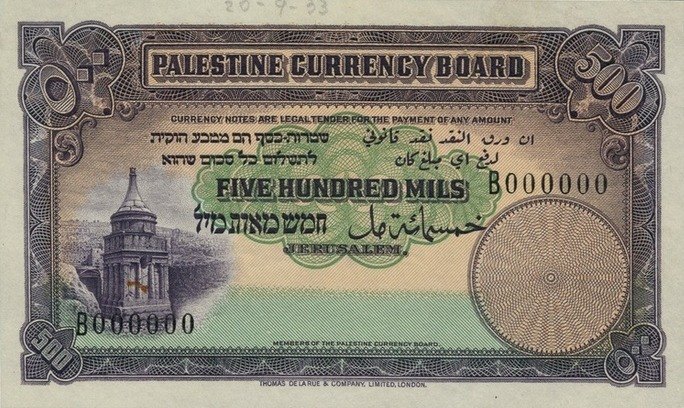
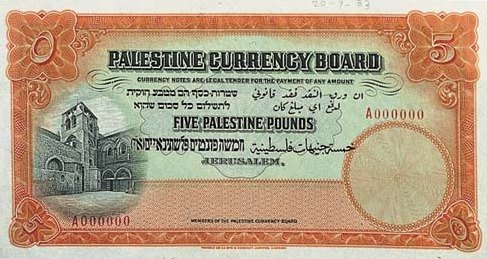
Spink (15 April 2014, lot 1273), citing the Crown Agents' file at the British Library (C.S.B. 117/5, 1937 volume), says a series of proofs was sent to the Currency Board for approval on 7th April 1937 and discussed on 19th April and 21st June, when it was decided to produce alternative designs. The day of sending is the day written on the trials of four values. Heritage Auctions (21 October 2015, lot 18021) says that a new issue was proposed as early as 1937 and that nothing was done until early 1939, when the stock of 500 mils already printed was running down. What was then printed was the old design with a new date, 20th April 1939.
The work did not stop there. The black proofs of the 500 mils and 1 pound are dated 15th July 1940 and signed by Ezechiel, Caulcutt and Downie; the proof of the 500 mils is annotated for approval. Spink (28 April 2021, lot 254) knows four proofs of the 500 mils design, each in different colours. Why the series was dropped after July 1940 the pages do not say.
Other wartime designs in the catalogue's archive are discussed in Wartime and occupation: what the design archive keeps from 1914 to 1945.
1941: plates made in Jerusalem
One proof of a 1 pound stands for a preparation made in Palestine itself. Spink (13 January 2023, lot 225; 24 November 2023, lot 637) describes it as part of a preparation of 1941, when the supply line from Britain was unsafe and the Palestine Government Printer made ready to print notes locally, among them 50 and 100 mils in place of the silver coins. By the same descriptions the plates were made by Emil Pikovsky Zincography in Jerusalem and destroyed by the Government Printer once the supply held. Spink calls this proof the only one in private hands, the few others being in the Bank of Israel Museum. Sources mention an example sold in Israel in March 2012.
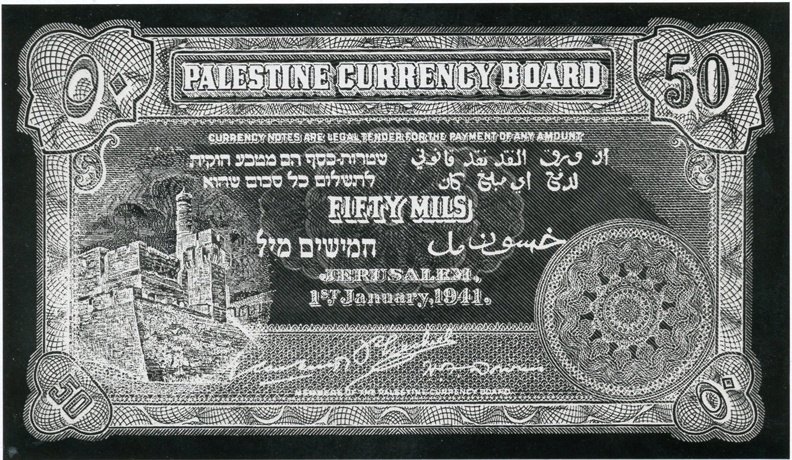
All of this is Spink's account. The pages name no official paper for the preparation of 1941.
1942: the last design of the 100 pounds
The date 10th September 1942 is known for the 100 pounds from a die proof of the front and from specimens with an all-zero serial number and a CANCELLED perforation. The die proof carries the signatures of Ezechiel, Caulcutt and Boyd and is signed by Boyd in the margin as approved on 8th October 1942: the handwritten note reads 8/10/42, and Spink's lot text (15 April 2014, lot 1274) prints it as 8/1/42 in error. Spink adds that no issued note of 1942 is believed to exist.
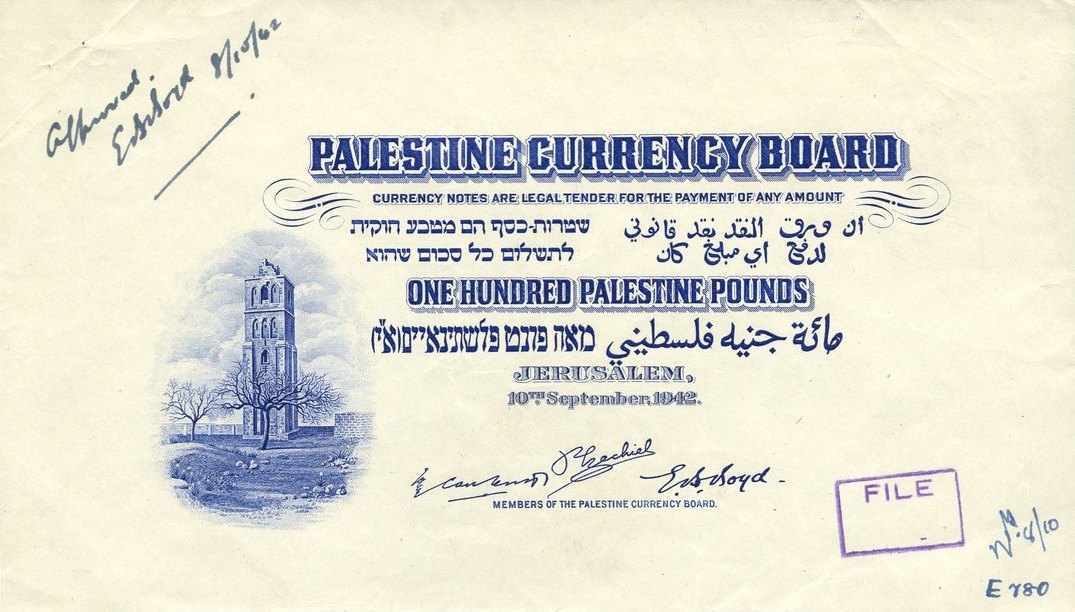
The three signatures date the design closely. Howard M. Berlin (The Palestine Currency Board, 2025) has Caine joining the Board as a fourth member on 1st October 1942, three weeks after the date on the design. The reports of an issued note of this date, none of them confirmed by a note or a photograph, are set out on the page of the 100 pounds.
1943: three small notes dated 26th March
De La Rue also prepared three small-format notes dated 26th March 1943: a 50 mils, a 100 mils, which measures 115 x 69 mm, and a 1 pound. None was issued. They carry the printed signatures of four members of the Board: Ezechiel, Caulcutt, Boyd and Caine. Howard M. Berlin (The Palestine Currency Board, 2025, pp. 53 and 54) has Caine joining the Board as its fourth member on 1st October 1942 and Caulcutt dying on 29th April 1943, five weeks after the date on the design. No issued note of the main series has these four names together.
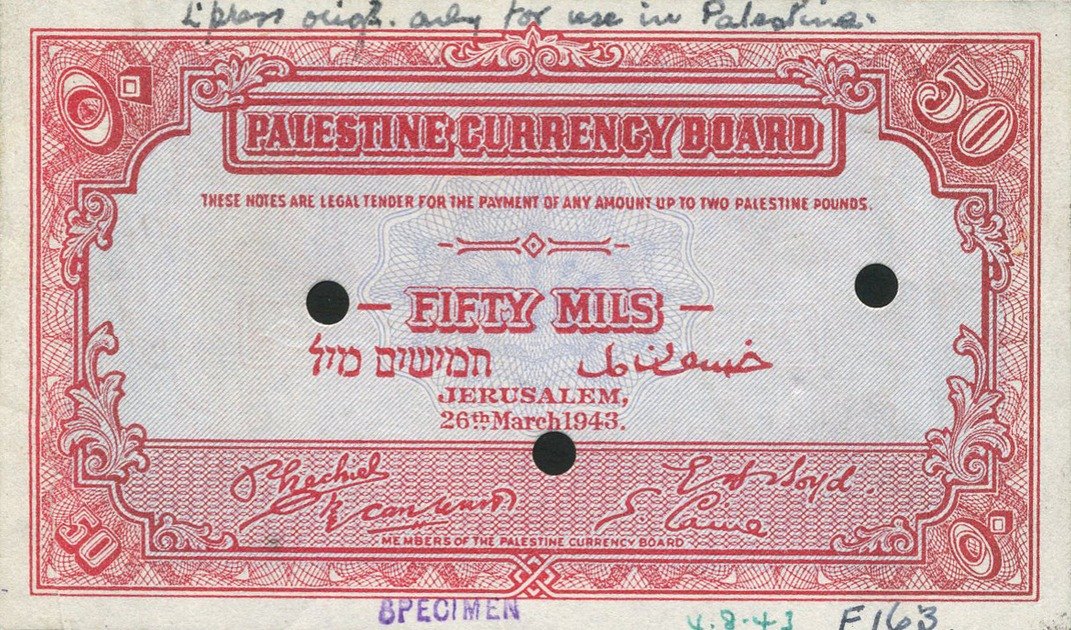
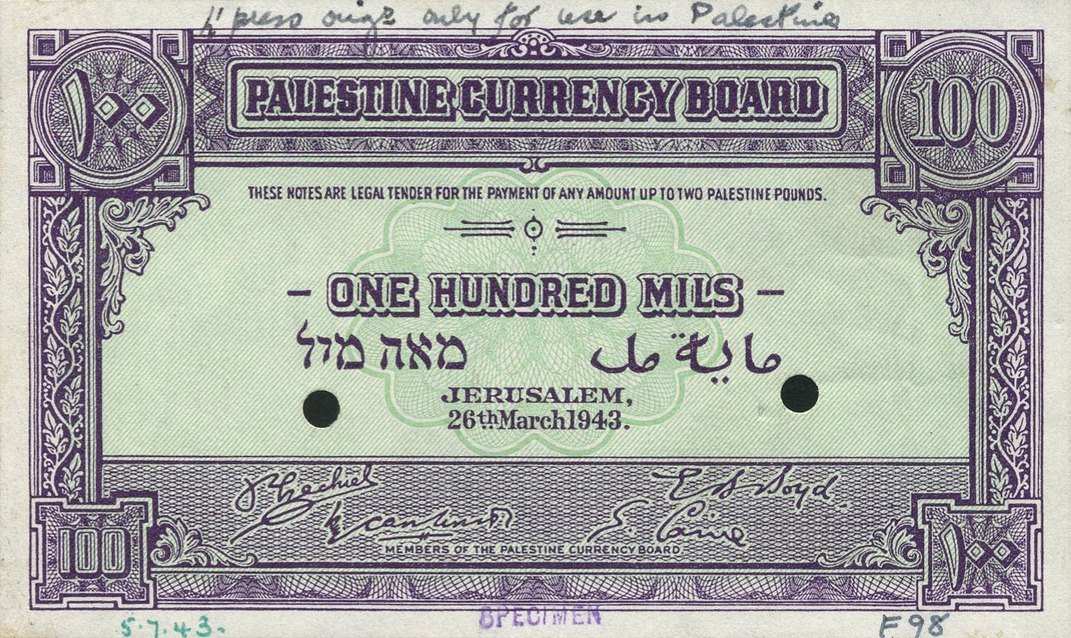
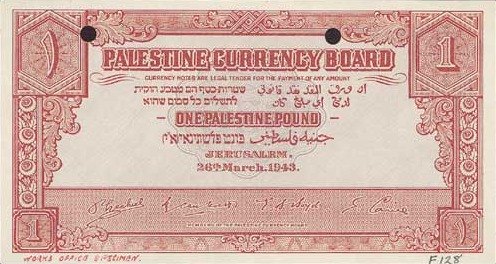
They are known as specimens and as proofs:
- 50 mils. Specimens with a purple SPECIMEN handstamp in the lower margin and three punch holes, or with two punch holes and a WORKS OFFICE SPECIMEN annotation; proofs of the front without punch holes. Spink (29 September 2015, lot 733) believes five examples of the specimen survive; the one it sold is annotated in ink 4.8.43 and "only for use in Palestine".
- 100 mils. Specimens with a purple SPECIMEN handstamp and two punch holes, or with two punch holes and a WORKS OFFICE SPECIMEN annotation; proofs. The specimen sold by Spink on 12 April 2016 (lot 1697) is annotated in the top margin "L' Press orig only for use in Palestine"; Spink believes only a handful survive.
- 1 pound. Specimens with a WORKS OFFICE SPECIMEN annotation and two punch holes, or with a purple SPECIMEN handstamp and four punch holes; proofs of the front and the back. Spink (28 April 2021, lot 255) calls the front proof on large-format paper an approval proof, the only one in that form, and counts six examples of different kinds for the 1 pound of 1943.
Sources mention that the Board's report of 20th September 1945 says no value of note or coin ever ran short in Palestine during the war, so the emergency currency that had been prepared never had to be issued.
What is not known
- Which of the two days, 17th December 1926 or 18th January 1927, is the day De La Rue was chosen.
- Who received the notes cancelled for presentation in 1929, and how many there were.
- Why the second series was given up after the proofs of 15th July 1940.
- Whether the preparation of 1941 in Jerusalem and De La Rue's three notes of 1943 were parts of one plan. Spink's account of 1941 speaks of 50 and 100 mils to replace the silver coins, the same two small values that De La Rue prepared in 1943.
Sources
- The catalogue's pages for the issued and the unissued Palestine notes, for what the pieces show.
- Howard M. Berlin, The Palestine Currency Board, 2025, pp. 35, 37, 53 and 54.
- Shlomo Tepper, I.B.N.S. Journal, vol. 43 no. 1, 2004.
- Bank Note Reporter, November 1999 and May 2003.
- Christie's, 3 May 2001, lot 608.
- Sotheby's, 19 December 2012, lot 172, as cited by Stack's Bowers.
- Spink: 15 April 2014, lots 1273 and 1274; 29 September 2015, lot 733; 12 April 2016, lot 1697; 28 April 2021, lots 254 and 255; 28 April 2022, lot 257; 13 January 2023, lot 225; 24 November 2023, lot 637; 30 September 2026, lot 286.
- Stack's Bowers, 6 May 2026, lots 50014, 50061 and 50063.
- Heritage Auctions, 21 October 2015, lot 18021.
Member comments
Log in or register to post a comment.