This is the story of the notes of Palestine in order of time, from the money they replaced to the last notes handed in. It is put together from the catalogue's pages on the six values, which until now each carried most of it. Each part names its source as those pages do. Where a longer article on one part already exists, it is linked.
The six values are the 500 mils, the 1 pound, the 5 pounds, the 10 pounds, the 50 pounds and the 100 pounds. All were printed by Thomas de la Rue and Company.
Before the Palestine pound, 1918 to 1927
Egyptian notes were the legal tender that the Palestine notes replaced. British Treasury 1 pound notes and Bank of England 5 pound notes were also legal tender in the areas the British occupied in 1918.
From 22nd January 1921 a Public Notice of the High Commissioner made Egyptian gold, notes, silver and nickel coins, and the British gold sovereign at 97.5 Egyptian piastres, the only legal tender. Howard M. Berlin (The Palestine Currency Board, 2025, p. 11) prints the Notice. The Palestine Currency Order of 1927 revoked it, citing it as No. 36 of 1st February 1921 in the Official Gazette, and kept the coins and notes under it legal tender until a Proclamation should say otherwise.
The Egyptian notes of 5 and 10 piastres went first. They ceased to be legal tender in Palestine after 30th June 1927, by a notice of 19th April 1927 (Berlin, p. 26).
The Board and the law, 1924 to 1927
Sources mention that the currency was first proposed by a committee appointed by the High Commissioner in March 1924 under the Treasurer of Palestine, S. S. Davis, and that the Colonial Office placed it under a board in London on the model of the West African Currency Board.
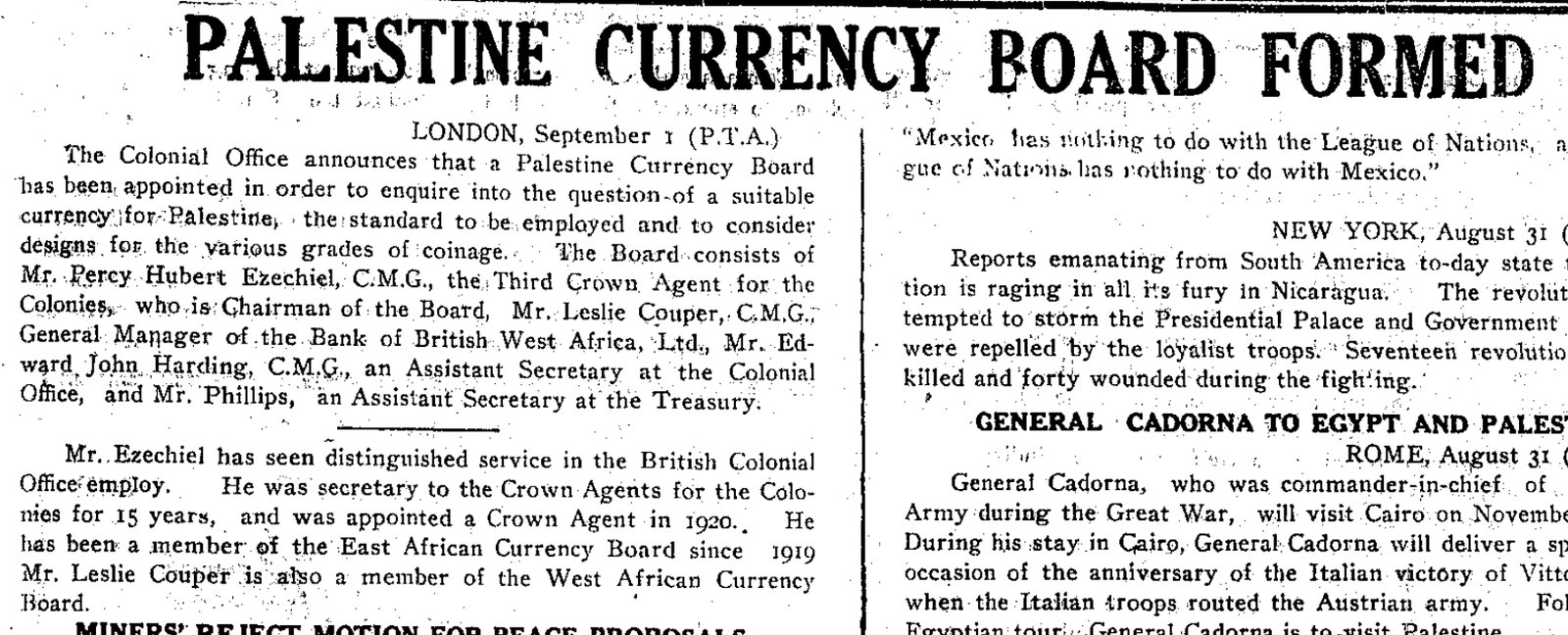
The Palestine Currency Board was formed in London on 15 June 1926. The first members were P. H. Ezechiel, one of the Crown Agents for the Colonies, Leslie Couper, General Manager of the Bank of British West Africa, and A. J. Harding of the Colonial Office, with H. C. Ransom of the Crown Agents as Secretary. The Treasurer of Palestine served as the Board's Currency Officer in Palestine. Under the Currency Officer the Board's Agent in Jerusalem was Barclays Bank (Dominion, Colonial and Overseas), as the annual report for 1929 says.
The Palestine Currency Order, 1927, was made in Council on 7 February 1927 and printed in the London Gazette of 22 February 1927. It made the Palestine pound, divided into 1,000 mils, the standard of currency, at one Palestine pound to the British gold sovereign. The Order deals with coin. The notes were made legal tender by the Currency Notes Ordinance, 1927, and the Board kept the Palestine pound equal to the pound sterling. The Order came into operation on 1 November 1927 under a Proclamation of the High Commissioner dated 29 September 1927.
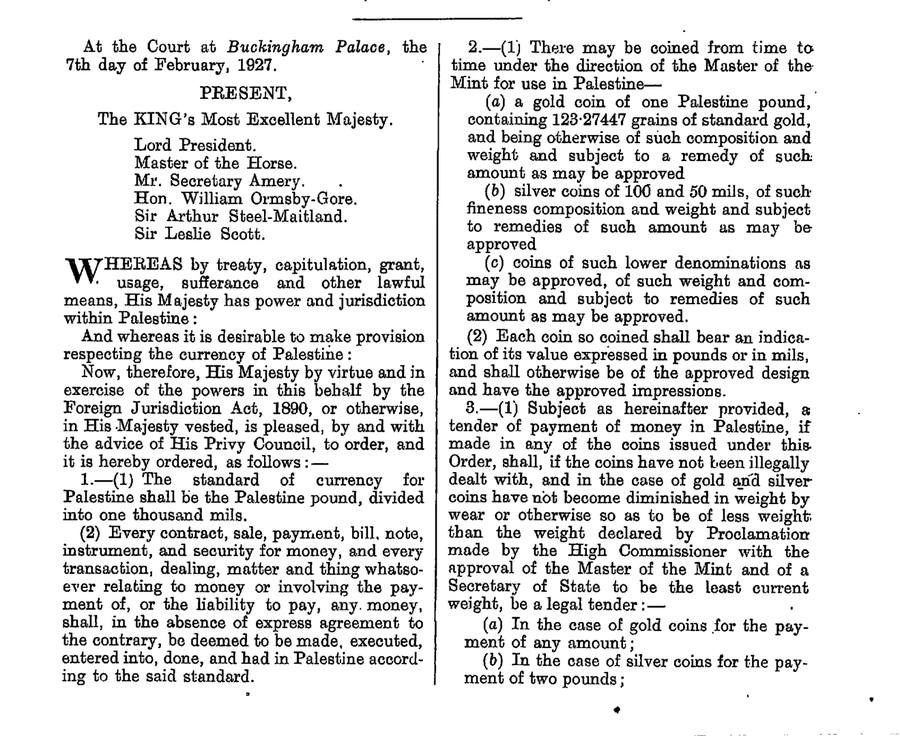
What the Order says, clause by clause, is set out in What the Palestine Currency Order of 1927 really says, and which money the Palestine pound replaced.
The order to De La Rue
Howard M. Berlin (The Palestine Currency Board, 2025, p. 35) writes that De La Rue, Bradbury Wilkinson and Waterlow all tendered for the engraving, printing and paper, and that the Board gave the contract to De La Rue, the lowest of the three, on 18th January 1927. Berlin adds that the Arabic and Hebrew wording, prepared in Palestine, was checked on the proofs with the help of the School of Oriental Languages in London.
Spink's description of lot 286 in its sale of 30 September 2026, a Bradbury Wilkinson essay for a 1 pound, gives another day: it says the Board approved De La Rue on 17th December 1926. The description cites Raphael Dabbah's book (pp. 109 to 111) for the Board's meetings of November and December 1926. The two days are not reconciled here. The essay itself is described in Essays, specimens, proofs and designs never issued.
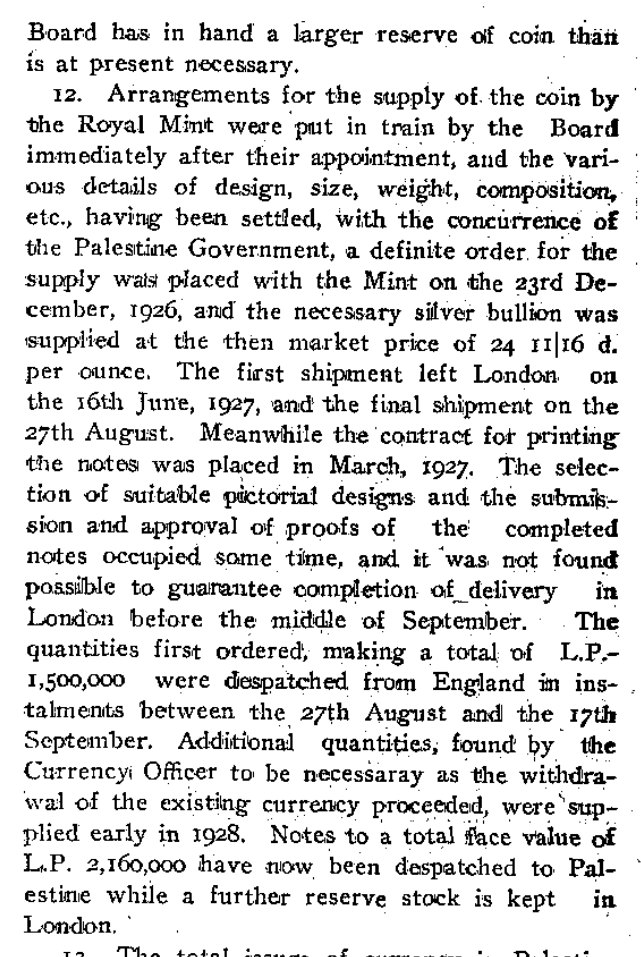
Sources mention that the first order for notes, placed in March 1927, was set at 1,500,000 pounds and soon raised to 2,160,000 pounds, and that it was complete in London only in the middle of September 1927. The Board's first report (The Palestine Bulletin, 10th December 1928, p. 2) has the 1,500,000 pounds of notes leaving England in instalments between 27th August and 17th September 1927 and more following early in 1928, 2,160,000 pounds in all sent to Palestine by the time it was written, with a further reserve kept in London.
The designs
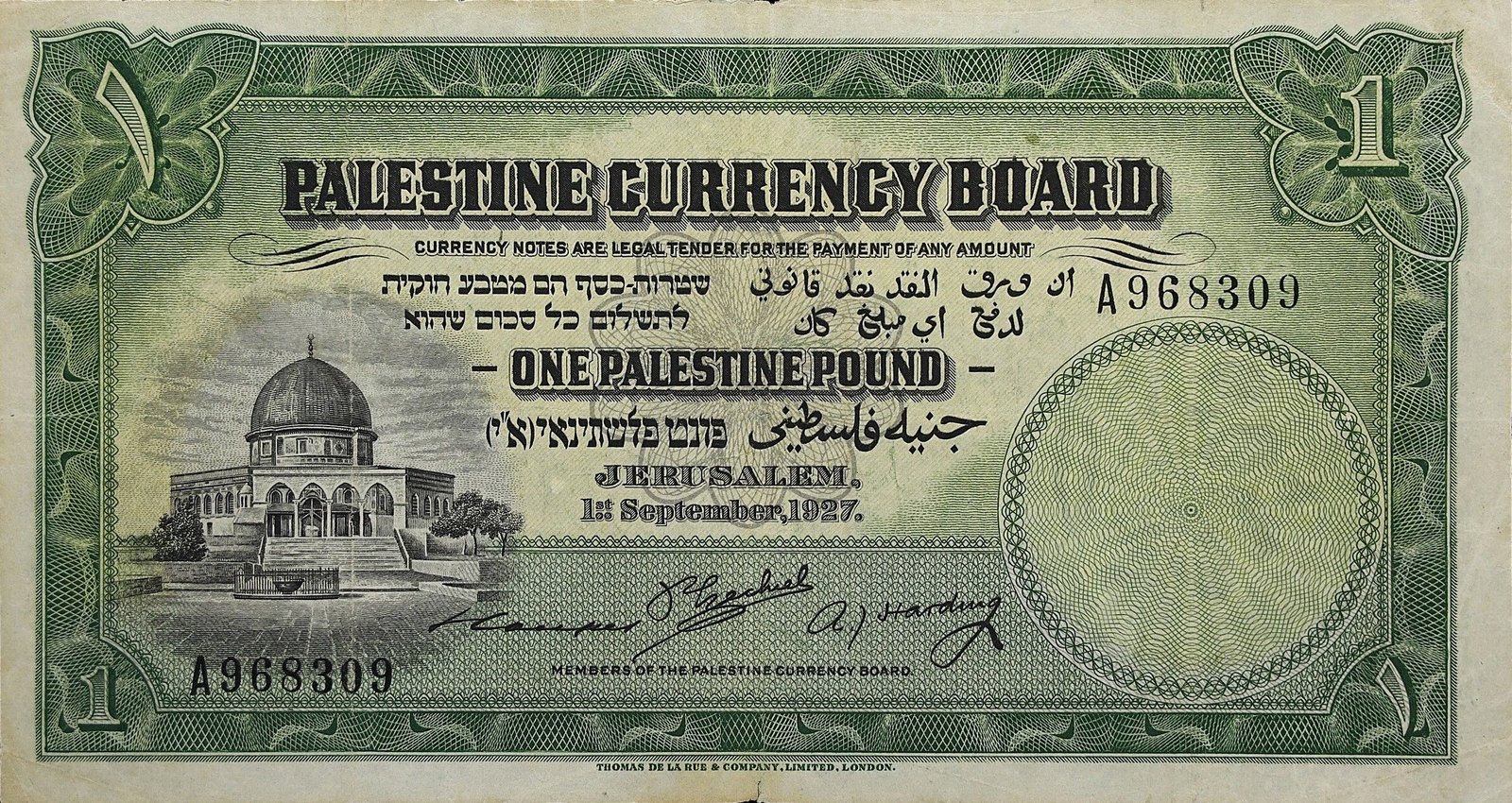
The notes carry text in the three official languages of Palestine, Arabic, English and Hebrew, as Article 22 of the Mandate required.
| Value | Front | Size |
|---|---|---|
| 500 mils | Rachel's Tomb near Bethlehem | 127 x 76 mm |
| 1 pound | The Dome of the Rock on the Temple Mount in Jerusalem, with the ablution fountain and an arcade at the head of the southern stairs before it | 165 x 89 mm |
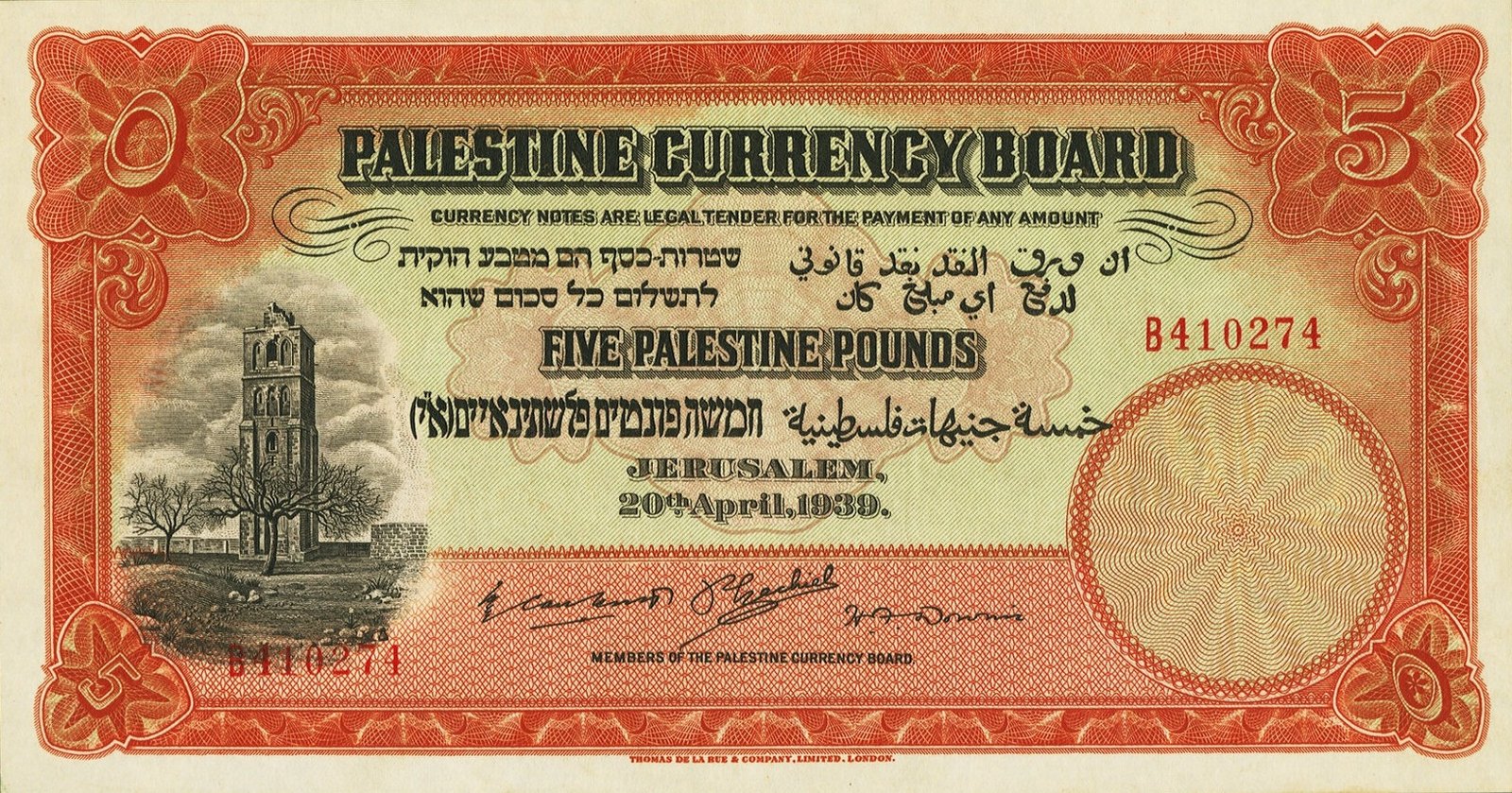
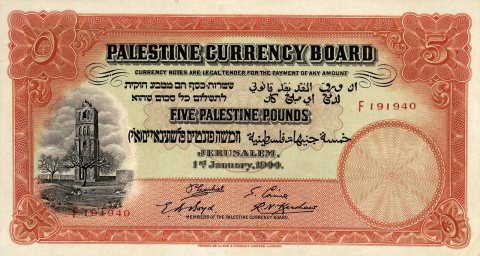
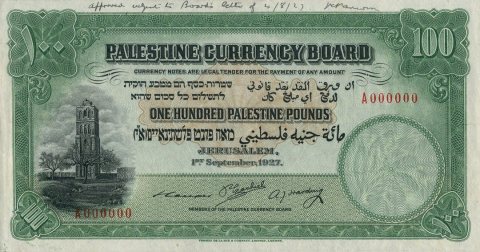
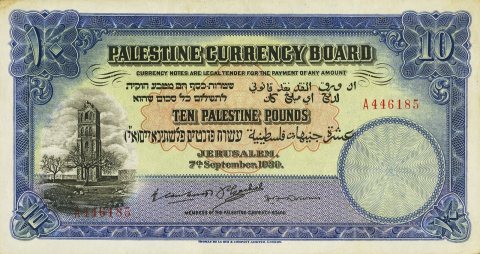
| 5, 10, 50 and 100 pounds | The White Tower at Ramla (Ramleh), a Mamluk minaret long known as the Crusader's Tower, the name the Board gave it | 191 x 102 mm |
Every back shows the Tower of David, the citadel of Jerusalem. The watermark is an olive sprig in the round panel at the right. The serial numbers are printed in black on the 500 mils and 1 pound and in red on the higher values.
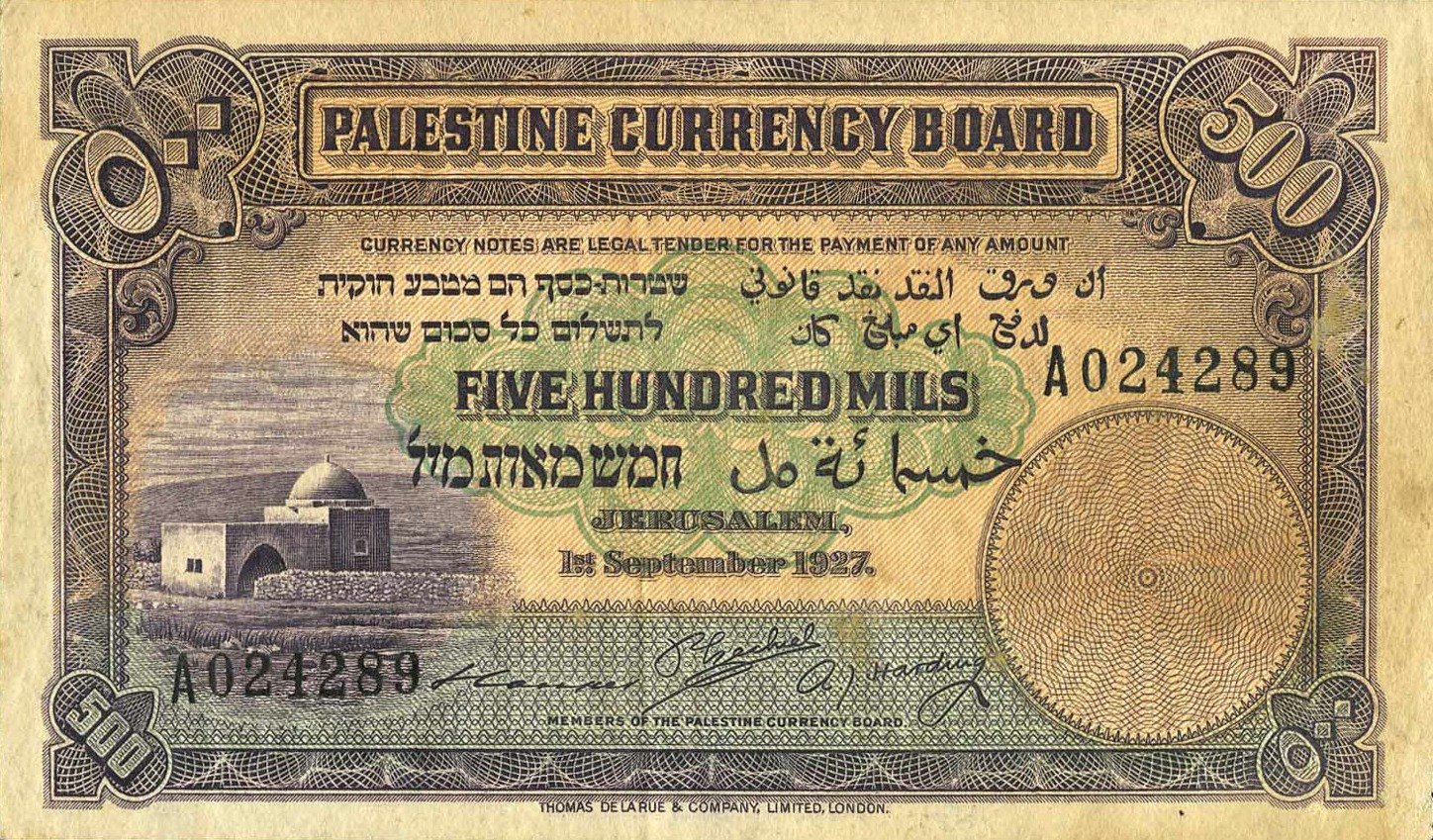
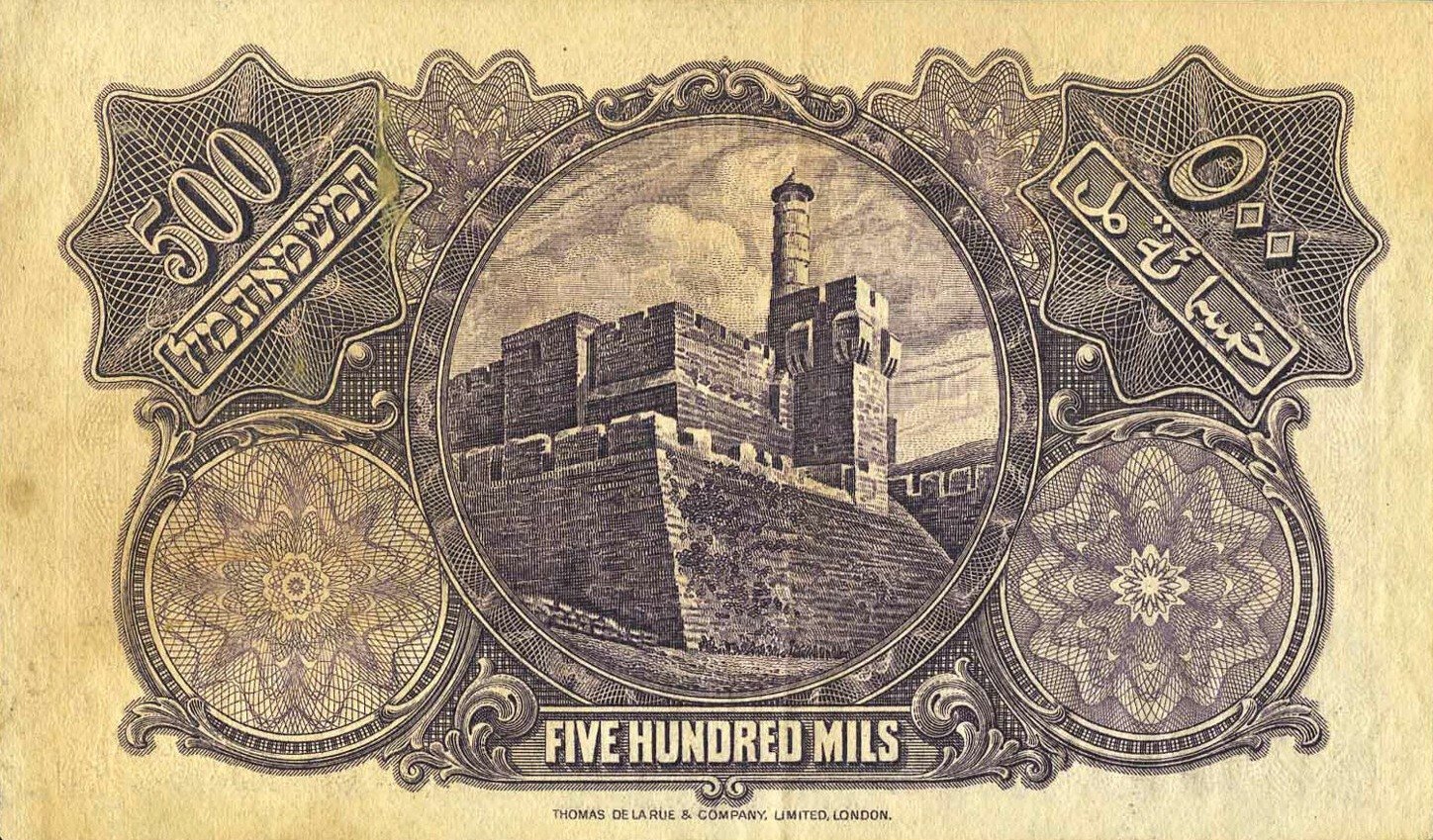
When the notes of 1927 came out, Christians in Palestine complained that none of the vignettes stood for their faith. Howard M. Berlin, who reports it, gives the Church of the Holy Sepulchre as the example (The Palestine Currency Board, 2025, p. 37). That church is the vignette of two designs of the 1930s that were never issued.
1st November 1927: the issue
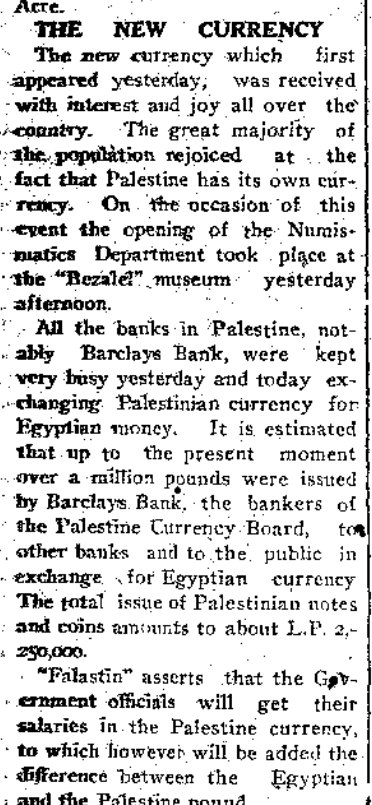
Sources mention that the issue was planned for 1st October 1927 and put back a month, that Transjordan took the new currency from the same day, and that the public notice of 1st October 1927, signed by the Currency Officer, S. S. Davis, set the Palestine pound at 97.5 Egyptian piastres. The Board's first report, printed in The Palestine Bulletin of 10th December 1928 (p. 4), gives the reason for the delay: the disturbance caused by the earthquake of 11th July 1927 and the financial adjustments needed before the change, for which the Government of Palestine put the day back a month.
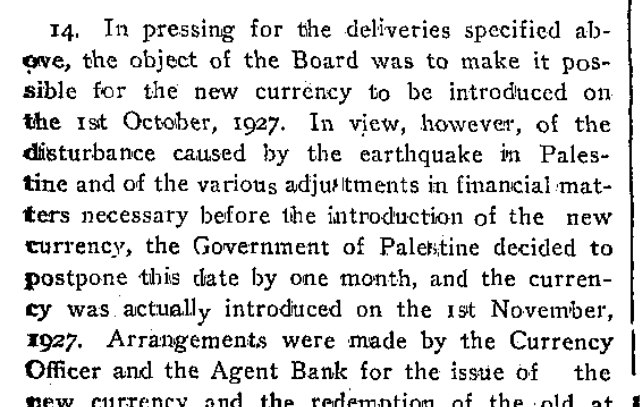
The notes entered circulation on 1 November 1927. The Palestine Bulletin of 2nd November 1927 (p. 3) reports the banks kept very busy on the first two days, with over a million pounds paid out through Barclays Bank. The issue of 16th November (p. 3) has 900,000 pounds of the notes allotted to the Jerusalem division, 350,000 to Haifa and 250,000 to Jaffa. The Board's first report says the old money was exchanged at twenty centres.
Egyptian notes remained legal tender until 31 March 1928. By that day about 1,899,000 pounds in notes had been issued in exchange for about 1,810,000 pounds of Egyptian notes. Proclamations of 9th and 29th February 1928 declared the Egyptian notes and coins, and the British gold sovereign, no longer legal tender after 31st March 1928. The annual report to the League of Nations for 1929 gives 2,048,607 Egyptian pounds as all the Egyptian currency, notes and coin together, withdrawn in the period of redemption.
The newspaper's reports are followed day by day in How the Palestine pound arrived, 1926 to 1928, as The Palestine Bulletin reported it.
Four dates and the Board's members who signed
Each value carries up to four dates. Three members of the Board signed until 1939 and four from 1944.
| Date on the note | Values | Signatures |
|---|---|---|
| 1st September 1927 | all six | Ezechiel, Couper and Harding |
| 30th September 1929 | all six | Ezechiel, Caulcutt and Vernon |
| 20th April 1939 | 500 mils, 1 pound, 5 pounds | Ezechiel, Caulcutt and Downie |
| 7th September 1939 | 10 pounds, 50 pounds | Ezechiel, Caulcutt and Downie |
| 10th September 1942 | 100 pounds, a die proof and specimens only | Ezechiel, Caulcutt and Boyd |
| 1st January 1944 | 1 pound, 5 pounds, 10 pounds | Ezechiel, Caine, Boyd and Kershaw |
| 15th August 1945 | 500 mils | Ezechiel, Kershaw, Caine and Eastwood |
Sources mention that the notes of 30th September 1929 were put into circulation on 20th January 1930. Howard M. Berlin (The Palestine Currency Board, 2025, p. 54) writes that the Board approved the issue of the notes dated 1st January 1944 on 20th January 1944. Sources mention that the 500 mils of 15th August 1945 went into circulation in the Board's year to 31st March 1946, to meet a growing demand for that value.
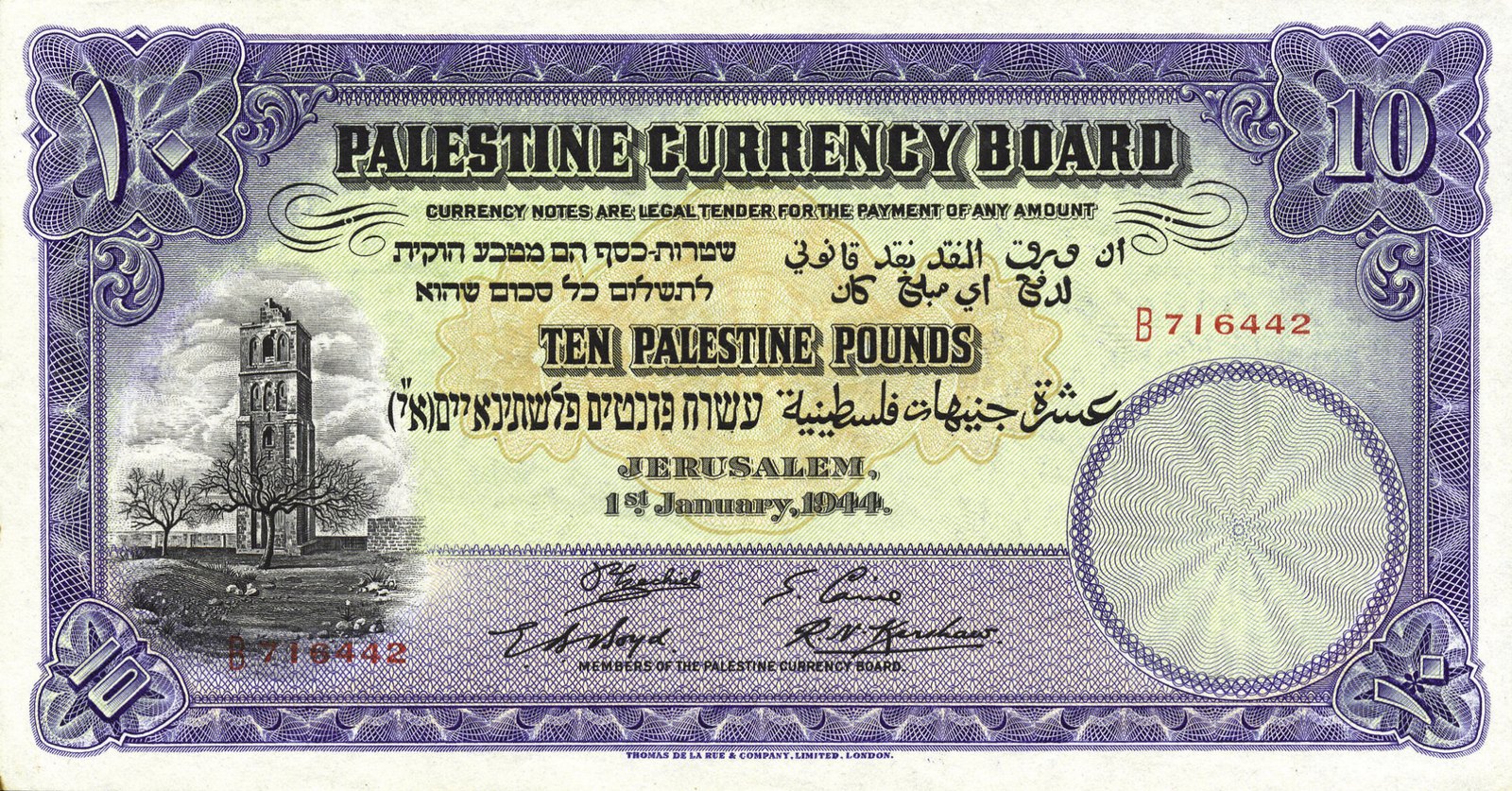
Sources mention that Ezechiel chaired the Board from its formation until 30th June 1947. The Colonial Office Lists show the Board's members: Ezechiel, Couper and Harding in the List for 1927; Ezechiel, R. V. Vernon and J. Caulcutt in that for 1937; and H. F. Downie as chairman in that for 1949.
Howard M. Berlin (The Palestine Currency Board, 2025, pp. 16, 20, 40, 45, 53 and 54) gives the days on which the signers came and went:
- Harding resigned on 30th September 1928 and Vernon was appointed on 1st March 1929.
- Couper died on 16th April 1929 and Caulcutt took the place.
- Vernon resigned on 2nd June 1937 and Downie followed.
- Downie retired on 19th May 1941 and Boyd followed.
- Caine joined as a fourth member on 1st October 1942, three weeks after the date of the 1942 design of the 100 pounds.
- Caulcutt died on 29th April 1943 and Kershaw followed.
- Eastwood took Boyd's place on 1st April 1945 and left on 1st December 1945.
- Caine left on 1st July 1946.
The days are set beside the dates on the notes in Ten signers, seven sets of signatures: who signed the Palestine notes, and when.
Forgery and the law against it
The Currency Notes Ordinance, published in draft in the Official Gazette of 1st April 1927, set up to ten years for forging a note and up to three months or a fine for mutilating one (The Palestine Bulletin, 5th April 1927, p. 3). A second Ordinance carried its rules on forgery over to bank notes (the quarterly report of the administration, in The Palestine Bulletin of 30th December 1927, p. 1). The Bank Notes Forgery Ordinance, No. 32 of 1927, was passed on 16th September 1927 and published in the Official Gazette on 1st November 1927, the day the notes were issued (Howard M. Berlin, The Palestine Currency Board, 2025, p. 39).
Sources mention that forged notes appeared within weeks of the first issue, a forged 500 mils being reported on 28th November 1927, and that during the Second World War every value below 50 pounds was forged, the 1 and 5 pounds most often. The Palestine Bulletin of 21st November 1927 (p. 3) reports an arrest on suspicion of passing forged 5 pound notes, without saying whether they were Palestine or Egyptian notes. The Palestine Post of 6th December 1938 (p. 2) reports forged 1 pound notes seized in Jerusalem with the press that printed them.
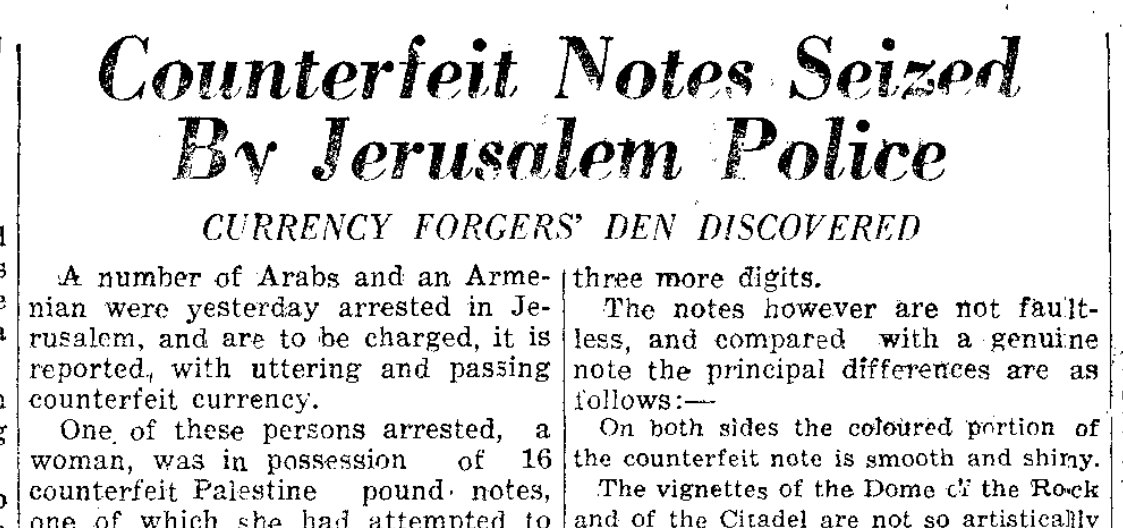
The catalogue has rows for forged notes of the 1 pound of 30th September 1929, the 1 pound of 20th April 1939, the 5 pounds of 20th April 1939 and the 10 pounds of 1st January 1944. The pages of those values say how each is told. The newspaper reports are read in Forged Palestine notes in the newspapers, 1927 to 1938, and a police notice on the 1 pound.
Coin and paper, 1931 and 1938
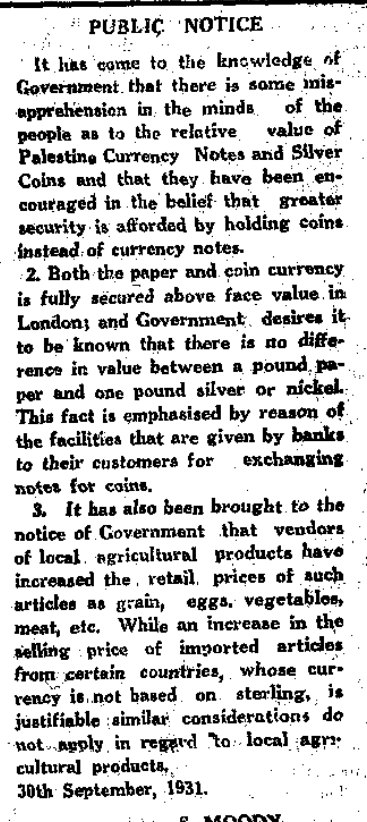
When sterling left gold in September 1931 many people in Palestine preferred coin to notes, and a Public Notice of 30th September 1931 declared a paper pound and a pound in coin to be of the same value (The Palestine Bulletin, 1st October 1931, p. 1). In the year to March 1932 the notes in circulation fell by 7,160 pounds while coin rose by 46,160 (the same paper, 12th December 1932, p. 4).
In September 1938, during the crisis in Europe, 1,975,000 pounds of extra currency was called for, 1,090,000 of it on 28th September alone, and notes were hoarded again in February and March 1939 (The Palestine Post, 6th December 1939, p. 5, from the Board's report for 1938-39).
Both are told in full in Coin or paper? Two runs on the Palestine currency, 1931 and 1938. The figures for each value, year by year, are in The Palestine notes in circulation, value by value, 1928 to 1974.
Palestine notes in Cyprus, 1942
Sources mention that in 1942 the 1 and 5 pounds were also legal tender in Cyprus, from 5th May to 17th November 1942, during a shortage of Cyprus notes. Fred Schwan wrote in Bank Note Reporter in February 1983 that 150,000 notes of 1 pound and 20,000 of 5 pounds were delivered to Cyprus, in two shipments that arrived on 24th February and 11th April 1942, and that overprinting them was discussed but not done.
Howard M. Berlin (The Palestine Currency Board, 2025, pp. 48 to 52) gives the steps:
- The Governor of Cyprus asked on 6th February 1942 for 100,000 pounds in Palestine notes.
- London agreed on 13th February, against 100,000 pounds sterling paid into the Board's account.
- An overprint reading "legal tender in Cyprus only" was turned down, because notes so marked could not have gone back into use in Palestine.
- The 1 and 5 pounds were made legal tender in Cyprus by a Proclamation of 5th May 1942.
- They ceased to be so from 18th November 1942, under a Proclamation that Berlin cites from the Cyprus Gazette of 10th September 1942. The Gazette itself shows it was made on 10th September and printed on 17th September 1942, with 17th November as the notes' last day as legal tender.
The 10th of September 1942 is the day Noble Numismatics (17 April 2012, lot 4257) gives for their withdrawal; it is the day the Proclamation was made. The whole episode is in Palestine pounds in Cyprus, 1942: the notes that were never overprinted.
1948 to 1952: the end of the currency
The Palestine Currency Board was excluded from the Sterling Bloc in February 1948, and the last Currency Officer left Palestine on 15 May 1948.
Howard M. Berlin (The Palestine Currency Board, 2025, pp. 61 and 62), following the Board's report for 1948, writes that the currency centre in Jerusalem was closed at the end of April 1948 and its reserve of notes sent to Haifa and to Amman, where the Ottoman Bank opened a centre as the Board's agent on 8th May 1948; that the Haifa centre closed at the end of May 1948 and its reserve was shipped to Britain; and that a centre for redeeming the notes opened on 26th July 1948 at Barclays Bank (Dominion, Colonial and Overseas), 29 Gracechurch Street, London.
Sources mention that the notes ceased to be legal tender in Israel on 15 September 1948, in the Gaza Strip on 9 June 1951 (some sources give 1950) and in Jordan on 30 September 1950. Howard M. Berlin (The Palestine Currency Board, 2025, p. 63), following the Board's reports for 1951 and 1952, writes that the Jordan Currency Board issued its own notes from 1st July 1950, that less than 5,500,000 pounds of Palestine currency was left in circulation in Jordan on 30th September 1950, and that more than 1,700,000 pounds was exchanged in Gaza when the currency ceased to be legal tender there in 1951.
The Palestine Post of 30th November 1949 (p. 3), from the Board's report for the year to March 1949, adds that notes had to be flown out to Palestine in April and May 1948; that almost 37 million pounds was redeemed between June 1948 and March 1949, 27 million of it in London by the Anglo-Palestine Bank and 10 million at Amman by the Ottoman Bank; and that about thirty of the bank's staff spent nearly a year sorting the notes by their numbers before the halves were sent. Sources also mention that in 1948 the Anglo-Palestine Bank cut the notes it held in half and flew the two sets of halves to London one after the other, to change them for sterling.
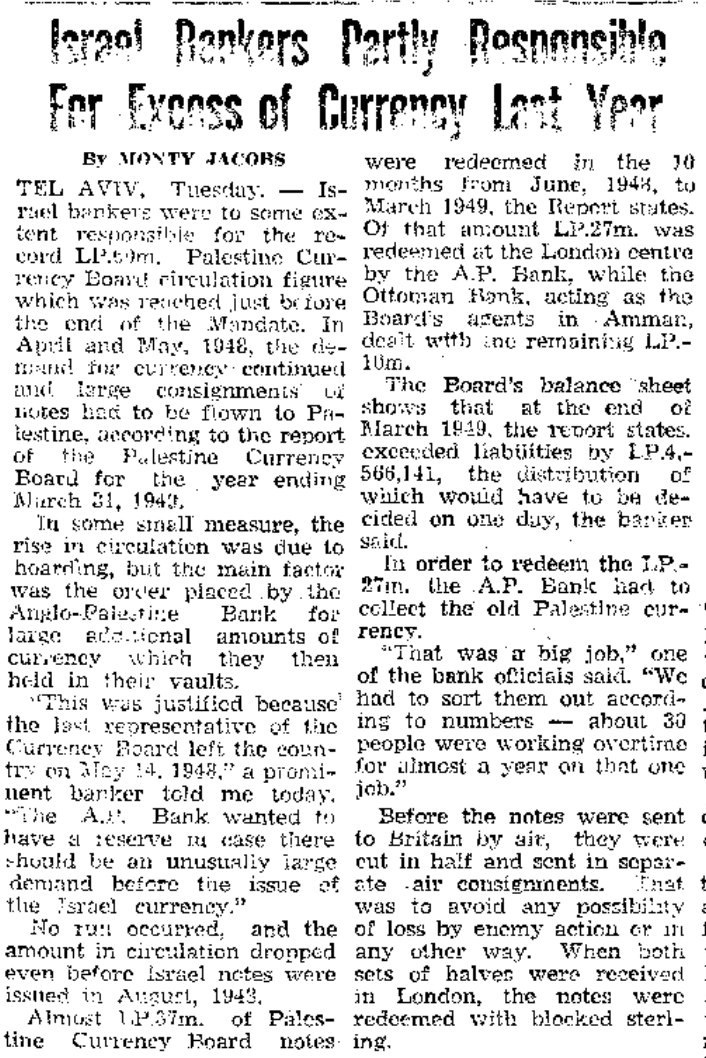
The Board was dissolved on 31st March 1952. Howard M. Berlin (The Palestine Currency Board, 2025, p. 64), following the Board's last report, writes that its remaining assets, 1,293,383 pounds, passed to the Crown Agents for the Colonies on 1st April 1952, and that the Crown Agents engaged Barclays Bank (Dominion, Colonial and Overseas) as their agent for redeeming the notes in London.
The longer account is The last years of the Palestine pound, 1948 to 1952.
Redemption after 1952 and the cancelled notes
After the Board was dissolved its notes could still be redeemed in London, where sources name the Westminster Bank, which held the Board's account, and the Crown Agents. Sources mention notes still being redeemed in the 1970s. Sylvia Haffner wrote in Bank Note Reporter in July 1980 that the Bank of Israel had stopped redeeming them on 14th May 1968, while the British still redeemed them in London.
Sources mention that redeemed notes were stamped CANCELLED by hand on both sides, folded and punched with holes in a random pattern, and then cut in half, the halves going to London separately; that no record of their numbers was kept; and that some such notes survive, fourteen being known in 1985. Jack H. Fisher wrote in Bank Note Reporter in June 1999 of knowing only two type sets of such cancelled notes, 500 mils to 50 pounds, one of them in the Fisher family's collection and the other in another private collection, and of three more cancelled 50 pounds in private collections.
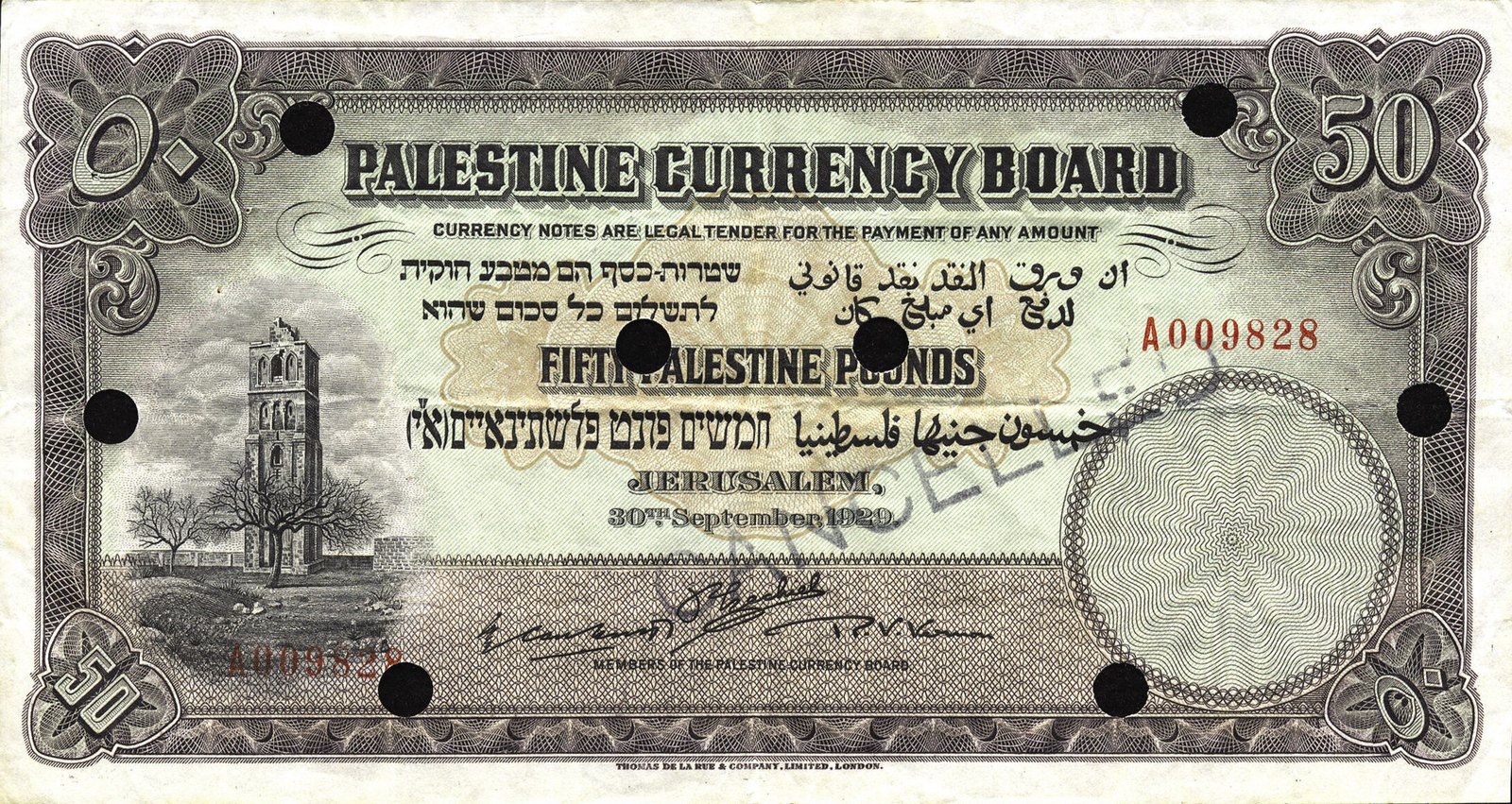
These notes, cancelled by hand when they were paid, are not the same as the few 50 and 100 pounds with a CANCELLED perforation, which the houses say were taken from stock in 1929 for presentation. Those are described in Essays, specimens, proofs and designs never issued.
What the pages do not say
The pages name no source for several statements and write "sources mention": the committee of 1924, the size of the first order, the day in January 1930 on which the notes of 1929 came out, the three days on which the notes ceased to be legal tender, and the way redeemed notes were cancelled. For Gaza the year itself is given two ways, 1951 and 1950. The day on which the Board chose De La Rue is given two ways, as shown above.
Sources
- The London Gazette, 22 February 1927: the Palestine Currency Order, 1927.
- The Palestine Bulletin, 5th April 1927 (p. 3), 2nd November 1927 (p. 3), 16th November 1927 (p. 3), 21st November 1927 (p. 3), 30th December 1927 (p. 1), 10th December 1928 (pp. 2 and 4, the Board's first report), 1st October 1931 (p. 1), 12th December 1932 (p. 4).
- The Palestine Post, 6th December 1938 (p. 2), 6th December 1939 (p. 5), 30th November 1949 (p. 3).
- The annual report to the League of Nations for 1929.
- The Colonial Office Lists for 1927, 1937 and 1949.
- Howard M. Berlin, The Palestine Currency Board, 2025, pp. 11, 16, 20, 26, 35, 37, 39, 40, 45, 48 to 54, 61 to 64.
- Fred Schwan, Bank Note Reporter, February 1983.
- Sylvia Haffner, Bank Note Reporter, July 1980.
- Jack H. Fisher, Bank Note Reporter, June 1999.
- Noble Numismatics, 17 April 2012, lot 4257.
- Spink, 30 September 2026, lot 286.
- The catalogue's own pages for the six values, for the dates, signatures and designs read from the notes.
Member comments
Log in or register to post a comment.