On 31 March 1948 more Palestine Currency Board notes were in circulation than ever before: just over 51 million pounds. Four years later there were 603,217 pounds. This article follows what happened in between: where the Board's stock of notes went when Jerusalem became unsafe, when the notes stopped being legal tender in each place, how they were redeemed, and what the figures say was never handed in.
The account of 1948 to 1952 is from Howard M. Berlin, The Palestine Currency Board: Its History and Currency (EconSciences Books, 2025, pp. 60 to 68), which follows the Board's yearly reports. The figures are the Board's own, as Jack H. Fisher printed them in The Shekel and Berlin in the book.
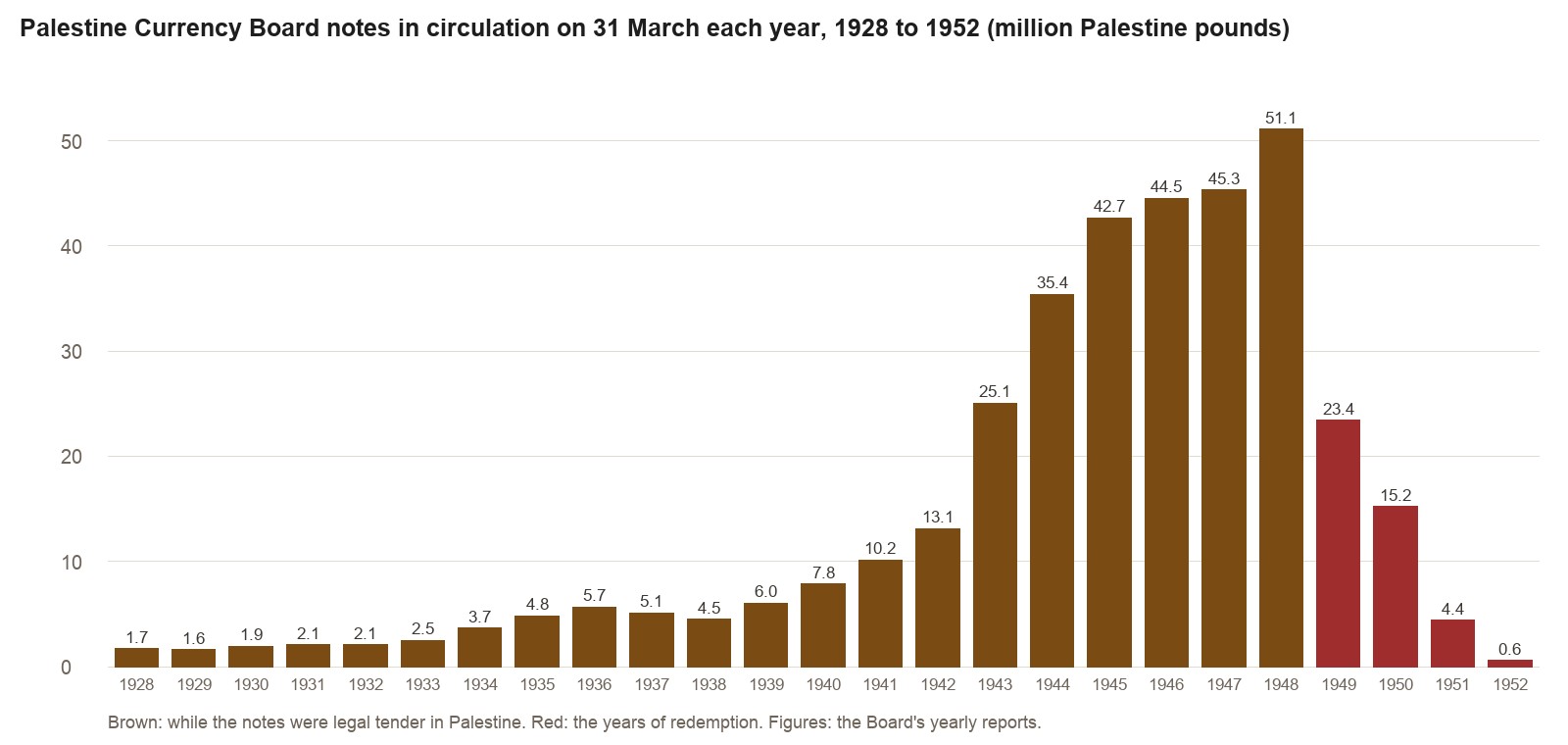
At the peak
| Value | Notes in circulation, 31 March 1948 | In pounds |
|---|---|---|
| 500 mils | about 1,872,800 | 936,405 |
| 1 pound | 9,413,578 | 9,413,578 |
| 5 pounds | 3,909,230 | 19,546,150 |
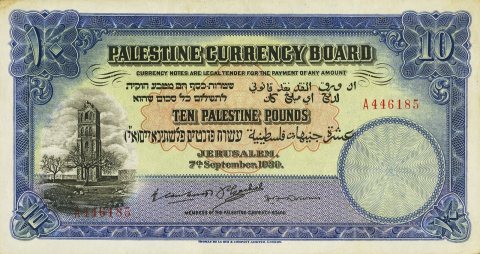
| 10 pounds | 2,004,128 | 20,041,280 |
| 50 pounds | 20,577 | 1,028,850 |
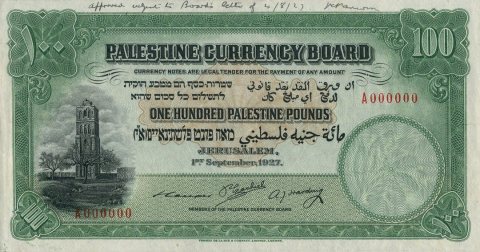
| 100 pounds | 1,587 | 158,700 |
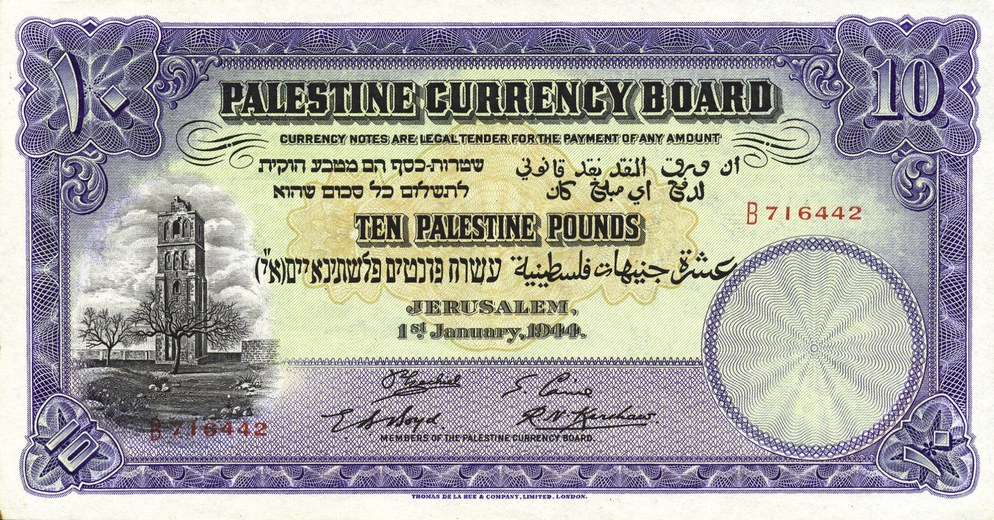
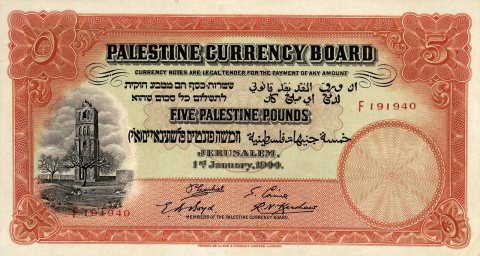
Most of the money was in the 5 and 10 pounds. The last dates printed on them were of 1st January 1944.
1948: the stock is moved
| Day | What happened |
|---|---|
| February 1948 | Palestine is excluded from the sterling area |
| end of April 1948 | The Board closes its currency centre in Jerusalem, where the reserve of notes is no longer safe. Most of the reserve goes to Haifa, the rest to Amman |
| 8 May 1948 | The Ottoman Bank opens a currency centre at Amman as the Board's agent |
| 14 May 1948 | The Mandate ends |
| 15 May 1948 | The last Currency Officer leaves Palestine |
| end of May 1948 | The Haifa centre, which had gone on issuing notes under a British military guard, is closed. Its reserve is shipped to Britain |
| 26 July 1948 | A centre for redeeming the notes opens in London, at Barclays Bank (Dominion, Colonial and Overseas), 29 Gracechurch Street |
| August 1948 | The Anglo-Palestine Bank issues its own notes in Israel in place of the Board's |
The Palestine Post of 30 November 1949 (p. 3), reporting the Board's account of that year, adds what the table cannot show. In April and May 1948 the demand for notes was still rising, and large consignments had to be flown out to Palestine. The Anglo-Palestine Bank had ordered a large extra amount and kept it in its vaults in case of a run before Israel's own notes were ready. No run came, and the circulation was already falling before those notes were issued in August.
When the notes stopped being legal tender
| Place | Last day |
|---|---|
| Israel | 15 September 1948 |
| Jordan | 30 September 1950 (notes); 30 June 1951 (coin) |
| Gaza | 9 June 1951 |
In Jordan the Jordan Currency Board began to issue its own notes on 1 July 1950; when the Palestine notes ceased to be legal tender there, under 5,500,000 pounds was still out. In Gaza, where Egyptian money took their place, more than 1,700,000 pounds was exchanged at the Barclays branch.
How the totals fell
| 31 March | 500 mils | 1 pound | 5 pounds | 10 pounds | 50 pounds | 100 pounds |
|---|---|---|---|---|---|---|
| 1948 | 936,405 | 9,413,578 | 19,546,150 | 20,041,280 | 1,028,850 | 158,700 |
| 1949 | 589,362 | 3,795,913 | 10,156,100 | 8,391,630 | 411,450 | 85,400 |
| 1950 | 172,445 | 2,334,606 | 4,957,170 | 7,364,355 | 332,050 | 52,500 |
| 1951 | 105,263 | 746,913 | 1,531,295 | 1,959,930 | 73,500 | 7,500 |
| 1952 | 68,533 | 225,743 | 126,470 | 160,570 | 20,300 | 1,600 |
The figures are in Palestine pounds. On 31 March 1952 that was 406 notes of 50 pounds and 16 of 100 pounds.
How a note was redeemed
A redeemed note was stamped CANCELLED by hand on both sides, folded in half, and punched with holes through the fold in no fixed pattern. The notes were then cut in two, and the halves were sent for destruction in separate shipments, to keep down the cost of insurance. No list of the numbers was kept.
The largest single lot came from the Anglo-Palestine Bank, which gathered in the Board's notes in Israel. Of almost 37 million pounds redeemed between June 1948 and March 1949, the bank presented 27 million in London, and the Ottoman Bank took in the other 10 million at Amman. A bank official told The Palestine Post that the notes had first to be sorted by their numbers, a task that kept about thirty people at work, with overtime, for almost a year. The notes were then cut in half and the two sets of halves flown to Britain separately, so that no one loss could cost the whole; they were paid for in blocked sterling.
A few notes that had been stamped and punched were not destroyed. Berlin counted fourteen in The Shekel in 1985 and gives the same count in the book of 2025.
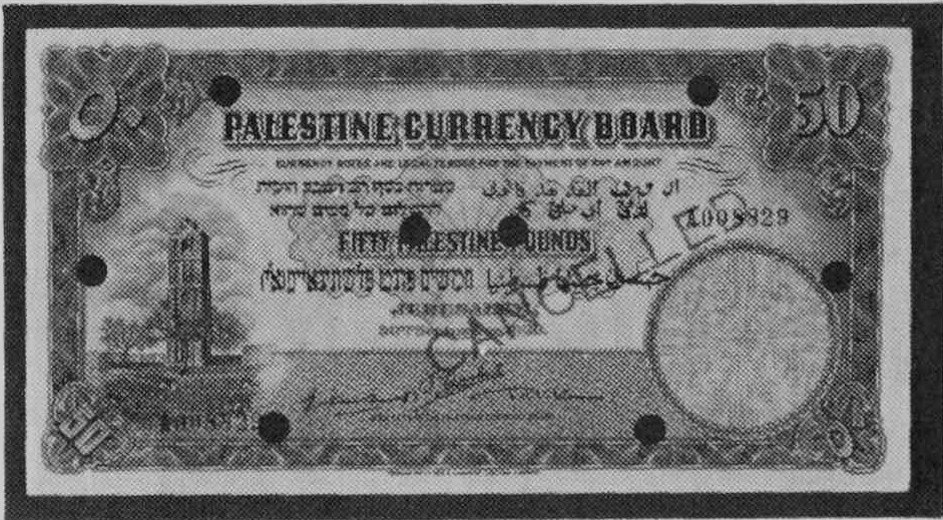
So a CANCELLED stamp with scattered punch holes on an issued note is the mark of redemption after 1948. It is a different thing from the neat CANCELLED perforation on a specimen, which the printer made.
The end of the Board
By the end of 1951 the notes were legal tender nowhere, and the Board told the Secretary of State that a Board was no longer needed to oversee what was left. It held its last meeting on 31 March 1952. On 1 April its remaining assets, 1,293,383 pounds, passed to the Crown Agents for the Colonies, who engaged Barclays Bank (Dominion, Colonial and Overseas) to go on redeeming notes in London.
What was never handed in
The official count went on after 1952. Fisher printed these figures in The Shekel:
| Value | Not redeemed |
|---|---|
| 500 mils | 65,431 pounds, about 130,860 notes, on 31 May 1974 |
| 1 pound | 184,643 notes in March 1966 |
| 5 pounds | 11,365 notes in March 1966 |
| 10 pounds | 3,699 notes in March 1966; 3,003 in the summer of 1974 |
| 50 pounds | 104 notes in March 1966; 82 in the summer of 1974 |
| 100 pounds | 7 notes in March 1966; 6 in the summer of 1974 |
These are notes that were never presented, not notes known to exist. Many will have been lost or destroyed in private hands. They are an upper limit for what can survive of each value, apart from specimens and the few cancelled notes that were kept.
Berlin gives no last day for redemption: Fisher redeemed worn notes with the Crown Agents in 1974, and the book of 2025 says the notes are still payable at par.
Member comments
Log in or register to post a comment.