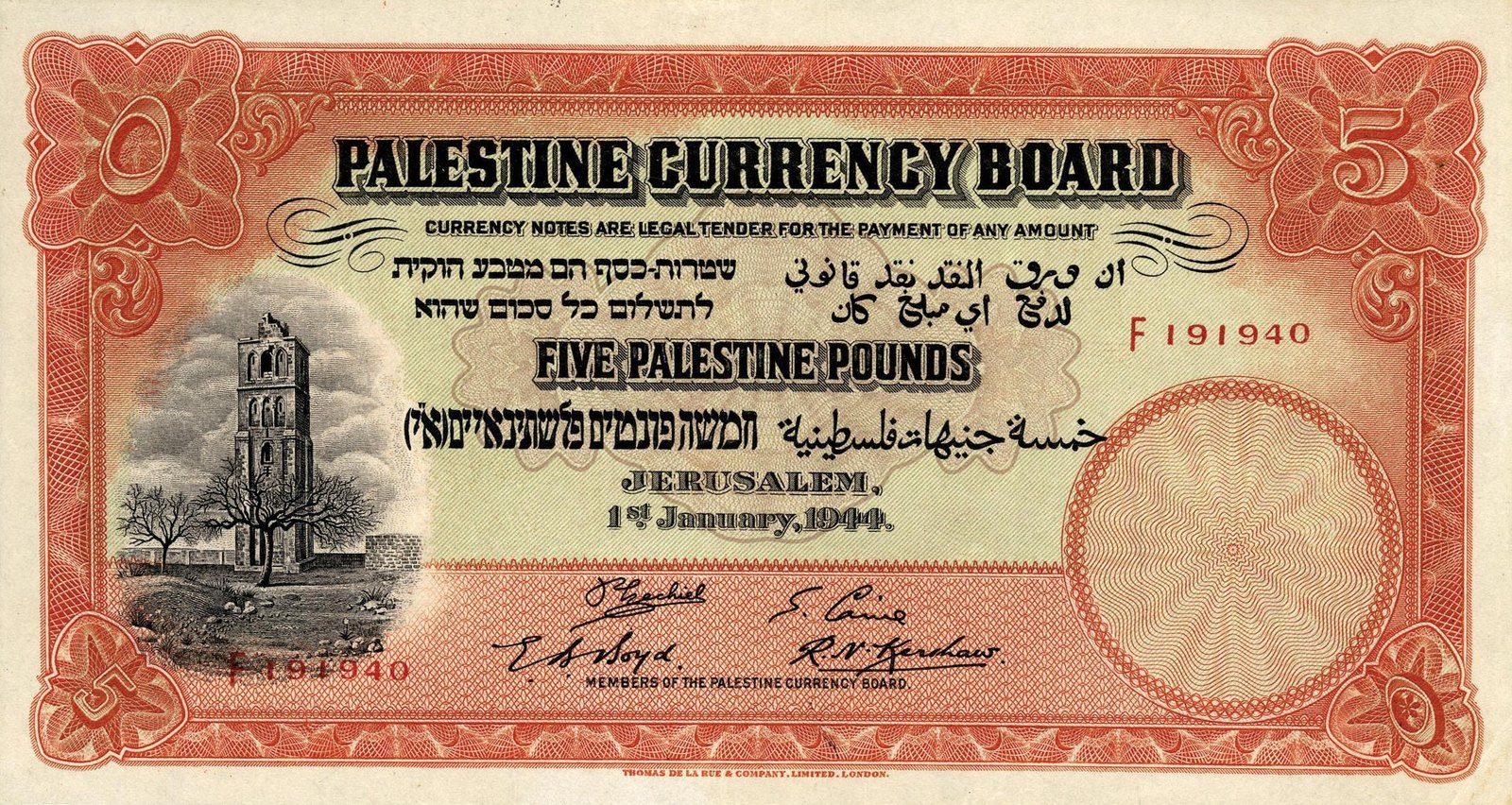
Most of what is said about the notes of Palestine was first printed in three collectors' journals: The Shekel, the I.B.N.S. Journal and the newspaper Bank Note Reporter. All three were read for this catalogue in November 2026, every pictured note set against the notes already on record and every statement against the pages. This article sets out who wrote what, and sorts the statements into four kinds: things only the journals preserve, things that another source or the notes themselves support, things that the notes or another source contradict, and things nobody has yet been able to test. Where one source is set against another, both are named.
Counts of surviving notes are left out here. They are gathered, writer by writer, in Prefixes, serial numbers, print runs and survivors of the Palestine notes and in Palestine 50 and 100 pounds: how many survive.
How far each journal was read
The Shekel. Of 310 issues held, 84 were read, from 1968 to 2024: the 80 that the journal's own lists and index volumes mark as touching the Currency Board, and four more found through the index. They hold 89 pictures of Palestine Currency Board notes, specimens and proofs. Most are black and white halftones. The other 228 issues were not read.
The I.B.N.S. Journal. The issues cited here run from vol. 9 no. 2 of 1969 to vol. 56 no. 1 of 2017.
Bank Note Reporter. The pieces cited here run from June 1973 to August 2005.
The Shekel, article by article
| Year | Issue | Writer | Subject or title |
|---|---|---|---|
| 1968 | Sylvia Haffner | A list of the dated notes, which counts 10th September 1942 as an issued date of the 100 pounds | |
| 1971 | vol. 4 no. 2 | Jack H. Fisher | The 50 pounds |
| 1971 | vol. 4 no. 3 | Jack H. Fisher | "Seven Notes Left: Palestine Currency Board 100-Pound Note" |
| 1972 | vol. 5 no. 4 | Jack H. Fisher | "The Search Continues: Palestine Currency Board 10 Pound Notes" |
| 1973 | vol. 6 no. 3 | Jack H. Fisher | The 5 pounds |
| 1974 | vol. 7 no. 1 | Jack H. Fisher | "The Search Continues: Palestine Currency Board One Pound Notes" |
| 1975 | vol. 8 no. 4 | Jack H. Fisher | The 500 mils |
| 1978 | vol. 11 no. 1 | H. Bar-Hai; Sidney L. Olson | "A Note of Gold"; the specimen set of 1927 and the 100 pounds |
| 1983 | vol. 16 no. 4 | Howard M. Berlin | What the high values cost to collect |
| 1984 | vol. 17 no. 5 | Howard M. Berlin | "Religious Sites on Mandate Notes" |
| 1985 | vol. 18 no. 2 | Howard M. Berlin | "The 100-Pound Notes of the Palestine Currency Board: A Family Portrait" |
| 1985 | vol. 18 no. 5 | Howard M. Berlin | "Cancelled Banknotes of the Palestine Currency Board Notes" |
| 1986 | vol. 19 no. 3 | Sylvia Haffner Magnus | "Palestine Numismatics, Part III: One Hundred Pound Palestine Notes" |
| 1987 | vol. 20 no. 3 | Jack H. Fisher | "Palestine Notes Prove Elusive" |
| 1988 | vol. 21 no. 3 | Jerry Yahalom and Josef Meroz | "The Story of the Palestine Currency Board 100 Pound Bank Note" |
| 1989 | vol. 22 no. 2 | Jack H. Fisher | "Update on Palestine Coins and Paper Money" |
| 1989 and 1990 | vol. 22 no. 4 to vol. 23 no. 5 | Jack H. Fisher | "Chronology of the Palestine Currency Board", a series printed from the Board's yearly reports |
| 1991 | vol. 24 no. 4 | Jack H. Fisher | "Palestine Currency Board Bank Notes Enter Spotlight" |
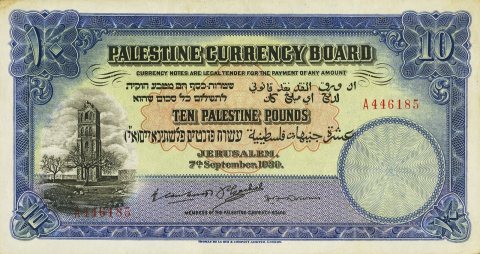
| 1994 | vol. 27 no. 4 | Jack H. Fisher | The 10 pounds of 1st September 1927 |
| 1995 | vol. 28 no. 1 and no. 3 | Jack H. Fisher | "Fifty Pound Palestine Currency Board Notes" and "Update on 50 Pound Palestine Currency Board Notes" |
| 1998 | vol. 31 no. 6 | R. Nahum and S. Tepper | "Paper Money in Israel" |
| 2000 | vol. 33 no. 1 | Abraham Birenbaum | Pinchas Rutenberg and the 50 and 100 pounds with serial number 1 |
| 2001 | vol. 34 no. 5 | Howard M. Berlin | The Dome of the Rock on the 1 pound |
| 2004 | vol. 37 no. 2 | Shlomo Tepper | "About the Palestine Currency Notes" |
| 2022 | first quarter | Simcha Kuritzky | "Changes in Israel's Denominations on Currency" |
| 2023 | fourth quarter | A notice of a book on the Board, pp. 41 to 45 | |
| 2024 | no. 1 | A colour photograph of a cancelled 100 pounds of 1927 |
Two writers carry most of it. Jack H. Fisher of Kalamazoo, Michigan, wrote on each value in turn from 1971 to 1975 and came back to them for twenty years. Howard M. Berlin wrote from 1983 and published books on the subject in 2001 and 2025.
The I.B.N.S. Journal and Bank Note Reporter
In the I.B.N.S. Journal:
- vol. 9 no. 2, 1969: Jack H. Fisher, a list of the dates verified for each value (pp. 54 and 55).
- vol. 11 no. 4, June 1972: Jack H. Fisher, "Palestine Currency Board Fifty Pounds Note".
- vol. 14 no. 3, 1975, and vol. 15 no. 1, 1976: Frankl on the Palestine notes, with a list of dates and signers.
- vol. 22 no. 4, 1983: Santamas on the Cyprus notes and their quantities, with the Palestine notes sent to Cyprus in 1942 (p. 110).
- vol. 33 no. 1, 1994: Jack H. Fisher on the 10 pounds.
- vol. 38 no. 2, 1999: a forged 5 pounds pictured, with a caption by Levius.
- vol. 42 no. 4, 2003: Shlomo Tepper, "News about the Palestine currency notes", with a table of prefixes (p. 42).
- vol. 43 no. 1, 2004: Shlomo Tepper, "Pinchas Rotenberg and the New Currencies in Palestine".
- vol. 48 no. 4, 2009: Bonine on the Dome of the Rock.
- vol. 51 no. 4, 2012: Raphael Dabbah on the 50 pounds of 1939 (pp. 13 and 14).
- vol. 56 no. 1, 2017: Shneydor on the order of the three languages (p. 29).
In Bank Note Reporter: an item on the 100 pounds in June 1973; Sylvia Haffner on the Currency Board notes in July 1980; Fred Schwan, "Cyprus Military Currency Studied", in February 1983; Jack H. Fisher, "Palestine Currency Board bank notes enter spotlight", in April 1991, and further pieces in November 1994 and June 1999; reports of sales in November 1999, May 2003 and August 2005.
What only the journals preserve
Some things are on record nowhere else that has been read.
The search itself. Fisher advertised for years for the high values. The first 100 pounds to come to light, a note of 30th September 1929, was found for Fisher in 1970. A second, of 1927, came from a London auction of 1972 and went to the collection of Sidney L. Olson. A third, of 1927, was bought in 1973 from a dealer in Denver and was in the collection of Arnold Kagan from 1977. A fourth, of 1929, was with Dr. G. H. Neale of Canada by 1974, with Stanley Yulish from 1977 and later with Howard M. Berlin. That is the order of finding as Sylvia Haffner Magnus sets it out in The Shekel in 1986. For years Fisher's own 50 pounds and 10 pounds of 1st September 1927 were each the only note of its date known to Fisher.
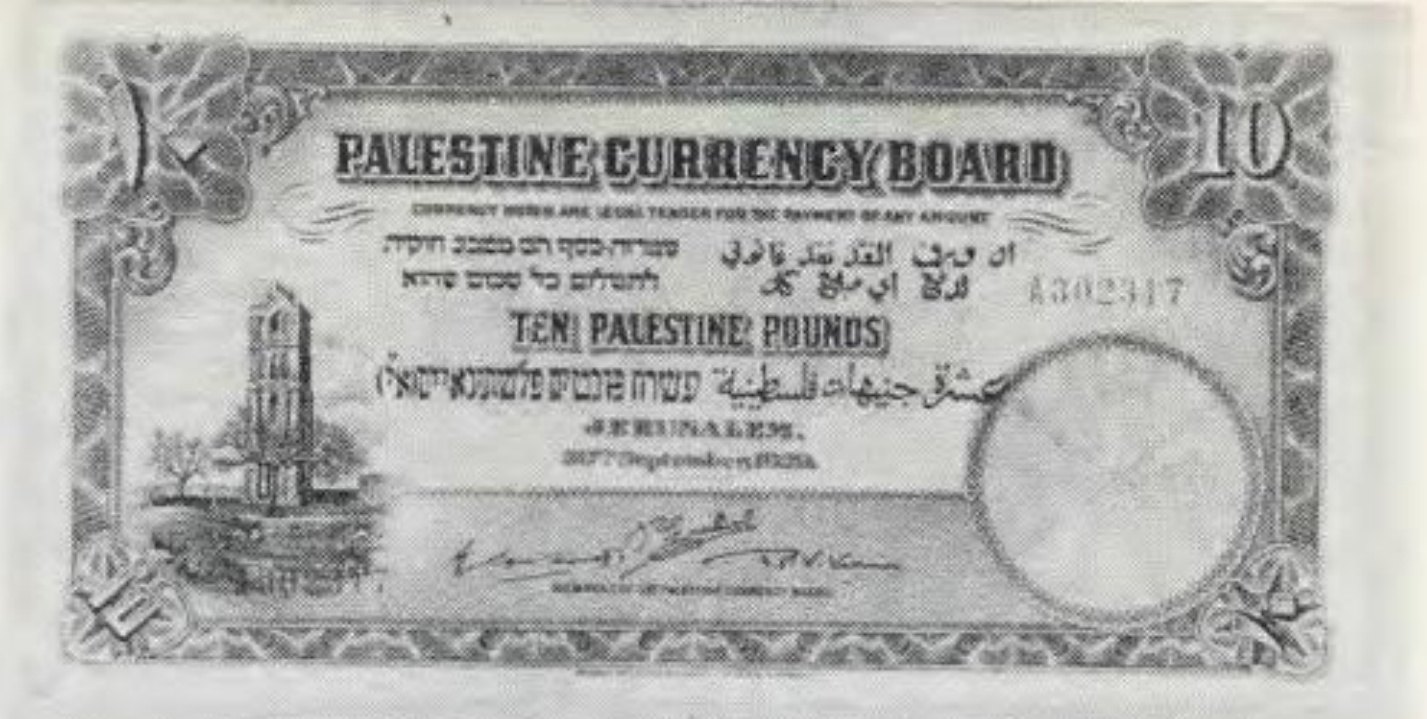
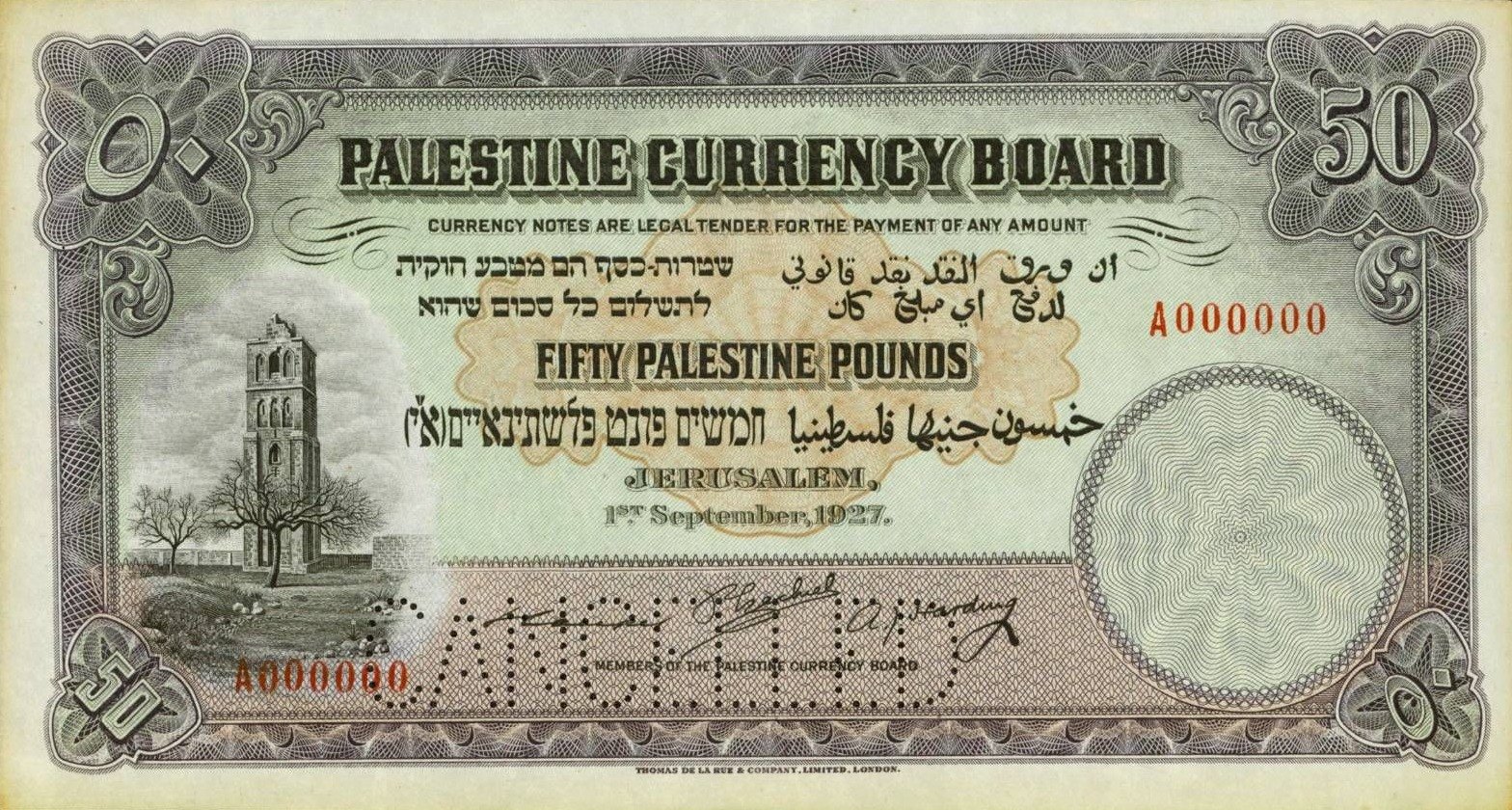
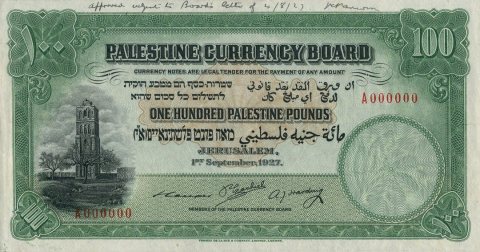
The Couper papers. Sidney L. Olson (1978) and Berlin (1985) record that the printer made specimens of 1st September 1927 numbered A 000000, with CANCELLED perforated in small holes across the signatures and without the word SPECIMEN; that a set from 500 mils to 50 pounds was presented to Leslie Couper, a member of the Board; that it stayed with the Couper family until 1972, was sold in London together with Couper's letter of appointment, and was sold again at auction in the United States on 15th August 1978. Tepper's article of 2004 pictures the letter, dated 5th June 1926.
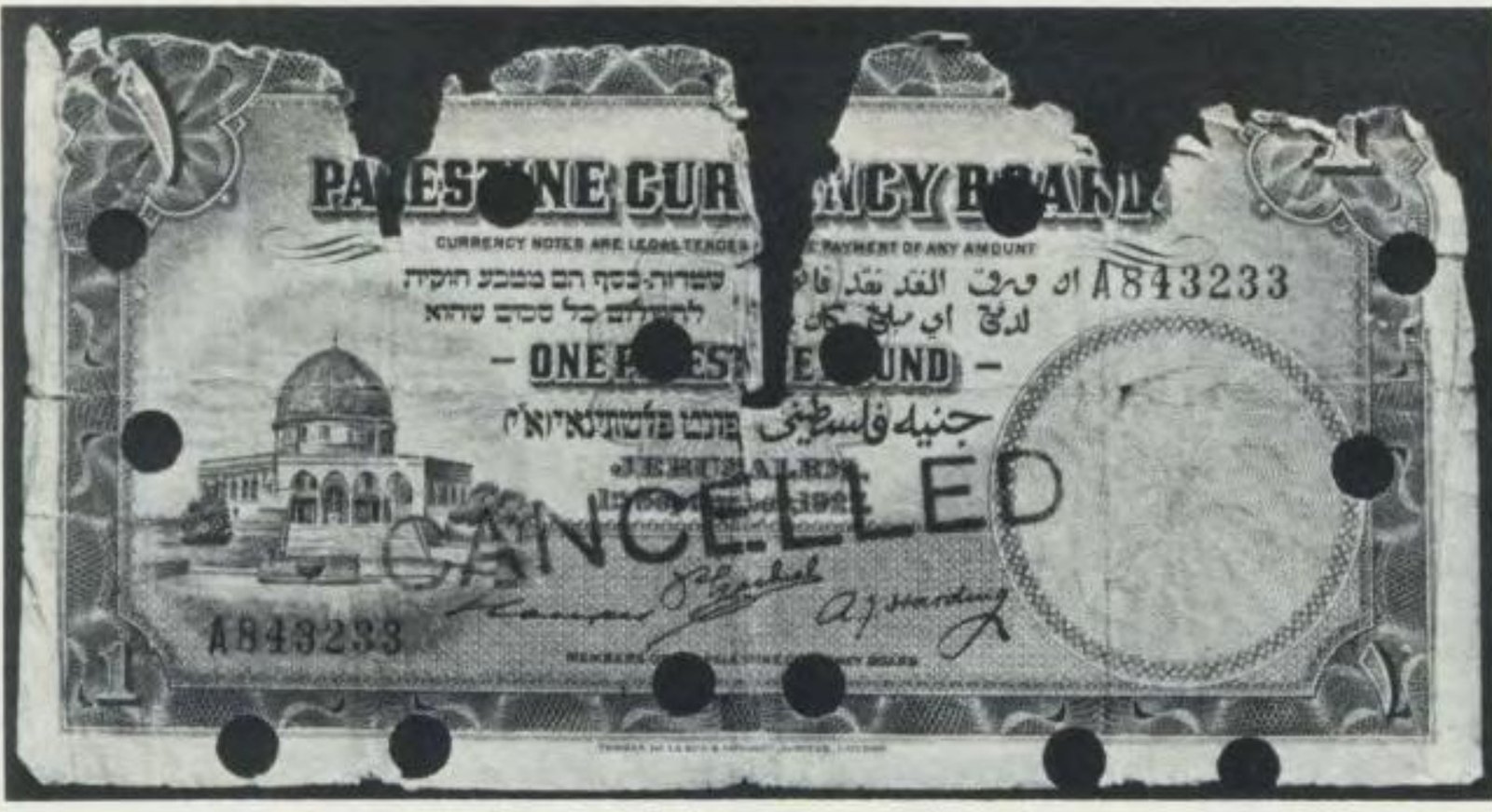
The cancelled notes. Berlin's article of 1985 tells how a redeemed note was treated: stamped CANCELLED by hand on both sides, folded in half, punched with holes in no fixed pattern, cut in two, and the halves sent to London separately to keep the insurance down, with no record kept of the numbers. Berlin lists the notes then known to have been stamped and punched and yet saved: fourteen in all, from 500 mils to 50 pounds, twelve of them with value, number and date. Five are pictured in the article. Berlin adds that on one 50 pounds of 1939 the punch holes have been filled with matching pieces cut from a 10 pounds note.
The papers with the two notes numbered 1. Abraham Birenbaum (2000) pictures both notes and what was kept with them: the registered envelope posted at Haifa on 14th June 1932 and delivered the next day, and the note in Menachem Ussishkin's own hand that the two notes were taken as a keepsake, locked in a safe at the Anglo-Palestine Bank, and belonged to the Fund.
The public notice of 1st October 1927. Tepper's article of 2004 pictures the notice, signed "S. S. Davis, Currency Officer". It is the source of the official sizes: 127 x 76 mm for the 500 mils, 165 x 89 mm for the 1 pound and 191 x 102 mm, which is 7½ by 4 inches, for the four high values.
Statements that another source or the notes support
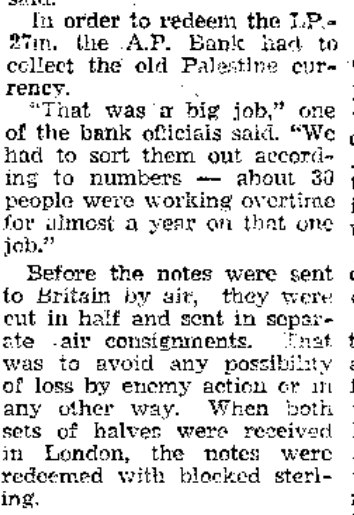
- The halved notes of 1948. Three articles in The Shekel (1968, 1970 and 1986) and one in the I.B.N.S. Journal (vol. 20 no. 3-4, 1981, pp. 85 and 86) say that the Anglo-Palestine Bank cut the Board's notes it held in half and sent the two sets of halves to London one after the other. None of the four gives an archive reference. The Palestine Post of 30th November 1949 (p. 3), from the Board's report for the year to March 1949, has the same thing: the notes that the Anglo-Palestine Bank redeemed in London were sorted by number and cut in half, and the halves were sent in separate air consignments.
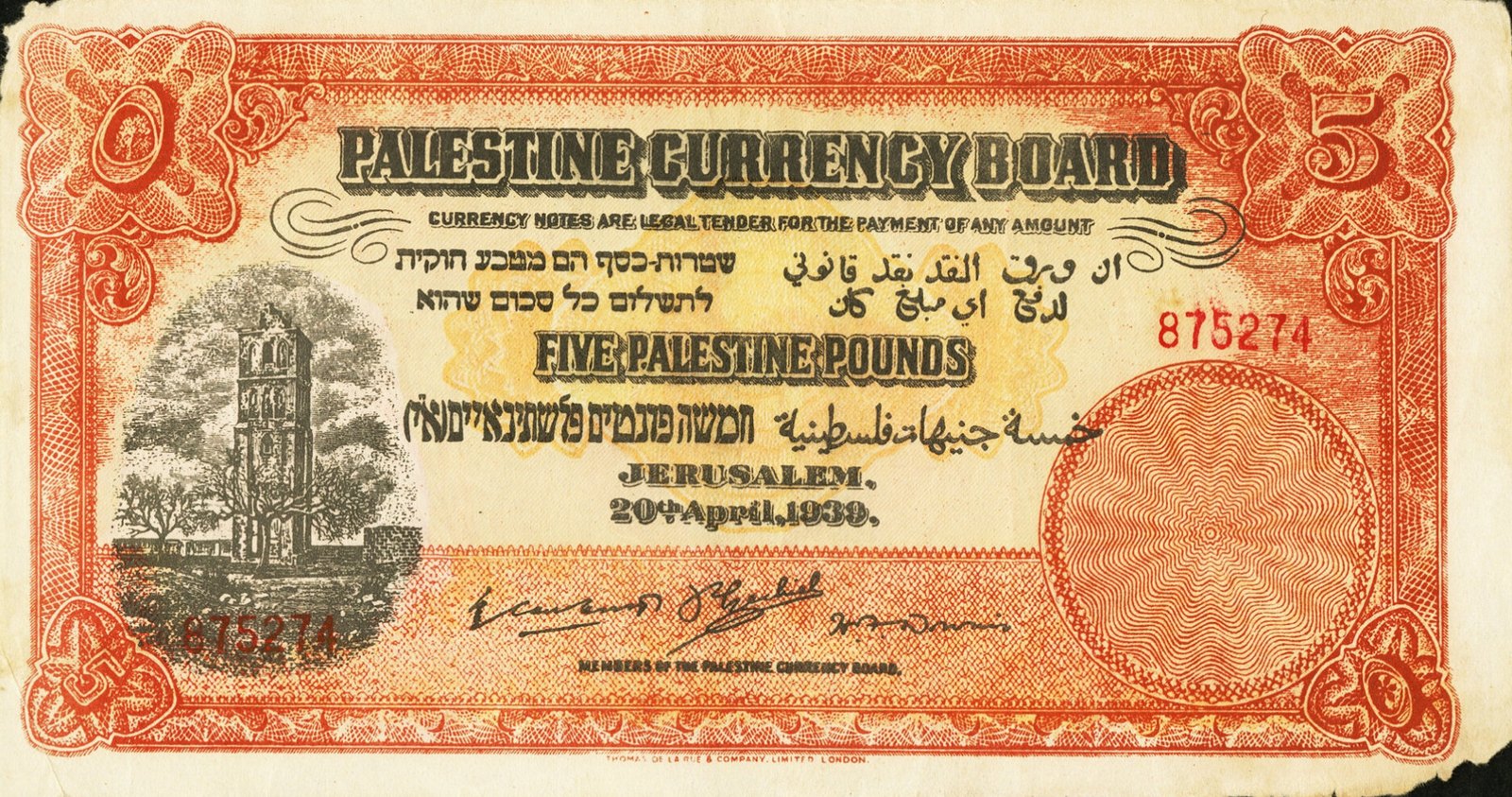
- The tower. Berlin (The Shekel, vol. 17 no. 5, 1984) says that the tower on the 5 to 100 pounds is the minaret of the White Mosque at Ramla and that "Crusader's Tower" is a misnomer. Bonine (I.B.N.S. Journal, vol. 48 no. 4, 2009, p. 42) says the same: a minaret, wrongly called the Crusader's Tower. The Board itself called it the Crusaders' Tower at Ramleh. The catalogue now gives both names, with the Board's own name second. Bonine has the tower built by Baybars in 1268. The catalogue leaves the builder and the year out, because other accounts date the tower later.
- Two types of serial number on the notes of 1939. Raphael Dabbah (I.B.N.S. Journal, vol. 51 no. 4, 2012, p. 13) says that the 500 mils to 10 pounds of 1939 come first with the large serif number of the earlier dates and then with a small sans serif number. Four photographs of notes on the catalogue's pages were checked against this and agree. One page of the catalogue had the two types the wrong way round and was corrected from this article.
- The prefixes. Tepper's table (I.B.N.S. Journal, vol. 42 no. 4, 2003, p. 42) gives the prefix letters of each date: for the 500 mils A, A to D, D to J and J to K; for the 1 pound A to B, B to H, H to Z and A/1 to C/1; for the 5 pounds A, A to B, B to D and D to F; for the 10 pounds A, A, A to B and B to C; for the 50 pounds A on every date. Every one agrees with the prefixes on the catalogue's pages.
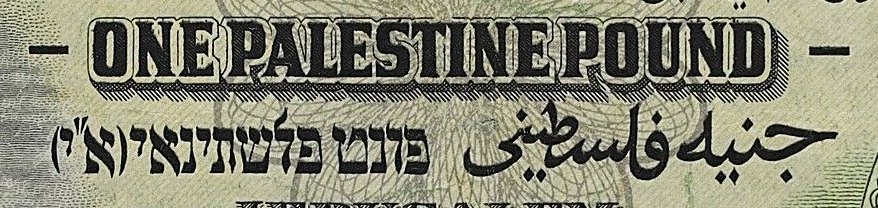
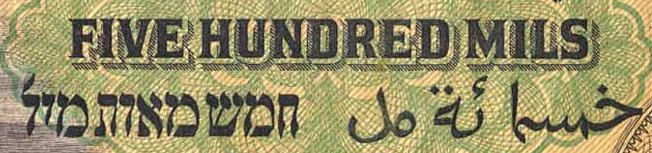
- The Hebrew initials. Frankl (I.B.N.S. Journal, vol. 14 no. 3, 1975, p. 125) noticed that the 500 mils lacks the Hebrew initials aleph and yod that the other values carry after the name of the country. Photographs of a 500 mils and a 1 pound of 1927 on the catalogue's pages show it. It is the same on every 500 mils, so it tells no two notes apart.
- Cyprus. Santamas (I.B.N.S. Journal, vol. 22 no. 4, 1983, p. 110) has the Palestine notes made legal in Cyprus by the Regulation of 5th May 1942 and in use from 6th May, the Cyprus notes arriving on 25th May, the Palestine notes demonetised on 17th November 1942, and a second consignment on 11th April of 20,000 notes of 5 pounds and 50,000 of 1 pound. Fred Schwan (Bank Note Reporter, February 1983) has 150,000 notes of 1 pound and 20,000 of 5 pounds in two shipments, of 24th February and 11th April. Berlin's book of 2025 (pp. 48 to 52) cites the Proclamations from the Cyprus Gazette: one of 5th May 1942, and one that Berlin places in the Gazette of 10th September 1942, under which the notes were no longer legal tender from 18th November 1942. The Gazette itself shows that the second Proclamation was made on 10th September and printed on 17th September 1942, and that 17th November was the last day the notes were legal tender, the day Santamas gives. The whole story is in Palestine pounds in Cyprus, 1942: the notes that were never overprinted.
Statements that the notes or another source contradict
- Rachel's Tomb "near Hebron". So Fisher (The Shekel, vol. 8 no. 4, 1975) and Frankl (I.B.N.S. Journal, vol. 15 no. 1, 1976, p. 25). The catalogue's page for the 500 mils has the tomb near Bethlehem.
- Misprinted dates. Lists in The Shekel print 30th April 1939 for the 500 mils, 7th September 1927 for the 100 pounds, "September 20, 1929", "1999" and "1959". The notes pictured in the same journal carry the catalogue's dates.
- Misprinted numbers. Fisher's article of 1989 in The Shekel prints a 10 pounds of 1927 with a rough top border as A 023675. Fisher's articles of 1994, in The Shekel and in the I.B.N.S. Journal (vol. 33 no. 1), print it twice as A 023657. A sale of 2010 has the note, described with a corroded top margin, as A 023675. In the same way one 50 pounds in Berlin's list of cancelled notes has two digits changed round, as the photograph of the note in a later sale shows, and an article of 1988 prints the numbers of four 100 pounds with a prefix D while its own plate shows prefix A. No Palestine note has prefix D on that value.
- The 5 pounds "issued 1929 to 1945". So a caption by Levius (I.B.N.S. Journal, vol. 38 no. 2, 1999, p. 10). The notes are dated from 1st September 1927 to 1st January 1944.
- Red numbers on the 1 pound. An article of 1986 in The Shekel says the serial numbers are black on the 500 mils and red on the 1 to 100 pounds. Colour photographs show black numbers on the 500 mils and the 1 pound and red on the higher values.
- "The Anglo-Palestine Bank's Palestine Currency Board". So one article of 1986 in The Shekel. By its own first report the Board was constituted by a minute of 15th June 1926, and its members were invited by the Colonial Office. It was no part of the bank.
- Totals called "issued". Bonine (I.B.N.S. Journal, vol. 48 no. 4, 2009, p. 41), quoting Berlin, gives as the notes issued 1.8 million of 500 mils, 9.4 million of 1 pound, 3.9 million of 5 pounds, 2 million of 10 pounds, 10,577 of 50 pounds and 1,587 of 100 pounds. The serial numbers on record run far past those totals on the 500 mils, the 1 pound and the 50 pounds. For comparison, The last years of the Palestine pound, 1948 to 1952 gives, from the Board's figures, the notes in circulation on 31st March 1948: about 1,872,800 of 500 mils, 9,413,578 of 1 pound, 3,909,230 of 5 pounds, 2,004,128 of 10 pounds, 20,577 of 50 pounds and 1,587 of 100 pounds. So Bonine has 10,577 for the 50 pounds where the figures for that day have 20,577. Neither Bonine nor Berlin, as quoted, says that the totals are those of that day.
- The wrong note under a caption. The Shekel no. 1 of 2024 prints the first photograph seen for this catalogue of the second cancelled 100 pounds of 1927. Its caption tells of a sale in England in 2022, which was the sale of the other cancelled note.
Statements still untested
- Was the 100 pounds of 10th September 1942 issued? Haffner's list of 1968 counts it as issued. Fisher (I.B.N.S. Journal, vol. 9 no. 2, 1969) lists it among the dates verified. Frankl (vol. 15 no. 1, 1976, p. 25) lists it too, with the signatures of Ezechiel, Caulcutt and Boyd, but says plainly that Frankl never saw a 50 or 100 pounds and took the dates from catalogues. Bank Note Reporter of June 1973 counts a found note of that date. Berlin (The Shekel, 1985) says the Board's records show 100 pounds issued with the date. No writer saw or pictured such a note, and the catalogue keeps the date as a die proof and specimens, with an issued row marked unconfirmed.
- Names written on the high values. Frankl (I.B.N.S. Journal, vol. 14 no. 3, 1975, pp. 125 and 126) remembers bank tellers writing depositors' names on 50 and 100 pounds notes. An article of 1988 in The Shekel says holders signed such notes in the margin as a guarantee, and ties the habit to a bank robbery of the 1940s in which 50 pounds notes of known numbers were taken. Neither gives a source. The two accounts agree that names were written and differ on who wrote them.
- Who forged the 5 pounds of 1939. Levius's caption of 1999 says the forgery was made before the war by members of Palestine's German community, with the Mufti and Arab leaders. No evidence is given. The catalogue describes the forged 5 pounds by what can be seen on it.
- Dabbah on 1939. Dabbah (2012, p. 13) writes that on 20th February 1939 London reported low reserves of 500 mils and 300,000 notes were ordered, and gives die proofs dated by hand: the 1 pound 27/7/39, the 5 pounds 2/5/39, the 10 pounds 4/10/39 and the 50 pounds 5/10/39, which Dabbah takes as "probably" the Board's approval. Dabbah also thinks it extremely likely that 50 pounds with the sans serif number were issued, and says it cannot be proved. All four hand dates fall after the dates printed on the notes. None of the proofs has been matched to a piece on the catalogue's pages, and no 50 pounds with the sans serif number is on record as an issued note.
- A specimen set in the British Museum. An article of 1986 in The Shekel knows a second specimen set of 1927 in the British Museum, together with a 100 pounds of 1942. The museum's own records, as they were read for this catalogue, list three Palestine Currency Board notes only: a 500 mils and a 1 pound of 1939 and a 5 pounds of 1944, bought in 1984. The article of 1986 stands alone on the point.
- Zerder's count of specimens. A table of 1986 in The Shekel gives three known specimens for each value of 1927 from 500 mils to 50 pounds, a single one for most later dates, and two for the 100 pounds of 1942. The counts are given here as Zerder's. No other source read repeats them.
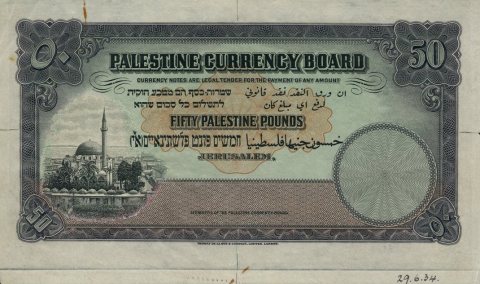
- Tepper's ink dates. Tepper's table of 2003 (I.B.N.S. Journal, vol. 42 no. 4, p. 43) gives ink dates on proofs of the designs that were never issued: 26/6/34 on a 50 pounds and 5/10/36 on a 100 pounds. The 100 pounds pictured in the same article reads 18.3.38, and the pieces on the catalogue's pages carry 29.6.34 on the 50 pounds and 24.1.36 on the 100 pounds. Whether Tepper's two days are further pieces or slips is not known. The designs are described in Essays, specimens, proofs and designs never issued.
- Use in Jordan "until 1952". Fisher (1994, in both journals) writes that the notes were still used regularly in Jordan until 1952. The notes ceased to be legal tender there on 30th September 1950. Use in practice after that day is a different thing, and nothing read so far tests it.
What the journals do not hold
Fisher asked the printer and the authorities for figures of notes printed by date and was told that no such records were kept or had survived. So The Shekel has no print figure by date or prefix and no range of serial numbers. What Fisher did print, from the Board's reports, were the yearly figures of circulation and the supplies of 1932 to 1936: they are set out in Every 31st March from 1928 to 1952: the Palestine Currency Board's yearly figures in full.
The Shekel does not give the day on which the notes of 1929, 1939 or 1945 were first paid out. It gives no dates of office for any member of the Board except the chairman. The days on which the signers joined and left came only with Berlin's book of 2025, and are in Ten signers, seven sets of signatures.
Sources
- The Shekel, 84 issues from 1968 to 2024, as listed in the table above.
- I.B.N.S. Journal: vol. 9 no. 2, 1969; vol. 11 no. 4, 1972; vol. 14 no. 3, 1975; vol. 15 no. 1, 1976; vol. 20 no. 3-4; vol. 22 no. 4, 1983; vol. 33 no. 1, 1994; vol. 38 no. 2, 1999; vol. 42 no. 4, 2003; vol. 43 no. 1, 2004; vol. 48 no. 4, 2009; vol. 51 no. 4, 2012; vol. 56 no. 1, 2017.
- Bank Note Reporter: June 1973, July 1980, February 1983, April 1991, November 1994, June 1999, November 1999, May 2003 and August 2005.
- The Palestine Post, 30th November 1949, p. 3.
- Howard M. Berlin, The Palestine Currency Board: Its History and Currency, 2025.
- The catalogue's pages for the six values, for the dates, prefixes and photographs the statements were tested against.
Member comments
Log in or register to post a comment.