This article is about the numbers on the notes of Palestine: the prefix letters, the two kinds of serial number, the range of numbers that sources give for each date, how many notes the auction houses say were printed, and how many each source says survive. It is drawn from the catalogue's pages on the six values and from the descriptions the auction houses wrote for their lots. A house's count is that house's claim, and the claims are given here with the house, the day and the lot.
How the notes were numbered
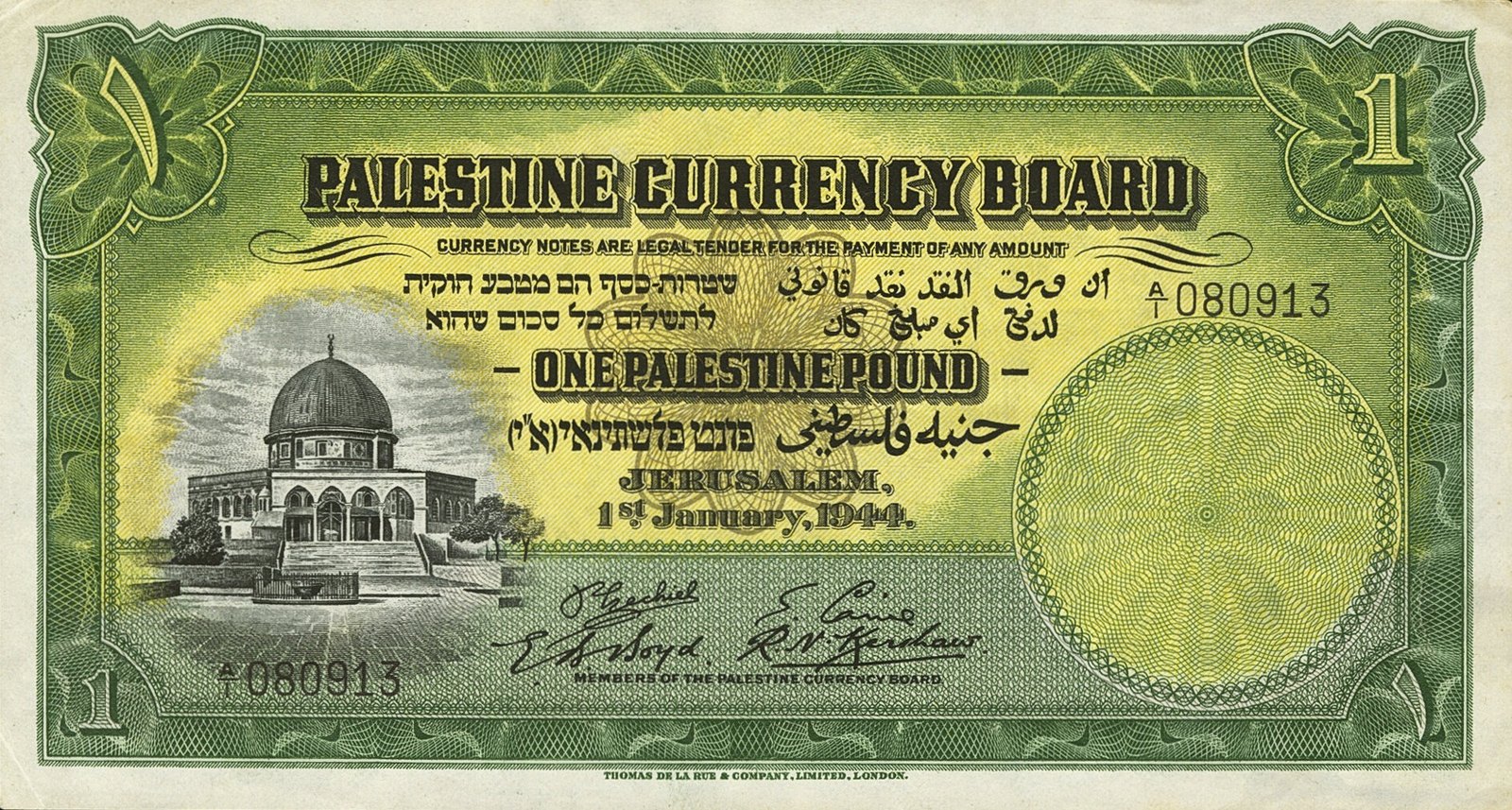
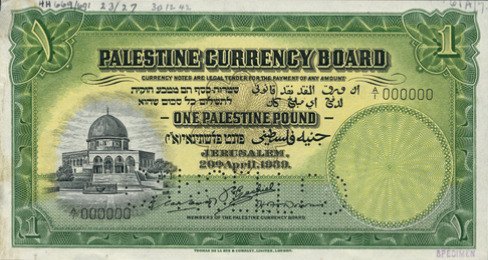
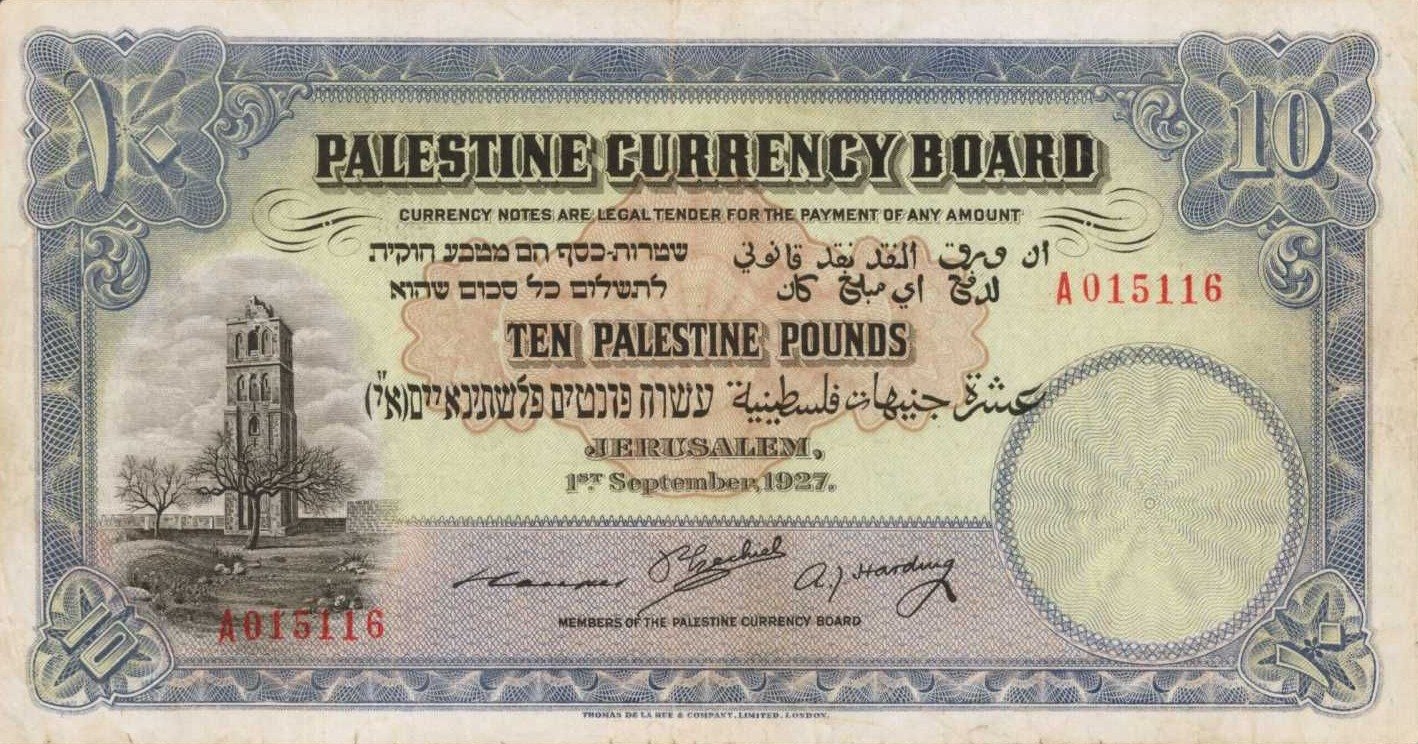
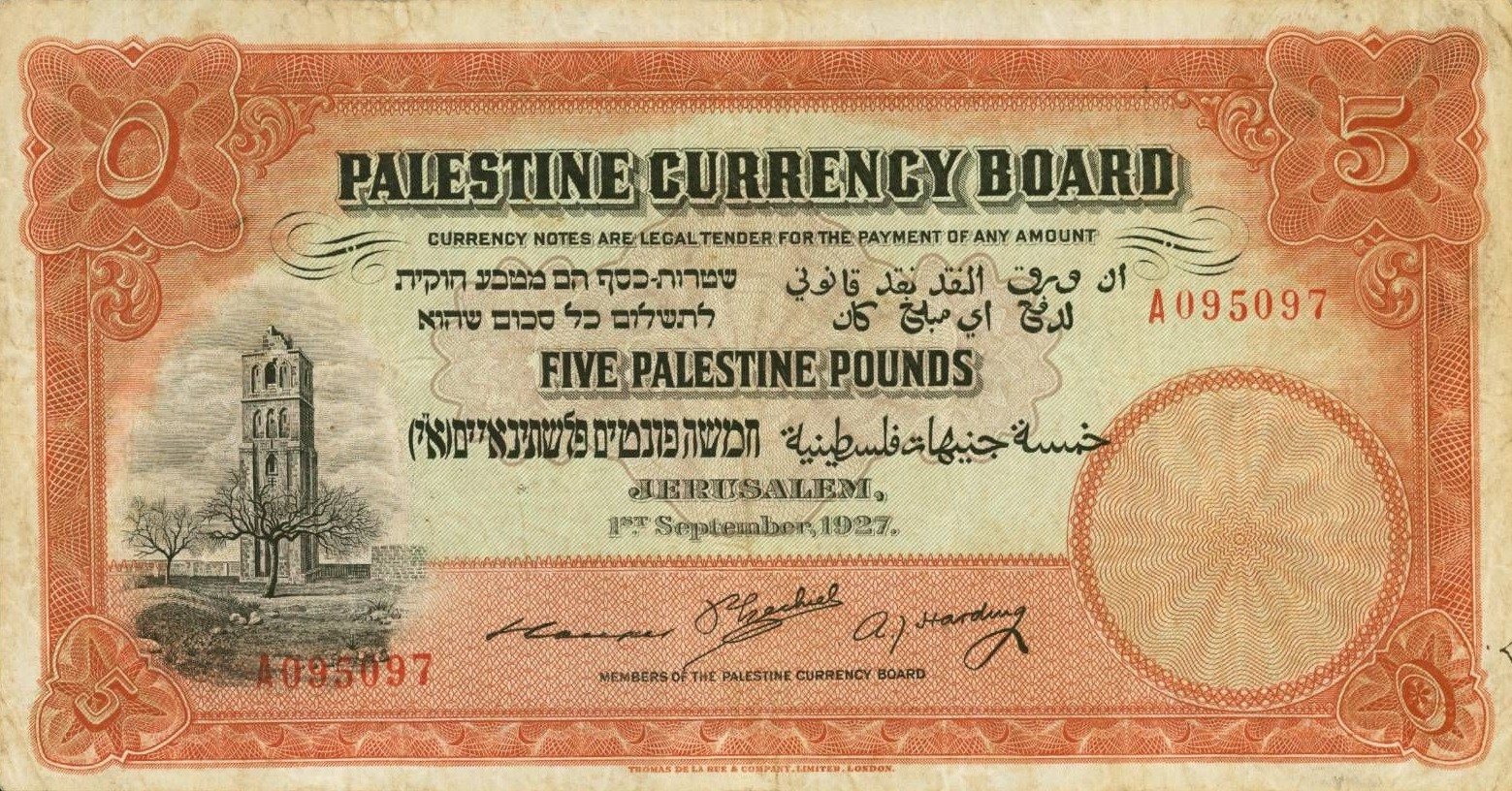
Each denomination starts at prefix A and moves through the alphabet over the years, leaving out I and O. After Z it restarts at A/1. Only the 1 pound got that far: the issued notes with prefix A/1 are dated 1st January 1944. A specimen dated 20 April 1939 with prefix A/1 is recorded, but no issued note of that date past prefix Z is recorded. Stack's Bowers, describing a 1 pound with prefix Z (2 October 2024, lot 20656), calls Z the last prefix before the printer went over to the fractional prefixes.
The serial numbers are printed in black on the 500 mils and 1 pound and in red on the higher values.
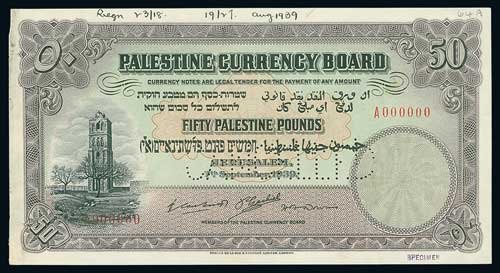
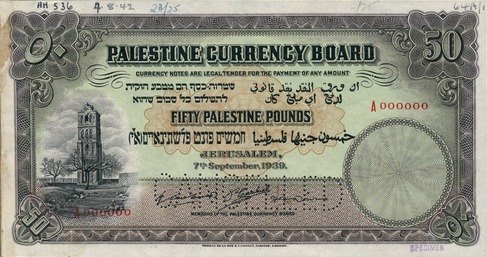
Sources mention that the notes dated 1939 come in two serial number types: first the large serif type of the earlier dates, then a small sans serif type, kept on all later dates. The catalogue keeps each date on one row whatever the type. The 50 pounds is the exception: sources mention that the issued notes dated 1939 keep the serif number of the earlier dates, while the specimens of 7th September 1939 come with either type. Spink (10 April 2013, lot 1138), following Raphael Dabbah's article, takes the sans serif specimen as evidence that issued 50 pounds with the sans serif number were printed and released. None has been recorded.
A date does not own a prefix. Several prefixes were begun under one date and finished under the next, and that is where the short runs named below come from.
The number ranges that sources give
Sources mention a number range for each date of four values. The pages do not name the source more closely. The ranges are these:
500 mils
| Date | Range |
|---|---|
| 1st September 1927 | A 000001 to A 799000 |
| 30th September 1929 | A 856001 to D 414000 |
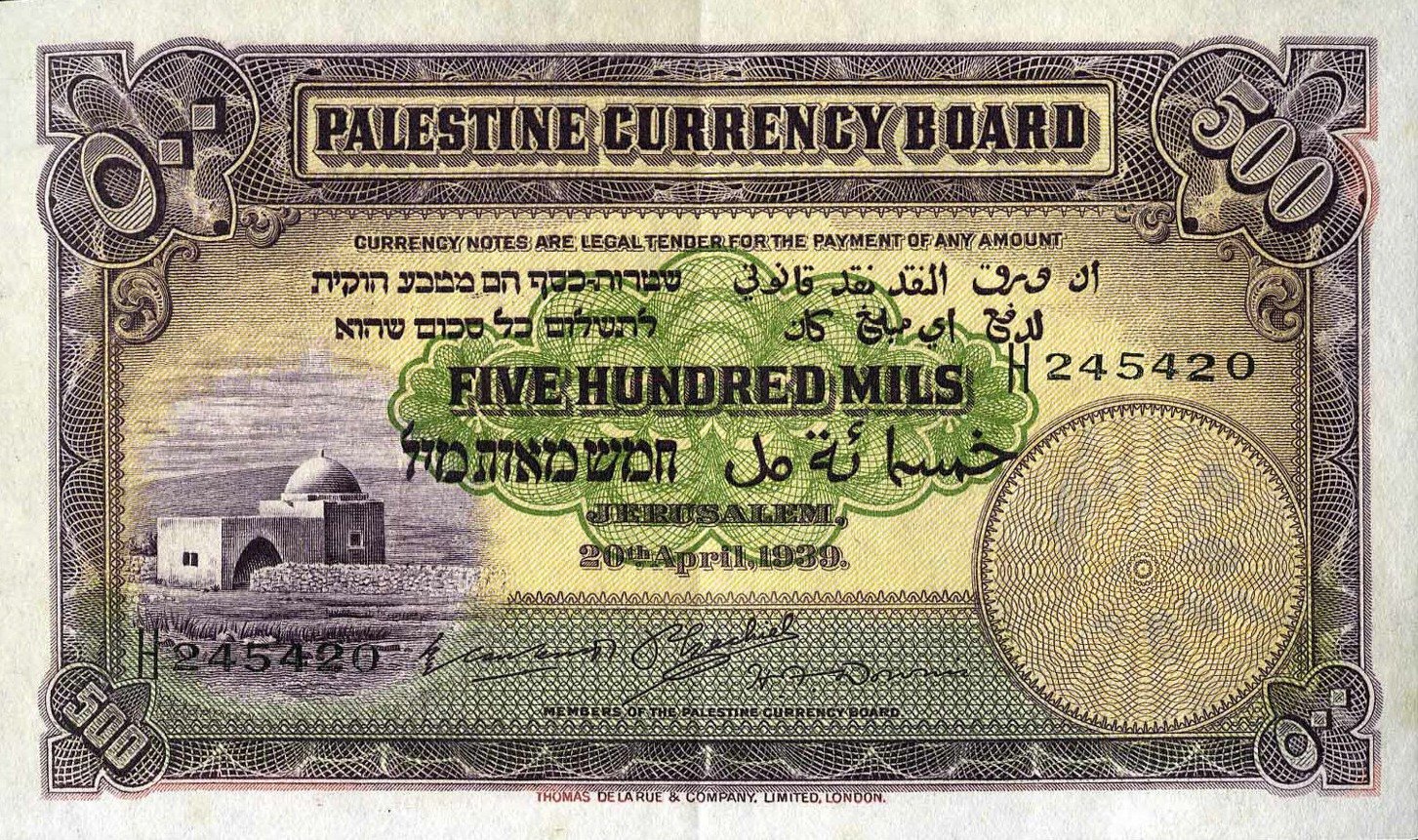
| 20th April 1939, large serial number | D 536001 to E 982000 |
| 20th April 1939, small serial number | F 037001 to J 073000 |
| 15th August 1945 | J 199001 to K 044000 |
1 pound
| Date | Range |
|---|---|
| 1st September 1927 | A 000001 to A 920000 |
| 30th September 1929 | B 130001 to H 810000 |
| 20th April 1939, with serifs | H 850001 to K 870000 |
| 20th April 1939, without serifs | K 950001 to Z 480000 |
| 1st January 1944 | A/1 050001 to C/1 070000 |
5 pounds
| Date | Range |
|---|---|
| 1st September 1927 | A 000001 to A 130000 |
| 30th September 1929 | the same figures repeated |
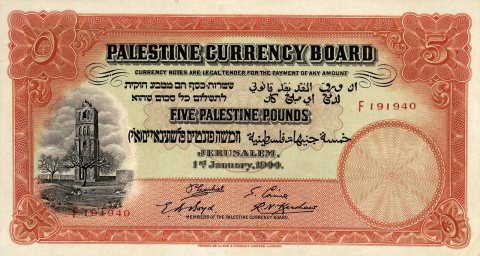
| 20th April 1939, large serial number | B 230001 to B 500000 |
| 20th April 1939, small serial number | B 500001 to D 570000 |
| 1st January 1944 | D 650001 to F 500000 |
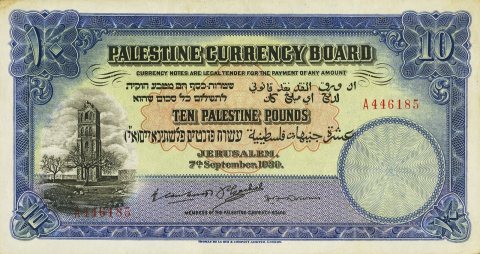
10 pounds
| Date | Range |
|---|---|
| 1st September 1927 | A 000001 to A 010000 |
| 30th September 1929 | A 040001 to A 430000 |
| 7th September 1939, large serial number | A 440001 to A 640000 |
| 7th September 1939, small serial number | A 640001 to B 440000 |
| 1st January 1944 | B 470001 to C 390000 |
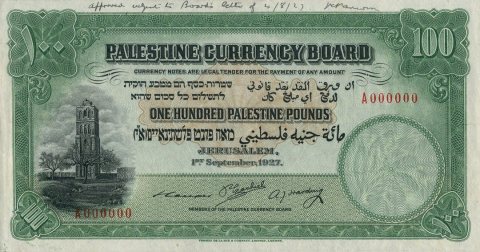
No range is given on the pages for the 50 pounds or the 100 pounds. All recorded issued notes of both carry prefix A.
Where the recorded notes break the ranges
The catalogue's pages test each range against the notes on record. The result is the same on every value: no recorded note falls inside the range of another date, but recorded notes lie outside the range of their own, so the ranges are narrower than the notes that exist.
- 500 mils. Notes lie outside their own range for 1929, 1939 and 1945, at both ends. A note of 15th August 1945 with a prefix K number above 100,000 is on record, well past the K 044000 at which the range stops.
- 1 pound. The recorded notes of 1927 run on into prefix B, past the end of the range at A 920000, and the notes of 1944 run on past C/1 070000 to above C/1 200000.
- 5 pounds. The range for 1929 only repeats the range for 1927. None of the recorded notes of 1929 falls inside it: they begin in prefix A above the end of the range and run into prefix B. A few notes of 1939 and 1944 lie just below the start of their own ranges, and one of 1939 lies past the end of its own.
- 10 pounds. Most of the recorded notes of 1927 lie above A 010000, up to A 027384. Sources mention official figures of 16,000 notes of 10 pounds in circulation on 31 March 1928 and 16,500 on 31 March 1929, all of them of the 1927 date, which also points to a 1927 range running well past A 010000.
The exact numbers are on the page of each value, under "Not yet settled", and they stay there because they change as notes are added.
Print runs, as the houses put it
None of these figures is from a printer's or a Board's record that the pages name. Each is a statement in a sale catalogue.
| Value and date | Prefix | Notes printed, as stated | Who says it |
|---|---|---|---|
| 500 mils, 20th April 1939 | D | 455,000, an extra run that completed a prefix begun with the 1929 date | Spink, 10 April 2013, lot 1105 |
| 500 mils, 20th April 1939 | E, F, G, H | one million each | Stack's Bowers, 6 May 2026, lot 50010 |
| 500 mils, 20th April 1939 | J | 150,000 | Spink, 29 September 2010, lot 1261 |
| 500 mils, 15th August 1945 | K | about 110,000 | Stack's Bowers, 6 May 2026, lot 50013 |
| 1 pound, 1st September 1927 | B | 180,000, the rest of the prefix being used for the 1929 date | Spink, 27 September 2011, lot 1329 |
| 1 pound, 20th April 1939 | H | 180,000, an extra run | Spink, 27 September 2011, lot 1337 |
| 5 pounds, 1st January 1944 | not named | 370,000, an extra run that followed the 1939 issue | Spink, 27 September 2011, lot 1365 |
| 10 pounds, before the 1939 date | A | fewer than 50,000 | Stack's Bowers, 6 May 2026, lot 50055 |
| 50 pounds, 30th September 1929 | A | perhaps 16,000 to 20,000, from the known serial numbers | Heritage Auctions, 15 October 2026, lot 24690 |
| 50 pounds, 30th September 1929 | A | an estimated 17,500 issued | Stack's Bowers, 6 May 2026, lot 50062 |
Some of these can be set against other evidence on the pages. The Board's reports for 1932 to 1936 name supplies of 313,000 notes of 10 pounds, well above the "fewer than 50,000" of Stack's Bowers. Stack's Bowers (6 May 2026, lot 50024) notes that only a small fraction of the 1 pound notes of 1939 carry prefix H, which that date shares with 1929; that fits Spink's 180,000. Of the 500 mils with prefix H, Stack's Bowers (lot 50010) says that it comes to auction about as seldom as prefix D, although it had a full run, and that the reason is not clear. The yearly figures are set out in The Palestine notes in circulation, value by value, 1928 to 1974.
Stack's Bowers (6 May 2026, lot 50053) says demand for the 10 pounds was modest for most of the note's life, which kept the print runs small. Of the 500 mils with prefix K the same house (lot 50013) says it is not clear whether the whole run was issued, and that whatever stayed in the vault was destroyed after the notes were withdrawn.
Survivors of the four lower values, as each source puts it
The counts below were made at different times and by different people. They are not added together here, and they are not a count of what exists. Each page of the catalogue gives the number of notes its own register holds, which changes as notes are found.
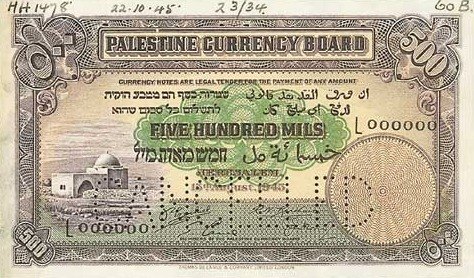
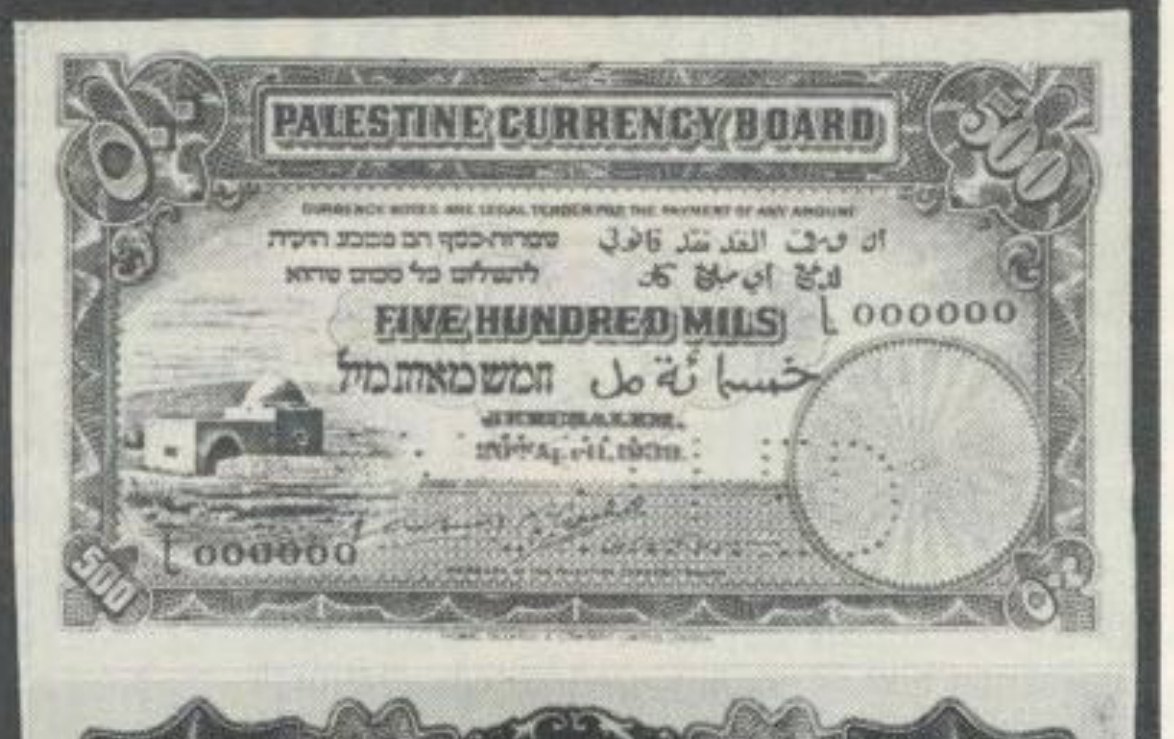
500 mils of 15th August 1945, prefix K. Spink: fewer than ten (29 September 2010, lot 1263), seven (27 September 2011, lot 1327), six (11 April 2018, lot 13; 28 April 2022, lot 266). Stack's Bowers (6 May 2026, lot 50013): at most six or seven. Spink (11 April 2018, lot 67) calls the specimen of the unissued prefix L one of three known. A specimen with prefix L photographed in 1986 appears to carry the date 20th April 1939, not 1945; the date is small on the photograph and is not certain.
1 pound of 1st September 1927, prefix B. Lyn Knight (13 October 2009, lot 525) knew nine notes of that date and prefix.
1 pound of 1st January 1944, prefix C/1. Spink: fewer than ten known (29 September 2010, lot 1293), about ten (10 April 2013, lot 1123), five (11 April 2018, lot 43).
5 pounds of 1st September 1927. Spink: about ten (29 September 2010, lot 1294; 10 December 2010, lot 667; 15 April 2014, lot 1268) and 15 (27 September 2011, lot 1358). Stack's Bowers (2 October 2025, lot 50326) says most of the 1927 notes stayed in circulation until they wore out and were then redeemed and destroyed.
10 pounds of 1st September 1927. Jack H. Fisher (The Shekel, 1987, 1991 and 1994) knew four notes of that date in 1987, six in 1991 and seven in 1994. Spink: ten (29 September 2010, lot 1304), 12 (27 September 2011, lot 1369), fewer than ten (27 September 2017, lot 2457). The catalogue's own register now holds more numbers of this date than any of those counts.
The counts for one note do not rise steadily with time. Spink's own figure for the 5 pounds of 1927 goes from about ten to 15 and back to about ten within four years. A count in a sale catalogue is the cataloguer's knowledge on the day, not a census.
Survivors of the 50 pounds, as each source puts it
- Jack H. Fisher (I.B.N.S. Journal, vol. 11 no. 4, 1972): the only 1927 note known to Fisher to survive was Fisher's own.
- Sylvia Haffner (Bank Note Reporter, July 1980): 82 notes of 50 pounds outstanding from February 1974, of which only about 60 were thought to survive.
- NASCA (30 April 1981, lot 200): under 80 notes of 50 pounds unredeemed.
- Howard M. Berlin (The Shekel, vol. 18 no. 5, 1985): five 50 pounds among the 14 notes known to have been cancelled on redemption and saved.
- Jack H. Fisher (The Shekel, vol. 28 no. 1 and no. 3, 1995): 15 issued notes known in June 1994 and 23 by March 1995, two of 1927, nineteen of 1929 and two of 1939.
- Spink (27 September 2011, lot 1376): about 30 notes of the 1929 date.
- Raphael Dabbah (I.B.N.S. Journal, vol. 51 no. 4, 2012): four notes of the 1939 date, two of them cancelled after circulation.
- Spink (10 April 2013, lot 1138): two specimens of the 1939 date, one with each type of serial number.
- Stack's Bowers (6 May 2026, lot 50061): six issued notes of the 1927 date, among them serial number 1 and three cancelled notes; no more than one or two specimens of that date in private hands.
- Stack's Bowers (6 May 2026, lot 50062): about thirty-five notes of 50 pounds known across all three dates, specimens included, most of them dated 1929.
Survivors of the 100 pounds, as each source puts it
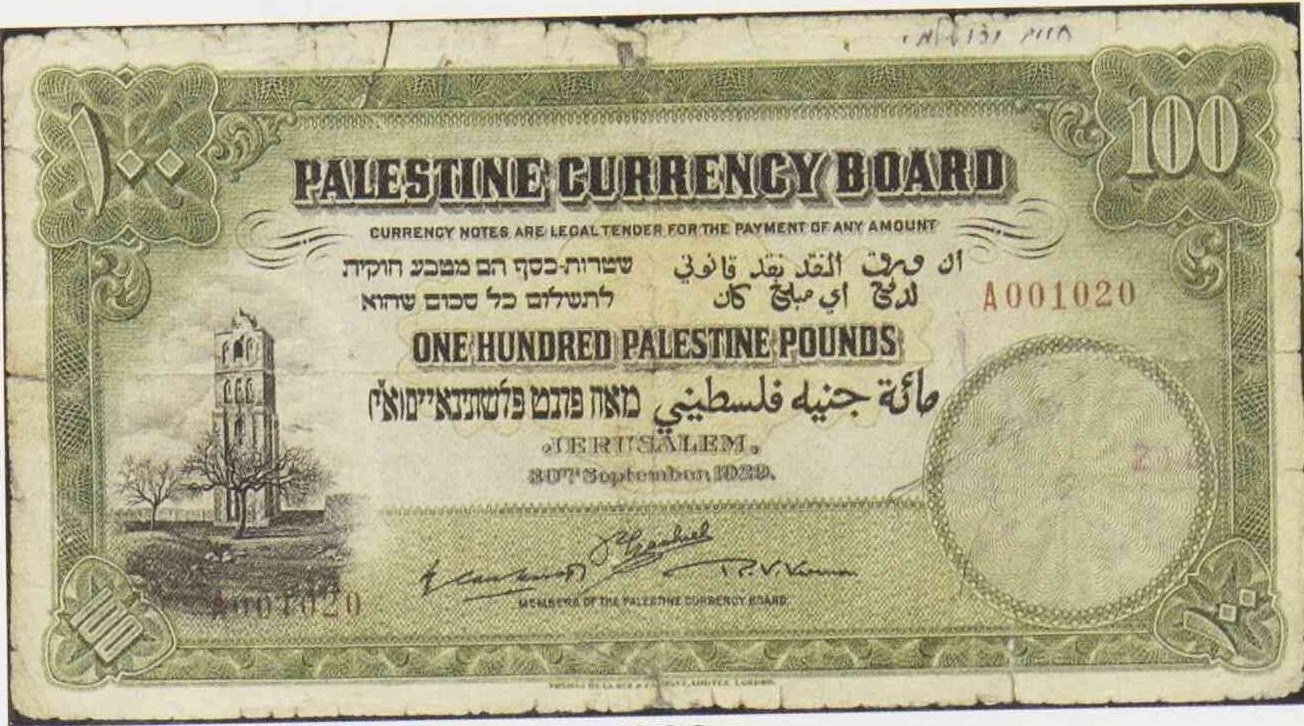
- Bank Note Reporter (June 1973, "Rare Note Of Palestine"): by the records of the time seven notes not accounted for; one of each of the three dates, 1927, 1929 and 1942, since found, leaving four at large.
- Sylvia Haffner (Bank Note Reporter, July 1980): four issued notes known, two of 1927 and two of 1929, the first of them found in 1970; about seven thought still outstanding.
- Howard M. Berlin (The Shekel, vol. 18 no. 2, 1985): four issued notes known, two of 1927 and two of 1929, all in private collections.
- Jack H. Fisher (Bank Note Reporter, November 1994): six issued notes never redeemed, four of them known.
- Jack H. Fisher (Bank Note Reporter, June 1999): two notes of 1927 and two of 1929 known out of seven never redeemed; of 1942, one specimen and no issued note.
- R. M. Smythe (18 June 2005, lot 4803): five issued notes known, three of them available to collectors.
- Heritage Auctions (9 January 2006, lot 14368): the Bank of England records show six issued notes not redeemed, five of them known, without counting the serial number 1 note found in Israel.
- Sotheby's (19 December 2012, lot 172): five known, in the note on a 100 pounds of 1927 sold inside a whole collection.
- Spink (10 April 2013, lot 1139): five issued notes known.
- Spink (28 April 2022, lot 257): its cancelled note the fourth known of its type, and three issued 100 pounds offered at public auction in twenty years, one of them the second cancelled note.
- Stack's Bowers (6 May 2026, lot 50063): nine notes known, seven dated 1927 and two dated 1929; apart from serial number 1, all within a range of about three hundred numbers; four of the nine cancelled; several in museums and no more than four in private hands.
The Bank Note Reporter of June 1973 counts a found note of 1942. Every later source knows that date as a specimen only, and the catalogue has seen no issued note of 1942. Stack's Bowers counts seven notes dated 1927, more than the catalogue's register has seen; its two notes dated 1929 match the two on the register.
Each note of the two high values, with every sale and source behind it, is in Palestine 50 and 100 pounds: how many survive.
Sources
- The catalogue's pages for the six values: the numbering rules, the ranges ("sources mention") and the test of each range against the notes on record.
- Jack H. Fisher: I.B.N.S. Journal, vol. 11 no. 4, 1972; The Shekel, 1987, 1991 and 1994; The Shekel, vol. 28 no. 1 and no. 3, 1995; Bank Note Reporter, November 1994 and June 1999.
- Sylvia Haffner, Bank Note Reporter, July 1980. Bank Note Reporter, June 1973, "Rare Note Of Palestine".
- Howard M. Berlin, The Shekel, vol. 18 no. 2 and no. 5, 1985.
- Raphael Dabbah, I.B.N.S. Journal, vol. 51 no. 4, 2012.
- NASCA, 30 April 1981, lot 200. R. M. Smythe, 18 June 2005, lot 4803. Heritage Auctions, 9 January 2006, lot 14368, and 15 October 2026, lot 24690. Lyn Knight, 13 October 2009, lot 525. Sotheby's, 19 December 2012, lot 172.
- Spink: 29 September 2010, lots 1261, 1263, 1293, 1294 and 1304; 10 December 2010, lot 667; 27 September 2011, lots 1327, 1329, 1337, 1358, 1365, 1369 and 1376; 10 April 2013, lots 1105, 1123, 1138 and 1139; 15 April 2014, lot 1268; 27 September 2017, lot 2457; 11 April 2018, lots 13, 43 and 67; 28 April 2022, lots 257 and 266.
- Stack's Bowers: 2 October 2024, lot 20656; 2 October 2025, lot 50326; 6 May 2026, lots 50010, 50013, 50024, 50053, 50055, 50061, 50062 and 50063.
Member comments
Log in or register to post a comment.