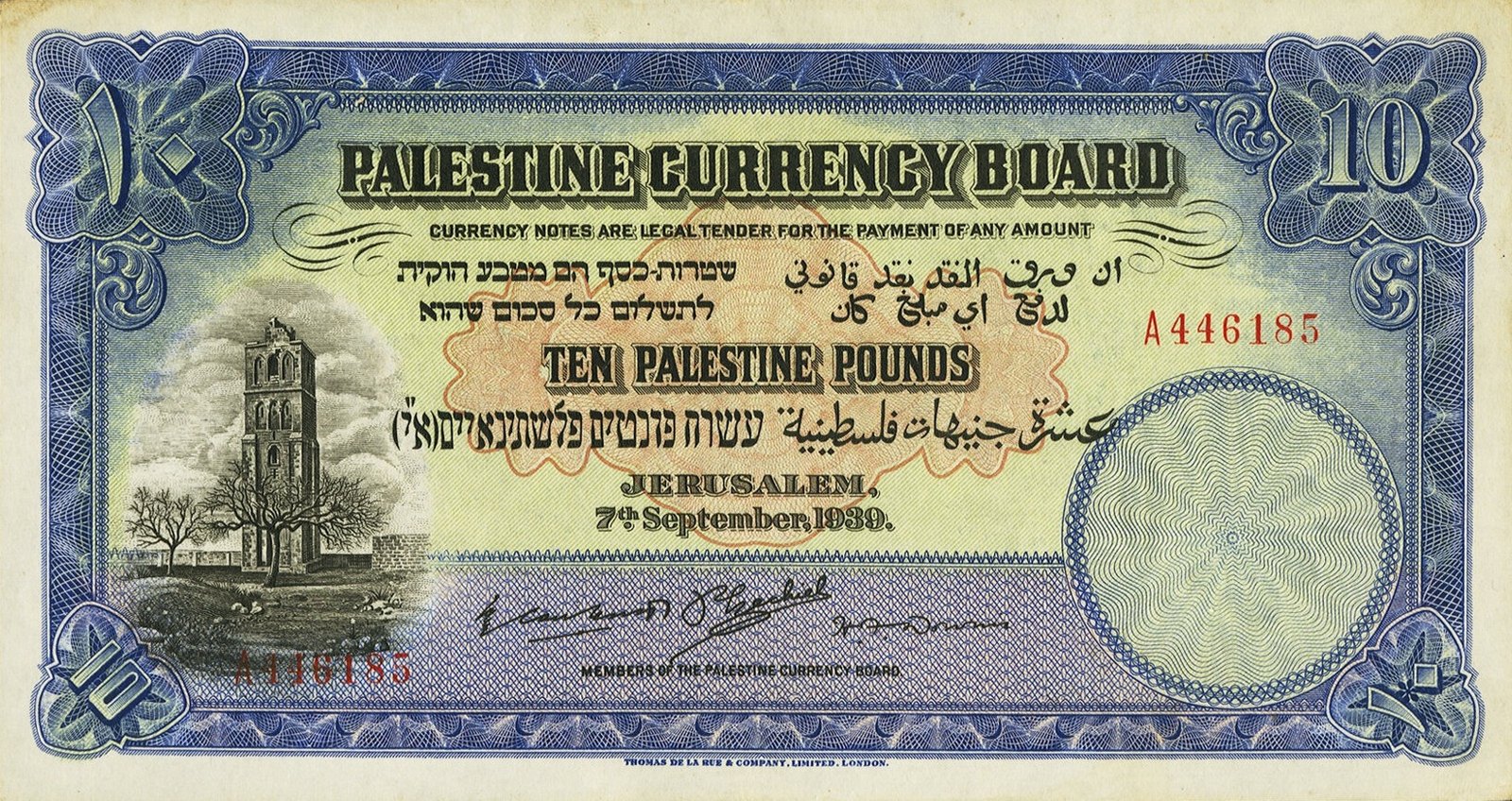
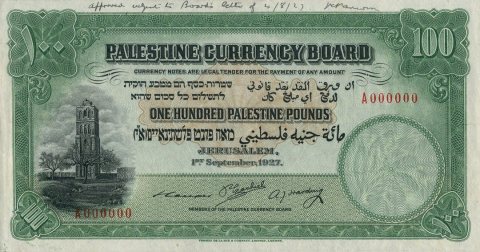
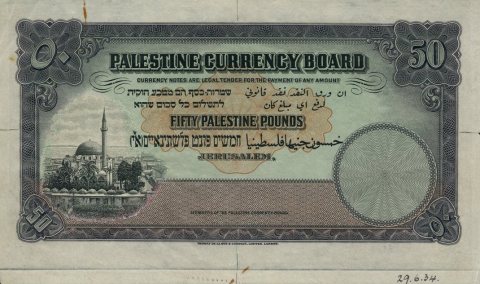
The Palestine Currency Board counted its notes in circulation once a year, on 31st March, value by value. The earlier article on the notes in circulation, value by value gives the first figure, the highest and the last for each value. This article gives the whole series: all twenty-five years for all six values of Palestine, with the coin, the reserve, the notes sent out new and the notes taken back as unfit. It also shows where one printing of a figure differs from another.
The figures are in Palestine pounds unless a column says otherwise. For the 1 pound the pounds are also the number of notes.
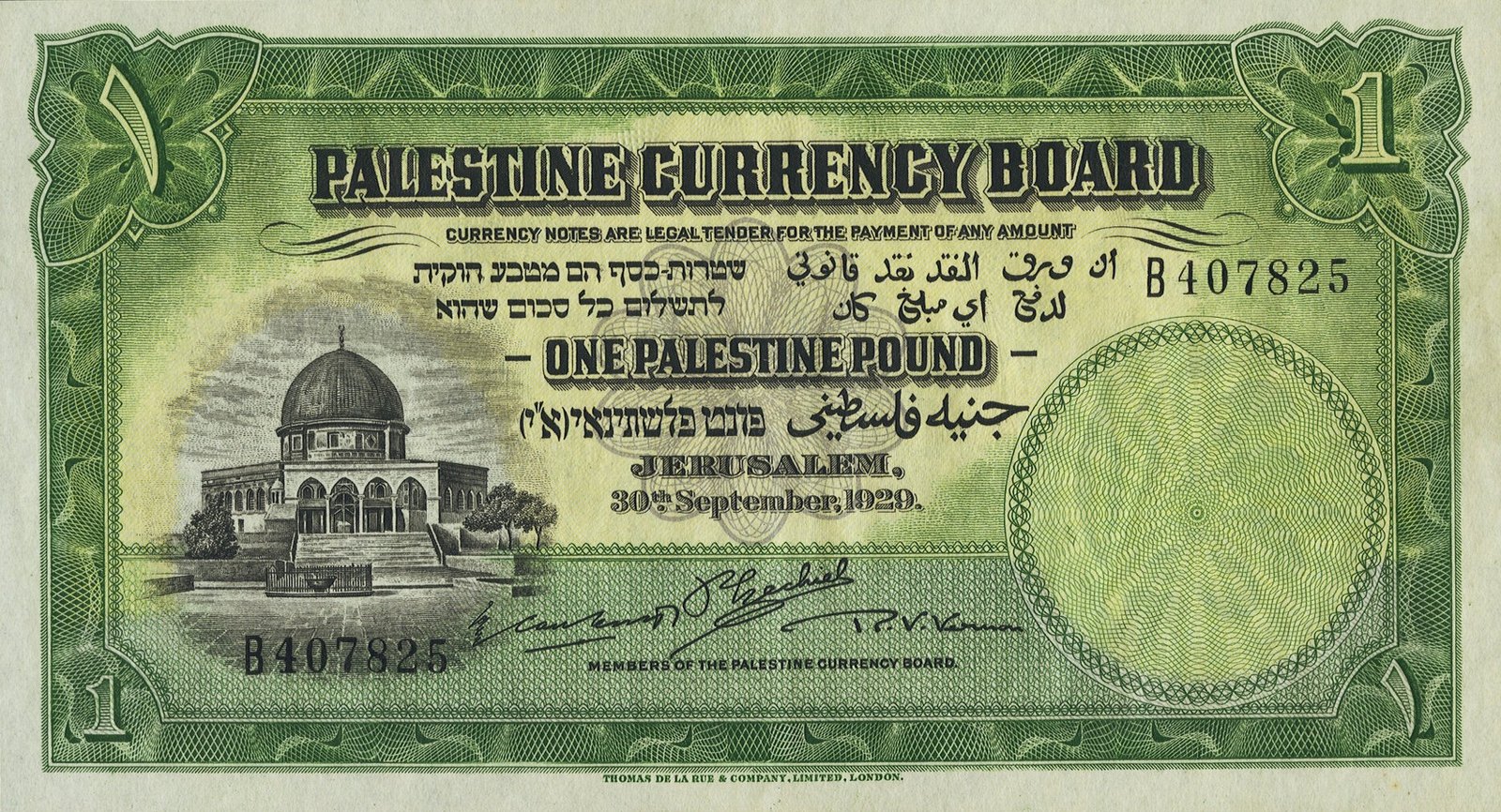
Where the figures are printed
No report of the Board itself has been read for this catalogue apart from the first, which The Palestine Bulletin printed in full on 10th December 1928. The yearly figures reach us through four printings:
- The Palestine Blue Book for 1938, Section XIX, Currency, printed pages 443 and 444: a table headed "Value of currency in circulation and amount of Currency Reserve Fund as at March 31st, 1928-1938". The same table stands in the Blue Books for 1935 (p. 789) and 1937 (p. 455).
- The annual reports to the League of Nations for 1928 (pp. 11 and 12), 1929 (p. 21), 1930 (p. 111) and 1931 (p. 88), which count on 31st December and not on 31st March.
- Jack H. Fisher in The Shekel. Fisher printed a table for each value from official records between 1971 and 1975, and in 1989 and 1990 printed the Board's yearly tables for 1928 to 1946 with the six values side by side and the coin above them (the series "Chronology of the Palestine Currency Board", vol. 22 and vol. 23).
- Howard M. Berlin, The Palestine Currency Board, 2025, Appendix E, pp. 100 to 102: a table for every 31st March from 1928 to 1952.
The Statistical Abstract of Palestine for 1929 (p. 8) prints the notes by value for March 1928, December 1928 and March 1929. Its figures for the 500 mils (206,000, 181,145 and 161,769 pounds) and the 100 pounds (53,500, 22,300 and 26,300 pounds) are those of the tables below.
1928 to 1938, from the Palestine Blue Book
| 31st March | 500 mils | 1 pound | 5 pounds | 10 pounds | 50 pounds | 100 pounds | All notes |
|---|---|---|---|---|---|---|---|
| 1928 | 206,000 | 765,000 | 410,000 | 160,000 | 98,000 | 53,500 | 1,692,500 |
| 1929 | 161,769 | 731,712 | 402,935 | 165,050 | 98,150 | 26,300 | 1,585,916 |
| 1930 | 153,577 | 888,043 | 562,920 | 225,080 | 97,200 | 21,600 | 1,948,420 |
| 1931 | 104,385 | 999,943 | 648,770 | 231,880 | 88,350 | 12,000 | 2,085,328 |
| 1932 | 117,779 | 985,514 | 643,815 | 244,710 | 76,850 | 9,500 | 2,078,168 |
| 1933 | 181,679 | 1,164,856 | 751,825 | 310,960 | 70,200 | 8,400 | 2,487,920 |
| 1934 | 254,645 | 1,532,740 | 1,226,075 | 564,270 | 68,250 | 5,600 | 3,651,580 |
| 1935 | 297,599 | 1,839,844 | 1,611,575 | 958,100 | 90,150 | 11,900 | 4,809,168 |
| 1936 | 295,610 | 2,025,230 | 1,974,355 | 1,188,340 | 136,700 | 44,700 | 5,664,935 |
| 1937 | 301,909 | 2,031,230 | 1,701,355 | 962,340 | 76,200 | 20,600 | 5,093,634 |
| 1938 | 298,509 | 1,926,530 | 1,484,355 | 734,340 | 53,400 | 14,700 | 4,511,834 |
The same table gives the coin and the Currency Reserve Fund for each of those days:
| 31st March | All coin | Coin and notes together | Currency Reserve Fund |
|---|---|---|---|
| 1928 | 194,848 | 1,887,348 | 1,816,057 |
| 1929 | 201,748 | 1,787,664 | 1,743,079 |
| 1930 | 249,244 | 2,197,664 | 2,184,673 |
| 1931 | 284,336 | 2,369,664 | 2,421,595 |
| 1932 | 330,496 | 2,408,664 | 2,522,260 |
| 1933 | 333,744 | 2,821,664 | 3,009,403 |
| 1934 | 418,084 | 4,069,664 | 4,290,974 |
| 1935 | 517,060 | 5,326,228 | 5,597,632 |
| 1936 | 571,200 | 6,236,135 | 6,446,529 |
| 1937 | 532,500 | 5,626,134 | 5,734,917 |
| 1938 | 497,300 | 5,009,134 | 5,195,341 |
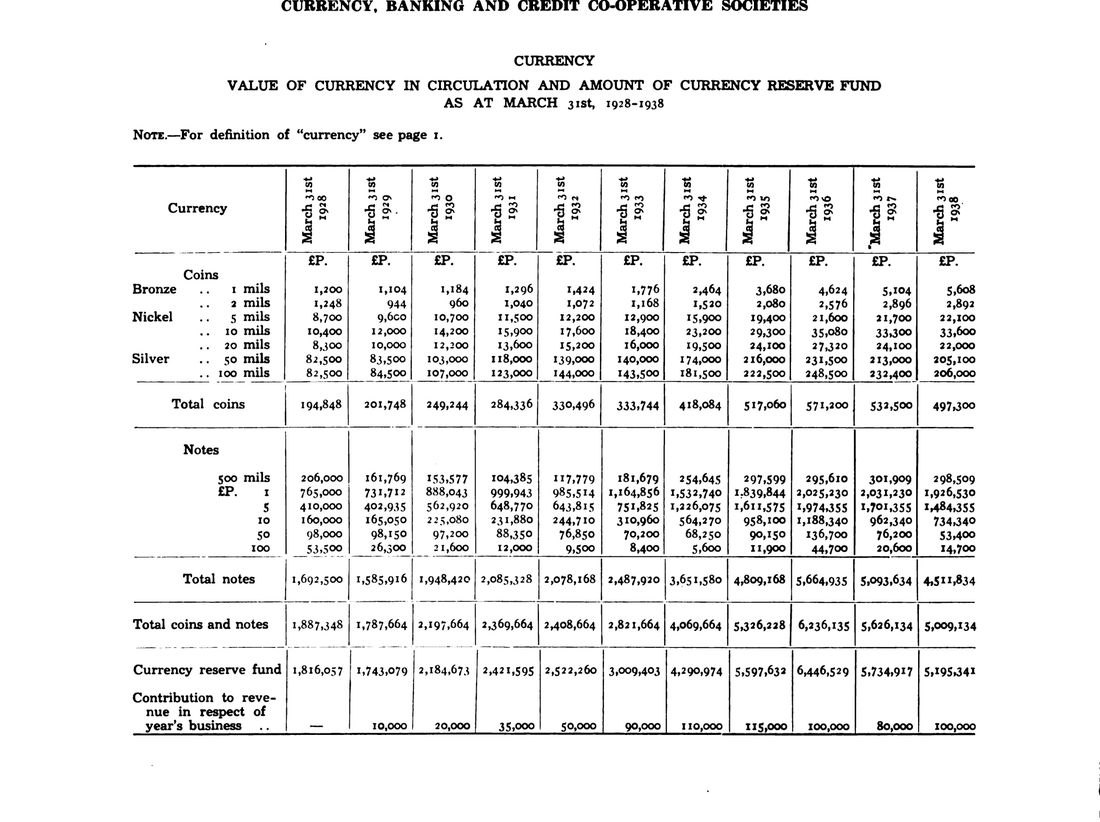
The figure of coin and notes together for 1935, 5,326,228 pounds, is printed in the Blue Book's table; the annual report to the League of Nations for 1935 gives the same figure. The Economic Survey for 1933 gives the same 4,069,664 pounds for 31st March 1934 as the Blue Book.
31st December 1928 to 1931, from the reports to the League of Nations
| 31st December | 500 mils | 1 pound | 5 pounds | 10 pounds | 50 pounds | 100 pounds | All notes | Coin and notes together |
|---|---|---|---|---|---|---|---|---|
| 1928 | 181,145 | 742,453 | 377,750 | 152,750 | 71,550 | 22,300 | 1,547,948 | 1,762,664 |
| 1929 | 169,819 | 865,731 | 531,580 | 191,340 | 96,450 | 25,100 | 1,880,020 | 2,117,664 |
| 1930 | 109,985 | 968,845 | 588,680 | 213,200 | 66,750 | 11,600 | 1,959,060 | 2,244,664 |
| 1931 | 110,111 | 975,615 | 587,320 | 228,470 | 62,300 | 9,500 | 1,973,316 | 2,303,664 |
The report for 1928 also gives the number of notes: 362,290 of 500 mils, 742,453 of 1 pound, 75,550 of 5 pounds, 15,275 of 10 pounds, 1,431 of 50 pounds and 223 of 100 pounds. These four December columns were read in the text of the reports, not on the printed page.
1939 to 1952, from the tables Jack H. Fisher printed in The Shekel
The Blue Book series stops in 1938, and no Blue Book or annual report after that year has been read. From 1939 the figures below are those of Fisher's tables. The 100 pounds is given as Fisher's own table gives it, in numbers of notes.
| 31st March | 500 mils | 1 pound | 5 pounds | 10 pounds | 50 pounds | 100 pounds (notes) |
|---|---|---|---|---|---|---|
| 1939 | 384,854 | 2,457,821 | 1,949,245 | 1,046,470 | 170,200 | 238 |
| 1940 | 477,825 | 2,785,821 | 2,581,535 | 1,686,090 | 295,800 | 146 |
| 1941 | 639,717 | 3,716,346 | 3,014,890 | 2,154,980 | 611,050 | 135 |
| 1942 | 705,698 | 5,464,702 | 3,766,665 | 2,603,300 | 575,250 | 133 |
| 1943 | 1,125,205.500 | 9,893,099 | 7,496,760 | 5,687,490 | 802,400 | 461 |
| 1944 | 932,056.500 | 12,494,508 | 11,564,275 | 9,228,930 | 1,092,000 | 757 |
| 1945 | 712,049 | 11,449,583 | 15,534,205 | 13,626,730 | 1,208,500 | 1,457 |
| 1946 | 843,543.500 | 9,579,528 | 16,762,940 | 16,021,280 | 1,165,000 | 1,422 |
| 1947 | 854,956 | 8,928,469 | 17,127,660 | 17,010,660 | 1,235,500 | 1,795 |
| 1948 | 936,405.500 | 9,413,578 | 19,546,150 | 20,041,280 | 1,028,850 | 1,587 |
| 1949 | 589,362 | 3,795,913 | 10,156,100 | 8,391,630 | 411,450 | 854 |
| 1950 | 172,445 | 2,334,606 | 4,957,170 | 7,364,355 | 332,050 | 525 |
| 1951 | 105,263 | 746,913 | 1,531,295 | 1,959,930 | 73,500 | 75 |
| 1952 | 68,533 | 225,743 | 126,470 | 160,570 | 20,300 | 16 |
Fisher prints the 500 mils with half pounds where an odd number of notes was out. The Blue Book rounds the same figure for 1936 to 295,610 pounds.
For 1940 to 1946 the yearly tables that Fisher printed in 1989 and 1990 also give the totals:
| 31st March | All notes | All coin | Coin and notes together |
|---|---|---|---|
| 1940 | 7,841,671 | 699,964 | 8,541,635 |
| 1941 | 10,150,483 | 890,152 | 11,040,635 |
| 1942 | 13,128,915 | 1,087,720 | 14,216,915 |
| 1943 | 25,051,054.500 | 1,436,620 | 26,487,674.500 |
| 1944 | 35,387,469.500 | 1,651,230 | 37,038,699.500 |
| 1945 | 42,676,767 | 1,610,426 | 44,287,193 |
| 1946 | 44,514,491.500 | 1,673,650 | 46,188,141.500 |
In those tables the 100 pounds stands in pounds: 14,600 in 1940, 13,500 in 1941, 13,300 in 1942, 46,100 in 1943, 75,700 in 1944, 145,700 in 1945 and 142,200 in 1946. Each agrees with the count of notes in the table above.
For 31st March 1939 The Palestine Post of 6th December 1939 (p. 5), from the Board's report, gives 6,574,134 pounds of coin and notes together. For 31st March 1947 Berlin's table has 46,887,894 pounds, where Berlin's own text (p. 60) speaks of 46,067,894 pounds in April 1947 falling to 40,957,804 in November 1947.
Where the printings differ
The four printings were set against one another when the Colonial Office volumes, The Shekel and Berlin's book were read. They agree in all but a few figures.
| Value and day | One printing | Another printing |
|---|---|---|
| 1 pound, 31st March 1931 | 999,943 in the Blue Book for 1938 and in Fisher's table of the 1 pound | 999,843 in the yearly table Fisher printed in 1989 and in Berlin's Appendix E |
| 1 pound, 31st March 1935 | 1,839,844 in the Blue Book and in the yearly table of 1989 | not printed in Fisher's table of the 1 pound |
| 5 pounds, 31st March 1935 | 1,611,575 in the Blue Book, the yearly table of 1989 and Berlin | 1,611,375 in Fisher's table of the 5 pounds |
| 10 pounds, 31st March 1929, 1930 and 1933 | 165,050, 225,080 and 310,960 in the Blue Book, in Fisher's first table of 1972 and in the yearly tables of 1989 | 165,000, 225,000 and 310,000 in Fisher's printings of the table in 1987 and 1994 |
| 10 pounds, 31st March 1937 | 962,340 in the Blue Book, in Fisher's tables of 1972 and 1987 and in the yearly table of 1989 | 987,340 in Fisher's table of 1994 |
| 50 pounds, 31st March 1931 | 88,350 in the Blue Book, in Fisher's table of 1971 and in the yearly table of 1989 | 98,350 in Fisher's table of 1995 |
| 50 pounds, 31st March 1950 | 332,050 in Fisher's table of 1971 | 322,050 in Fisher's table of 1995 |
| 1 pound, 31st March 1950 | 2,334,606 in Fisher's table of 1974 | 2,334,607 in Berlin's Appendix E |
| 1 pound, 31st March 1952 | 225,743 in Fisher's table of 1974 | 225,744 in Berlin's Appendix E |
| Coin and notes together, 31st March 1942 | 14,216,915 in the yearly table in The Shekel, vol. 23 no. 1, 1990 | 14,216,635 in the table in vol. 23 no. 2, 1990 |
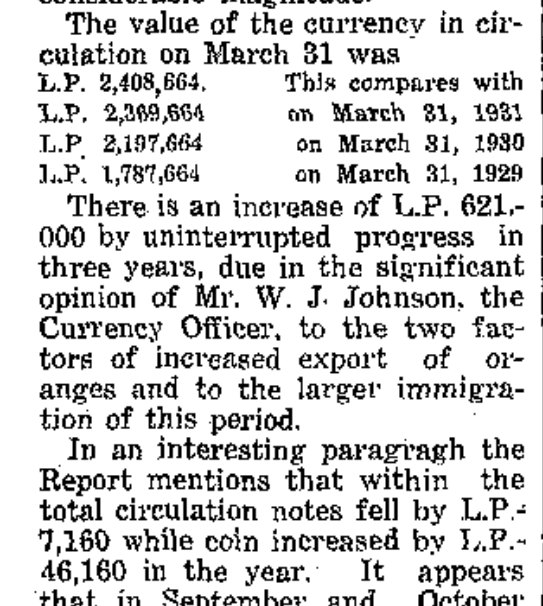
No printing is taken here as the right one. Other papers bear on three of the differences. For 1931, The Palestine Bulletin of 12th December 1932 (p. 4), from the Board's report for the year to March 1932, prints the totals of coin and notes together as 1,787,664 pounds for 1929, 2,197,664 for 1930, 2,369,664 for 1931 and 2,408,664 for 1932, and says that notes fell by 7,160 pounds in the last year. Those are the Blue Book's totals. Berlin's table has 2,369,564 for 1931 and a fall of 7,060. In the yearly table that Fisher printed in 1989 the total of notes for 1931 is 2,085,328 pounds, as in the Blue Book, although the table has 999,843 for the 1 pound. For the 5 pounds of 1935 the Blue Book, the yearly table of 1989 and Berlin have one figure and Fisher's table of the 5 pounds, printed in 1973, has the other. For the 1 pound of 1950 and 1952, Berlin prints the 500 mils in whole pounds where Fisher has half pounds.
Fisher's table of the 50 pounds printed in 1995 also leaves out 1944, 1947 and 1948 and sets 1,028,850 pounds against 1946, which is the figure of 1948 in the table of 1971.
One figure is the same in Fisher's tables and in Berlin's and is odd in both: 7,364,355 pounds of 10 pounds notes on 31st March 1950 is not a whole number of notes.
New notes supplied and unfit notes withdrawn, 1932 to 1940
Fisher also printed, from the Board's yearly reports (The Shekel, vol. 22 no. 3, no. 5 and no. 6, 1989), the notes received new and the notes taken out of use as unfit. These are numbers of notes.
| Board's year | Movement | 500 mils | 1 pound | 5 pounds | 10 pounds | 50 pounds | 100 pounds |
|---|---|---|---|---|---|---|---|
| 1932-33 | supplied | 280,000 | 280,000 | 27,000 | 5,000 | none named | none named |
| 1932-33 | withdrawn | 64,600 | 132,920 | 11,948 | 2,052 | 158 | 10 |
| 1934-35 | delivered | 200,000 | 580,000 | 158,000 | 63,000 | none named | none named |
| 1934-35 | withdrawn | 127,800 | 221,900 | 22,000 | 3,200 | 388 | 33 |
| 1935-36 | produced | 400,000 | 1,540,000 | 415,000 | 245,000 | 14,000 | 3,000 |
| 1935-36 | withdrawn unfit | 239,000 | 338,000 | 38,000 | 6,650 | 692 | 80 |
| 1936-37 | produced | none | none | none | none | none | none |
| 1936-37 | withdrawn unfit | 209,001 | 292,000 | 34,000 | 6,100 | 360 | 94 |
| March 1937 to March 1938 | withdrawn unfit | 247,000 | 427,000 | 51,000 | 9,000 | 370 | 60 |
| year to March 1939 | withdrawn unfit | 190,010 | 298,022 | 37,022 | 6,000 | 148 | 26 |
| year to 31st March 1940 | withdrawn unfit | 265,058 | 364,759 | 38,790 | 5,363 | 105 | 20 |
The value of the notes withdrawn is printed as 254,380 pounds for 1932-33, 356,800 for 1933-34 (for which no split by value is given), 450,500 for 1934-35, 756,600 for 1935-36, 654,900.500 for 1936-37, 920,000 for the year to March 1938, 648,137 for the year to March 1939 and 752,118 for the year to 31st March 1940.
The supplies of 1932 to 1936 are already on the catalogue's pages. The withdrawals are not. In the Board's year 1936-37, when no new notes were made, 209,001 notes of 500 mils were withdrawn as unfit, against 301,909 pounds of that value in circulation at the end of the year.
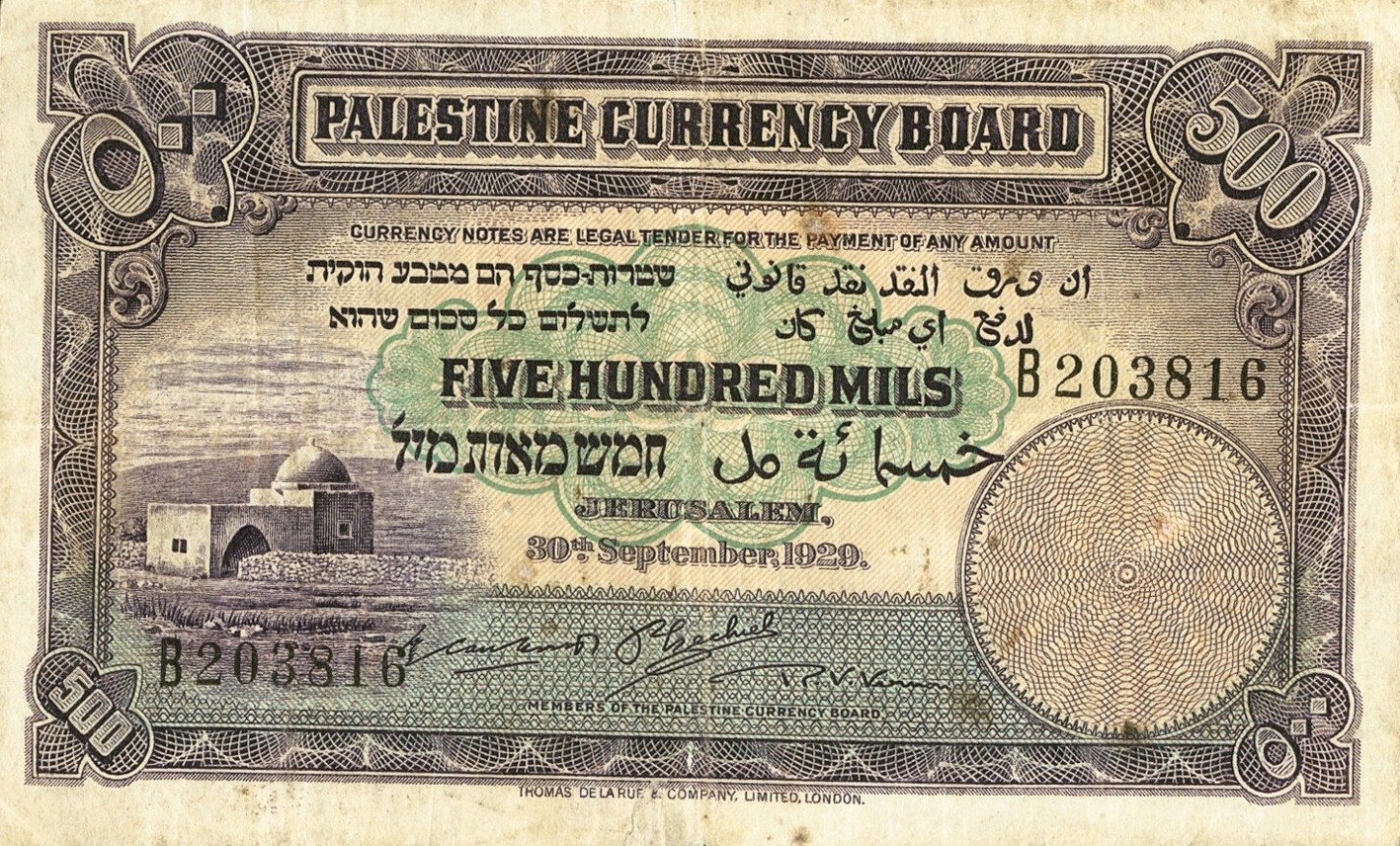
No such figures have been found for any year before 1932-33 or after March 1940. The first order of 1927 is known only as a sum, 1,500,000 pounds raised to 2,160,000.
The war years
Fisher's series of 1990 prints an index of currency in circulation and bank deposits in Palestine, with August 1939 as 100:
| Month | Index |
|---|---|
| August 1939 | 100 |
| December 1939 | 92 |
| June 1940 | 99 |
| December 1940 | 99 |
| June 1941 | 112 |
| December 1941 | 132 |
| June 1942 | 158 |
| December 1942 | 207 |
| June 1943 | 260 |
| December 1943 | 328 |
| June 1944 | 372 |
| December 1944 | 422 |
Beside it stand the bank deposits in Palestine: 16,847,000 pounds in 1938, 19,920,000 in 1939, 16,199,000 in 1940, 16,685,000 in 1941, 23,742,000 in 1942, 38,690,000 in 1943, 63,025,000 in 1944 and 80,117,000 in 1945.
From the Board's reports as Fisher prints them, the Secretary's report of 20th September 1945 says that for nearly five years most currency went out by sea round the Cape, that of 122 consignments sent during the war in Europe three were lost, and that no value of note or coin ever ran short in Palestine.
Raphael Dabbah (I.B.N.S. Journal, vol. 51 no. 4, 2012, p. 14) gives the 50 pounds in numbers of notes: 5,916 in 1940, 12,221 in 1941, 11,505 in 1942, 16,048 in 1943, 21,840 in 1944 and a peak of 24,710 in 1947. Berlin (p. 47) has the same 11,505 notes of 50 pounds, and 133 of 100 pounds, for 31st March 1942.
Three sudden calls for notes
The yearly figures hide what happened inside a year. Three such movements are on record.
- Berlin (p. 44) writes that about 1,800,000 pounds was issued between 27th August and 8th September 1936, after Italy invaded Ethiopia, and that most of it came back. Fisher (The Shekel, 1990), from the Board's reports, has the Board sending notes by air, some on chartered aircraft, during a run on the banks in September 1935. The two accounts give different years for what reads as one event, and the Board's report has not been read to settle it.
- In September 1938 an extra 1,975,000 pounds was called for, as told in Coin or paper? Two runs on the Palestine currency, 1931 and 1938. Berlin (p. 45) adds that the circulation reached nearly 11 million pounds at the end of August 1938 and that over 2,600,000 pounds was redeemed by February 1940. Raphael Dabbah (I.B.N.S. Journal, vol. 51 no. 4, 2012, p. 13) has the money in circulation rising from about 6.6 million to almost 11 million pounds in August 1939. The two writers give the same peak a different year.
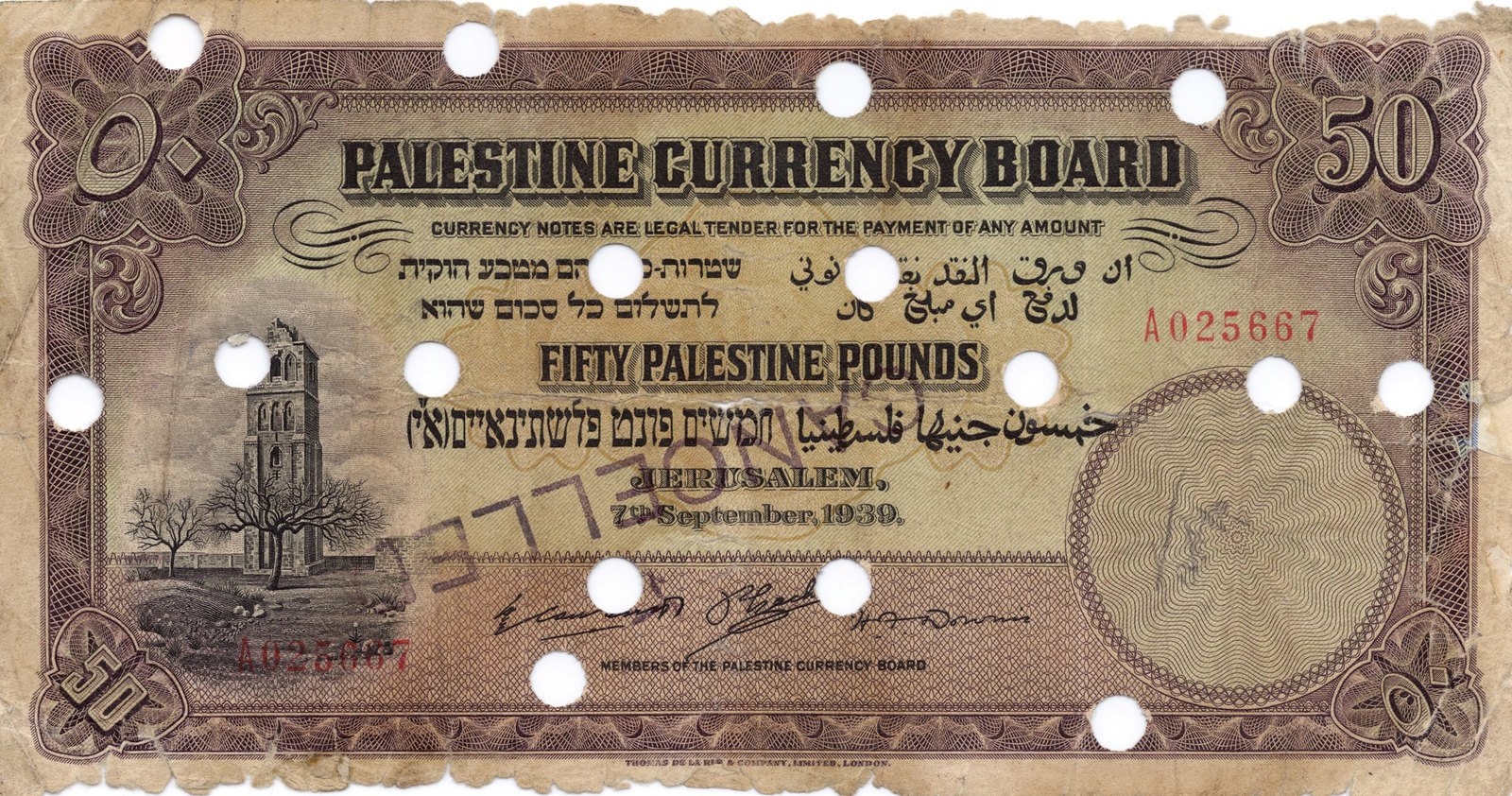
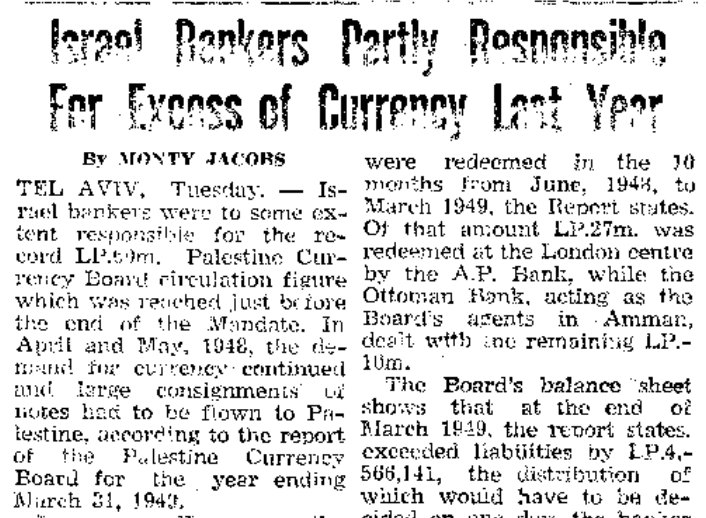
- In April and May 1948 notes had to be flown out to Palestine (The Palestine Post, 30th November 1949, p. 3). The rest is in The last years of the Palestine pound, 1948 to 1952.
What the figures do not tell
- The date on the notes. The Board counted by value, never by the date printed on a note. Nothing here divides a year's figure between the notes of 1927, 1929, 1939 and 1944.
- How many were printed. Fisher wrote more than once in The Shekel that the printer kept no record of when each value was issued, that many of the Board's records were lost in the Second World War, and that no figures of notes printed by date were to be had. The supplies of 1932 to 1936 are the only ones known.
- The serial numbers. No table names a prefix or a number.
- What exists. A note counted as in circulation is a note not yet paid back. Fisher was warned by the officials who gave the later figures that they are figures of the books, and that many of the notes must have been lost or destroyed.
The count went on after the Board was dissolved on 31st March 1952. Those later figures, of notes still not redeemed in 1966 and 1974, are in the article on the notes in circulation, value by value.
Sources
- The Palestine Blue Book for 1938, Section XIX, Currency, printed pp. 443 and 444; the same table in the Blue Books for 1935 (p. 789) and 1937 (p. 455).
- The annual reports to the League of Nations on Palestine for 1928 (pp. 11 and 12), 1929 (p. 21), 1930 (p. 111), 1931 (p. 88) and 1935.
- The Economic Survey of Palestine for 1933.
- The Statistical Abstract of Palestine, 1929, p. 8.
- Jack H. Fisher in The Shekel: the tables of each value printed from 1971 to 1975; the 10 pounds again in 1987 and 1994 and the 50 pounds in 1995 (vol. 28 no. 1 and no. 3); vol. 22 no. 3 to no. 6, 1989, and vol. 23, 1990, among them the series "Chronology of the Palestine Currency Board".
- Howard M. Berlin, The Palestine Currency Board: Its History and Currency, 2025, pp. 44, 45, 47, 60 and Appendix E, pp. 100 to 102.
- Raphael Dabbah, I.B.N.S. Journal, vol. 51 no. 4, 2012, pp. 13 and 14.
- The Palestine Bulletin, 10th December 1928 and 12th December 1932 (p. 4). The Palestine Post, 6th December 1939 (p. 5) and 30th November 1949 (p. 3).
Member comments
Log in or register to post a comment.