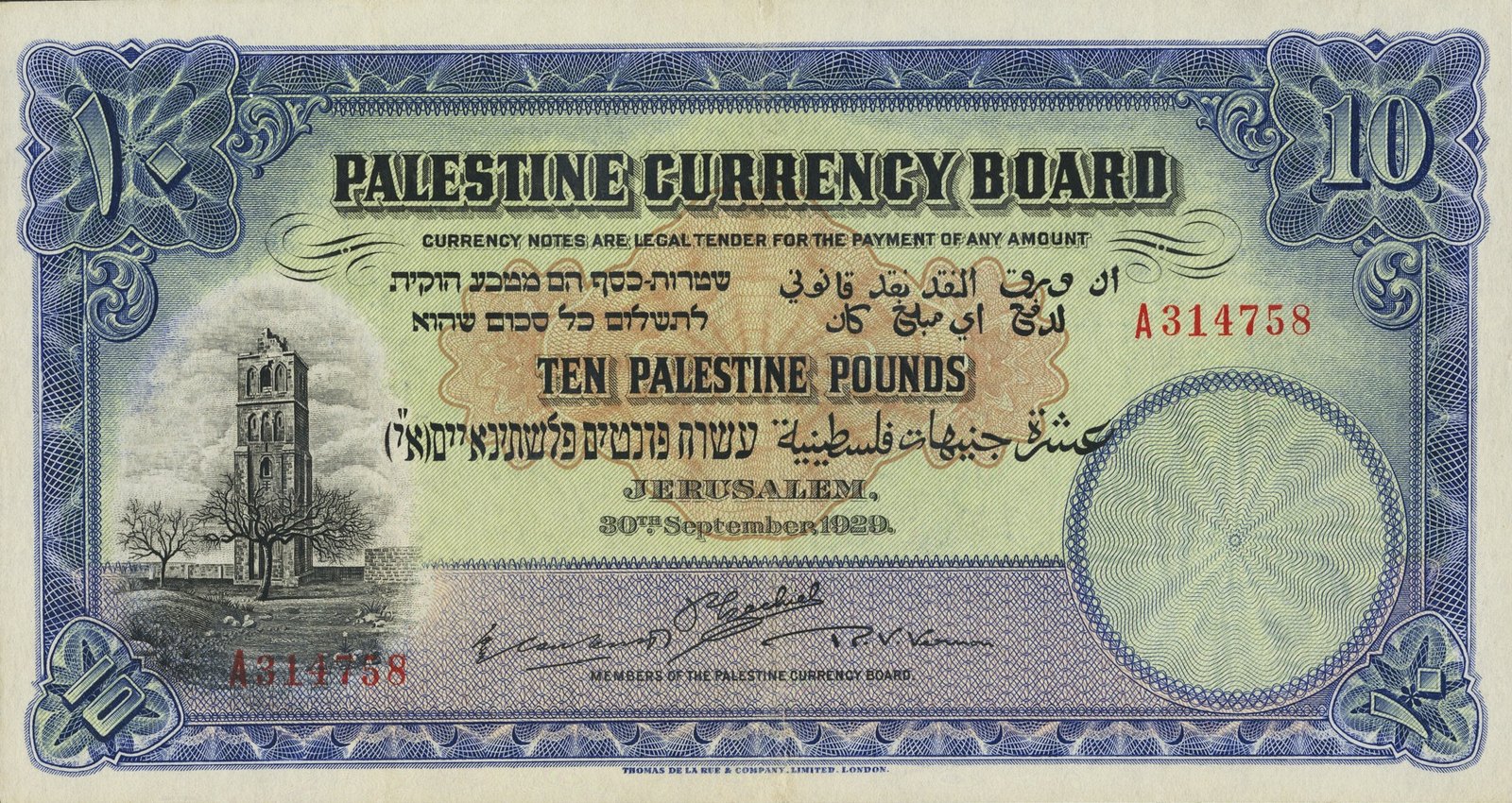
This article puts in one place the figures that the catalogue's pages give for the notes of Palestine in circulation: the number of notes of each value on given days from 1928 to 1952, the new supplies of 1932 to 1936, and the notes not yet redeemed in 1966 and 1974. The figures come from the Palestine Blue Book for 1938, the annual report to the League of Nations for 1928, and the Palestine Currency Board's yearly figures as the pages pass them on. Where the pages write "sources mention", no closer source is named, and that is said here too.
The six values in 1928
The first figures are for 31st March 1928, five months after the issue, and for 31st December 1928.
| Value | In circulation, 31st March 1928 | In circulation, 31st December 1928 |
|---|---|---|
| 500 mils | 412,000 notes (206,000 pounds) | 362,290 notes |
| 1 pound | 765,000 notes | 742,453 notes |
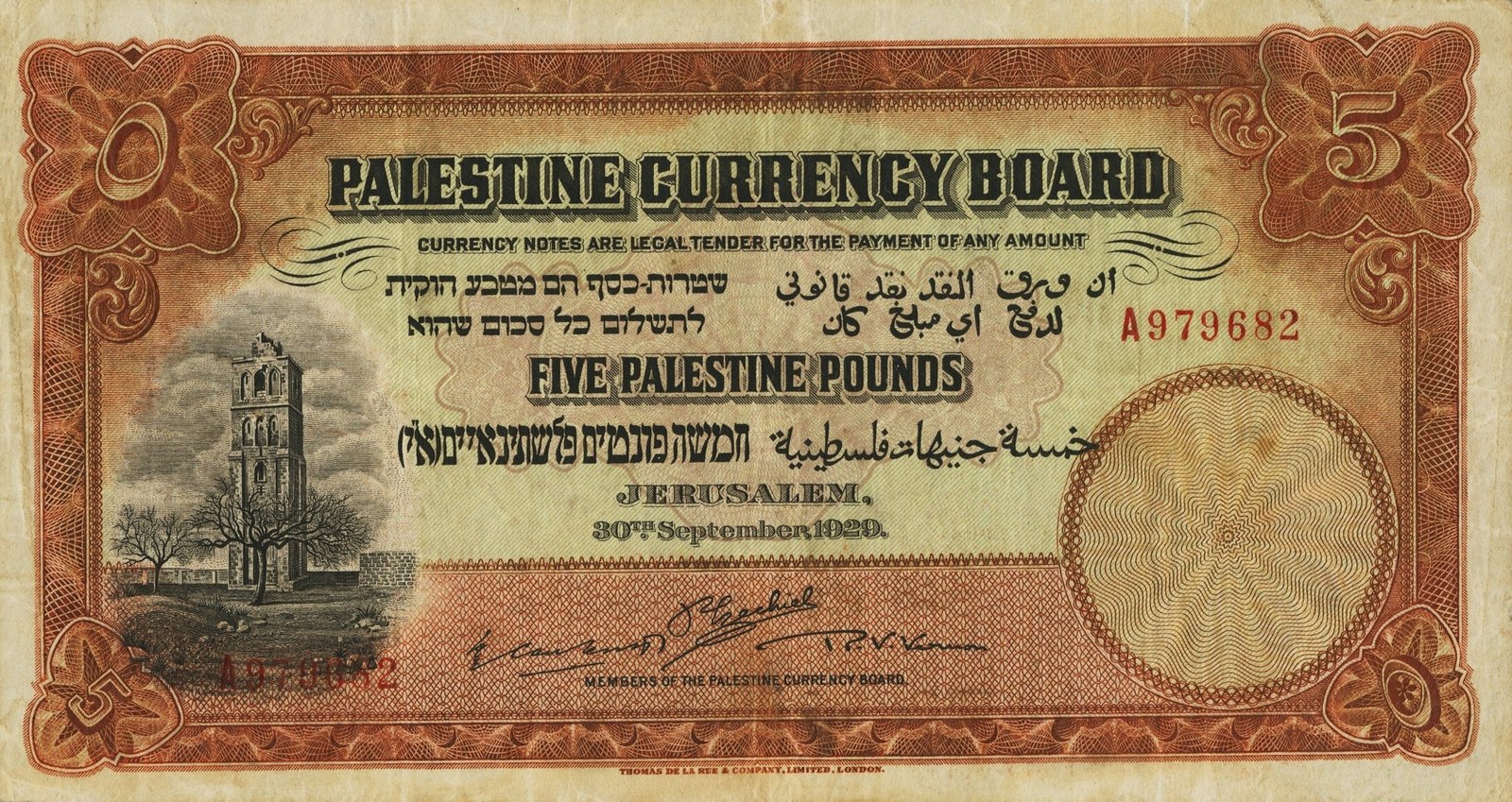
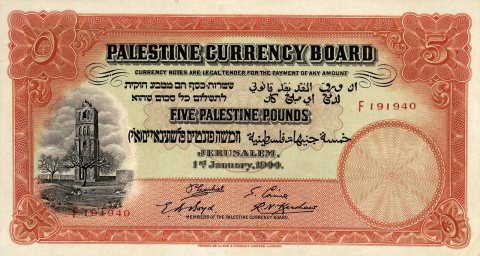
| 5 pounds | 82,000 notes (410,000 pounds) | 75,550 notes |
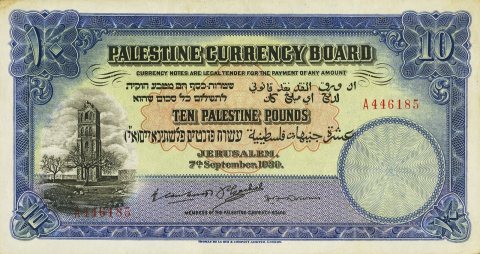
| 10 pounds | 16,000 notes (160,000 pounds) | 15,275 notes |
| 50 pounds | 1,960 notes (98,000 pounds) | 1,431 notes |
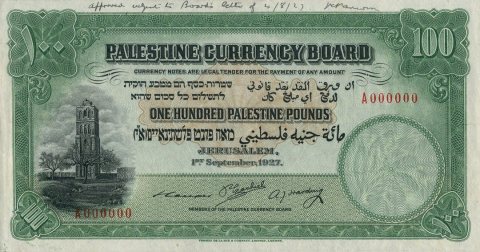
| 100 pounds | 535 notes | 223 notes |
The March column is what sources mention from the Board's yearly figures, and the Palestine Blue Book for 1938 gives the same numbers. The December column is from the annual report to the League of Nations for 1928.
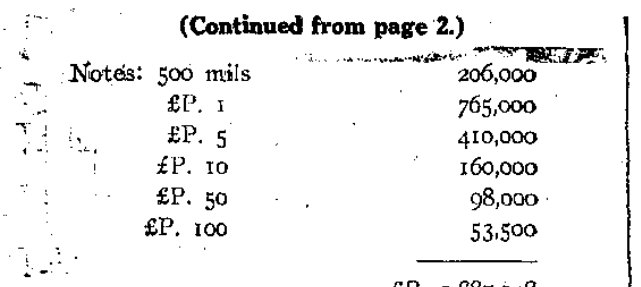
By value, the March figures add up to 1,692,500 pounds. The pages also say that by 31st March 1928 about 1,899,000 pounds in notes had been issued in exchange for about 1,810,000 pounds of Egyptian notes. The pages do not explain the difference between the two totals. One counts notes issued in exchange and the other notes in circulation on the day, and they need not be the same.
1928 to 1938, from the Palestine Blue Book
The Palestine Blue Book for 1938 gives the figure for every 31st March from 1928 to 1938. The pages quote these years from it, in numbers of notes:
| 31st March | 500 mils | 1 pound | 5 pounds | 10 pounds | 50 pounds | 100 pounds |
|---|---|---|---|---|---|---|
| 1928 | 412,000 | 765,000 | 82,000 | 16,000 | about 1,950 | 535 |
| 1929 | not quoted | 731,712 | 80,587 | 16,505 | about 1,950 | 263 |
| 1930 | not quoted | not quoted | not quoted | not quoted | about 1,950 | 216 |
| 1934 | not quoted | over a million | 245,215 | 56,427 | 1,365 | 56 |
| 1935 | not quoted | over a million | not quoted | not quoted | not quoted | 119 |
| 1936 | not quoted | over a million | 394,871 | 118,834 | 2,734 | 447 |
| 1937 | not quoted | 2,031,230 | not quoted | not quoted | not quoted | 206 |
| 1938 | 597,018 | 1,926,530 | 296,871 | 73,434 | 1,068 | 147 |
"Not quoted" means only that the page does not repeat the Blue Book's figure for that year. For the 500 mils the page says that from 206,000 pounds in 1928 the amount in circulation fell by about half in the early 1930s and stood at 298,509 pounds in 1938. For the 1 pound it says more than a million from 1933. For the 50 pounds the Board's figure for 31st March 1928 is 1,960 notes, where the Blue Book is quoted as about 1,950 for 1928 to 1930.
Three things show in the table. Among the years quoted, the 5 and 10 pounds stood highest in 1936 and had fallen back by 1938. The 100 pounds fell from 535 notes to 56 in six years and then rose again. The 50 pounds stood at its lowest, 1,068 notes (53,400 pounds), on 31st March 1938.
Heritage Auctions' description of lot 18019 in its sale of 21 October 2015 says that only 394,871 notes of 5 pounds were issued in the ten years of the 1929 date. That is the Blue Book's number for the 5 pounds in circulation on 31st March 1936. It is a count of notes in circulation on one day, not a count of notes issued or printed.
New supplies, 1932 to 1936
Sources mention, from the Board's yearly reports, the new supplies of notes in three of its years. All fall between the dates of 1929 and 1939, so on the dates known the notes would carry the date 30th September 1929.
| Board's year | 500 mils | 1 pound | 5 pounds | 10 pounds | 50 pounds | 100 pounds |
|---|---|---|---|---|---|---|
| 1932-33 | 280,000 | 280,000 | 27,000 | 5,000 | none named | none named |
| 1934-35 | 200,000 | 580,000 | 158,000 | 63,000 | none named | none named |
| 1935-36 | 400,000 | 1,540,000 | 415,000 | 245,000 | 14,000 | 3,000 |
The supplies of 10 pounds come to 313,000 notes. Stack's Bowers, in its sale of 6 May 2026 (lot 50055), says that fewer than 50,000 notes of 10 pounds had been printed by the time the 1939 date entered circulation. The two statements do not agree, and the page of the 10 pounds keeps the question open.
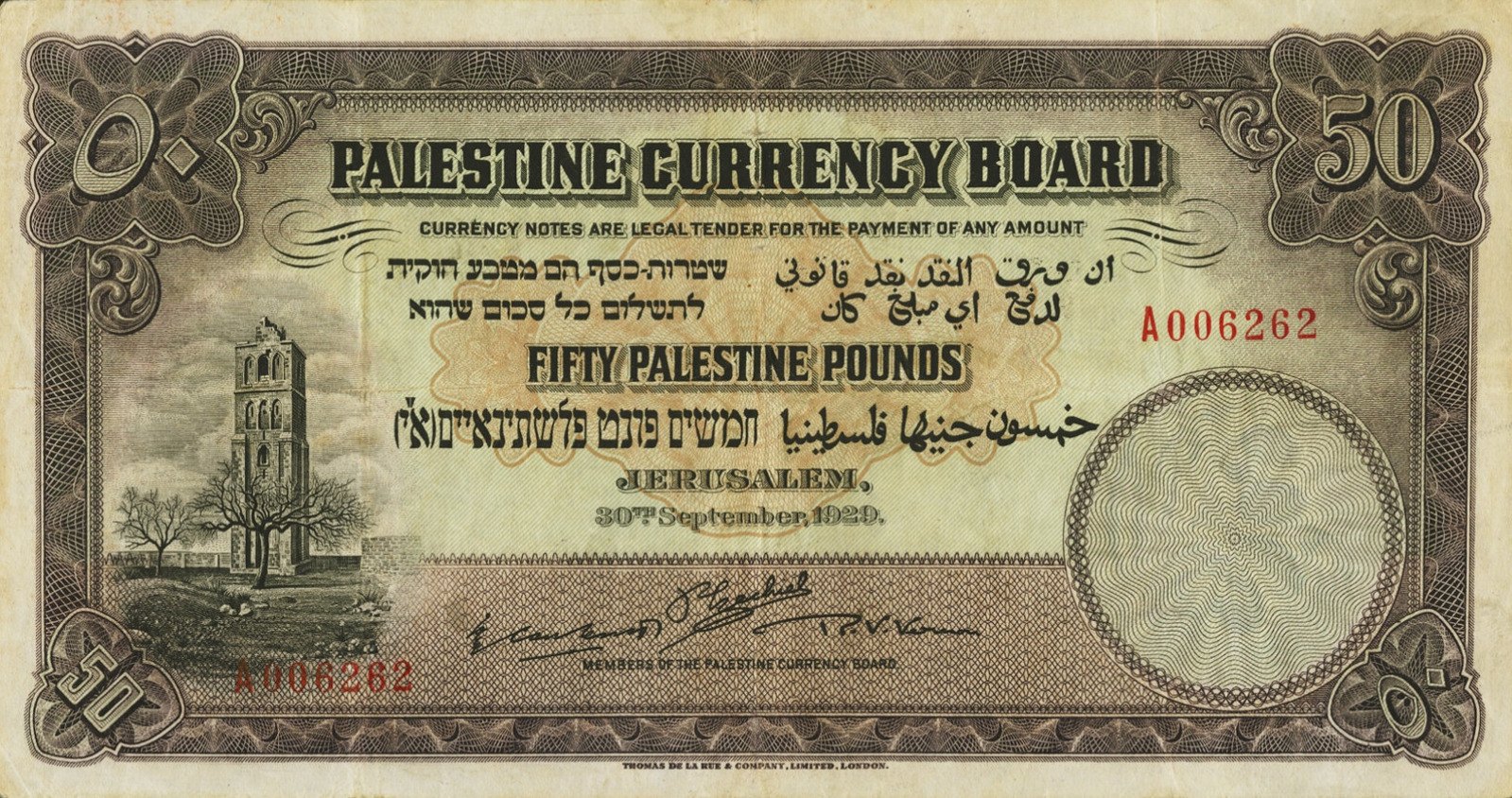
Heritage Auctions' description of lot 24690 in its sale of 15 October 2026 estimates, from the known serial numbers, perhaps 16,000 to 20,000 notes of 50 pounds printed with the 1929 date. Stack's Bowers (6 May 2026, lot 50062) puts the same issue at an estimated 17,500 notes. The 14,000 notes of 1935-36 named in the Board's report are fewer than either estimate.
The peaks, 1942 to 1948
Sources mention, from the Board's yearly figures, the highest figure for each value and the day it was reached.
| Value | Peak | Day |
|---|---|---|
| 500 mils | 1,125,205 pounds (about 2.25 million notes) | 31st March 1943 |
| 1 pound | 12,494,508 notes | 31st March 1944 |
| 5 pounds | 19,546,150 pounds (about 3.9 million notes) | 31st March 1948 |
| 10 pounds | 20,041,280 pounds (about two million notes) | 31st March 1948 |
| 50 pounds | 1,235,500 pounds (24,710 notes) | 31st March 1947 |
| 100 pounds | 1,795 notes | 31st March 1947 |
The small values reached their height in the middle of the war and the 5 and 10 pounds in the last year of the Mandate. Heritage Auctions (21 October 2015, lot 18021) says that from 1939 to 1944 the number of the Board's notes in circulation rose more than fourfold, and that the 10 pounds made up less than 8 per cent of the notes in use. The pages give no figure to check either statement against.
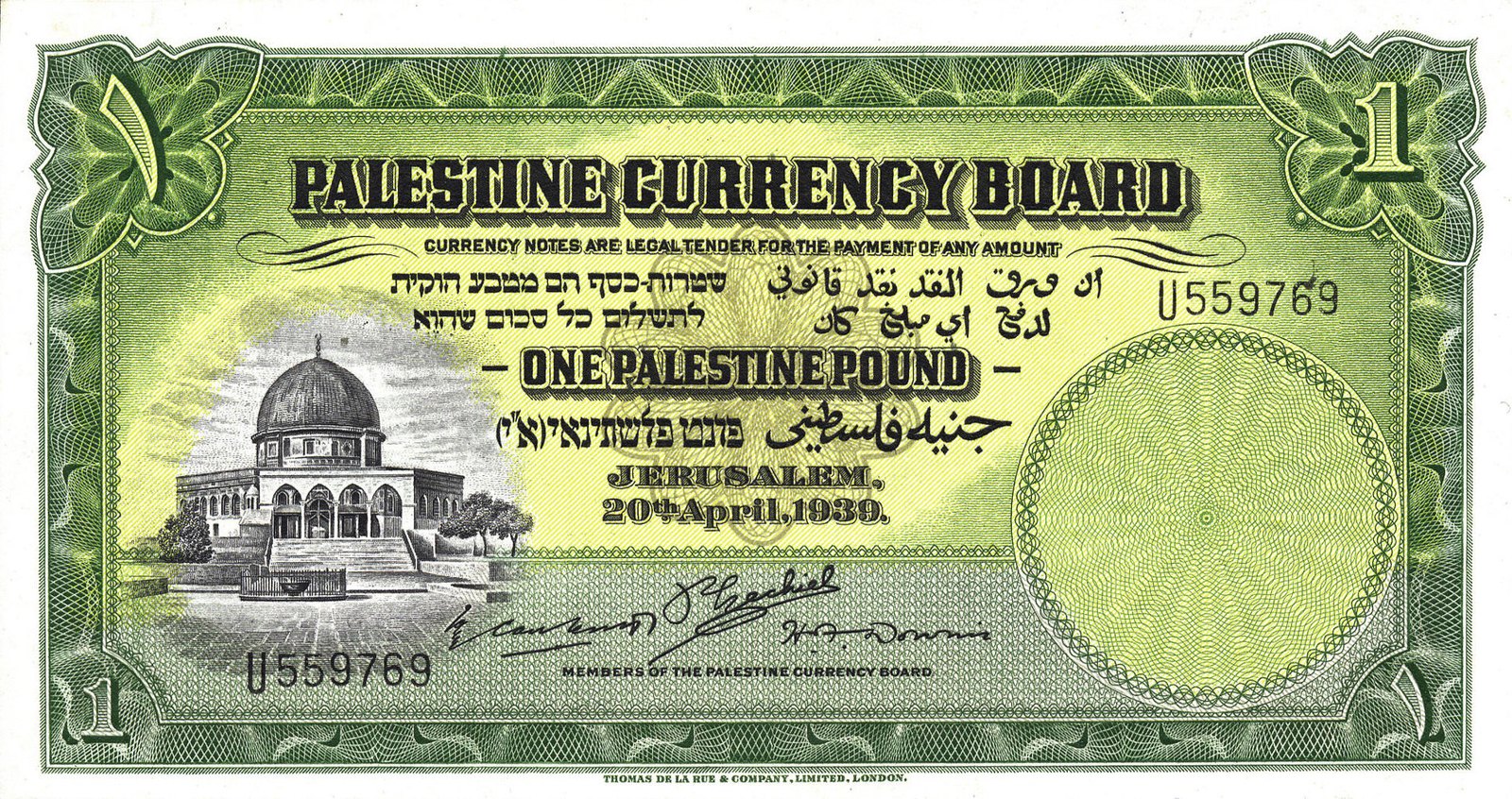
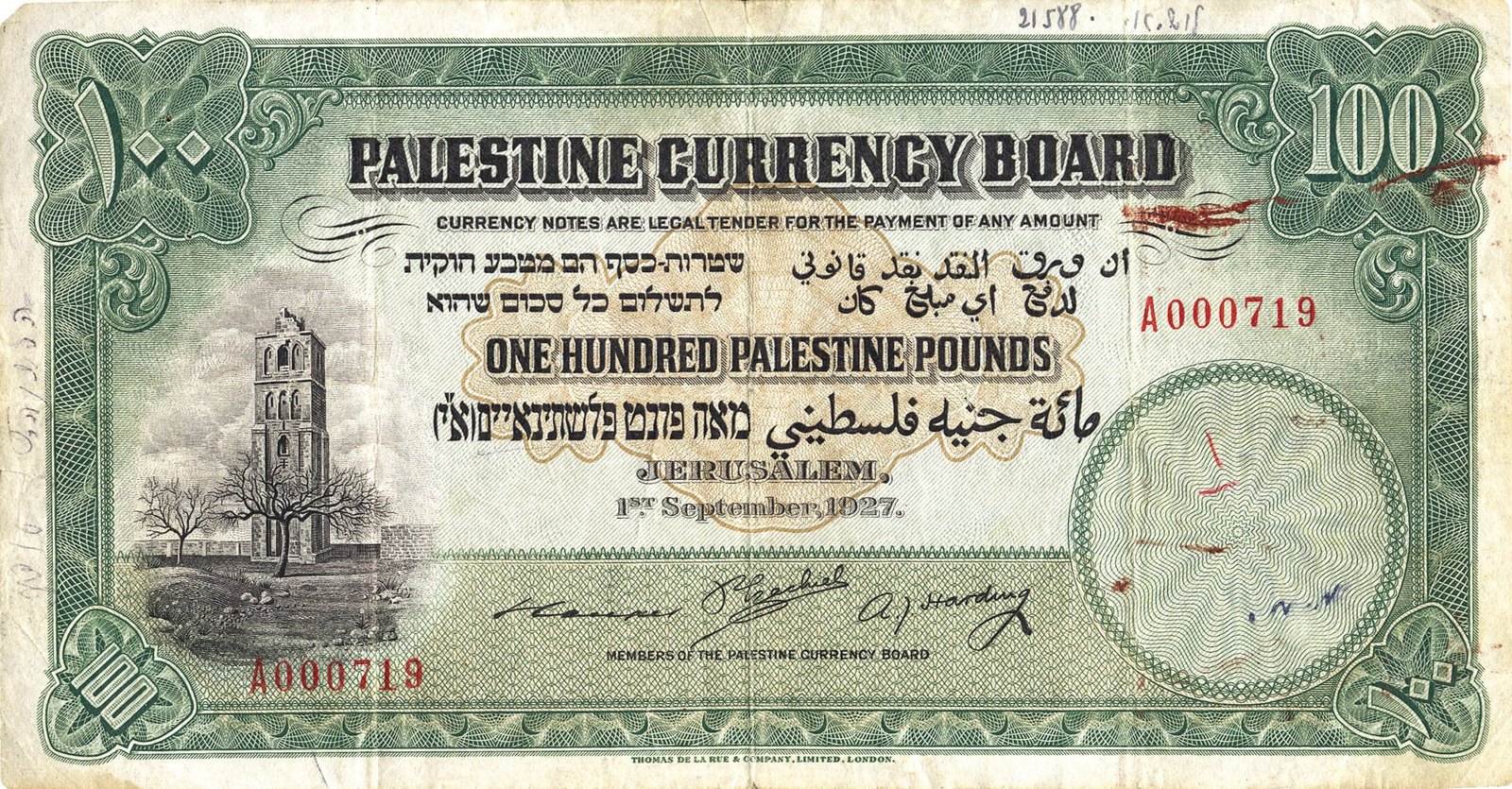
Sources mention that the two high values were used mainly between banks, 100 pounds being more than a year's pay for most people in Palestine. For the 100 pounds, sources mention 133 notes in circulation on 31st March 1942 and 1,795 on 31st March 1947, so that more than 1,600 notes were paid out after the design dated 10th September 1942 was approved. The figures do not say which date those notes bore, and no issued note of 1942 has been seen.
31st March 1952, when the Board was dissolved
| Value | In circulation, 31st March 1952 |
|---|---|
| 500 mils | 68,533 pounds |
| 1 pound | 225,743 notes |
| 5 pounds | 126,470 pounds |
| 10 pounds | 160,570 pounds |
| 50 pounds | 20,300 pounds (406 notes) |
| 100 pounds | 16 notes |
These are again what sources mention from the Board's yearly figures. How the totals fell between 1948 and 1952 is told in The last years of the Palestine pound, 1948 to 1952.
Not handed in: 1966 and 1974
| Value | Not redeemed | Day |
|---|---|---|
| 500 mils | about 130,860 notes (65,431 pounds) | 31st May 1974 |
| 1 pound | 184,643 notes | March 1966 |
| 5 pounds | 11,365 notes (56,825 pounds) | March 1966 |
| 10 pounds | 3,699 notes, then 3,003, then 2,999 | March 1966, the summer of 1974, some fifteen years later |
| 50 pounds | 104 notes, then 82 | 31st March 1966, the summer of 1974 |
| 100 pounds | seven notes, then six | 31st March 1966, the summer of 1974 |
For all of these the pages write "sources mention". No record was kept of the dates on the notes redeemed, so the figures cannot be divided between the dates of 1927, 1929, 1939 and later.
For the two high values the sources do not agree with one another:
- 50 pounds. Sources mention that 82 notes, of all dates, were never redeemed at the Bank of England. NASCA (30 April 1981, lot 200) put the figure at under 80. Sylvia Haffner (Bank Note Reporter, July 1980) wrote of 82 notes outstanding from February 1974, of which only about 60 were thought to survive. Sources mention that five notes were redeemed in 1967, presented from Arab countries, as Sylvia Haffner wrote in the same article.
- 100 pounds. Sources mention 8 notes, of all dates, never redeemed at the Bank of England. Heritage Auctions (9 January 2006, lot 14368) gives six from the same records. The official figures that sources mention are seven on 31st March 1966 and six in the summer of 1974.
Each note of the two high values that is on record is listed in Palestine 50 and 100 pounds: how many survive.
When the public turned from notes, and to them
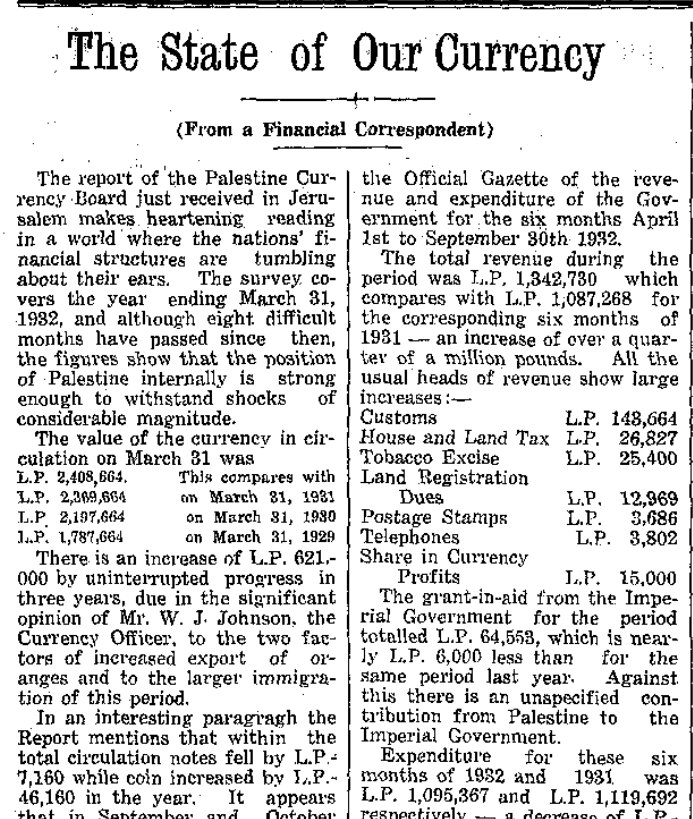
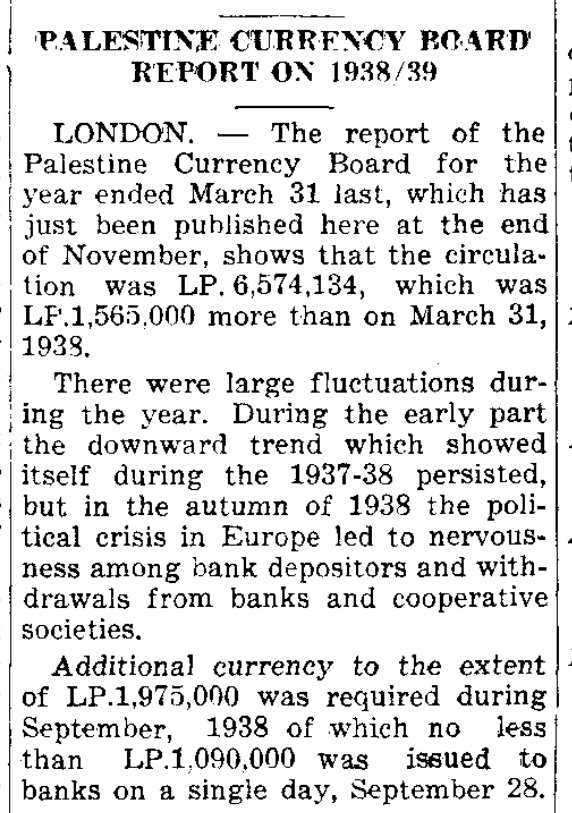
Two short movements stand out from the yearly figures. In the year to March 1932, after sterling left gold, the notes in circulation fell by 7,160 pounds while coin rose by 46,160 (The Palestine Bulletin, 12th December 1932, p. 4). In September 1938, 1,975,000 pounds of extra currency was called for, 1,090,000 of it on 28th September alone (The Palestine Post, 6th December 1939, p. 5, from the Board's report for 1938-39). Both are the subject of Coin or paper? Two runs on the Palestine currency, 1931 and 1938.
Sources
- The Palestine Blue Book for 1938: notes in circulation on every 31st March from 1928 to 1938.
- The annual report to the League of Nations for 1928: notes in circulation on 31st December 1928.
- The Palestine Currency Board's yearly figures and yearly reports, as the catalogue's pages pass them on under "sources mention": the figures for 1928, the peaks, 1952, the new supplies of 1932 to 1936, and the notes not redeemed in 1966 and 1974.
- The Palestine Bulletin, 12th December 1932 (p. 4); The Palestine Post, 6th December 1939 (p. 5).
- Sylvia Haffner, Bank Note Reporter, July 1980.
- NASCA, 30 April 1981, lot 200.
- Heritage Auctions, 9 January 2006, lot 14368; 21 October 2015, lots 18019 and 18021; 15 October 2026, lot 24690.
- Stack's Bowers, 6 May 2026, lots 50055 and 50062.
Member comments
Log in or register to post a comment.