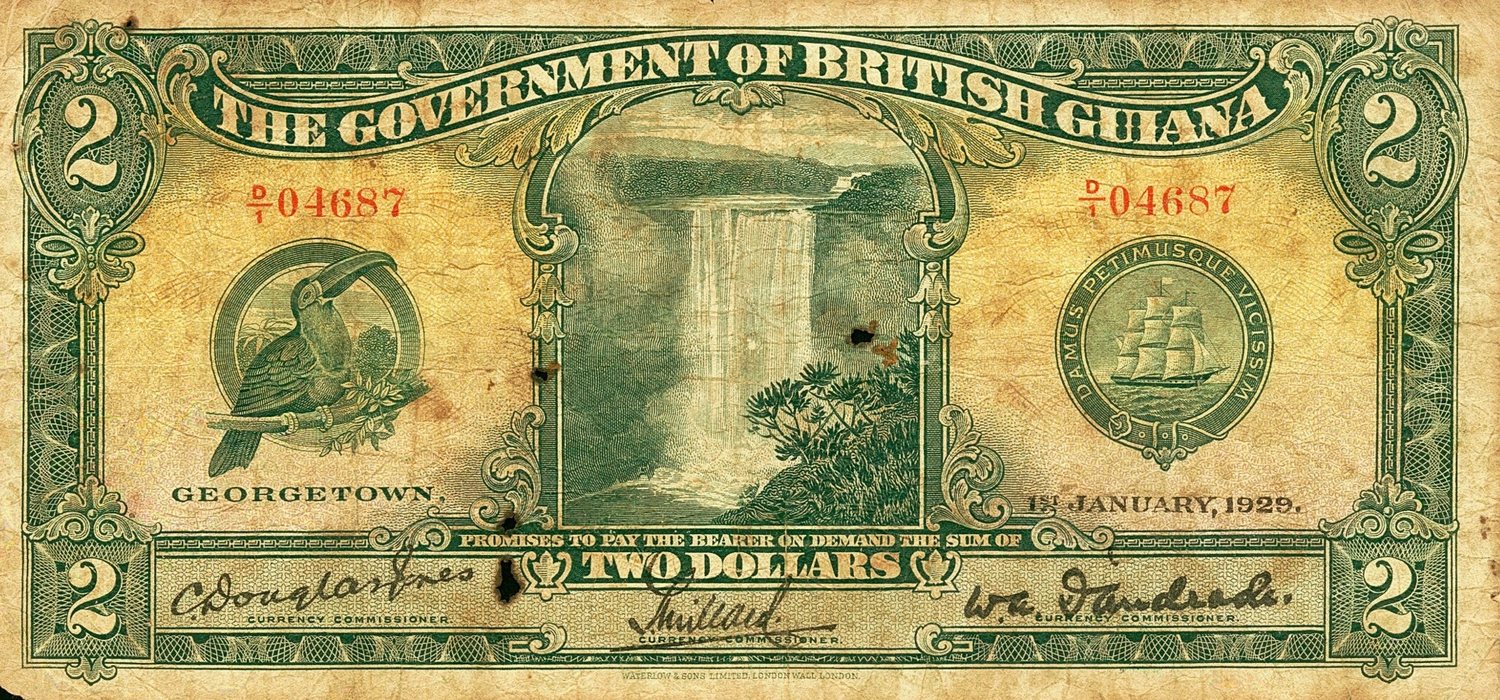
The Government of British Guiana's 1 and 2 dollar notes with the toucan and Kaieteur Falls carry the date 1st January 1929. That is the date printed on them, not the day they reached the public. The colony's own yearly report gives that day: 12th February 1929. This article sets out what four of the printed annual reports on British Guiana say of the colony's paper money between 1908 and 1929, and, just as plainly, what they leave out.
The source
The Colonial Reports (Annual) were the yearly printed report of each colony to the Secretary of State for the Colonies. They were sold to the public by H.M. Stationery Office and each has a number in one long series. We have read four on British Guiana: the report for 1908-9 (No. 632), for 1922 (No. 1174), for 1928 (No. 1441) and for 1929 (No. 1496). In each the paper money gets a few lines only, under "Currency" or, in 1922, under "Banks and Banking Facilities".
Before the Government's notes: two banks
The report for 1908-9 knows no Government note. Its Currency paragraph says the coin was British gold, silver and bronze, that accounts were kept in dollars and cents, "the dollar being equal to 4s. 2d.", and then: "Notes are issued by the British Guiana and Colonial Banks in denominations of $5, $20, and $100."
So in the year to 31st March 1909 the smallest note the report names was 5 dollars, and it was a bank's. Our pages on the first Government notes say the British Guiana Bank issued notes until 1907. The report still names that bank as an issuer, in the present tense. We do not know which is right. The sentence in the report may be a standing one, carried over from earlier years; the year 1907 may be the last date printed on that bank's notes and not the year they stopped being paid out. We have left both on the pages.
1915 to 1917: the Government's own 1 and 2 dollars
The three later reports open their account of the notes with the same two sentences. In the words of the report for 1922: "On the 16th August, 1915, the Combined Court approved of the issue of Government Currency Notes of the face value of $1=4s. 2d. and $2=8s. 4d. The first notes were issued in January, 1917".
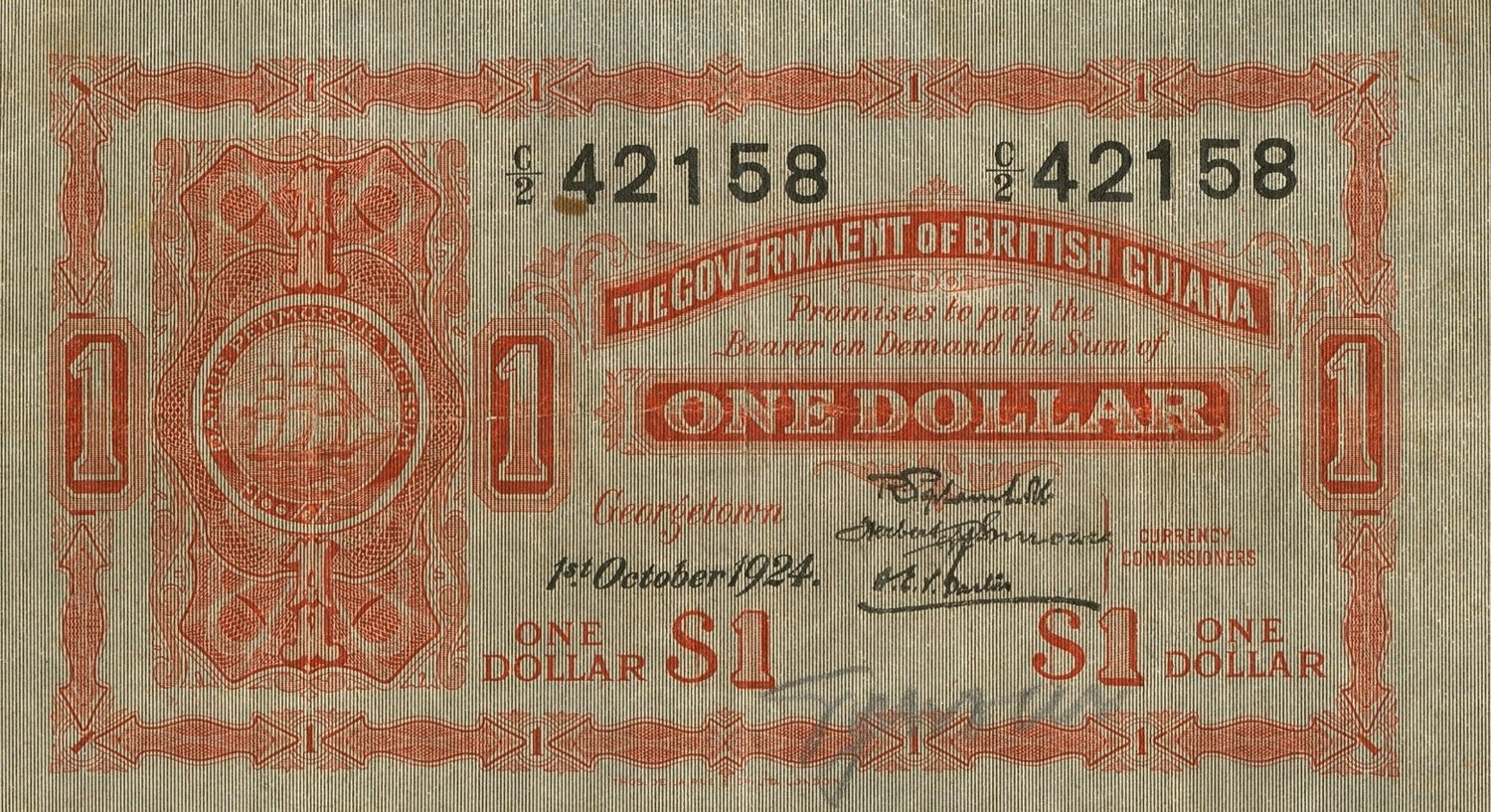
Our pages already had the law, the Government Currency Note Ordinance, 1915 (No. 16 of 1915, of 30th June 1915). The Combined Court's approval some weeks later is new to them. January 1917 as the month of first issue was on the pages before, but without a source that could be named; it now has one. The first notes are dated 1st August 1916, so about five months lie between the date on them and their issue.
| Note | Dates on the notes | Printer | Signed by |
|---|---|---|---|
| 1 dollar, first size | 1st August 1916, 2nd January 1918 | Thomas de la Rue | Clementi, Grannum and Robson |
| 2 dollars, first size | 1st August 1916, 2nd January 1918 | Thomas de la Rue | Clementi, Grannum and Robson |
| 1 dollar, larger paper | 1st January 1920, 1st October 1924 | Thomas de la Rue | Clementi, Grannum and Reid (1920); Lobb, Burrowes and Barton (1924) |
| 2 dollars, larger paper | 1st January 1920, 1st October 1924 | Thomas de la Rue | Clementi, Grannum and Reid (1920); Lobb, Burrowes and Barton (1924) |
| 1 dollar, new design | 1st January 1929, 1st January 1936 | Waterlow and Sons | Douglas-Jones, Millard and d'Andrade (1929) |
| 2 dollars, new design | 1st January 1929, 1st January 1936 | Waterlow and Sons | Douglas-Jones, Millard and d'Andrade (1929) |
The dates, printers and signers in this table are the catalogue's, read from the notes; the reports name no printer and no signer. The report for 1922 does record, in another place, that Cecil Clementi had been transferred to Ceylon and that R. Popham Lobb had taken the post of Colonial Secretary, which agrees with the change of the first signature between the notes of 1920 and those of 1924.
1927 and 1928: a new design is decided
The report for 1928 is the first to speak of a change: "During the year 1927 it was decided to change the design of the local currency notes. It is proposed to withdraw the notes at present in circulation and to issue early in 1929 in exchange therefor notes of the new design."
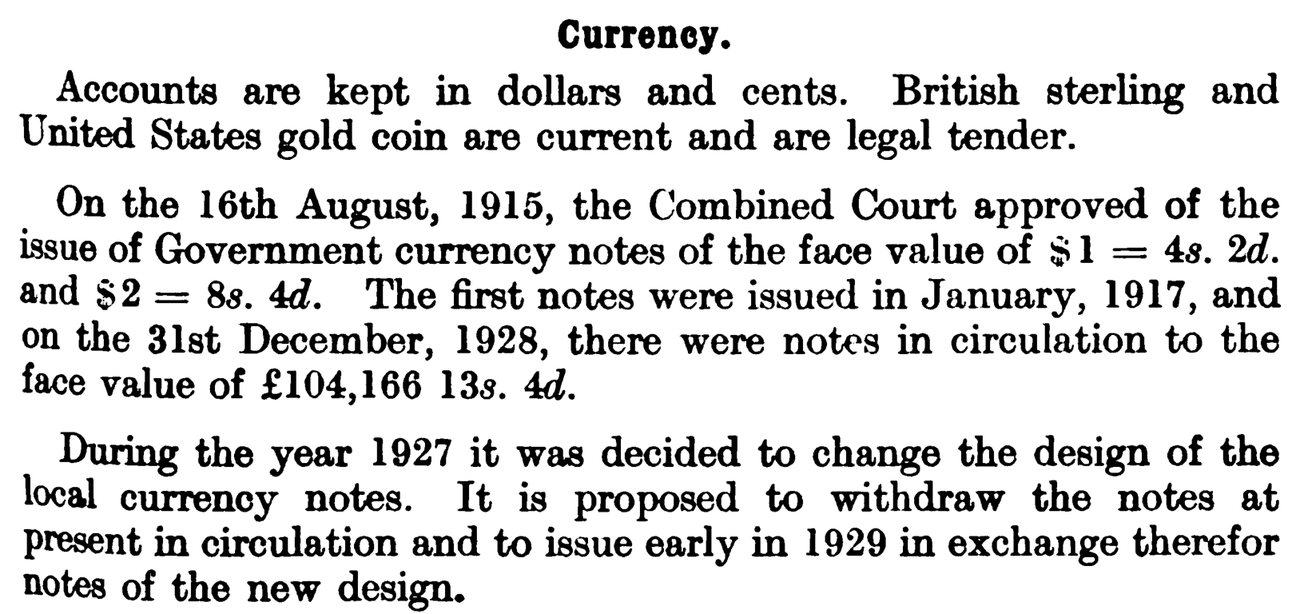
Two things stand out. The plan was an exchange, old notes handed in for new ones, not a second issue running beside the first. And the report gives no reason for the change. The same page of the report records that the Combined Court, the body that had approved the notes in 1915, came to an end on 18th July 1928, when a Legislative Council took its place. The new notes were therefore decided under the old constitution and issued under the new one. The report does not connect the two things, and neither do we.
12th February 1929
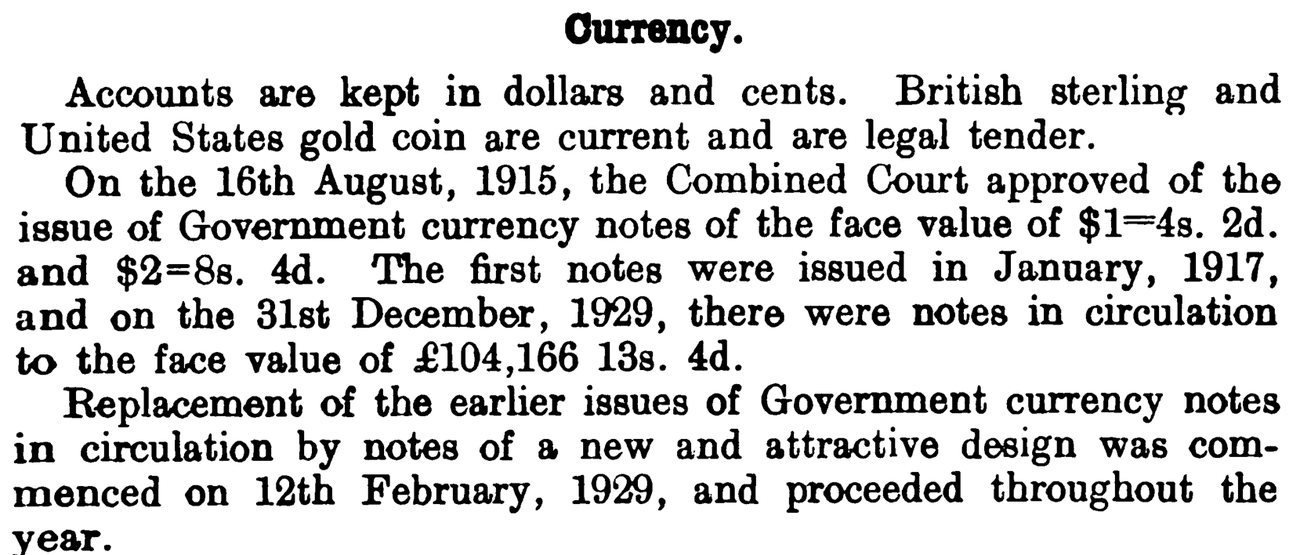
The report for 1929 has the sentence this article is named for: "Replacement of the earlier issues of Government currency notes in circulation by notes of a new and attractive design was commenced on 12th February, 1929, and proceeded throughout the year."
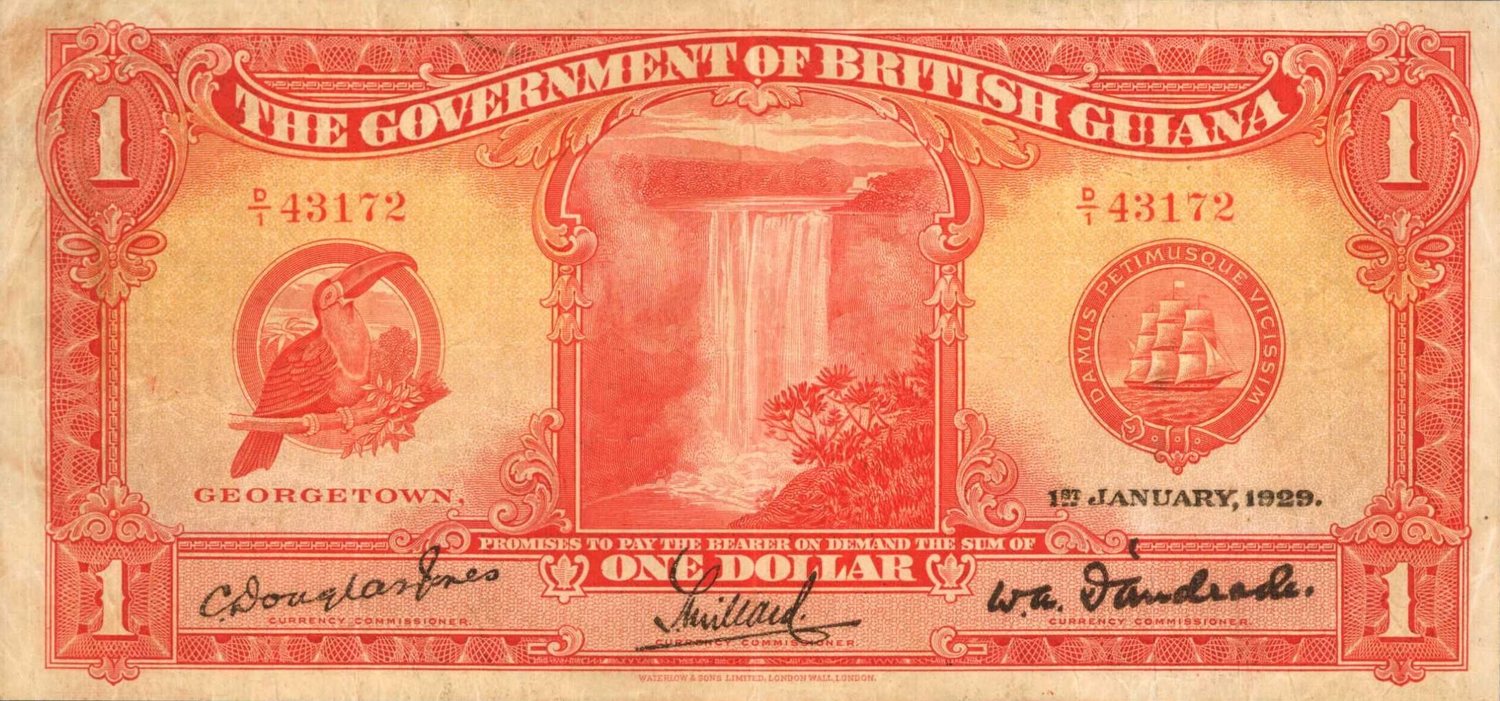
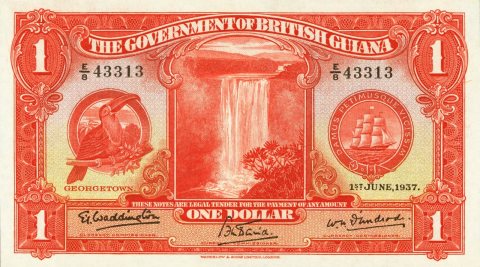
The notes "of a new and attractive design" are the 1 and 2 dollars dated 1st January 1929. They keep the colony's seal with the sailing ship and add a toucan at the left and Kaieteur Falls at the centre, with King George V on the back. They came into use six weeks after the date they bear. The words "earlier issues", in the plural, tell us that notes of more than one of the old printings were still out; the report does not say which.
A figure that never moves
Each of the three later reports gives the Government notes in circulation at the end of its year.
| On | Notes in circulation | Report |
|---|---|---|
| 31st December 1922 | 104,166 pounds 13 shillings 4 pence | 1922, No. 1174 |
| 31st December 1928 | 104,166 pounds 13 shillings 4 pence | 1928, No. 1441 |
| 31st December 1929 | 104,166 pounds 13 shillings 4 pence | 1929, No. 1496 |
The figure is the same to the penny at three dates seven years apart, the last of them after a year in which the notes themselves were being changed. The arithmetic that follows is ours and is in no report: at the reports' own rate of 4 shillings 2 pence to the dollar, 104,166 pounds 13 shillings 4 pence is exactly 500,000 dollars. A round sum that does not move looks like a fixed limit of issue, fully taken up. No report says so, and we have put only the sterling figure on the pages. If it was a limit, the exchange of 1929 changed the notes in people's hands and nothing else: a new note went out for each old one that came in.
By then the banks beside the Government had changed too. The report for 1922 names the Colonial Bank and the Royal Bank of Canada as having establishments at Georgetown; those for 1928 and 1929 name Barclays Bank (Dominion, Colonial and Overseas) and the Royal Bank of Canada. None of the three says a word about these banks' notes.
What the reports do not say
This is a thin record, and here is where it stops.
- No report gives the number of notes, or how the 104,166 pounds 13 shillings 4 pence was split between 1 and 2 dollars.
- No report says when the exchange ended. That for 1929 says only that it went on through the year.
- No report says the old notes ceased to be legal tender. On our pages the withdrawal date of every one of these notes, old design and new, is 2nd January 1955, and nothing read here changes that.
- No report names the printer of the new notes, their cost, the Commissioners of Currency, or the fund held against the notes.
- No report gives the amount of the banks' notes in circulation.
The place to look is the colony's Official Gazette for 1929, and for 1927 and 1928. A notice to the public of the exchange, with any last day for handing in old notes, and any change in the law on the notes, would be looked for there. We have not read it.
Member comments
Log in or register to post a comment.