The first notes of the Government of India, with the portrait of Queen Victoria, were issued from 1st March 1862. For their first four years the three Presidency Banks handed them out as the Government's agents, and the people who used them had to tell at a glance where a note came from and where it would be paid. They did it with marks: a letter in a coloured frame, a bank's stamp, the name of a town printed over the note, a "No. 1". Most of those marks are not described in any catalogue. A Government volume of 1867 describes them, and draws five of them.
This article sets out what that volume says, with the pages themselves, so that anyone who owns or sees a note of 1861 to 1865 knows what to look for. None of the marked notes of the Bank of Bengal's branches, and no "No. 1" note, is recorded in our catalogue yet.
The source
In February 1866 the Governor General appointed a Commission "to enquire into the operation of Act XIX of 1861", the Act that had created the Government paper currency. It heard witnesses at Calcutta in February and March 1866, among them Major Hyde, the Mint Master and Head Commissioner of Currency whose signature is on the Calcutta notes, and Colonel Ballard, who signed the Bombay notes. It wrote to every treasury in India with thirty-two questions, and it printed the answers, the evidence and the papers the banks sent in. We have read Vol. II of its report (Calcutta, Office of Superintendent Government Printing, 1867; 625 pages), which holds all of that, in the copy scanned by the Gokhale Institute of Politics and Economics, Pune. Vol. I, with the report itself, we have not seen.
The Bank of Bengal's branch marks
Appendix XXVI prints the Bank of Bengal's circulars to its branches. The first is dated 20th February 1862, nine days before the notes came out. It sends each branch 200,000 rupees in the new notes and goes on: "You will observe that your Notes bear a distinguishing mark ... those of the other Branches are as follows, the Head Office Notes being without mark". Then the marks are drawn.
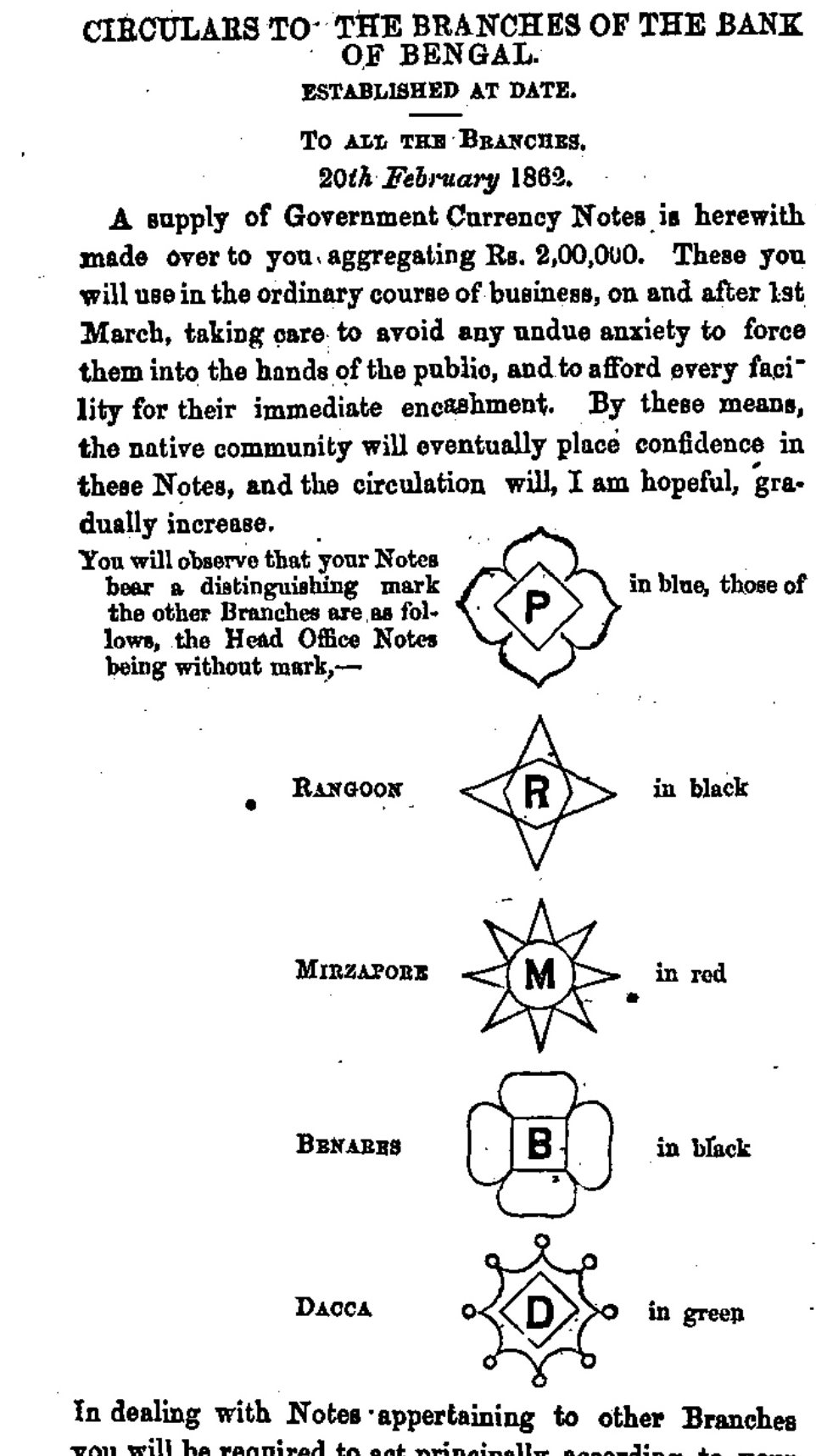
| Branch | Letter | Frame, as drawn | Colour |
|---|---|---|---|
| not named in this copy | P | a diamond inside a frame of four lobes | blue |
| Rangoon | R | a four-pointed star | black |
| Mirzapore | M | a circle inside a star of eight points | red |
| Benares | B | a square with a lobe on each side | black |
| Dacca | D | a diamond inside an eight-pointed frame with a small ring at each point | green |
| Head Office, Calcutta | none |
The copy the Commission printed is the one sent to the branch whose letter was P, so it says "your Notes" and does not name the place. The Bank's own list of branches in the same appendix has Patna, opened in March 1862, and no other town that begins with P.
Three other papers in the volume show the marks in use:
- The Commissioner of Cooch Behar was paid at the Dacca branch in January 1864 in 10 rupee notes: "These Notes had received a local stamp of green paint, and consequently adhered together." Green is Dacca's colour in the circular.
- The Deputy Commissioner of Allahabad wrote in May 1866 that the Bank of Bengal "has thus affiliated Government notes of each circle, stamping them 'Lucknow,' 'Benares,' &c., and receiving them at par, as its own". The Bank opened branches at Allahabad, Lucknow and Nagpore in February 1863 and at Agra in August 1863, after the circular, so there were more marks than the five drawn.
- When the Government made Allahabad a circle of its own, a notification of 21st April 1864, signed "H. Hyde, Head Commissioner", called in the notes "issued through the agency of the Branches of the Bank of Bengal at Mirzapore and Benares": from 1st May 1864 they would be paid in coin or exchanged for notes of the Allahabad Circle. A treasury circular of 1865 calls them the notes "of the abolished circles of Mirzapore and Benares".
The Bank's agency ended on 31st December 1865, when the management of the currency passed to the Mint. A circular of January 1866 told the branches that there was "no further occasion for you to watch the circulation of Notes specially branded for your Branch".
So a Calcutta note of 1862 to 1865 with a P, R, M, B or D in a frame, in blue, black, red or green, is a note that went out through a branch of the Bank of Bengal. The six Calcutta notes pictured on our pages show no such mark.
Rangoon, twenty years before it had a circle
The circular to Rangoon is the most surprising. "By this opportunity I forward Rs. 2,00,000 of Government Currency Notes ... You will observe that Rangoon is not included in the Circle of Issue, so that new Notes must be left to find their way in public confidence just as if they were our own issues." The notes were Calcutta notes with the R in a star. They were not legal tender in Burma. The Chief Commissioner of British Burmah wrote in June 1866 that until March of that year they "had to be sent to Rangoon before cash could be obtained for them", and that since then "all currency notes issued in British Burmah with the branch bank's private mark are cashed at par" at the treasuries. Rangoon became a circle of issue only in the 1880s; the oldest Rangoon notes in the catalogue are of 1897.
Bombay and Madras: the bank's own stamp
The other two banks did the same in their own way. The Bank of Bombay told the Government in 1866 that its agents "are in the habit of marking with the Branch Stamp all Currency Notes which they issue themselves, and these they are always ready to cash at par and re-issue at par". The Bank of Madras ordered each branch to cash at par "all Notes bearing its own stamp".
That is what the red oval on this note is. It is one of five Bombay notes of 10 rupees on our page, every one of which carries a red oval bank stamp; the 1,000 rupees of Madras dated 31st July 1861 has an oval BANK OF MADRAS stamp.
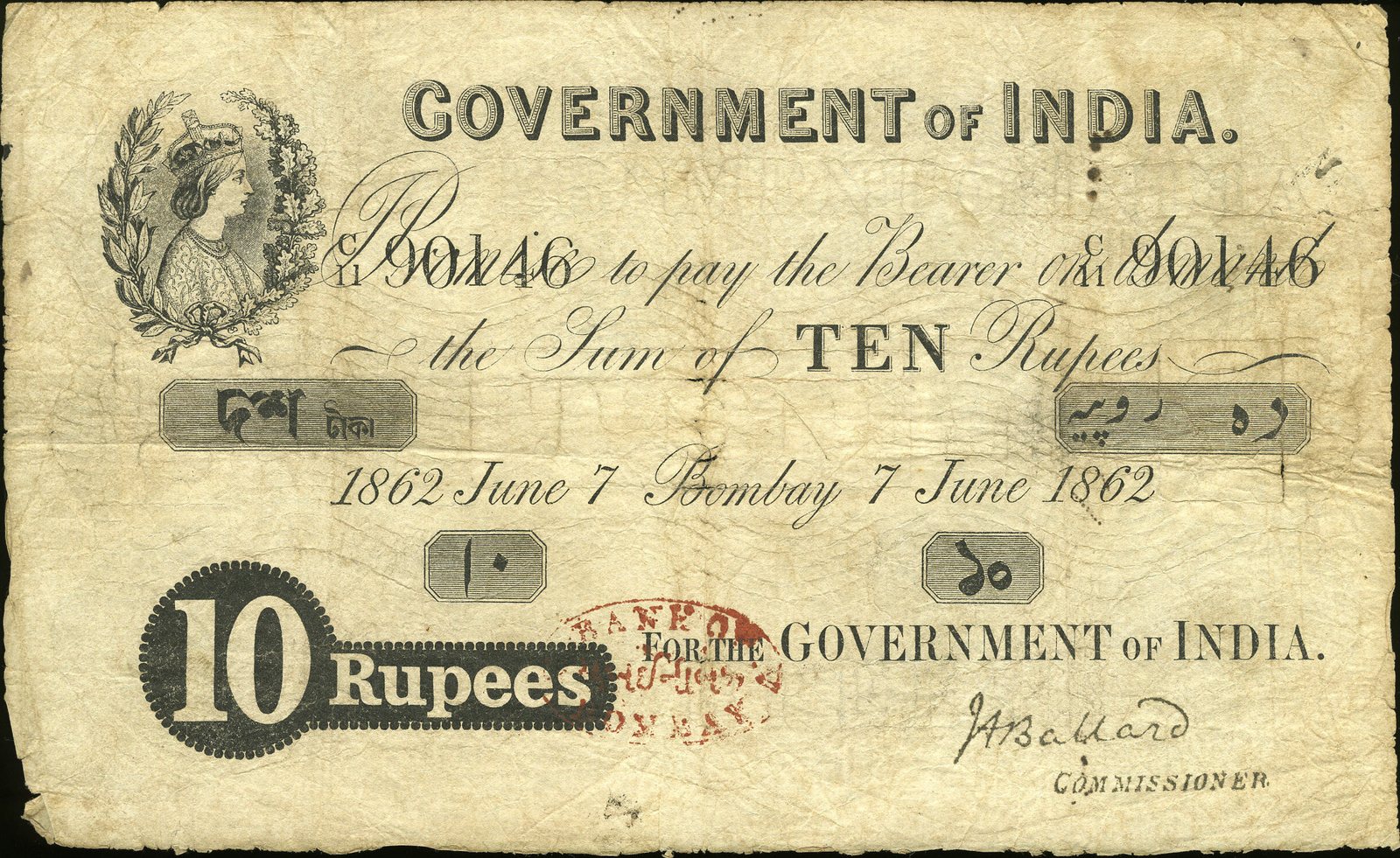
The Collector of Ahmedabad wrote that the Bank of Bombay's branch there paid silver without discount "for notes of the Ahmedabad circle only" and charged a half to one per cent on the rest. There never was an Ahmedabad circle of issue: we take these for notes with the Ahmedabad branch's stamp.
The "No. 1" notes of Assam
Hugh Sandeman, the Accountant General of Bengal, was asked on 20th February 1866 whether there was one circle or more in the Bengal Presidency.
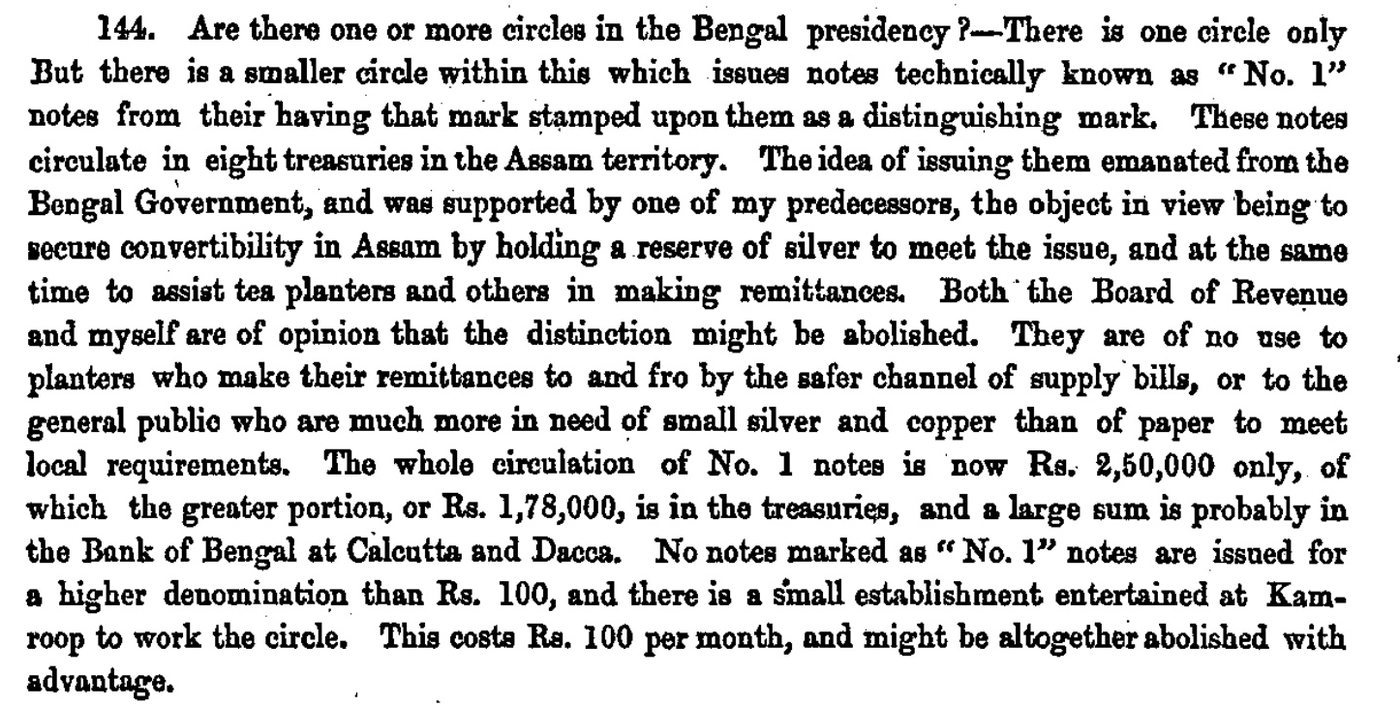
A report of the Board of Revenue printed with the evidence has a table headed "No. 1 Notes current only in Assam, Cachar, and Sylhet". They were supplied from Gowhatty, in notes of 10, 20, 50 and 100 rupees only. At the end of 1864-65 the treasuries of those districts had 8,227 of them in store:
| Value | No. 1 notes in store, end of 1864-65 |
|---|---|
| 10 rupees | 7,665 |
| 20 rupees | 277 |
| 50 rupees | 112 |
| 100 rupees | 173 |
About 250,000 rupees of them were out in February 1866, most of that lying in the treasuries. The Accountant General and the Board both wanted the distinction ended. None of the papers says what the mark looked like or where on the note it stood, beyond the words "No. 1" and that it was stamped.
The circles, and the name printed across the note
The Government's own way of telling notes apart was to print the name of the new circle on a Calcutta, Bombay or Madras note: ALLAHABAD, LAHORE, NAGPORE, KURRACHEE and the rest. Major Hyde gave the Commission the month in which each of these circles was established.
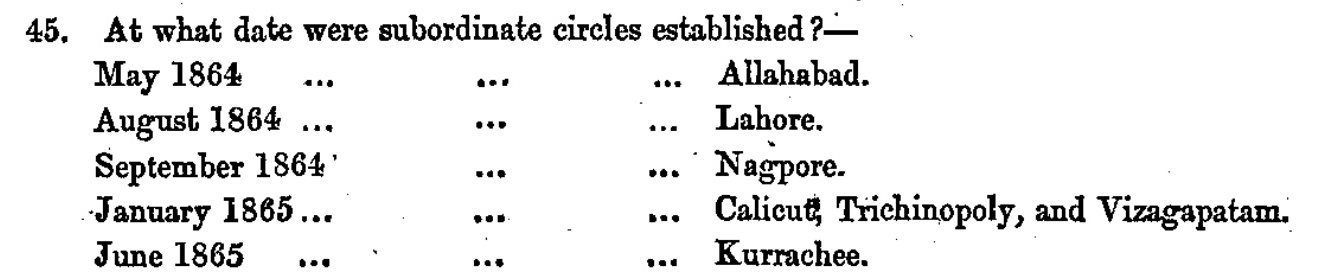
The same papers add the day for two of them: the notes of the Allahabad Circle were legal tender from 1st May 1864, and the paper currency came to the Punjab on 1st August 1864.
A note of such a circle was payable at its own office and at the Presidency town, which is why merchants bought them up-country and sent them down to be cashed. On 28th February 1866 the head office at Calcutta held 21,579 Lahore notes, of every one of the six values:
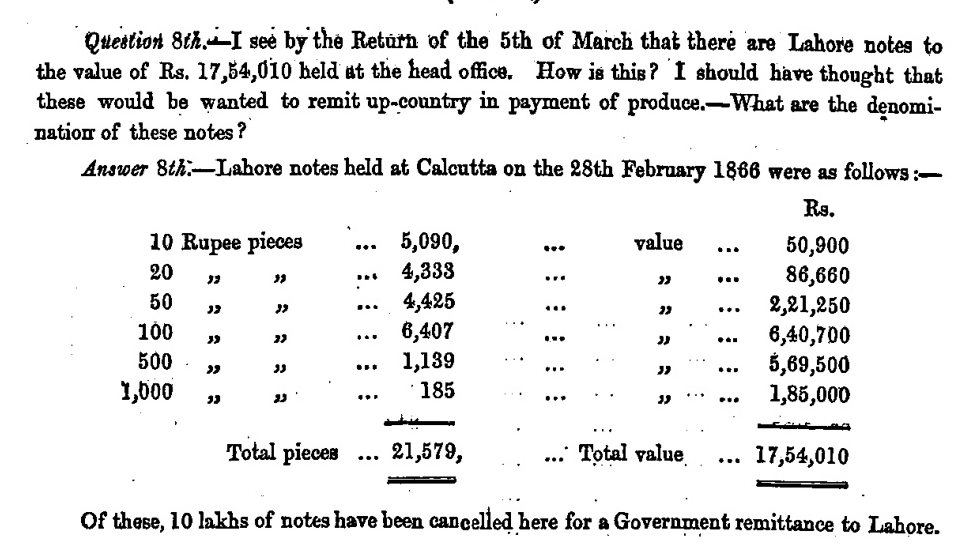
Appendix XXV gives the value of the notes in circulation at the end of February 1866 for each office and each value. Divided by the value of the note, the figures come out as whole numbers of notes everywhere:
| Office | 10 rupees | 20 | 50 | 100 | 500 | 1,000 |
|---|---|---|---|---|---|---|
| Calcutta | 170,727 | 102,949 | 54,562 | 50,891 | 6,598 | 11,464 |
| Allahabad | 21,865 | 12,722 | 7,401 | 5,646 | 1,038 | 456 |
| Lahore | 17,868 | 12,822 | 14,450 | 11,468 | 1,770 | 561 |
| Nagpore | 9,778 | 3,725 | 3,697 | 953 | 112 | 462 |
| Madras | 23,890 | 17,985 | 12,860 | 13,589 | 2,007 | 1,896 |
| Calicut | 2,151 | 1,532 | 1,175 | 881 | 91 | 60 |
| Trichinopoly | 1,338 | 1,088 | 808 | 680 | 149 | 75 |
| Vizagapatam | 4,284 | 2,381 | 1,155 | 800 | 119 | 105 |
| Bombay | 191,000 | 94,000 | 46,300 | 61,500 | 4,604 | 15,148 |
| Kurrachee | 3,329 | 1,632 | 1,150 | 1,628 | 254 | 674 |
| All offices | 446,230 | 250,836 | 143,558 | 148,036 | 16,742 | 30,901 |
The figures are of 28th February 1866, and of 22nd February for Calicut, Trichinopoly and Bombay. Every office had every value out. Our pages have notes or rows for far fewer: Lahore, for one, is recorded on the 10, 20 and 100 rupees only.
Half notes, and names written on notes
Two more things seen on these notes are explained in the volume.
Halves. The treasury rules of Bengal ordered: "When a remittance is to be made, the left-hand halves of the Notes only are to be sent in the first instance, the right-hand halves being retained until the receipt of the left-hand halves is acknowledged." The currency office at Allahabad cut its 500 and 1,000 rupee notes in half before sending them to the treasuries. If a half was lost on the way, that office asked for three advertisements in the Gazettes, a bond for twice the value with two sureties and a wait of three months before it paid. A whole note lost was not made good at all.
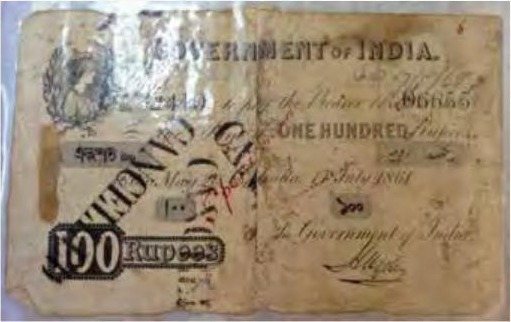
Names. The officer in charge of the Hooghly treasury complained that anyone who presented a note, even one of 20 rupees, was made to sign it, "a practice now in vogue", and that notes were nearly always signed when they changed hands in the bazar. The 20 rupees below has such a name, in Bengali, under the signature.
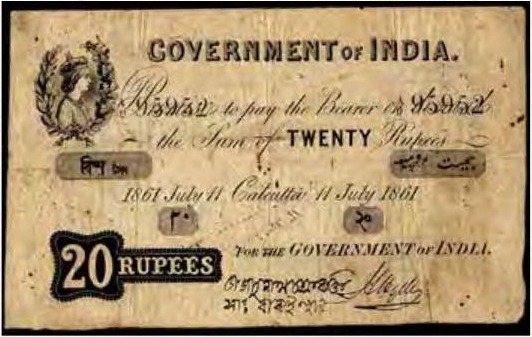
Notes that came back to Calcutta were not destroyed as a matter of course. Major Hyde told the Commission that they were checked against the list of stopped notes, entered in a register and sent back to the issue department, and withdrawn only "when they are found to be worn out".
What to look for
On a note of 10 to 1,000 rupees with the Queen's portrait, dated 1861 to 1865:
- a letter P, R, M, B or D inside a small frame, in blue, black, red or green: a branch of the Bank of Bengal (Calcutta notes only);
- the name of a town such as Lucknow stamped on a Calcutta note: a later branch of the same bank;
- an oval stamp of the Bank of Bombay or the Bank of Madras: a note issued through that bank or one of its branches;
- "No. 1" stamped on a Calcutta note of 10, 20, 50 or 100 rupees: a note for Assam, Cachar and Sylhet;
- the name of a circle printed over the note, with a second signature: Allahabad, Lahore, Nagpore, Calicut, Trichinopoly, Vizagapatam or Kurrachee;
- a name written in ink on the front: the person who paid the note in;
- a cut down the middle: a note that travelled by post.
If you have a note with one of the first four, or a photograph of one, we would like to hear of it.
What the volume does not say
It does not describe the paper, the watermark or the numbering of the notes, and it does not picture a note. It says that forged notes had appeared at Bombay, good enough that only bank experts could tell them, and that a reward of 3,000 rupees was paid there in 1865-66 for detecting forgers, but it describes no forgery. It does not say when the "No. 1" notes began. The answer to that, and the Commission's own conclusions, should be in Vol. I.
Member comments
Log in or register to post a comment.