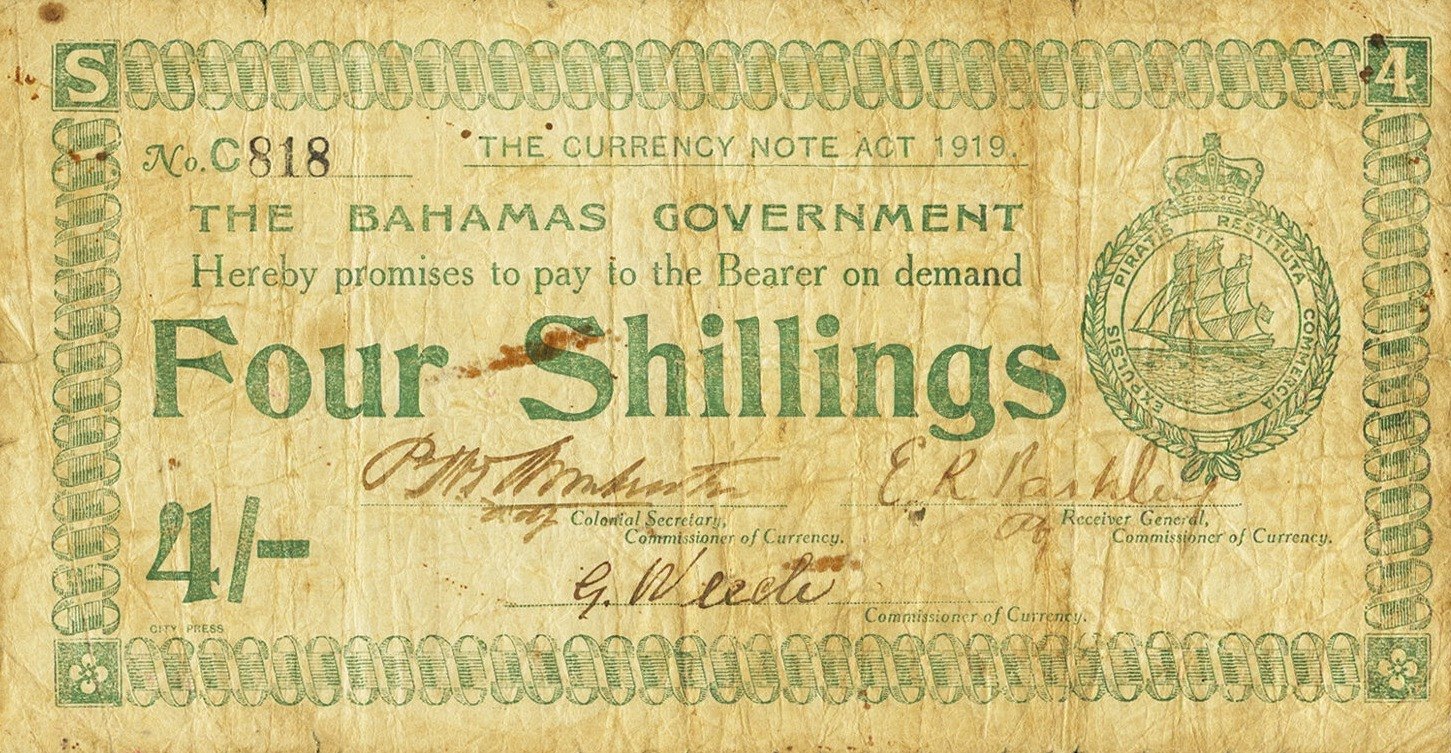
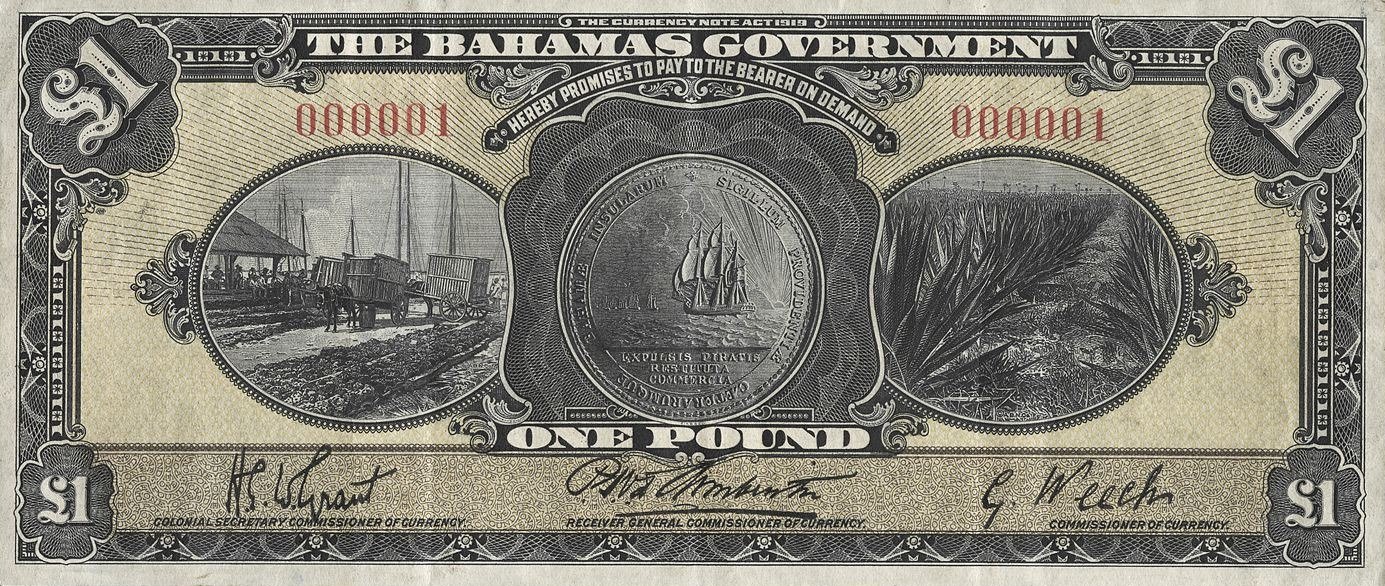
The Government of the Bahamas announced its first currency notes through notices in the Nassau Guardian. This article goes through those notices in order of time, from the Proclamation of 31st January 1920 to the abstract of December 1922, with the text of the Currency Note Act 1919 beside them. The outline of the issue is in The Bahamas Government's sterling notes, 1919 to 1966; here are the documents themselves, the month-by-month table and the names of those who signed.
What the Act of 1919 required
The Currency Note Act 1919 is Chapter 21 of the Acts of 1919, dated 18th December 1919 (pages 150 to 158 of the volume of Acts). As printed there it provides:
- Commissioners of Currency: the Colonial Secretary, the Receiver General and one unofficial member named by the Governor;
- notes of 4 shillings, 10 shillings and 1 pound only (section 5, sub-section 1);
- a total issue of not more than 10,000 pounds;
- that the notes are legal tender;
- that each issue is to be announced in the Gazette with its denominations and its distinguishing letters and numbers;
- that the Act takes effect only when the Governor proclaims that it is His Majesty's pleasure not to disallow it (section 17).
Each of the notices below answers one of these provisions.
The Proclamation of 31st January 1920
The Nassau Guardian of 31st January 1920 printed a Proclamation of the same day by the Governor, Sir William Lamond Allardyce, countersigned by F. C. Wells Durrant as Acting Colonial Secretary. It recites section 17 of the Act and ends: the Act "shall come into operation upon the 12th day of February, A.D. 1920".
The unofficial Commissioner, 14th February 1920
Government Notice No. 73 of 14th February 1920 reads: "His Excellency the Administrator has been pleased to nominate George Weech to be a member of the Board of Commissioners of Currency, to act in conjunction with the Colonial Secretary and Receiver General of the Colony, under the authority of The Currency Note Act 1919." The notice was printed again on 18th February. George Weech is the Weech who signs the local 4 shillings and the first row of the engraved 4 shillings, 10 shillings and 1 pound.
Government Notice No. 115, 17th March 1920
The notice of the first issue reads: "an issue of Currency Notes under the authority of The Currency Note Act 1919 has been authorised, and that the denominations, distinguishing letters and numbers of such issue are as follows, viz:- £1 notes A1 to A 2000. 10/- notes B1 to B 2000. 4/- notes C1 to C 10,000." It is signed P. W. D. Armbrister, Acting Colonial Secretary; E. R. Pashley, Acting Receiver General; G. Weech; Commissioners of Currency. It was printed in the Nassau Guardian of 17th March 1920 and again on 20th March.
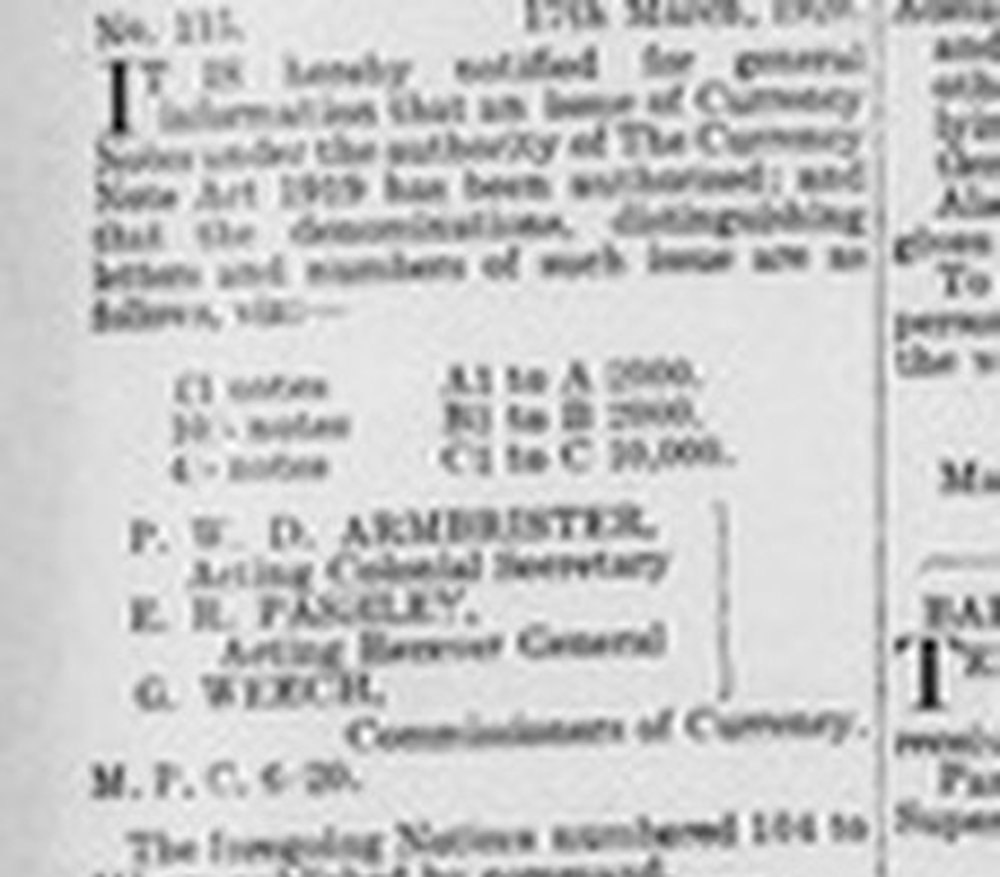
The same three sign the one recorded note of the local printing by hand, and the catalogue's page for it says the two officials have Actg written in before their printed titles. The notice was read on the image of the page. The dates of Pashley's acting appointment are given in two ways. The Government Notices in the Nassau Guardian (Nos. 49 and 50 of 3rd February 1920 and No. 114 of 17th March 1920, read in the text only) have Pashley acting as Receiver General and Treasurer from about 10th March 1920. The Colonial Office Lists of 1922 and 1925 give the spell as 15th March to 8th April 1920.
The survey rules of 25th August 1920
Government Notice No. 352, in the Nassau Guardian of 1st September 1920, prints rules made by the Governor in Council under section 10 of the Act, headed Surveys of Currency Funds. A Board of Survey of at least three members, none of them a Commissioner of Currency, was to count the Commissioners' funds and the unissued notes every quarter. One rule reads: "At all subsequent surveys during the same year at least one member of the Board shall count every Ten Shilling and every One Pound note and at one at least of such surveys every Four Shilling note." Another lets the Board "accept packages of new notes bearing the unbroken seal of the printers of the notes". The rules name the three values of the Act and no other. This notice was read in the text of the newspaper only.
The monthly abstracts of the Currency Note Fund
From August 1920 the Office of the Commissioners of Currency published a monthly abstract of the Currency Note Fund. The first that has been found is dated 10th August 1920 and was printed on 14th August.
| Date of the abstract | Notes in circulation | Coin portion of the Note Guarantee Fund | Investment portion | Signed by |
|---|---|---|---|---|
| 10th August 1920 | 3,200 pounds | gold, 2,200 pounds | 1,000 pounds, a remittance in transit | Armbrister, Acting Colonial Secretary; Nigel B. Burnside, Acting Receiver General; George Weech |
| 10th September 1920 | 3,200 pounds | gold, 2,200 pounds | 1,000 pounds | the same |
| 11th October 1920 | 3,800 pounds | gold, 2,780 pounds, and silver, 20 pounds: 2,800 pounds | War Loan 1929-1947, 5 per cent, of the face value of 1,170 pounds 6s 7d, bought on 19th August 1920 at a cost of 997 pounds 14s 1d, with brokerage of 2 pounds 5s 11d | the same |
| 10th December 1920 | 3,800 pounds | 2,800 pounds | the same | H. E. W. Grant, Colonial Secretary; Armbrister, Receiver General; Weech |
| January to October 1921, each month | 3,800 pounds | 2,800 pounds | the same | Grant; Armbrister; Weech |
| November 1921 to May 1922 | 3,800 pounds | 2,800 pounds | the same | Armbrister, Acting Colonial Secretary; Burnside, Acting Receiver General; Weech |
| June and July 1922 | 3,800 pounds | the same | Armbrister, Acting Colonial Secretary; J. Herbert Peet, Acting Receiver General; Weech | |
| August to October 1922 | 3,800 pounds | the same | Armbrister, Acting Colonial Secretary; Geo. K. K. Brace, Acting Receiver General; Weech | |
| November and December 1922 | 3,800 pounds | the same | Grant; Armbrister; Weech |
Some cautions go with the table. The abstracts of August, October and December 1920 were read on the image of the newspaper page; that of September 1920 and those of 1921 and 1922 were read in the text only. The abstract of 10th December 1920 prints its figure as standing "on 10th November". The page of 14th August 1920 misprints its own year as 1923. Three abstracts (10th December 1921, 11th September 1922 and 10th November 1922) have figures that cannot be read in the copy used; other printings of the same months read 3,800 pounds. An earlier abstract may stand in the Nassau Guardian of 11th August 1920, where the page cannot be read.
The names show who sat as Commissioners in each month. In the months when Armbrister, the Receiver General, signs as Acting Colonial Secretary, another officer signs as Acting Receiver General: Pashley under the notice of March 1920, then Nigel B. Burnside, J. Herbert Peet and Geo. K. K. Brace under the abstracts. Weech signs every abstract. The names under an abstract are those of the Commissioners in office that month. They do not show whose signatures were on the notes in use, and Burnside, Peet and Brace sign no note recorded in the catalogue.
The Acts of the session of 1920
The Nassau Guardian of 27th November 1920 lists two Acts of the session that touch paper money:
- 10 & 11 Geo. V, chapter 22: "An Act to repeal the Importation of British Currency Notes Prohibition Act 1919";
- 10 & 11 Geo. V, chapter 23: "An Act to amend the Currency Note Act 1919".
The amending bill was brought in on 7th August 1920 and had its third reading in the House on 14th August. What it changed is not printed on the pages that were read. This list was read in the text of the newspaper only.
What the notices leave open
- The size of the issue. Notice No. 115 authorised numbers up to A 2000, B 2000 and C 10,000. The abstracts never show more than 3,800 pounds in circulation to the end of 1922. They do not divide the figure by value.
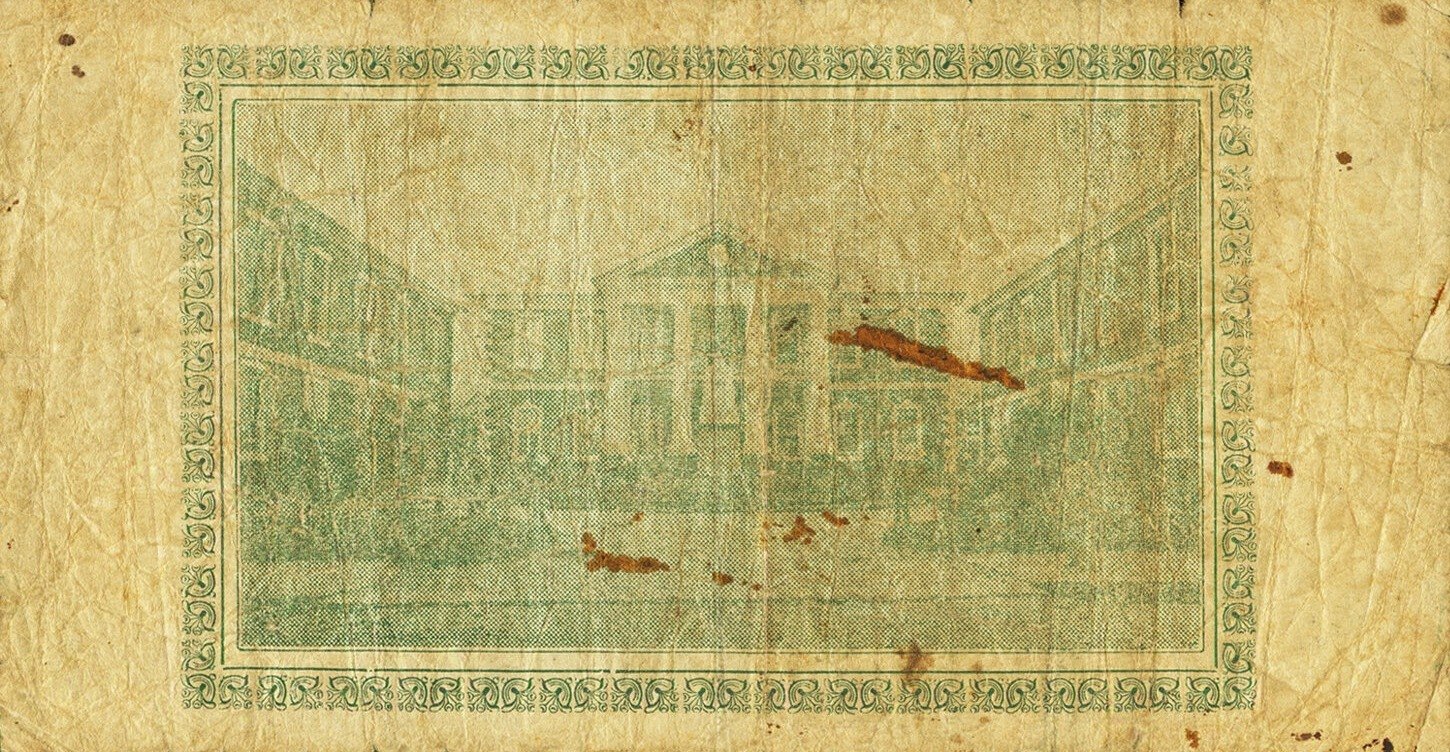
- The 10 shillings and the 1 pound of the local printing. The notice names them. Only the 4 shillings with the imprint CITY PRESS has been recorded.
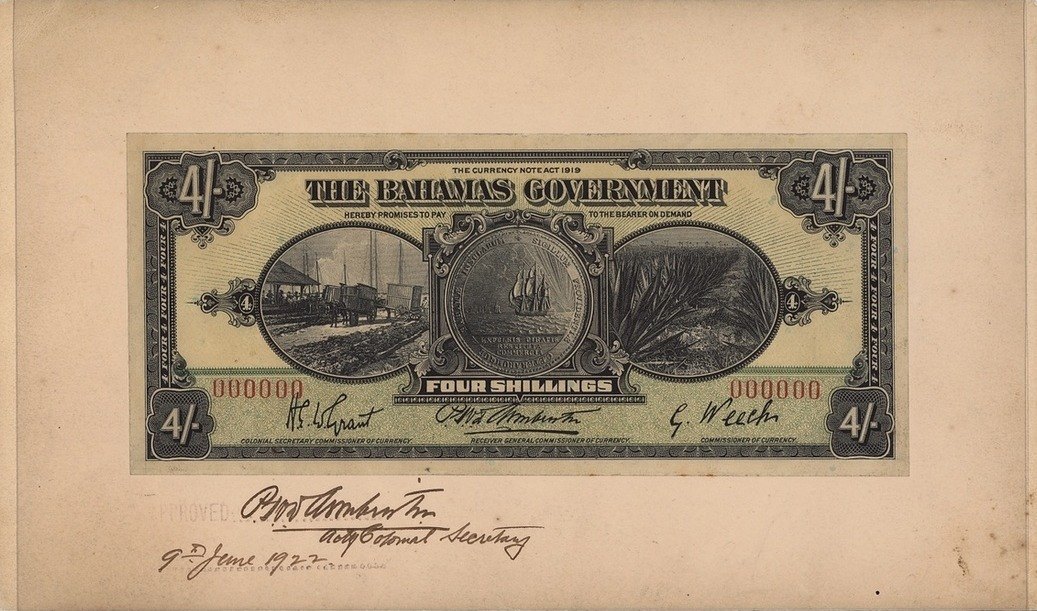
- When the engraved notes came out. The annual report on the Bahamas for the year to 31st March 1922 (Colonial Reports, Annual No. 1145, page 3) names only British currency notes of 1 pound and 10 shillings as paper in circulation and says nothing of the Government's own. The catalogue's pages for the engraved notes say that their front proofs on card were approved and signed by Armbrister as Acting Colonial Secretary on 9 June 1922. The abstracts stand at 3,800 pounds through all of 1922. The annual reports for 1924 and 1925 then give 60,000 pounds. No notice of a second issue is among the pages read.
- The limit of 10,000 pounds. The amending Act of 1920 is the only change to the Act of 1919 that these pages name, and its contents are not known. The Currency Note Amendment Act of 1932 and the Act of 1936 are treated in Notes in circulation in the Bahamas, 1911 to 1962.
- Lost or stolen notes. No notice of a lost or stolen Government note with its number was found in the Nassau Guardian of 1909 to 1922.
Sources
- The Currency Note Act 1919, Acts of 1919, Chapter 21, pages 150 to 158.
- Nassau Guardian, 31st January 1920: Proclamation of 31st January 1920.
- Nassau Guardian, 14th and 18th February 1920: Government Notice No. 73 of 14th February 1920.
- Nassau Guardian, 17th and 20th March 1920: Government Notice No. 115 of 17th March 1920; Government Notices Nos. 49, 50 and 114 on Pashley's acting appointment.
- Nassau Guardian, 1st September 1920: Government Notice No. 352, Surveys of Currency Funds, rules of 25th August 1920.
- Nassau Guardian, 14th August 1920 to December 1922: the monthly abstracts of the Currency Note Fund.
- Nassau Guardian, 27th November 1920: the list of the Acts of the session, 10 & 11 Geo. V, chapters 22 and 23.
- The Colonial Office Lists for 1922 and 1925, record of services of E. R. Pashley.
- Colonial Reports, Annual No. 1145, Bahamas 1921-22, page 3; the annual reports for 1924 and 1925.
Member comments
Log in or register to post a comment.